1 
Verb Tenses 
To Think About Verb Tenses, Use a Time Line
2 
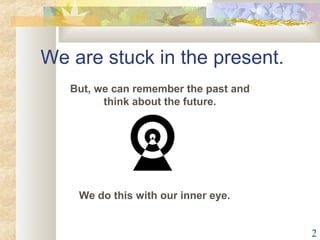
We are stuck in the present. 
But, we can remember the past and 
think about the future. 
We do this with our inner eye.
3 
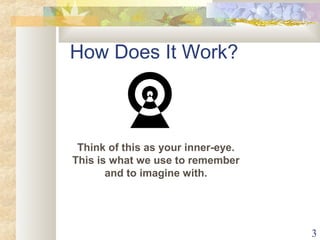
How Does It Work? 
Think of this as your inner-eye. 
This is what we use to remember 
and to imagine with.
4 
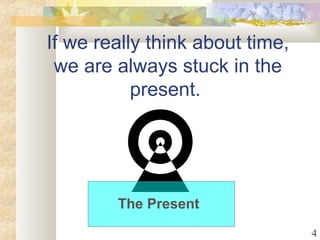
If we really think about time, 
we are always stuck in the 
present. 
The Present
5 
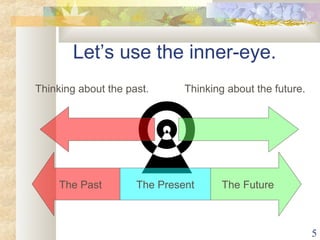
Let’s use the inner-eye. 
Thinking about the future. 
The Present 
The Future 
Thinking about the past. 
The Past
6 
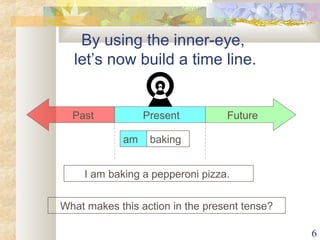
By using the inner-eye, 
let’s now build a time line. 
Past Present Future 
am baking 
I am baking a pepperoni pizza. 
What makes this action in the present tense?
7 
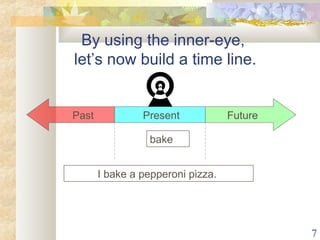
By using the inner-eye, 
let’s now build a time line. 
Past Present Future 
bake 
I bake a pepperoni pizza.
 Biofuels provide a potential route to 
avoiding the global political instability 
and environmental issues that arise 
from reliance on petroleum. 
8
 When philosophers discuss personal 
identity they are not talking about such 
down-to-earth concerns as ethnicity 
and multiculturalism. Instead, they are 
referring to the more abstractly 
metaphysical question of what makes 
each of us the same person he or she 
was last week. 
9
10 
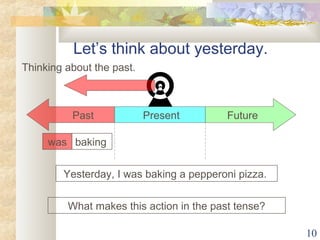
Let’s think about yesterday. 
Thinking about the past. 
Yesterday, I was baking a pepperoni pizza. 
What makes this action in the past tense? 
was 
Past Present Future 
baking
 The citrus seeds oil samples contained 
eight fatty acids while linoleic, oleic and 
palmitic acids were major acids. Some 
antinutritional compounds were 
detected in the flours. The results 
revealed that, glucosides, stachyose, 
raffinose, trypsin inhibitor, phytic acid 
and tannins were present in all citrus 
seeds flours. 
11
12 
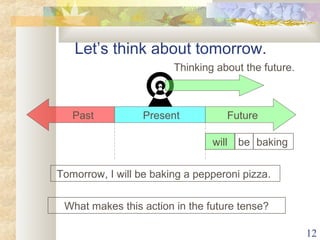
Let’s think about tomorrow. 
Thinking about the future. 
Past Present Future 
will 
be baking 
Tomorrow, I will be baking a pepperoni pizza. 
What makes this action in the future tense?
 The article also proposes that in order 
to encourage teacher research, the 
educational community will need to 
address incentives for teachers, the 
creation and maintenance of 
supportive networks 
13
14 
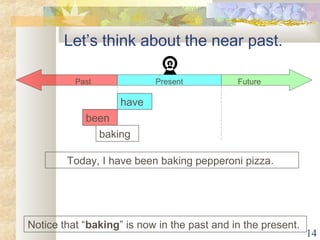
Let’s think about the near past. 
Past Present Future 
have 
been 
baking 
Today, I have been baking pepperoni pizza. 
Notice that “baking” is now in the past and in the present.
 Here we have demonstrated the 
second stage of metabolic engineering 
effort by designing and engineering a 
regulatory circuit to control gene 
expression in response to intracellular 
metabolic states. 
15
 Global energy demand and 
environmental concerns have 
stimulated increasing efforts to produce 
carbon-neutral fuels directly from 
renewable resources 
16
 hybridity in African post-colonial 
literature have often been heavily laden 
with nationalist and leftist ideological 
encumbrances, 
17
18 
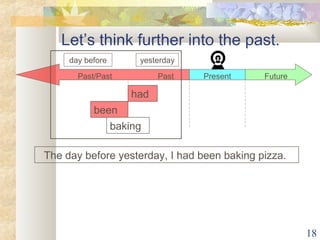
Let’s think further into the past. 
day before yesterday 
Past/Past Past Present Future 
had 
been 
baking 
The day before yesterday, I had been baking pizza.
 The first six grades in school were 
experienced by the interviewees as full 
of distress and failure for a majority. 
Though peer relations were often good, 
many had experienced bullying. 
19
Practice 
 CDC (Center for diseases Control and 
Prevention) is working with other U.S. 
government agencies, the World Health 
Organization (WHO), and other domestic 
and international partners and has activated 
its Emergency Operations Center to help 
coordinate technical assistance and control 
activities with partners. CDC has also 
deployed teams of public health experts to 
West Africa and will continue to send experts 
to the affected countries. 
 Source: http://www.cdc.gov/vhf/ebola/outbreaks/guinea/ 20
A New Entry Is Shaking Up 
Brazil’s Vote 
 Marina Silva learned how to read as a 
teenager and worked as a maid before 
entering politics as an icon of the 
environmental movement. Now, with a 
trajectory appealing to big parts of 
Brazil’s electorate, Ms. Silva is stirring 
an acutely competitive presidential 
race. 
 http://www.nytimes.com/2014/08/21/world/americas/a-newcomer-is-shaking- 
up-brazils-vote.html?_r=1 21
Brazil's scary PISA results 
 Since unveiling the 2012 PISA 
assessment of 15-years-old results in 
early December, 2013, I have been 
considering writing about these data 
and their implications for higher 
education in Brazil. 
22
 More than 67% of the students are low 
performers in mathematics, meaning 
that they can hardly extract relevant 
information from a single source or use 
basic algorithms, formulae, procedures 
or conventions to solve problems 
involving whole numbers. 
 https://www.insidehighered.com/blogs/ 
world-view/brazils-scary-pisa-results 
23
 Additionally, some 61% of Brazilian 
students are low performers in science, 
meaning that, at best, they can present 
scientific explanations that are obvious 
and respond to explicit scientific 
evidence. 
24
 In Brazil, more than one in three (36%) 
15-year-old students have repeated a 
grade at least once in primary or 
secondary school; many were held 
back more than once. This is one of 
the highest rates of grade repetition 
among countries participating in PISA. 
25
Group work 
 Imagine we are the scientific 
committee and we are selecting 
abstracts to be accepted or not. 
 Criteria: 
 A) Presents unit 
 B) It’s clear or raise doubts for the 
reader 
 C) Can you easily find the main issue? 
 D) Are there many repetitions or 
something that could be crossed off? 26
Case Studies in Agribusiness: An 
Interview with Ray Goldberg 
 Agribusiness refers to the collection global systems involved 
in the production, distribution and consumption of food and 
fiber. Since the term was first coined by Harvard Business 
School (HBS) professors Ray Goldberg and John Davis in 
the 1950s, case studies have played a pivotal role in the 
development of the field. In this interview with Ray 
Goldberg, the impact of case studies on agribusiness 
thought and edu-cation are discussed. Highlights include 
how cases have served to define the field as an area of 
research, provided a means of communications between 
researchers and practicing executives, fostered 
communication between executives participating in different 
parts of the overall systems, and, most importantly, helped 
students to acquire a grasp of the complex relationships 
between agricultural products, trade, technology, and public 
policy
INEQUALITY OF EDUCATIONAL 
OUTCOMES: INTERNATIONAL 
EVIDENCE FROM PISA 
FREEMAN, Richard B. MACHIN, Stephen J. VIARENGO, Martina G. 
 This paper examines the relation between measures of 
the within-country inequality of student scores on 
international academic tests and the average level of 
scores across countries, using the PISA mathematics 
tests over 2000-2009. It finds that average test scores 
are higher in countries with lower inequality in scores – 
a virtuous efficiency-equity relation in test performance 
–and that family background factors are differently 
associated with student test performance across 
countries, but display little impact on the country-wide 
dispersion of test scores.
Accounting and Auditing 
Standards for Islamic Financial 
Institutions 
 The accounting practices of different Islamic financial 
institutions today vary greatly, and financial reporting in 
Islamic financial institutions lacks self-regulation and 
standardization. It is thus imperative that high and common 
accounting and auditing standards be developed and 
implemented across Islamic financial institutions. The 
Accounting and Auditing Organization for Islamic Financial 
Institutions, established in and based in Manama, Bahrai, has 
played a pioneering role in developing and promoting these 
standards. It has brought together a common Shari‘ah Board, 
worked with regulatory as well as financial institutions to 
implement its standards, and to date made a total of eighteen 
pronouncements on accounting and auditing standards for 
Islamic finance.
 Analyse if the text is good or not. 
 Criterias: 
 A) Presents unit 
 B) Is it clear for the reader or raise doubts 
 C) Is there a little background/intro to explain the 
objective/ Are the objectives, aims clear 
 D) How did the author go finding the results? What 
steps were taken to carry out the project? 
 E) Can you easily find the main issue 
 F) Are there many repetitions or something that 
could be crossed off 
 G) As a result of the procedure, what was found or 
created? 
30

Verb tense time line

  • 1.
    1 Verb Tenses To Think About Verb Tenses, Use a Time Line
  • 2.
    2 We arestuck in the present. But, we can remember the past and think about the future. We do this with our inner eye.
  • 3.
    3 How DoesIt Work? Think of this as your inner-eye. This is what we use to remember and to imagine with.
  • 4.
    4 If wereally think about time, we are always stuck in the present. The Present
  • 5.
    5 Let’s usethe inner-eye. Thinking about the future. The Present The Future Thinking about the past. The Past
  • 6.
    6 By usingthe inner-eye, let’s now build a time line. Past Present Future am baking I am baking a pepperoni pizza. What makes this action in the present tense?
  • 7.
    7 By usingthe inner-eye, let’s now build a time line. Past Present Future bake I bake a pepperoni pizza.
  • 8.
     Biofuels providea potential route to avoiding the global political instability and environmental issues that arise from reliance on petroleum. 8
  • 9.
     When philosophersdiscuss personal identity they are not talking about such down-to-earth concerns as ethnicity and multiculturalism. Instead, they are referring to the more abstractly metaphysical question of what makes each of us the same person he or she was last week. 9
  • 10.
    10 Let’s thinkabout yesterday. Thinking about the past. Yesterday, I was baking a pepperoni pizza. What makes this action in the past tense? was Past Present Future baking
  • 11.
     The citrusseeds oil samples contained eight fatty acids while linoleic, oleic and palmitic acids were major acids. Some antinutritional compounds were detected in the flours. The results revealed that, glucosides, stachyose, raffinose, trypsin inhibitor, phytic acid and tannins were present in all citrus seeds flours. 11
  • 12.
    12 Let’s thinkabout tomorrow. Thinking about the future. Past Present Future will be baking Tomorrow, I will be baking a pepperoni pizza. What makes this action in the future tense?
  • 13.
     The articlealso proposes that in order to encourage teacher research, the educational community will need to address incentives for teachers, the creation and maintenance of supportive networks 13
  • 14.
    14 Let’s thinkabout the near past. Past Present Future have been baking Today, I have been baking pepperoni pizza. Notice that “baking” is now in the past and in the present.
  • 15.
     Here wehave demonstrated the second stage of metabolic engineering effort by designing and engineering a regulatory circuit to control gene expression in response to intracellular metabolic states. 15
  • 16.
     Global energydemand and environmental concerns have stimulated increasing efforts to produce carbon-neutral fuels directly from renewable resources 16
  • 17.
     hybridity inAfrican post-colonial literature have often been heavily laden with nationalist and leftist ideological encumbrances, 17
  • 18.
    18 Let’s thinkfurther into the past. day before yesterday Past/Past Past Present Future had been baking The day before yesterday, I had been baking pizza.
  • 19.
     The firstsix grades in school were experienced by the interviewees as full of distress and failure for a majority. Though peer relations were often good, many had experienced bullying. 19
  • 20.
    Practice  CDC(Center for diseases Control and Prevention) is working with other U.S. government agencies, the World Health Organization (WHO), and other domestic and international partners and has activated its Emergency Operations Center to help coordinate technical assistance and control activities with partners. CDC has also deployed teams of public health experts to West Africa and will continue to send experts to the affected countries.  Source: http://www.cdc.gov/vhf/ebola/outbreaks/guinea/ 20
  • 21.
    A New EntryIs Shaking Up Brazil’s Vote  Marina Silva learned how to read as a teenager and worked as a maid before entering politics as an icon of the environmental movement. Now, with a trajectory appealing to big parts of Brazil’s electorate, Ms. Silva is stirring an acutely competitive presidential race.  http://www.nytimes.com/2014/08/21/world/americas/a-newcomer-is-shaking- up-brazils-vote.html?_r=1 21
  • 22.
    Brazil's scary PISAresults  Since unveiling the 2012 PISA assessment of 15-years-old results in early December, 2013, I have been considering writing about these data and their implications for higher education in Brazil. 22
  • 23.
     More than67% of the students are low performers in mathematics, meaning that they can hardly extract relevant information from a single source or use basic algorithms, formulae, procedures or conventions to solve problems involving whole numbers.  https://www.insidehighered.com/blogs/ world-view/brazils-scary-pisa-results 23
  • 24.
     Additionally, some61% of Brazilian students are low performers in science, meaning that, at best, they can present scientific explanations that are obvious and respond to explicit scientific evidence. 24
  • 25.
     In Brazil,more than one in three (36%) 15-year-old students have repeated a grade at least once in primary or secondary school; many were held back more than once. This is one of the highest rates of grade repetition among countries participating in PISA. 25
  • 26.
    Group work Imagine we are the scientific committee and we are selecting abstracts to be accepted or not.  Criteria:  A) Presents unit  B) It’s clear or raise doubts for the reader  C) Can you easily find the main issue?  D) Are there many repetitions or something that could be crossed off? 26
  • 27.
    Case Studies inAgribusiness: An Interview with Ray Goldberg  Agribusiness refers to the collection global systems involved in the production, distribution and consumption of food and fiber. Since the term was first coined by Harvard Business School (HBS) professors Ray Goldberg and John Davis in the 1950s, case studies have played a pivotal role in the development of the field. In this interview with Ray Goldberg, the impact of case studies on agribusiness thought and edu-cation are discussed. Highlights include how cases have served to define the field as an area of research, provided a means of communications between researchers and practicing executives, fostered communication between executives participating in different parts of the overall systems, and, most importantly, helped students to acquire a grasp of the complex relationships between agricultural products, trade, technology, and public policy
  • 28.
    INEQUALITY OF EDUCATIONAL OUTCOMES: INTERNATIONAL EVIDENCE FROM PISA FREEMAN, Richard B. MACHIN, Stephen J. VIARENGO, Martina G.  This paper examines the relation between measures of the within-country inequality of student scores on international academic tests and the average level of scores across countries, using the PISA mathematics tests over 2000-2009. It finds that average test scores are higher in countries with lower inequality in scores – a virtuous efficiency-equity relation in test performance –and that family background factors are differently associated with student test performance across countries, but display little impact on the country-wide dispersion of test scores.
  • 29.
    Accounting and Auditing Standards for Islamic Financial Institutions  The accounting practices of different Islamic financial institutions today vary greatly, and financial reporting in Islamic financial institutions lacks self-regulation and standardization. It is thus imperative that high and common accounting and auditing standards be developed and implemented across Islamic financial institutions. The Accounting and Auditing Organization for Islamic Financial Institutions, established in and based in Manama, Bahrai, has played a pioneering role in developing and promoting these standards. It has brought together a common Shari‘ah Board, worked with regulatory as well as financial institutions to implement its standards, and to date made a total of eighteen pronouncements on accounting and auditing standards for Islamic finance.
  • 30.
     Analyse ifthe text is good or not.  Criterias:  A) Presents unit  B) Is it clear for the reader or raise doubts  C) Is there a little background/intro to explain the objective/ Are the objectives, aims clear  D) How did the author go finding the results? What steps were taken to carry out the project?  E) Can you easily find the main issue  F) Are there many repetitions or something that could be crossed off  G) As a result of the procedure, what was found or created? 30