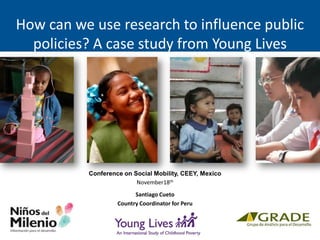
How can we use research to influence public
policies? A case study from Young Lives
Conference on Social Mobility, CEEY, Mexico
November18th
Santiago Cueto
Country Coordinator for Peru
Young Lives / Niños del Milenio:
A longitudinal study of childhood poverty
• Our aim is to shed light on the drivers and impacts of child poverty,
and generate evidence to help policymakers design programmes
that make a real difference to poor children and their families.
• We have been following 12,000 children in Ethiopia, India (in the
states of Andhra Pradesh and Telangana), Peru and Vietnam since
2002.
• YL is an international collaborative study coordinated by the
University of Oxford and core-funded by the Department for
International Development (DFID), with the support of several
other donors.
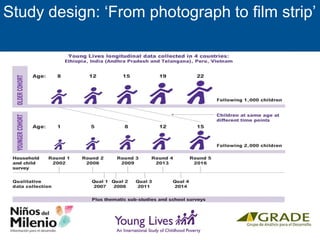
Study design: ‘From photograph to film strip’
Themes
• Low attrition between 2002 and 2013 (around 5%, excluding
deaths).
• Young Lives has aligned research and policy themes to some key
MDGs and EFAs goals, and now to the SDGs to reinforce our main
idea: inclusive policies –‘leaving no child behind’– are key to
creating healthier, more productive and just societies, and to break
the intergenerational transmission of poverty.
• Our main themes are: Poverty & inequality; Health & nutrition;
Education; Gender & youth; and Child protection.
Theory of change I
• Critically analyses whether what we are doing will achieve the aim
we want
By:
• Setting out underpinning assumptions and approaches
• Allows an organisation to set out the change that ought to happen
and its role within that (and the role of others)
• ToC is complemented/supported by other plans and reporting
• Building on what we have done
Theory of change II: Our tasks are
• To generate high-quality longitudinal evidence about the correlates and
impact of poverty on children’s lives in contexts of economic and social
change;
• To disseminate this evidence in accessible ways to global and national
stakeholders;
• Look to be used in the improvement of policies of governments and
other organizations at all stages of children’s lives;
• We also do advocacy to generate political will and shape policy agendas,
accountability and good governance within government and systems;
adherence to human rights and observing children’s rights; positive
resource allocation by ministries, donors and international organizations;
and community change.
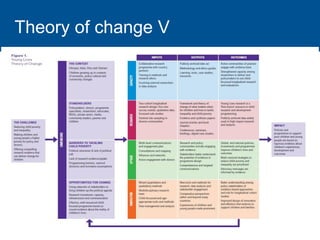
Theory of change III: document
published in 2015, includes
• The core challenge of childhood poverty: reducing child poverty and inequality;
• The dimensions of our work: Features of country contexts in which we work;
stakeholders with whom we work; the barriers to using evidence to tackle child
poverty; and the entry points through which Young Lives can deliver change.
• Our strategy, organized into four broad and interconnecting ‘channels’ of
activity: building CAPACITY; generating RESEARCH; promoting UPTAKE of
findings; and INNOVATION in methodology and knowledge.
• We also identify expected inputs that should occur, as well as outputs and
outcomes.
• The expected impact is “policies and programmes to support poor children and
young people are based on rigorous evidence about children’s experiences,
development and outcomes”.
• http://www.younglives.org.uk/content/young-lives-theory-change-1
Theory of change V
Have we made a difference?
• Easier to measure inputs and outputs than outcomes
and impact. Difficult to make causal attributions!
• We keep records of publications, meetings, downloads
of publications and data bases, visits to web sites,
quotes from stakeholders, and participation in national
and international boards, meetings and conferences.
• Need a better conceptual model and methodologies to
measure impact of research on policies.
Case studies (1)
Example 1: Creation of Child Research and Policy Forum (CRPF) in Ethiopia,
following research project which brought stakeholders together
• Benefits: Recognition of importance of face to fact contacts, improving research
quality by peer interaction, and creation of space where researchers could
engage with Ministry of Women, Children and Youth Affairs
• Challenges: keeping it going
Example 2: Relationship with UNICEF´s Office of Research to study the drivers of
violence.
• Benefits: Engagement of national teams (Young Lives and UNICEF country offices)
favoured involvement in national debates; working with partners increases
dissemination potential
• Challenges: Managing expectations of partners, reacting quickly
Case studies (2)
Example 3: Juntos (conditional cash-transfer program) in Peru
• We developed a series of studies on this program, focusing on different aspects
and using a variety of designs.
• Benefits: the accumulation of YL´s evidence, plus that generated by others,
allowed us to be a powerful partner of this program.
• Challenges: continue to be engaged with program officers as they rotate with
some frequency.
Example 4: publicly archived data set and promoting its use
• Total external users = 1,300. 1/3 non-OECD. Workshops on data use in Peru.
• Benefits: Stimulate external research potential; high VFM return for initial
investment; YL´s data set becomes increasingly interesting with every round.
• Challenges: Capacity gaps in low-/middle-income countries (researcher and
Government); no tradition of using research.
Case studies (3)
Example 5: Education
• Oxfam has used the Young Lives book Changing Lives in a Changing
World to develop Everyone Counts, aimed at children ages 9 to 12.
• We encourage the usage of our studies in universities, to help
develop the skills of the next generation of policy makers and
developers
• Benefits: develop sensitivity and skills among different young
audiences
• Challenges: develop skills in the teachers who use these materials
Meet Seble (From Everyone Counts)
“My name is Seble (Seb-lay). I think that I am 12 years old but
I’m not quite sure. I live with my family in a village in a rural area
of Oromiya state in Ethiopia… I started going to school when I
was eight years old. I still go to school but I’m behind for my
age… My own health hasn’t been good. I had tuberculosis when I
was six and I’m still not completely better. I have also had
malaria twice. If I am able to go to secondary school, I will have
to go and live with my grandmother in the nearest town. My
older sister has already done this.
Seble
I help my mother a lot in the house, cleaning and making coffee,
bread and injera. I learnt to make coffee when I was four years
old! I also fetch firewood and water. I like collecting firewood. My
friends and I talk and tell jokes while we walk to and from the
mountain to collect firewood.
Since I was 11 I have also been working part-time as a labourer,
doing work such as planting or picking vegetables. I work with
other girls in a group and how much we get paid depends on the
number of lines of vegetables we pick. We work up to eight
hours a day. After work we chat together.
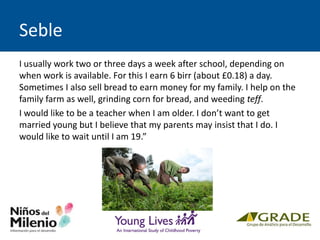
Seble
I usually work two or three days a week after school, depending on
when work is available. For this I earn 6 birr (about £0.18) a day.
Sometimes I also sell bread to earn money for my family. I help on the
family farm as well, grinding corn for bread, and weeding teff.
I would like to be a teacher when I am older. I don’t want to get
married young but I believe that my parents may insist that I do. I
would like to wait until I am 19.”
Looking forward: what does it all add
up to?
• We have produced summary country reports descrbibing
main trends after every round, one pending for round five.
• We are preparing synthesis reports for each country and
thematic cross-country reports in education, educational
trajectories, impact of preschool, school effectiveness,
adolescence, and tracing the consequences of poverty and
inequality for children.
• Seeking opportunities to continue studying both cohorts
and YL´s children (the next generation!)
Find out more
www.younglives.org.uk
• methods and research papers
• datasets (UK Data Archive)
• publications
• child profiles and photos
• e-newsletter
www.ninosdelmilenio.org
(for Peru, in Spanish)
Our social media
Facebook y Twitter:
/YoungLivesStudy
/NinosDelMilenio.org
@Yloxford
@NinosdelMilenio

Conference Social Mobility

  • 1.
    How can weuse research to influence public policies? A case study from Young Lives Conference on Social Mobility, CEEY, Mexico November18th Santiago Cueto Country Coordinator for Peru
  • 2.
    Young Lives /Niños del Milenio: A longitudinal study of childhood poverty • Our aim is to shed light on the drivers and impacts of child poverty, and generate evidence to help policymakers design programmes that make a real difference to poor children and their families. • We have been following 12,000 children in Ethiopia, India (in the states of Andhra Pradesh and Telangana), Peru and Vietnam since 2002. • YL is an international collaborative study coordinated by the University of Oxford and core-funded by the Department for International Development (DFID), with the support of several other donors.
  • 3.
    Study design: ‘Fromphotograph to film strip’
  • 4.
    Themes • Low attritionbetween 2002 and 2013 (around 5%, excluding deaths). • Young Lives has aligned research and policy themes to some key MDGs and EFAs goals, and now to the SDGs to reinforce our main idea: inclusive policies –‘leaving no child behind’– are key to creating healthier, more productive and just societies, and to break the intergenerational transmission of poverty. • Our main themes are: Poverty & inequality; Health & nutrition; Education; Gender & youth; and Child protection.
  • 5.
    Theory of changeI • Critically analyses whether what we are doing will achieve the aim we want By: • Setting out underpinning assumptions and approaches • Allows an organisation to set out the change that ought to happen and its role within that (and the role of others) • ToC is complemented/supported by other plans and reporting • Building on what we have done
  • 6.
    Theory of changeII: Our tasks are • To generate high-quality longitudinal evidence about the correlates and impact of poverty on children’s lives in contexts of economic and social change; • To disseminate this evidence in accessible ways to global and national stakeholders; • Look to be used in the improvement of policies of governments and other organizations at all stages of children’s lives; • We also do advocacy to generate political will and shape policy agendas, accountability and good governance within government and systems; adherence to human rights and observing children’s rights; positive resource allocation by ministries, donors and international organizations; and community change.
  • 7.
    Theory of changeIII: document published in 2015, includes • The core challenge of childhood poverty: reducing child poverty and inequality; • The dimensions of our work: Features of country contexts in which we work; stakeholders with whom we work; the barriers to using evidence to tackle child poverty; and the entry points through which Young Lives can deliver change. • Our strategy, organized into four broad and interconnecting ‘channels’ of activity: building CAPACITY; generating RESEARCH; promoting UPTAKE of findings; and INNOVATION in methodology and knowledge. • We also identify expected inputs that should occur, as well as outputs and outcomes. • The expected impact is “policies and programmes to support poor children and young people are based on rigorous evidence about children’s experiences, development and outcomes”. • http://www.younglives.org.uk/content/young-lives-theory-change-1
  • 8.
  • 9.
    Have we madea difference? • Easier to measure inputs and outputs than outcomes and impact. Difficult to make causal attributions! • We keep records of publications, meetings, downloads of publications and data bases, visits to web sites, quotes from stakeholders, and participation in national and international boards, meetings and conferences. • Need a better conceptual model and methodologies to measure impact of research on policies.
  • 10.
    Case studies (1) Example1: Creation of Child Research and Policy Forum (CRPF) in Ethiopia, following research project which brought stakeholders together • Benefits: Recognition of importance of face to fact contacts, improving research quality by peer interaction, and creation of space where researchers could engage with Ministry of Women, Children and Youth Affairs • Challenges: keeping it going Example 2: Relationship with UNICEF´s Office of Research to study the drivers of violence. • Benefits: Engagement of national teams (Young Lives and UNICEF country offices) favoured involvement in national debates; working with partners increases dissemination potential • Challenges: Managing expectations of partners, reacting quickly
  • 11.
    Case studies (2) Example3: Juntos (conditional cash-transfer program) in Peru • We developed a series of studies on this program, focusing on different aspects and using a variety of designs. • Benefits: the accumulation of YL´s evidence, plus that generated by others, allowed us to be a powerful partner of this program. • Challenges: continue to be engaged with program officers as they rotate with some frequency. Example 4: publicly archived data set and promoting its use • Total external users = 1,300. 1/3 non-OECD. Workshops on data use in Peru. • Benefits: Stimulate external research potential; high VFM return for initial investment; YL´s data set becomes increasingly interesting with every round. • Challenges: Capacity gaps in low-/middle-income countries (researcher and Government); no tradition of using research.
  • 12.
    Case studies (3) Example5: Education • Oxfam has used the Young Lives book Changing Lives in a Changing World to develop Everyone Counts, aimed at children ages 9 to 12. • We encourage the usage of our studies in universities, to help develop the skills of the next generation of policy makers and developers • Benefits: develop sensitivity and skills among different young audiences • Challenges: develop skills in the teachers who use these materials
  • 13.
    Meet Seble (FromEveryone Counts) “My name is Seble (Seb-lay). I think that I am 12 years old but I’m not quite sure. I live with my family in a village in a rural area of Oromiya state in Ethiopia… I started going to school when I was eight years old. I still go to school but I’m behind for my age… My own health hasn’t been good. I had tuberculosis when I was six and I’m still not completely better. I have also had malaria twice. If I am able to go to secondary school, I will have to go and live with my grandmother in the nearest town. My older sister has already done this.
  • 14.
    Seble I help mymother a lot in the house, cleaning and making coffee, bread and injera. I learnt to make coffee when I was four years old! I also fetch firewood and water. I like collecting firewood. My friends and I talk and tell jokes while we walk to and from the mountain to collect firewood. Since I was 11 I have also been working part-time as a labourer, doing work such as planting or picking vegetables. I work with other girls in a group and how much we get paid depends on the number of lines of vegetables we pick. We work up to eight hours a day. After work we chat together.
  • 15.
    Seble I usually worktwo or three days a week after school, depending on when work is available. For this I earn 6 birr (about £0.18) a day. Sometimes I also sell bread to earn money for my family. I help on the family farm as well, grinding corn for bread, and weeding teff. I would like to be a teacher when I am older. I don’t want to get married young but I believe that my parents may insist that I do. I would like to wait until I am 19.”
  • 16.
    Looking forward: whatdoes it all add up to? • We have produced summary country reports descrbibing main trends after every round, one pending for round five. • We are preparing synthesis reports for each country and thematic cross-country reports in education, educational trajectories, impact of preschool, school effectiveness, adolescence, and tracing the consequences of poverty and inequality for children. • Seeking opportunities to continue studying both cohorts and YL´s children (the next generation!)
  • 17.
    Find out more www.younglives.org.uk •methods and research papers • datasets (UK Data Archive) • publications • child profiles and photos • e-newsletter www.ninosdelmilenio.org (for Peru, in Spanish)
  • 18.
    Our social media Facebooky Twitter: /YoungLivesStudy /NinosDelMilenio.org @Yloxford @NinosdelMilenio