MINIMUM VENTILATION
3rd ROSS BREEDERS ANADOLU
INFORMATION SHARING MEETINGINFORMATION SHARING MEETING
October 2010
Bernard Green
Discussion Topics
• Why we ventilate
• When do we use minimum ventilation?
• Bird requirements
• Effects of temperature on oxygen demand
• House sealing
• Problems with poorly sealed houses• Problems with poorly sealed houses
• Potential solutions to managing “older” houses
• What is negative pressure
• Why it is important
• Minimum ventilation system
• Minimum ventilation rate
• Evaluating minimum ventilation
Why We Ventilate
We ventilate to:
• Create an air exchange
• Control moisture levels
• Control the heat load
• Control the effective temperature
– (Temp + RH + air speed + bird age)– (Temp + RH + air speed + bird age)
• Supply oxygen
• Remove harmful gases
When Do We Use Min Vent?
• It can be used summer and winter
• It is used anytime the actual house temperature is below
the required set point temperature for the birds
• It is used when trying to maintain temperature, but still
putting the least amount of fresh air possible to maintain
good air qualitygood air quality
• When the house temperature goes above the required
set point temperature, then it is no longer in minimum
ventilation mode
Set Point Temperature
Minimum Ventilation
Transition and Tunnel Ventilation
Bird Requirements
• Warm floor during brooding
• Good air quality (oxygen)
• No temperature fluctuations
• No drafts
• No environmental stresses
• It doesn’t matter what type of housing you have!
• These are the bird requirements
Effects of Temperature on
Oxygen Demand
• Oxygen demand is lowest when the environment allows
the chick to be in its thermoneutral zone
• As environmental temperature decreases, oxygen
demand increases
– You cannot compromise ventilation for temperature– You cannot compromise ventilation for temperature
• When environmental temperature increases and the bird
begins to pant, oxygen demand increases
House Sealing
• Regardless of the type of ventilation system, it is
important to seal the house
• Reduces cold air leakage onto the birds
• Gives better control over what is happening in house
• Gives you more control over the incoming air
• Reduces the effect of outside conditions• Reduces the effect of outside conditions
• Increases the operating pressure of the whole house
Problems With Poorly Sealed Houses
• Cold floors due to drafts
• Cold drafts onto the chicks
• Can’t maintain temperature in winter
• Can’t ventilate effectively in winter
Stress, stocking density, uniformity, health, poor start
• Cold drafts onto the heater probe
• Heat loss through the cracks and openings
• No mixing of cold incoming air with warm inside air
• Unable to access the heat in the peak of the roof
High heating costs, can’t maintain temperature
Poorly Sealed Catching Door
(University of Georgia)
Cold Air Leakage at Catching Door
(University of Georgia)
Sealed vs. Unsealed Side Wall
(University of Georgia)
Chick Spread – Uninsulated, Poor Seal
(University of Georgia)
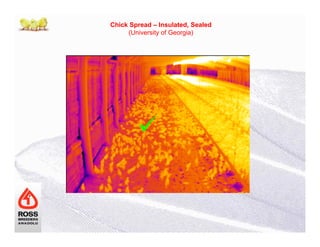
Chick Spread – Insulated, Sealed
(University of Georgia)
Always Seal Fans From The Outside
Curtain Leakage, Cold Floors
(University of Georgia)
Curtain Leakage on a Windy Day
(University of Georgia)
Air Leakage Through a Poorly Sealed Curtain
(University of Georgia)
Potential Solutions to
Managing “Older” Houses
• SEAL THE HOUSE!! (minimal cost, huge impact)
– Make sure tunnel inlet/cooling pad seals well
– Seal around doors, fans, windows
– Seal eave of the roof
– Seal all joints in the roof
• Roof insulation (summer and winter benefit)• Roof insulation (summer and winter benefit)
• Review your heating system (type and capacity)
– Radiant heaters put the heat where the chicks need it
• Review your heat distribution
• Preheat the house for at least 2-3 days
• Make sure floors are warm before chicks arrive
Potential Solutions to
Managing “Older” Houses
Some ideas:
• Use secondary inner curtain to protect the birds from
drafts
• Fan Jet system – explained below
• Install minimum ventilation – examples below
– Air cannons– Air cannons
– Inlets (pressure balanced, winch operated)
• Circulation fans can help to distribute heat (but they are
NOT a substitute for minimum ventilation)
Radiant Heating
(University of Georgia)
Puts heat where needed, on the floor
Internal Curtain
Internal CurtainInternal Curtain
Draft on chicksNo draft on chicks
Fan Jet
Inlet
Damper
Fan Jet
Fan Jet System
Fan Jet Plastic Tube
Exhaust Fan
Fan Jet System
Advantages:
• “Positive pressure” system
• House does not have to be extremely well sealed
• Fan jet runs continuously → good mixing of air and heat
• Incoming air directed up away from birds
• Heating system can be located at FJ for distribution• Heating system can be located at FJ for distribution
• Relatively cheap system
Disadvantages:
• May not be able to provide enough min vent for whole
cycle
• Depends on stocking density, weight
Air Cannons
Pressure Balanced Inlet
Air Cannons, Pressure Inlets
Advantages:
• Quite an effective minimum ventilation system
• Fairly cost effective – cheap “inlets” (Ø90mm pipe)
• Curtains stay closed
• Mixes incoming air with warm house air
Disadvantages:Disadvantages:
• System works on negative pressure, so…
• House must be well sealed, or else……
• House may get colder than before, chicks more stressed
• Do not take this approach unless house can be well
sealed
• Requires ventilation controller or cycle timer
How Many Air Cannons?
• First, remember that air cannons are only for bare
minimum ventilation
• They are not there for transitional ventilation
• Don’t try to calculate the number of air cannons
– The number will usually be very big
• Suggestion:• Suggestion:
– Install one in each bay on both sides of the house
– Install two in each corner of the house
– Check the operating pressure
– Decide if more air cannons are required
Hot Air
Poor Air Cannon Installation Examples
Bringing in Cold Air
Valuable Heat
Wasted
Chicks chilled, wet litter
Negative Pressure Ventilation
Closed Environment Houses
What is Negative Pressure?
• When a fan tries to extract more air from a house than is
allowed to enter the house
• When this happens air rushes in through inlets to replace
the exhausted air
• Just because a fan is running, doesn’t mean there is
a negative pressurea negative pressure
Side curtain full open, air short-cuts to fans.
Ventilated
Not
Ventilated
No Negative Pressure
Side curtain slightly closed.
Air still short-cuts to fans.
Ventilated
Not
Ventilated
No Negative Pressure
Side curtain more closed.
Air drawn from further down house.
Ventilated
Not Ventilated
No Negative Pressure
Side curtain almost closed.
Air drawn from entire length of house.
Ventilated
Negative Pressure inNegative Pressure in
Whole House
Ventilated
Why Is It Important?
• With negative pressure, air enters evenly through every
inlet (including areas of leakage)
• By spreading inlets evenly can get even fresh air
• By restricting inlet size, can regulate incoming air speed
• Control over how far the air goes into the house
• Air should go to the middle (peak) of the roof• Air should go to the middle (peak) of the roof
• Higher incoming speed allows better mixing
• Pressure determines the incoming air speed
• High P → high air speed, Low P → low air speed
• The wider the house → higher the pressure
• By using pressure, we can put the air where we want
it
Air Movement Based on Pressure
Just right
Low Pressure
Bit higher
Higher
Minimum Ventilation System
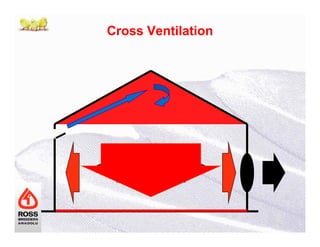
• Cross ventilation is most successful
• Fans and inlets located in the side walls
• Hot air gathers in the peak of the roof
• Fans operate on a cycle timer (ON/OFF)
• Pressure controlled side wall inlets direct cold air to peak
• Cold, moist air mixes and pushes hot, dry air down• Cold, moist air mixes and pushes hot, dry air down
• Distributes fresh, warm air
• Low air movement at bird level (<0,25ms-1)
Cross Ventilation
Proper Inlet Air Flow
(University of Georgia)
4˚C
10˚C
15˚C
50%
27˚C
10˚C
75%
50%
Inlet Air Flow
(University of Georgia)
“Seeing” Air Movement
Pressure low
Pressure better, but still low
Pressure rightPressure right
Pressure too high
Air Inlet Management
• Inlets should open at least 4-5cm during minimum
ventilation
• Having fewer inlets opening correct amount is better
than too many opening only a little
• Inlets must open equally
• Inlets used must be evenly distributed• Inlets used must be evenly distributed
• Must operate on static pressure
• Air direction plate required if there are ceiling
obstructions
• Good inlet management is important!
• Take care when choosing new inlets
System To Automatically Control Which Inlets Will Open
This Inlet Type Must Be Manually “Locked” Closed
Air Flow Through Modern Inlet
(University of Georgia)
Air Flow Through “Older” Type Inlet
(University of Georgia)
Controller
• There are simple, and complicated controllers available
• Choose one that you can use with confidence!
• A complicated controller is worth nothing if you can’t use
it!
Management/Stockmanship
• The above is not worth much without good management
• Manager is link between birds and ventilation system
• Must be able to “read” bird behaviour and other signs
• Must be able to adjust vent to satisfy bird requirement
• There is no ventilation system that does not require
managementmanagement
Minimum Ventilation Rate
• Theoretical/calculated rates (??m3/hr/kg) are only a
guide!
• The right minimum rate is critical for bird performance
and to minimise heat consumption
• Extremely fine line between under and over ventilating
• Evaluate your minimum ventilation setting every day• Evaluate your minimum ventilation setting every day
• Minimum ventilation fans should operate on a cycle timer
Example Calculation
Assume:
• Bird weight = 200g ; 30 000 birds
• Ventilation “factor” = 1,1m³/hr/kg
Calculation:
• Ventilation = 30 000 x 0,2kg x 1,1m³/hr/kg = 6 600m³/hr
Cycle Timer Setting:Cycle Timer Setting:
• 5 minute cycle ; fan = 20 000m³/hr (at pressure)
Time ON = (6600 x 5) ÷ (1 x 20000) = 1,65 minutes
Time ON = 1 min 39 sec
Time OFF = 3 min 21 sec
Evaluating Minimum Ventilation
• The only way is by visiting the house
• Done preferably first thing each morning
• Evaluate in the first 30 seconds:
– stuffiness
– ammonia
– condensation (walls, drinker pipes, steelwork)– condensation (walls, drinker pipes, steelwork)
– bird comfort
– “AIR QUALITY”
– What you feel in first 30 seconds is what the chicken
lived with all night
• “Purging” the house is unacceptable
Remember!
• Minimum ventilation determines how much fresh air
you bring into the house (air quality)
• Pressure is used to make the air go where you want it to
when it enters the house
THANK YOU

Minimum ventilation havaland - Ross

  • 1.
    MINIMUM VENTILATION 3rd ROSSBREEDERS ANADOLU INFORMATION SHARING MEETINGINFORMATION SHARING MEETING October 2010 Bernard Green
  • 2.
    Discussion Topics • Whywe ventilate • When do we use minimum ventilation? • Bird requirements • Effects of temperature on oxygen demand • House sealing • Problems with poorly sealed houses• Problems with poorly sealed houses • Potential solutions to managing “older” houses • What is negative pressure • Why it is important • Minimum ventilation system • Minimum ventilation rate • Evaluating minimum ventilation
  • 3.
    Why We Ventilate Weventilate to: • Create an air exchange • Control moisture levels • Control the heat load • Control the effective temperature – (Temp + RH + air speed + bird age)– (Temp + RH + air speed + bird age) • Supply oxygen • Remove harmful gases
  • 4.
    When Do WeUse Min Vent? • It can be used summer and winter • It is used anytime the actual house temperature is below the required set point temperature for the birds • It is used when trying to maintain temperature, but still putting the least amount of fresh air possible to maintain good air qualitygood air quality • When the house temperature goes above the required set point temperature, then it is no longer in minimum ventilation mode Set Point Temperature Minimum Ventilation Transition and Tunnel Ventilation
  • 5.
    Bird Requirements • Warmfloor during brooding • Good air quality (oxygen) • No temperature fluctuations • No drafts • No environmental stresses • It doesn’t matter what type of housing you have! • These are the bird requirements
  • 6.
    Effects of Temperatureon Oxygen Demand • Oxygen demand is lowest when the environment allows the chick to be in its thermoneutral zone • As environmental temperature decreases, oxygen demand increases – You cannot compromise ventilation for temperature– You cannot compromise ventilation for temperature • When environmental temperature increases and the bird begins to pant, oxygen demand increases
  • 7.
    House Sealing • Regardlessof the type of ventilation system, it is important to seal the house • Reduces cold air leakage onto the birds • Gives better control over what is happening in house • Gives you more control over the incoming air • Reduces the effect of outside conditions• Reduces the effect of outside conditions • Increases the operating pressure of the whole house
  • 8.
    Problems With PoorlySealed Houses • Cold floors due to drafts • Cold drafts onto the chicks • Can’t maintain temperature in winter • Can’t ventilate effectively in winter Stress, stocking density, uniformity, health, poor start • Cold drafts onto the heater probe • Heat loss through the cracks and openings • No mixing of cold incoming air with warm inside air • Unable to access the heat in the peak of the roof High heating costs, can’t maintain temperature
  • 9.
    Poorly Sealed CatchingDoor (University of Georgia)
  • 10.
    Cold Air Leakageat Catching Door (University of Georgia)
  • 11.
    Sealed vs. UnsealedSide Wall (University of Georgia)
  • 12.
    Chick Spread –Uninsulated, Poor Seal (University of Georgia)
  • 13.
    Chick Spread –Insulated, Sealed (University of Georgia)
  • 14.
    Always Seal FansFrom The Outside
  • 15.
    Curtain Leakage, ColdFloors (University of Georgia)
  • 16.
    Curtain Leakage ona Windy Day (University of Georgia)
  • 17.
    Air Leakage Througha Poorly Sealed Curtain (University of Georgia)
  • 18.
    Potential Solutions to Managing“Older” Houses • SEAL THE HOUSE!! (minimal cost, huge impact) – Make sure tunnel inlet/cooling pad seals well – Seal around doors, fans, windows – Seal eave of the roof – Seal all joints in the roof • Roof insulation (summer and winter benefit)• Roof insulation (summer and winter benefit) • Review your heating system (type and capacity) – Radiant heaters put the heat where the chicks need it • Review your heat distribution • Preheat the house for at least 2-3 days • Make sure floors are warm before chicks arrive
  • 19.
    Potential Solutions to Managing“Older” Houses Some ideas: • Use secondary inner curtain to protect the birds from drafts • Fan Jet system – explained below • Install minimum ventilation – examples below – Air cannons– Air cannons – Inlets (pressure balanced, winch operated) • Circulation fans can help to distribute heat (but they are NOT a substitute for minimum ventilation)
  • 20.
    Radiant Heating (University ofGeorgia) Puts heat where needed, on the floor
  • 21.
    Internal Curtain Internal CurtainInternalCurtain Draft on chicksNo draft on chicks
  • 22.
  • 23.
  • 24.
    Fan Jet System FanJet Plastic Tube Exhaust Fan
  • 25.
    Fan Jet System Advantages: •“Positive pressure” system • House does not have to be extremely well sealed • Fan jet runs continuously → good mixing of air and heat • Incoming air directed up away from birds • Heating system can be located at FJ for distribution• Heating system can be located at FJ for distribution • Relatively cheap system Disadvantages: • May not be able to provide enough min vent for whole cycle • Depends on stocking density, weight
  • 26.
  • 27.
  • 28.
    Air Cannons, PressureInlets Advantages: • Quite an effective minimum ventilation system • Fairly cost effective – cheap “inlets” (Ø90mm pipe) • Curtains stay closed • Mixes incoming air with warm house air Disadvantages:Disadvantages: • System works on negative pressure, so… • House must be well sealed, or else…… • House may get colder than before, chicks more stressed • Do not take this approach unless house can be well sealed • Requires ventilation controller or cycle timer
  • 29.
    How Many AirCannons? • First, remember that air cannons are only for bare minimum ventilation • They are not there for transitional ventilation • Don’t try to calculate the number of air cannons – The number will usually be very big • Suggestion:• Suggestion: – Install one in each bay on both sides of the house – Install two in each corner of the house – Check the operating pressure – Decide if more air cannons are required
  • 30.
    Hot Air Poor AirCannon Installation Examples
  • 31.
    Bringing in ColdAir Valuable Heat Wasted Chicks chilled, wet litter Negative Pressure Ventilation Closed Environment Houses
  • 32.
    What is NegativePressure? • When a fan tries to extract more air from a house than is allowed to enter the house • When this happens air rushes in through inlets to replace the exhausted air • Just because a fan is running, doesn’t mean there is a negative pressurea negative pressure
  • 33.
    Side curtain fullopen, air short-cuts to fans. Ventilated Not Ventilated No Negative Pressure
  • 34.
    Side curtain slightlyclosed. Air still short-cuts to fans. Ventilated Not Ventilated No Negative Pressure
  • 35.
    Side curtain moreclosed. Air drawn from further down house. Ventilated Not Ventilated No Negative Pressure
  • 36.
    Side curtain almostclosed. Air drawn from entire length of house. Ventilated Negative Pressure inNegative Pressure in Whole House Ventilated
  • 37.
    Why Is ItImportant? • With negative pressure, air enters evenly through every inlet (including areas of leakage) • By spreading inlets evenly can get even fresh air • By restricting inlet size, can regulate incoming air speed • Control over how far the air goes into the house • Air should go to the middle (peak) of the roof• Air should go to the middle (peak) of the roof • Higher incoming speed allows better mixing • Pressure determines the incoming air speed • High P → high air speed, Low P → low air speed • The wider the house → higher the pressure • By using pressure, we can put the air where we want it
  • 38.
    Air Movement Basedon Pressure Just right Low Pressure Bit higher Higher
  • 39.
    Minimum Ventilation System •Cross ventilation is most successful • Fans and inlets located in the side walls • Hot air gathers in the peak of the roof • Fans operate on a cycle timer (ON/OFF) • Pressure controlled side wall inlets direct cold air to peak • Cold, moist air mixes and pushes hot, dry air down• Cold, moist air mixes and pushes hot, dry air down • Distributes fresh, warm air • Low air movement at bird level (<0,25ms-1)
  • 40.
  • 41.
    Proper Inlet AirFlow (University of Georgia) 4˚C 10˚C 15˚C 50% 27˚C 10˚C 75% 50%
  • 42.
  • 43.
    “Seeing” Air Movement Pressurelow Pressure better, but still low Pressure rightPressure right Pressure too high
  • 44.
    Air Inlet Management •Inlets should open at least 4-5cm during minimum ventilation • Having fewer inlets opening correct amount is better than too many opening only a little • Inlets must open equally • Inlets used must be evenly distributed• Inlets used must be evenly distributed • Must operate on static pressure • Air direction plate required if there are ceiling obstructions • Good inlet management is important! • Take care when choosing new inlets
  • 45.
    System To AutomaticallyControl Which Inlets Will Open
  • 46.
    This Inlet TypeMust Be Manually “Locked” Closed
  • 47.
    Air Flow ThroughModern Inlet (University of Georgia)
  • 48.
    Air Flow Through“Older” Type Inlet (University of Georgia)
  • 49.
    Controller • There aresimple, and complicated controllers available • Choose one that you can use with confidence! • A complicated controller is worth nothing if you can’t use it!
  • 50.
    Management/Stockmanship • The aboveis not worth much without good management • Manager is link between birds and ventilation system • Must be able to “read” bird behaviour and other signs • Must be able to adjust vent to satisfy bird requirement • There is no ventilation system that does not require managementmanagement
  • 51.
    Minimum Ventilation Rate •Theoretical/calculated rates (??m3/hr/kg) are only a guide! • The right minimum rate is critical for bird performance and to minimise heat consumption • Extremely fine line between under and over ventilating • Evaluate your minimum ventilation setting every day• Evaluate your minimum ventilation setting every day • Minimum ventilation fans should operate on a cycle timer
  • 52.
    Example Calculation Assume: • Birdweight = 200g ; 30 000 birds • Ventilation “factor” = 1,1m³/hr/kg Calculation: • Ventilation = 30 000 x 0,2kg x 1,1m³/hr/kg = 6 600m³/hr Cycle Timer Setting:Cycle Timer Setting: • 5 minute cycle ; fan = 20 000m³/hr (at pressure) Time ON = (6600 x 5) ÷ (1 x 20000) = 1,65 minutes Time ON = 1 min 39 sec Time OFF = 3 min 21 sec
  • 53.
    Evaluating Minimum Ventilation •The only way is by visiting the house • Done preferably first thing each morning • Evaluate in the first 30 seconds: – stuffiness – ammonia – condensation (walls, drinker pipes, steelwork)– condensation (walls, drinker pipes, steelwork) – bird comfort – “AIR QUALITY” – What you feel in first 30 seconds is what the chicken lived with all night • “Purging” the house is unacceptable
  • 54.
    Remember! • Minimum ventilationdetermines how much fresh air you bring into the house (air quality) • Pressure is used to make the air go where you want it to when it enters the house
  • 55.