VEDIC MATHEMATICS
R. P. SINGH
INDEX
 Introduction of Vedic Mathematics.
 Benefits of Vedic Mathematics.
 The Ten Point Circle – representing numbers on
a circle.
 Mental Addition
 Subtraction
 Doubling/ Halving
 Multiplication
 Squaring/ Squareroots
 Cubing
Introduction
 Vedic Mathematics is the name given to the ancient
system to the mathematics, which was rediscovered
from the Vedas between 1911 and 1918 by Sri Bharti
Krishna Tirathji (1884-1960), former Jagadguru
Sankaracharya of Puri.
 These formulae describe the way the mind naturally
works and are therefore a great help in directing the
student to the appropriate method of solution.
WHY?
 Vedic Mathematics converts a tedious subject into a
playful and blissful one which students learn with
smiles.
 Saves a lot of time and effort in solving the problems
compared to the formal methods presently in vogue.
 Involves rational thinking, which, in the process,
helps improve intuition.
WHY?
 It allows for constant expression of a student's
creativity, and is found to be easier to learn.
 The element of choice and flexibility at each stage
keeps the mind lively and alert to develop clarity of
thought and intuition, and thereby a holistic
development of the human brain automatically takes
place.
 Vedic Mathematics with its special features has the
inbuilt potential to solve the psychological problem of
Mathematics - anxiety. Vedic Mathematics can be
used to remove ‘Mathphobia.’
CONTD…
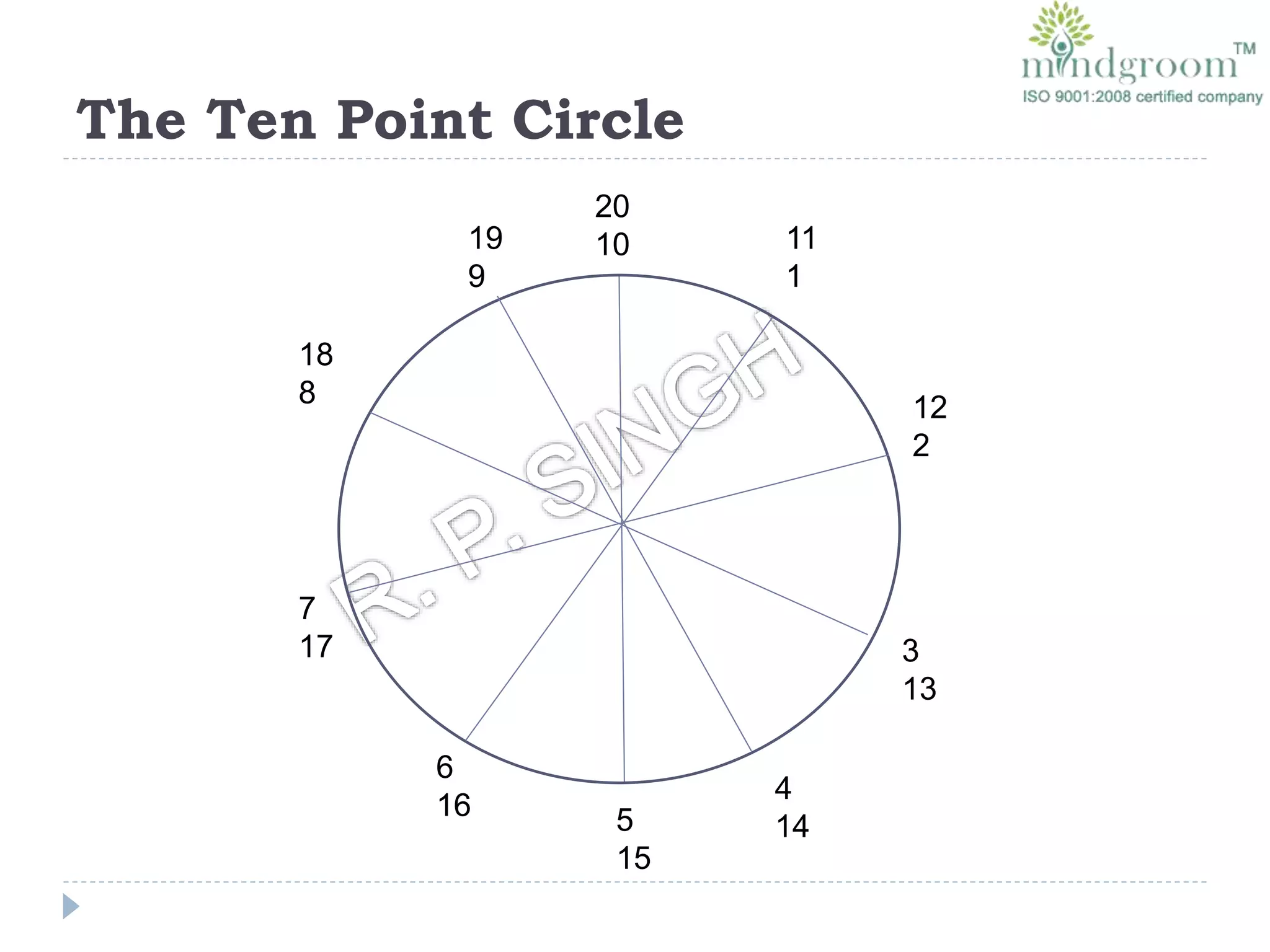
The Ten Point Circle
20
10
18
8
7
17
6
16 5
15
4
14
3
13
12
2
11
1
19
9
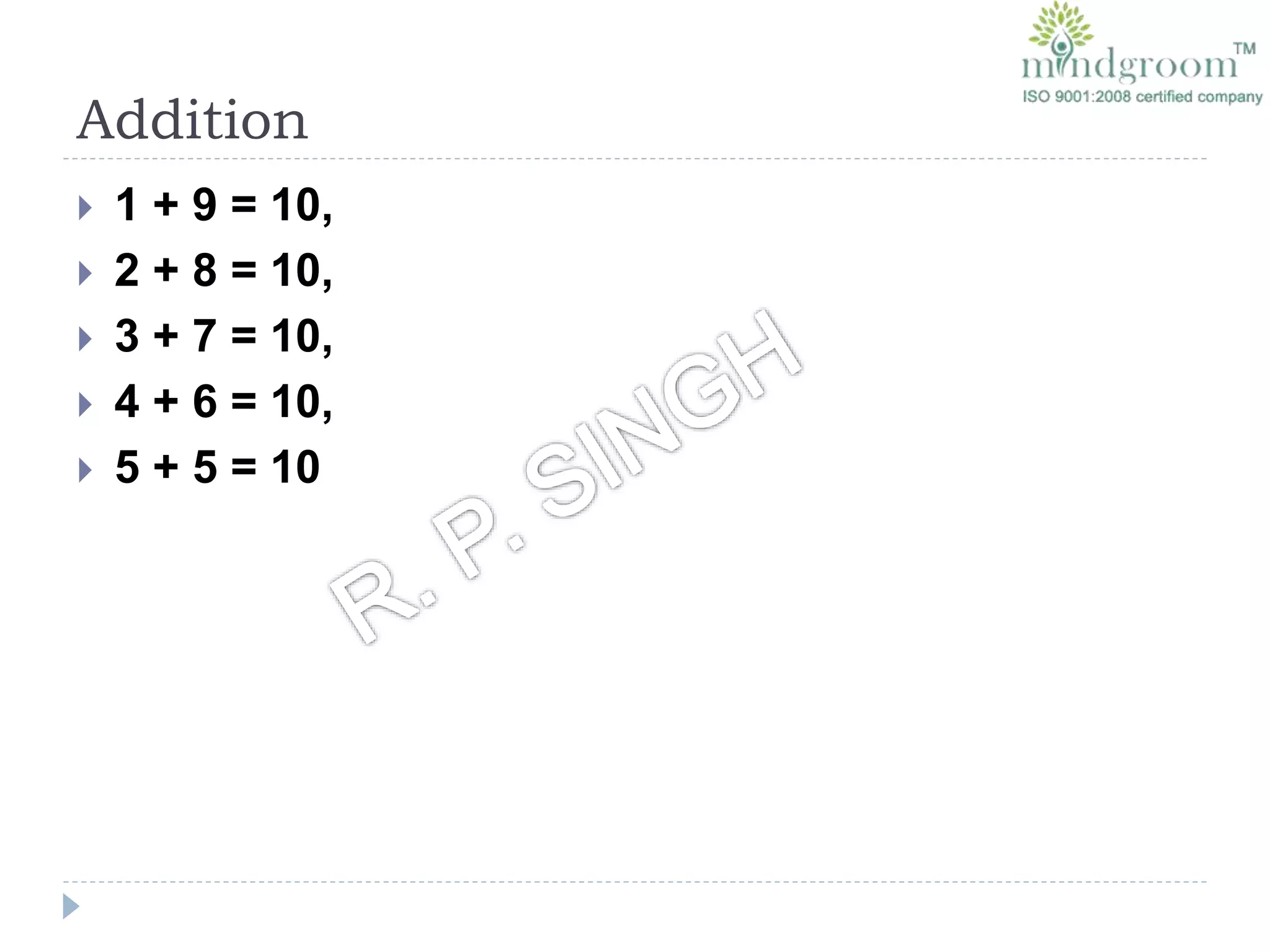
Addition
 1 + 9 = 10,
 2 + 8 = 10,
 3 + 7 = 10,
 4 + 6 = 10,
 5 + 5 = 10
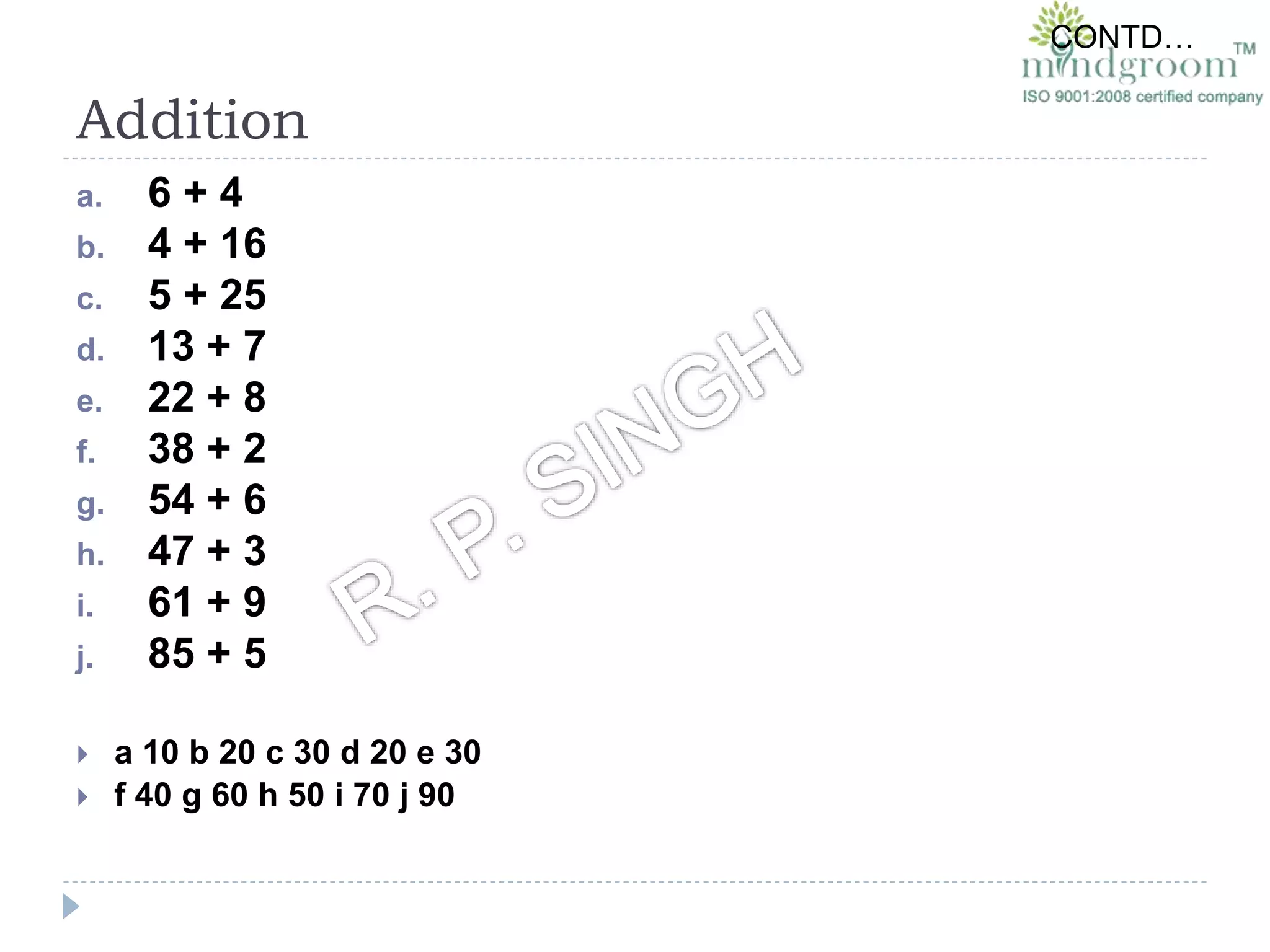
Addition
a. 6 + 4
b. 4 + 16
c. 5 + 25
d. 13 + 7
e. 22 + 8
f. 38 + 2
g. 54 + 6
h. 47 + 3
i. 61 + 9
j. 85 + 5
 a 10 b 20 c 30 d 20 e 30
 f 40 g 60 h 50 i 70 j 90
CONTD…
Addition
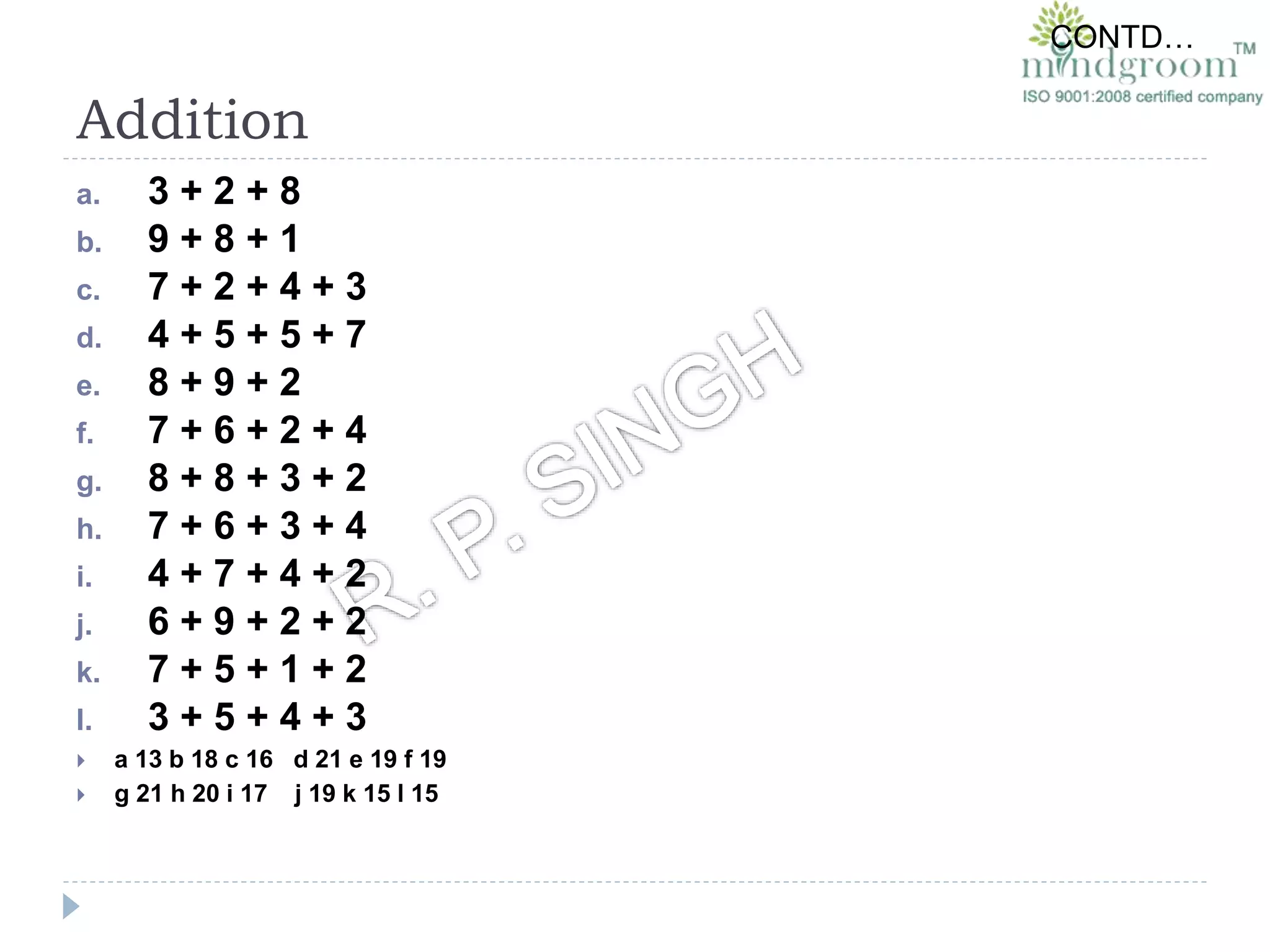
a. 3 + 2 + 8
b. 9 + 8 + 1
c. 7 + 2 + 4 + 3
d. 4 + 5 + 5 + 7
e. 8 + 9 + 2
f. 7 + 6 + 2 + 4
g. 8 + 8 + 3 + 2
h. 7 + 6 + 3 + 4
i. 4 + 7 + 4 + 2
j. 6 + 9 + 2 + 2
k. 7 + 5 + 1 + 2
l. 3 + 5 + 4 + 3
 a 13 b 18 c 16 d 21 e 19 f 19
 g 21 h 20 i 17 j 19 k 15 l 15
CONTD…
Addition
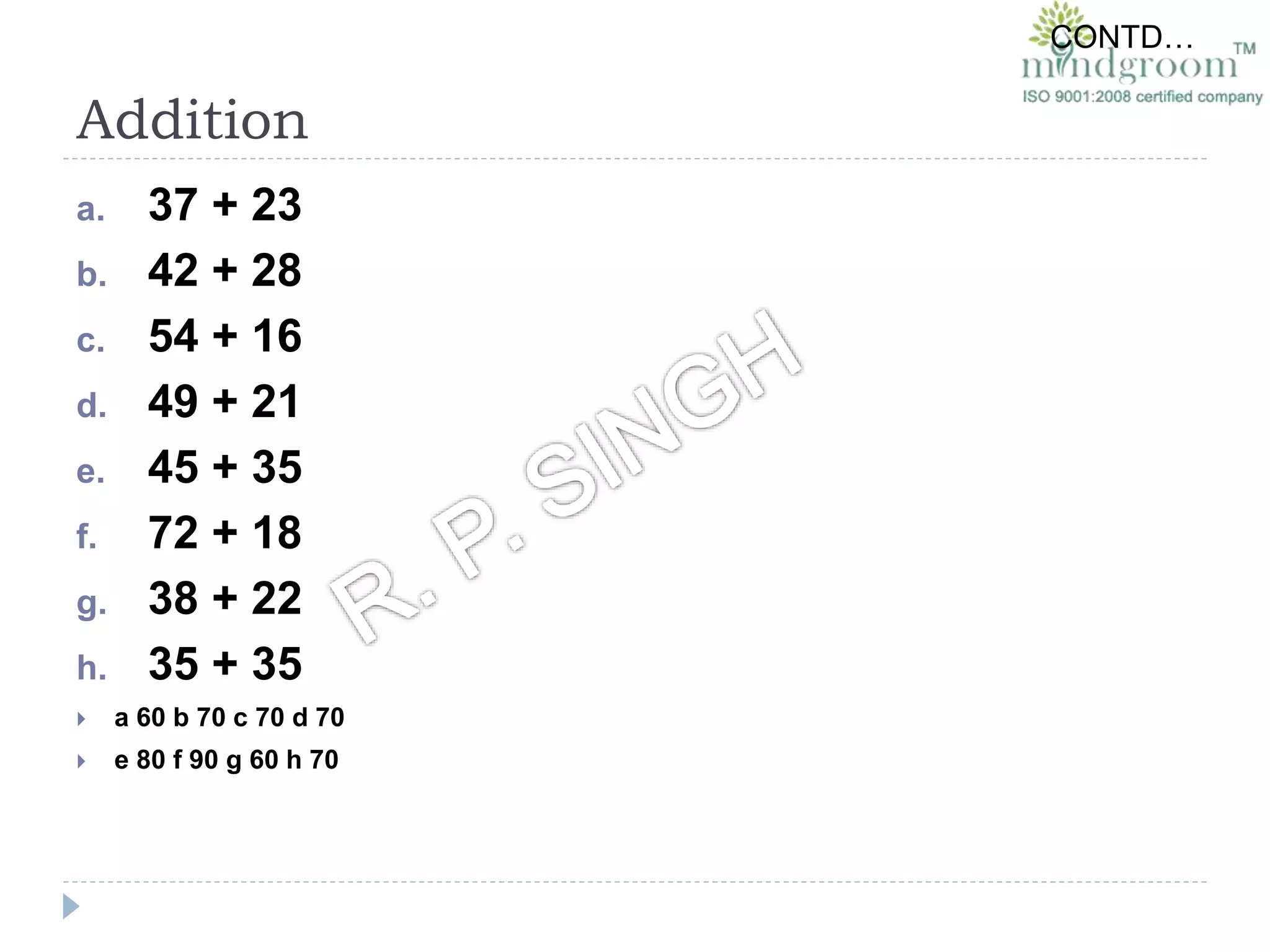
a. 37 + 23
b. 42 + 28
c. 54 + 16
d. 49 + 21
e. 45 + 35
f. 72 + 18
g. 38 + 22
h. 35 + 35
 a 60 b 70 c 70 d 70
 e 80 f 90 g 60 h 70
CONTD…
Addition
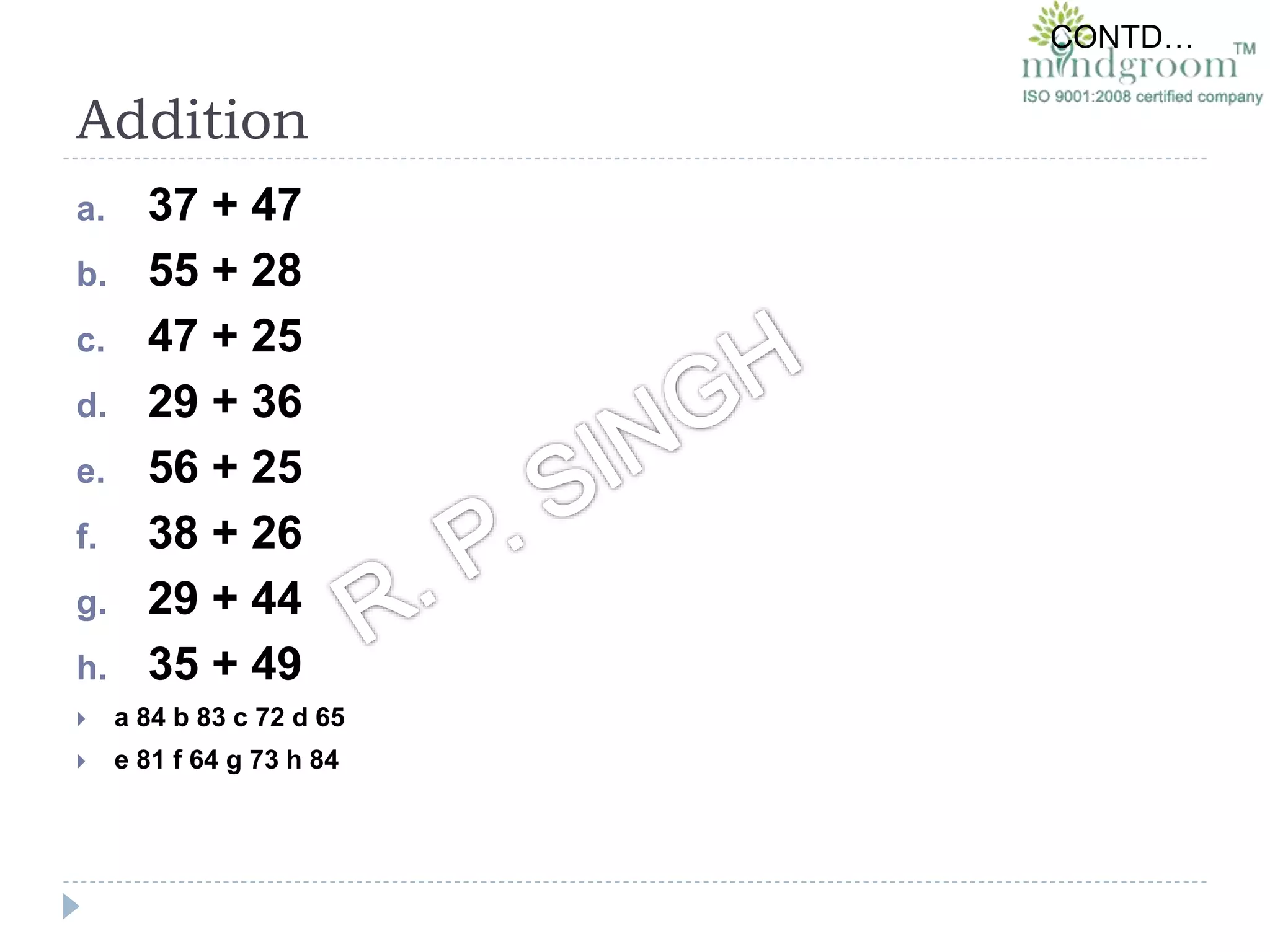
a. 37 + 47
b. 55 + 28
c. 47 + 25
d. 29 + 36
e. 56 + 25
f. 38 + 26
g. 29 + 44
h. 35 + 49
 a 84 b 83 c 72 d 65
 e 81 f 64 g 73 h 84
CONTD…
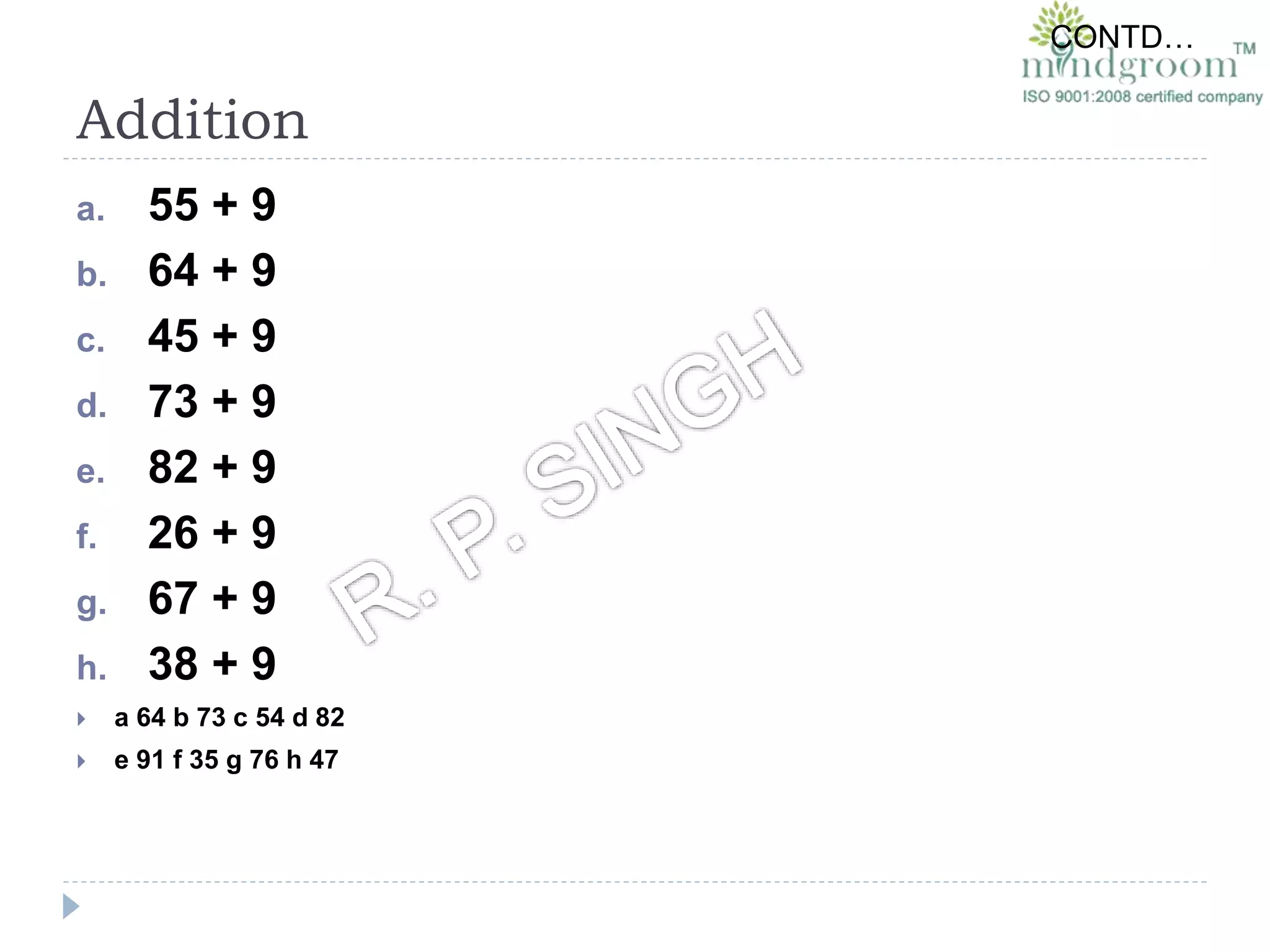
a. 55 + 9
b. 64 + 9
c. 45 + 9
d. 73 + 9
e. 82 + 9
f. 26 + 9
g. 67 + 9
h. 38 + 9
 a 64 b 73 c 54 d 82
 e 91 f 35 g 76 h 47
CONTD…
Addition
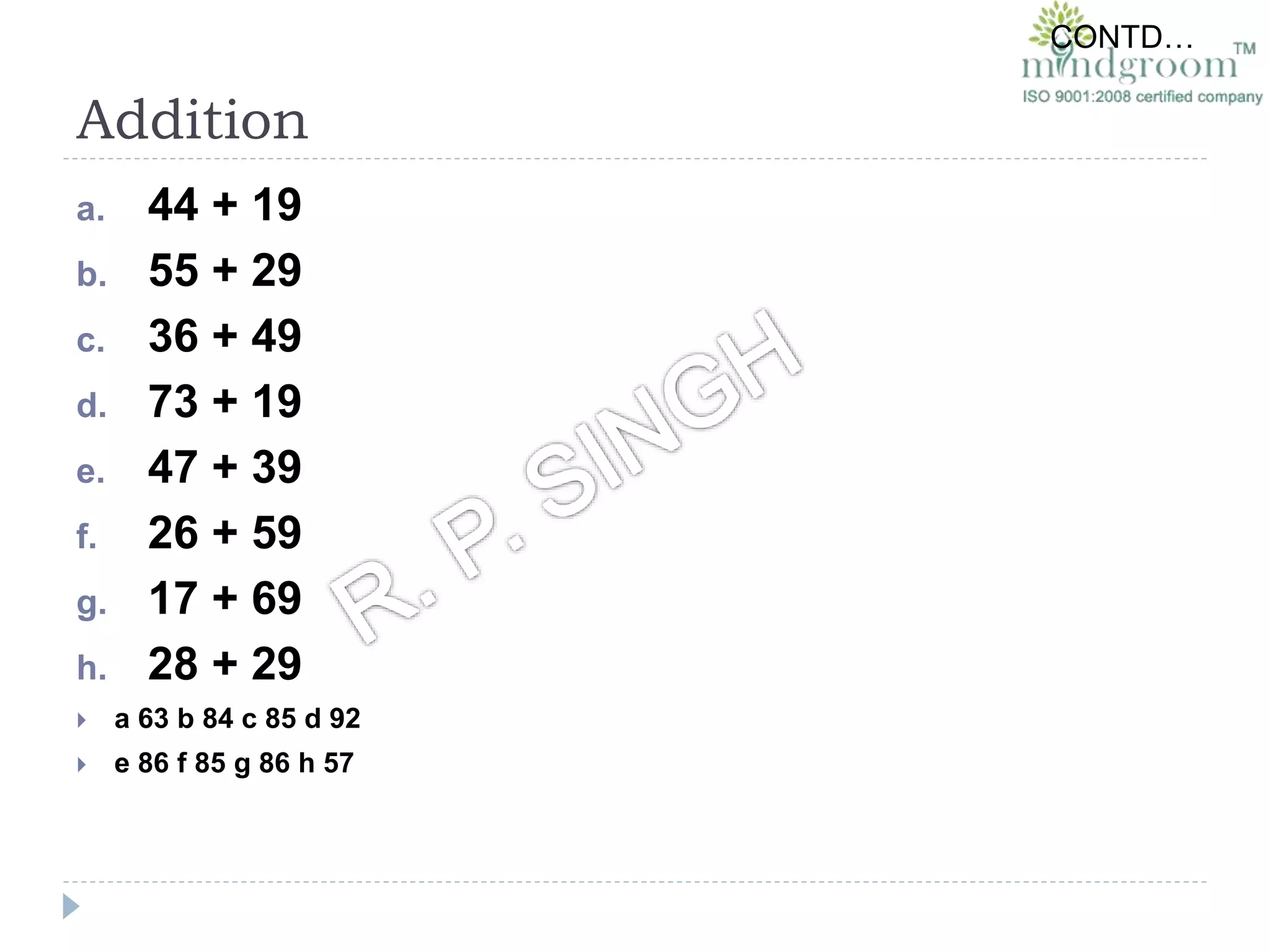
Addition
a. 44 + 19
b. 55 + 29
c. 36 + 49
d. 73 + 19
e. 47 + 39
f. 26 + 59
g. 17 + 69
h. 28 + 29
 a 63 b 84 c 85 d 92
 e 86 f 85 g 86 h 57
CONTD…
Addition
a. 44 + 18
b. 44 + 27
c. 55 + 28
d. 35 + 37
e. 62 + 29
f. 36 + 37
g. 19 + 19
h. 28 + 29
 a 62 b 71 c 83 d 72
 e 91 f 73 g 38 h 57
CONTD…
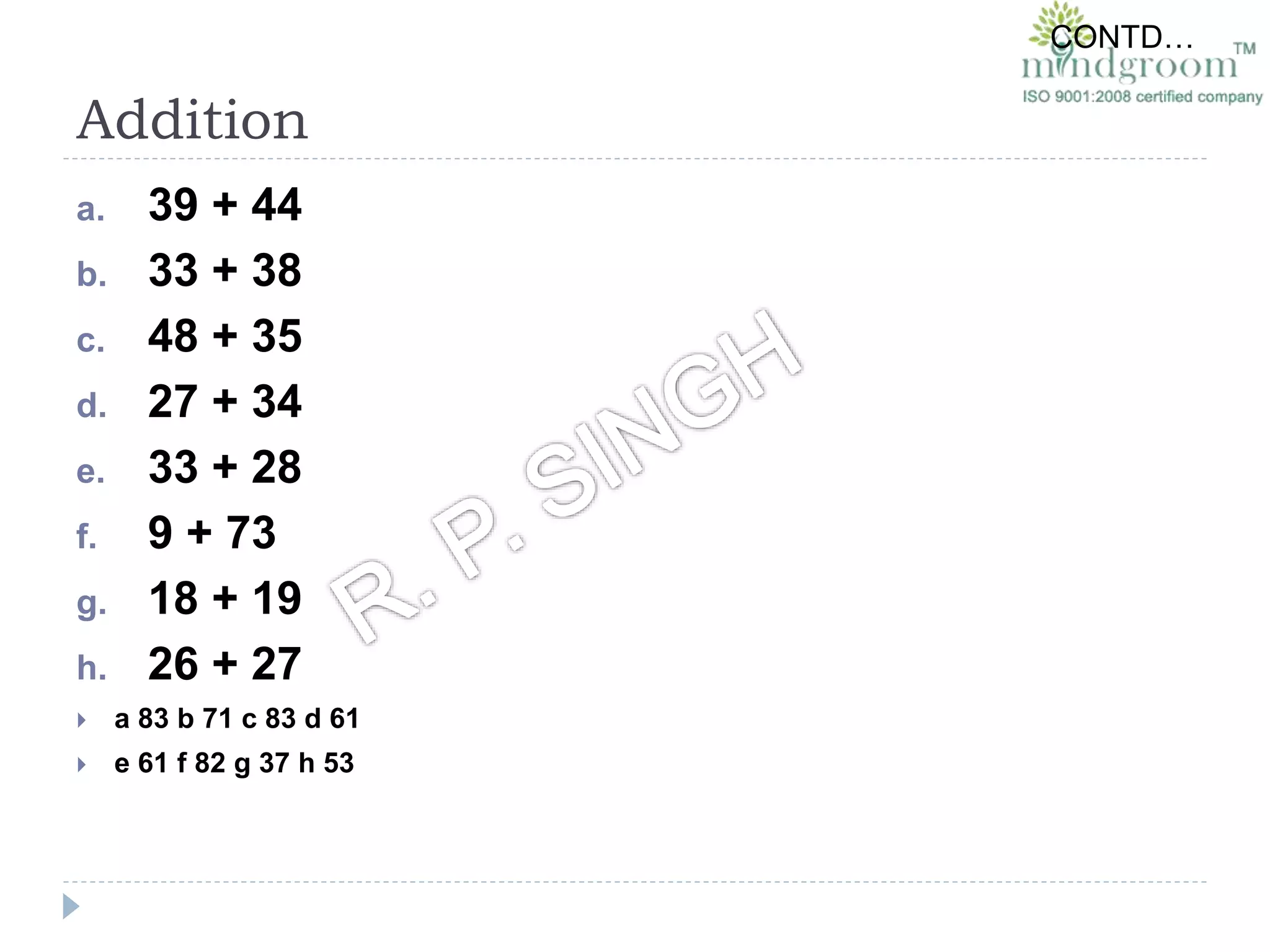
Addition
a. 39 + 44
b. 33 + 38
c. 48 + 35
d. 27 + 34
e. 33 + 28
f. 9 + 73
g. 18 + 19
h. 26 + 27
 a 83 b 71 c 83 d 61
 e 61 f 82 g 37 h 53
CONTD…
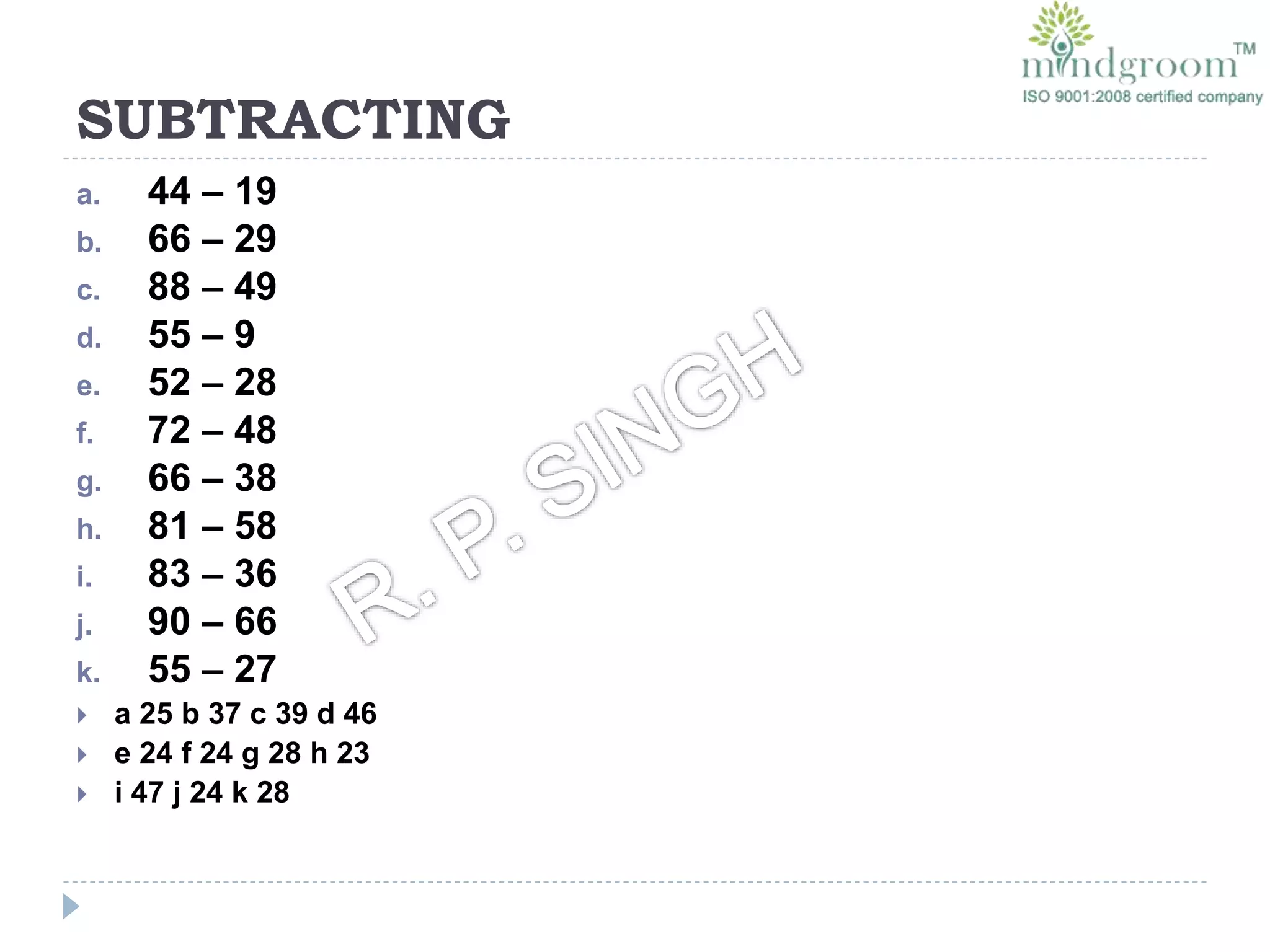
SUBTRACTING
a. 44 – 19
b. 66 – 29
c. 88 – 49
d. 55 – 9
e. 52 – 28
f. 72 – 48
g. 66 – 38
h. 81 – 58
i. 83 – 36
j. 90 – 66
k. 55 – 27
 a 25 b 37 c 39 d 46
 e 24 f 24 g 28 h 23
 i 47 j 24 k 28
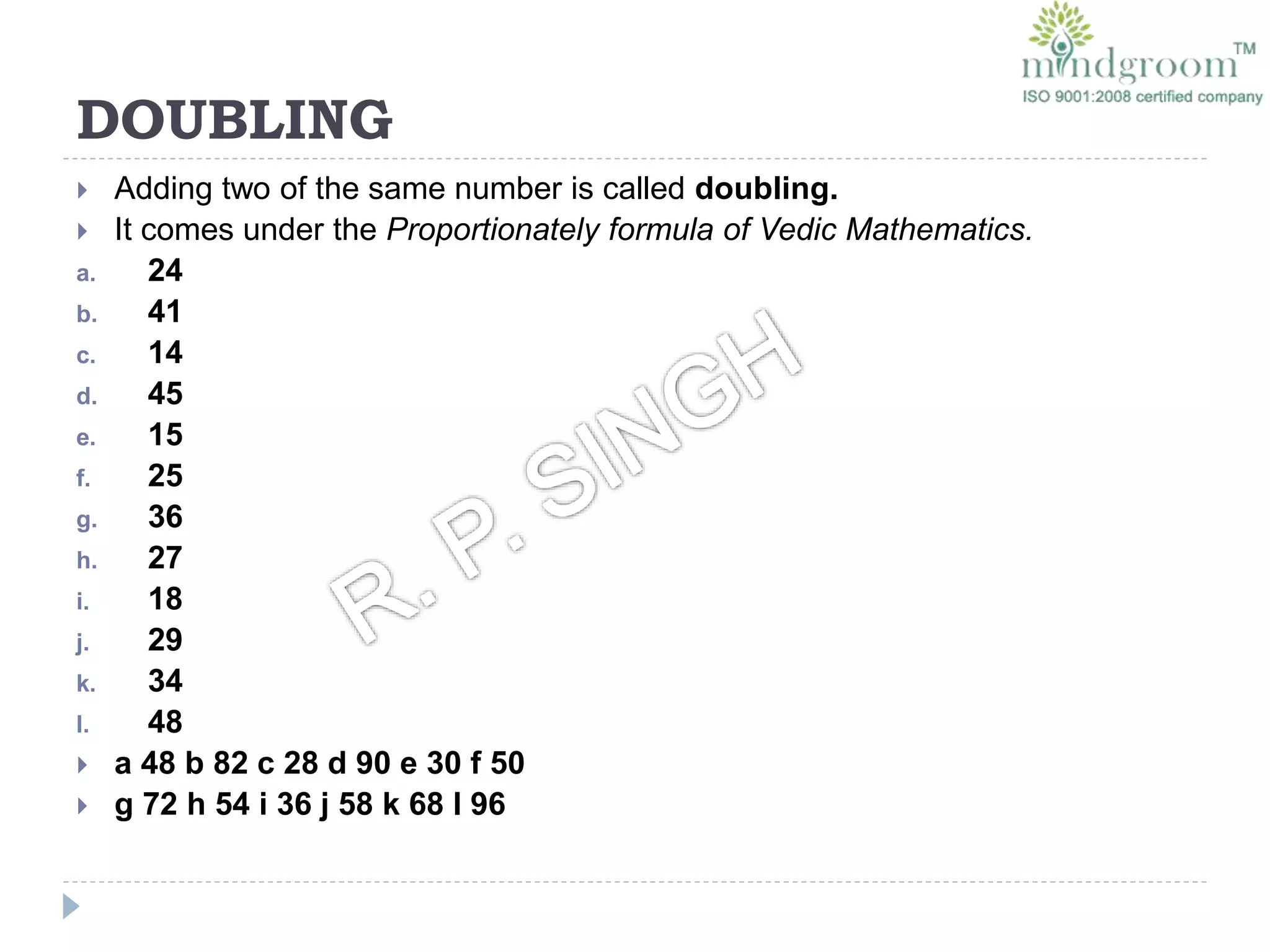
DOUBLING
 Adding two of the same number is called doubling.
 It comes under the Proportionately formula of Vedic Mathematics.
a. 24
b. 41
c. 14
d. 45
e. 15
f. 25
g. 36
h. 27
i. 18
j. 29
k. 34
l. 48
 a 48 b 82 c 28 d 90 e 30 f 50
 g 72 h 54 i 36 j 58 k 68 l 96
DOUBLING
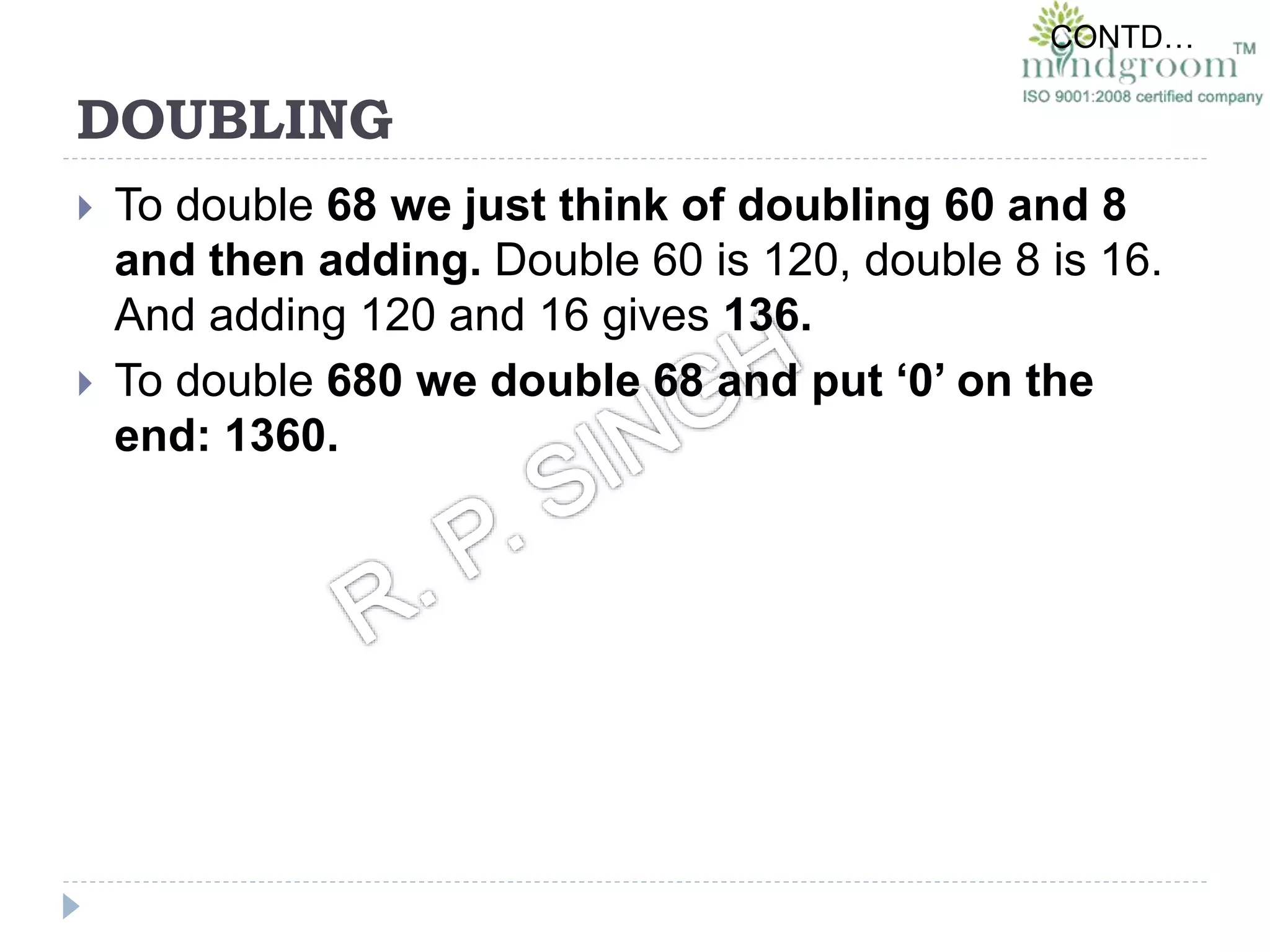
 To double 68 we just think of doubling 60 and 8
and then adding. Double 60 is 120, double 8 is 16.
And adding 120 and 16 gives 136.
 To double 680 we double 68 and put ‘0’ on the
end: 1360.
CONTD…
DOUBLING
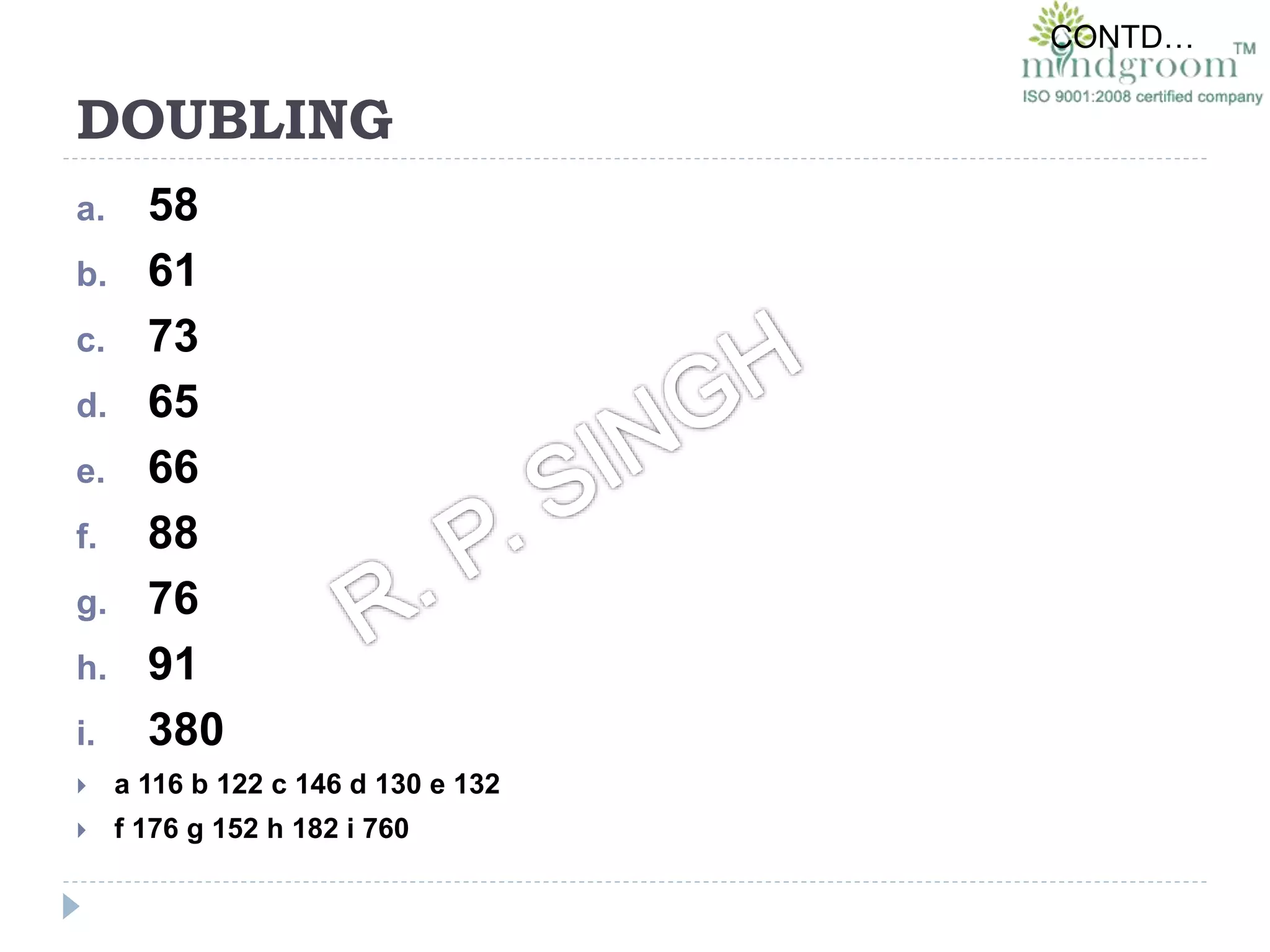
a. 58
b. 61
c. 73
d. 65
e. 66
f. 88
g. 76
h. 91
i. 380
 a 116 b 122 c 146 d 130 e 132
 f 176 g 152 h 182 i 760
CONTD…
DOUBLING
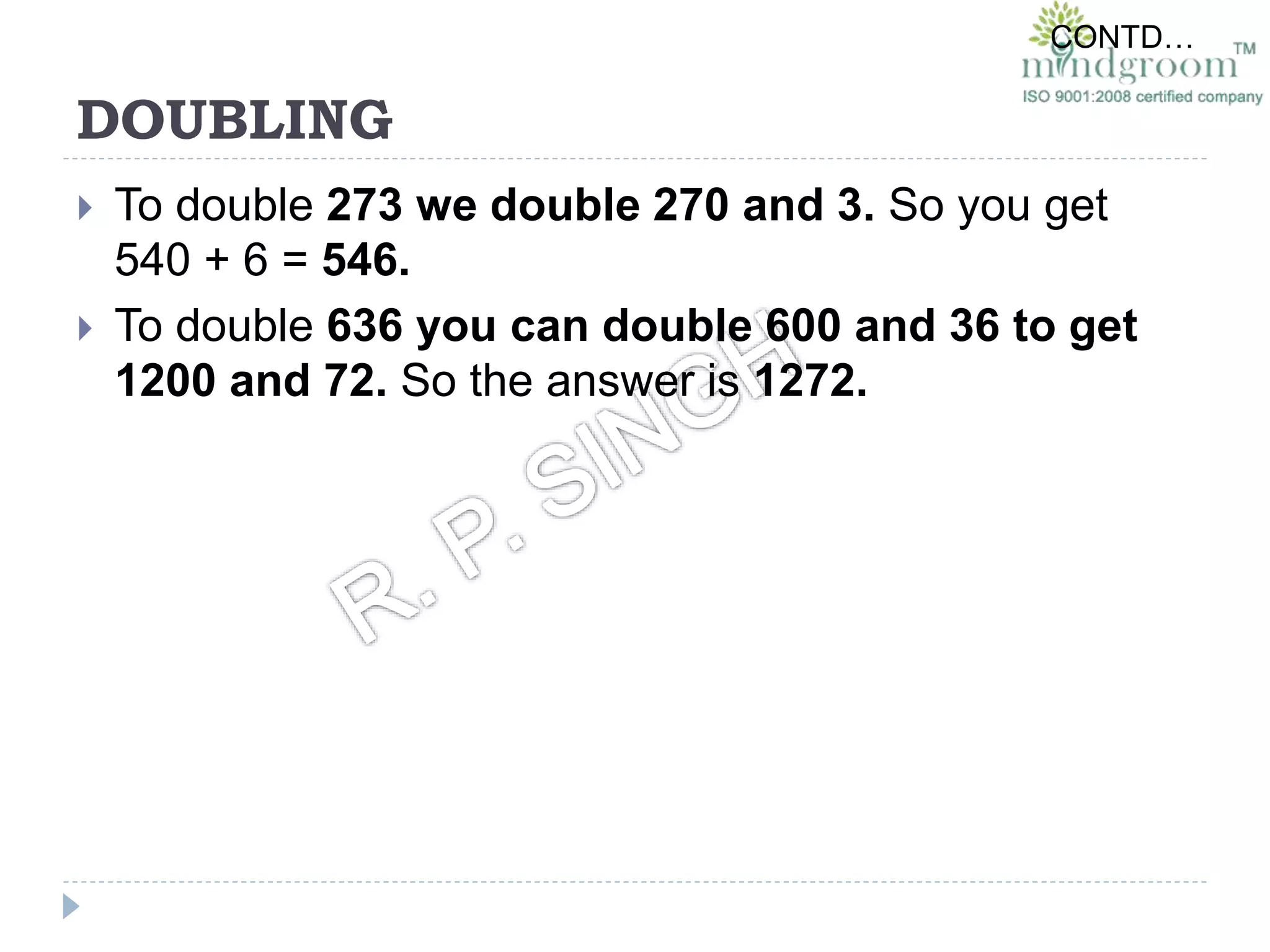
 To double 273 we double 270 and 3. So you get
540 + 6 = 546.
 To double 636 you can double 600 and 36 to get
1200 and 72. So the answer is 1272.
CONTD…
DOUBLING
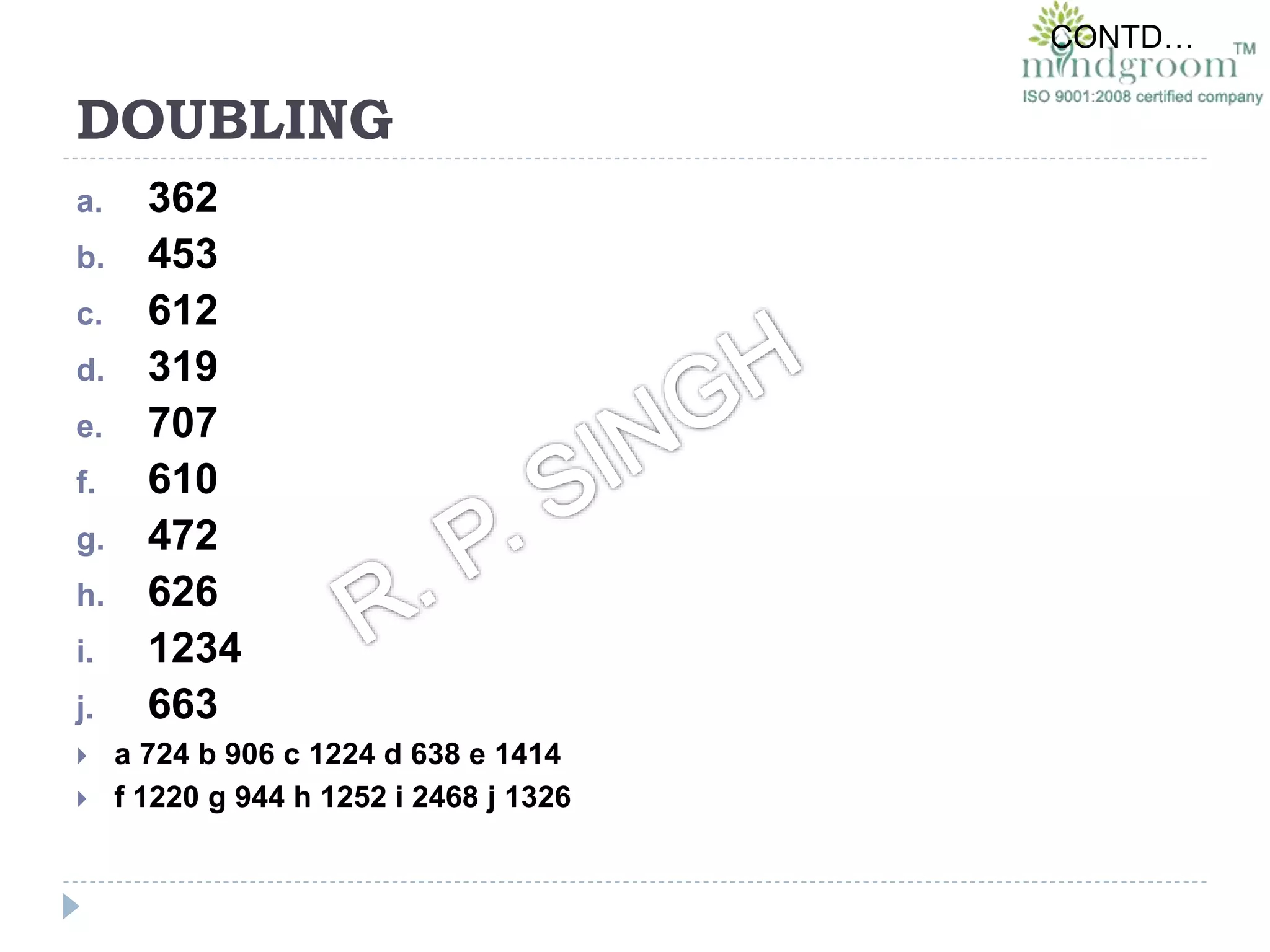
a. 362
b. 453
c. 612
d. 319
e. 707
f. 610
g. 472
h. 626
i. 1234
j. 663
 a 724 b 906 c 1224 d 638 e 1414
 f 1220 g 944 h 1252 i 2468 j 1326
CONTD…
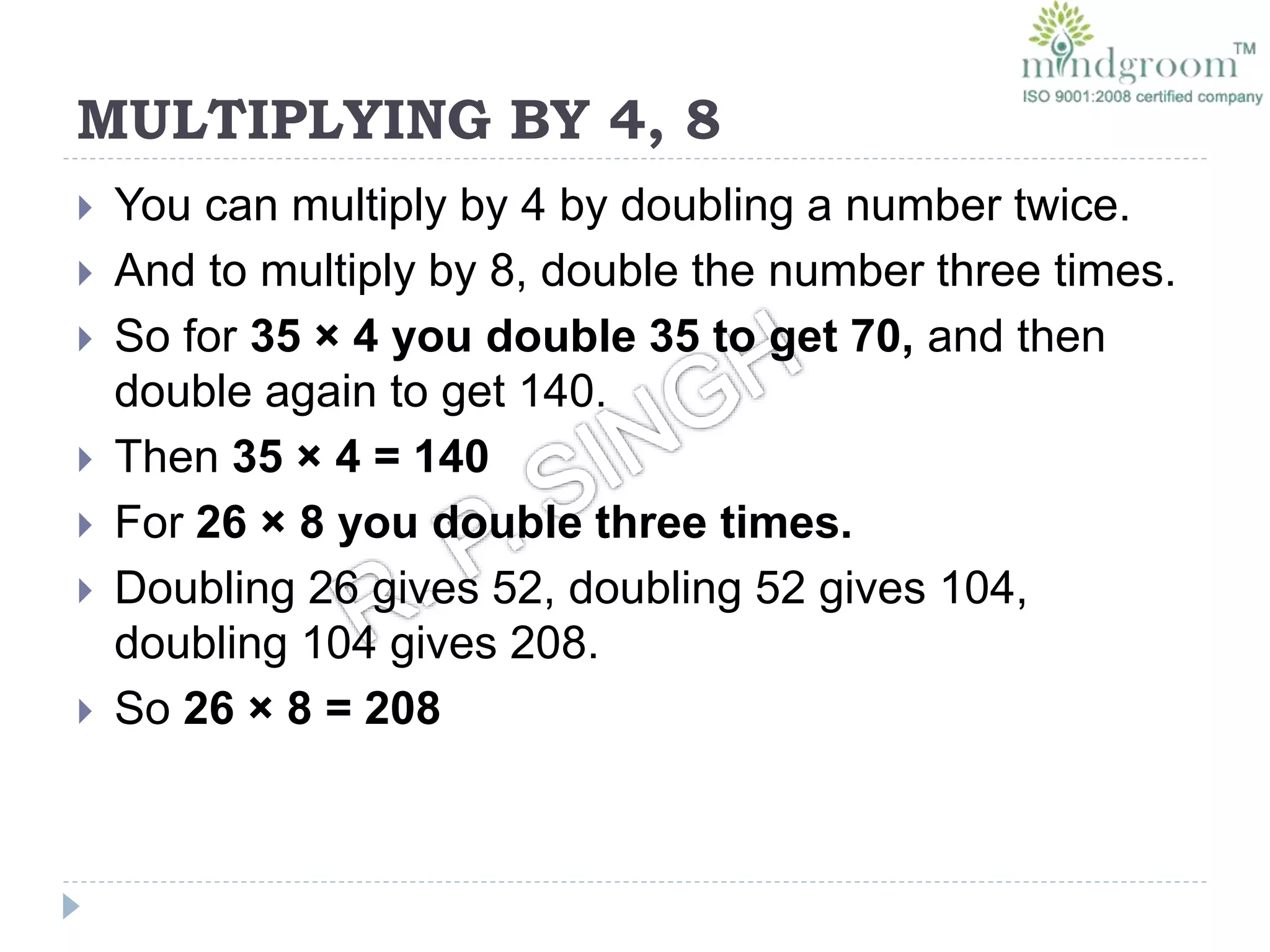
MULTIPLYING BY 4, 8
 You can multiply by 4 by doubling a number twice.
 And to multiply by 8, double the number three times.
 So for 35 × 4 you double 35 to get 70, and then
double again to get 140.
 Then 35 × 4 = 140
 For 26 × 8 you double three times.
 Doubling 26 gives 52, doubling 52 gives 104,
doubling 104 gives 208.
 So 26 × 8 = 208
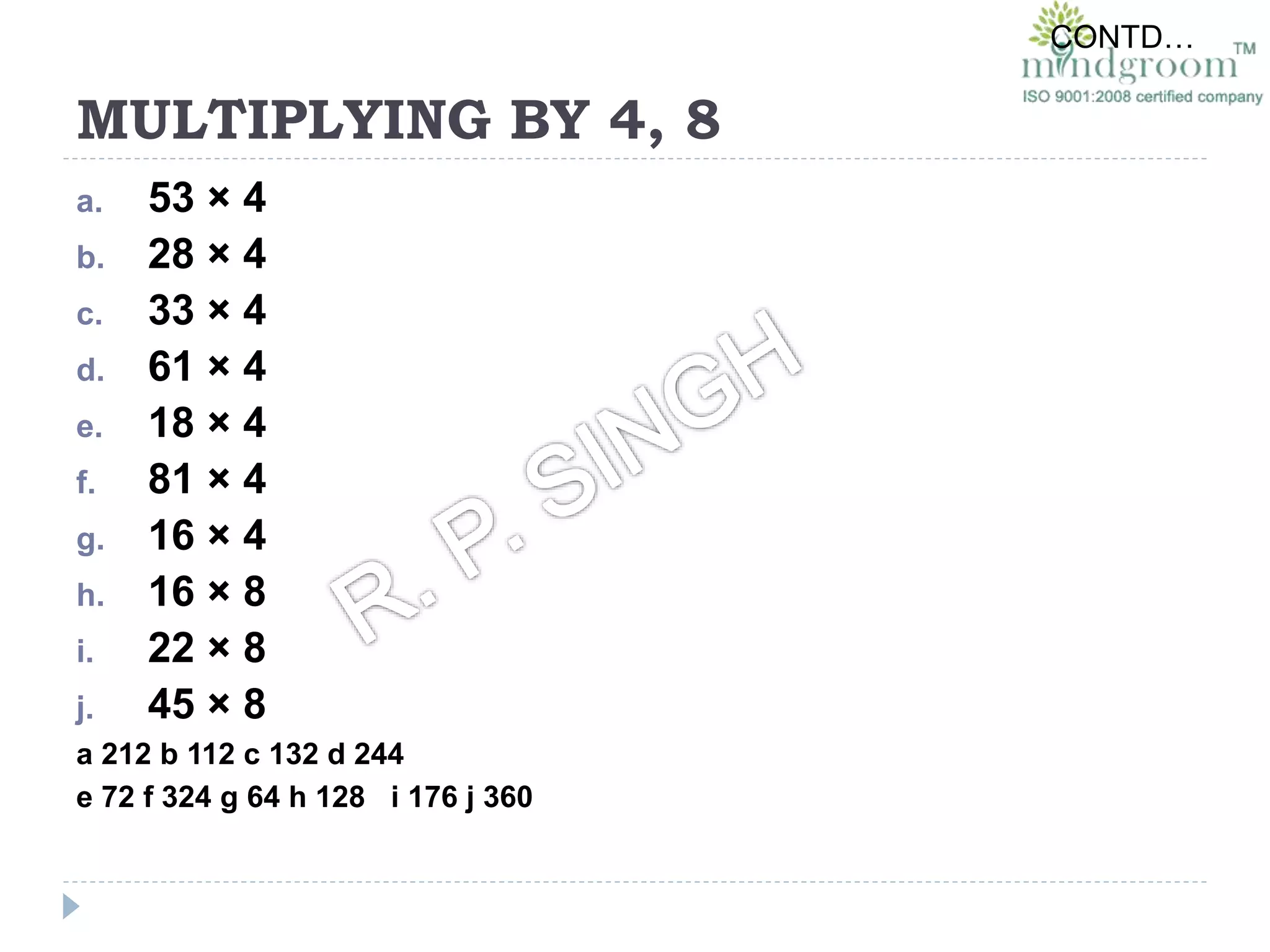
MULTIPLYING BY 4, 8
a. 53 × 4
b. 28 × 4
c. 33 × 4
d. 61 × 4
e. 18 × 4
f. 81 × 4
g. 16 × 4
h. 16 × 8
i. 22 × 8
j. 45 × 8
a 212 b 112 c 132 d 244
e 72 f 324 g 64 h 128 i 176 j 360
CONTD…
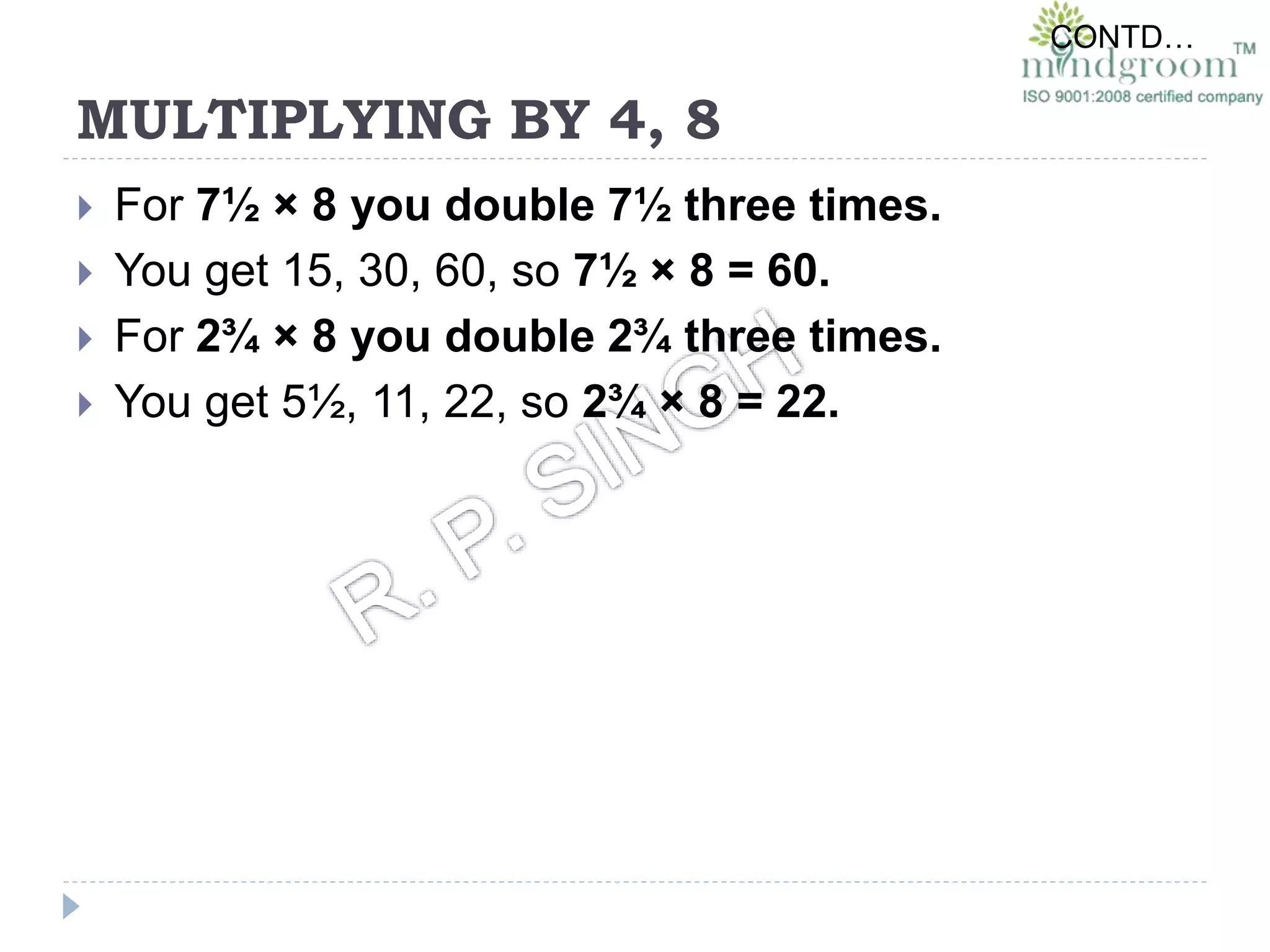
MULTIPLYING BY 4, 8
 For 7½ × 8 you double 7½ three times.
 You get 15, 30, 60, so 7½ × 8 = 60.
 For 2¾ × 8 you double 2¾ three times.
 You get 5½, 11, 22, so 2¾ × 8 = 22.
CONTD…
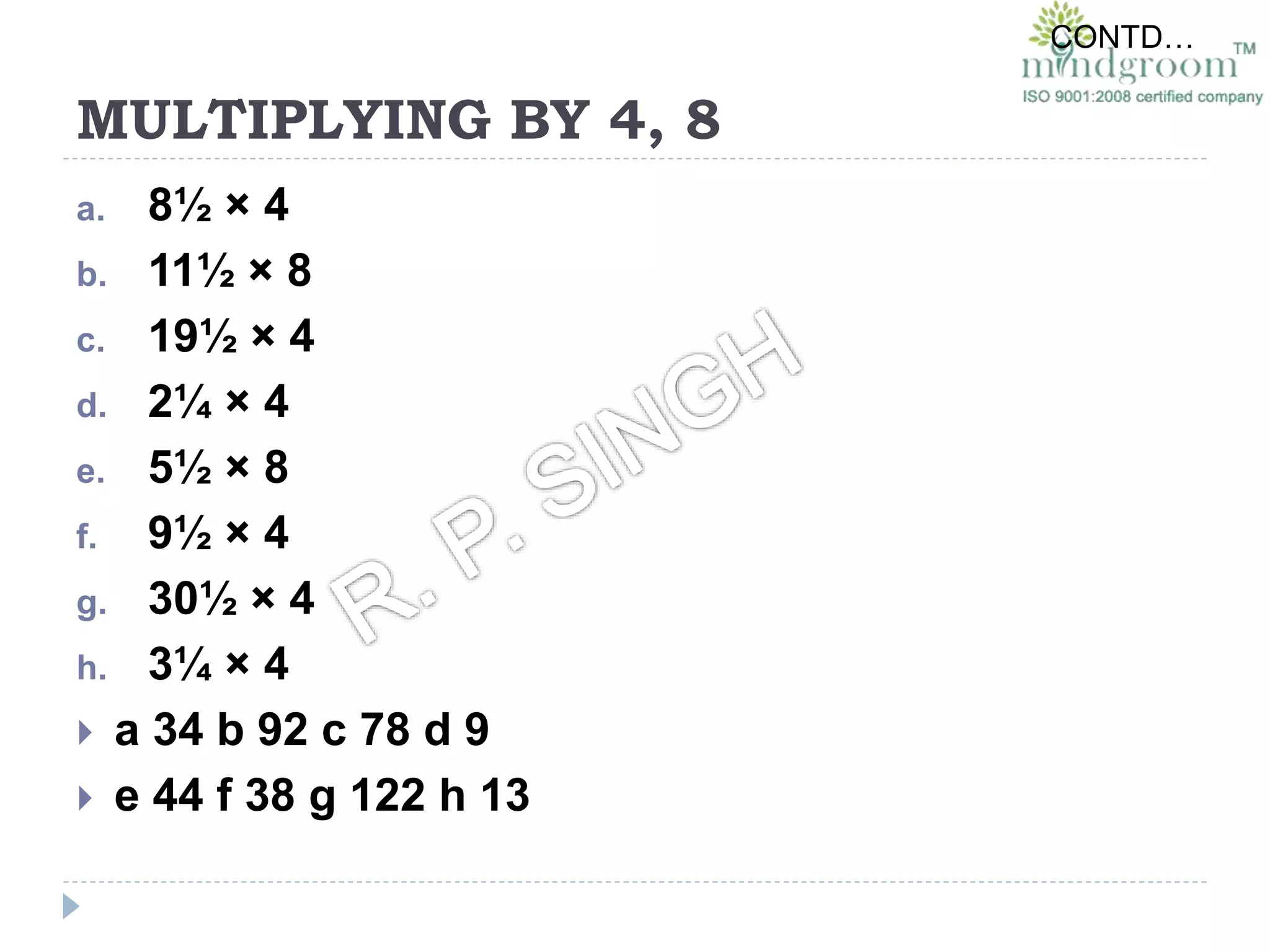
MULTIPLYING BY 4, 8
a. 8½ × 4
b. 11½ × 8
c. 19½ × 4
d. 2¼ × 4
e. 5½ × 8
f. 9½ × 4
g. 30½ × 4
h. 3¼ × 4
 a 34 b 92 c 78 d 9
 e 44 f 38 g 122 h 13
CONTD…
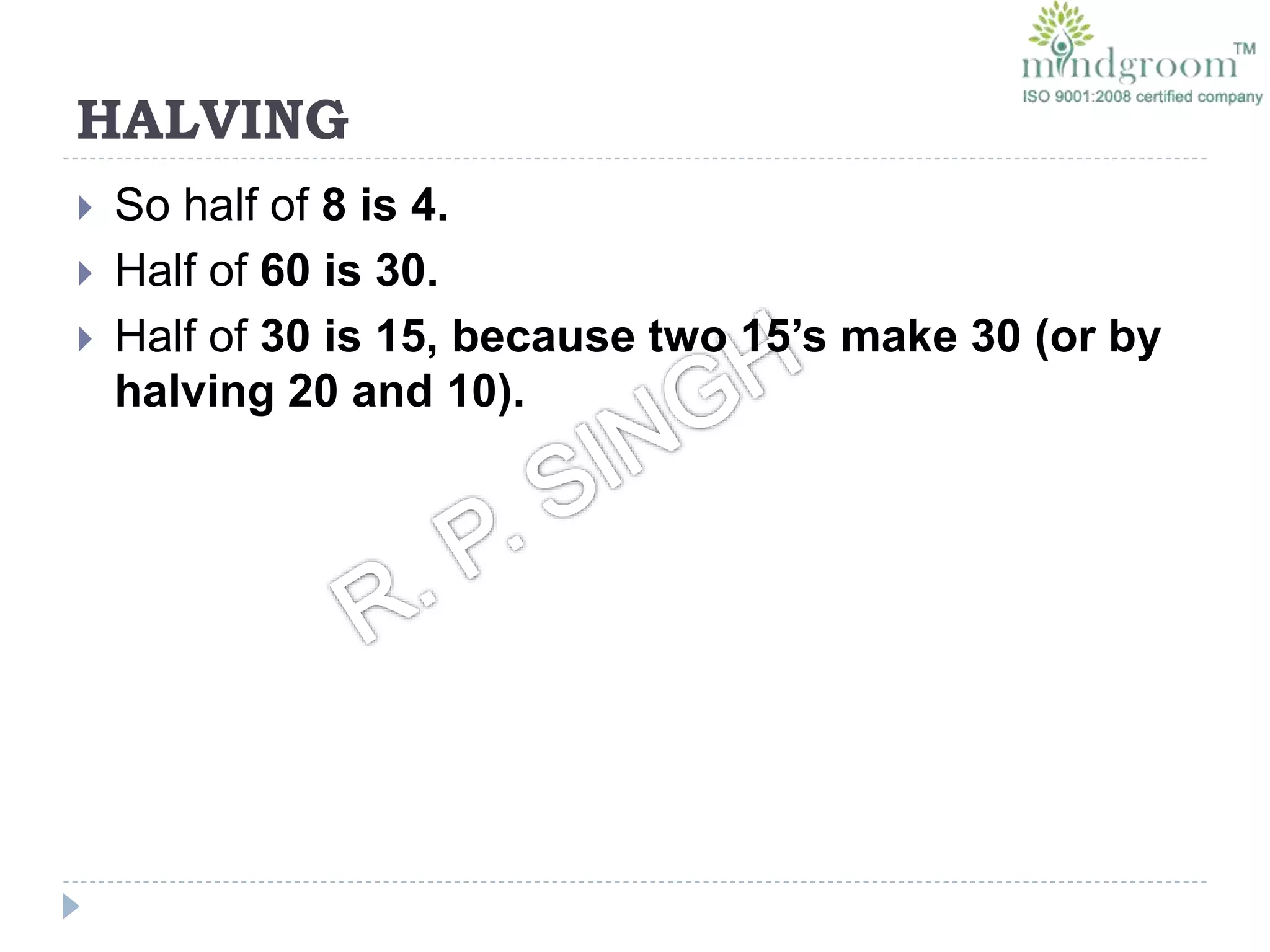
HALVING
 So half of 8 is 4.
 Half of 60 is 30.
 Half of 30 is 15, because two 15’s make 30 (or by
halving 20 and 10).
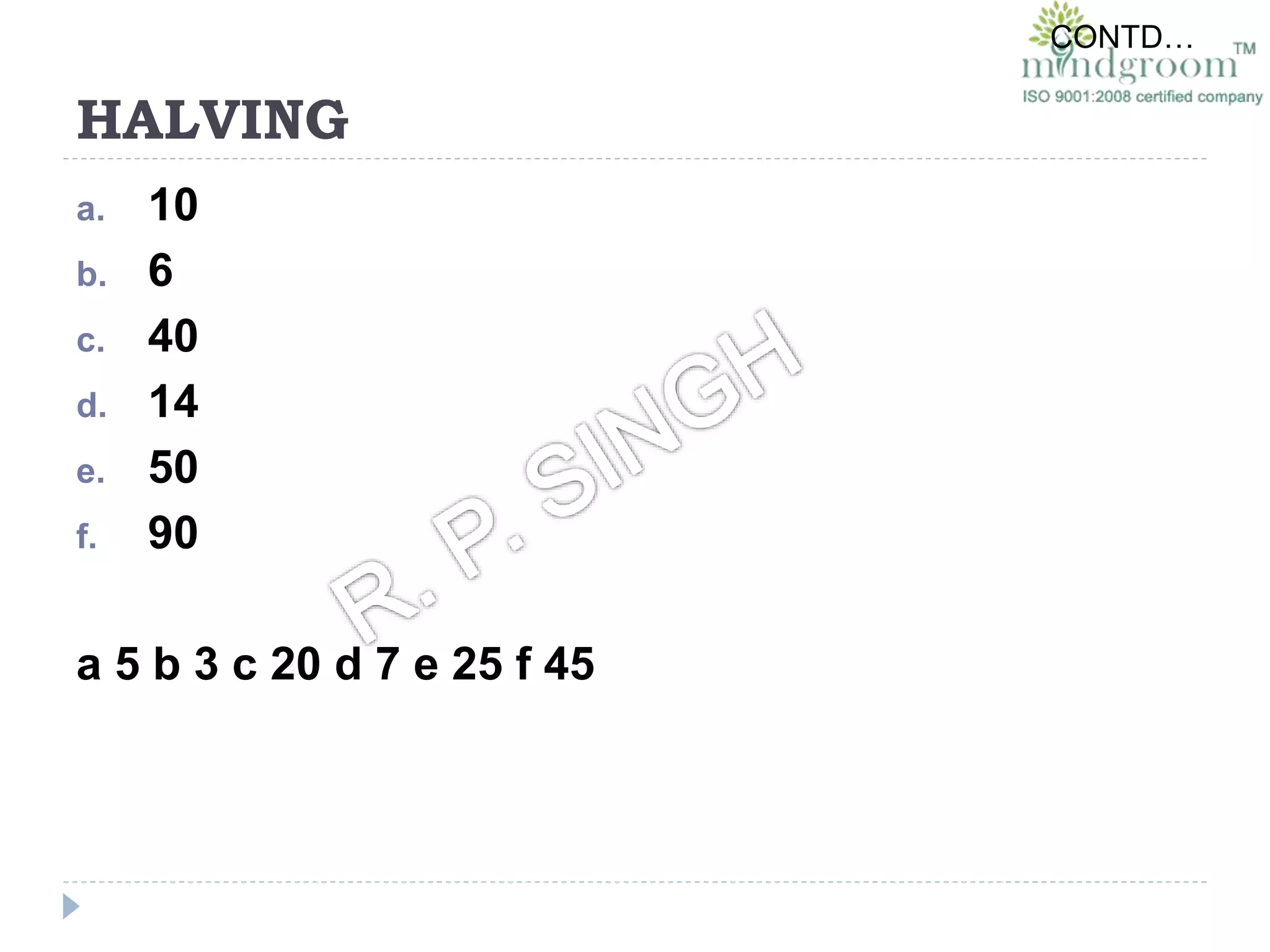
HALVING
a. 10
b. 6
c. 40
d. 14
e. 50
f. 90
a 5 b 3 c 20 d 7 e 25 f 45
CONTD…
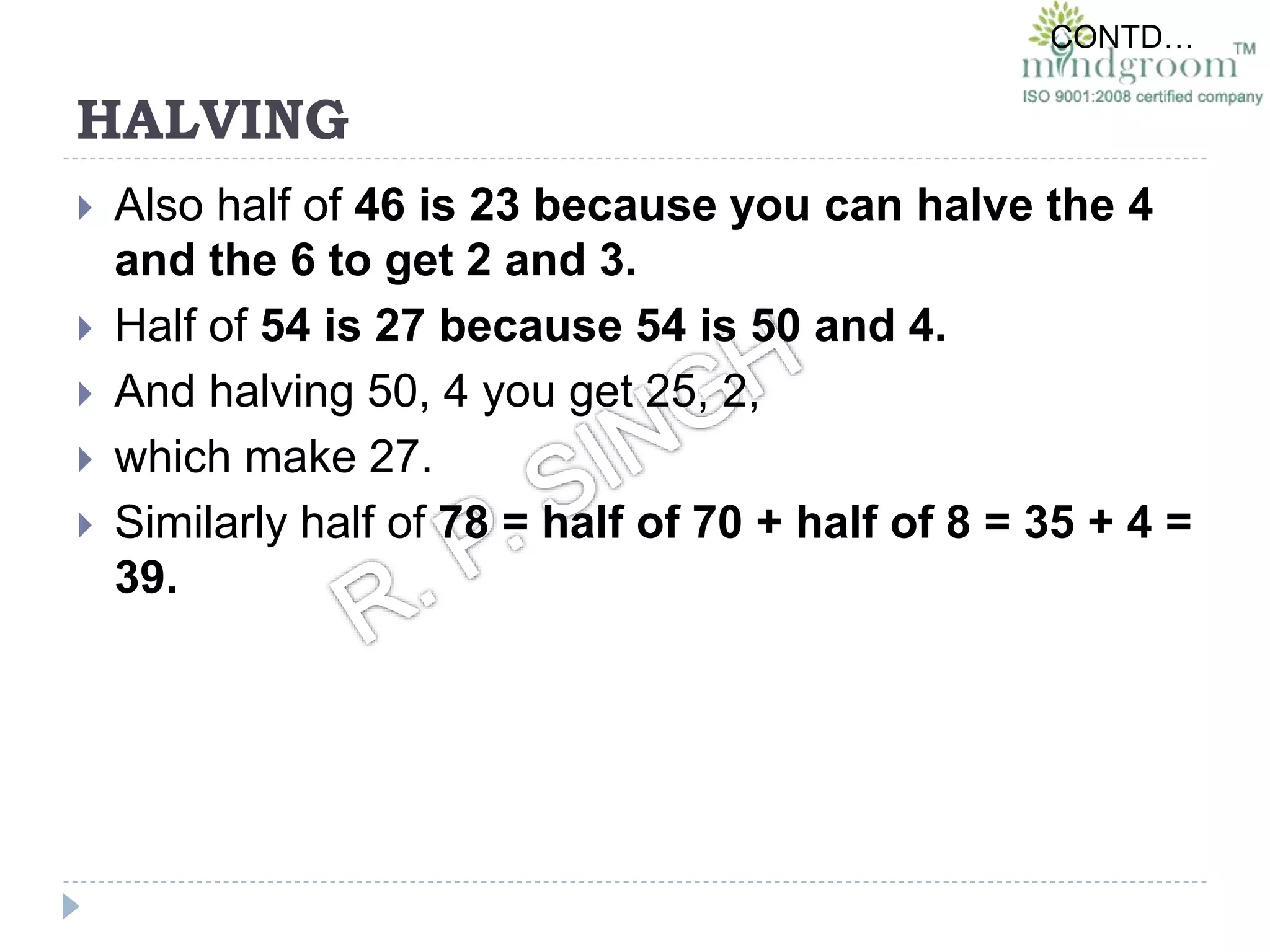
HALVING
 Also half of 46 is 23 because you can halve the 4
and the 6 to get 2 and 3.
 Half of 54 is 27 because 54 is 50 and 4.
 And halving 50, 4 you get 25, 2,
 which make 27.
 Similarly half of 78 = half of 70 + half of 8 = 35 + 4 =
39.
CONTD…
HALVING
a. 36
b. 28
c. 52
d. 18
e. 34
f. 86
g. 56
h. 32
i. 62
j. 98
 a 18 b 14 c 26 d 9 e 17
 f 43 g 28 h 16 i 31 j 49
CONTD…
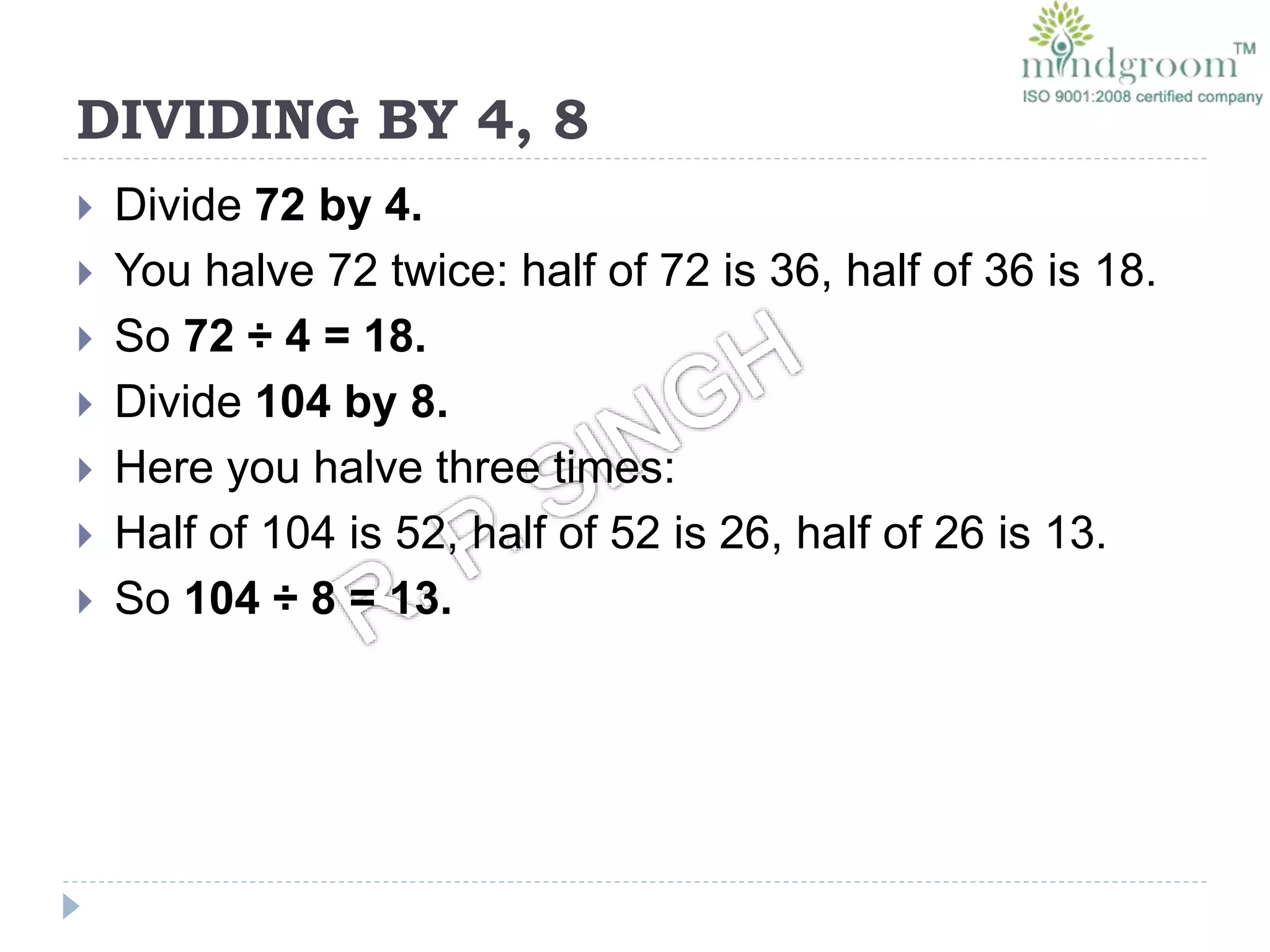
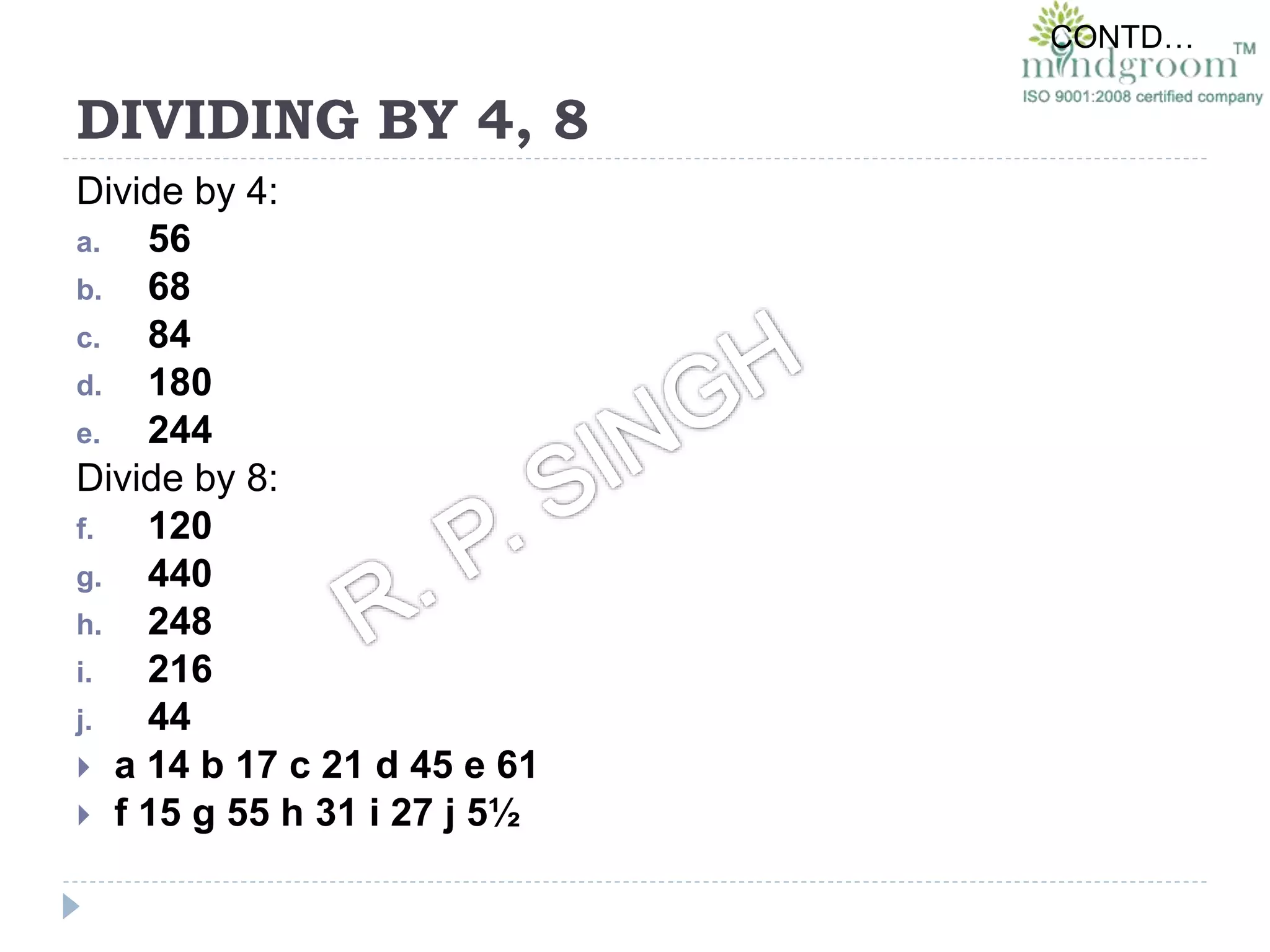
DIVIDING BY 4, 8
 Divide 72 by 4.
 You halve 72 twice: half of 72 is 36, half of 36 is 18.
 So 72 ÷ 4 = 18.
 Divide 104 by 8.
 Here you halve three times:
 Half of 104 is 52, half of 52 is 26, half of 26 is 13.
 So 104 ÷ 8 = 13.
DIVIDING BY 4, 8
Divide by 4:
a. 56
b. 68
c. 84
d. 180
e. 244
Divide by 8:
f. 120
g. 440
h. 248
i. 216
j. 44
 a 14 b 17 c 21 d 45 e 61
 f 15 g 55 h 31 i 27 j 5½
CONTD…
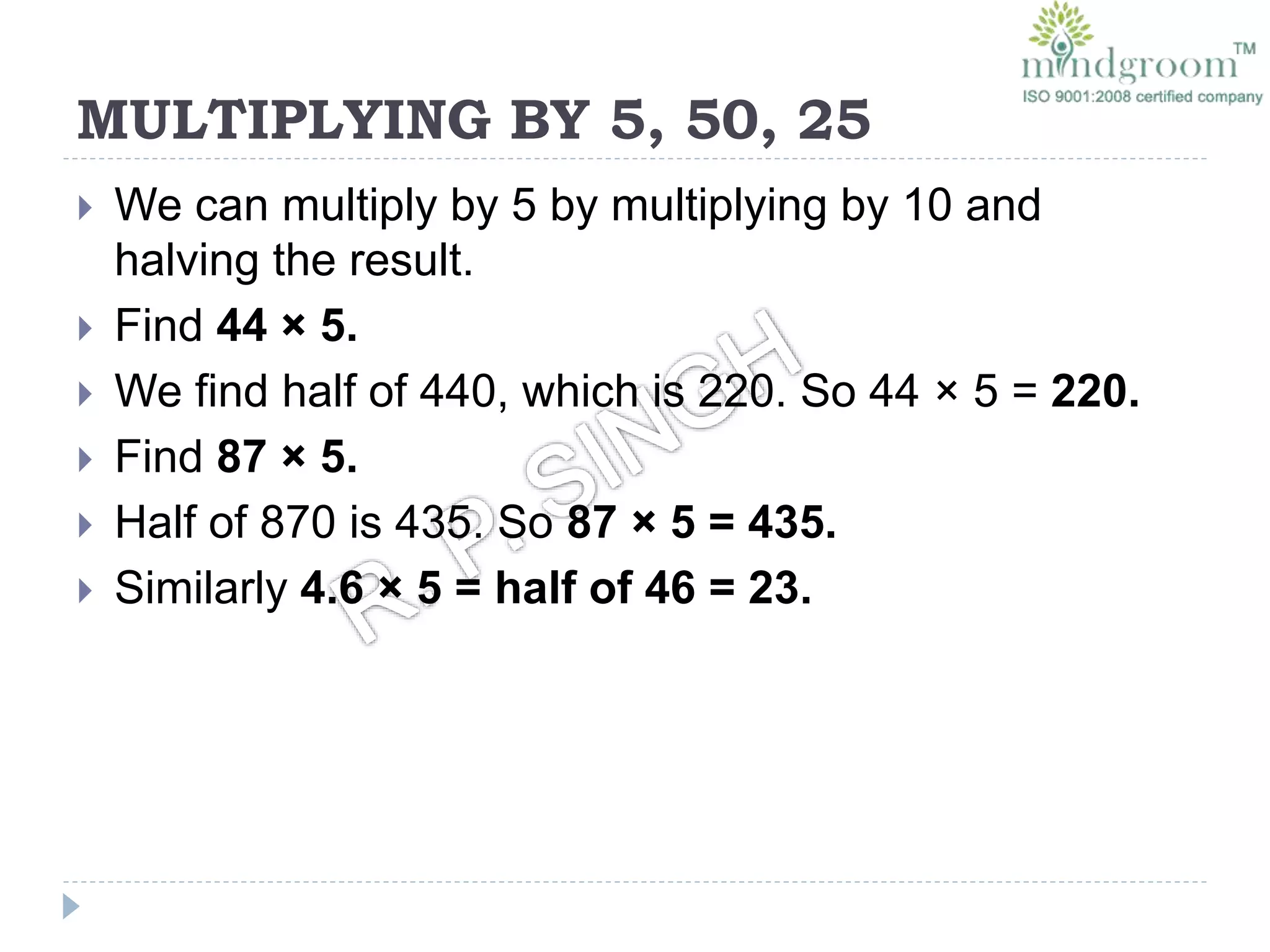
MULTIPLYING BY 5, 50, 25
 We can multiply by 5 by multiplying by 10 and
halving the result.
 Find 44 × 5.
 We find half of 440, which is 220. So 44 × 5 = 220.
 Find 87 × 5.
 Half of 870 is 435. So 87 × 5 = 435.
 Similarly 4.6 × 5 = half of 46 = 23.
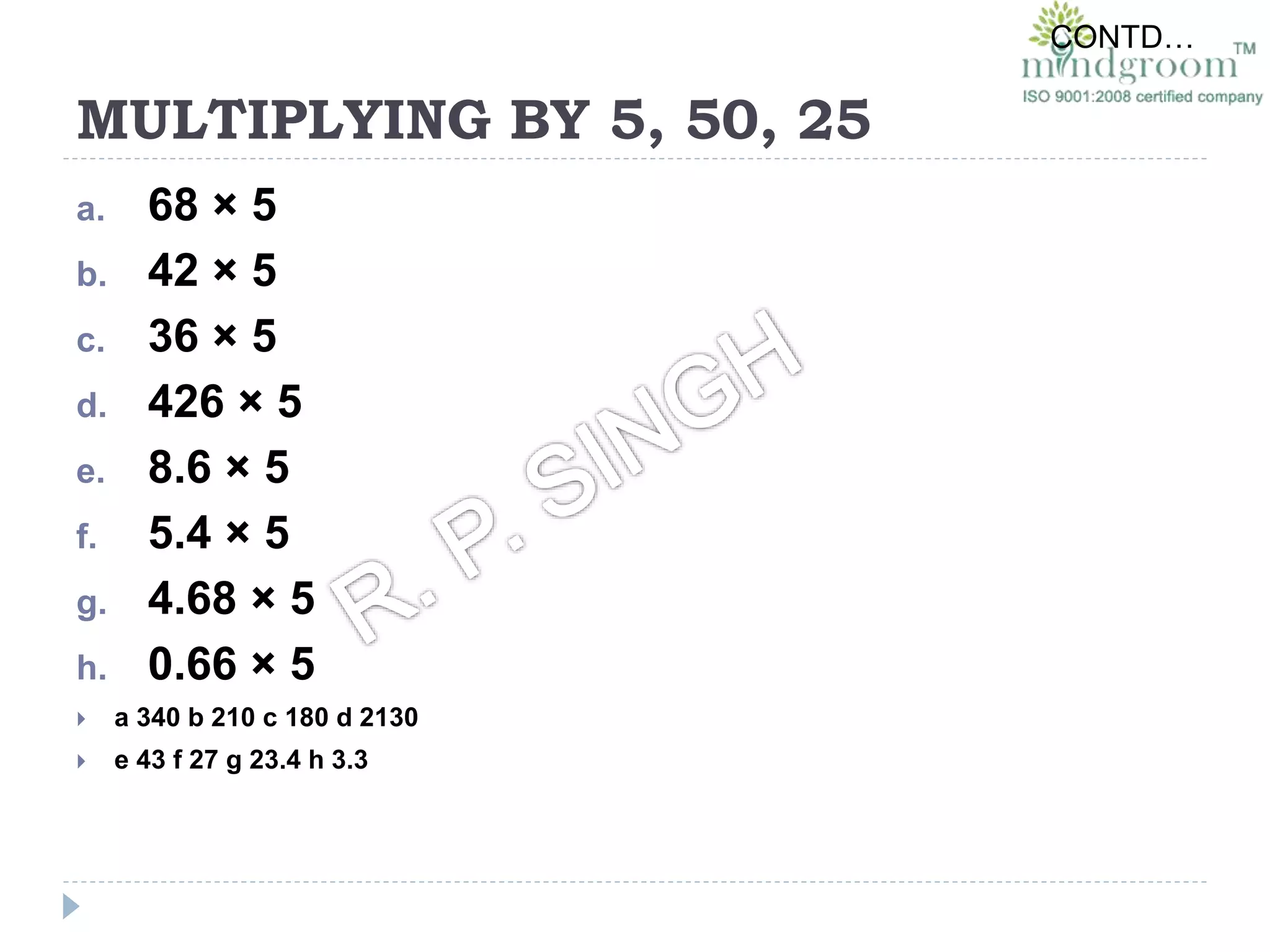
MULTIPLYING BY 5, 50, 25
a. 68 × 5
b. 42 × 5
c. 36 × 5
d. 426 × 5
e. 8.6 × 5
f. 5.4 × 5
g. 4.68 × 5
h. 0.66 × 5
 a 340 b 210 c 180 d 2130
 e 43 f 27 g 23.4 h 3.3
CONTD…
MULTIPLYING BY 5, 50, 25
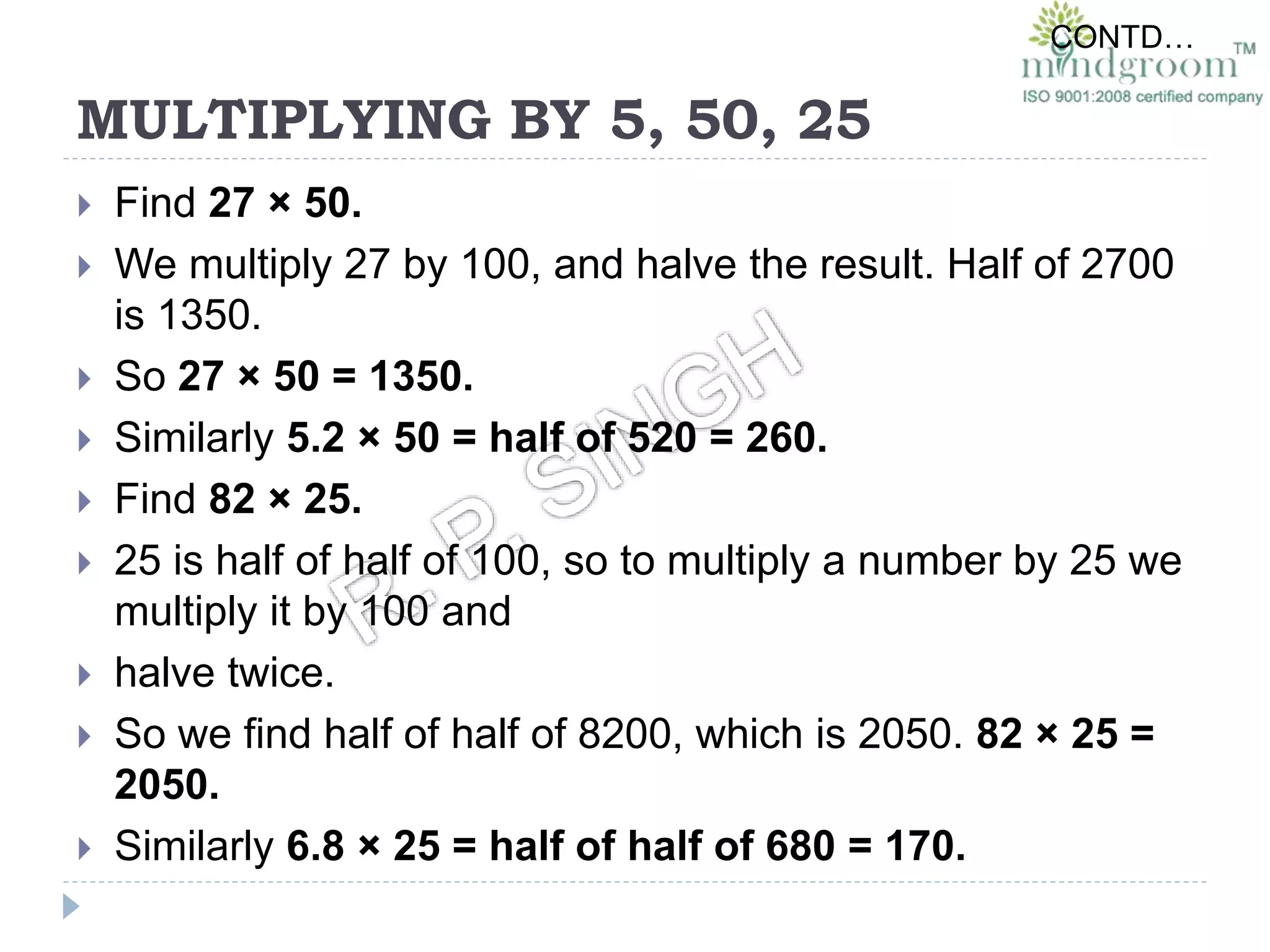
 Find 27 × 50.
 We multiply 27 by 100, and halve the result. Half of 2700
is 1350.
 So 27 × 50 = 1350.
 Similarly 5.2 × 50 = half of 520 = 260.
 Find 82 × 25.
 25 is half of half of 100, so to multiply a number by 25 we
multiply it by 100 and
 halve twice.
 So we find half of half of 8200, which is 2050. 82 × 25 =
2050.
 Similarly 6.8 × 25 = half of half of 680 = 170.
CONTD…
MULTIPLYING BY 5, 50, 25
a. 46 × 50
b. 864 × 50
c. 72 × 25
d. 85 × 25
e. 86.8 × 50
f. 4.2 × 50
g. 34.56 × 50
h. 2.8 × 25
 a 2300 b 43200 c 1800 d 2125
 e 4340 f 210 g 1728 h 70
CONTD…
DIVIDING BY 5
 For dividing by 5 we can double and then divide by
10.
 85 ÷ 5 = 17.
 So 85 is doubled to 170, and dividing by 10 gives 17.
 665 ÷ 5 = 133 since 665 doubled is 1330.
 73 ÷ 5 = 14.6.
 Similarly here double 73 is 146, and dividing by 10
gives 14.6.
DIVIDING BY 5
a. 65
b. 135
c. 375
d. 470
e. 505
a 13 b 27 c 75 d 94 e 101
CONTD…
DIVIDING BY 50, 25
 Since 50 is half of 100 dividing by 50 involves
doubling and dividing by 100.
 Find 750 ÷ 50.
 Doubling 750 gives 1500, and dividing this by 100
gives 15.
 So 750 ÷ 50 = 15.
 Again the alternative formula The Ultimate and Twice
the Penultimate tells us to
 double the 7 and add on the one extra 50, giving 15
again.
 54.32 ÷ 50 = 1.0864.
 Doubling 54.32 gives 108.64, and dividing by 100
gives 1.0864.
DIVIDING BY 50, 25
 25 is a quarter of 100 so to divide by 25 we can
double twice and divide by 100.
 Find 425 ÷ 25.
 Doubling 425 gives 850, and doubling this gives
1700.
 Dividing by 100 then gives us 17. So 425 ÷ 25 = 17
CONTD…
DIVIDING BY 50, 25
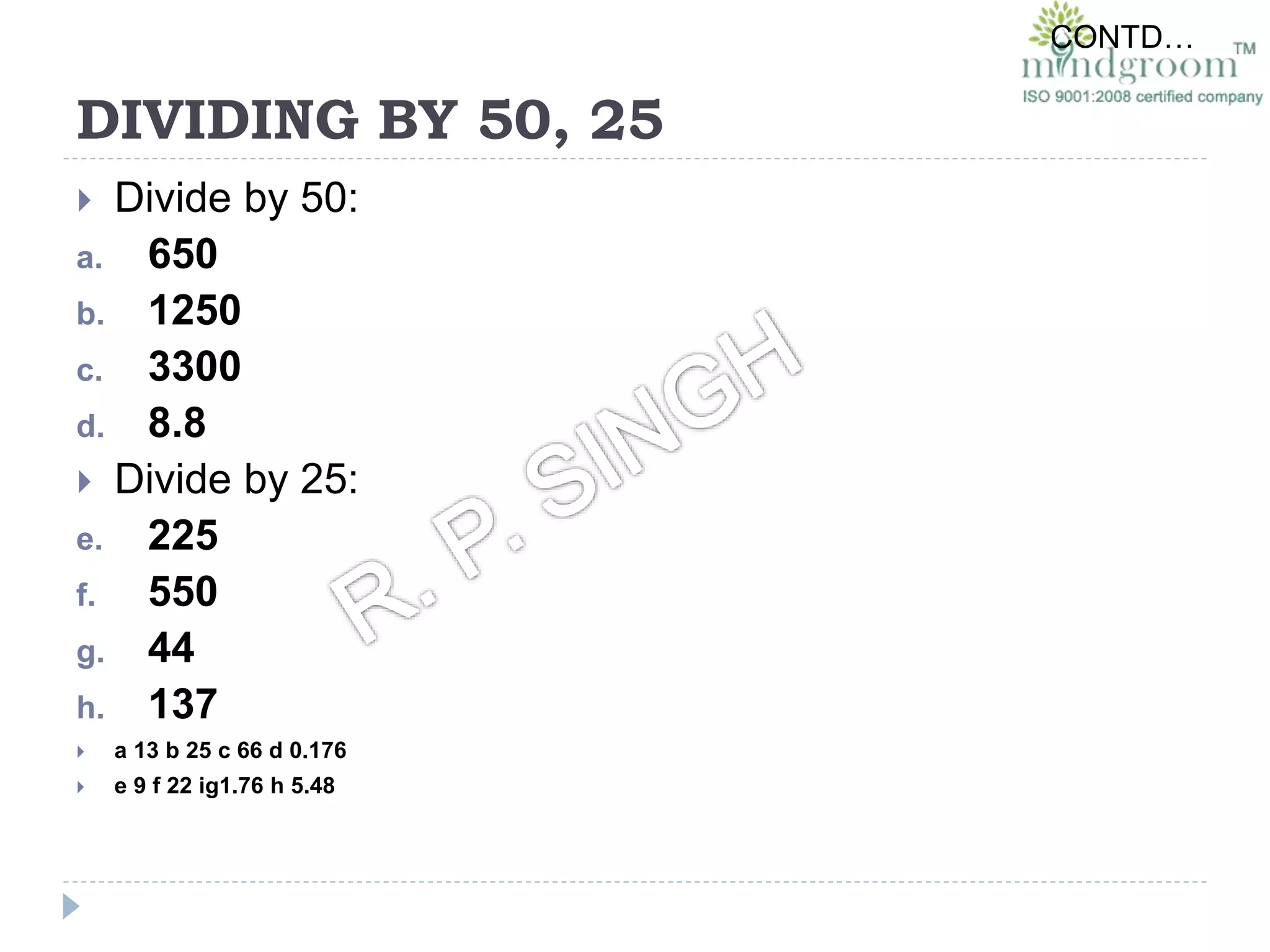
 Divide by 50:
a. 650
b. 1250
c. 3300
d. 8.8
 Divide by 25:
e. 225
f. 550
g. 44
h. 137
 a 13 b 25 c 66 d 0.176
 e 9 f 22 ig1.76 h 5.48
CONTD…
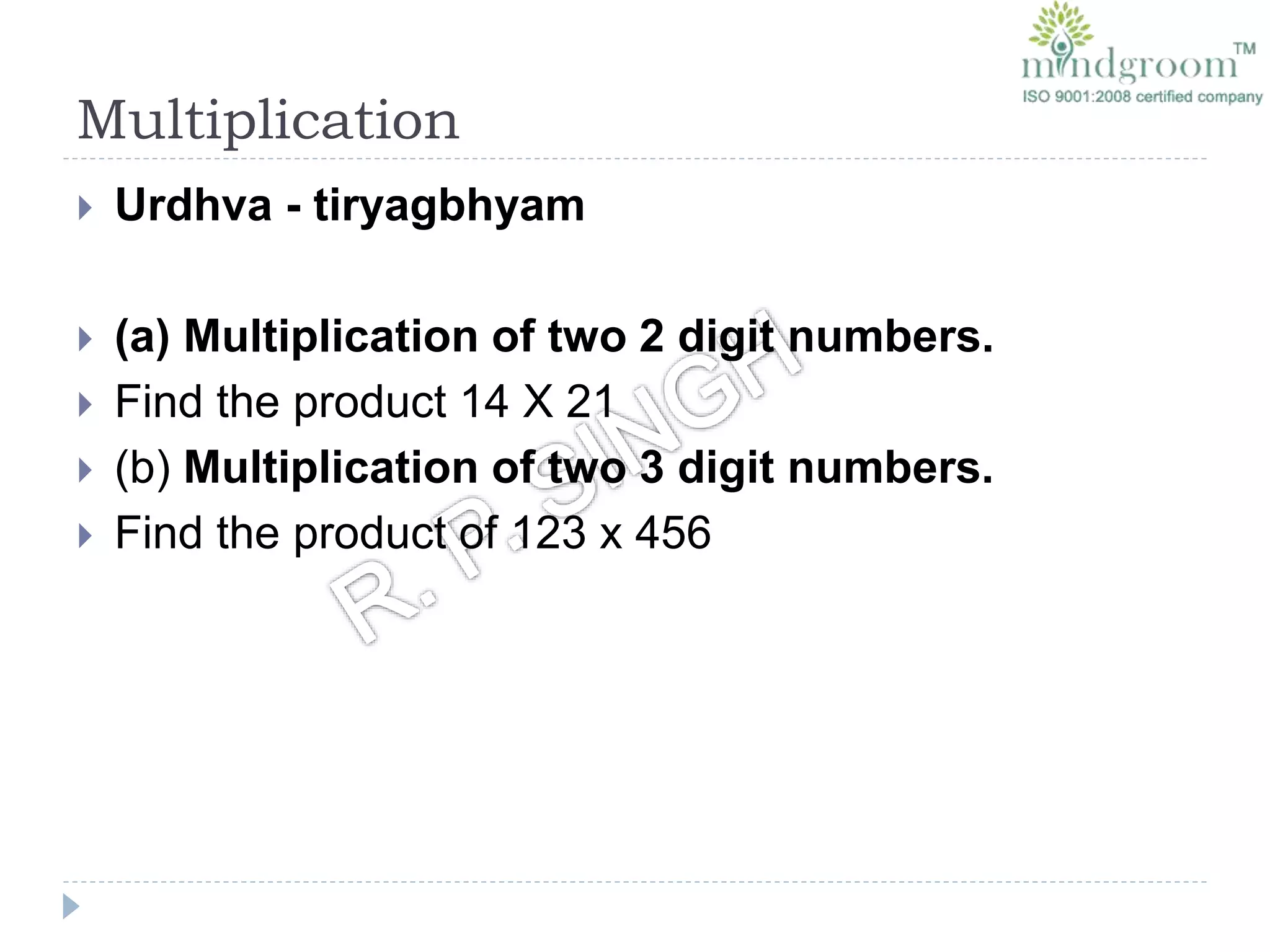
Multiplication
 Urdhva - tiryagbhyam
 (a) Multiplication of two 2 digit numbers.
 Find the product 14 X 21
 (b) Multiplication of two 3 digit numbers.
 Find the product of 123 x 456
Multiplication
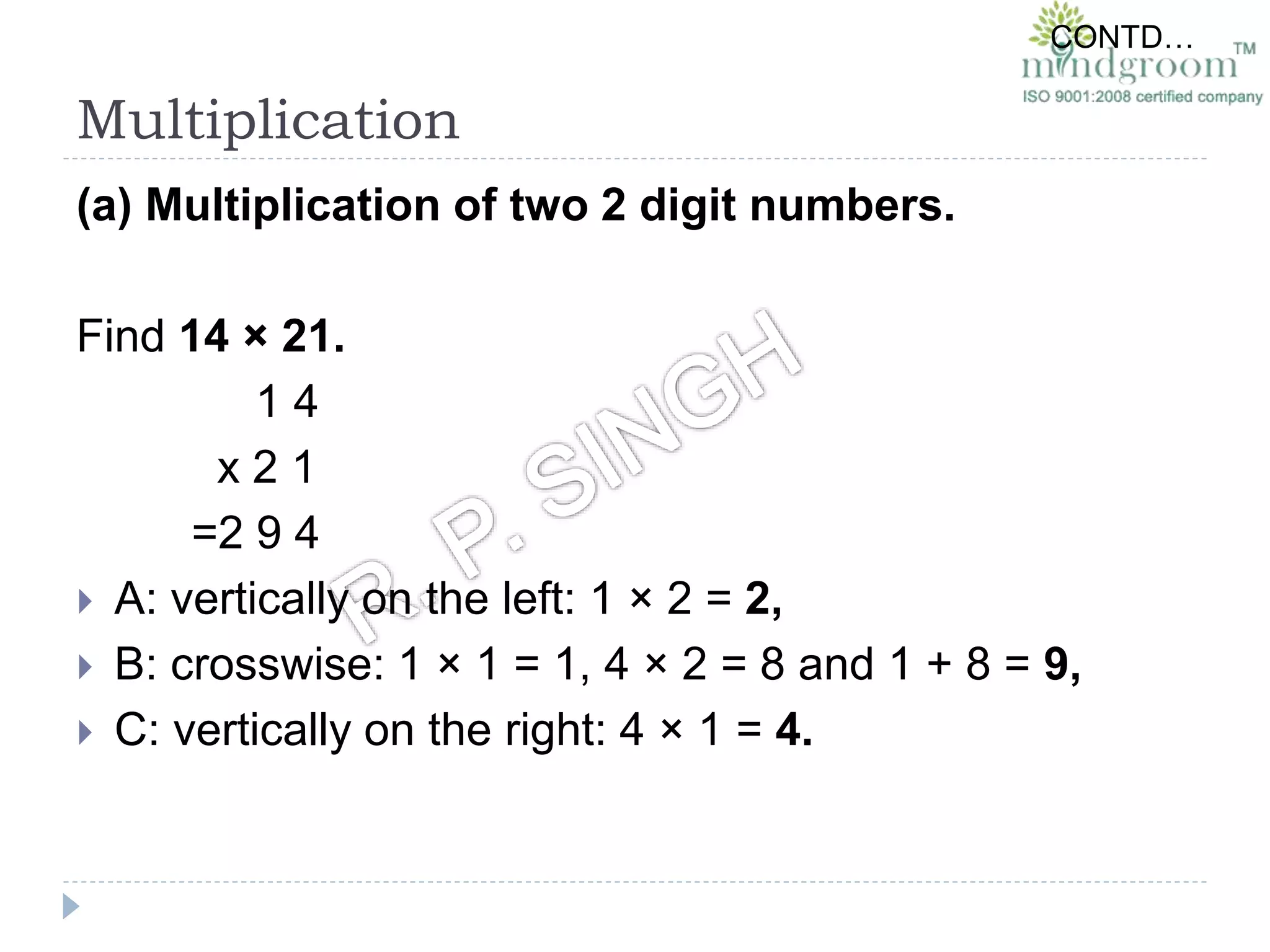
(a) Multiplication of two 2 digit numbers.
Find 14 × 21.
1 4
x 2 1
=2 9 4
 A: vertically on the left: 1 × 2 = 2,
 B: crosswise: 1 × 1 = 1, 4 × 2 = 8 and 1 + 8 = 9,
 C: vertically on the right: 4 × 1 = 4.
CONTD…
Multiplication
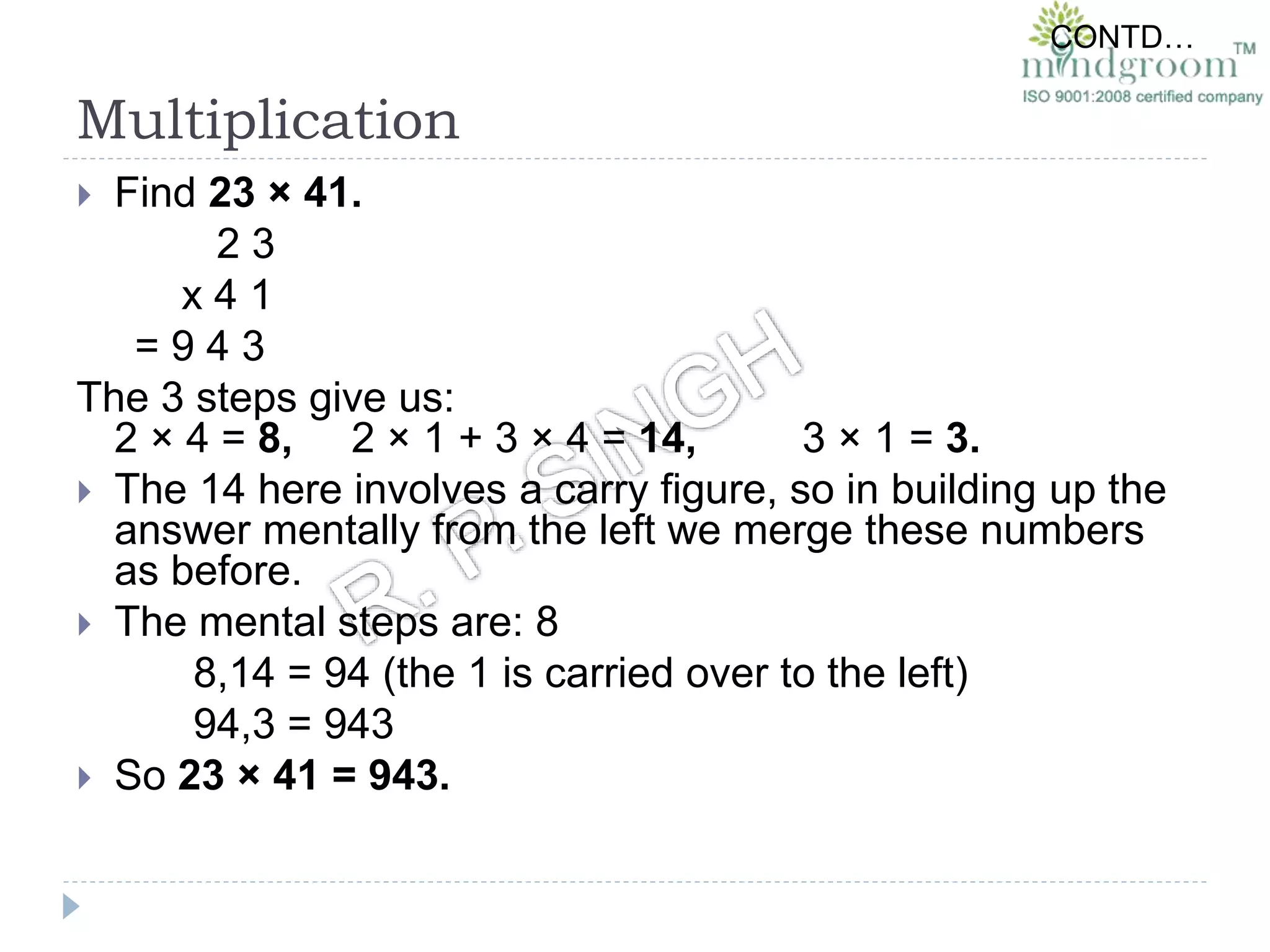
 Find 23 × 41.
2 3
x 4 1
= 9 4 3
The 3 steps give us:
2 × 4 = 8, 2 × 1 + 3 × 4 = 14, 3 × 1 = 3.
 The 14 here involves a carry figure, so in building up the
answer mentally from the left we merge these numbers
as before.
 The mental steps are: 8
8,14 = 94 (the 1 is carried over to the left)
94,3 = 943
 So 23 × 41 = 943.
CONTD…
Multiplication
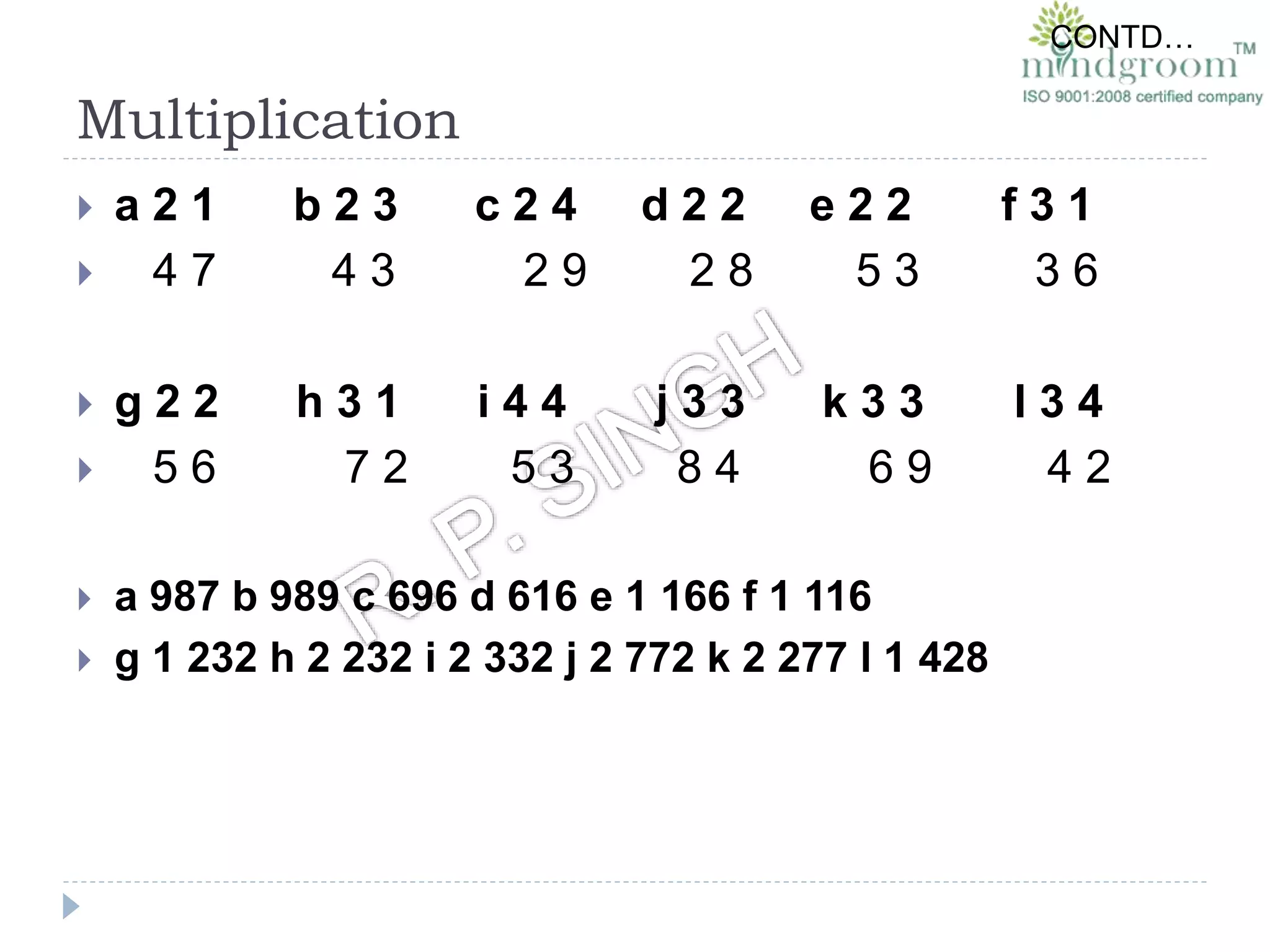
 a 2 1 b 2 3 c 2 4 d 2 2 e 2 2 f 3 1
 4 7 4 3 2 9 2 8 5 3 3 6
 g 2 2 h 3 1 i 4 4 j 3 3 k 3 3 l 3 4
 5 6 7 2 5 3 8 4 6 9 4 2
 a 987 b 989 c 696 d 616 e 1 166 f 1 116
 g 1 232 h 2 232 i 2 332 j 2 772 k 2 277 l 1 428
CONTD…
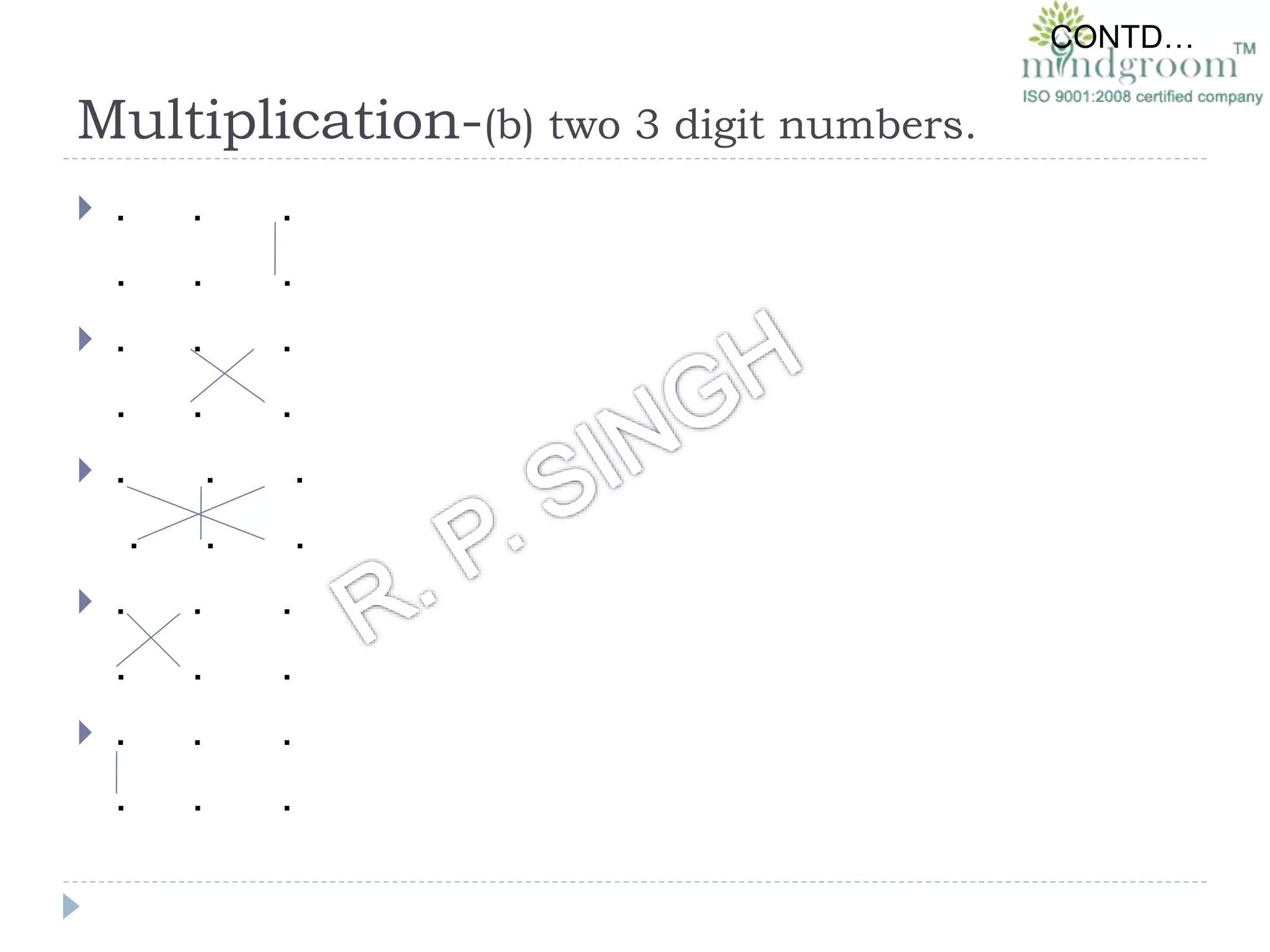
Multiplication-(b) two 3 digit numbers.
 . . .
. . .
 . . .
. . .
 . . .
. . .
 . . .
. . .
 . . .
. . .
CONTD…
Multiplication
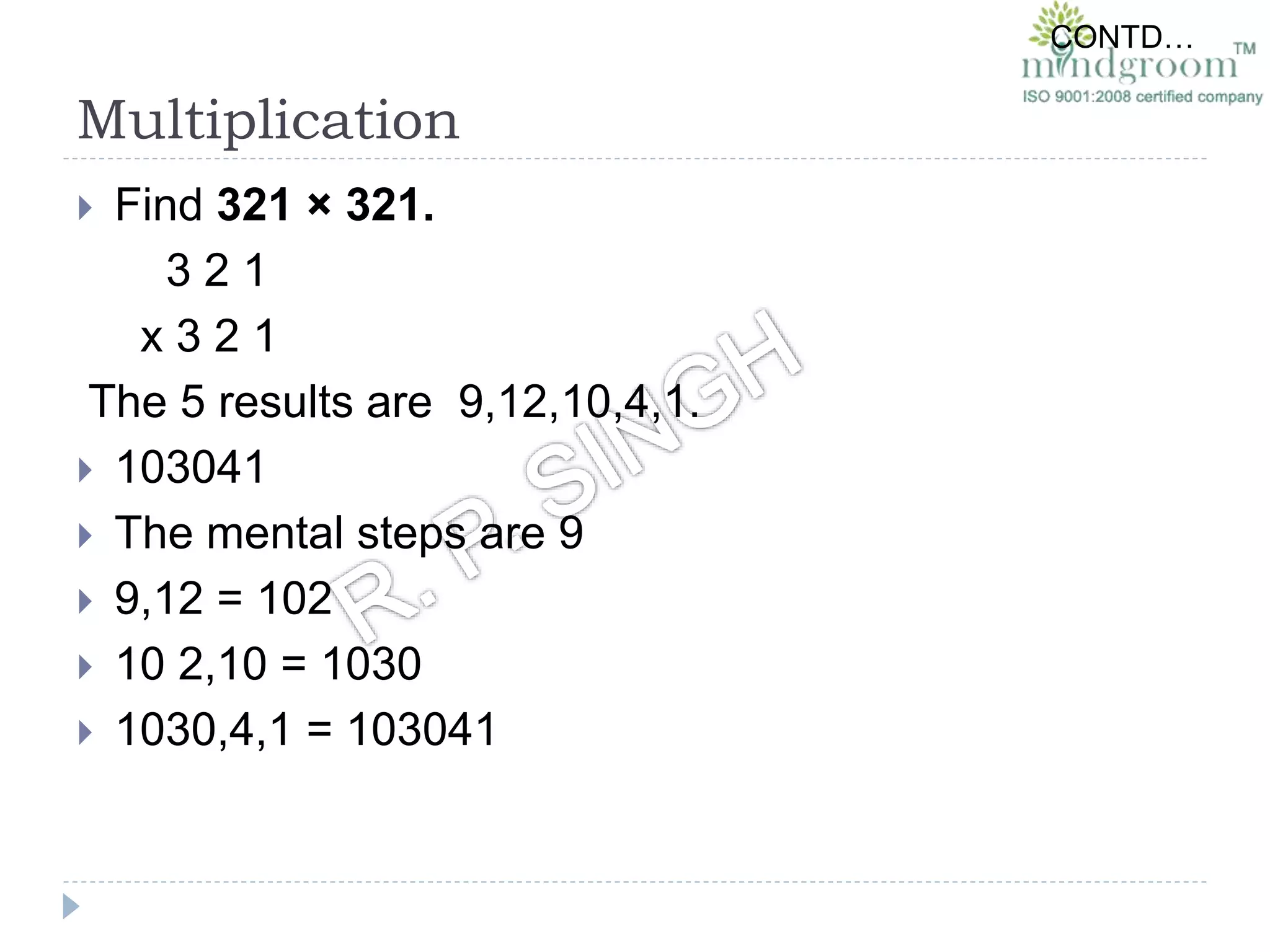
 Find 321 × 321.
3 2 1
x 3 2 1
The 5 results are 9,12,10,4,1.
 103041
 The mental steps are 9
 9,12 = 102
 10 2,10 = 1030
 1030,4,1 = 103041
CONTD…
Multiplication
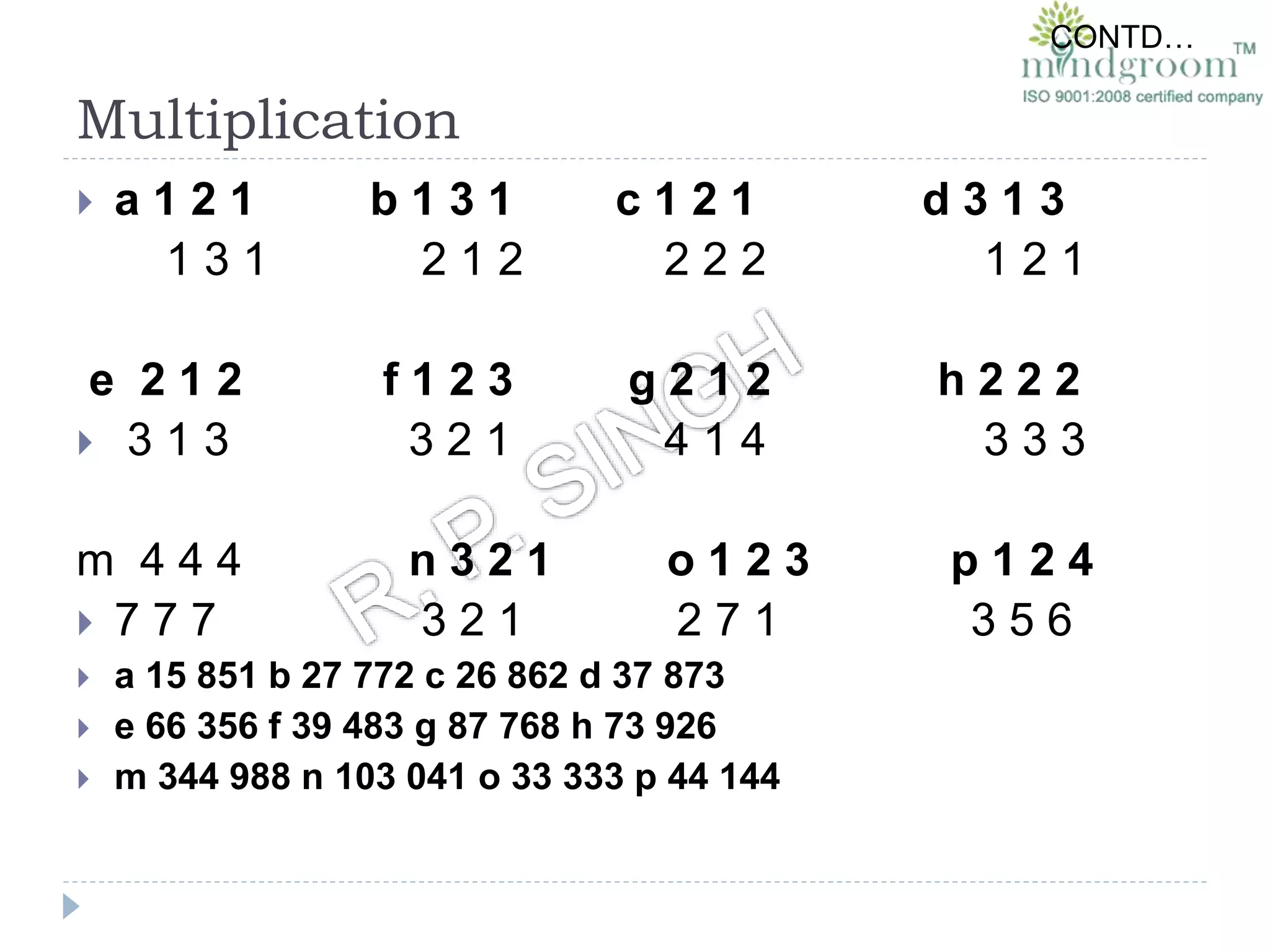
 a 1 2 1 b 1 3 1 c 1 2 1 d 3 1 3
1 3 1 2 1 2 2 2 2 1 2 1
e 2 1 2 f 1 2 3 g 2 1 2 h 2 2 2
 3 1 3 3 2 1 4 1 4 3 3 3
m 4 4 4 n 3 2 1 o 1 2 3 p 1 2 4
 7 7 7 3 2 1 2 7 1 3 5 6
 a 15 851 b 27 772 c 26 862 d 37 873
 e 66 356 f 39 483 g 87 768 h 73 926
 m 344 988 n 103 041 o 33 333 p 44 144
CONTD…
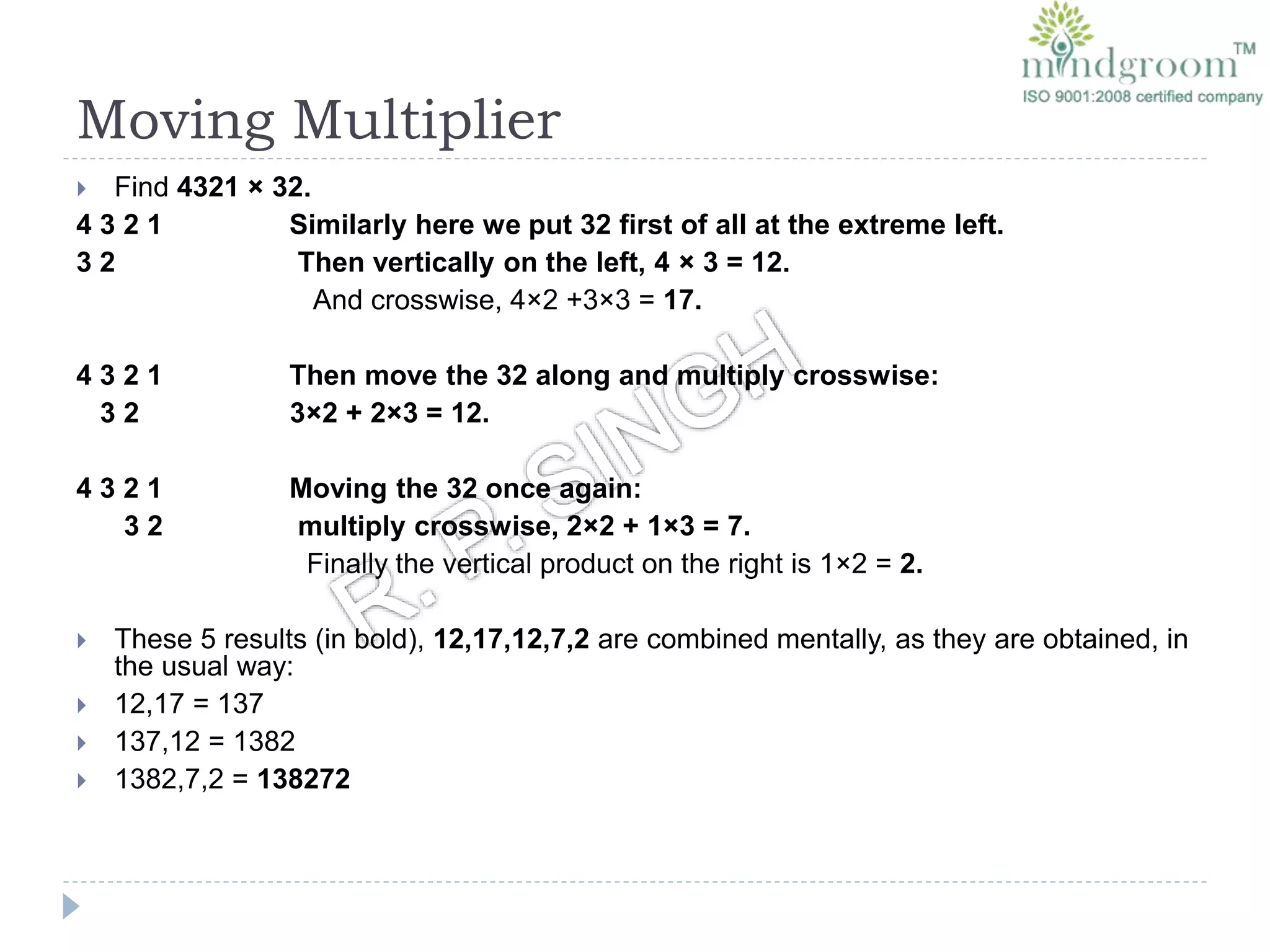
Moving Multiplier
 Find 4321 × 32.
4 3 2 1 Similarly here we put 32 first of all at the extreme left.
3 2 Then vertically on the left, 4 × 3 = 12.
And crosswise, 4×2 +3×3 = 17.
4 3 2 1 Then move the 32 along and multiply crosswise:
3 2 3×2 + 2×3 = 12.
4 3 2 1 Moving the 32 once again:
3 2 multiply crosswise, 2×2 + 1×3 = 7.
Finally the vertical product on the right is 1×2 = 2.
 These 5 results (in bold), 12,17,12,7,2 are combined mentally, as they are obtained, in
the usual way:
 12,17 = 137
 137,12 = 1382
 1382,7,2 = 138272
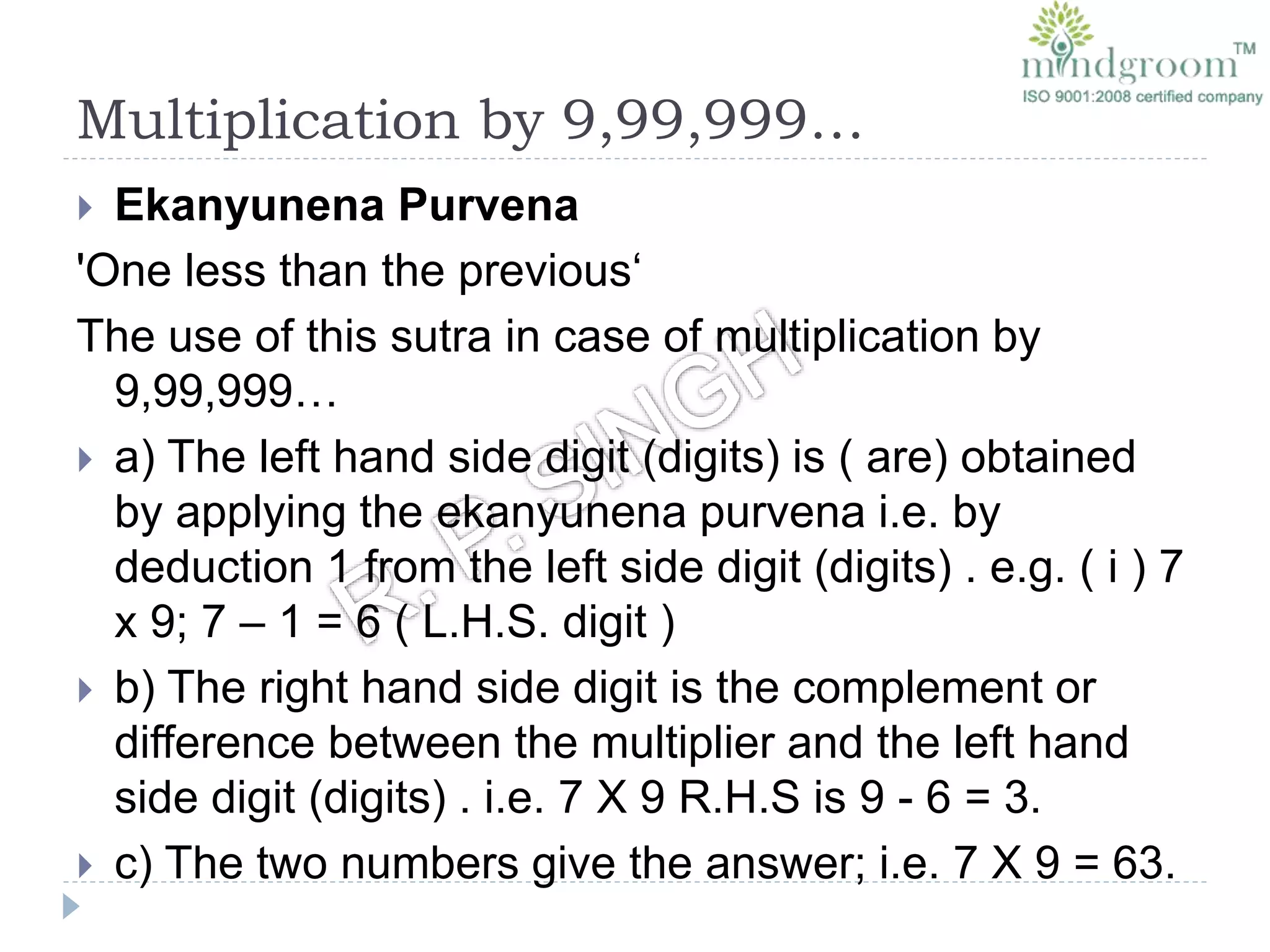
Multiplication by 9,99,999…
 Ekanyunena Purvena
'One less than the previous‘
The use of this sutra in case of multiplication by
9,99,999…
 a) The left hand side digit (digits) is ( are) obtained
by applying the ekanyunena purvena i.e. by
deduction 1 from the left side digit (digits) . e.g. ( i ) 7
x 9; 7 – 1 = 6 ( L.H.S. digit )
 b) The right hand side digit is the complement or
difference between the multiplier and the left hand
side digit (digits) . i.e. 7 X 9 R.H.S is 9 - 6 = 3.
 c) The two numbers give the answer; i.e. 7 X 9 = 63.
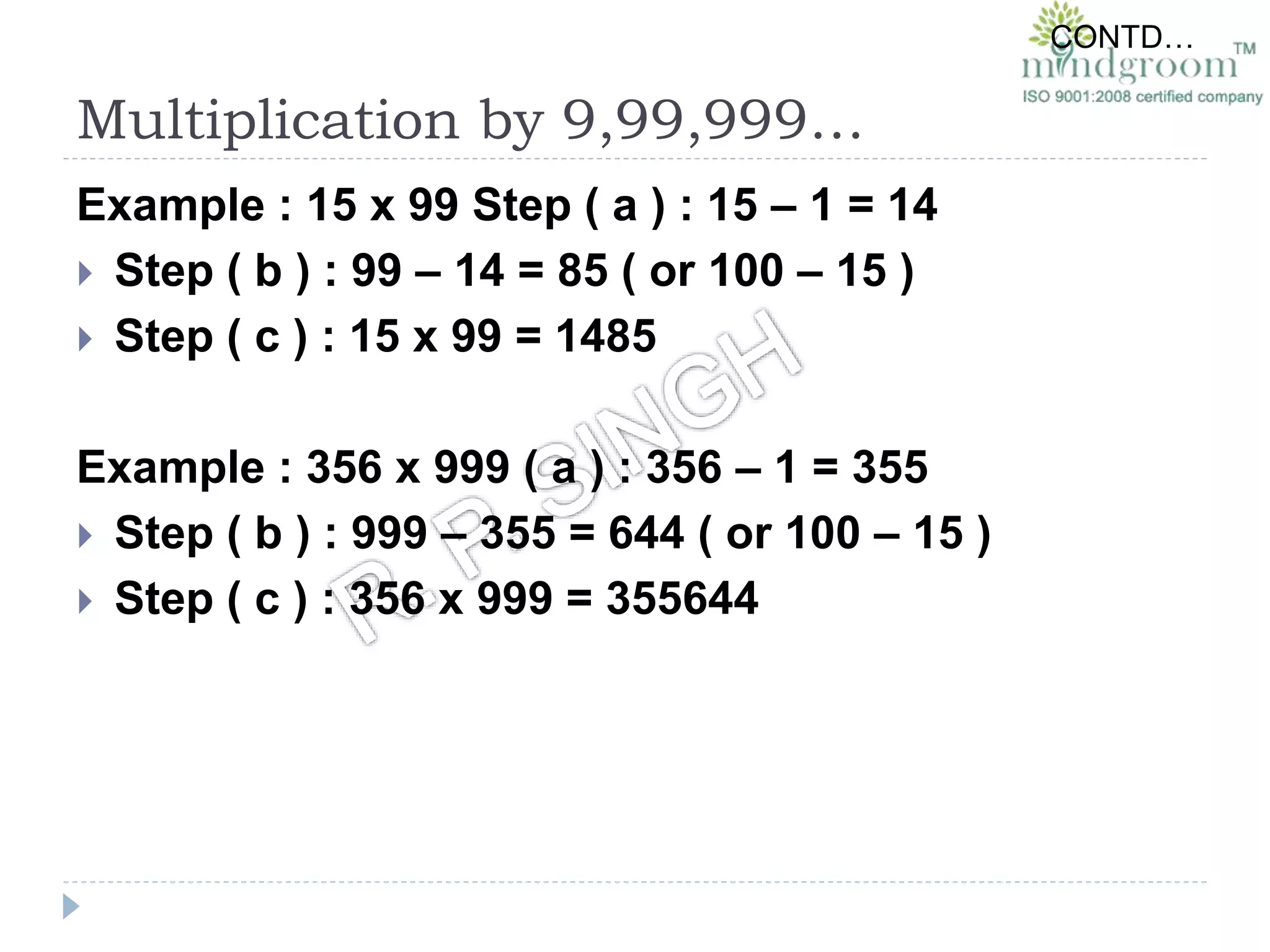
Multiplication by 9,99,999…
Example : 15 x 99 Step ( a ) : 15 – 1 = 14
 Step ( b ) : 99 – 14 = 85 ( or 100 – 15 )
 Step ( c ) : 15 x 99 = 1485
Example : 356 x 999 ( a ) : 356 – 1 = 355
 Step ( b ) : 999 – 355 = 644 ( or 100 – 15 )
 Step ( c ) : 356 x 999 = 355644
CONTD…
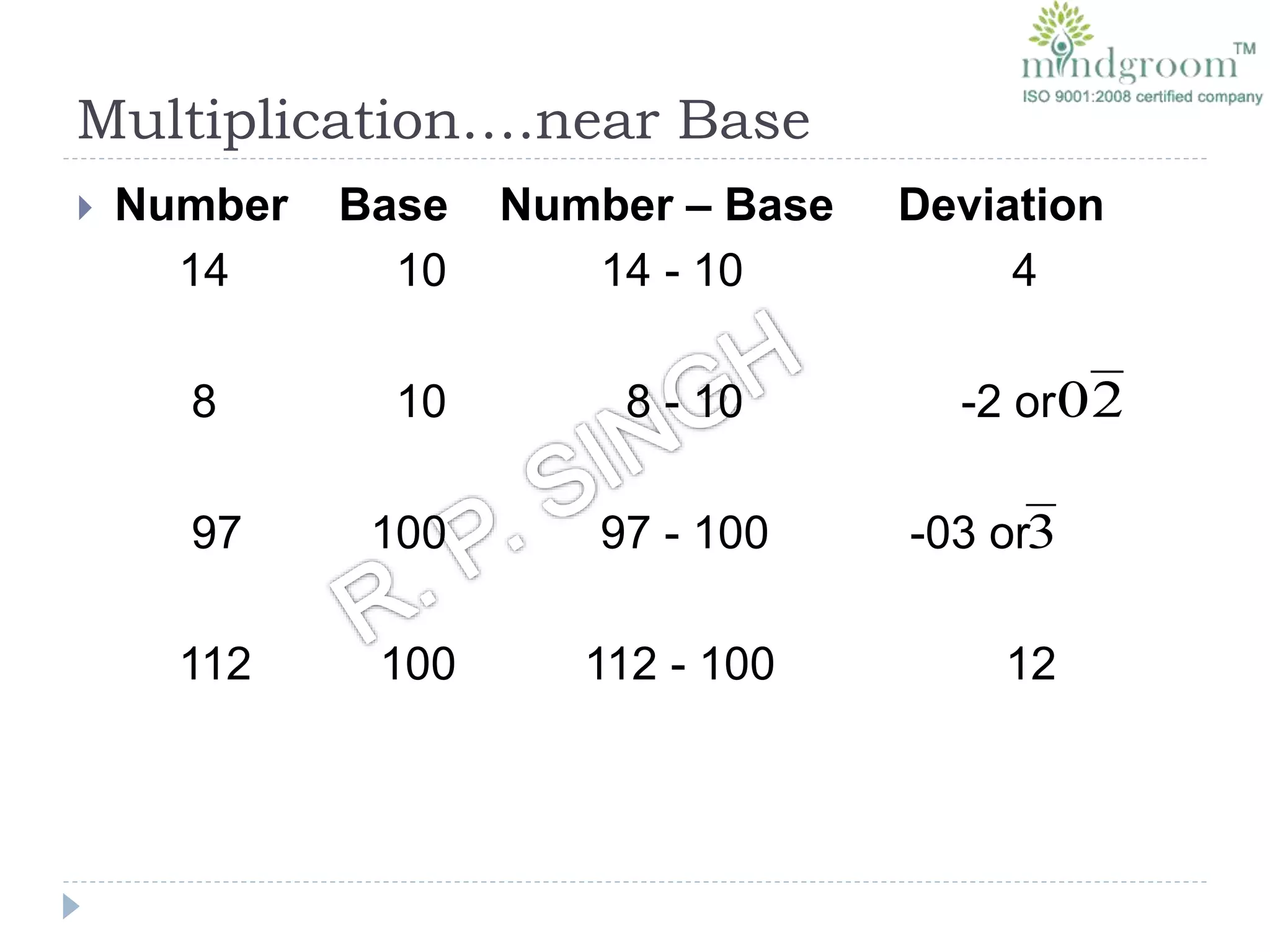
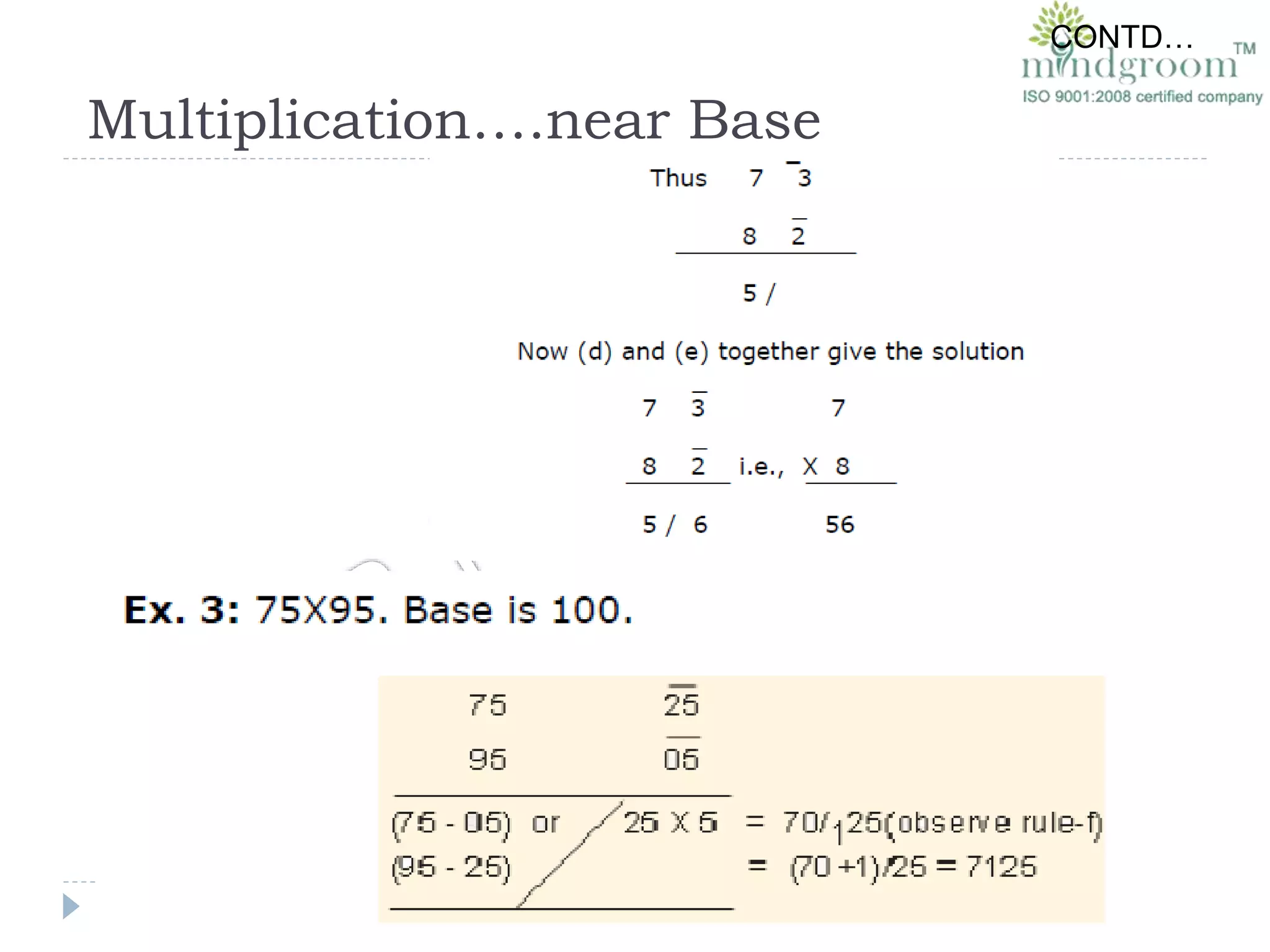
Multiplication….near Base
 Number Base Number – Base Deviation
14 10 14 - 10 4
8 10 8 - 10 -2 or
97 100 97 - 100 -03 or
112 100 112 - 100 12
20
3
Multiplication….near Base
CONTD…
Multiplication-Near the common bases
11. Anurupyena
 The upa-Sutra 'anurupyena' means 'proportionality'.
This Sutra is highly useful to find products of two
numbers when both of them are near the Common
bases i.e powers of base 10 . It is very clear that in
such cases the expected 'Simplicity ' in doing
problems is absent.
 Example : 46 X 43
Multiplication-Near the common bases
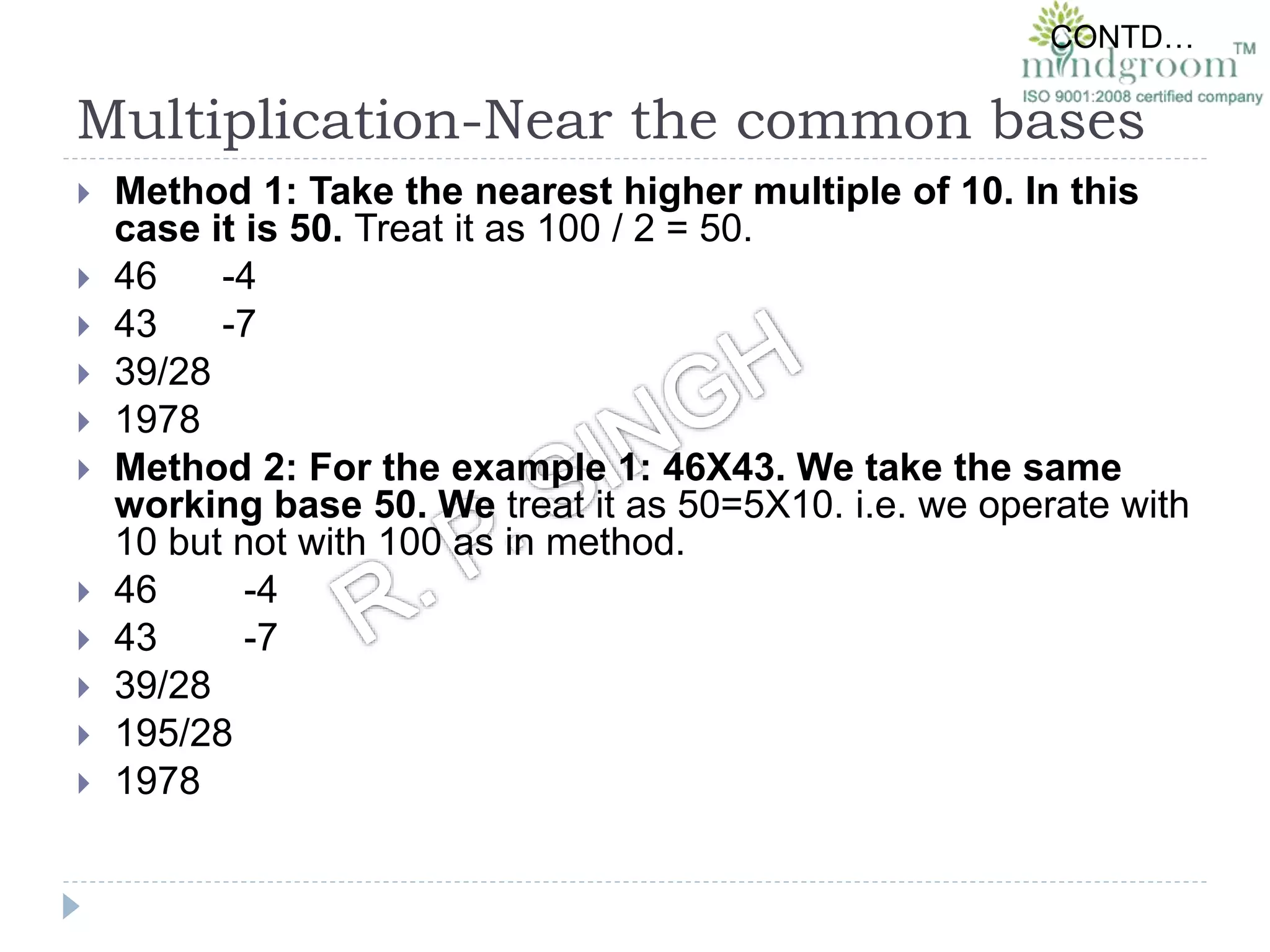
 Method 1: Take the nearest higher multiple of 10. In this
case it is 50. Treat it as 100 / 2 = 50.
 46 -4
 43 -7
 39/28
 1978
 Method 2: For the example 1: 46X43. We take the same
working base 50. We treat it as 50=5X10. i.e. we operate with
10 but not with 100 as in method.
 46 -4
 43 -7
 39/28
 195/28
 1978
CONTD…
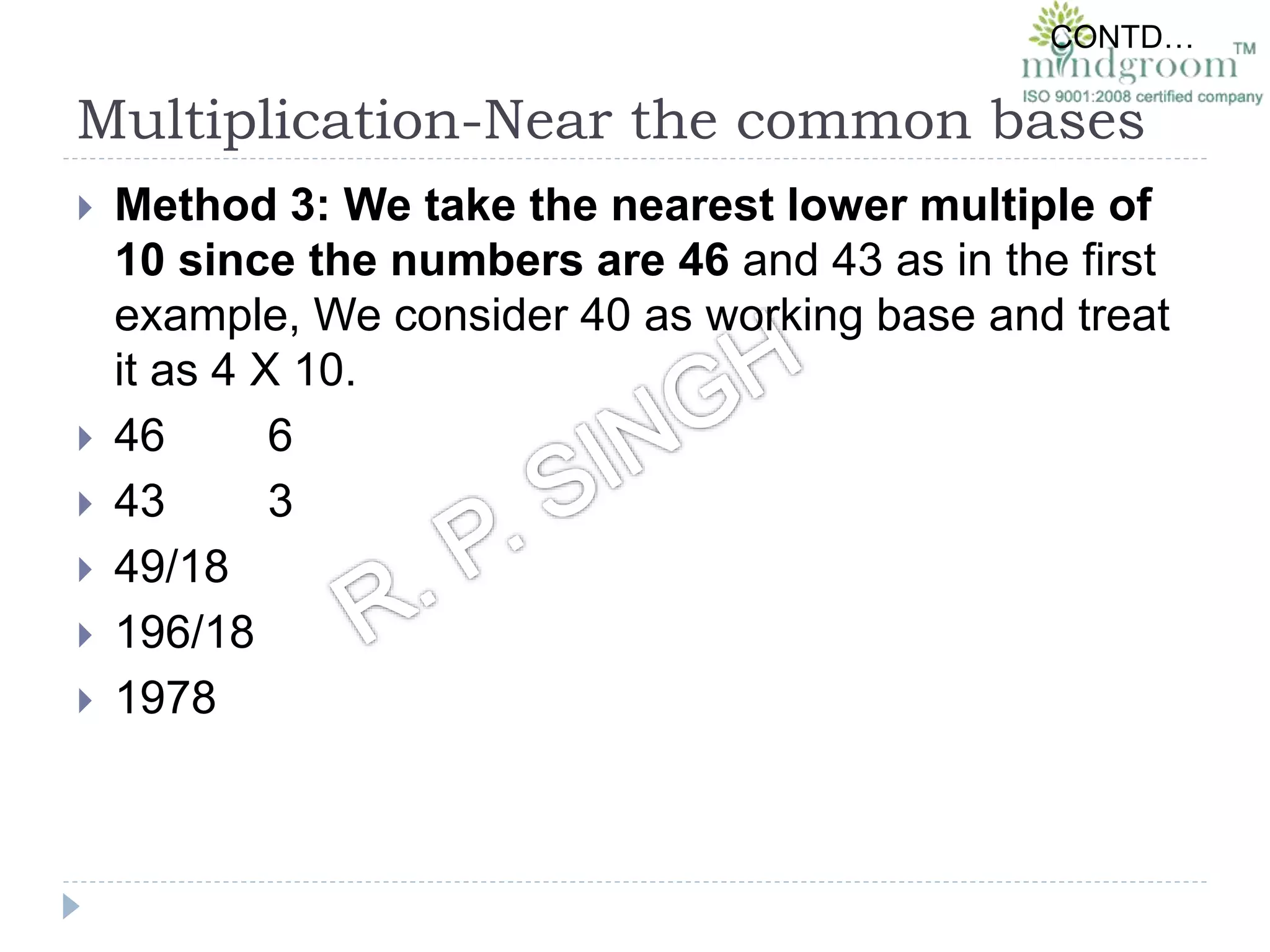
 Method 3: We take the nearest lower multiple of
10 since the numbers are 46 and 43 as in the first
example, We consider 40 as working base and treat
it as 4 X 10.
 46 6
 43 3
 49/18
 196/18
 1978
Multiplication-Near the common bases
CONTD…
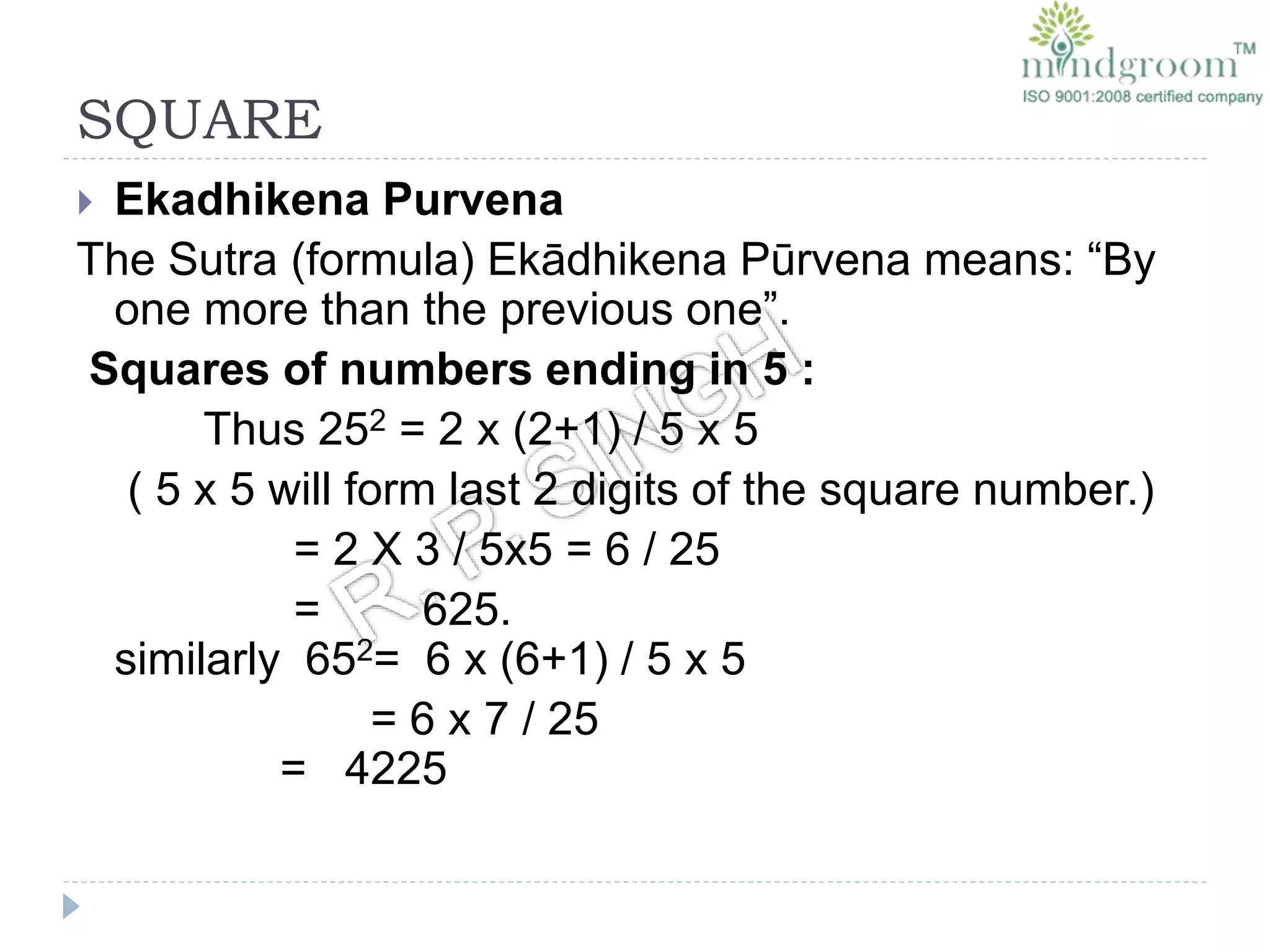
SQUARE
 Ekadhikena Purvena
The Sutra (formula) Ekādhikena Pūrvena means: “By
one more than the previous one”.
Squares of numbers ending in 5 :
Thus 252 = 2 x (2+1) / 5 x 5
( 5 x 5 will form last 2 digits of the square number.)
= 2 X 3 / 5x5 = 6 / 25
= 625.
similarly 652= 6 x (6+1) / 5 x 5
= 6 x 7 / 25
= 4225
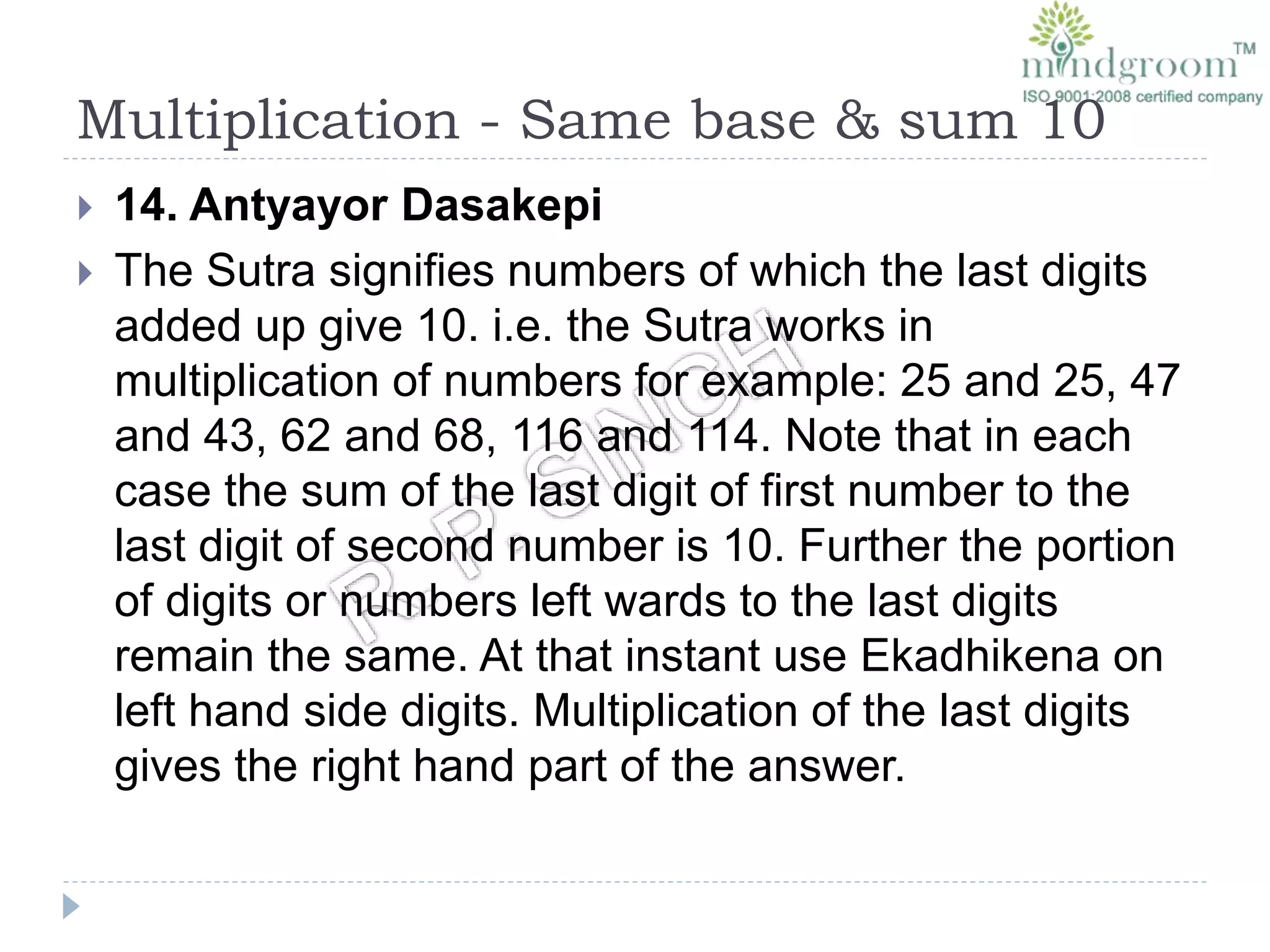
Multiplication - Same base & sum 10
 14. Antyayor Dasakepi
 The Sutra signifies numbers of which the last digits
added up give 10. i.e. the Sutra works in
multiplication of numbers for example: 25 and 25, 47
and 43, 62 and 68, 116 and 114. Note that in each
case the sum of the last digit of first number to the
last digit of second number is 10. Further the portion
of digits or numbers left wards to the last digits
remain the same. At that instant use Ekadhikena on
left hand side digits. Multiplication of the last digits
gives the right hand part of the answer.
Multiplication - Same base & sum 10
 Example- multiplication where sum of last digits are
10. and previous digits are same.
54 x 56
= 5 x 6 / 4 x 6 = 30 / 24
= 3024
79 x 71
= 7 x 8 / 9 x 1 = 56/09 = 5609
CONTD…
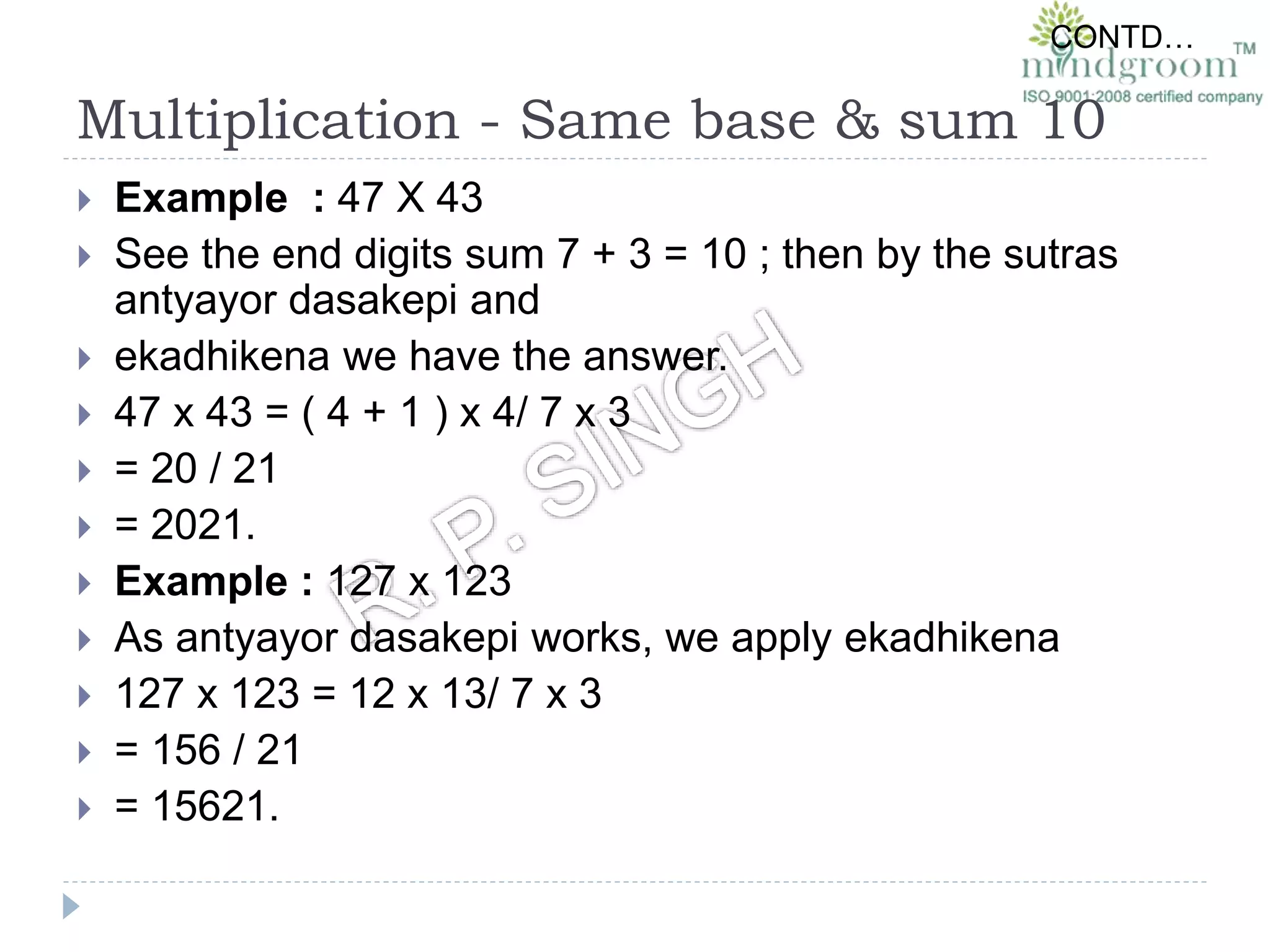
Multiplication - Same base & sum 10
 Example : 47 X 43
 See the end digits sum 7 + 3 = 10 ; then by the sutras
antyayor dasakepi and
 ekadhikena we have the answer.
 47 x 43 = ( 4 + 1 ) x 4/ 7 x 3
 = 20 / 21
 = 2021.
 Example : 127 x 123
 As antyayor dasakepi works, we apply ekadhikena
 127 x 123 = 12 x 13/ 7 x 3
 = 156 / 21
 = 15621.
CONTD…
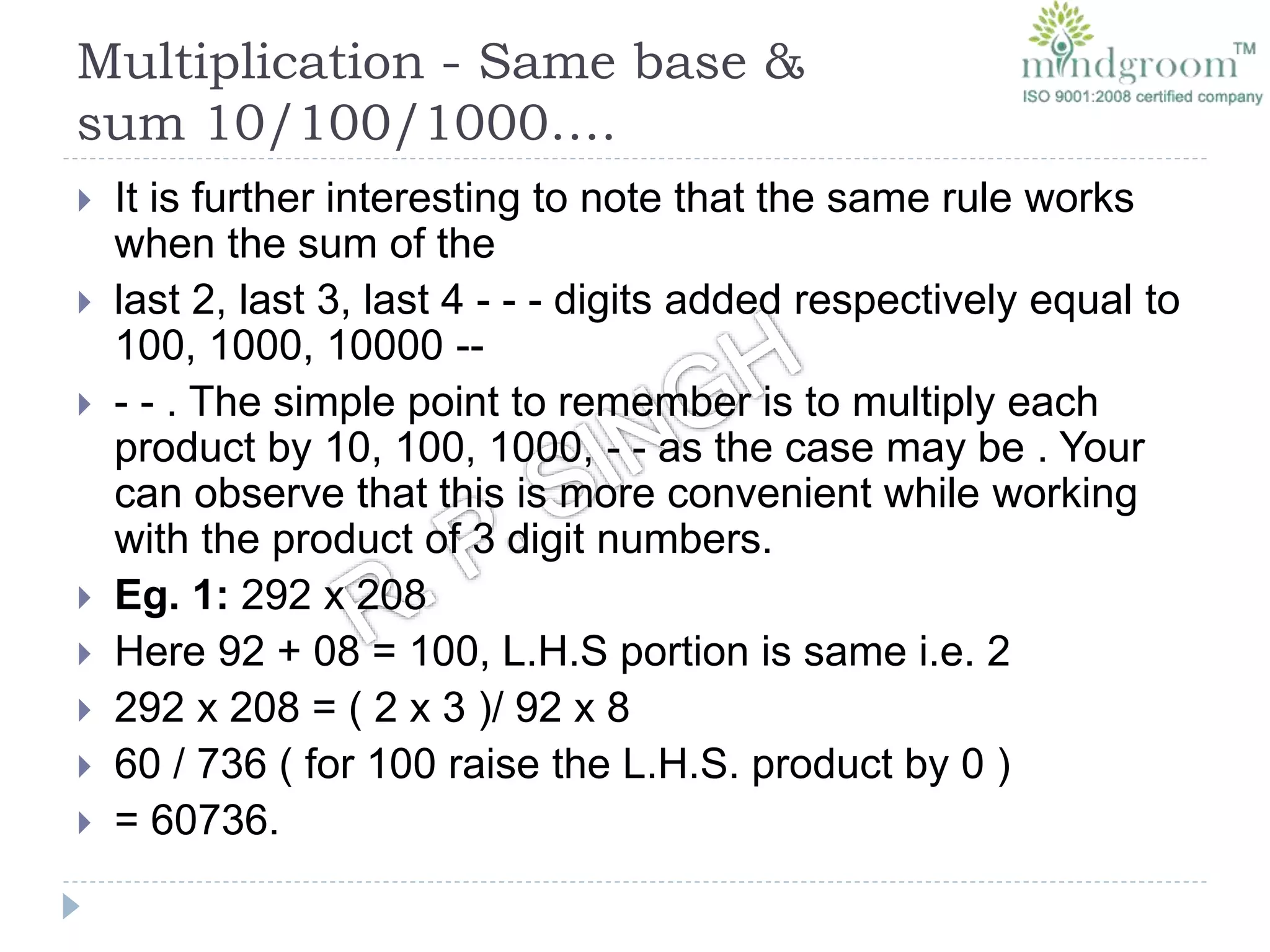
Multiplication - Same base &
sum 10/100/1000….
 It is further interesting to note that the same rule works
when the sum of the
 last 2, last 3, last 4 - - - digits added respectively equal to
100, 1000, 10000 --
 - - . The simple point to remember is to multiply each
product by 10, 100, 1000, - - as the case may be . Your
can observe that this is more convenient while working
with the product of 3 digit numbers.
 Eg. 1: 292 x 208
 Here 92 + 08 = 100, L.H.S portion is same i.e. 2
 292 x 208 = ( 2 x 3 )/ 92 x 8
 60 / 736 ( for 100 raise the L.H.S. product by 0 )
 = 60736.
Multiplication - Same base &
sum 10/100/1000….
 Eg. 2: 848 X 852
 Here 48 + 52 = 100, L.H.S portion is 8 and its ‘ekhadhikena’ is 9.
 Now R.H.S product 48 X 52 can be obtained by ‘anurupyena’ mentally.
 _
 48 2
 52 2
 _______
 _ _
 2) 50 /4 = 25/ 04
 24 / ( 100 – 4 )
 =24/ 96
 = 2496
 and write 848 x 852 = 8 x 9 / 48 x 52
 720 = 2496
 = 722496.
 [Since L.H.S product is to be multiplied by 10 and 2 to be carried over as the
 base is 100].
CONTD…
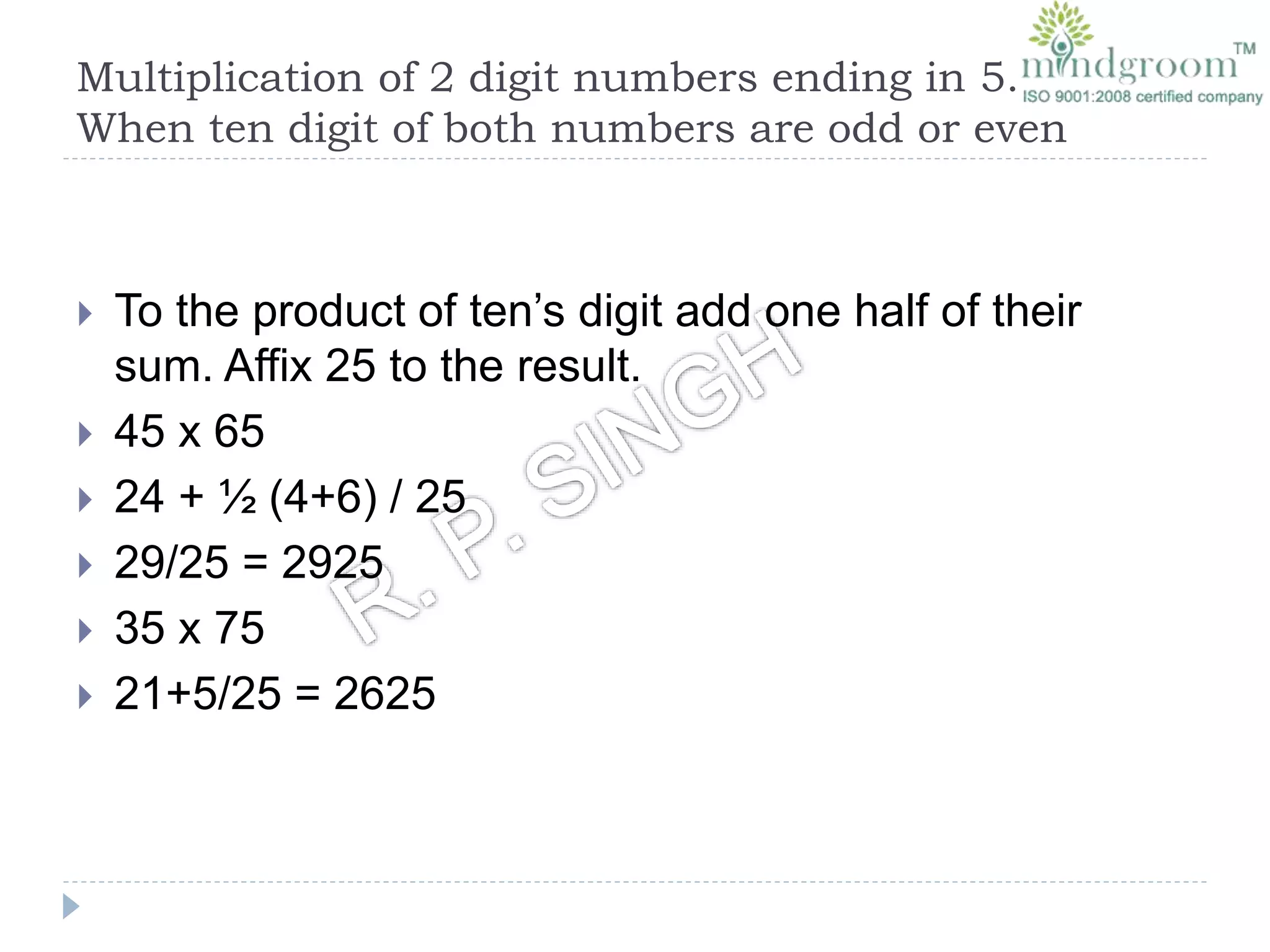
Multiplication of 2 digit numbers ending in 5.
When ten digit of both numbers are odd or even
 To the product of ten’s digit add one half of their
sum. Affix 25 to the result.
 45 x 65
 24 + ½ (4+6) / 25
 29/25 = 2925
 35 x 75
 21+5/25 = 2625
SQUARING
SQUARING
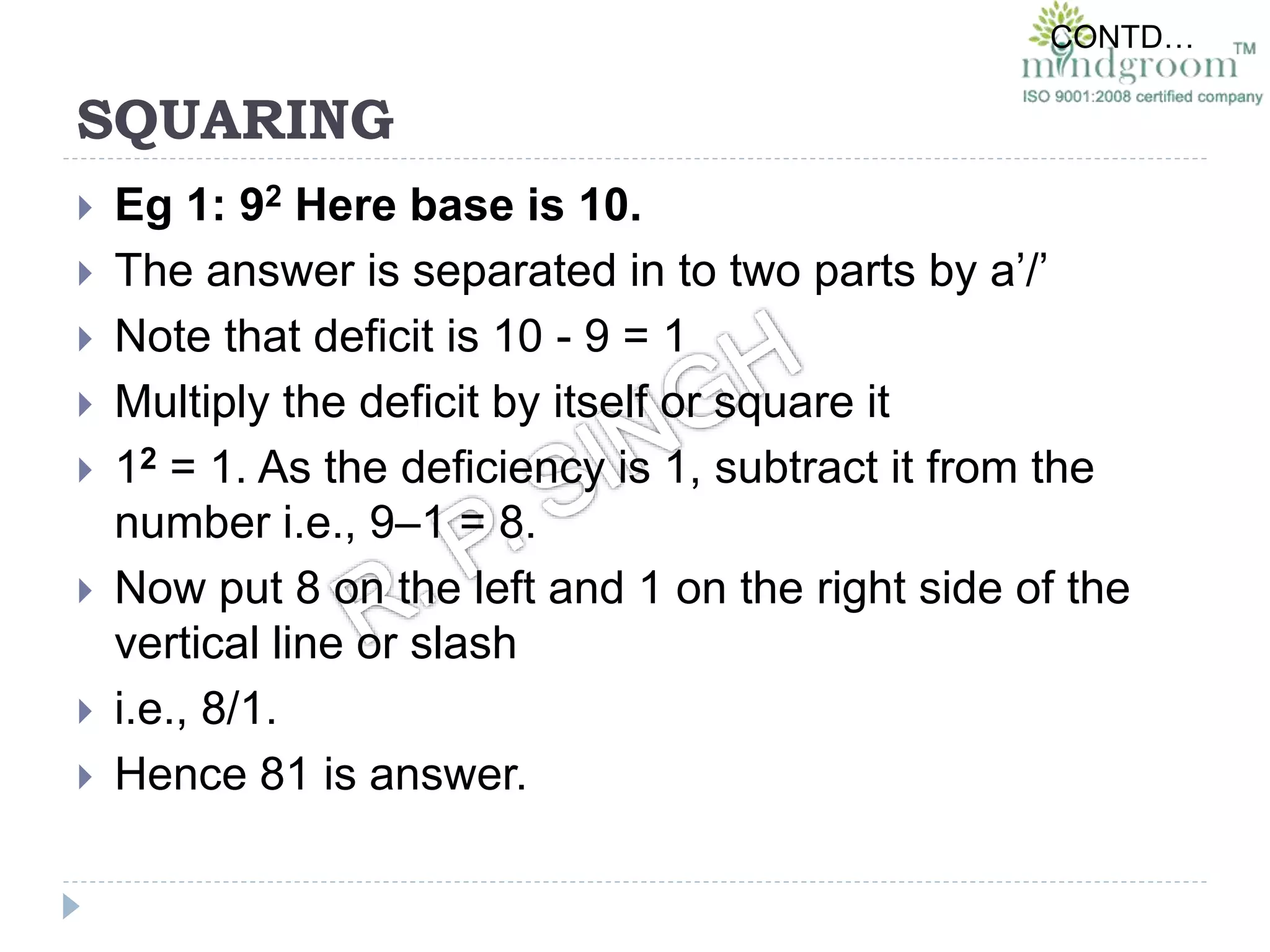
 Eg 1: 92 Here base is 10.
 The answer is separated in to two parts by a’/’
 Note that deficit is 10 - 9 = 1
 Multiply the deficit by itself or square it
 12 = 1. As the deficiency is 1, subtract it from the
number i.e., 9–1 = 8.
 Now put 8 on the left and 1 on the right side of the
vertical line or slash
 i.e., 8/1.
 Hence 81 is answer.
CONTD…
SQUARING NUMBERS NEAR 100
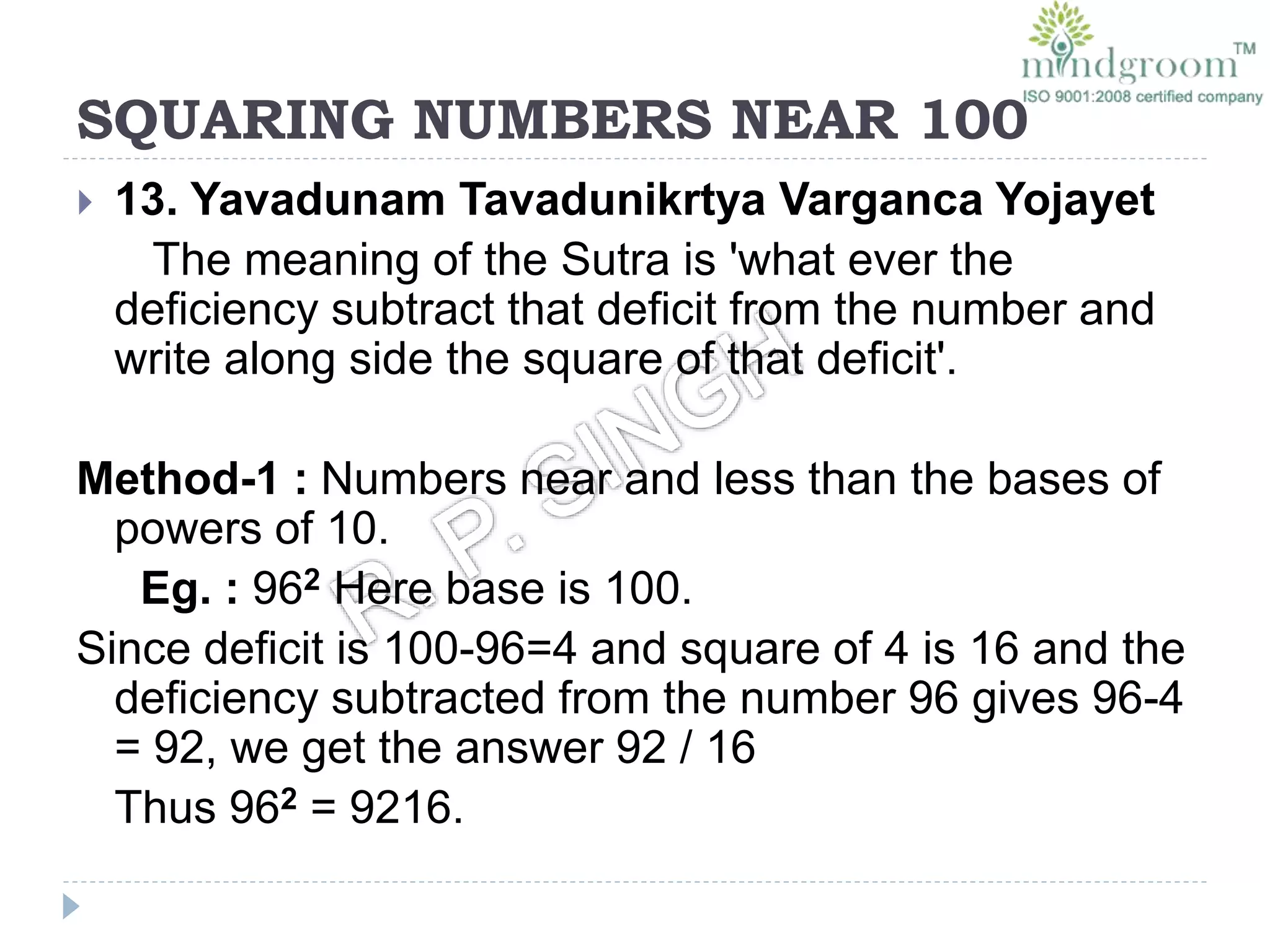
 13. Yavadunam Tavadunikrtya Varganca Yojayet
The meaning of the Sutra is 'what ever the
deficiency subtract that deficit from the number and
write along side the square of that deficit'.
Method-1 : Numbers near and less than the bases of
powers of 10.
Eg. : 962 Here base is 100.
Since deficit is 100-96=4 and square of 4 is 16 and the
deficiency subtracted from the number 96 gives 96-4
= 92, we get the answer 92 / 16
Thus 962 = 9216.
SQUARING NUMBERS NEAR 100
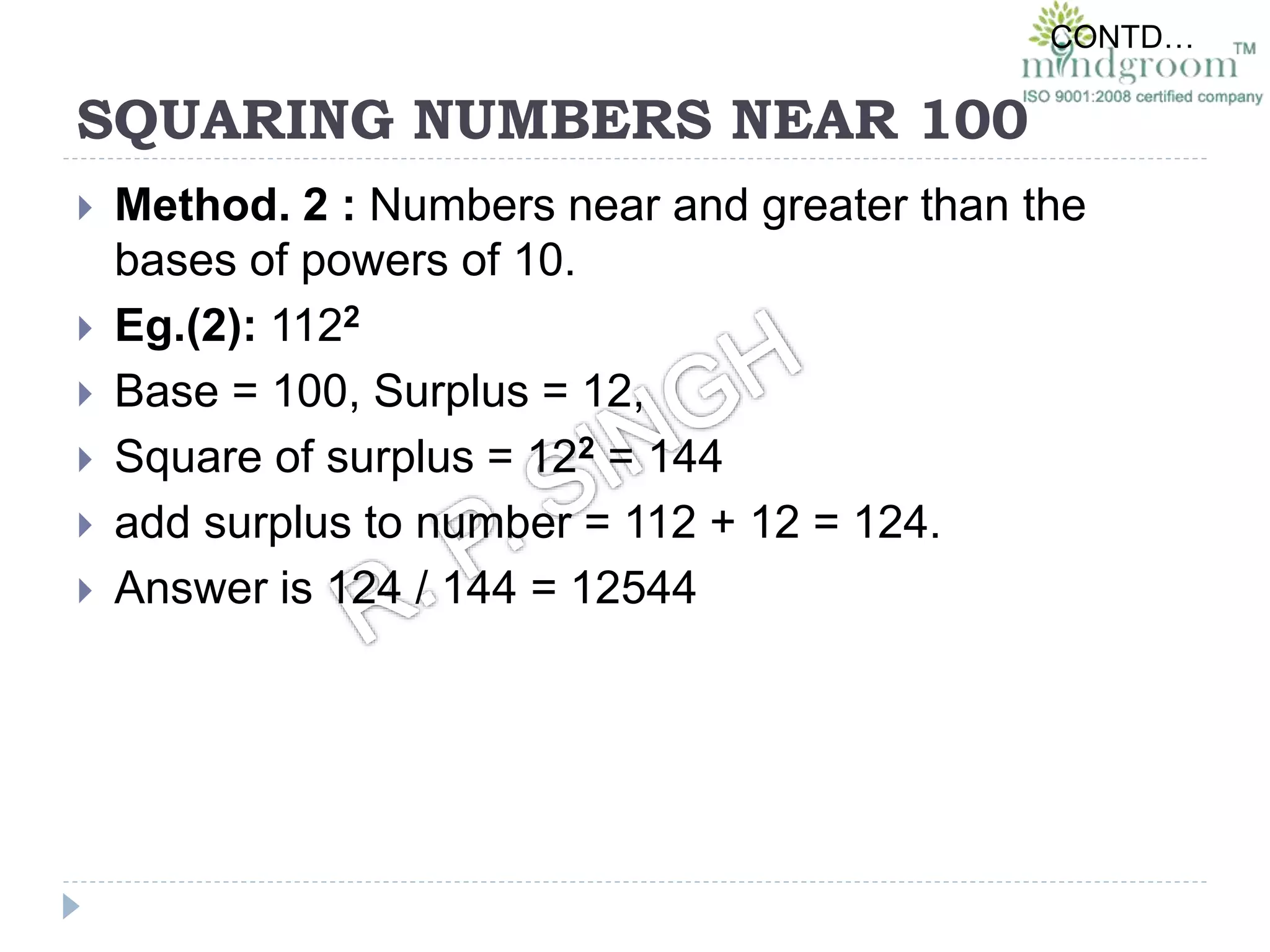
 Method. 2 : Numbers near and greater than the
bases of powers of 10.
 Eg.(2): 1122
 Base = 100, Surplus = 12,
 Square of surplus = 122 = 144
 add surplus to number = 112 + 12 = 124.
 Answer is 124 / 144 = 12544
CONTD…
SQUARING NUMBERS NEAR 1000
 Eg. 3: 9942 Base is 1000
Deficit is 1000 - 994 = 6. Square of it is 36.
Deficiency subtracted from 994 gives 994 - 6 = 988
Answer is 988 / 036 [since base is 1000]
CONTD…
SQUARING NUMBERS NEAR 50
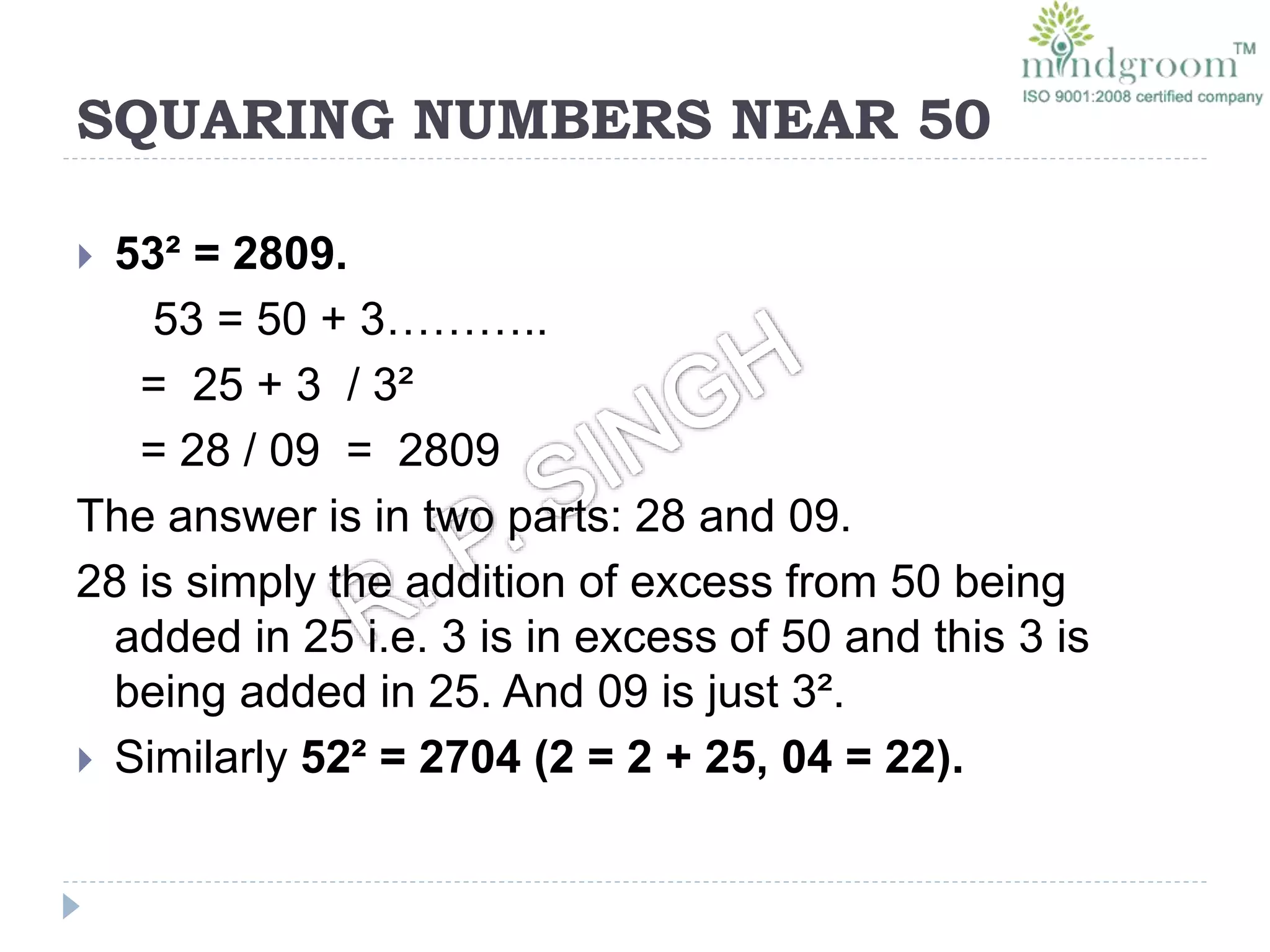
 53² = 2809.
53 = 50 + 3………..
= 25 + 3 / 3²
= 28 / 09 = 2809
The answer is in two parts: 28 and 09.
28 is simply the addition of excess from 50 being
added in 25 i.e. 3 is in excess of 50 and this 3 is
being added in 25. And 09 is just 3².
 Similarly 52² = 2704 (2 = 2 + 25, 04 = 22).
SQUARING NUMBERS NEAR 50
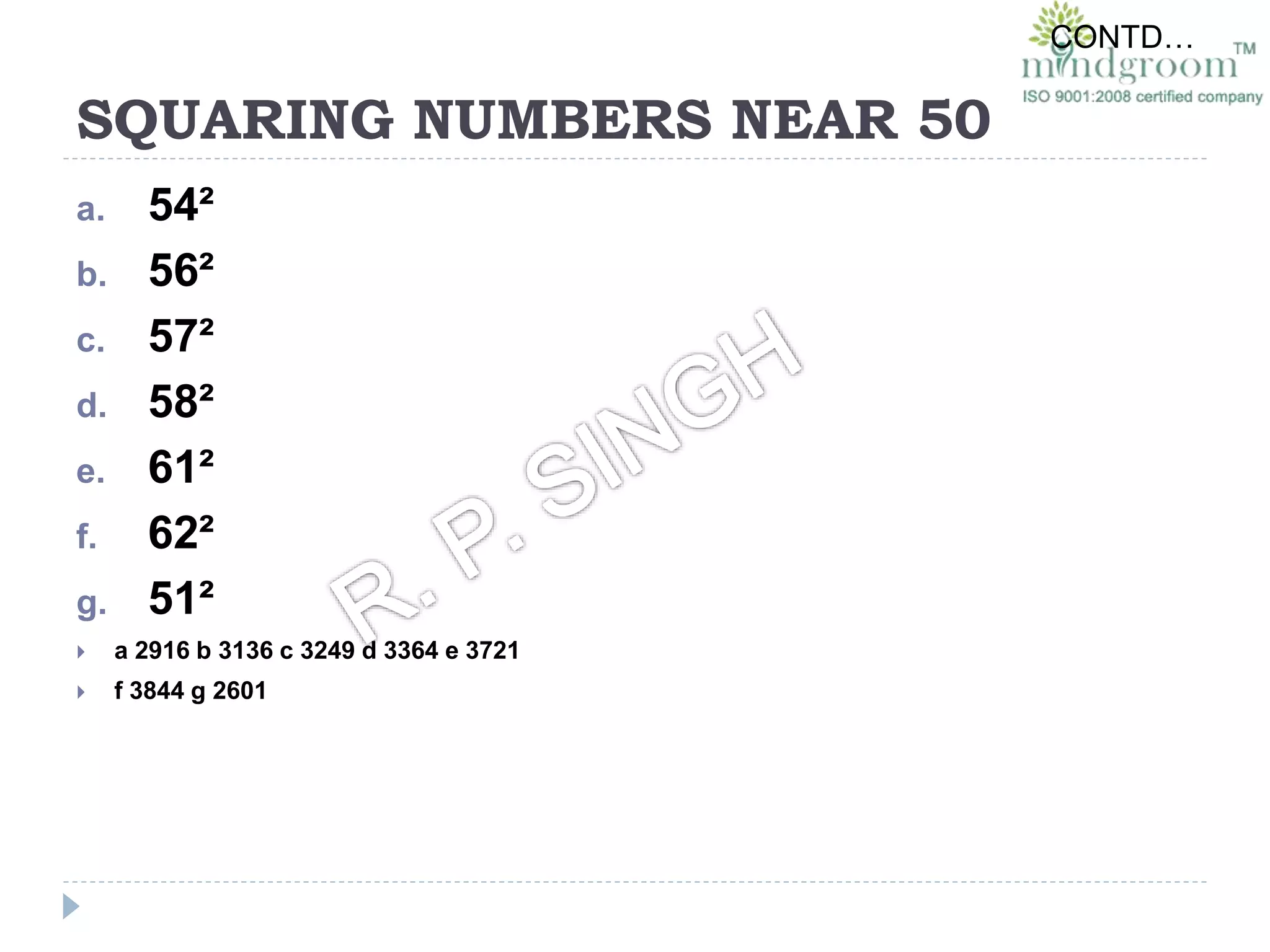
a. 54²
b. 56²
c. 57²
d. 58²
e. 61²
f. 62²
g. 51²
 a 2916 b 3136 c 3249 d 3364 e 3721
 f 3844 g 2601
CONTD…
SQUARING NUMBERS NEAR 50
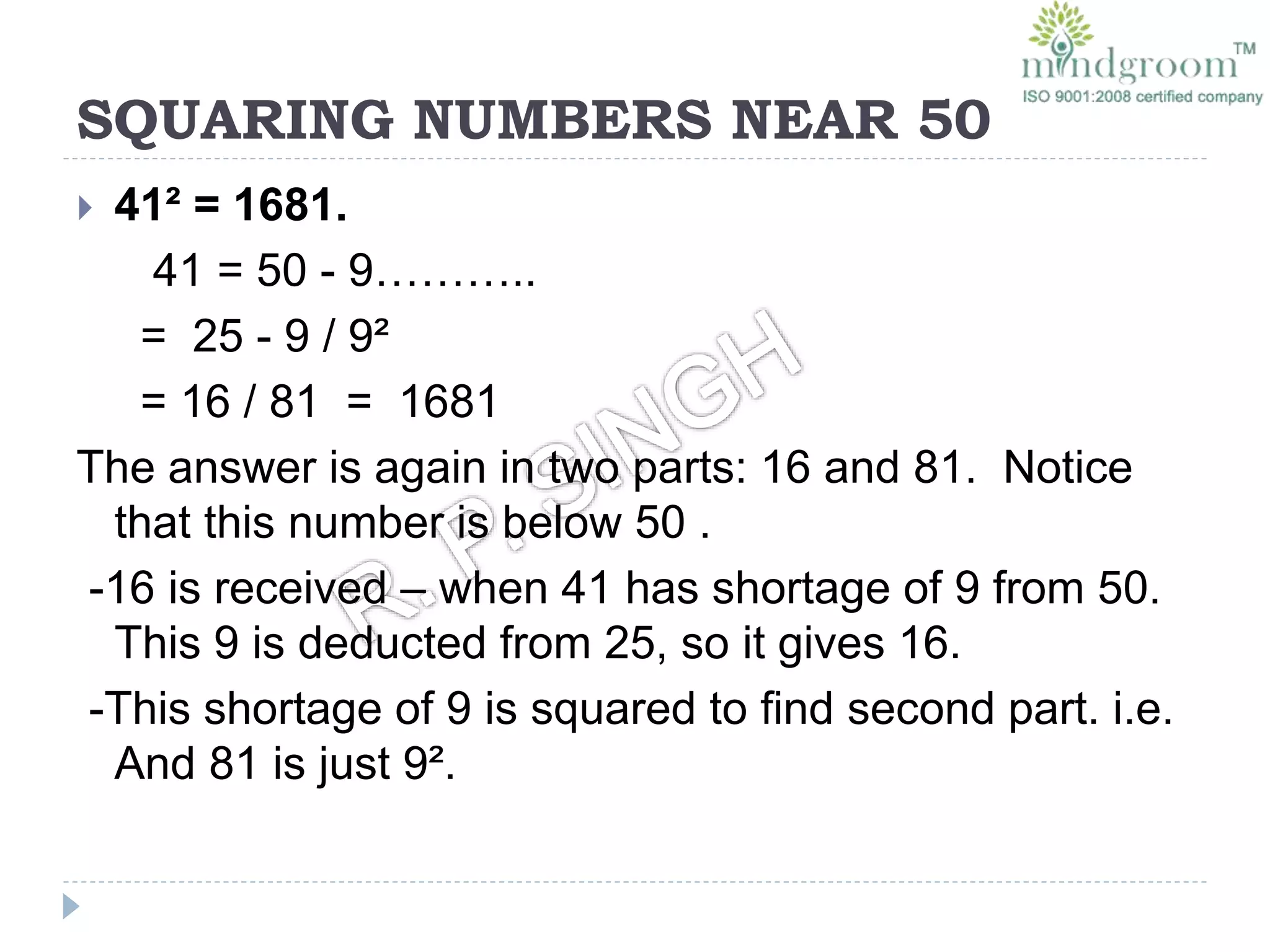
 41² = 1681.
41 = 50 - 9………..
= 25 - 9 / 9²
= 16 / 81 = 1681
The answer is again in two parts: 16 and 81. Notice
that this number is below 50 .
-16 is received – when 41 has shortage of 9 from 50.
This 9 is deducted from 25, so it gives 16.
-This shortage of 9 is squared to find second part. i.e.
And 81 is just 9².
SQUARING NUMBERS NEAR 50
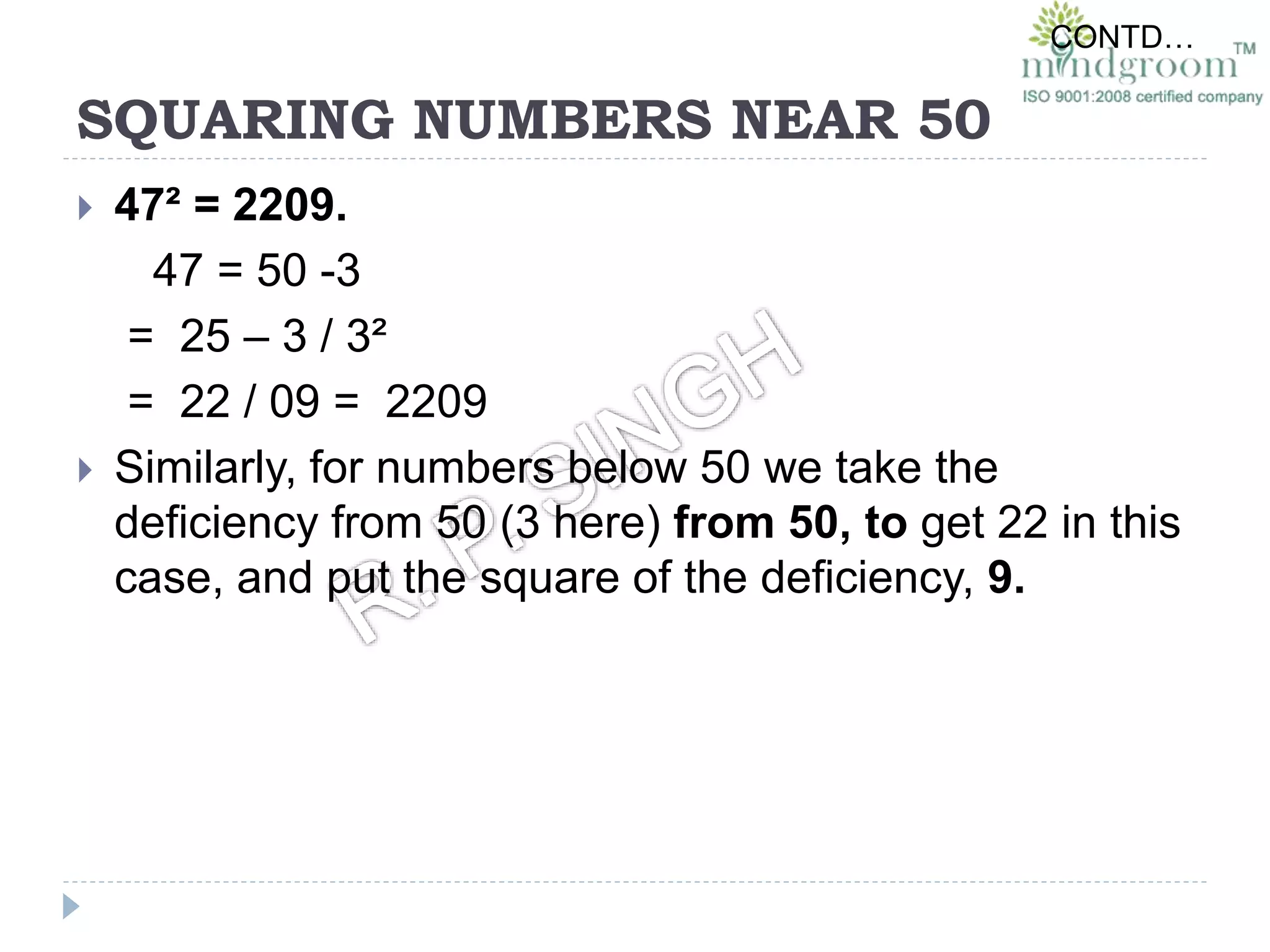
 47² = 2209.
47 = 50 -3
= 25 – 3 / 3²
= 22 / 09 = 2209
 Similarly, for numbers below 50 we take the
deficiency from 50 (3 here) from 50, to get 22 in this
case, and put the square of the deficiency, 9.
CONTD…
SQUARING NUMBERS NEAR 50
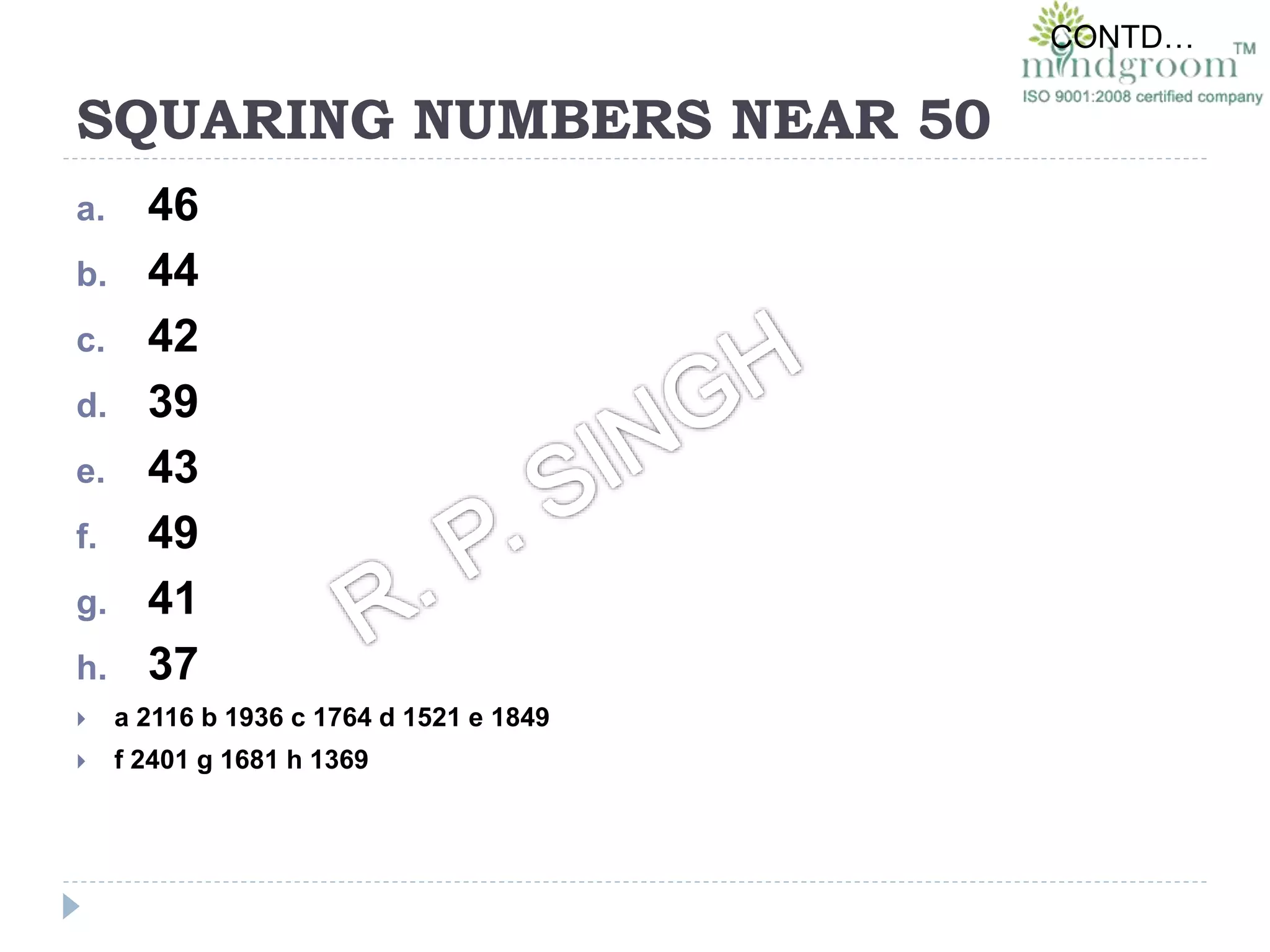
a. 46
b. 44
c. 42
d. 39
e. 43
f. 49
g. 41
h. 37
 a 2116 b 1936 c 1764 d 1521 e 1849
 f 2401 g 1681 h 1369
CONTD…
SQUARING
 Method - 3: This is applicable to numbers which are near
to multiples of 10, 100, 1000 .... etc. For this we combine
the upa-Sutra 'anurupyena' and 'yavadunam
tavadunikritya varganca yojayet' together.
 Example 1: 3882 Nearest base = 400.
We treat 400 as 4 x 100. As the number is less than the
base we proceed as follows
Number 388, deficit = 400 - 388 = 12
Since it is less than base, deduct the deficit i.e. 388 - 12 =
376.
multiply this result by 4 since base is 4 X 100 = 400.
376 x 4 = 1504
Square of deficit = 122 = 144.
Hence answer is 1504 / 144 = 150544 [since we have
taken multiples of 100].
SQUARING
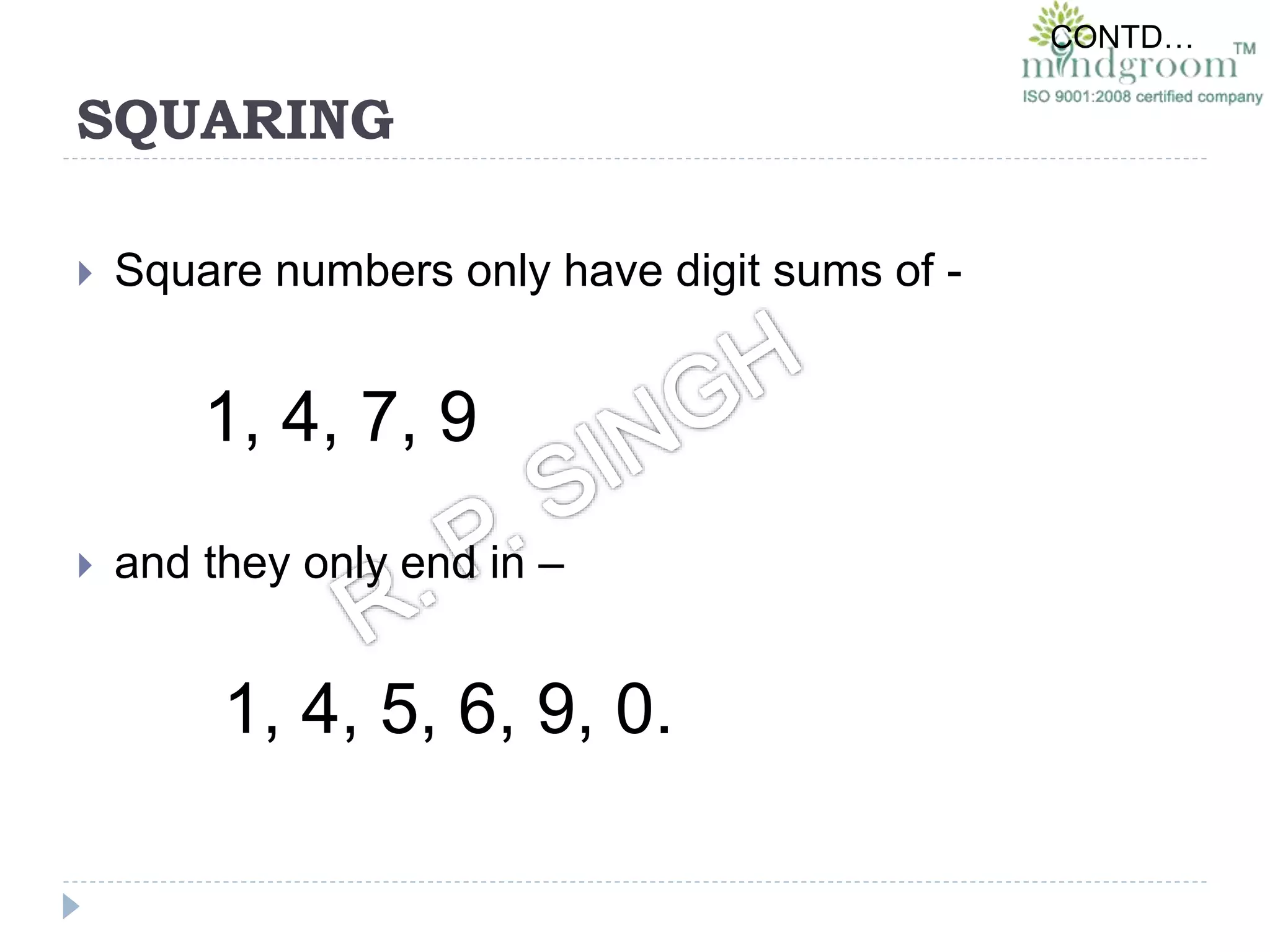
 Square numbers only have digit sums of -
1, 4, 7, 9
 and they only end in –
1, 4, 5, 6, 9, 0.
CONTD…
SQUARING
Which are not square numbers (judging by the above
results)?
a. 4539
b. 5776
c. 6889
d. 5271
e. 104976
f. 65436
g. 27478
h. 75379
a, d, f, g
CONTD…
SQUARE ROOTS OF PERFECT SQUARES
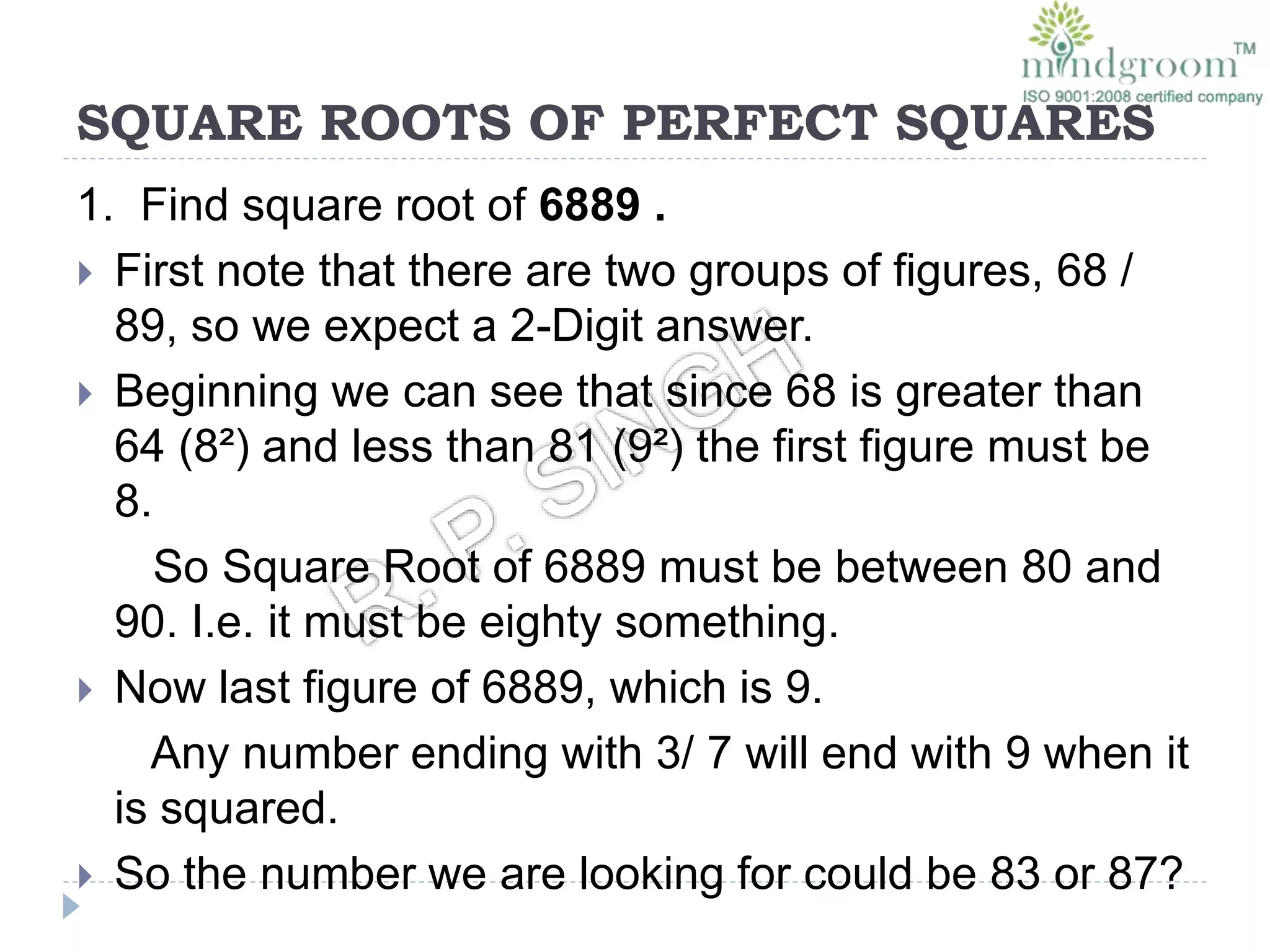
1. Find square root of 6889 .
 First note that there are two groups of figures, 68 /
89, so we expect a 2-Digit answer.
 Beginning we can see that since 68 is greater than
64 (8²) and less than 81 (9²) the first figure must be
8.
So Square Root of 6889 must be between 80 and
90. I.e. it must be eighty something.
 Now last figure of 6889, which is 9.
Any number ending with 3/ 7 will end with 9 when it
is squared.
 So the number we are looking for could be 83 or 87?
SQUARE ROOTS OF PERFECT SQUARES
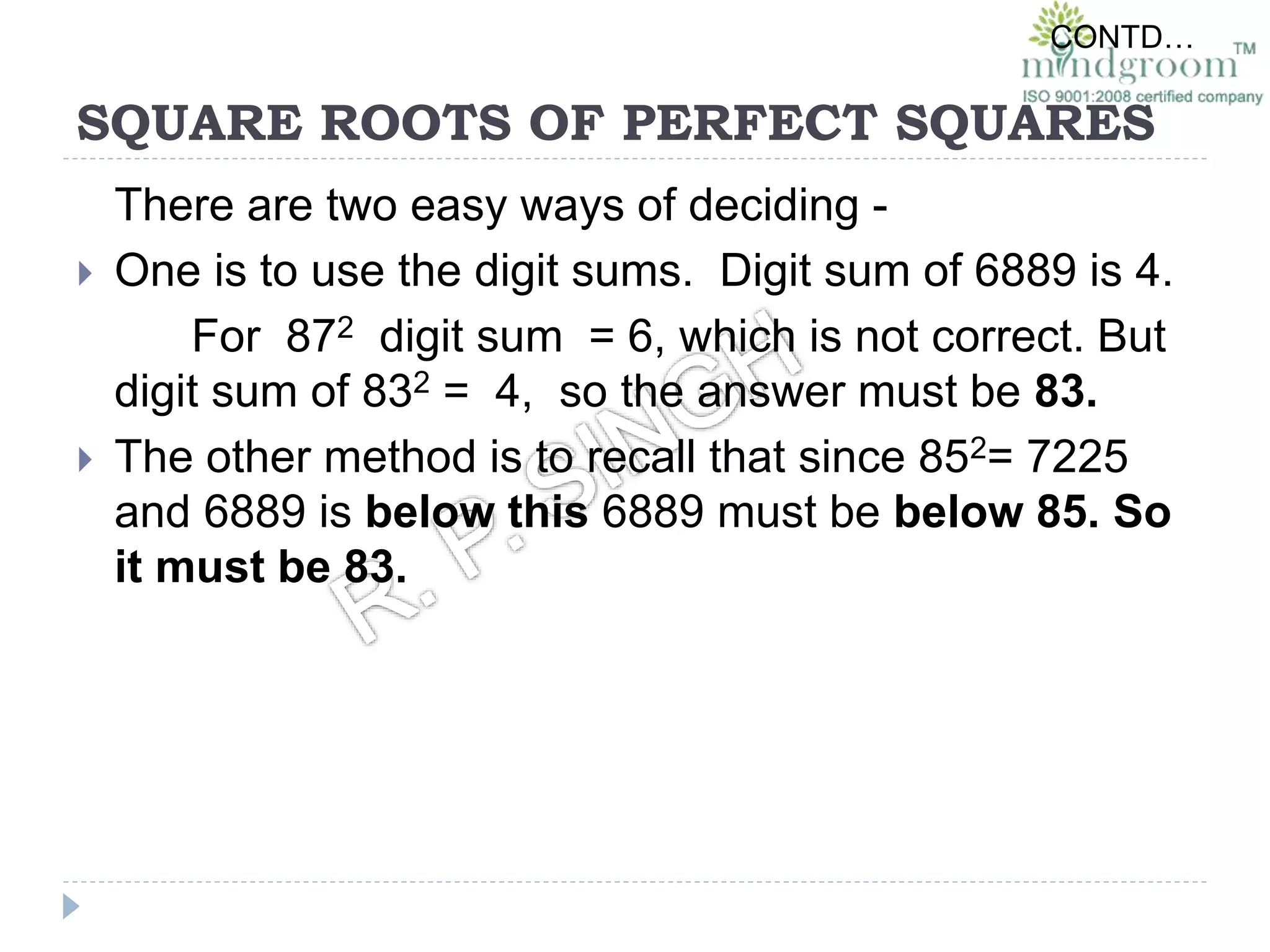
There are two easy ways of deciding -
 One is to use the digit sums. Digit sum of 6889 is 4.
For 872 digit sum = 6, which is not correct. But
digit sum of 832 = 4, so the answer must be 83.
 The other method is to recall that since 852= 7225
and 6889 is below this 6889 must be below 85. So
it must be 83.
CONTD…
SQUARE ROOTS OF PERFECT SQUARES
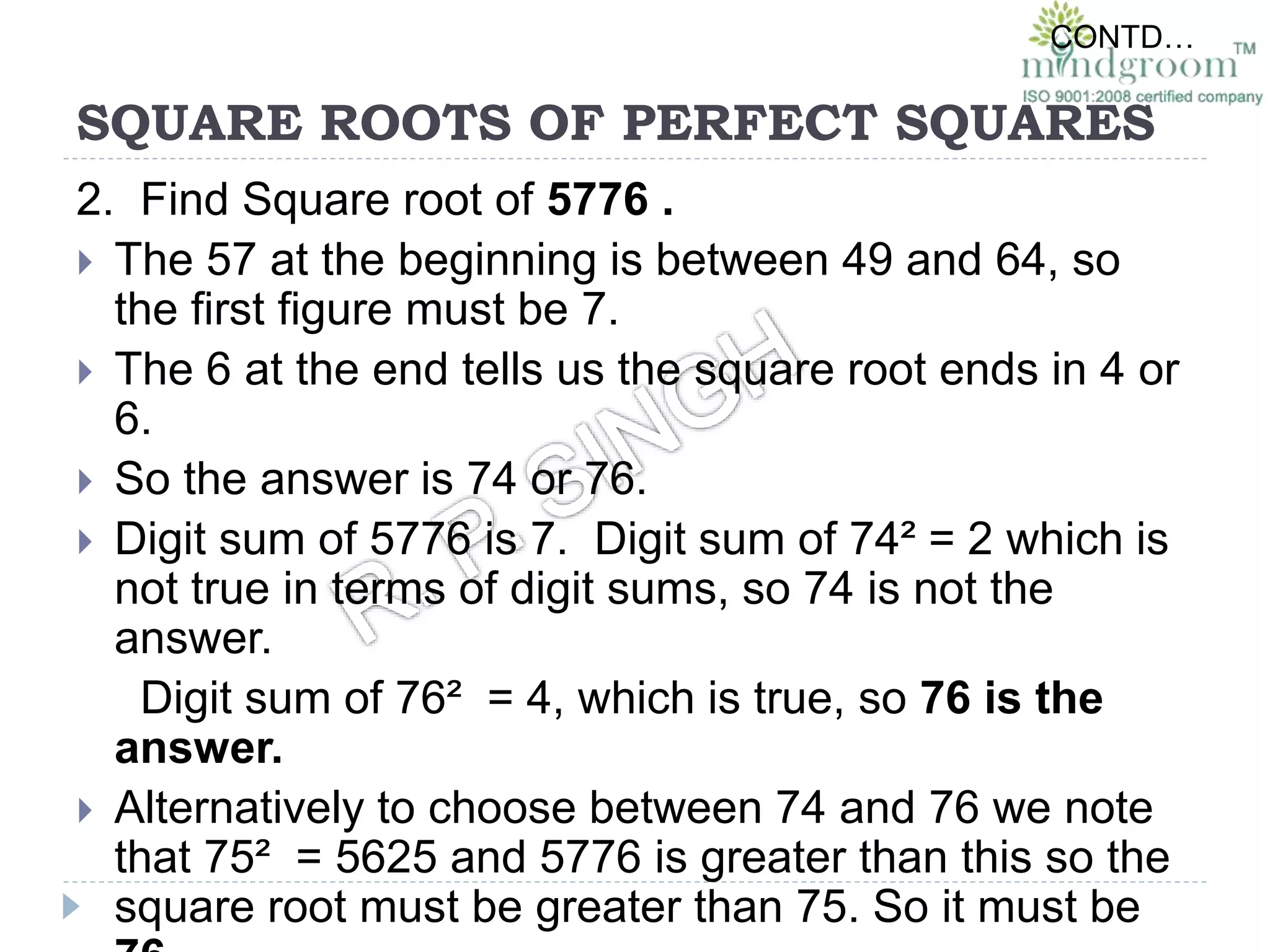
2. Find Square root of 5776 .
 The 57 at the beginning is between 49 and 64, so
the first figure must be 7.
 The 6 at the end tells us the square root ends in 4 or
6.
 So the answer is 74 or 76.
 Digit sum of 5776 is 7. Digit sum of 74² = 2 which is
not true in terms of digit sums, so 74 is not the
answer.
Digit sum of 76² = 4, which is true, so 76 is the
answer.
 Alternatively to choose between 74 and 76 we note
that 75² = 5625 and 5776 is greater than this so the
square root must be greater than 75. So it must be
CONTD…
SQUARE ROOTS OF PERFECT SQUARES
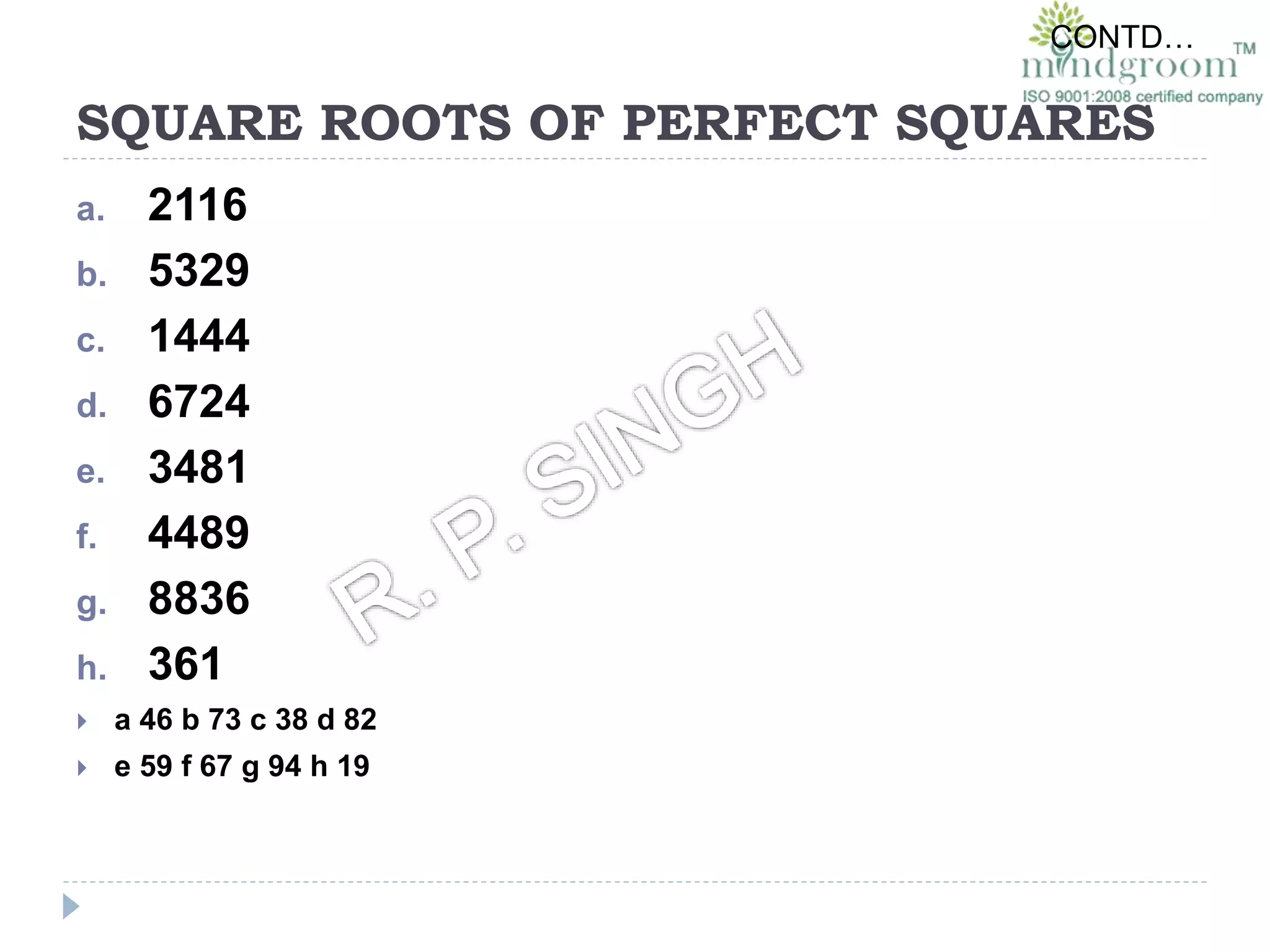
a. 2116
b. 5329
c. 1444
d. 6724
e. 3481
f. 4489
g. 8836
h. 361
 a 46 b 73 c 38 d 82
 e 59 f 67 g 94 h 19
CONTD…
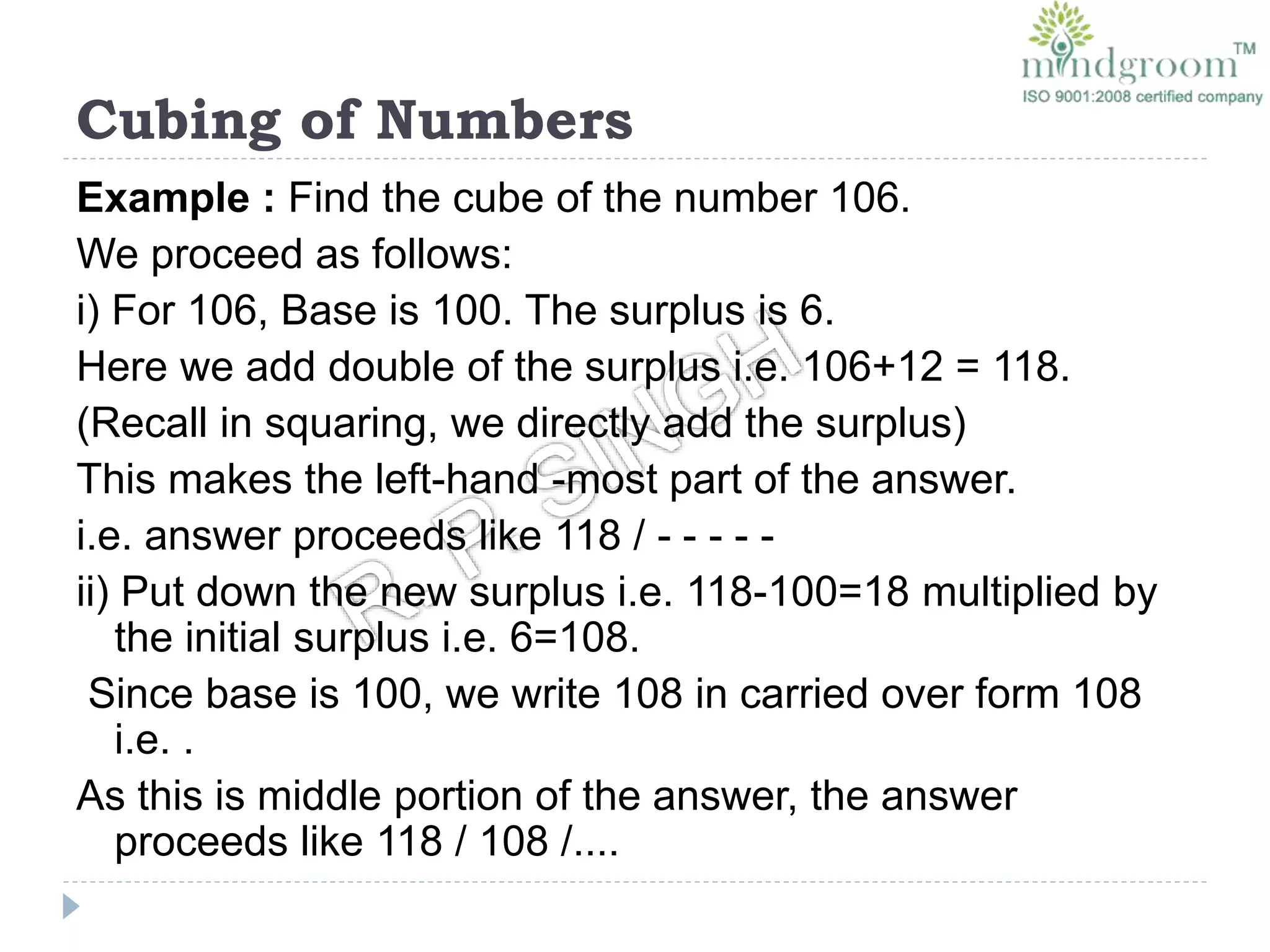
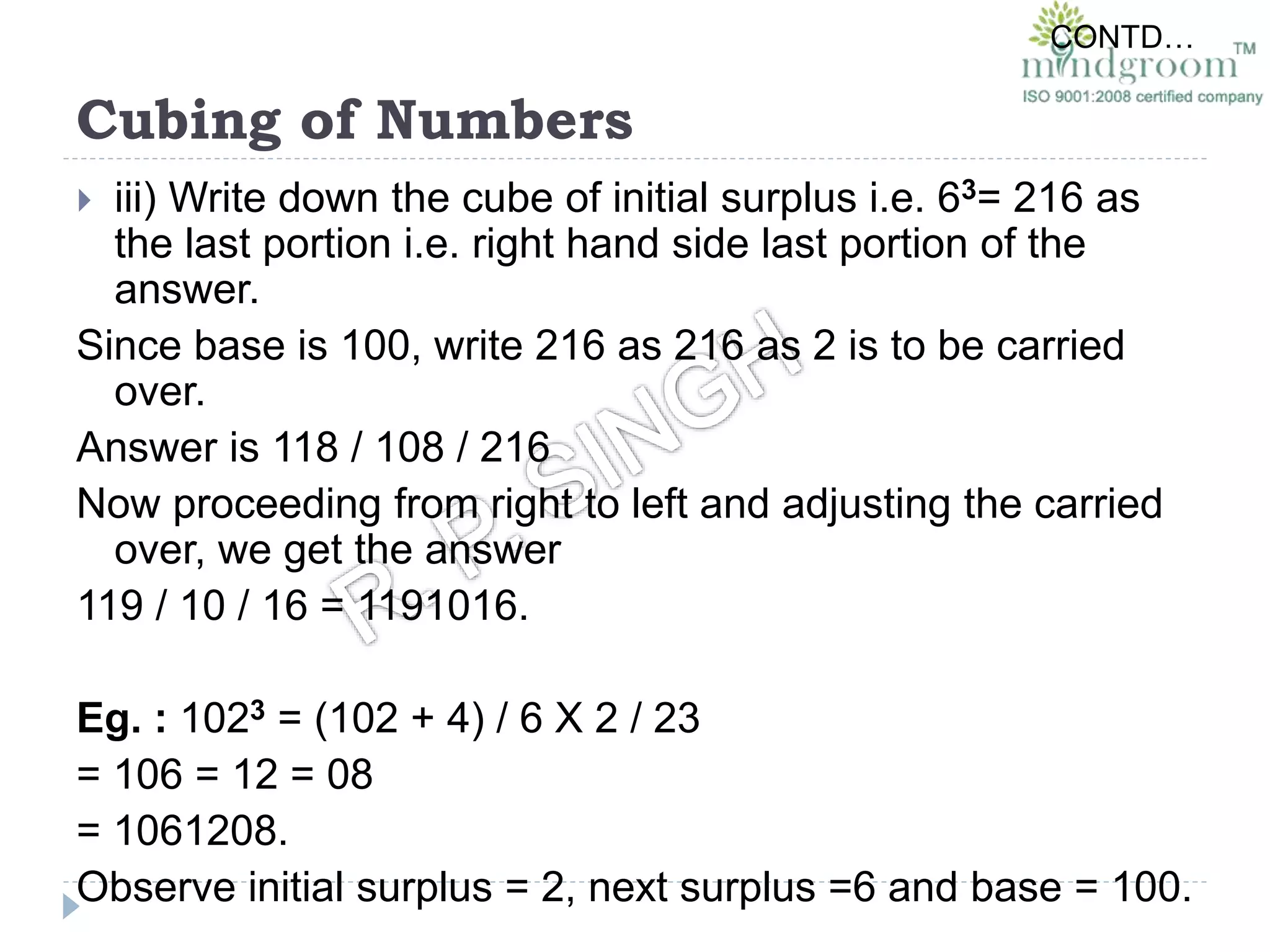
Cubing of Numbers
Example : Find the cube of the number 106.
We proceed as follows:
i) For 106, Base is 100. The surplus is 6.
Here we add double of the surplus i.e. 106+12 = 118.
(Recall in squaring, we directly add the surplus)
This makes the left-hand -most part of the answer.
i.e. answer proceeds like 118 / - - - - -
ii) Put down the new surplus i.e. 118-100=18 multiplied by
the initial surplus i.e. 6=108.
Since base is 100, we write 108 in carried over form 108
i.e. .
As this is middle portion of the answer, the answer
proceeds like 118 / 108 /....
Cubing of Numbers
 iii) Write down the cube of initial surplus i.e. 63= 216 as
the last portion i.e. right hand side last portion of the
answer.
Since base is 100, write 216 as 216 as 2 is to be carried
over.
Answer is 118 / 108 / 216
Now proceeding from right to left and adjusting the carried
over, we get the answer
119 / 10 / 16 = 1191016.
Eg. : 1023 = (102 + 4) / 6 X 2 / 23
= 106 = 12 = 08
= 1061208.
Observe initial surplus = 2, next surplus =6 and base = 100.
CONTD…
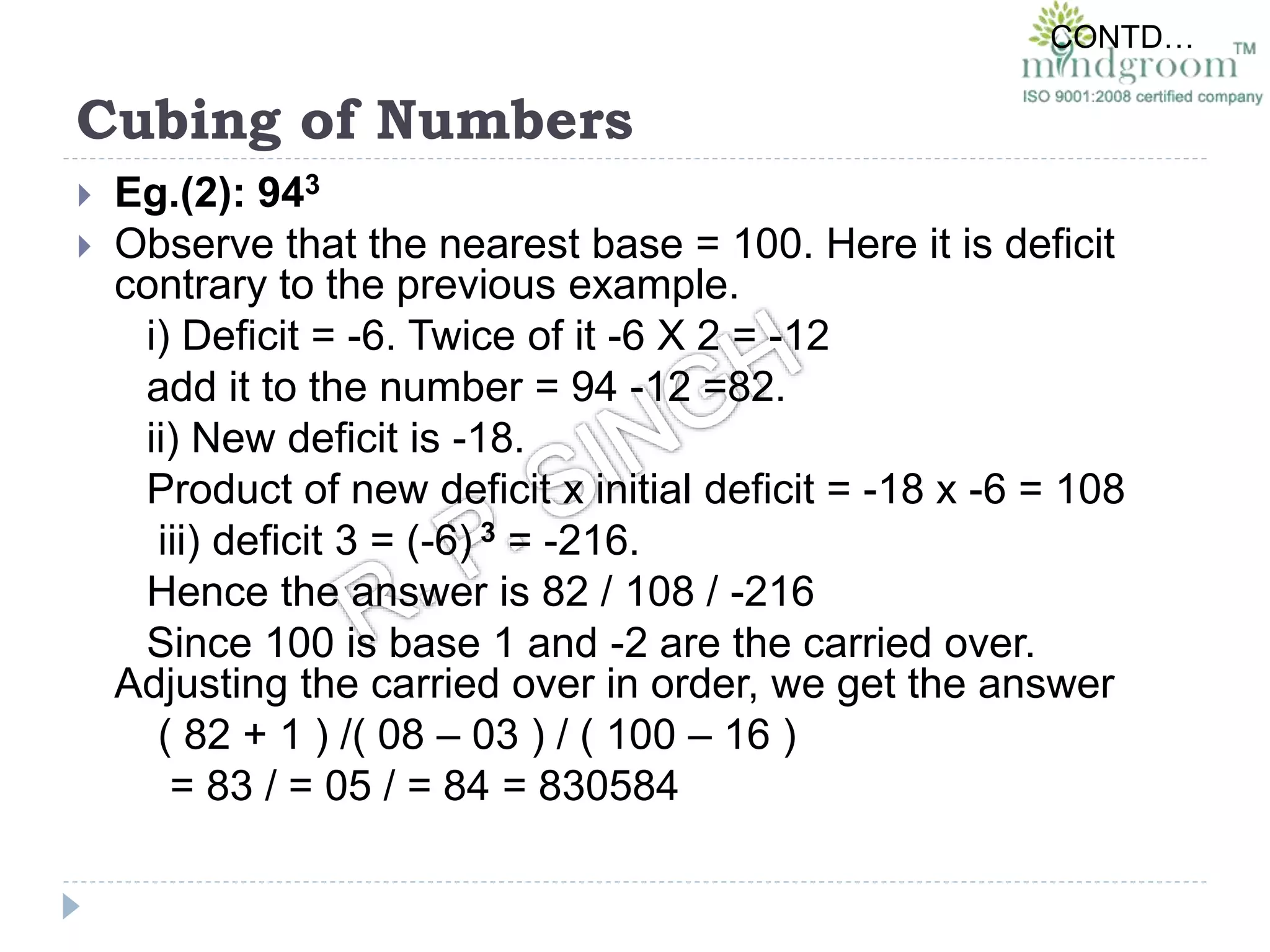
Cubing of Numbers
 Eg.(2): 943
 Observe that the nearest base = 100. Here it is deficit
contrary to the previous example.
i) Deficit = -6. Twice of it -6 X 2 = -12
add it to the number = 94 -12 =82.
ii) New deficit is -18.
Product of new deficit x initial deficit = -18 x -6 = 108
iii) deficit 3 = (-6) 3 = -216.
Hence the answer is 82 / 108 / -216
Since 100 is base 1 and -2 are the carried over.
Adjusting the carried over in order, we get the answer
( 82 + 1 ) /( 08 – 03 ) / ( 100 – 16 )
= 83 / = 05 / = 84 = 830584
CONTD…
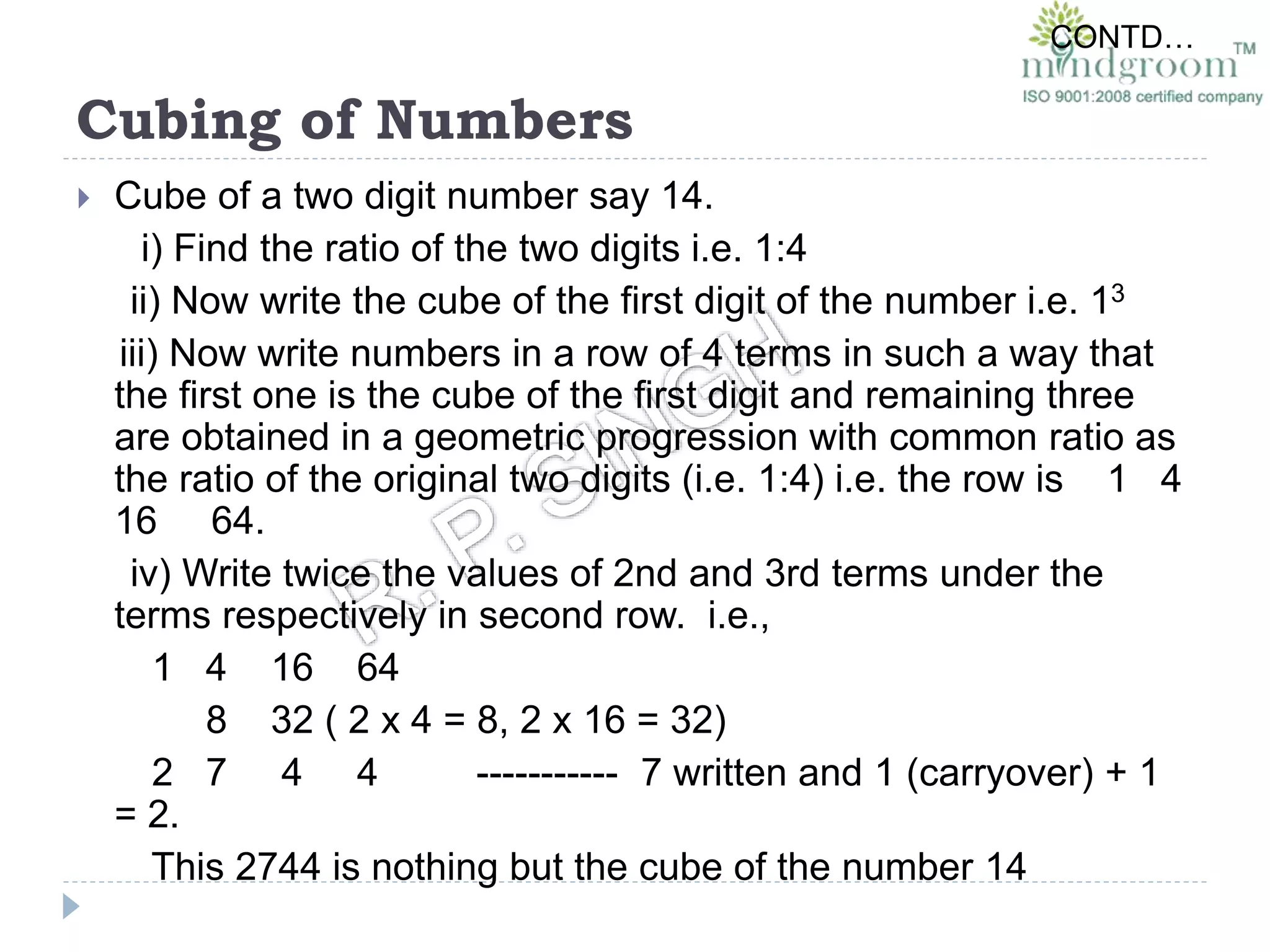
Cubing of Numbers
 Cube of a two digit number say 14.
i) Find the ratio of the two digits i.e. 1:4
ii) Now write the cube of the first digit of the number i.e. 13
iii) Now write numbers in a row of 4 terms in such a way that
the first one is the cube of the first digit and remaining three
are obtained in a geometric progression with common ratio as
the ratio of the original two digits (i.e. 1:4) i.e. the row is 1 4
16 64.
iv) Write twice the values of 2nd and 3rd terms under the
terms respectively in second row. i.e.,
1 4 16 64
8 32 ( 2 x 4 = 8, 2 x 16 = 32)
2 7 4 4 ----------- 7 written and 1 (carryover) + 1
= 2.
This 2744 is nothing but the cube of the number 14
CONTD…
Cubing of Numbers
 36
 Take ratio of 3 : 6
 1:2
 Take cube of 3 --- 27
 Write in same ratio 3 times
 27 54 108 216
 108 216
 27 162 324 216
 46656
CONTD…
Vedic mathematics ALL

Vedic mathematics ALL

  • 1.
  • 2.
    INDEX  Introduction ofVedic Mathematics.  Benefits of Vedic Mathematics.  The Ten Point Circle – representing numbers on a circle.  Mental Addition  Subtraction  Doubling/ Halving  Multiplication  Squaring/ Squareroots  Cubing
  • 3.
    Introduction  Vedic Mathematicsis the name given to the ancient system to the mathematics, which was rediscovered from the Vedas between 1911 and 1918 by Sri Bharti Krishna Tirathji (1884-1960), former Jagadguru Sankaracharya of Puri.  These formulae describe the way the mind naturally works and are therefore a great help in directing the student to the appropriate method of solution.
  • 4.
    WHY?  Vedic Mathematicsconverts a tedious subject into a playful and blissful one which students learn with smiles.  Saves a lot of time and effort in solving the problems compared to the formal methods presently in vogue.  Involves rational thinking, which, in the process, helps improve intuition.
  • 5.
    WHY?  It allowsfor constant expression of a student's creativity, and is found to be easier to learn.  The element of choice and flexibility at each stage keeps the mind lively and alert to develop clarity of thought and intuition, and thereby a holistic development of the human brain automatically takes place.  Vedic Mathematics with its special features has the inbuilt potential to solve the psychological problem of Mathematics - anxiety. Vedic Mathematics can be used to remove ‘Mathphobia.’ CONTD…
  • 6.
    The Ten PointCircle 20 10 18 8 7 17 6 16 5 15 4 14 3 13 12 2 11 1 19 9
  • 7.
    Addition  1 +9 = 10,  2 + 8 = 10,  3 + 7 = 10,  4 + 6 = 10,  5 + 5 = 10
  • 8.
    Addition a. 6 +4 b. 4 + 16 c. 5 + 25 d. 13 + 7 e. 22 + 8 f. 38 + 2 g. 54 + 6 h. 47 + 3 i. 61 + 9 j. 85 + 5  a 10 b 20 c 30 d 20 e 30  f 40 g 60 h 50 i 70 j 90 CONTD…
  • 9.
    Addition a. 3 +2 + 8 b. 9 + 8 + 1 c. 7 + 2 + 4 + 3 d. 4 + 5 + 5 + 7 e. 8 + 9 + 2 f. 7 + 6 + 2 + 4 g. 8 + 8 + 3 + 2 h. 7 + 6 + 3 + 4 i. 4 + 7 + 4 + 2 j. 6 + 9 + 2 + 2 k. 7 + 5 + 1 + 2 l. 3 + 5 + 4 + 3  a 13 b 18 c 16 d 21 e 19 f 19  g 21 h 20 i 17 j 19 k 15 l 15 CONTD…
  • 10.
    Addition a. 37 +23 b. 42 + 28 c. 54 + 16 d. 49 + 21 e. 45 + 35 f. 72 + 18 g. 38 + 22 h. 35 + 35  a 60 b 70 c 70 d 70  e 80 f 90 g 60 h 70 CONTD…
  • 11.
    Addition a. 37 +47 b. 55 + 28 c. 47 + 25 d. 29 + 36 e. 56 + 25 f. 38 + 26 g. 29 + 44 h. 35 + 49  a 84 b 83 c 72 d 65  e 81 f 64 g 73 h 84 CONTD…
  • 12.
    a. 55 +9 b. 64 + 9 c. 45 + 9 d. 73 + 9 e. 82 + 9 f. 26 + 9 g. 67 + 9 h. 38 + 9  a 64 b 73 c 54 d 82  e 91 f 35 g 76 h 47 CONTD… Addition
  • 13.
    Addition a. 44 +19 b. 55 + 29 c. 36 + 49 d. 73 + 19 e. 47 + 39 f. 26 + 59 g. 17 + 69 h. 28 + 29  a 63 b 84 c 85 d 92  e 86 f 85 g 86 h 57 CONTD…
  • 14.
    Addition a. 44 +18 b. 44 + 27 c. 55 + 28 d. 35 + 37 e. 62 + 29 f. 36 + 37 g. 19 + 19 h. 28 + 29  a 62 b 71 c 83 d 72  e 91 f 73 g 38 h 57 CONTD…
  • 15.
    Addition a. 39 +44 b. 33 + 38 c. 48 + 35 d. 27 + 34 e. 33 + 28 f. 9 + 73 g. 18 + 19 h. 26 + 27  a 83 b 71 c 83 d 61  e 61 f 82 g 37 h 53 CONTD…
  • 16.
    SUBTRACTING a. 44 –19 b. 66 – 29 c. 88 – 49 d. 55 – 9 e. 52 – 28 f. 72 – 48 g. 66 – 38 h. 81 – 58 i. 83 – 36 j. 90 – 66 k. 55 – 27  a 25 b 37 c 39 d 46  e 24 f 24 g 28 h 23  i 47 j 24 k 28
  • 17.
    DOUBLING  Adding twoof the same number is called doubling.  It comes under the Proportionately formula of Vedic Mathematics. a. 24 b. 41 c. 14 d. 45 e. 15 f. 25 g. 36 h. 27 i. 18 j. 29 k. 34 l. 48  a 48 b 82 c 28 d 90 e 30 f 50  g 72 h 54 i 36 j 58 k 68 l 96
  • 18.
    DOUBLING  To double68 we just think of doubling 60 and 8 and then adding. Double 60 is 120, double 8 is 16. And adding 120 and 16 gives 136.  To double 680 we double 68 and put ‘0’ on the end: 1360. CONTD…
  • 19.
    DOUBLING a. 58 b. 61 c.73 d. 65 e. 66 f. 88 g. 76 h. 91 i. 380  a 116 b 122 c 146 d 130 e 132  f 176 g 152 h 182 i 760 CONTD…
  • 20.
    DOUBLING  To double273 we double 270 and 3. So you get 540 + 6 = 546.  To double 636 you can double 600 and 36 to get 1200 and 72. So the answer is 1272. CONTD…
  • 21.
    DOUBLING a. 362 b. 453 c.612 d. 319 e. 707 f. 610 g. 472 h. 626 i. 1234 j. 663  a 724 b 906 c 1224 d 638 e 1414  f 1220 g 944 h 1252 i 2468 j 1326 CONTD…
  • 22.
    MULTIPLYING BY 4,8  You can multiply by 4 by doubling a number twice.  And to multiply by 8, double the number three times.  So for 35 × 4 you double 35 to get 70, and then double again to get 140.  Then 35 × 4 = 140  For 26 × 8 you double three times.  Doubling 26 gives 52, doubling 52 gives 104, doubling 104 gives 208.  So 26 × 8 = 208
  • 23.
    MULTIPLYING BY 4,8 a. 53 × 4 b. 28 × 4 c. 33 × 4 d. 61 × 4 e. 18 × 4 f. 81 × 4 g. 16 × 4 h. 16 × 8 i. 22 × 8 j. 45 × 8 a 212 b 112 c 132 d 244 e 72 f 324 g 64 h 128 i 176 j 360 CONTD…
  • 24.
    MULTIPLYING BY 4,8  For 7½ × 8 you double 7½ three times.  You get 15, 30, 60, so 7½ × 8 = 60.  For 2¾ × 8 you double 2¾ three times.  You get 5½, 11, 22, so 2¾ × 8 = 22. CONTD…
  • 25.
    MULTIPLYING BY 4,8 a. 8½ × 4 b. 11½ × 8 c. 19½ × 4 d. 2¼ × 4 e. 5½ × 8 f. 9½ × 4 g. 30½ × 4 h. 3¼ × 4  a 34 b 92 c 78 d 9  e 44 f 38 g 122 h 13 CONTD…
  • 26.
    HALVING  So halfof 8 is 4.  Half of 60 is 30.  Half of 30 is 15, because two 15’s make 30 (or by halving 20 and 10).
  • 27.
    HALVING a. 10 b. 6 c.40 d. 14 e. 50 f. 90 a 5 b 3 c 20 d 7 e 25 f 45 CONTD…
  • 28.
    HALVING  Also halfof 46 is 23 because you can halve the 4 and the 6 to get 2 and 3.  Half of 54 is 27 because 54 is 50 and 4.  And halving 50, 4 you get 25, 2,  which make 27.  Similarly half of 78 = half of 70 + half of 8 = 35 + 4 = 39. CONTD…
  • 29.
    HALVING a. 36 b. 28 c.52 d. 18 e. 34 f. 86 g. 56 h. 32 i. 62 j. 98  a 18 b 14 c 26 d 9 e 17  f 43 g 28 h 16 i 31 j 49 CONTD…
  • 30.
    DIVIDING BY 4,8  Divide 72 by 4.  You halve 72 twice: half of 72 is 36, half of 36 is 18.  So 72 ÷ 4 = 18.  Divide 104 by 8.  Here you halve three times:  Half of 104 is 52, half of 52 is 26, half of 26 is 13.  So 104 ÷ 8 = 13.
  • 31.
    DIVIDING BY 4,8 Divide by 4: a. 56 b. 68 c. 84 d. 180 e. 244 Divide by 8: f. 120 g. 440 h. 248 i. 216 j. 44  a 14 b 17 c 21 d 45 e 61  f 15 g 55 h 31 i 27 j 5½ CONTD…
  • 32.
    MULTIPLYING BY 5,50, 25  We can multiply by 5 by multiplying by 10 and halving the result.  Find 44 × 5.  We find half of 440, which is 220. So 44 × 5 = 220.  Find 87 × 5.  Half of 870 is 435. So 87 × 5 = 435.  Similarly 4.6 × 5 = half of 46 = 23.
  • 33.
    MULTIPLYING BY 5,50, 25 a. 68 × 5 b. 42 × 5 c. 36 × 5 d. 426 × 5 e. 8.6 × 5 f. 5.4 × 5 g. 4.68 × 5 h. 0.66 × 5  a 340 b 210 c 180 d 2130  e 43 f 27 g 23.4 h 3.3 CONTD…
  • 34.
    MULTIPLYING BY 5,50, 25  Find 27 × 50.  We multiply 27 by 100, and halve the result. Half of 2700 is 1350.  So 27 × 50 = 1350.  Similarly 5.2 × 50 = half of 520 = 260.  Find 82 × 25.  25 is half of half of 100, so to multiply a number by 25 we multiply it by 100 and  halve twice.  So we find half of half of 8200, which is 2050. 82 × 25 = 2050.  Similarly 6.8 × 25 = half of half of 680 = 170. CONTD…
  • 35.
    MULTIPLYING BY 5,50, 25 a. 46 × 50 b. 864 × 50 c. 72 × 25 d. 85 × 25 e. 86.8 × 50 f. 4.2 × 50 g. 34.56 × 50 h. 2.8 × 25  a 2300 b 43200 c 1800 d 2125  e 4340 f 210 g 1728 h 70 CONTD…
  • 36.
    DIVIDING BY 5 For dividing by 5 we can double and then divide by 10.  85 ÷ 5 = 17.  So 85 is doubled to 170, and dividing by 10 gives 17.  665 ÷ 5 = 133 since 665 doubled is 1330.  73 ÷ 5 = 14.6.  Similarly here double 73 is 146, and dividing by 10 gives 14.6.
  • 37.
    DIVIDING BY 5 a.65 b. 135 c. 375 d. 470 e. 505 a 13 b 27 c 75 d 94 e 101 CONTD…
  • 38.
    DIVIDING BY 50,25  Since 50 is half of 100 dividing by 50 involves doubling and dividing by 100.  Find 750 ÷ 50.  Doubling 750 gives 1500, and dividing this by 100 gives 15.  So 750 ÷ 50 = 15.  Again the alternative formula The Ultimate and Twice the Penultimate tells us to  double the 7 and add on the one extra 50, giving 15 again.  54.32 ÷ 50 = 1.0864.  Doubling 54.32 gives 108.64, and dividing by 100 gives 1.0864.
  • 39.
    DIVIDING BY 50,25  25 is a quarter of 100 so to divide by 25 we can double twice and divide by 100.  Find 425 ÷ 25.  Doubling 425 gives 850, and doubling this gives 1700.  Dividing by 100 then gives us 17. So 425 ÷ 25 = 17 CONTD…
  • 40.
    DIVIDING BY 50,25  Divide by 50: a. 650 b. 1250 c. 3300 d. 8.8  Divide by 25: e. 225 f. 550 g. 44 h. 137  a 13 b 25 c 66 d 0.176  e 9 f 22 ig1.76 h 5.48 CONTD…
  • 41.
    Multiplication  Urdhva -tiryagbhyam  (a) Multiplication of two 2 digit numbers.  Find the product 14 X 21  (b) Multiplication of two 3 digit numbers.  Find the product of 123 x 456
  • 42.
    Multiplication (a) Multiplication oftwo 2 digit numbers. Find 14 × 21. 1 4 x 2 1 =2 9 4  A: vertically on the left: 1 × 2 = 2,  B: crosswise: 1 × 1 = 1, 4 × 2 = 8 and 1 + 8 = 9,  C: vertically on the right: 4 × 1 = 4. CONTD…
  • 43.
    Multiplication  Find 23× 41. 2 3 x 4 1 = 9 4 3 The 3 steps give us: 2 × 4 = 8, 2 × 1 + 3 × 4 = 14, 3 × 1 = 3.  The 14 here involves a carry figure, so in building up the answer mentally from the left we merge these numbers as before.  The mental steps are: 8 8,14 = 94 (the 1 is carried over to the left) 94,3 = 943  So 23 × 41 = 943. CONTD…
  • 44.
    Multiplication  a 21 b 2 3 c 2 4 d 2 2 e 2 2 f 3 1  4 7 4 3 2 9 2 8 5 3 3 6  g 2 2 h 3 1 i 4 4 j 3 3 k 3 3 l 3 4  5 6 7 2 5 3 8 4 6 9 4 2  a 987 b 989 c 696 d 616 e 1 166 f 1 116  g 1 232 h 2 232 i 2 332 j 2 772 k 2 277 l 1 428 CONTD…
  • 45.
    Multiplication-(b) two 3digit numbers.  . . . . . .  . . . . . .  . . . . . .  . . . . . .  . . . . . . CONTD…
  • 46.
    Multiplication  Find 321× 321. 3 2 1 x 3 2 1 The 5 results are 9,12,10,4,1.  103041  The mental steps are 9  9,12 = 102  10 2,10 = 1030  1030,4,1 = 103041 CONTD…
  • 47.
    Multiplication  a 12 1 b 1 3 1 c 1 2 1 d 3 1 3 1 3 1 2 1 2 2 2 2 1 2 1 e 2 1 2 f 1 2 3 g 2 1 2 h 2 2 2  3 1 3 3 2 1 4 1 4 3 3 3 m 4 4 4 n 3 2 1 o 1 2 3 p 1 2 4  7 7 7 3 2 1 2 7 1 3 5 6  a 15 851 b 27 772 c 26 862 d 37 873  e 66 356 f 39 483 g 87 768 h 73 926  m 344 988 n 103 041 o 33 333 p 44 144 CONTD…
  • 48.
    Moving Multiplier  Find4321 × 32. 4 3 2 1 Similarly here we put 32 first of all at the extreme left. 3 2 Then vertically on the left, 4 × 3 = 12. And crosswise, 4×2 +3×3 = 17. 4 3 2 1 Then move the 32 along and multiply crosswise: 3 2 3×2 + 2×3 = 12. 4 3 2 1 Moving the 32 once again: 3 2 multiply crosswise, 2×2 + 1×3 = 7. Finally the vertical product on the right is 1×2 = 2.  These 5 results (in bold), 12,17,12,7,2 are combined mentally, as they are obtained, in the usual way:  12,17 = 137  137,12 = 1382  1382,7,2 = 138272
  • 49.
    Multiplication by 9,99,999… Ekanyunena Purvena 'One less than the previous‘ The use of this sutra in case of multiplication by 9,99,999…  a) The left hand side digit (digits) is ( are) obtained by applying the ekanyunena purvena i.e. by deduction 1 from the left side digit (digits) . e.g. ( i ) 7 x 9; 7 – 1 = 6 ( L.H.S. digit )  b) The right hand side digit is the complement or difference between the multiplier and the left hand side digit (digits) . i.e. 7 X 9 R.H.S is 9 - 6 = 3.  c) The two numbers give the answer; i.e. 7 X 9 = 63.
  • 50.
    Multiplication by 9,99,999… Example: 15 x 99 Step ( a ) : 15 – 1 = 14  Step ( b ) : 99 – 14 = 85 ( or 100 – 15 )  Step ( c ) : 15 x 99 = 1485 Example : 356 x 999 ( a ) : 356 – 1 = 355  Step ( b ) : 999 – 355 = 644 ( or 100 – 15 )  Step ( c ) : 356 x 999 = 355644 CONTD…
  • 51.
    Multiplication….near Base  NumberBase Number – Base Deviation 14 10 14 - 10 4 8 10 8 - 10 -2 or 97 100 97 - 100 -03 or 112 100 112 - 100 12 20 3
  • 52.
  • 53.
    Multiplication-Near the commonbases 11. Anurupyena  The upa-Sutra 'anurupyena' means 'proportionality'. This Sutra is highly useful to find products of two numbers when both of them are near the Common bases i.e powers of base 10 . It is very clear that in such cases the expected 'Simplicity ' in doing problems is absent.  Example : 46 X 43
  • 54.
    Multiplication-Near the commonbases  Method 1: Take the nearest higher multiple of 10. In this case it is 50. Treat it as 100 / 2 = 50.  46 -4  43 -7  39/28  1978  Method 2: For the example 1: 46X43. We take the same working base 50. We treat it as 50=5X10. i.e. we operate with 10 but not with 100 as in method.  46 -4  43 -7  39/28  195/28  1978 CONTD…
  • 55.
     Method 3:We take the nearest lower multiple of 10 since the numbers are 46 and 43 as in the first example, We consider 40 as working base and treat it as 4 X 10.  46 6  43 3  49/18  196/18  1978 Multiplication-Near the common bases CONTD…
  • 56.
    SQUARE  Ekadhikena Purvena TheSutra (formula) Ekādhikena Pūrvena means: “By one more than the previous one”. Squares of numbers ending in 5 : Thus 252 = 2 x (2+1) / 5 x 5 ( 5 x 5 will form last 2 digits of the square number.) = 2 X 3 / 5x5 = 6 / 25 = 625. similarly 652= 6 x (6+1) / 5 x 5 = 6 x 7 / 25 = 4225
  • 57.
    Multiplication - Samebase & sum 10  14. Antyayor Dasakepi  The Sutra signifies numbers of which the last digits added up give 10. i.e. the Sutra works in multiplication of numbers for example: 25 and 25, 47 and 43, 62 and 68, 116 and 114. Note that in each case the sum of the last digit of first number to the last digit of second number is 10. Further the portion of digits or numbers left wards to the last digits remain the same. At that instant use Ekadhikena on left hand side digits. Multiplication of the last digits gives the right hand part of the answer.
  • 58.
    Multiplication - Samebase & sum 10  Example- multiplication where sum of last digits are 10. and previous digits are same. 54 x 56 = 5 x 6 / 4 x 6 = 30 / 24 = 3024 79 x 71 = 7 x 8 / 9 x 1 = 56/09 = 5609 CONTD…
  • 59.
    Multiplication - Samebase & sum 10  Example : 47 X 43  See the end digits sum 7 + 3 = 10 ; then by the sutras antyayor dasakepi and  ekadhikena we have the answer.  47 x 43 = ( 4 + 1 ) x 4/ 7 x 3  = 20 / 21  = 2021.  Example : 127 x 123  As antyayor dasakepi works, we apply ekadhikena  127 x 123 = 12 x 13/ 7 x 3  = 156 / 21  = 15621. CONTD…
  • 60.
    Multiplication - Samebase & sum 10/100/1000….  It is further interesting to note that the same rule works when the sum of the  last 2, last 3, last 4 - - - digits added respectively equal to 100, 1000, 10000 --  - - . The simple point to remember is to multiply each product by 10, 100, 1000, - - as the case may be . Your can observe that this is more convenient while working with the product of 3 digit numbers.  Eg. 1: 292 x 208  Here 92 + 08 = 100, L.H.S portion is same i.e. 2  292 x 208 = ( 2 x 3 )/ 92 x 8  60 / 736 ( for 100 raise the L.H.S. product by 0 )  = 60736.
  • 61.
    Multiplication - Samebase & sum 10/100/1000….  Eg. 2: 848 X 852  Here 48 + 52 = 100, L.H.S portion is 8 and its ‘ekhadhikena’ is 9.  Now R.H.S product 48 X 52 can be obtained by ‘anurupyena’ mentally.  _  48 2  52 2  _______  _ _  2) 50 /4 = 25/ 04  24 / ( 100 – 4 )  =24/ 96  = 2496  and write 848 x 852 = 8 x 9 / 48 x 52  720 = 2496  = 722496.  [Since L.H.S product is to be multiplied by 10 and 2 to be carried over as the  base is 100]. CONTD…
  • 62.
    Multiplication of 2digit numbers ending in 5. When ten digit of both numbers are odd or even  To the product of ten’s digit add one half of their sum. Affix 25 to the result.  45 x 65  24 + ½ (4+6) / 25  29/25 = 2925  35 x 75  21+5/25 = 2625
  • 63.
  • 64.
    SQUARING  Eg 1:92 Here base is 10.  The answer is separated in to two parts by a’/’  Note that deficit is 10 - 9 = 1  Multiply the deficit by itself or square it  12 = 1. As the deficiency is 1, subtract it from the number i.e., 9–1 = 8.  Now put 8 on the left and 1 on the right side of the vertical line or slash  i.e., 8/1.  Hence 81 is answer. CONTD…
  • 65.
    SQUARING NUMBERS NEAR100  13. Yavadunam Tavadunikrtya Varganca Yojayet The meaning of the Sutra is 'what ever the deficiency subtract that deficit from the number and write along side the square of that deficit'. Method-1 : Numbers near and less than the bases of powers of 10. Eg. : 962 Here base is 100. Since deficit is 100-96=4 and square of 4 is 16 and the deficiency subtracted from the number 96 gives 96-4 = 92, we get the answer 92 / 16 Thus 962 = 9216.
  • 66.
    SQUARING NUMBERS NEAR100  Method. 2 : Numbers near and greater than the bases of powers of 10.  Eg.(2): 1122  Base = 100, Surplus = 12,  Square of surplus = 122 = 144  add surplus to number = 112 + 12 = 124.  Answer is 124 / 144 = 12544 CONTD…
  • 67.
    SQUARING NUMBERS NEAR1000  Eg. 3: 9942 Base is 1000 Deficit is 1000 - 994 = 6. Square of it is 36. Deficiency subtracted from 994 gives 994 - 6 = 988 Answer is 988 / 036 [since base is 1000] CONTD…
  • 68.
    SQUARING NUMBERS NEAR50  53² = 2809. 53 = 50 + 3……….. = 25 + 3 / 3² = 28 / 09 = 2809 The answer is in two parts: 28 and 09. 28 is simply the addition of excess from 50 being added in 25 i.e. 3 is in excess of 50 and this 3 is being added in 25. And 09 is just 3².  Similarly 52² = 2704 (2 = 2 + 25, 04 = 22).
  • 69.
    SQUARING NUMBERS NEAR50 a. 54² b. 56² c. 57² d. 58² e. 61² f. 62² g. 51²  a 2916 b 3136 c 3249 d 3364 e 3721  f 3844 g 2601 CONTD…
  • 70.
    SQUARING NUMBERS NEAR50  41² = 1681. 41 = 50 - 9……….. = 25 - 9 / 9² = 16 / 81 = 1681 The answer is again in two parts: 16 and 81. Notice that this number is below 50 . -16 is received – when 41 has shortage of 9 from 50. This 9 is deducted from 25, so it gives 16. -This shortage of 9 is squared to find second part. i.e. And 81 is just 9².
  • 71.
    SQUARING NUMBERS NEAR50  47² = 2209. 47 = 50 -3 = 25 – 3 / 3² = 22 / 09 = 2209  Similarly, for numbers below 50 we take the deficiency from 50 (3 here) from 50, to get 22 in this case, and put the square of the deficiency, 9. CONTD…
  • 72.
    SQUARING NUMBERS NEAR50 a. 46 b. 44 c. 42 d. 39 e. 43 f. 49 g. 41 h. 37  a 2116 b 1936 c 1764 d 1521 e 1849  f 2401 g 1681 h 1369 CONTD…
  • 73.
    SQUARING  Method -3: This is applicable to numbers which are near to multiples of 10, 100, 1000 .... etc. For this we combine the upa-Sutra 'anurupyena' and 'yavadunam tavadunikritya varganca yojayet' together.  Example 1: 3882 Nearest base = 400. We treat 400 as 4 x 100. As the number is less than the base we proceed as follows Number 388, deficit = 400 - 388 = 12 Since it is less than base, deduct the deficit i.e. 388 - 12 = 376. multiply this result by 4 since base is 4 X 100 = 400. 376 x 4 = 1504 Square of deficit = 122 = 144. Hence answer is 1504 / 144 = 150544 [since we have taken multiples of 100].
  • 74.
    SQUARING  Square numbersonly have digit sums of - 1, 4, 7, 9  and they only end in – 1, 4, 5, 6, 9, 0. CONTD…
  • 75.
    SQUARING Which are notsquare numbers (judging by the above results)? a. 4539 b. 5776 c. 6889 d. 5271 e. 104976 f. 65436 g. 27478 h. 75379 a, d, f, g CONTD…
  • 76.
    SQUARE ROOTS OFPERFECT SQUARES 1. Find square root of 6889 .  First note that there are two groups of figures, 68 / 89, so we expect a 2-Digit answer.  Beginning we can see that since 68 is greater than 64 (8²) and less than 81 (9²) the first figure must be 8. So Square Root of 6889 must be between 80 and 90. I.e. it must be eighty something.  Now last figure of 6889, which is 9. Any number ending with 3/ 7 will end with 9 when it is squared.  So the number we are looking for could be 83 or 87?
  • 77.
    SQUARE ROOTS OFPERFECT SQUARES There are two easy ways of deciding -  One is to use the digit sums. Digit sum of 6889 is 4. For 872 digit sum = 6, which is not correct. But digit sum of 832 = 4, so the answer must be 83.  The other method is to recall that since 852= 7225 and 6889 is below this 6889 must be below 85. So it must be 83. CONTD…
  • 78.
    SQUARE ROOTS OFPERFECT SQUARES 2. Find Square root of 5776 .  The 57 at the beginning is between 49 and 64, so the first figure must be 7.  The 6 at the end tells us the square root ends in 4 or 6.  So the answer is 74 or 76.  Digit sum of 5776 is 7. Digit sum of 74² = 2 which is not true in terms of digit sums, so 74 is not the answer. Digit sum of 76² = 4, which is true, so 76 is the answer.  Alternatively to choose between 74 and 76 we note that 75² = 5625 and 5776 is greater than this so the square root must be greater than 75. So it must be CONTD…
  • 79.
    SQUARE ROOTS OFPERFECT SQUARES a. 2116 b. 5329 c. 1444 d. 6724 e. 3481 f. 4489 g. 8836 h. 361  a 46 b 73 c 38 d 82  e 59 f 67 g 94 h 19 CONTD…
  • 80.
    Cubing of Numbers Example: Find the cube of the number 106. We proceed as follows: i) For 106, Base is 100. The surplus is 6. Here we add double of the surplus i.e. 106+12 = 118. (Recall in squaring, we directly add the surplus) This makes the left-hand -most part of the answer. i.e. answer proceeds like 118 / - - - - - ii) Put down the new surplus i.e. 118-100=18 multiplied by the initial surplus i.e. 6=108. Since base is 100, we write 108 in carried over form 108 i.e. . As this is middle portion of the answer, the answer proceeds like 118 / 108 /....
  • 81.
    Cubing of Numbers iii) Write down the cube of initial surplus i.e. 63= 216 as the last portion i.e. right hand side last portion of the answer. Since base is 100, write 216 as 216 as 2 is to be carried over. Answer is 118 / 108 / 216 Now proceeding from right to left and adjusting the carried over, we get the answer 119 / 10 / 16 = 1191016. Eg. : 1023 = (102 + 4) / 6 X 2 / 23 = 106 = 12 = 08 = 1061208. Observe initial surplus = 2, next surplus =6 and base = 100. CONTD…
  • 82.
    Cubing of Numbers Eg.(2): 943  Observe that the nearest base = 100. Here it is deficit contrary to the previous example. i) Deficit = -6. Twice of it -6 X 2 = -12 add it to the number = 94 -12 =82. ii) New deficit is -18. Product of new deficit x initial deficit = -18 x -6 = 108 iii) deficit 3 = (-6) 3 = -216. Hence the answer is 82 / 108 / -216 Since 100 is base 1 and -2 are the carried over. Adjusting the carried over in order, we get the answer ( 82 + 1 ) /( 08 – 03 ) / ( 100 – 16 ) = 83 / = 05 / = 84 = 830584 CONTD…
  • 83.
    Cubing of Numbers Cube of a two digit number say 14. i) Find the ratio of the two digits i.e. 1:4 ii) Now write the cube of the first digit of the number i.e. 13 iii) Now write numbers in a row of 4 terms in such a way that the first one is the cube of the first digit and remaining three are obtained in a geometric progression with common ratio as the ratio of the original two digits (i.e. 1:4) i.e. the row is 1 4 16 64. iv) Write twice the values of 2nd and 3rd terms under the terms respectively in second row. i.e., 1 4 16 64 8 32 ( 2 x 4 = 8, 2 x 16 = 32) 2 7 4 4 ----------- 7 written and 1 (carryover) + 1 = 2. This 2744 is nothing but the cube of the number 14 CONTD…
  • 84.
    Cubing of Numbers 36  Take ratio of 3 : 6  1:2  Take cube of 3 --- 27  Write in same ratio 3 times  27 54 108 216  108 216  27 162 324 216  46656 CONTD…