FACULTY: Asst Prof. Shaibal Sahoo
Lecture 1
Introduction to vectors and tensors
ENGINEERING MECHANICS
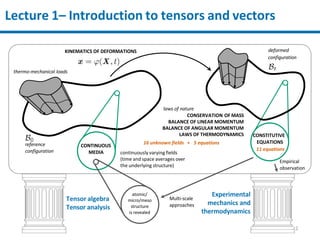
Lecture 1– Introduction to tensors and vectors
KINEMATICS OF DEFORMATIONS
2
deformed
configuration
thermo-mechanical loads
laws of nature .
CONSERVATION OF MASS
BALANCE OF LINEAR MOMENTUM
BALANCE OF ANGULAR MOMENTUM
LAWS OF THERMODYNAMICS
reference
configuration
CONTINUOUS
MEDIA
5 equations
16 unknown fields +
continuously varying fields
(time and space averages over
the underlying structure)
CONSTITUTIVE
EQUATIONS
11 equations
Empirical
observation
Tensor algebra
Tensor analysis
atomic/
micro/meso
structure
is revealed
Multi-scale
approaches
Experimental
mechanics and
thermodynamics
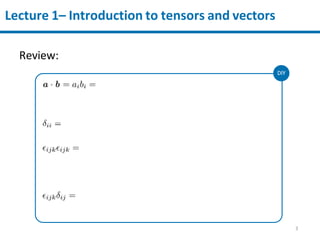
Lecture 1– Introduction to tensors and vectors
Review:
3
DIY
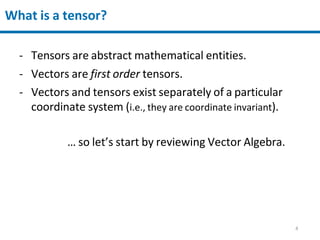
What is a tensor?
4
- Tensors are abstract mathematical entities.
- Vectors are first order tensors.
- Vectors and tensors exist separately of a particular
coordinate system (i.e., they are coordinate invariant).
… so let’s start by reviewing Vector Algebra.
Vector algebra
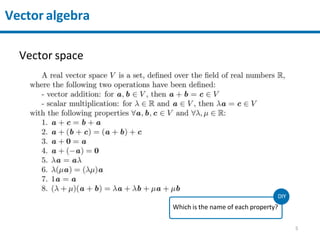
DIY
Which is the name of each property?
5
Vector space
Vector algebra
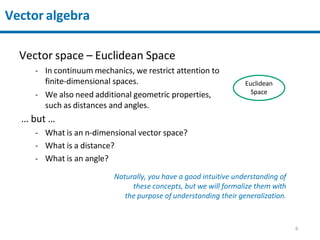
Vector space – Euclidean Space
- In continuum mechanics, we restrict attention to
finite-dimensional spaces.
- We also need additional geometric properties,
such as distances and angles.
… but …
- What is an n-dimensional vector space?
- What is a distance?
- What is an angle?
Naturally, you have a good intuitive understanding of
these concepts, but we will formalize them with
the purpose of understanding their generalization.
Euclidean
Space
6
Vector algebra
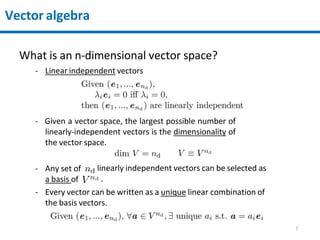
What is an n-dimensional vector space?
- Linear independent vectors
- Given a vector space, the largest possible number of
linearly-independent vectors is the dimensionality of
the vector space.
- Any set of
a basis of
linearly independent vectors can be selected as
.
- Every vector can be written as a unique linear combination of
the basis vectors.
7
Vector algebra
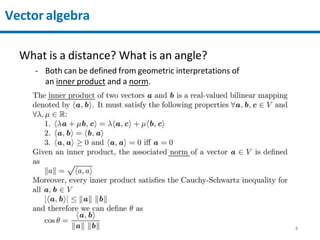
What is a distance? What is an angle?
- Both can be defined from geometric interpretations of
an inner product and a norm.
8
Vector algebra
What is a distance? What is an angle?
- Both can be defined from geometric interpretations of
an inner product and a norm.
- Euclidean space:
Euclidean
Space
DIY
9
Let’s recall addition and multiplication in
Vector algebra
Euclidean
Space
What is a distance? What is an angle?
- Both can be defined from geometric interpretations of
an inner product and a norm.
- Euclidean space
- Euclidean point space
- Now we can naturally extend the notion of distance and angle to:
+ Distance between two points
+ Angle formed by three points
10
Vector algebra
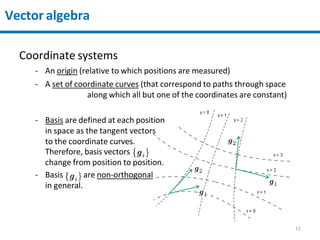
Coordinate systems
- An origin (relative to which positions are measured)
- A set of coordinate curves (that correspond to paths through space
along which all but one of the coordinates are constant)
11
Vector algebra
Coordinate systems
- An origin (relative to which positions are measured)
- A set of coordinate curves (that correspond to paths through space
along which all but one of the coordinates are constant)
- Basis are defined at each position
in space as the tangent vectors
to the coordinate curves.
Therefore, basis vectors
change from position to position.
- Basis are non-orthogonal
in general.
12
Vector algebra
DIY
What is the component of a vector (or the coordinate of a position vector)
along a basis vector direction?
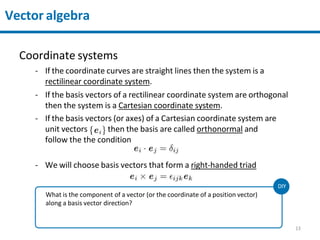
Coordinate systems
- If the coordinate curves are straight lines then the system is a
rectilinear coordinate system.
- If the basis vectors of a rectilinear coordinate system are orthogonal
then the system is a Cartesian coordinate system.
- If the basis vectors (or axes) of a Cartesian coordinate system are
unit vectors then the basis are called orthonormal and
follow the the condition
- We will choose basis vectors that form a right-handed triad
13
Vector algebra
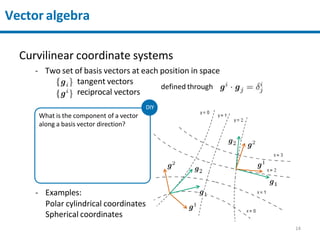
Curvilinear coordinate systems
- Two set of basis vectors at each position in space
tangent vectors
reciprocal vectors
defined through
DIY
What is the component of a vector
along a basis vector direction?
- Examples:
Polar cylindrical coordinates
Spherical coordinates
14
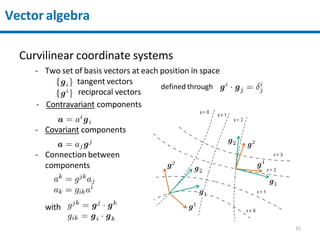
Vector algebra
Curvilinear coordinate systems
- Two set of basis vectors at each position in space
tangent vectors
reciprocal vectors
- Contravariant components
- Covariant components
- Connection between
components
with
defined through
15
Vector algebra
Curvilinear coordinate systems
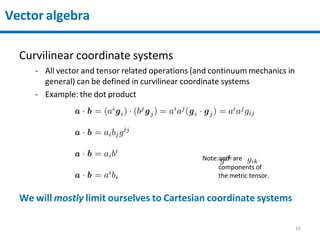
- All vector and tensor related operations (and continuum mechanics in
general) can be defined in curvilinear coordinate systems
- Example: the dot product
16
Note:and are
components of
the metric tensor.
We will mostly limit ourselves to Cartesian coordinate systems
Vector algebra
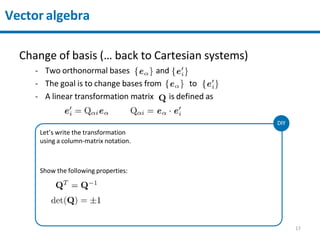
Change of basis (… back to Cartesian systems)
- Two orthonormal bases and
- The goal is to change bases from
- A linear transformation matrix
to
is defined as
DIY
17
Let’s write the transformation
using a column-matrix notation.
Show the following properties:
Vector algebra
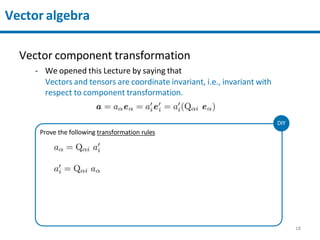
Vector component transformation
- We opened this Lecture by saying that
Vectors and tensors are coordinate invariant, i.e., invariant with
respect to component transformation.
DIY
18
Prove the following transformation rules
Vector algebra
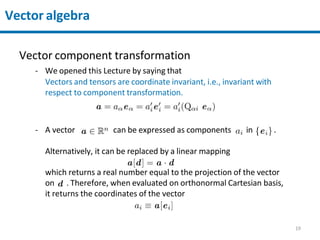
Vector component transformation
- We opened this Lecture by saying that
Vectors and tensors are coordinate invariant, i.e., invariant with
respect to component transformation.
- A vector can be expressed as components in
Alternatively, it can be replaced by a linear mapping
.
which returns a real number equal to the projection of the vector
on . Therefore, when evaluated on orthonormal Cartesian basis,
it returns the coordinates of the vector
19
DIY
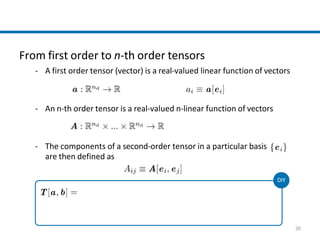
From first order to n-th order tensors
- A first order tensor (vector) is a real-valued linear function of vectors
- An n-th order tensor is a real-valued n-linear function of vectors
- The components of a second-order tensor in a particular basis
are then defined as
20

vector and tensor.pptx

  • 1.
    FACULTY: Asst Prof.Shaibal Sahoo Lecture 1 Introduction to vectors and tensors ENGINEERING MECHANICS
  • 2.
    Lecture 1– Introductionto tensors and vectors KINEMATICS OF DEFORMATIONS 2 deformed configuration thermo-mechanical loads laws of nature . CONSERVATION OF MASS BALANCE OF LINEAR MOMENTUM BALANCE OF ANGULAR MOMENTUM LAWS OF THERMODYNAMICS reference configuration CONTINUOUS MEDIA 5 equations 16 unknown fields + continuously varying fields (time and space averages over the underlying structure) CONSTITUTIVE EQUATIONS 11 equations Empirical observation Tensor algebra Tensor analysis atomic/ micro/meso structure is revealed Multi-scale approaches Experimental mechanics and thermodynamics
  • 3.
    Lecture 1– Introductionto tensors and vectors Review: 3 DIY
  • 4.
    What is atensor? 4 - Tensors are abstract mathematical entities. - Vectors are first order tensors. - Vectors and tensors exist separately of a particular coordinate system (i.e., they are coordinate invariant). … so let’s start by reviewing Vector Algebra.
  • 5.
    Vector algebra DIY Which isthe name of each property? 5 Vector space
  • 6.
    Vector algebra Vector space– Euclidean Space - In continuum mechanics, we restrict attention to finite-dimensional spaces. - We also need additional geometric properties, such as distances and angles. … but … - What is an n-dimensional vector space? - What is a distance? - What is an angle? Naturally, you have a good intuitive understanding of these concepts, but we will formalize them with the purpose of understanding their generalization. Euclidean Space 6
  • 7.
    Vector algebra What isan n-dimensional vector space? - Linear independent vectors - Given a vector space, the largest possible number of linearly-independent vectors is the dimensionality of the vector space. - Any set of a basis of linearly independent vectors can be selected as . - Every vector can be written as a unique linear combination of the basis vectors. 7
  • 8.
    Vector algebra What isa distance? What is an angle? - Both can be defined from geometric interpretations of an inner product and a norm. 8
  • 9.
    Vector algebra What isa distance? What is an angle? - Both can be defined from geometric interpretations of an inner product and a norm. - Euclidean space: Euclidean Space DIY 9 Let’s recall addition and multiplication in
  • 10.
    Vector algebra Euclidean Space What isa distance? What is an angle? - Both can be defined from geometric interpretations of an inner product and a norm. - Euclidean space - Euclidean point space - Now we can naturally extend the notion of distance and angle to: + Distance between two points + Angle formed by three points 10
  • 11.
    Vector algebra Coordinate systems -An origin (relative to which positions are measured) - A set of coordinate curves (that correspond to paths through space along which all but one of the coordinates are constant) 11
  • 12.
    Vector algebra Coordinate systems -An origin (relative to which positions are measured) - A set of coordinate curves (that correspond to paths through space along which all but one of the coordinates are constant) - Basis are defined at each position in space as the tangent vectors to the coordinate curves. Therefore, basis vectors change from position to position. - Basis are non-orthogonal in general. 12
  • 13.
    Vector algebra DIY What isthe component of a vector (or the coordinate of a position vector) along a basis vector direction? Coordinate systems - If the coordinate curves are straight lines then the system is a rectilinear coordinate system. - If the basis vectors of a rectilinear coordinate system are orthogonal then the system is a Cartesian coordinate system. - If the basis vectors (or axes) of a Cartesian coordinate system are unit vectors then the basis are called orthonormal and follow the the condition - We will choose basis vectors that form a right-handed triad 13
  • 14.
    Vector algebra Curvilinear coordinatesystems - Two set of basis vectors at each position in space tangent vectors reciprocal vectors defined through DIY What is the component of a vector along a basis vector direction? - Examples: Polar cylindrical coordinates Spherical coordinates 14
  • 15.
    Vector algebra Curvilinear coordinatesystems - Two set of basis vectors at each position in space tangent vectors reciprocal vectors - Contravariant components - Covariant components - Connection between components with defined through 15
  • 16.
    Vector algebra Curvilinear coordinatesystems - All vector and tensor related operations (and continuum mechanics in general) can be defined in curvilinear coordinate systems - Example: the dot product 16 Note:and are components of the metric tensor. We will mostly limit ourselves to Cartesian coordinate systems
  • 17.
    Vector algebra Change ofbasis (… back to Cartesian systems) - Two orthonormal bases and - The goal is to change bases from - A linear transformation matrix to is defined as DIY 17 Let’s write the transformation using a column-matrix notation. Show the following properties:
  • 18.
    Vector algebra Vector componenttransformation - We opened this Lecture by saying that Vectors and tensors are coordinate invariant, i.e., invariant with respect to component transformation. DIY 18 Prove the following transformation rules
  • 19.
    Vector algebra Vector componenttransformation - We opened this Lecture by saying that Vectors and tensors are coordinate invariant, i.e., invariant with respect to component transformation. - A vector can be expressed as components in Alternatively, it can be replaced by a linear mapping . which returns a real number equal to the projection of the vector on . Therefore, when evaluated on orthonormal Cartesian basis, it returns the coordinates of the vector 19
  • 20.
    DIY From first orderto n-th order tensors - A first order tensor (vector) is a real-valued linear function of vectors - An n-th order tensor is a real-valued n-linear function of vectors - The components of a second-order tensor in a particular basis are then defined as 20