IMPLICIT DIFFERENTIATION
AND
RELATED RATES
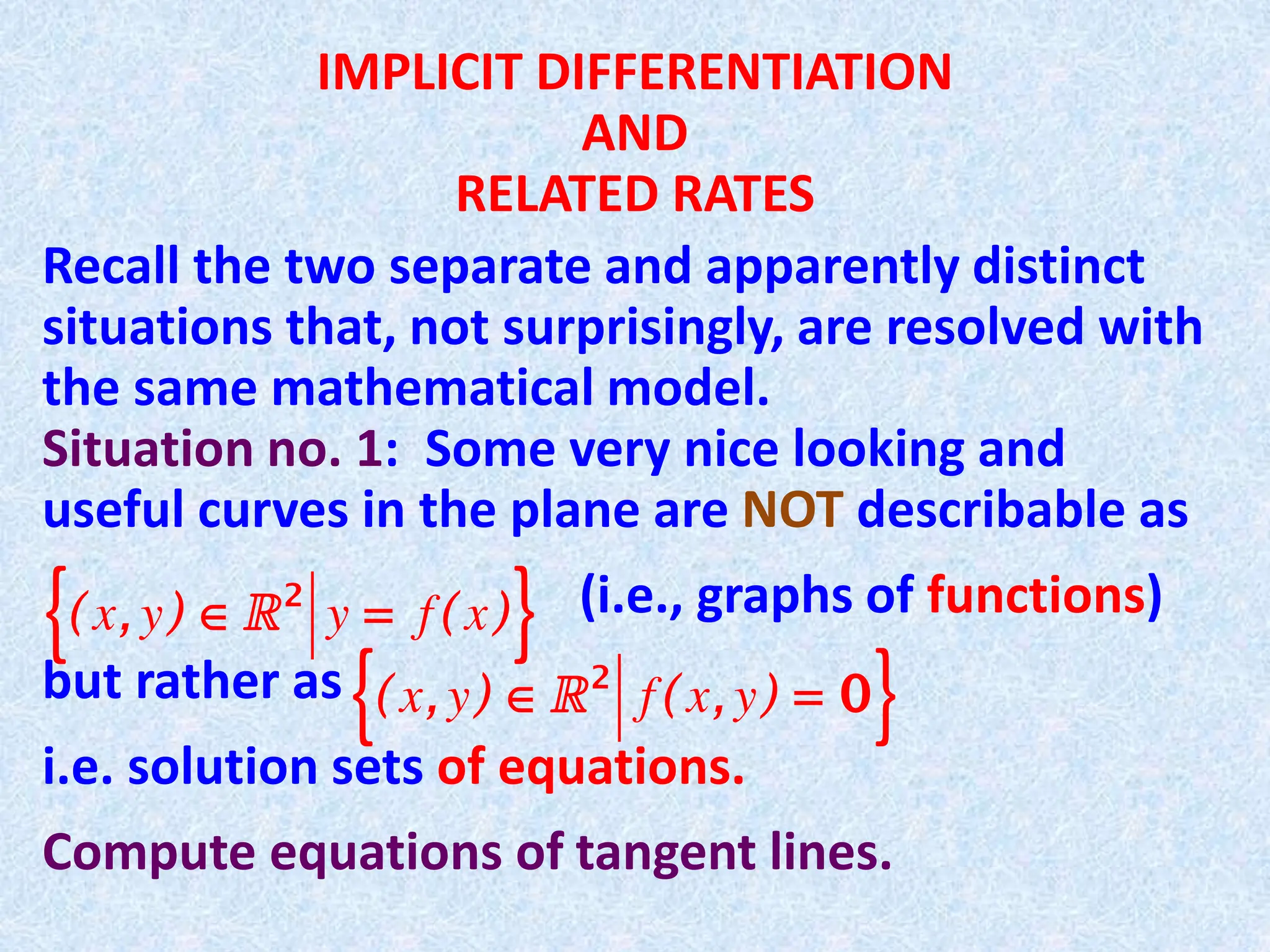
Recall the two separate and apparently distinct
situations that, not surprisingly, are resolved with
the same mathematical model.
Situation no. 1: Some very nice looking and
useful curves in the plane are NOT describable as
(i.e., graphs of functions)
but rather as
i.e. solution sets of equations.
Compute equations of tangent lines.
Situation no. 2: Two quantities and are
related to each other via some formula
(easiest example:
is the surface area of a sphere,
is the volume of the same sphere.
You should be able to show that
, the formula that relates and )
You know how fast changes.
How fast does change?
(Pump air in the sphere at a certain known rate.
How fast does the surface area expand?)
A
V
A V
Situation No. 2 as stated is a little beyond (but not
by much) our immediate reach.
We’ll make it easier by assuming that the
relationship is actually of the form
(that is, depends on )
and we will ask ourselves
At what rate does change relative to a change
in ? More precisely, if changes in value
from to ,
then changes from to and
a b
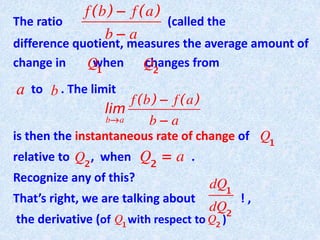
The ratio (called the
difference quotient, measures the average amount of
change in when changes from
to . The limit
is then the instantaneous rate of change of
relative to , when .
Recognize any of this?
That’s right, we are talking about ! ,
the derivative (of with respect to )
a b
As a mathematician I don’t have to tell you what
and stand for, just two numerical quantities
related to each other by some formula
This is the beauty of Mathematics,
as your textbook puts it, on p. 73,
A single mathematical concept (such as the
derivative) can have different interpretations in each
of the sciences. Joseph Fourier (you’ll meet his work
eventually) put it this way:
Mathematics compares the most diverse
phenomena and discovers the secret analogies that
unite them.
Let me paraphrase what your textbook says:
A single mathematical concept (such as the
derivative of ) can have different
interpretations in each of the sciences.
Let me tell you that
 Each science (Physics, Chemistry, Biology,
Psychology, Sociology, Computer Science,
Medicine,… you name it)
 Each sub-branch of each science
 Each group or researchers in each sub-branch of
each science
 Each individual researcher in each group …
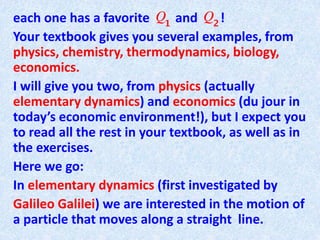
each one has a favorite and !
Your textbook gives you several examples, from
physics, chemistry, thermodynamics, biology,
economics.
I will give you two, from physics (actually
elementary dynamics) and economics (du jour in
today’s economic environment!), but I expect you
to read all the rest in your textbook, as well as in
the exercises.
Here we go:
In elementary dynamics (first investigated by
Galileo Galilei) we are interested in the motion of
a particle that moves along a straight line.
The only thing that’s needed on that line is a
“coordinate system”
So we can talk numerically about the position of
the particle on the line.
You have been brainwashed into thinking that the
straight line is either horizontal or vertical,
but actually it could be anywhere, even Galileo
was studying how a ball rolls down on a slope!
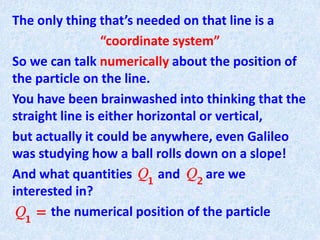
And what quantities and are we
interested in?
the numerical position of the particle
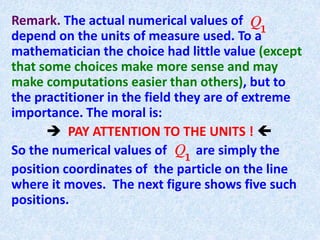
Remark. The actual numerical values of
depend on the units of measure used. To a
mathematician the choice had little value (except
that some choices make more sense and may
make computations easier than others), but to
the practitioner in the field they are of extreme
importance. The moral is:
 PAY ATTENTION TO THE UNITS ! 
So the numerical values of are simply the
position coordinates of the particle on the line
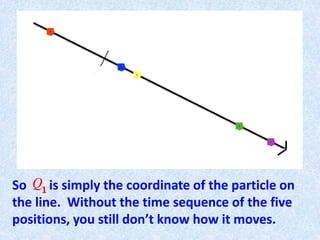
where it moves. The next figure shows five such
positions.
So is simply the coordinate of the particle on
the line. Without the time sequence of the five
positions, you still don’t know how it moves.
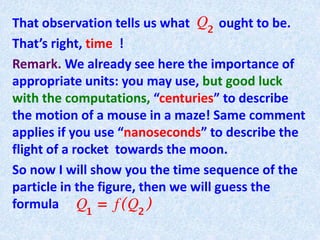
That observation tells us what ought to be.
That’s right, time !
Remark. We already see here the importance of
appropriate units: you may use, but good luck
with the computations, “centuries” to describe
the motion of a mouse in a maze! Same comment
applies if you use “nanoseconds” to describe the
flight of a rocket towards the moon.
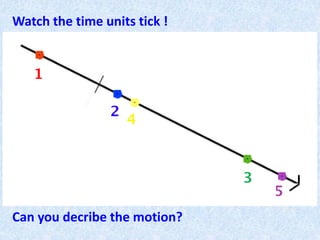
So now I will show you the time sequence of the
particle in the figure, then we will guess the
formula
Watch the time units tick !
Can you decribe the motion?
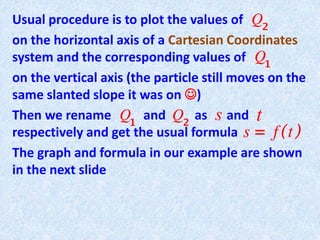
Usual procedure is to plot the values of
on the horizontal axis of a Cartesian Coordinates
system and the corresponding values of
on the vertical axis (the particle still moves on the
same slanted slope it was on )
Then we rename and as and
respectively and get the usual formula
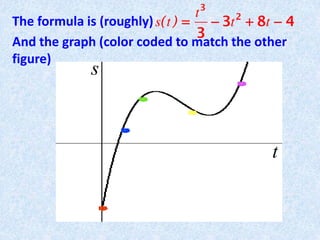
The graph and formula in our example are shown
in the next slide
s t
The formula is (roughly)
And the graph (color coded to match the other
figure)
s
t
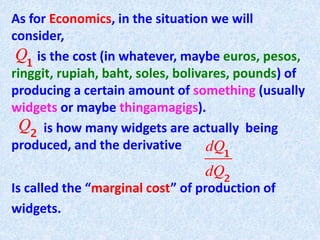
As for Economics, in the situation we will
consider,
is the cost (in whatever, maybe euros, pesos,
ringgit, rupiah, baht, soles, bolivares, pounds) of
producing a certain amount of something (usually
widgets or maybe thingamagigs).
is how many widgets are actually being
produced, and the derivative
Is called the “marginal cost” of production of
widgets.
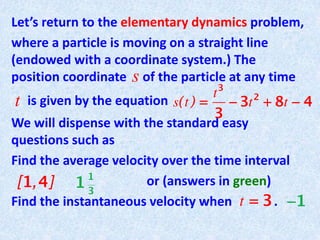
Let’s return to the elementary dynamics problem,
where a particle is moving on a straight line
(endowed with a coordinate system.) The
position coordinate of the particle at any time
is given by the equation
We will dispense with the standard easy
questions such as
Find the average velocity over the time interval
or (answers in green)
Find the instantaneous velocity when .
t
s
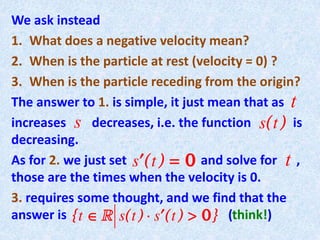
We ask instead
1. What does a negative velocity mean?
2. When is the particle at rest (velocity = 0) ?
3. When is the particle receding from the origin?
The answer to 1. is simple, it just mean that as
increases decreases, i.e. the function is
decreasing.
As for 2. we just set and solve for ,
those are the times when the velocity is 0.
3. requires some thought, and we find that the
answer is (think!)
t
s
t
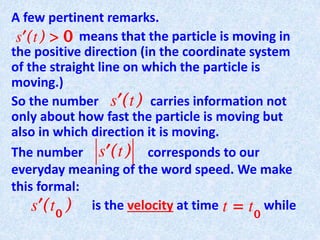
A few pertinent remarks.
means that the particle is moving in
the positive direction (in the coordinate system
of the straight line on which the particle is
moving.)
So the number carries information not
only about how fast the particle is moving but
also in which direction it is moving.
The number corresponds to our
everyday meaning of the word speed. We make
this formal:
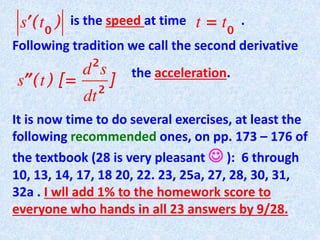
is the velocity at time while
is the speed at time .
Following tradition we call the second derivative
the acceleration.
It is now time to do several exercises, at least the
following recommended ones, on pp. 173 – 176 of
the textbook (28 is very pleasant  ): 6 through
10, 13, 14, 17, 18 20, 22. 23, 25a, 27, 28, 30, 31,
32a . I wll add 1% to the homework score to
everyone who hands in all 23 answers by 9/28.

IMPLICIT DIFFERENTIATION AND RELATED RATES

  • 1.
    IMPLICIT DIFFERENTIATION AND RELATED RATES Recallthe two separate and apparently distinct situations that, not surprisingly, are resolved with the same mathematical model. Situation no. 1: Some very nice looking and useful curves in the plane are NOT describable as (i.e., graphs of functions) but rather as i.e. solution sets of equations. Compute equations of tangent lines.
  • 2.
    Situation no. 2:Two quantities and are related to each other via some formula (easiest example: is the surface area of a sphere, is the volume of the same sphere. You should be able to show that , the formula that relates and ) You know how fast changes. How fast does change? (Pump air in the sphere at a certain known rate. How fast does the surface area expand?) A V A V
  • 3.
    Situation No. 2as stated is a little beyond (but not by much) our immediate reach. We’ll make it easier by assuming that the relationship is actually of the form (that is, depends on ) and we will ask ourselves At what rate does change relative to a change in ? More precisely, if changes in value from to , then changes from to and a b
  • 4.
    The ratio (calledthe difference quotient, measures the average amount of change in when changes from to . The limit is then the instantaneous rate of change of relative to , when . Recognize any of this? That’s right, we are talking about ! , the derivative (of with respect to ) a b
  • 5.
    As a mathematicianI don’t have to tell you what and stand for, just two numerical quantities related to each other by some formula This is the beauty of Mathematics, as your textbook puts it, on p. 73, A single mathematical concept (such as the derivative) can have different interpretations in each of the sciences. Joseph Fourier (you’ll meet his work eventually) put it this way: Mathematics compares the most diverse phenomena and discovers the secret analogies that unite them.
  • 6.
    Let me paraphrasewhat your textbook says: A single mathematical concept (such as the derivative of ) can have different interpretations in each of the sciences. Let me tell you that  Each science (Physics, Chemistry, Biology, Psychology, Sociology, Computer Science, Medicine,… you name it)  Each sub-branch of each science  Each group or researchers in each sub-branch of each science  Each individual researcher in each group …
  • 7.
    each one hasa favorite and ! Your textbook gives you several examples, from physics, chemistry, thermodynamics, biology, economics. I will give you two, from physics (actually elementary dynamics) and economics (du jour in today’s economic environment!), but I expect you to read all the rest in your textbook, as well as in the exercises. Here we go: In elementary dynamics (first investigated by Galileo Galilei) we are interested in the motion of a particle that moves along a straight line.
  • 8.
    The only thingthat’s needed on that line is a “coordinate system” So we can talk numerically about the position of the particle on the line. You have been brainwashed into thinking that the straight line is either horizontal or vertical, but actually it could be anywhere, even Galileo was studying how a ball rolls down on a slope! And what quantities and are we interested in? the numerical position of the particle
  • 9.
    Remark. The actualnumerical values of depend on the units of measure used. To a mathematician the choice had little value (except that some choices make more sense and may make computations easier than others), but to the practitioner in the field they are of extreme importance. The moral is:  PAY ATTENTION TO THE UNITS !  So the numerical values of are simply the position coordinates of the particle on the line where it moves. The next figure shows five such positions.
  • 10.
    So is simplythe coordinate of the particle on the line. Without the time sequence of the five positions, you still don’t know how it moves.
  • 11.
    That observation tellsus what ought to be. That’s right, time ! Remark. We already see here the importance of appropriate units: you may use, but good luck with the computations, “centuries” to describe the motion of a mouse in a maze! Same comment applies if you use “nanoseconds” to describe the flight of a rocket towards the moon. So now I will show you the time sequence of the particle in the figure, then we will guess the formula
  • 12.
    Watch the timeunits tick ! Can you decribe the motion?
  • 13.
    Usual procedure isto plot the values of on the horizontal axis of a Cartesian Coordinates system and the corresponding values of on the vertical axis (the particle still moves on the same slanted slope it was on ) Then we rename and as and respectively and get the usual formula The graph and formula in our example are shown in the next slide s t
  • 14.
    The formula is(roughly) And the graph (color coded to match the other figure) s t
  • 15.
    As for Economics,in the situation we will consider, is the cost (in whatever, maybe euros, pesos, ringgit, rupiah, baht, soles, bolivares, pounds) of producing a certain amount of something (usually widgets or maybe thingamagigs). is how many widgets are actually being produced, and the derivative Is called the “marginal cost” of production of widgets.
  • 16.
    Let’s return tothe elementary dynamics problem, where a particle is moving on a straight line (endowed with a coordinate system.) The position coordinate of the particle at any time is given by the equation We will dispense with the standard easy questions such as Find the average velocity over the time interval or (answers in green) Find the instantaneous velocity when . t s
  • 17.
    We ask instead 1.What does a negative velocity mean? 2. When is the particle at rest (velocity = 0) ? 3. When is the particle receding from the origin? The answer to 1. is simple, it just mean that as increases decreases, i.e. the function is decreasing. As for 2. we just set and solve for , those are the times when the velocity is 0. 3. requires some thought, and we find that the answer is (think!) t s t
  • 18.
    A few pertinentremarks. means that the particle is moving in the positive direction (in the coordinate system of the straight line on which the particle is moving.) So the number carries information not only about how fast the particle is moving but also in which direction it is moving. The number corresponds to our everyday meaning of the word speed. We make this formal: is the velocity at time while
  • 19.
    is the speedat time . Following tradition we call the second derivative the acceleration. It is now time to do several exercises, at least the following recommended ones, on pp. 173 – 176 of the textbook (28 is very pleasant  ): 6 through 10, 13, 14, 17, 18 20, 22. 23, 25a, 27, 28, 30, 31, 32a . I wll add 1% to the homework score to everyone who hands in all 23 answers by 9/28.

Editor's Notes