Community Asset Transfer
VAT Awareness
Centurion VAT Specialists Ltd
June 10th 2015
Liz Maher: VAT Director
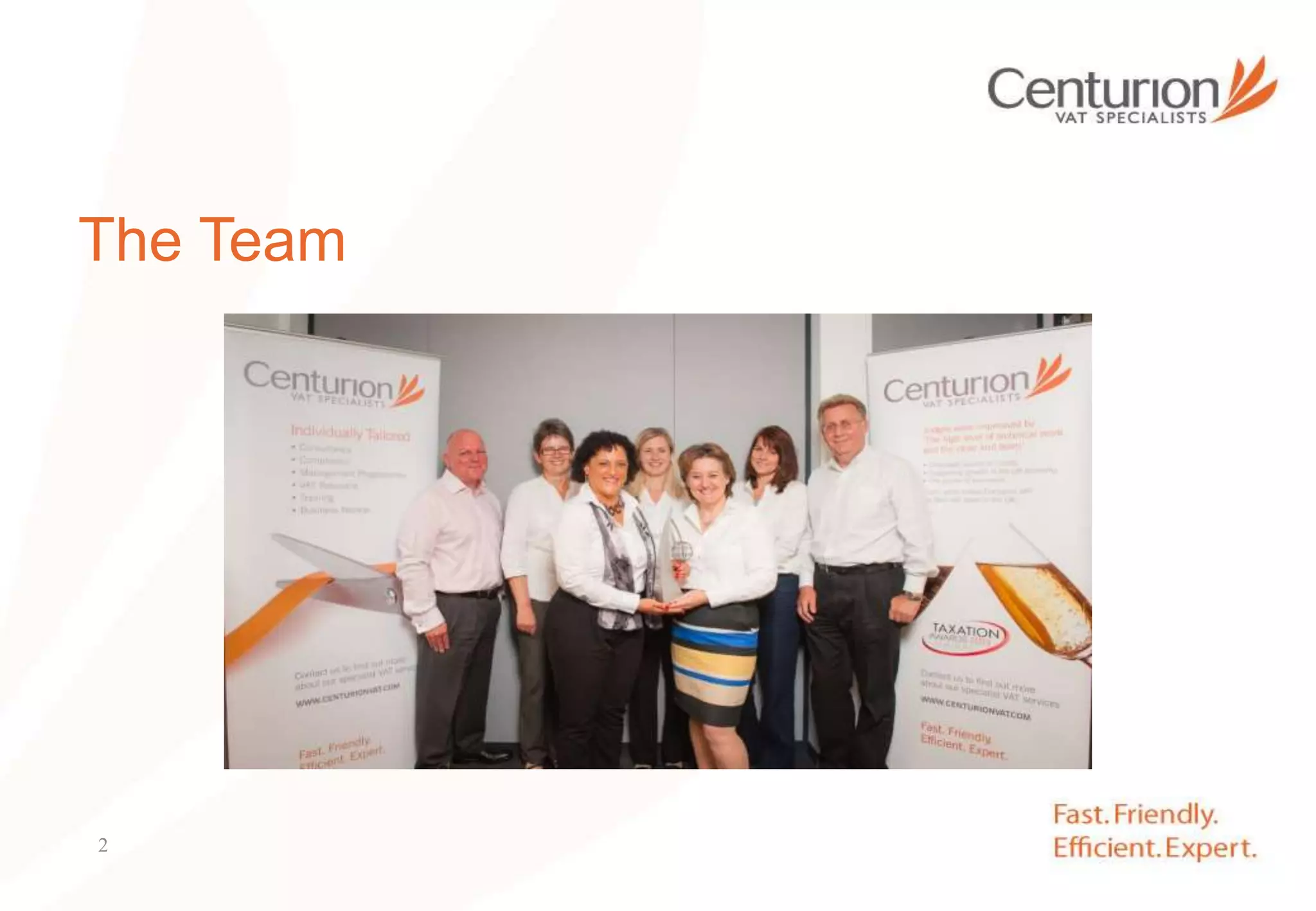
The Team
2
Agenda
• Basic UK VAT Rules
• VAT Difference between Councils & Charities
• VAT & Funding applications
• Registering for VAT
• VAT liabilities of supplies
• Recovering VAT
• Managing Property Assets & the VAT implications
(c) 2015 Centurion VAT Specialists Ltd3
Basic VAT Principles
VAT is chargeable on a
taxable supply of goods or services;
made by a taxable person;
made in the UK;
in the course of business.
(c) 2015 Centurion VAT Specialists Ltd4
Scope of VAT
• A tax on transactions
(c) 2015 Centurion VAT Specialists Ltd5
Basic UK VAT Rules:
Basic VAT rules:
Output Tax is the VAT charged on taxable supplies made in the UK and is paid over
to HMRC.
Input Tax is the VAT incurred on costs borne by a business and can be offset against
the Output Tax due on the VAT return subject to certain rules on recovery
(c) 2015 Centurion VAT Specialists Ltd6
Basic Rules: VAT Liabilities
VAT applies to supplies made by way of business:
• Taxable: Standard / Reduced rate / Zero
• Exempt
………………………………………………………………………………………………………….
• Outside the scope/non business
• Some activities undertaken by a charity are non business supplies:
• No VAT accountable on a non business income eg: donations/grants
• VAT on Costs relating to non business activities is blocked from recovery
• Supplies which happen Outside the UK will be outside the scope of UK VAT.
• Statutory activities undertaken by a local authority or activities by other public bodies
such as an NHS Trust or an FE College can be regarded as non business and outside the
scope of VAT. Special VAT recovery rules can apply to these bodies but the rules will
vary. Some will have no special recovery rules for eg an FE College.
(c) 2015 Centurion VAT Specialists Ltd7
VAT Difference between Councils & Charities
(c) 2015 Centurion VAT Specialists Ltd8
Councils
• Special VAT Status – Section 33
• Statutory Bodies that make Non
Business Supplies: social
care/education/refuse collection
• Allowed to recover VAT incurred in
making non business supplies
• Will have business income with mixed
VAT liabilities
• De minimis Partial Exemption levels
set higher than for charities
• Assessable back over 3 years
Charities
• No Special VAT status – treated as a normal
business
• Recent change for Hospice sector on palliative care
provision – can assess section 33 relief in part*
• Will make non business supplies – free supplies of
goods and services (funded either by grant support
or donations/investments)
• No right to recover VAT on costs relating to non
business activities*
• Same De minimis Partial Exemption rules as a
normal business
• Limited reliefs from having to charge VAT on the
goods and services they sell
• Limited reliefs from having to pay VAT on the goods
and services a charity buys in.
• Assessable back over 4 years
(c) 2015 Centurion VAT Specialists Ltd9
VAT & Funding Applications
(c) 2015 Centurion VAT Specialists Ltd10
Funding Applications
• Are you asking for grant support or pitching to win a contract to supply goods or services to the funder?
• Leisure/Cultural assets transferred from the Council – will you own them outright or run them on behalf of
the council and charge the council for your management services?
• Confusing language in documents = “bid should include VAT” what could that mean?
To consider these questions you need to identify whether what you will be doing will generate taxable business
activities & therefore a VAT registration.
Then you need to establish:
1. The mix of your taxable income in comparison to non business or VAT Exempt income and,
2. The likely throughput of VAT on your costs to establish how much of that could be either,
I. Recoverable from HMRC,
II. Benefit from a lower or zero rate of VAT due to the nature of those costs and what activities they will relate to in
you organisation,
III. Remain as a cost and not recoverable so needs to be built into and grant funding application.
Grants to fund major building refurbishments or property acquisitions need particular attention due to the 10
year Capital Goods Scheme Requirements.
(c) 2015 Centurion VAT Specialists Ltd11
VAT Registration
(c) 2015 Centurion VAT Specialists Ltd12
Making Supplies in the UK – What
triggers a VAT registration
 Place of supply of goods in country
 Place of supply of services in country
 Acquisitions of goods from the EU
 Importing services from outside the UK
 Distance Selling – goods sold on line
 Digital Services – delivered on line, not just web design type
services
(c) 2015 Centurion VAT Specialists Ltd13
UK VAT registration thresholds:
 Taxable supplies over £82,000 from 1 April 2015
 Compulsory & Voluntary VAT registration
 Distance selling threshold: £70,000 (from 1 Jan of the year in
question)
(c) 2015 Centurion VAT Specialists Ltd14
What entity is registered:
• Sole Proprietor
• Partnership
• Limited Company
• Unincorporated Association
• Single Entity or VAT Group Registration
(c) 2015 Centurion VAT Specialists Ltd15
Liability Areas:
(c) 2015 Centurion VAT Specialists Ltd16
Zero Rated Areas
• Transport
• Food
• Books, magazines and newspapers
• Some Reliefs for supplies to or by Charities
• Bank notes
• Caravans and houseboats
• Clothing and Footwear
• Construction of buildings
• Drugs, medicines, aids for the handicapped
• Sewerage Services and Water
• Talking Books for the Blind & Handicapped and
wireless sets
• Protected Buildings
• International Services
• Gold
• Imports, Exports
• European Research Infrastructure Consortia
(c) 2015 Centurion VAT Specialists Ltd17
Reduced Rate Areas
• Fuel and Power for domestic or charity use
• Certain goods and services in connection with energy efficiency
• Residential Conversions
• Grant funded installation of heating equipment or security goods or connection of gas
supply
• Women’s Sanitary products
• Children’s Car Seats
• Residential Renovations and alterations
• Contraceptive Products
• Welfare Advice or Information
• Installation of Mobility Aids for the Elderly
• Smoking Cessation Products
• Caravans
• Cable-suspended Passenger Transport Systems
(c) 2015 Centurion VAT Specialists Ltd18
Exempt Areas
• Education
• Health & Welfare
• Land
• Insurance
• Postal Services
• Betting, Gaming, Dutiable Machine Games and Lotteries
• Finance
• Burial & Cremation
• Subscriptions to trade Unions, professional and other public interest bodies
• Sport, Sports competitions and physical education
• Works of Art
• Fund Raising events by Charities and other qualifying bodies
• Cultural Services
• Supplies of goods where input tax cannot be recovered
• Investment Gold
• Supplies of Services by Groups involving Cost Sharing
(c) 2015 Centurion VAT Specialists Ltd19
Other Non VAT areas
• Some examples where VAT is specifically not chargeable
 salaries and wages
 tips and gratuities
 penalties and fines
 compensation
 rates and council tax
(c) 2015 Centurion VAT Specialists Ltd20
Standard Rate Areas
If it is a supply by way of business
and
not covered in any of the other schedules
then it will attract
the
standard rate of VAT
(c) 2015 Centurion VAT Specialists Ltd21
Input Tax
(c) 2015 Centurion VAT Specialists Ltd22
Recovery of Input Tax
• VAT is generally recoverable on expenses in relation to a
taxable business activity.
But not recoverable on:
Business entertainment;
Motor car purchase or lease *
When related to exempt income (subject to
de minimis rule)
When related to non business activities.
* Partially recoverable on car leasing
(c) 2015 Centurion VAT Specialists Ltd23
Tax Evidence
No
• Request for payment
• Proforma Invoices
• Statement
• Purchase Order
Yes
• Self Billing Invoices
• Authenticated Receipts
• Invoices
• Less Detailed Invoices
• Credit Notes
(c) 2015 Centurion VAT Specialists Ltd24
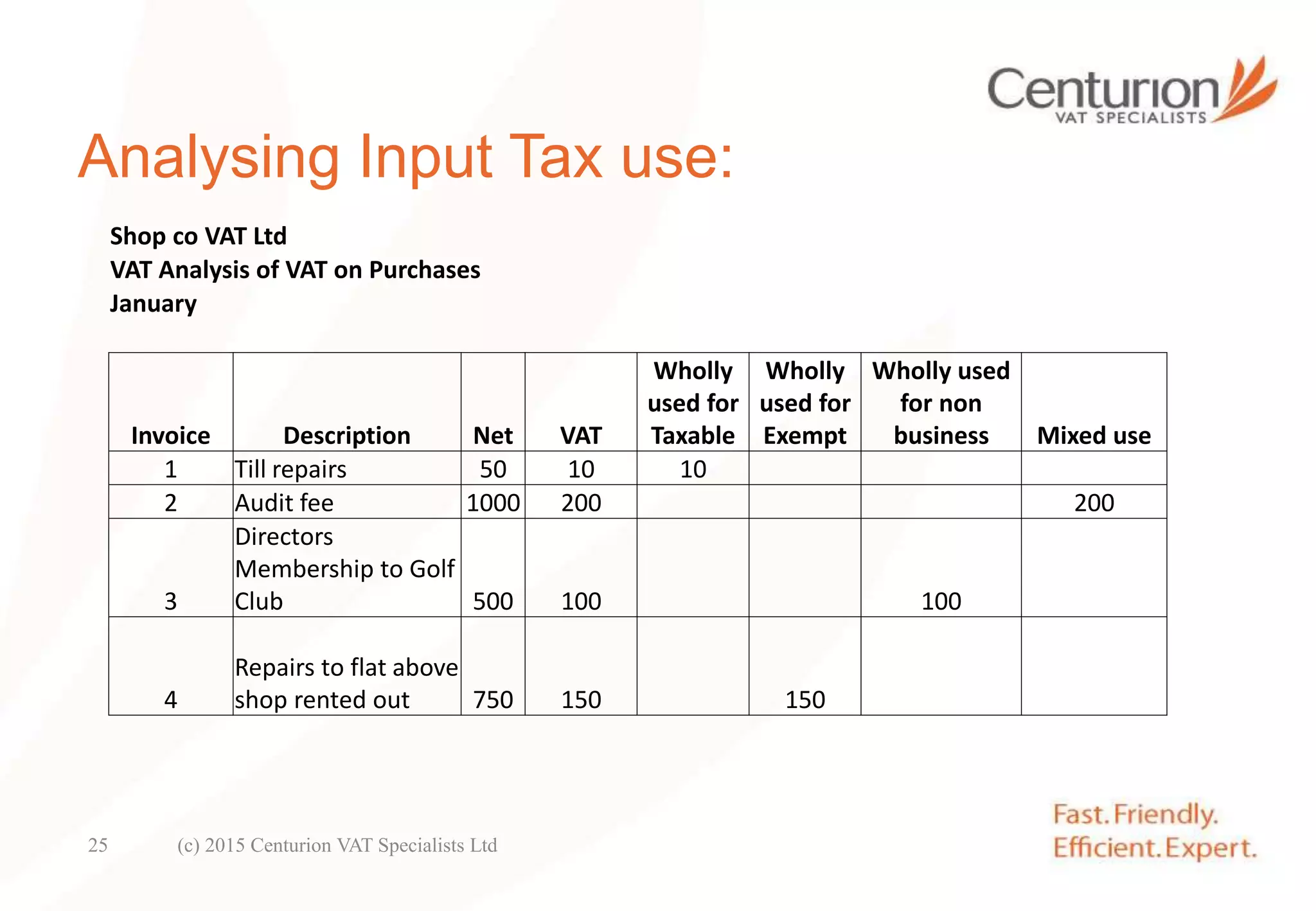
Analysing Input Tax use:
Shop co VAT Ltd
VAT Analysis of VAT on Purchases
January
Invoice Description Net VAT
Wholly
used for
Taxable
Wholly
used for
Exempt
Wholly used
for non
business Mixed use
1 Till repairs 50 10 10
2 Audit fee 1000 200 200
3
Directors
Membership to Golf
Club 500 100 100
4
Repairs to flat above
shop rented out 750 150 150
(c) 2015 Centurion VAT Specialists Ltd25
Partial exemption
De minimis levels for charity/business’s “insignificant proportion” of
input tax
• Not more than £625 per month on average i.e.£7500 p.a. and
• Not more than 50% of all input tax
If exempt input tax is less than these both limits, it can be recovered
Simplified tests introduced from April 2010 but the above rules still
apply to annual adjustment calculation.
© Centurion VAT Specialists 201526
Managing Property
• The “exploitation” of property is regarded as a business activity:
– Granting a lease in commercial/residential properties
– Selling property
– Surrendering an interest in property
– Renting out a room/flat/house
– Renting out offices space or desk space and use of facilities
– Holiday/Hotel/hostel accommodation
– Access to sporting facilities
– Admission to events
– Advertising hoardings
– Grazing rights/Fishing rights/mineral right/tree felling rights
(c) 2015 Centurion VAT Specialists Ltd27
Property Income VAT liabilities:
• Zero/ Exempt/ Standard rated if by way of business:
– Influenced by the type of the property
– The nature of the transaction (FH/Lease)
– The age of the property
– Whether the vendor has “opted to tax” their interest in the property
– What the property will be used for
• Possible non business treatment if interests disposed of for a
peppercorn.
(c) 2015 Centurion VAT Specialists Ltd28
Capital Goods Scheme:
• Triggered if you spend £250k plus VAT on any property related costs such
as buying a FH/LH property, building from new/refurbishing/extending etc
• Brings a requirement to monitor the use of that asset for a period of 10
intervals (10 years effectively)
• The VAT recovery treatment of the costs incurred at the start can
therefore be adjusted up or down as time passes as the taxable use of the
property varies over that period.
• Some grant funder might expected additional improvements in recovery
in later years on projects they’ve supported to be refunded to them.
(c) 2015 Centurion VAT Specialists Ltd29
Any Questions?
(c) 2015 Centurion VAT Specialists Ltd30
Contact:
Centurion VAT Specialists Ltd: 01633 415390
Charity Specialist Team:
Liz Maher: liz.maher@centurionvat.com
Julie Rawlinson-Smith: Julie.rawlinsonsmith@centurionvat.com
Andrea Brindley: andrea.brindley@centurionvat.com
www.centurionvat.com
emailus@centurionvat.com
(c) 2015 Centurion VAT Specialists Ltd31
We make every effort to ensure that the information contained in these slides is
accurate as at the date of the event in which they formed the basis of the
presentation.
This presentation is for discussion purposes only and does not contain general or
specific advice.
Please seek appropriate advice before making any financial decisions.
(c) 2015 Centurion VAT Specialists Ltd32

VAT issues

  • 1.
    Community Asset Transfer VATAwareness Centurion VAT Specialists Ltd June 10th 2015 Liz Maher: VAT Director
  • 2.
  • 3.
    Agenda • Basic UKVAT Rules • VAT Difference between Councils & Charities • VAT & Funding applications • Registering for VAT • VAT liabilities of supplies • Recovering VAT • Managing Property Assets & the VAT implications (c) 2015 Centurion VAT Specialists Ltd3
  • 4.
    Basic VAT Principles VATis chargeable on a taxable supply of goods or services; made by a taxable person; made in the UK; in the course of business. (c) 2015 Centurion VAT Specialists Ltd4
  • 5.
    Scope of VAT •A tax on transactions (c) 2015 Centurion VAT Specialists Ltd5
  • 6.
    Basic UK VATRules: Basic VAT rules: Output Tax is the VAT charged on taxable supplies made in the UK and is paid over to HMRC. Input Tax is the VAT incurred on costs borne by a business and can be offset against the Output Tax due on the VAT return subject to certain rules on recovery (c) 2015 Centurion VAT Specialists Ltd6
  • 7.
    Basic Rules: VATLiabilities VAT applies to supplies made by way of business: • Taxable: Standard / Reduced rate / Zero • Exempt …………………………………………………………………………………………………………. • Outside the scope/non business • Some activities undertaken by a charity are non business supplies: • No VAT accountable on a non business income eg: donations/grants • VAT on Costs relating to non business activities is blocked from recovery • Supplies which happen Outside the UK will be outside the scope of UK VAT. • Statutory activities undertaken by a local authority or activities by other public bodies such as an NHS Trust or an FE College can be regarded as non business and outside the scope of VAT. Special VAT recovery rules can apply to these bodies but the rules will vary. Some will have no special recovery rules for eg an FE College. (c) 2015 Centurion VAT Specialists Ltd7
  • 8.
    VAT Difference betweenCouncils & Charities (c) 2015 Centurion VAT Specialists Ltd8
  • 9.
    Councils • Special VATStatus – Section 33 • Statutory Bodies that make Non Business Supplies: social care/education/refuse collection • Allowed to recover VAT incurred in making non business supplies • Will have business income with mixed VAT liabilities • De minimis Partial Exemption levels set higher than for charities • Assessable back over 3 years Charities • No Special VAT status – treated as a normal business • Recent change for Hospice sector on palliative care provision – can assess section 33 relief in part* • Will make non business supplies – free supplies of goods and services (funded either by grant support or donations/investments) • No right to recover VAT on costs relating to non business activities* • Same De minimis Partial Exemption rules as a normal business • Limited reliefs from having to charge VAT on the goods and services they sell • Limited reliefs from having to pay VAT on the goods and services a charity buys in. • Assessable back over 4 years (c) 2015 Centurion VAT Specialists Ltd9
  • 10.
    VAT & FundingApplications (c) 2015 Centurion VAT Specialists Ltd10
  • 11.
    Funding Applications • Areyou asking for grant support or pitching to win a contract to supply goods or services to the funder? • Leisure/Cultural assets transferred from the Council – will you own them outright or run them on behalf of the council and charge the council for your management services? • Confusing language in documents = “bid should include VAT” what could that mean? To consider these questions you need to identify whether what you will be doing will generate taxable business activities & therefore a VAT registration. Then you need to establish: 1. The mix of your taxable income in comparison to non business or VAT Exempt income and, 2. The likely throughput of VAT on your costs to establish how much of that could be either, I. Recoverable from HMRC, II. Benefit from a lower or zero rate of VAT due to the nature of those costs and what activities they will relate to in you organisation, III. Remain as a cost and not recoverable so needs to be built into and grant funding application. Grants to fund major building refurbishments or property acquisitions need particular attention due to the 10 year Capital Goods Scheme Requirements. (c) 2015 Centurion VAT Specialists Ltd11
  • 12.
    VAT Registration (c) 2015Centurion VAT Specialists Ltd12
  • 13.
    Making Supplies inthe UK – What triggers a VAT registration  Place of supply of goods in country  Place of supply of services in country  Acquisitions of goods from the EU  Importing services from outside the UK  Distance Selling – goods sold on line  Digital Services – delivered on line, not just web design type services (c) 2015 Centurion VAT Specialists Ltd13
  • 14.
    UK VAT registrationthresholds:  Taxable supplies over £82,000 from 1 April 2015  Compulsory & Voluntary VAT registration  Distance selling threshold: £70,000 (from 1 Jan of the year in question) (c) 2015 Centurion VAT Specialists Ltd14
  • 15.
    What entity isregistered: • Sole Proprietor • Partnership • Limited Company • Unincorporated Association • Single Entity or VAT Group Registration (c) 2015 Centurion VAT Specialists Ltd15
  • 16.
    Liability Areas: (c) 2015Centurion VAT Specialists Ltd16
  • 17.
    Zero Rated Areas •Transport • Food • Books, magazines and newspapers • Some Reliefs for supplies to or by Charities • Bank notes • Caravans and houseboats • Clothing and Footwear • Construction of buildings • Drugs, medicines, aids for the handicapped • Sewerage Services and Water • Talking Books for the Blind & Handicapped and wireless sets • Protected Buildings • International Services • Gold • Imports, Exports • European Research Infrastructure Consortia (c) 2015 Centurion VAT Specialists Ltd17
  • 18.
    Reduced Rate Areas •Fuel and Power for domestic or charity use • Certain goods and services in connection with energy efficiency • Residential Conversions • Grant funded installation of heating equipment or security goods or connection of gas supply • Women’s Sanitary products • Children’s Car Seats • Residential Renovations and alterations • Contraceptive Products • Welfare Advice or Information • Installation of Mobility Aids for the Elderly • Smoking Cessation Products • Caravans • Cable-suspended Passenger Transport Systems (c) 2015 Centurion VAT Specialists Ltd18
  • 19.
    Exempt Areas • Education •Health & Welfare • Land • Insurance • Postal Services • Betting, Gaming, Dutiable Machine Games and Lotteries • Finance • Burial & Cremation • Subscriptions to trade Unions, professional and other public interest bodies • Sport, Sports competitions and physical education • Works of Art • Fund Raising events by Charities and other qualifying bodies • Cultural Services • Supplies of goods where input tax cannot be recovered • Investment Gold • Supplies of Services by Groups involving Cost Sharing (c) 2015 Centurion VAT Specialists Ltd19
  • 20.
    Other Non VATareas • Some examples where VAT is specifically not chargeable  salaries and wages  tips and gratuities  penalties and fines  compensation  rates and council tax (c) 2015 Centurion VAT Specialists Ltd20
  • 21.
    Standard Rate Areas Ifit is a supply by way of business and not covered in any of the other schedules then it will attract the standard rate of VAT (c) 2015 Centurion VAT Specialists Ltd21
  • 22.
    Input Tax (c) 2015Centurion VAT Specialists Ltd22
  • 23.
    Recovery of InputTax • VAT is generally recoverable on expenses in relation to a taxable business activity. But not recoverable on: Business entertainment; Motor car purchase or lease * When related to exempt income (subject to de minimis rule) When related to non business activities. * Partially recoverable on car leasing (c) 2015 Centurion VAT Specialists Ltd23
  • 24.
    Tax Evidence No • Requestfor payment • Proforma Invoices • Statement • Purchase Order Yes • Self Billing Invoices • Authenticated Receipts • Invoices • Less Detailed Invoices • Credit Notes (c) 2015 Centurion VAT Specialists Ltd24
  • 25.
    Analysing Input Taxuse: Shop co VAT Ltd VAT Analysis of VAT on Purchases January Invoice Description Net VAT Wholly used for Taxable Wholly used for Exempt Wholly used for non business Mixed use 1 Till repairs 50 10 10 2 Audit fee 1000 200 200 3 Directors Membership to Golf Club 500 100 100 4 Repairs to flat above shop rented out 750 150 150 (c) 2015 Centurion VAT Specialists Ltd25
  • 26.
    Partial exemption De minimislevels for charity/business’s “insignificant proportion” of input tax • Not more than £625 per month on average i.e.£7500 p.a. and • Not more than 50% of all input tax If exempt input tax is less than these both limits, it can be recovered Simplified tests introduced from April 2010 but the above rules still apply to annual adjustment calculation. © Centurion VAT Specialists 201526
  • 27.
    Managing Property • The“exploitation” of property is regarded as a business activity: – Granting a lease in commercial/residential properties – Selling property – Surrendering an interest in property – Renting out a room/flat/house – Renting out offices space or desk space and use of facilities – Holiday/Hotel/hostel accommodation – Access to sporting facilities – Admission to events – Advertising hoardings – Grazing rights/Fishing rights/mineral right/tree felling rights (c) 2015 Centurion VAT Specialists Ltd27
  • 28.
    Property Income VATliabilities: • Zero/ Exempt/ Standard rated if by way of business: – Influenced by the type of the property – The nature of the transaction (FH/Lease) – The age of the property – Whether the vendor has “opted to tax” their interest in the property – What the property will be used for • Possible non business treatment if interests disposed of for a peppercorn. (c) 2015 Centurion VAT Specialists Ltd28
  • 29.
    Capital Goods Scheme: •Triggered if you spend £250k plus VAT on any property related costs such as buying a FH/LH property, building from new/refurbishing/extending etc • Brings a requirement to monitor the use of that asset for a period of 10 intervals (10 years effectively) • The VAT recovery treatment of the costs incurred at the start can therefore be adjusted up or down as time passes as the taxable use of the property varies over that period. • Some grant funder might expected additional improvements in recovery in later years on projects they’ve supported to be refunded to them. (c) 2015 Centurion VAT Specialists Ltd29
  • 30.
    Any Questions? (c) 2015Centurion VAT Specialists Ltd30
  • 31.
    Contact: Centurion VAT SpecialistsLtd: 01633 415390 Charity Specialist Team: Liz Maher: liz.maher@centurionvat.com Julie Rawlinson-Smith: Julie.rawlinsonsmith@centurionvat.com Andrea Brindley: andrea.brindley@centurionvat.com www.centurionvat.com emailus@centurionvat.com (c) 2015 Centurion VAT Specialists Ltd31
  • 32.
    We make everyeffort to ensure that the information contained in these slides is accurate as at the date of the event in which they formed the basis of the presentation. This presentation is for discussion purposes only and does not contain general or specific advice. Please seek appropriate advice before making any financial decisions. (c) 2015 Centurion VAT Specialists Ltd32