Base Erosion and Profit Shifting Actions
Implementation in Italy
Stefano Rossi
CPA
Noda Studio Venezia
Maurizio Di Salvo
Tax lawyer, CPA, LLM
Noda Studio Milano
Paris, 09.06.2016
for
Base Erosion and Profit Shifting Actions
ITALY - Countering Base Erosion
and Profit Shifting
The Italian Government has been focusing on
fighting tax evasion and avoidance in recent years.
Many of the measures suggested within the
context of the BEPS Project have been
implemented in Italy by Legislative Decree No.
147 of September 14th 2015, which contains
provisions laying down measures for [the] growth
and internationalization of enterprises”.
However, the OECD indications on transfer pricing
documentation were implemented by Law No.
208 of December 30th 2015 (Stability Law).
Italy already has stringent rules on interest
deductibility, royalties, lease and other payments,
anti-hybrid provisions, and anti-abuse rules
concerning EU directives, each resembling OECD
and/or EU recommendations. Nevertheless, the
rules will be reviewed in light of the OECD’s final
proposals.
Paris, 09.06.2016 | p.2
Base Erosion and Profit Shifting Actions
Action 5 – Countering Harmful
Tax Practices More Effectively
Italy has introduced a patent box regime for
entities deriving income from certain R&D
activities.
Said regime is in line with the «nexus approach»
described in Action 5 report and, therefore, aims to
restrict the tax regime to situations where
«substantial activities» are carried out in Italy.
As for software, the 2016 Italian Stability Law has
restricted the eligibility to those protected by
copyright, in line with Action 5.
Marketing-related IP assets (trademarks) will be
incentivized upon conclusion of the «transition
peridod» (2015/2019).
The election applies, irrevocably, for 5 years
and is renewable.
Paris, 09.06.2016 | p.3
Action 5 – The Italian Patent
Box Regime
Italian policy objectives are essentially a
response to the high-level mobility of IP, and of
the relevant income subject to preferential
treatment.
The government’s aims include the intention to:
– promote the placement or maintenance in
Italy of certain (legally protectable) intangibles,
guaranteeing benefits based on the incurring of
R&D expenditures;
– prevent the allocation abroad of qualifying
IP assets, making the Italian market more
attractive to domestic and foreign investment;
– follow the OECD recommendations on
preventing aggressive tax practices.
Qualifying expenditures: qualifying
expenditures must all relate to actual R&D
activity.
Preferential treatment: the preferential tax
regime applies:
• in case of qualifying income from the direct
or indirect use of qualifying IP assets: 50%
exemption (30% - 2015 / 40% - 2016);
• in case of capital gains from the disposal of
qualifying IP assets: 100% exclusion (90%
to be reinvested within the second tax year
from the disposal).
Taxes covered: corporate income tax (27,5%
of the taxable income) and regional business
tax (3,9% of the valued added of the production
factors).
Which income? Italian qualifying income is that
derived from the following qualifying IP assets:
– industrial patents;
– intellectual property;
– drawings and models (legally protectable);
– legally protectable processes, formulas and
information; and
– trademarks.
Base Erosion and Profit Shifting Actions
Paris, 09.06.2016 | p.4
Action 5 – The Italian Patent
Box Regime
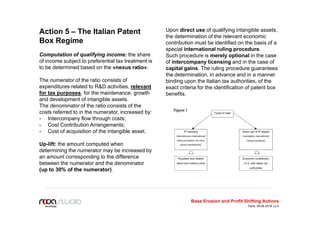
Computation of qualifying income: the share
of income subject to preferential tax treatment is
to be determined based on the «nexus ratio».
The numerator of the ratio consists of
expenditures related to R&D activities, relevant
for tax purposes, for the maintenance, growth
and development of intangible assets.
The denominator of the ratio consists of the
costs referred to in the numerator, increased by:
- Intercompany flow through costs;
- Cost Contribution Arrangements;
- Cost of acquisition of the intangible asset.
Up-lift: the amount computed when
determining the numerator may be increased by
an amount corresponding to the difference
between the numerator and the denominator
(up to 30% of the numerator).
Upon direct use of qualifying intangible assets,
the determination of the relevant economic
contribution must be identified on the basis of a
special international ruling procedure.
Such procedure is merely optional in the case
of intercompany licensing and in the case of
capital gains. The ruling procedure guarantees
the determination, in advance and in a manner
binding upon the Italian tax authorities, of the
exact criteria for the identification of patent box
benefits.
Base Erosion and Profit Shifting Actions
Paris, 09.06.2016 | p.5
Action 5 – Patent Box in an
international context
Regarding the type of costs that form the
numerator and denominator of the ratio, while
Italian law expressly provides that such
costs must be relevant for Italian tax
purposes, the OECD seems to follow a
different approach.
In fact, the Action 5 Final Report states that the
costs to be considered in the calculation of the
ratio are those incurred during the reporting
period, regardless of the tax regime and the
accounting treatment thereof.
The Italian Paten Box regime seems
generally in line with international rules:
i. Compatibility with the non-discrimination
provision of double tax conventions
(DTCs): PEs of foreign companies can
benefit from the measures;
ii. Compatibility with EU fundamental
freedoms: the regime applies to costs
sustained in EU or EEA Member States;
iii. Compatibility with EU state aid rules: the
deduction regime for R&D costs is
available to all businesses;
iv. Harmful tax competition and
fundamental freedoms: there seem to be
no territorial restrictions in the patent box
regime;
The implementing Decree, which clarifies how
the proportion of income that benefits from the
incentive is computed, makes the regime
compliant with the modified «nexus
approach» endorsed by OECD.
Base Erosion and Profit Shifting Actions
Paris, 09.06.2016 | p.6
Action 8 10 – Aligning Transfer
Pricing Outcomes with Value
Creation
Even though this Action has not yet been
implemented, the Internationalization Decree
published in September 2015 contains rules
regarding the determination of the taxable profits
of a permanent establishment (PE) in Italy,
formally recognising the «functional separate
entity approach».
Therefore, TP Guidelines apply to dealings
occurred between resident PEs and the foreign
parent company.
Free capital attributable to resident PE to be
determined based on functions performed, risks
assumed and assets held by the PE.
Base Erosion and Profit Shifting Actions
Paris, 09.06.2016 | p.7
Action 13 – Transfer Pricing
Documentation and CbC-R
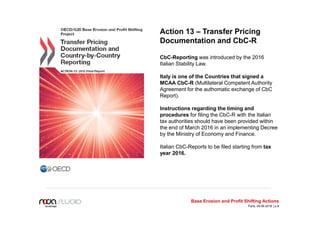
CbC-Reporting was introduced by the 2016
Italian Stability Law.
Italy is one of the Countries that signed a
MCAA CbC-R (Multilateral Competent Authority
Agreement for the authomatic exchange of CbC
Report).
Instructions regarding the timing and
procedures for filing the CbC-R with the Italian
tax authorities should have been provided within
the end of March 2016 in an implementing Decree
by the Ministry of Economy and Finance.
Italian CbC-Reports to be filed starting from tax
year 2016.
Base Erosion and Profit Shifting Actions
Paris, 09.06.2016 | p.8
Action 13 – The legal
framework
2010 OECD TPG indirectly enforced in the
Italian framework by Circular Letter n. 58/2010.
The documentation that complies with specific
regulations – annually updated - may benefit of
a penalty protection regime.
Before 2016 Stability Law Italy did not have
any statutory requirement of filing transfer
pricing documentation (Master File and Country
File). TP File is recommended to avoid shifting
the burden of proof regarding arm’s length
pricing to the taxpayer (discretionary filing).
In compliance with OECD Guidelines the 2016
Stability Law enforced into the Italian legal
system specific reporting obligations for
multinational enterprises (MNEs).
Subjective requirements: CbC-Reporting
obligation applies to the holding company
(Ultimate Parent Entity) of the group residing
in Italy subject to consolidated financial
statements requirements and whose
consolidated result in the previous tax year
worth at least EUR 750 million.
The same obligation applies also to
subsidiaries located in Italy (Surrogate
Reporting Entity / Other Reporting Entity):
• if the parent company is resident in a
country which did not introduce any CbC-R
obligation; or
• does not have any agreement with Italy
which is in force to allow exchange of
information related to the CbC-R; or
• that has not complied with its obligation to
exchange information relating to the CbC-R.
The amount of revenue and gross income,
taxes paid and accrued, as well as other
elements that indicate a genuine economic
activity are all subject to reporting.
Base Erosion and Profit Shifting Actions
Paris, 09.06.2016 | p.9
Action 13 – The legal
framework
Further details covering the effective date,
specific content, filing requirements and
methods, and other procedural terms and
conditions to be followed in relation to the CbC-
Report should have been provided by an
implementing Decree to be issued by the
Ministry of Economic Affairs and Finance within
the end of March 2016 (not yet issued).
Failure to provide the report or providing an
incorrect or incomplete report will trigger
penalties ranging from EUR 10.000 to EUR
50.000.
No reference was made in the 2016 Stability
Law provisions to any potential modifications
to the existing Italian transfer pricing
documentation regime.
The Italian tax authorities guarantee the
confidentiality of information subject to
reporting in accordance with the confidentiality
obligations set out in the Multilateral Convention
on Mutual Administrative Assistance in Tax
Matters.
This is in line with OECD provisions set
forth on the matter, within the context of the
BEPS Project.
Base Erosion and Profit Shifting Actions
Paris, 09.06.2016 | p.10
Action 3 – Cfc rule
Italian CFC rule reshaping
The Italian CFC legislation is provided by article
167 of the Italian Consolidate Income tax (“TUIR”)
and the implementing legislation, i.e. Miniserial
Decree 429 21st November 2001
The Final Report of Action 3 includes detailed
recommendations for the design of CFC rules for
countries to consider if they are interested in
implementing a new regime or modifying an
existing regime
The Italian CFC rule has been reshaped after
the release of the OECD draft on Action 3, and on
the basis of the Article 8 of Legislative Decree
147/2015.
What’s new???
Base Erosion and Profit Shifting Actions
Paris, 09.06.2016 | p.11
Action 3 – Cfc rule
Italian CFC rule reshaping
A) Definition of CFC (art. 167 PD 917/86)
The profits realized by a non-resident
company (this term is used to describe the
most common case, i.e. CFC rules applied to
non-resident companies, but the CFC rules
may also apply to other types of entities,
including partnerships) are deemed to be
the profits of an Italian resident person if:
1) the resident person controls, directly or
indirectly, also through trustee companies or
interposed third persons, the non-resident
company;
Art. 2359 cc: company is deemed to be controlled if:
- another company holds, directly or indirectly, the
majority of the votes at the shareholders’ meeting;-
another company holds, directly or indirectly, sufficient
votes to exert a decisive influence in the shareholders’
meeting; or
- the company is under the relevant influence of
another company due to a special contractual
relationship.
2) the company is resident in a jurisdiction that
is deemed to have a low-tax regime.
The level of taxation is deemed to be substantially lower
than in Italy if the tax rate in the foreign jurisdiction is
lower than 50% of the corporate income tax rate
applicable in Italy (i.e. lower than 13.75% and 12% from
2017).
The CFC regime also applies to profits of
non-resident persons that are not resident in
a low-tax jurisdiction if the profits were
earned through a permanent establishment
situated in a low-tax jurisdiction.
From 1 July 2009, the scope of the CFC
rules may also apply to companies located
in the European Union, provided that both
the following conditions are met:
-the actual income tax paid in the foreign jurisdiction is
lower than 50% of the Italian corporate income tax that
would be applicable to the company if it were resident in
Italy;
- more than 50% of the proceeds of the controlled
company derive from financial activities, services, even
if intragroup.
Base Erosion and Profit Shifting Actions
Paris, 09.06.2016 | p.12
Action 3 – Cfc rule
Italian CFC rule reshaping
B) Attribution of profits (transparency)
Under the Italian CFC rules, the income
(profits) of the CFC must be allocated to the
Italian resident shareholder in proportion to
its equity interest, even if there is no
distribution of dividends or other form of
repatriation of profits.
The income is imputed to the shareholder on
the last day of the CFC’s fiscal year.
The resident shareholder must treat the income
allocated under the CFC rules as business
income and compute it accordingly, with certain
exceptions. The income is then taxed
separately from the other income of the resident
shareholder and is subject to a tax rate equal to
the average tax rate applied on the
shareholder’s aggregate income. However, this
average rate may not be lower than the ordinary
IRES rate.
Foreign Tax credit/CFC: taxes (e.g. corporate
income tax) paid by the CFC in the foreign
jurisdiction where it is resident may be credited
against the Italian corporate income tax.
If the CFC distributes dividends to the resident
shareholder, these dividends are not included in
the shareholder’s income and, therefore, are
not taxed in Italy up to the amount that has
already been taxed under the Italian CFC rules
(previously taxed income, or PTI).
Therefore, Italy does not tax the shareholder
twice.
Foreign taxes (e.g. withholding tax) levied on
the part of the profits that are PTI for the
resident shareholder (and, thus, not included
again in its taxable income) can also be
credited against the taxes due in Italy on the
CFC income up to the amount exceeding the
foreign taxes already credited under the CFC
regime.
Base Erosion and Profit Shifting Actions
Paris, 09.06.2016 | p.13
Action 3 – Cfc rule
Italian CFC rule reshaping
C) Safe Harbour rules
The Italian resident shareholder may apply for a
advanced tax ruling under article 11 of Law
212/2000, claiming the non-application of the
CFC rules.
To this end, the Italian resident taxpayer must
give evidence that:
- the CFC predominantly carries out, as its main
business purpose, an industrial or business
activity within the local market, i.e. within the
market of the country where the company is
located. For banks, financial institutions and
insurance companies, this evidence is deemed
to be given if most of the funds, investments,
and proceeds arise from the jurisdiction where
these entities are located;
- the participation in the CFC does not achieve
the result of shifting income to low-tax
jurisdictions.
After the enactment of LD 147/2015, the Italian
resident company may also prove the existence
of the conditions required for the safe harbours
during a tax audit process
Before issuing a notice of tax deficiency
based on the CFC rules, the tax authorities
must send a notice to the taxpayer whereby
the taxpayer is given the opportunity to
provide evidence of the application of one of
the described safe harbours within 90 days.
Unless the CFC rules have already been
applied or the taxpayer has obtained a positive
tax ruling from the tax authorities, it must
disclose in its IRES tax return the ownership
of shares in non-resident companies that are
potentially subject to the CFC rules.
If the taxpayer fails to disclose its ownership, a
penalty equal to 10% of the non-resident
company’s income attributable to the taxpayer
applies, with a minimum of EUR 1,000 and a
maximum of EUR 50,000.
Base Erosion and Profit Shifting Actions
Paris, 09.06.2016 | p.14
Action 6 – Italian GAAR – New
ruling for proposed investment
exceeding Euro 30 milns
Three different areas identified by Action 6:
(A) Treaty provisions and domestic rules to prevent
granting of treaty benefits in inappropriate circumstances;
(B) Clarification that tax treaties are not intended to be
used to generate double non-taxation (C) Identification of
tax policy considerations that countries should consider
before deciding to enter into a tax treaty with another
country.
Italian legislation has never had a true statutory
GAAR until Legislative Decree 128/2015, which
codified the case law doctrine of abuse of law (see
below).
The new GAAR is effective as of 1 October 2015
Art. 2 Legislative Decree 147/2015: a new ruling
procedure for proposed investments in Italy
has been introduced, allowing taxpayers to inquire
about the potential tax risks and implications for
the proposed investments
Base Erosion and Profit Shifting Actions
Paris, 09.06.2016 | p.15
Action 6 – Prevent tax abuse
Italian GAAR
Before BEPS:
Although Italy did not have a true statutory
GAAR before Legislative Decree 128/2015, the
tax authorities have however relied on
(i) an extensive range of specific anti-
avoidance rules aimed at tackling specific
transactions or practices,
(ii) a sort of semi-general statutory GAAR
(article 37-bis of Presidential decree 600/1973)
(iii) the overarching abuse of law doctrine.
Abuse of law doctrine: the Supreme Court
held that tax savings obtained via transactions
or arrangements not supported by valid
economic reasons are contrary to the
constitutional principles of the ability to pay and
of graduated taxation.
After BEPS
Legislative Decree 128/2015 introduced a new
statutory GAAR, added article 10-bis to L
212/2000, which provides for a new, single
statutory definition of “abuse of law”, and which
applies retrospectively to transactions that have
not yet been challenged by tax authorities
through the service of a formal notice of tax
deficiency. Under the new definition, abuse of
law exists when a transaction lacks any
economic substance and, although formally
consistent with tax law, is aimed at
obtaining undue tax advantages.
Under article 10-bis of L 212/2000 (as enacted
by DLgs 128/2015), the tax authorities must
comply with strict procedural requirements
if they want to resort to the statutory GAAR.
Advance tax ruling application is also provided
for the taxpayers
Under article 10-bis L 212/2000, any abusive
conduct does not constitute criminal behaviour
and thus cannot result in a criminal offence.
Base Erosion and Profit Shifting Actions
Paris, 09.06.2016 | p.16
Action 6 – Prevent tax abuse
New ruling for foreing
investment
Art. 2 Legislative Decree 147/2015
Resident and non-resident taxpayers may apply
for the ruling if they plan to make an
investment in Italy, which is equivalent to at
least € 30 million and with a significant and
long-lasting impact on employment.
The investment may also include the
restructuring of a business in crisis as long as
there are positive effects on employment
The advanced ruling is configured as a wide-
ranging consulting activity by the Italian Tax
Administration, made with references to
various taxes. The law specifically mentions the
possibility of asking for an explanation of the tax
treatment for an investment plan and for any
future extraordinary transactions.
It is possible to ask for information on the
existence of an ongoing concern, of abuse of
rights, of tax avoidance, of the requirements
to disregard anti-avoidance rules and to gain
access to particular regimes (e.g. tax
consolidation).
The Italian Tax administration has to reply within
120 days with an extension of a further 90 days
in case it is necessary to acquire additional
information. If the reply is not received by the
taxpayer within the specified period that means
that the tax administration is in agreement with
the interpretation of the behaviour proposed by
the taxpayer
The response is binding for the Italian Revenue
Agency as far as the facts and circumstances
described by the investor do not change and
comply with the Italian case law.
No tax assessment may be issued in contrast
with the content of such response.
Base Erosion and Profit Shifting Actions
Paris, 09.06.2016 | p.17
Action 7 – PE status – Changes
on the regulation of PE’s
Action 7 includes a proposal for additional
guidance on the determination of profits to be
attributed to the PE’s as a result of the revised
definition of PE will be provided.
The OECD aims to release such guidance by the
end of 2016
Italian Legislative Decree 147/2015 introduced
several changes in respect of the tax regime
applicable to permanent establishments (PEs), in:
- article 7 establishing new methods for
computing income attributable to Italian PEs;
- article 14 providing an election for an
exemption from the Italian tax base for income
attributable to foreign PEs of resident
enterprises
Base Erosion and Profit Shifting Actions
Paris, 09.06.2016 | p.18
Action 7 – PE status – new
methods for computing
income attributable to Italian
PEs
Rationale: the new provisions on the PE’s
provided by art. 7 LD 147/2015 are intended to
align Italy with the Authorised OECD Approach
(AOA), as well as boost investment in Italy by
non-resident MNEs.
As article 7(1) of the OECD Model (2014)
makes clear, the PE state is only entitled to tax
profits that the enterprise derives from that state
through its PE.
This means that, in principle, the right of the PE
state to tax does not extend to profits that the
non-resident enterprise may derive from that
state, but that are not attributable to the activity
carried out through the PE.
But tax legistlation of many states adhered to
the “force of attraction principle”.
Before art. 7 LD 147/2015
Art, 23 (1) of Presidential Decree 917/1986
provides that business income derived through
a PE situated in Italy are deemed to be
originated in Italy, and are to be taxed in Italy.
Article 151(2) of PD 917/1986, before the
amendments were enacted, contained a
provision that relied on a limited “force of
attraction” doctrine. Specifically, article 151(2) of
the same PD 917/1986 stipulated that, where a
PE exists in Italy, certain items of income
derived from activities carried out in Italy not
through that PE should nevertheless be
attributed to that PE.
After art. 7 LD 147/2015
The amended article 152(1) of PD 917/1986
has abolished the remains of the force of
attraction principle, making it clear that income
attributable to an Italian PE only comprises
gains and losses pertaining to it. Specifically,
profits and losses of Italian PEs are calculated
similarly to resident enterprises, i.e. by taking
into account separately each item of income
and by applying the PE test to each of them.
Base Erosion and Profit Shifting Actions
Paris, 09.06.2016 | p.19
Action 7 – PE status – italian
branch exemption regime
Rationale: to give resident enterprises an
opportunity to take advantage of the potentially
lower tax burden in the state in which the PE is
situated. This measure may also serve as a
deterrent to Italian MNEs considering
transferring their tax residence to other states
Art. 14 of LD 147/2015 introduces an optional
regime allowing resident enterprises to
exempt the profits of their foreign PEs.
It follows that the corresponding losses
incurred by foreign PEs would also not be
taken into account. This optional exemption
constitutes an alternative to the ordinary foreign
tax credit system with regard to the profits and
losses of foreign PEs.
This represents a major shift toward a
territorial system of taxation and a
significant departure from the worldwide
taxation regime generally applicable in Italy.
The branch exemption enables resident
enterprises having PEs in a state with a lower
tax burden to effectively benefit from the foreign
state’s lower tax rate.
The new rules took effect on 1 January 2016.
Anti- avoidance rule
First, the election made by the resident
enterprise is irrevocable.
In addition, an all-in all-out approach has been
adopted, meaning that the option must be
exercised for all foreign PEs of a resident
enterprise at the time the PE is constituted, or,
for existing PEs of resident enterprises, the
election is to be made by the second annual tax
period subsequent to the introduction of the
new regime.
The attribution of profits to foreign PEs
follows the same rules for the attribution of
profits to Italian PEs
Base Erosion and Profit Shifting Actions
Paris, 09.06.2016 | p.20
Action 12 – Disclosure of
aggressive tax planning – The
new italian cooperative
compliance regime
The Action 12 Report makes a series of
recommendations about the design of mandatory
disclosure regimes intended to allow maximum
consistency between countries while also being
sensitive to local needs and to compliance costs.
The Action 12 Report considers the mandatory
disclosure regimes implemented in
various countries (eg tax rulings, reporting
obligations in tax returns and voluntary disclosure
rules)
After a project pilot of 2013, Decree 128 of 5
August 2015 introduces into the Italian domestic
tax system, the new cooperative compliance
regime as of 1 January 2016 for large taxpayers
Law 186 of 15 December 2014 introduced a
voluntary disclosure procedure for Italian
residents to regularize their tax positions.
Base Erosion and Profit Shifting Actions
Paris, 09.06.2016 | p.21
Action 12 – Aggressive tax
planning – The new italian
cooperative compliance
regime
Rationale: the new tax compliance regime is
aimed at promoting reinforced forms of dialogue
and cooperation between the tax authorities
and taxpayers who have put in place a
mechanism of detection, measurement,
management and control of “tax risk”.
- “tax risk” is defined as the risk of managing an
undertaking in violation of tax rules or in contrast with
the aims and principles of the tax system
Initially, the regime will only be available to
qualifying taxpayers with a turnover of at least
EUR 10 billion. The Ministry of Economy and
Finance will issue a decree that will set the
criteria to identify additional eligible taxpayers,
provided that they have a turnover (or gross
revenues) of at least EUR 100 million.
A report must be submitted at last yearly to the
board of directors. This report will confirm that
the tax obbligation have been fulfilled, will
identify that check and controls put in place and
indicate the results of these controls and the
initiative taken to resolve any problem that have
emerged. Taxpayers may elect to participate in
the regime by electronically filing a specific
request with the tax authorities.
Participating taxpayers may achieve a joint
evaluation of their potential tax risks with the tax
authorities before the filing of the tax returns.
In relation to the tax risks timely disclosed to the
tax authorities, participating taxpayers will
enjoy:
- a 50% reduction of the tax penalties if the
tax authorities end up disagreeing with the
position taken by the taxpayer;
- the possibility of not providing any
guarantee when they apply for the refund of
taxes, whether direct or indirect.
Base Erosion and Profit Shifting Actions
Paris, 09.06.2016 | p.22
Action 12 – Aggressive tax
planning – Voluntary
disclosure program for italian
tax residents
Until 30 November 2015, Italian residents
subject to individual income tax who, up to 30
September 2014, omitted to declare in their
income tax return assets and investments
held abroad may have commence a voluntary
disclosure procedure, except if they are
already subject to tax audit or inspection.
The voluntary disclosure procedure was also
available to taxpayers who wanted to
regularize their tax positions with respect to
the tax years still open to assessment, including
violations of WHT obligations on employment
income and irrespective of the connection with
undeclared assets and investments held
abroad. The voluntary disclosure procedure was
also available to PE of no residents.
Taxpayers must file a request with the tax
authorities disclosing all assets and
investments held abroad, and provide for the
relevant documentation and infoon income
necessary for their creation or acquisition and
possible income. Under the new procedure,
taxpayers must have to pay the entire amount
interest and taxes due: penalties were
generally equal to the minimum penalty,
reduced by one quarter, and sometimes
further reduced by up to 50% of the
minimum penalty.
For undisclosed activities not excd EUR 2
million, taxpayers may also opt for a simplified
assessment procedure (amount due by
applying a flat rate of 27% on 5% of the value of
the undisclosed activities at the end of the tax
year).
Participating taxpayers are not liable to
criminal prosecution for fraudulent tax
returns, the omission or inaccurate filing of
tax returns, failure to pay VAT or certified
WHT, money laundering and self-laundering.
Base Erosion and Profit Shifting Actions
Paris, 09.06.2016 | p.23
Action 14 – Dispute resolution –
International ruling regime
The final report on Action 14, Making Dispute
Resolution Mechanisms More Effective, reflects
the commitment of participating countries to
implement substantial changes in their approach
to dispute resolution.
Legislative decre156/2015 completely reformed
the tax ruling system, providing - with effect from 1
January 2016 - for four types of tax rulings
- the interpretative ruling;
- the regime admission ruling;
- the anti-abuse ruling;
- the disapplication ruling.
In such a scenario, article 1 of LD 147/2015 added
article 31-ter to DPR 600/1973, which provides for
a new advance tax agreement (ATA) procedure.
Base Erosion and Profit Shifting Actions
Paris, 09.06.2016 | p.24
Action 14 – Dispute resolution
– New advance tax agreement
(ATA)
Scopes:
(i) transfer pricing (advance pricing
agreements);
(ii) attribution of income or losses to Italian
permanent establishments of non-
resident taxpayers and to foreign
permanent establishments of Italian
taxpayers;
(iii) application of domestic tax laws or tax
treaties to dividends, interest and
royalties or other items of income;
(iv) advance assessment of whether non-
resident persons’ activities in Italy give
rise to a permanent establishment;
(v) patent box regime issues;
(vi) determination of the tax basis of assets in
the case of inbound and outbound
migrations of companies.
Within 30 days of receipt of the ruling
application, the tax authorities invite the
taxpayer to discuss the documentation
provided, to request any supplemental
documentation and to define the time schedule
of the procedure.
The entire process must be completed within
180 days from the receipt of the application.
The tax authorities will gather information from
the documentation provided by the taxpayer,
from the meetings and from the ordinary
procedures to collect information at the
taxpayer’s premises, as well as through the
exchange of information with foreign tax
authorities (when the 180-day term is
suspended).
The procedure concludes with the signing of the
ATA, that is valid for 5 fiscal years, provided
that the underlying factual and legal
circumstances remain unchanged.
.
Base Erosion and Profit Shifting Actions
Paris, 09.06.2016 | p.25
Action 14 – Dispute resolution
– New advance tax agreement
(ATA) procedure
Rollback effects:
Article 31-ter of PD 600/1973:
- in the case of ATAs based on arrangements
reached with the competent authorities of
other countries under the MAP provided by
the tax treaties, the ATA is also binding for
previous fiscal years;
- in all other cases, taxpayers may decide to
roll back the terms of the ATA to previous
fiscal years, provided that there have been
no changes in the underlying factual and
legal circumstances that occurred.
The taxpayer has to file an amended tax
return for the previous years or voluntarily pay
any deficiency that results from applying the
terms of the ATA to such previous years. The
taxpayer is not subject to penalties.
After the ATA has been executed, the taxpayer
must periodically (or upon specific request)
submit documents and information to allow
the tax authorities to monitor the taxpayer’s
compliance with the terms of the ATA.
If following these checks or otherwise the tax
authorities determine that the underlying factual
or legal circumstances of the ATA have
changed, they send a notice to the taxpayer to
discuss the potential amendments to the ATA.
The implementing regulation issued by the tax
authorities also sets forth the procedure that
should be followed in case it is the taxpayer that
requests the amendment to the ATA.
In particular, in such a case, the same
procedure as provided for the original ATA
basically applies, and the term to sign the
amended ATA is 180 days.
Until the ATA is valid and binding, the tax
authorities may exercise their audit or
assessment powers only in relation to
matters other than those in the ATA.
Base Erosion and Profit Shifting Actions
Paris, 09.06.2016 | p.26
Thank you for your attention!
Base Erosion and Profit Shifting Actions
Paris, 09.06.2016 | p.27
Milano
via Vincenzo Monti, 8
20123 Milano
tel. +39 02 48 10 04 71
info.milano@nodastudio.it
Venezia
San Marco, 2757
30124 Venezia
tel. +39 041 52 04 488
info.venezia@nodastudio.it
Verbania
piazza Antonio Gramsci, 2
28922 Verbania
info.verbania@nodastudio.it
Roma
via Crescenzio, 16
00193 Roma
tel. +39 06 77 20 66 26
info.roma@nodastudio.it
Brescia
via Aldo Moro, 5
25124 Brescia
tel. +39 030 22 12 64
info.brescia@nodastudio.it
Monza
corso Italia, 46
20900 Monza
tel. +39 039 27 52 819
info.monza@nodastudio.it
Italian member firm
of Andersen Global
info@nodastudio.it
www.nodastudio.it

BEPS Base erosion and profit shifting

  • 1.
    Base Erosion andProfit Shifting Actions Implementation in Italy Stefano Rossi CPA Noda Studio Venezia Maurizio Di Salvo Tax lawyer, CPA, LLM Noda Studio Milano Paris, 09.06.2016 for
  • 2.
    Base Erosion andProfit Shifting Actions ITALY - Countering Base Erosion and Profit Shifting The Italian Government has been focusing on fighting tax evasion and avoidance in recent years. Many of the measures suggested within the context of the BEPS Project have been implemented in Italy by Legislative Decree No. 147 of September 14th 2015, which contains provisions laying down measures for [the] growth and internationalization of enterprises”. However, the OECD indications on transfer pricing documentation were implemented by Law No. 208 of December 30th 2015 (Stability Law). Italy already has stringent rules on interest deductibility, royalties, lease and other payments, anti-hybrid provisions, and anti-abuse rules concerning EU directives, each resembling OECD and/or EU recommendations. Nevertheless, the rules will be reviewed in light of the OECD’s final proposals. Paris, 09.06.2016 | p.2
  • 3.
    Base Erosion andProfit Shifting Actions Action 5 – Countering Harmful Tax Practices More Effectively Italy has introduced a patent box regime for entities deriving income from certain R&D activities. Said regime is in line with the «nexus approach» described in Action 5 report and, therefore, aims to restrict the tax regime to situations where «substantial activities» are carried out in Italy. As for software, the 2016 Italian Stability Law has restricted the eligibility to those protected by copyright, in line with Action 5. Marketing-related IP assets (trademarks) will be incentivized upon conclusion of the «transition peridod» (2015/2019). The election applies, irrevocably, for 5 years and is renewable. Paris, 09.06.2016 | p.3
  • 4.
    Action 5 –The Italian Patent Box Regime Italian policy objectives are essentially a response to the high-level mobility of IP, and of the relevant income subject to preferential treatment. The government’s aims include the intention to: – promote the placement or maintenance in Italy of certain (legally protectable) intangibles, guaranteeing benefits based on the incurring of R&D expenditures; – prevent the allocation abroad of qualifying IP assets, making the Italian market more attractive to domestic and foreign investment; – follow the OECD recommendations on preventing aggressive tax practices. Qualifying expenditures: qualifying expenditures must all relate to actual R&D activity. Preferential treatment: the preferential tax regime applies: • in case of qualifying income from the direct or indirect use of qualifying IP assets: 50% exemption (30% - 2015 / 40% - 2016); • in case of capital gains from the disposal of qualifying IP assets: 100% exclusion (90% to be reinvested within the second tax year from the disposal). Taxes covered: corporate income tax (27,5% of the taxable income) and regional business tax (3,9% of the valued added of the production factors). Which income? Italian qualifying income is that derived from the following qualifying IP assets: – industrial patents; – intellectual property; – drawings and models (legally protectable); – legally protectable processes, formulas and information; and – trademarks. Base Erosion and Profit Shifting Actions Paris, 09.06.2016 | p.4
  • 5.
    Action 5 –The Italian Patent Box Regime Computation of qualifying income: the share of income subject to preferential tax treatment is to be determined based on the «nexus ratio». The numerator of the ratio consists of expenditures related to R&D activities, relevant for tax purposes, for the maintenance, growth and development of intangible assets. The denominator of the ratio consists of the costs referred to in the numerator, increased by: - Intercompany flow through costs; - Cost Contribution Arrangements; - Cost of acquisition of the intangible asset. Up-lift: the amount computed when determining the numerator may be increased by an amount corresponding to the difference between the numerator and the denominator (up to 30% of the numerator). Upon direct use of qualifying intangible assets, the determination of the relevant economic contribution must be identified on the basis of a special international ruling procedure. Such procedure is merely optional in the case of intercompany licensing and in the case of capital gains. The ruling procedure guarantees the determination, in advance and in a manner binding upon the Italian tax authorities, of the exact criteria for the identification of patent box benefits. Base Erosion and Profit Shifting Actions Paris, 09.06.2016 | p.5
  • 6.
    Action 5 –Patent Box in an international context Regarding the type of costs that form the numerator and denominator of the ratio, while Italian law expressly provides that such costs must be relevant for Italian tax purposes, the OECD seems to follow a different approach. In fact, the Action 5 Final Report states that the costs to be considered in the calculation of the ratio are those incurred during the reporting period, regardless of the tax regime and the accounting treatment thereof. The Italian Paten Box regime seems generally in line with international rules: i. Compatibility with the non-discrimination provision of double tax conventions (DTCs): PEs of foreign companies can benefit from the measures; ii. Compatibility with EU fundamental freedoms: the regime applies to costs sustained in EU or EEA Member States; iii. Compatibility with EU state aid rules: the deduction regime for R&D costs is available to all businesses; iv. Harmful tax competition and fundamental freedoms: there seem to be no territorial restrictions in the patent box regime; The implementing Decree, which clarifies how the proportion of income that benefits from the incentive is computed, makes the regime compliant with the modified «nexus approach» endorsed by OECD. Base Erosion and Profit Shifting Actions Paris, 09.06.2016 | p.6
  • 7.
    Action 8 10– Aligning Transfer Pricing Outcomes with Value Creation Even though this Action has not yet been implemented, the Internationalization Decree published in September 2015 contains rules regarding the determination of the taxable profits of a permanent establishment (PE) in Italy, formally recognising the «functional separate entity approach». Therefore, TP Guidelines apply to dealings occurred between resident PEs and the foreign parent company. Free capital attributable to resident PE to be determined based on functions performed, risks assumed and assets held by the PE. Base Erosion and Profit Shifting Actions Paris, 09.06.2016 | p.7
  • 8.
    Action 13 –Transfer Pricing Documentation and CbC-R CbC-Reporting was introduced by the 2016 Italian Stability Law. Italy is one of the Countries that signed a MCAA CbC-R (Multilateral Competent Authority Agreement for the authomatic exchange of CbC Report). Instructions regarding the timing and procedures for filing the CbC-R with the Italian tax authorities should have been provided within the end of March 2016 in an implementing Decree by the Ministry of Economy and Finance. Italian CbC-Reports to be filed starting from tax year 2016. Base Erosion and Profit Shifting Actions Paris, 09.06.2016 | p.8
  • 9.
    Action 13 –The legal framework 2010 OECD TPG indirectly enforced in the Italian framework by Circular Letter n. 58/2010. The documentation that complies with specific regulations – annually updated - may benefit of a penalty protection regime. Before 2016 Stability Law Italy did not have any statutory requirement of filing transfer pricing documentation (Master File and Country File). TP File is recommended to avoid shifting the burden of proof regarding arm’s length pricing to the taxpayer (discretionary filing). In compliance with OECD Guidelines the 2016 Stability Law enforced into the Italian legal system specific reporting obligations for multinational enterprises (MNEs). Subjective requirements: CbC-Reporting obligation applies to the holding company (Ultimate Parent Entity) of the group residing in Italy subject to consolidated financial statements requirements and whose consolidated result in the previous tax year worth at least EUR 750 million. The same obligation applies also to subsidiaries located in Italy (Surrogate Reporting Entity / Other Reporting Entity): • if the parent company is resident in a country which did not introduce any CbC-R obligation; or • does not have any agreement with Italy which is in force to allow exchange of information related to the CbC-R; or • that has not complied with its obligation to exchange information relating to the CbC-R. The amount of revenue and gross income, taxes paid and accrued, as well as other elements that indicate a genuine economic activity are all subject to reporting. Base Erosion and Profit Shifting Actions Paris, 09.06.2016 | p.9
  • 10.
    Action 13 –The legal framework Further details covering the effective date, specific content, filing requirements and methods, and other procedural terms and conditions to be followed in relation to the CbC- Report should have been provided by an implementing Decree to be issued by the Ministry of Economic Affairs and Finance within the end of March 2016 (not yet issued). Failure to provide the report or providing an incorrect or incomplete report will trigger penalties ranging from EUR 10.000 to EUR 50.000. No reference was made in the 2016 Stability Law provisions to any potential modifications to the existing Italian transfer pricing documentation regime. The Italian tax authorities guarantee the confidentiality of information subject to reporting in accordance with the confidentiality obligations set out in the Multilateral Convention on Mutual Administrative Assistance in Tax Matters. This is in line with OECD provisions set forth on the matter, within the context of the BEPS Project. Base Erosion and Profit Shifting Actions Paris, 09.06.2016 | p.10
  • 11.
    Action 3 –Cfc rule Italian CFC rule reshaping The Italian CFC legislation is provided by article 167 of the Italian Consolidate Income tax (“TUIR”) and the implementing legislation, i.e. Miniserial Decree 429 21st November 2001 The Final Report of Action 3 includes detailed recommendations for the design of CFC rules for countries to consider if they are interested in implementing a new regime or modifying an existing regime The Italian CFC rule has been reshaped after the release of the OECD draft on Action 3, and on the basis of the Article 8 of Legislative Decree 147/2015. What’s new??? Base Erosion and Profit Shifting Actions Paris, 09.06.2016 | p.11
  • 12.
    Action 3 –Cfc rule Italian CFC rule reshaping A) Definition of CFC (art. 167 PD 917/86) The profits realized by a non-resident company (this term is used to describe the most common case, i.e. CFC rules applied to non-resident companies, but the CFC rules may also apply to other types of entities, including partnerships) are deemed to be the profits of an Italian resident person if: 1) the resident person controls, directly or indirectly, also through trustee companies or interposed third persons, the non-resident company; Art. 2359 cc: company is deemed to be controlled if: - another company holds, directly or indirectly, the majority of the votes at the shareholders’ meeting;- another company holds, directly or indirectly, sufficient votes to exert a decisive influence in the shareholders’ meeting; or - the company is under the relevant influence of another company due to a special contractual relationship. 2) the company is resident in a jurisdiction that is deemed to have a low-tax regime. The level of taxation is deemed to be substantially lower than in Italy if the tax rate in the foreign jurisdiction is lower than 50% of the corporate income tax rate applicable in Italy (i.e. lower than 13.75% and 12% from 2017). The CFC regime also applies to profits of non-resident persons that are not resident in a low-tax jurisdiction if the profits were earned through a permanent establishment situated in a low-tax jurisdiction. From 1 July 2009, the scope of the CFC rules may also apply to companies located in the European Union, provided that both the following conditions are met: -the actual income tax paid in the foreign jurisdiction is lower than 50% of the Italian corporate income tax that would be applicable to the company if it were resident in Italy; - more than 50% of the proceeds of the controlled company derive from financial activities, services, even if intragroup. Base Erosion and Profit Shifting Actions Paris, 09.06.2016 | p.12
  • 13.
    Action 3 –Cfc rule Italian CFC rule reshaping B) Attribution of profits (transparency) Under the Italian CFC rules, the income (profits) of the CFC must be allocated to the Italian resident shareholder in proportion to its equity interest, even if there is no distribution of dividends or other form of repatriation of profits. The income is imputed to the shareholder on the last day of the CFC’s fiscal year. The resident shareholder must treat the income allocated under the CFC rules as business income and compute it accordingly, with certain exceptions. The income is then taxed separately from the other income of the resident shareholder and is subject to a tax rate equal to the average tax rate applied on the shareholder’s aggregate income. However, this average rate may not be lower than the ordinary IRES rate. Foreign Tax credit/CFC: taxes (e.g. corporate income tax) paid by the CFC in the foreign jurisdiction where it is resident may be credited against the Italian corporate income tax. If the CFC distributes dividends to the resident shareholder, these dividends are not included in the shareholder’s income and, therefore, are not taxed in Italy up to the amount that has already been taxed under the Italian CFC rules (previously taxed income, or PTI). Therefore, Italy does not tax the shareholder twice. Foreign taxes (e.g. withholding tax) levied on the part of the profits that are PTI for the resident shareholder (and, thus, not included again in its taxable income) can also be credited against the taxes due in Italy on the CFC income up to the amount exceeding the foreign taxes already credited under the CFC regime. Base Erosion and Profit Shifting Actions Paris, 09.06.2016 | p.13
  • 14.
    Action 3 –Cfc rule Italian CFC rule reshaping C) Safe Harbour rules The Italian resident shareholder may apply for a advanced tax ruling under article 11 of Law 212/2000, claiming the non-application of the CFC rules. To this end, the Italian resident taxpayer must give evidence that: - the CFC predominantly carries out, as its main business purpose, an industrial or business activity within the local market, i.e. within the market of the country where the company is located. For banks, financial institutions and insurance companies, this evidence is deemed to be given if most of the funds, investments, and proceeds arise from the jurisdiction where these entities are located; - the participation in the CFC does not achieve the result of shifting income to low-tax jurisdictions. After the enactment of LD 147/2015, the Italian resident company may also prove the existence of the conditions required for the safe harbours during a tax audit process Before issuing a notice of tax deficiency based on the CFC rules, the tax authorities must send a notice to the taxpayer whereby the taxpayer is given the opportunity to provide evidence of the application of one of the described safe harbours within 90 days. Unless the CFC rules have already been applied or the taxpayer has obtained a positive tax ruling from the tax authorities, it must disclose in its IRES tax return the ownership of shares in non-resident companies that are potentially subject to the CFC rules. If the taxpayer fails to disclose its ownership, a penalty equal to 10% of the non-resident company’s income attributable to the taxpayer applies, with a minimum of EUR 1,000 and a maximum of EUR 50,000. Base Erosion and Profit Shifting Actions Paris, 09.06.2016 | p.14
  • 15.
    Action 6 –Italian GAAR – New ruling for proposed investment exceeding Euro 30 milns Three different areas identified by Action 6: (A) Treaty provisions and domestic rules to prevent granting of treaty benefits in inappropriate circumstances; (B) Clarification that tax treaties are not intended to be used to generate double non-taxation (C) Identification of tax policy considerations that countries should consider before deciding to enter into a tax treaty with another country. Italian legislation has never had a true statutory GAAR until Legislative Decree 128/2015, which codified the case law doctrine of abuse of law (see below). The new GAAR is effective as of 1 October 2015 Art. 2 Legislative Decree 147/2015: a new ruling procedure for proposed investments in Italy has been introduced, allowing taxpayers to inquire about the potential tax risks and implications for the proposed investments Base Erosion and Profit Shifting Actions Paris, 09.06.2016 | p.15
  • 16.
    Action 6 –Prevent tax abuse Italian GAAR Before BEPS: Although Italy did not have a true statutory GAAR before Legislative Decree 128/2015, the tax authorities have however relied on (i) an extensive range of specific anti- avoidance rules aimed at tackling specific transactions or practices, (ii) a sort of semi-general statutory GAAR (article 37-bis of Presidential decree 600/1973) (iii) the overarching abuse of law doctrine. Abuse of law doctrine: the Supreme Court held that tax savings obtained via transactions or arrangements not supported by valid economic reasons are contrary to the constitutional principles of the ability to pay and of graduated taxation. After BEPS Legislative Decree 128/2015 introduced a new statutory GAAR, added article 10-bis to L 212/2000, which provides for a new, single statutory definition of “abuse of law”, and which applies retrospectively to transactions that have not yet been challenged by tax authorities through the service of a formal notice of tax deficiency. Under the new definition, abuse of law exists when a transaction lacks any economic substance and, although formally consistent with tax law, is aimed at obtaining undue tax advantages. Under article 10-bis of L 212/2000 (as enacted by DLgs 128/2015), the tax authorities must comply with strict procedural requirements if they want to resort to the statutory GAAR. Advance tax ruling application is also provided for the taxpayers Under article 10-bis L 212/2000, any abusive conduct does not constitute criminal behaviour and thus cannot result in a criminal offence. Base Erosion and Profit Shifting Actions Paris, 09.06.2016 | p.16
  • 17.
    Action 6 –Prevent tax abuse New ruling for foreing investment Art. 2 Legislative Decree 147/2015 Resident and non-resident taxpayers may apply for the ruling if they plan to make an investment in Italy, which is equivalent to at least € 30 million and with a significant and long-lasting impact on employment. The investment may also include the restructuring of a business in crisis as long as there are positive effects on employment The advanced ruling is configured as a wide- ranging consulting activity by the Italian Tax Administration, made with references to various taxes. The law specifically mentions the possibility of asking for an explanation of the tax treatment for an investment plan and for any future extraordinary transactions. It is possible to ask for information on the existence of an ongoing concern, of abuse of rights, of tax avoidance, of the requirements to disregard anti-avoidance rules and to gain access to particular regimes (e.g. tax consolidation). The Italian Tax administration has to reply within 120 days with an extension of a further 90 days in case it is necessary to acquire additional information. If the reply is not received by the taxpayer within the specified period that means that the tax administration is in agreement with the interpretation of the behaviour proposed by the taxpayer The response is binding for the Italian Revenue Agency as far as the facts and circumstances described by the investor do not change and comply with the Italian case law. No tax assessment may be issued in contrast with the content of such response. Base Erosion and Profit Shifting Actions Paris, 09.06.2016 | p.17
  • 18.
    Action 7 –PE status – Changes on the regulation of PE’s Action 7 includes a proposal for additional guidance on the determination of profits to be attributed to the PE’s as a result of the revised definition of PE will be provided. The OECD aims to release such guidance by the end of 2016 Italian Legislative Decree 147/2015 introduced several changes in respect of the tax regime applicable to permanent establishments (PEs), in: - article 7 establishing new methods for computing income attributable to Italian PEs; - article 14 providing an election for an exemption from the Italian tax base for income attributable to foreign PEs of resident enterprises Base Erosion and Profit Shifting Actions Paris, 09.06.2016 | p.18
  • 19.
    Action 7 –PE status – new methods for computing income attributable to Italian PEs Rationale: the new provisions on the PE’s provided by art. 7 LD 147/2015 are intended to align Italy with the Authorised OECD Approach (AOA), as well as boost investment in Italy by non-resident MNEs. As article 7(1) of the OECD Model (2014) makes clear, the PE state is only entitled to tax profits that the enterprise derives from that state through its PE. This means that, in principle, the right of the PE state to tax does not extend to profits that the non-resident enterprise may derive from that state, but that are not attributable to the activity carried out through the PE. But tax legistlation of many states adhered to the “force of attraction principle”. Before art. 7 LD 147/2015 Art, 23 (1) of Presidential Decree 917/1986 provides that business income derived through a PE situated in Italy are deemed to be originated in Italy, and are to be taxed in Italy. Article 151(2) of PD 917/1986, before the amendments were enacted, contained a provision that relied on a limited “force of attraction” doctrine. Specifically, article 151(2) of the same PD 917/1986 stipulated that, where a PE exists in Italy, certain items of income derived from activities carried out in Italy not through that PE should nevertheless be attributed to that PE. After art. 7 LD 147/2015 The amended article 152(1) of PD 917/1986 has abolished the remains of the force of attraction principle, making it clear that income attributable to an Italian PE only comprises gains and losses pertaining to it. Specifically, profits and losses of Italian PEs are calculated similarly to resident enterprises, i.e. by taking into account separately each item of income and by applying the PE test to each of them. Base Erosion and Profit Shifting Actions Paris, 09.06.2016 | p.19
  • 20.
    Action 7 –PE status – italian branch exemption regime Rationale: to give resident enterprises an opportunity to take advantage of the potentially lower tax burden in the state in which the PE is situated. This measure may also serve as a deterrent to Italian MNEs considering transferring their tax residence to other states Art. 14 of LD 147/2015 introduces an optional regime allowing resident enterprises to exempt the profits of their foreign PEs. It follows that the corresponding losses incurred by foreign PEs would also not be taken into account. This optional exemption constitutes an alternative to the ordinary foreign tax credit system with regard to the profits and losses of foreign PEs. This represents a major shift toward a territorial system of taxation and a significant departure from the worldwide taxation regime generally applicable in Italy. The branch exemption enables resident enterprises having PEs in a state with a lower tax burden to effectively benefit from the foreign state’s lower tax rate. The new rules took effect on 1 January 2016. Anti- avoidance rule First, the election made by the resident enterprise is irrevocable. In addition, an all-in all-out approach has been adopted, meaning that the option must be exercised for all foreign PEs of a resident enterprise at the time the PE is constituted, or, for existing PEs of resident enterprises, the election is to be made by the second annual tax period subsequent to the introduction of the new regime. The attribution of profits to foreign PEs follows the same rules for the attribution of profits to Italian PEs Base Erosion and Profit Shifting Actions Paris, 09.06.2016 | p.20
  • 21.
    Action 12 –Disclosure of aggressive tax planning – The new italian cooperative compliance regime The Action 12 Report makes a series of recommendations about the design of mandatory disclosure regimes intended to allow maximum consistency between countries while also being sensitive to local needs and to compliance costs. The Action 12 Report considers the mandatory disclosure regimes implemented in various countries (eg tax rulings, reporting obligations in tax returns and voluntary disclosure rules) After a project pilot of 2013, Decree 128 of 5 August 2015 introduces into the Italian domestic tax system, the new cooperative compliance regime as of 1 January 2016 for large taxpayers Law 186 of 15 December 2014 introduced a voluntary disclosure procedure for Italian residents to regularize their tax positions. Base Erosion and Profit Shifting Actions Paris, 09.06.2016 | p.21
  • 22.
    Action 12 –Aggressive tax planning – The new italian cooperative compliance regime Rationale: the new tax compliance regime is aimed at promoting reinforced forms of dialogue and cooperation between the tax authorities and taxpayers who have put in place a mechanism of detection, measurement, management and control of “tax risk”. - “tax risk” is defined as the risk of managing an undertaking in violation of tax rules or in contrast with the aims and principles of the tax system Initially, the regime will only be available to qualifying taxpayers with a turnover of at least EUR 10 billion. The Ministry of Economy and Finance will issue a decree that will set the criteria to identify additional eligible taxpayers, provided that they have a turnover (or gross revenues) of at least EUR 100 million. A report must be submitted at last yearly to the board of directors. This report will confirm that the tax obbligation have been fulfilled, will identify that check and controls put in place and indicate the results of these controls and the initiative taken to resolve any problem that have emerged. Taxpayers may elect to participate in the regime by electronically filing a specific request with the tax authorities. Participating taxpayers may achieve a joint evaluation of their potential tax risks with the tax authorities before the filing of the tax returns. In relation to the tax risks timely disclosed to the tax authorities, participating taxpayers will enjoy: - a 50% reduction of the tax penalties if the tax authorities end up disagreeing with the position taken by the taxpayer; - the possibility of not providing any guarantee when they apply for the refund of taxes, whether direct or indirect. Base Erosion and Profit Shifting Actions Paris, 09.06.2016 | p.22
  • 23.
    Action 12 –Aggressive tax planning – Voluntary disclosure program for italian tax residents Until 30 November 2015, Italian residents subject to individual income tax who, up to 30 September 2014, omitted to declare in their income tax return assets and investments held abroad may have commence a voluntary disclosure procedure, except if they are already subject to tax audit or inspection. The voluntary disclosure procedure was also available to taxpayers who wanted to regularize their tax positions with respect to the tax years still open to assessment, including violations of WHT obligations on employment income and irrespective of the connection with undeclared assets and investments held abroad. The voluntary disclosure procedure was also available to PE of no residents. Taxpayers must file a request with the tax authorities disclosing all assets and investments held abroad, and provide for the relevant documentation and infoon income necessary for their creation or acquisition and possible income. Under the new procedure, taxpayers must have to pay the entire amount interest and taxes due: penalties were generally equal to the minimum penalty, reduced by one quarter, and sometimes further reduced by up to 50% of the minimum penalty. For undisclosed activities not excd EUR 2 million, taxpayers may also opt for a simplified assessment procedure (amount due by applying a flat rate of 27% on 5% of the value of the undisclosed activities at the end of the tax year). Participating taxpayers are not liable to criminal prosecution for fraudulent tax returns, the omission or inaccurate filing of tax returns, failure to pay VAT or certified WHT, money laundering and self-laundering. Base Erosion and Profit Shifting Actions Paris, 09.06.2016 | p.23
  • 24.
    Action 14 –Dispute resolution – International ruling regime The final report on Action 14, Making Dispute Resolution Mechanisms More Effective, reflects the commitment of participating countries to implement substantial changes in their approach to dispute resolution. Legislative decre156/2015 completely reformed the tax ruling system, providing - with effect from 1 January 2016 - for four types of tax rulings - the interpretative ruling; - the regime admission ruling; - the anti-abuse ruling; - the disapplication ruling. In such a scenario, article 1 of LD 147/2015 added article 31-ter to DPR 600/1973, which provides for a new advance tax agreement (ATA) procedure. Base Erosion and Profit Shifting Actions Paris, 09.06.2016 | p.24
  • 25.
    Action 14 –Dispute resolution – New advance tax agreement (ATA) Scopes: (i) transfer pricing (advance pricing agreements); (ii) attribution of income or losses to Italian permanent establishments of non- resident taxpayers and to foreign permanent establishments of Italian taxpayers; (iii) application of domestic tax laws or tax treaties to dividends, interest and royalties or other items of income; (iv) advance assessment of whether non- resident persons’ activities in Italy give rise to a permanent establishment; (v) patent box regime issues; (vi) determination of the tax basis of assets in the case of inbound and outbound migrations of companies. Within 30 days of receipt of the ruling application, the tax authorities invite the taxpayer to discuss the documentation provided, to request any supplemental documentation and to define the time schedule of the procedure. The entire process must be completed within 180 days from the receipt of the application. The tax authorities will gather information from the documentation provided by the taxpayer, from the meetings and from the ordinary procedures to collect information at the taxpayer’s premises, as well as through the exchange of information with foreign tax authorities (when the 180-day term is suspended). The procedure concludes with the signing of the ATA, that is valid for 5 fiscal years, provided that the underlying factual and legal circumstances remain unchanged. . Base Erosion and Profit Shifting Actions Paris, 09.06.2016 | p.25
  • 26.
    Action 14 –Dispute resolution – New advance tax agreement (ATA) procedure Rollback effects: Article 31-ter of PD 600/1973: - in the case of ATAs based on arrangements reached with the competent authorities of other countries under the MAP provided by the tax treaties, the ATA is also binding for previous fiscal years; - in all other cases, taxpayers may decide to roll back the terms of the ATA to previous fiscal years, provided that there have been no changes in the underlying factual and legal circumstances that occurred. The taxpayer has to file an amended tax return for the previous years or voluntarily pay any deficiency that results from applying the terms of the ATA to such previous years. The taxpayer is not subject to penalties. After the ATA has been executed, the taxpayer must periodically (or upon specific request) submit documents and information to allow the tax authorities to monitor the taxpayer’s compliance with the terms of the ATA. If following these checks or otherwise the tax authorities determine that the underlying factual or legal circumstances of the ATA have changed, they send a notice to the taxpayer to discuss the potential amendments to the ATA. The implementing regulation issued by the tax authorities also sets forth the procedure that should be followed in case it is the taxpayer that requests the amendment to the ATA. In particular, in such a case, the same procedure as provided for the original ATA basically applies, and the term to sign the amended ATA is 180 days. Until the ATA is valid and binding, the tax authorities may exercise their audit or assessment powers only in relation to matters other than those in the ATA. Base Erosion and Profit Shifting Actions Paris, 09.06.2016 | p.26
  • 27.
    Thank you foryour attention! Base Erosion and Profit Shifting Actions Paris, 09.06.2016 | p.27
  • 28.
    Milano via Vincenzo Monti,8 20123 Milano tel. +39 02 48 10 04 71 info.milano@nodastudio.it Venezia San Marco, 2757 30124 Venezia tel. +39 041 52 04 488 info.venezia@nodastudio.it Verbania piazza Antonio Gramsci, 2 28922 Verbania info.verbania@nodastudio.it Roma via Crescenzio, 16 00193 Roma tel. +39 06 77 20 66 26 info.roma@nodastudio.it Brescia via Aldo Moro, 5 25124 Brescia tel. +39 030 22 12 64 info.brescia@nodastudio.it Monza corso Italia, 46 20900 Monza tel. +39 039 27 52 819 info.monza@nodastudio.it Italian member firm of Andersen Global info@nodastudio.it www.nodastudio.it