Announcements
 The UAE Minister of State for Financial Affairs, His Excellency
Obaid Humaid Al Tayer was speaking in Dubai on 24 February
2016 after a joint press conference with Christine Lagarde,
Managing Director of the International Monetary Fund (IMF).
 On June 15, 2016, the Undersecretary of the UAE Ministry of
Finance, Younis Al Khoury, announced that companies in the
UAE that report annual revenues over Dh 3.75 million will be
obliged to be registered under the GCC VAT system. Al Khoury
also confirmed that companies whose revenues fall between Dh
1.87 million and Dh 3.75 million will have the option to register
for VAT during the first phase of the VAT implementation.
 VAT is one of the most common types of consumption tax found
around the world. Over 150 countries have implemented VAT
(or its equivalent, Goods and Services Tax), including all 29
European Union (EU) members, Canada, New Zealand,
Australia, Singapore and Malaysia.
What is VAT ?
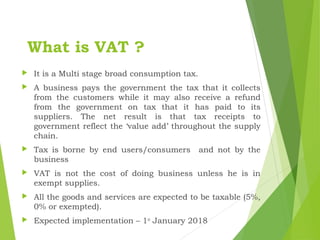
 It is a Multi stage broad consumption tax.
 A business pays the government the tax that it collects
from the customers while it may also receive a refund
from the government on tax that it has paid to its
suppliers. The net result is that tax receipts to
government reflect the ‘value add’ throughout the supply
chain.
 Tax is borne by end users/consumers and not by the
business
 VAT is not the cost of doing business unless he is in
exempt supplies.
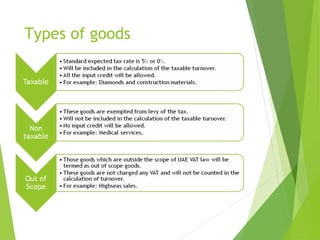
 All the goods and services are expected to be taxable (5%,
0% or exempted).
 Expected implementation – 1st
January 2018
How does it work
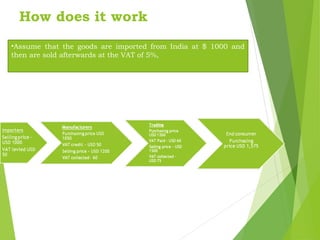
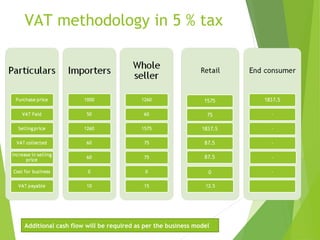
•Assume that the goods are imported from India at $ 1000 and
then are sold afterwards at the VAT of 5%,
Types of goods
VAT methodology in 5 % tax
Additional cash flow will be required as per the business model
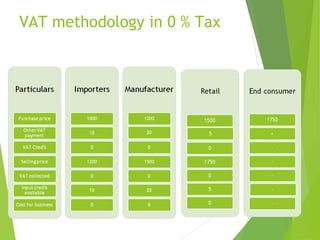
VAT methodology in 0 % Tax
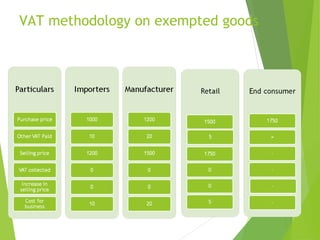
VAT methodology on exempted goods
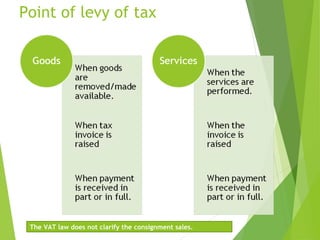
Point of levy of tax
The VAT law does not clarify the consignment sales.
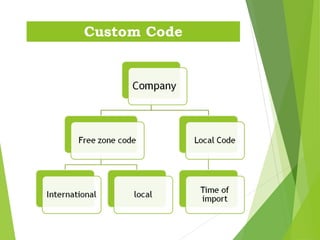
Custom Code
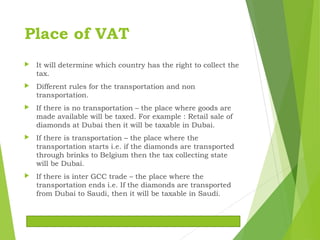
Place of VAT
 It will determine which country has the right to collect the
tax.
 Different rules for the transportation and non
transportation.
 If there is no transportation – the place where goods are
made available will be taxed. For example : Retail sale of
diamonds at Dubai then it will be taxable in Dubai.
 If there is transportation – the place where the
transportation starts i.e. if the diamonds are transported
through brinks to Belgium then the tax collecting state
will be Dubai.
 If there is inter GCC trade – the place where the
transportation ends i.e. If the diamonds are transported
from Dubai to Saudi, then it will be taxable in Saudi.
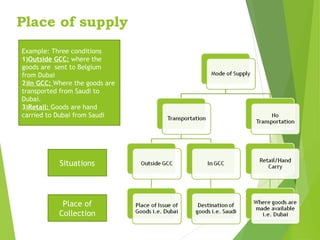
Place of supply
Situations
Place of
Collection
Example: Three conditions
1)Outside GCC: where the
goods are sent to Belgium
from Dubai
2)In GCC: Where the goods are
transported from Saudi to
Dubai.
3)Retail: Goods are hand
carried to Dubai from Saudi
Registration
 To be taxable every company has to get registered.
 For registration the annual turnover and future
annual turnover.
 If turnover is between USD 500,000 to USD
1,000,000 there should be a voluntary registration.
 If the turnover is above USD 1,000,000 it is
mandatory to register within 11 months from the
date the turnover crossed the limit.
Compliance for filing
returns (Proposed)
 Typically the VAT returns should be filed monthly
or quarterly.
 Lodgement for month/quarter end by say, 21st
of
the following month.
 An annual return may also be required to settle
down all the variances from the quarter if any.
VAT Exempt vs VAT Exempt with
Credit (Zero Rated Supplies)
 VAT systems often exempt certain banking,
insurance, financial services, medical and
education services This means no VAT is
chargeable by suppliers of any such services nor is
any related VAT incurred reclaimable .
 The supply of certain basic foodstuffs (e.g. fruit,
vegetables, meat, bread, milk, etc.) is sometimes
zero rated/VAT exempt with credit and VAT is fully
reclaimable by businesses making any such
supplies.
Other points to consider
 Out of scope supply refers to the supplies which
are out of scope of UAE VAT Law.
 VAT does not need to be charged on out of scope
supplies and also not to be reported in the returns.
 Services delivered to customers outside the UAE
will be treated as the export and zero rated for VAT
purposes.
Conclusion
 VAT systems are generally a very effective and
efficient means of collecting significant tax Revenue
around the world
 VAT compliance systems are now online in most
countries
 VAT is a Self-assessment system under which
businesses are obliged to submit correct returns
and pay liabilities in timely manner
 VAT systems are policed through regular tax audits
and the ongoing monitoring of exceptional trends
by the Tax Authorities across the glob

Vat in dubai updates

  • 2.
    Announcements  The UAEMinister of State for Financial Affairs, His Excellency Obaid Humaid Al Tayer was speaking in Dubai on 24 February 2016 after a joint press conference with Christine Lagarde, Managing Director of the International Monetary Fund (IMF).  On June 15, 2016, the Undersecretary of the UAE Ministry of Finance, Younis Al Khoury, announced that companies in the UAE that report annual revenues over Dh 3.75 million will be obliged to be registered under the GCC VAT system. Al Khoury also confirmed that companies whose revenues fall between Dh 1.87 million and Dh 3.75 million will have the option to register for VAT during the first phase of the VAT implementation.  VAT is one of the most common types of consumption tax found around the world. Over 150 countries have implemented VAT (or its equivalent, Goods and Services Tax), including all 29 European Union (EU) members, Canada, New Zealand, Australia, Singapore and Malaysia.
  • 3.
    What is VAT?  It is a Multi stage broad consumption tax.  A business pays the government the tax that it collects from the customers while it may also receive a refund from the government on tax that it has paid to its suppliers. The net result is that tax receipts to government reflect the ‘value add’ throughout the supply chain.  Tax is borne by end users/consumers and not by the business  VAT is not the cost of doing business unless he is in exempt supplies.  All the goods and services are expected to be taxable (5%, 0% or exempted).  Expected implementation – 1st January 2018
  • 4.
    How does itwork •Assume that the goods are imported from India at $ 1000 and then are sold afterwards at the VAT of 5%,
  • 5.
  • 6.
    VAT methodology in5 % tax Additional cash flow will be required as per the business model
  • 7.
  • 8.
    VAT methodology onexempted goods
  • 9.
    Point of levyof tax The VAT law does not clarify the consignment sales.
  • 10.
  • 11.
    Place of VAT It will determine which country has the right to collect the tax.  Different rules for the transportation and non transportation.  If there is no transportation – the place where goods are made available will be taxed. For example : Retail sale of diamonds at Dubai then it will be taxable in Dubai.  If there is transportation – the place where the transportation starts i.e. if the diamonds are transported through brinks to Belgium then the tax collecting state will be Dubai.  If there is inter GCC trade – the place where the transportation ends i.e. If the diamonds are transported from Dubai to Saudi, then it will be taxable in Saudi.
  • 12.
    Place of supply Situations Placeof Collection Example: Three conditions 1)Outside GCC: where the goods are sent to Belgium from Dubai 2)In GCC: Where the goods are transported from Saudi to Dubai. 3)Retail: Goods are hand carried to Dubai from Saudi
  • 13.
    Registration  To betaxable every company has to get registered.  For registration the annual turnover and future annual turnover.  If turnover is between USD 500,000 to USD 1,000,000 there should be a voluntary registration.  If the turnover is above USD 1,000,000 it is mandatory to register within 11 months from the date the turnover crossed the limit.
  • 14.
    Compliance for filing returns(Proposed)  Typically the VAT returns should be filed monthly or quarterly.  Lodgement for month/quarter end by say, 21st of the following month.  An annual return may also be required to settle down all the variances from the quarter if any.
  • 15.
    VAT Exempt vsVAT Exempt with Credit (Zero Rated Supplies)  VAT systems often exempt certain banking, insurance, financial services, medical and education services This means no VAT is chargeable by suppliers of any such services nor is any related VAT incurred reclaimable .  The supply of certain basic foodstuffs (e.g. fruit, vegetables, meat, bread, milk, etc.) is sometimes zero rated/VAT exempt with credit and VAT is fully reclaimable by businesses making any such supplies.
  • 16.
    Other points toconsider  Out of scope supply refers to the supplies which are out of scope of UAE VAT Law.  VAT does not need to be charged on out of scope supplies and also not to be reported in the returns.  Services delivered to customers outside the UAE will be treated as the export and zero rated for VAT purposes.
  • 17.
    Conclusion  VAT systemsare generally a very effective and efficient means of collecting significant tax Revenue around the world  VAT compliance systems are now online in most countries  VAT is a Self-assessment system under which businesses are obliged to submit correct returns and pay liabilities in timely manner  VAT systems are policed through regular tax audits and the ongoing monitoring of exceptional trends by the Tax Authorities across the glob