VASTU
SHASTRA
ARCHITECTURAL STRUCTURE
AR 504
PRESENTED TO – DR. (ER.) UMA PRASAD PANDEY
PRESENTED BY – FALAQ NAAZ
YEAR / SEM – 5TH
/ 9TH
Table of contents
1
4
2
5
3
6
Introduction &
History
Birth of vastu Purusa
Principles & Effects
Elements & its significance
Vastu & Climate
Importance of sun &
its position
7
8
Surrounding & site
Vastu plan
INTRODUCTION
India in the richness of its culture and tradition has some helpful tips
on how to design our buildings and are embodied in the ancient
traditions known as Vastu Shastra. Vastu Shastra is the refined
combination of ancient Hindu traditions developed as an art,
analyzed as a science , and interpreted astrologically can lead the
way into healthy living.
VASTU is a traditional Hindu system of architecture or the science of
architecture.
The word vastu is derived from the word vasu, or the earth, Shastra,
is defined as "science or technology".
Other translations define vastu to mean "the place where people
dwell".
HISTORY
● Vastu Shashtra developed between 6000 BCE to 3000 ВСЕ.
● It evolved during VEDIC times of India.
● The mention of Vastu Shastra can be found in ancient scriptures
like RIGVEDA, ATHARVAVEDA, RAMAYANA, MAHABHARATA, first
used by Indian maharajas and later on it spread in whole world.
● Its concepts transfers to Tibet, China and Japan where it provided
the base for development of what is now called FENG SHUI.
BIRTH OF VASTU PURUSA
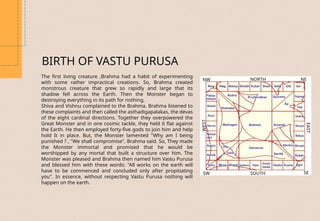
The first living creature ,Brahma had a habit of experimenting
with some rather impractical creations. So, Brahma created
monstrous creature that grew so rapidly and large that its
shadow fell across the Earth. Then the Monster began to
destroying everything in its path for nothing.
Shiva and Vishnu complained to the Brahma. Brahma listened to
these complaints and then called the asthadigapalakas, the devas
of the eight cardinal directions. Together they overpowered the
Great Monster and in one cosmic tackle, they held it flat against
the Earth. He then employed forty-five gods to join him and help
hold It in place. But, the Monster lamented "Why am I being
punished ? , "We shall compromise", Brahma said. So, They made
the Monster immortal and promised that he would be
worshipped by any mortal that built a structure over him. The
Monster was pleased and Brahma then named him Vastu Purusa
and blessed him with these words: "All works on the earth will
have to be commenced and concluded only after propitiating
you". In essence, without respecting Vastu Purusa nothing will
happen on the earth.
NORTH
NW
WEST
SOUTH
EAST
NE
SE
SW
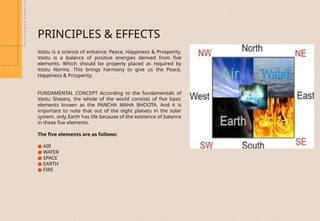
PRINCIPLES & EFFECTS
Vastu is a science of enhance: Peace, Happiness & Prosperity.
Vastu is a balance of positive energies derived from five
elements. Which should be properly placed as required by
Vastu Norms. This brings harmony to give us the Peace,
Happiness & Prosperity.
FUNDAMENTAL CONCEPT According to the fundamentals of
Vastu Shastra, the whole of the world consists of five basic
elements known as the PANCHA MAHA BHOOTA. And it is
important to note that out of the eight planets in the solar
system, only Earth has life because of the existence of balance
in these five elements.
The five elements are as follows:
● AIR
● WATER
● SPACE
● EARTH
● FIRE
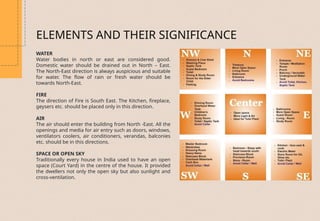
WATER
Water bodies in north or east are considered good.
Domestic water should be drained out in North – East.
The North-East direction is always auspicious and suitable
for water. The flow of rain or fresh water should be
towards North-East.
FIRE
The direction of Fire is South East. The Kitchen, fireplace,
geysers etc. should be placed only in this direction.
AIR
The air should enter the building from North -East. All the
openings and media for air entry such as doors, windows,
ventilators coolers, air conditioners, verandas, balconies
etc. should be in this directions.
SPACE OR OPEN SKY
Traditionally every house in India used to have an open
space (Court Yard) in the centre of the house. It provided
the dwellers not only the open sky but also sunlight and
cross-ventilation.
ELEMENTS AND THEIR SIGNIFICANCE
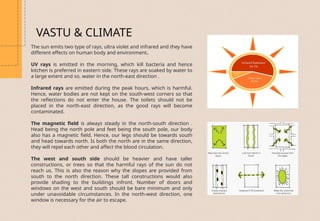
The sun emits two type of rays, ultra violet and infrared and they have
different effects on human body and environment.
UV rays is emitted in the morning, which kill bacteria and hence
kitchen is preferred in eastern side. These rays are soaked by water to
a large extent and so, water in the north-east direction .
Infrared rays are emitted during the peak hours, which is harmful.
Hence, water bodies are not kept on the south-west corners so that
the reflections do not enter the house. The toilets should not be
placed in the north-east direction, as the good rays will become
contaminated.
The magnetic field is always steady in the north-south direction .
Head being the north pole and feet being the south pole, our body
also has a magnetic field. Hence, our legs should be towards south
and head towards north. Is both the north are in the same direction,
they will repel each other and affect the blood circulation.
The west and south side should be heavier and have taller
constructions, or trees so that the harmful rays of the sun do not
reach us. This is also the reason why the slopes are provided from
south to the north direction. These tall constructions would also
provide shading to the buildings infront. Number of doors and
windows on the west and south should be bare minimum and only
under unavoidable circumstances. In the north-west direction, one
window is necessary for the air to escape.
VASTU & CLIMATE
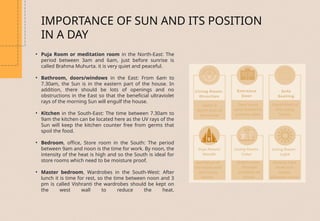
• Puja Room or meditation room in the North-East: The
period between 3am and 6am, just before sunrise is
called Brahma Muhurta. it is very quiet and peaceful.
• Bathroom, doors/windows in the East: From 6am to
7.30am, the Sun is in the eastern part of the house. In
addition, there should be lots of openings and no
obstructions in the East so that the beneficial ultraviolet
rays of the morning Sun will engulf the house.
• Kitchen in the South-East: The time between 7.30am to
9am the kitchen can be located here as the UV rays of the
Sun will keep the kitchen counter free from germs that
spoil the food.
• Bedroom, office, Store room in the South: The period
between 9am and noon is the time for work. By noon, the
intensity of the heat is high and so the South is ideal for
store rooms which need to be moisture proof.
• Master bedroom, Wardrobes in the South-West: After
lunch it is time for rest, so the time between noon and 3
pm is called Vishranti the wardrobes should be kept on
the west wall to reduce the heat.
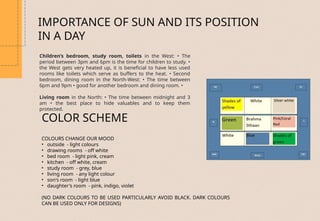
IMPORTANCE OF SUN AND ITS POSITION
IN A DAY
Children’s bedroom, study room, toilets in the West: • The
period between 3pm and 6pm is the time for children to study. •
the West gets very heated up, it is beneficial to have less used
rooms like toilets which serve as buffers to the heat. • Second
bedroom, dining room in the North-West: • The time between
6pm and 9pm • good for another bedroom and dining room. •
Living room in the North: • The time between midnight and 3
am • the best place to hide valuables and to keep them
protected.
IMPORTANCE OF SUN AND ITS POSITION
IN A DAY
COLOURS CHANGE OUR MOOD
• outside - light colours
• drawing rooms - off white
• bed room - light pink, cream
• kitchen - off white, cream
• study room - grey, blue
• living room - any light colour
• son's room - light blue
• daughter's room - pink, indigo, violet
(NO DARK COLOURS TO BE USED PARTICULARLY AVOID BLACK. DARK COLOURS
CAN BE USED ONLY FOR DESIGNS)
COLOR SCHEME
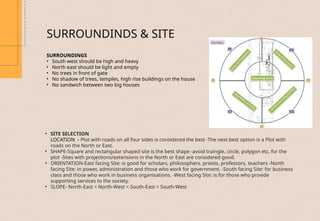
SURROUNDINGS
• South west should be high and heavy
• North east should be light and empty
• No trees in front of gate
• No shadow of trees, temples, high rise buildings on the house
• No sandwich between two big houses
• SITE SELECTION
LOCATION - Plot with roads on all four sides is considered the best -The next best option is a Plot with
roads on the North or East.
• SHAPE-Square and rectangular shaped site is the best shape -avoid traingle, circle, polygon etc, for the
plot -Sites with projections/extensions in the North or East are considered good.
• ORIENTATION-East facing Site: is good for scholars, philosophers, priests, professors, teachers -North
facing Site: in power, administration and those who work for government. -South facing Site: for business
class and those who work in business organisations. -West facing Site: is for those who provide
supporting services to the society.
• SLOPE- North-East < North-West < South-East < South-West
SURROUNDINDS & SITE
BASEMENT
• Avoid basements for living areas • It is preferable to have only part-basement, and that too, only in the North-
East or East of the house • At least one-fourth of the Basement should be above ground • Any heavy equipment
should be located in the South and West parts of the Basement • The height of the Basement walls should be at
least 9 feet • should be painted white and not a dark colour
WATER TANK
• The Sump should be located in the North-East corner • should not touch the compound walls or the building
walls • The overhead tank should be in the West or South-West of the building • Avoid the Overhead tank in the
centre of the building • should not directly rest on the roof slab • should be at least 2′ (60cm) above the topmost
roof slab • can be lined with light coloured tiles
PLANTS
• Smaller shrubs– may be planted on the East or North sides • Tall trees– like Coconut can be planted in the
South-West, West sides but should should not be too close to a building • Large trees– like Peepal, Banyan should
not be located too near the house • Good trees– that can be planted in a house compound are useful trees like
coconut, neem, betel, sandalwood, lemon, pineapple, bilva, almond, jackfruit, pomegranate, mango, amla, and
katha. • Avoid flowering trees in gardens.Trees with insects, worms, honey bees, bumble bee, owls, serpents,
should be avoided for obvious reasons.
SURROUNDINDS & SITE
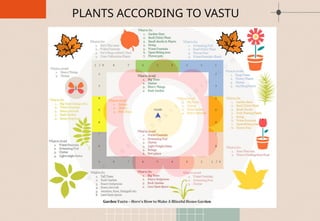
PLANTS ACCORDING TO VASTU
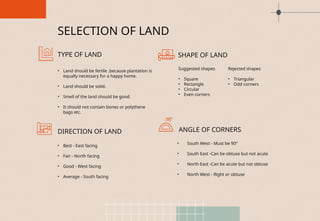
DIRECTION OF LAND
• Land should be fertile ,because plantation is
equally necessary for a happy home.
• Land should be solid.
• Smell of the land should be good.
• It should not contain bones or polythene
bags etc.
Suggested shapes
• Square
• Rectangle
• Circular
• Even corners
• Best - East facing
• Fair - North facing
• Good - West facing
• Average - South facing
TYPE OF LAND SHAPE OF LAND
Rejected shapes
• Triangular
• Odd corners
SELECTION OF LAND
• South West - Must be 90°
• South East -Can be obtuse but not acute
• North East -Can be acute but not obtuse
• North West - Right or obtuse
ANGLE OF CORNERS
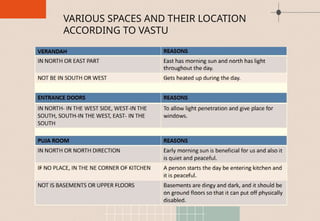
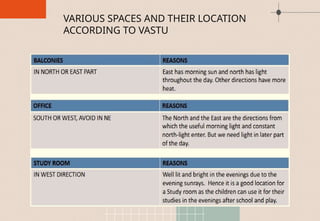
VARIOUS SPACES AND THEIR LOCATION
ACCORDING TO VASTU
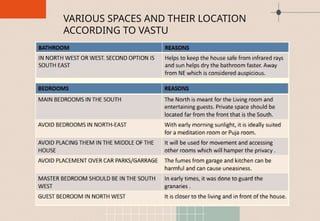
VARIOUS SPACES AND THEIR LOCATION
ACCORDING TO VASTU
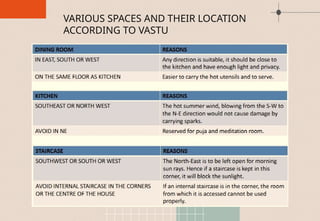
VARIOUS SPACES AND THEIR LOCATION
ACCORDING TO VASTU
VARIOUS SPACES AND THEIR LOCATION
ACCORDING TO VASTU
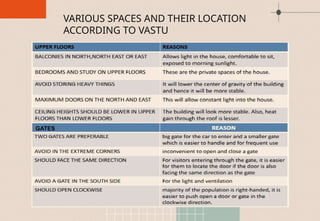
GATES
VARIOUS SPACES AND THEIR LOCATION
ACCORDING TO VASTU
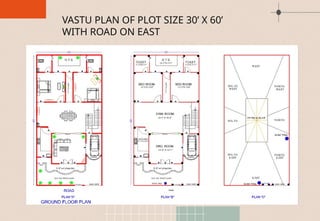
VASTU PLAN OF PLOT SIZE 30’ X 60’
WITH ROAD ON EAST

VASTU sastra b arch assignmentpresent.pptx

  • 1.
    VASTU SHASTRA ARCHITECTURAL STRUCTURE AR 504 PRESENTEDTO – DR. (ER.) UMA PRASAD PANDEY PRESENTED BY – FALAQ NAAZ YEAR / SEM – 5TH / 9TH
  • 2.
    Table of contents 1 4 2 5 3 6 Introduction& History Birth of vastu Purusa Principles & Effects Elements & its significance Vastu & Climate Importance of sun & its position 7 8 Surrounding & site Vastu plan
  • 3.
    INTRODUCTION India in therichness of its culture and tradition has some helpful tips on how to design our buildings and are embodied in the ancient traditions known as Vastu Shastra. Vastu Shastra is the refined combination of ancient Hindu traditions developed as an art, analyzed as a science , and interpreted astrologically can lead the way into healthy living. VASTU is a traditional Hindu system of architecture or the science of architecture. The word vastu is derived from the word vasu, or the earth, Shastra, is defined as "science or technology". Other translations define vastu to mean "the place where people dwell". HISTORY ● Vastu Shashtra developed between 6000 BCE to 3000 ВСЕ. ● It evolved during VEDIC times of India. ● The mention of Vastu Shastra can be found in ancient scriptures like RIGVEDA, ATHARVAVEDA, RAMAYANA, MAHABHARATA, first used by Indian maharajas and later on it spread in whole world. ● Its concepts transfers to Tibet, China and Japan where it provided the base for development of what is now called FENG SHUI.
  • 4.
    BIRTH OF VASTUPURUSA The first living creature ,Brahma had a habit of experimenting with some rather impractical creations. So, Brahma created monstrous creature that grew so rapidly and large that its shadow fell across the Earth. Then the Monster began to destroying everything in its path for nothing. Shiva and Vishnu complained to the Brahma. Brahma listened to these complaints and then called the asthadigapalakas, the devas of the eight cardinal directions. Together they overpowered the Great Monster and in one cosmic tackle, they held it flat against the Earth. He then employed forty-five gods to join him and help hold It in place. But, the Monster lamented "Why am I being punished ? , "We shall compromise", Brahma said. So, They made the Monster immortal and promised that he would be worshipped by any mortal that built a structure over him. The Monster was pleased and Brahma then named him Vastu Purusa and blessed him with these words: "All works on the earth will have to be commenced and concluded only after propitiating you". In essence, without respecting Vastu Purusa nothing will happen on the earth. NORTH NW WEST SOUTH EAST NE SE SW
  • 5.
    PRINCIPLES & EFFECTS Vastuis a science of enhance: Peace, Happiness & Prosperity. Vastu is a balance of positive energies derived from five elements. Which should be properly placed as required by Vastu Norms. This brings harmony to give us the Peace, Happiness & Prosperity. FUNDAMENTAL CONCEPT According to the fundamentals of Vastu Shastra, the whole of the world consists of five basic elements known as the PANCHA MAHA BHOOTA. And it is important to note that out of the eight planets in the solar system, only Earth has life because of the existence of balance in these five elements. The five elements are as follows: ● AIR ● WATER ● SPACE ● EARTH ● FIRE
  • 6.
    WATER Water bodies innorth or east are considered good. Domestic water should be drained out in North – East. The North-East direction is always auspicious and suitable for water. The flow of rain or fresh water should be towards North-East. FIRE The direction of Fire is South East. The Kitchen, fireplace, geysers etc. should be placed only in this direction. AIR The air should enter the building from North -East. All the openings and media for air entry such as doors, windows, ventilators coolers, air conditioners, verandas, balconies etc. should be in this directions. SPACE OR OPEN SKY Traditionally every house in India used to have an open space (Court Yard) in the centre of the house. It provided the dwellers not only the open sky but also sunlight and cross-ventilation. ELEMENTS AND THEIR SIGNIFICANCE
  • 7.
    The sun emitstwo type of rays, ultra violet and infrared and they have different effects on human body and environment. UV rays is emitted in the morning, which kill bacteria and hence kitchen is preferred in eastern side. These rays are soaked by water to a large extent and so, water in the north-east direction . Infrared rays are emitted during the peak hours, which is harmful. Hence, water bodies are not kept on the south-west corners so that the reflections do not enter the house. The toilets should not be placed in the north-east direction, as the good rays will become contaminated. The magnetic field is always steady in the north-south direction . Head being the north pole and feet being the south pole, our body also has a magnetic field. Hence, our legs should be towards south and head towards north. Is both the north are in the same direction, they will repel each other and affect the blood circulation. The west and south side should be heavier and have taller constructions, or trees so that the harmful rays of the sun do not reach us. This is also the reason why the slopes are provided from south to the north direction. These tall constructions would also provide shading to the buildings infront. Number of doors and windows on the west and south should be bare minimum and only under unavoidable circumstances. In the north-west direction, one window is necessary for the air to escape. VASTU & CLIMATE
  • 8.
    • Puja Roomor meditation room in the North-East: The period between 3am and 6am, just before sunrise is called Brahma Muhurta. it is very quiet and peaceful. • Bathroom, doors/windows in the East: From 6am to 7.30am, the Sun is in the eastern part of the house. In addition, there should be lots of openings and no obstructions in the East so that the beneficial ultraviolet rays of the morning Sun will engulf the house. • Kitchen in the South-East: The time between 7.30am to 9am the kitchen can be located here as the UV rays of the Sun will keep the kitchen counter free from germs that spoil the food. • Bedroom, office, Store room in the South: The period between 9am and noon is the time for work. By noon, the intensity of the heat is high and so the South is ideal for store rooms which need to be moisture proof. • Master bedroom, Wardrobes in the South-West: After lunch it is time for rest, so the time between noon and 3 pm is called Vishranti the wardrobes should be kept on the west wall to reduce the heat. IMPORTANCE OF SUN AND ITS POSITION IN A DAY
  • 9.
    Children’s bedroom, studyroom, toilets in the West: • The period between 3pm and 6pm is the time for children to study. • the West gets very heated up, it is beneficial to have less used rooms like toilets which serve as buffers to the heat. • Second bedroom, dining room in the North-West: • The time between 6pm and 9pm • good for another bedroom and dining room. • Living room in the North: • The time between midnight and 3 am • the best place to hide valuables and to keep them protected. IMPORTANCE OF SUN AND ITS POSITION IN A DAY COLOURS CHANGE OUR MOOD • outside - light colours • drawing rooms - off white • bed room - light pink, cream • kitchen - off white, cream • study room - grey, blue • living room - any light colour • son's room - light blue • daughter's room - pink, indigo, violet (NO DARK COLOURS TO BE USED PARTICULARLY AVOID BLACK. DARK COLOURS CAN BE USED ONLY FOR DESIGNS) COLOR SCHEME
  • 10.
    SURROUNDINGS • South westshould be high and heavy • North east should be light and empty • No trees in front of gate • No shadow of trees, temples, high rise buildings on the house • No sandwich between two big houses • SITE SELECTION LOCATION - Plot with roads on all four sides is considered the best -The next best option is a Plot with roads on the North or East. • SHAPE-Square and rectangular shaped site is the best shape -avoid traingle, circle, polygon etc, for the plot -Sites with projections/extensions in the North or East are considered good. • ORIENTATION-East facing Site: is good for scholars, philosophers, priests, professors, teachers -North facing Site: in power, administration and those who work for government. -South facing Site: for business class and those who work in business organisations. -West facing Site: is for those who provide supporting services to the society. • SLOPE- North-East < North-West < South-East < South-West SURROUNDINDS & SITE
  • 11.
    BASEMENT • Avoid basementsfor living areas • It is preferable to have only part-basement, and that too, only in the North- East or East of the house • At least one-fourth of the Basement should be above ground • Any heavy equipment should be located in the South and West parts of the Basement • The height of the Basement walls should be at least 9 feet • should be painted white and not a dark colour WATER TANK • The Sump should be located in the North-East corner • should not touch the compound walls or the building walls • The overhead tank should be in the West or South-West of the building • Avoid the Overhead tank in the centre of the building • should not directly rest on the roof slab • should be at least 2′ (60cm) above the topmost roof slab • can be lined with light coloured tiles PLANTS • Smaller shrubs– may be planted on the East or North sides • Tall trees– like Coconut can be planted in the South-West, West sides but should should not be too close to a building • Large trees– like Peepal, Banyan should not be located too near the house • Good trees– that can be planted in a house compound are useful trees like coconut, neem, betel, sandalwood, lemon, pineapple, bilva, almond, jackfruit, pomegranate, mango, amla, and katha. • Avoid flowering trees in gardens.Trees with insects, worms, honey bees, bumble bee, owls, serpents, should be avoided for obvious reasons. SURROUNDINDS & SITE
  • 12.
  • 13.
    DIRECTION OF LAND •Land should be fertile ,because plantation is equally necessary for a happy home. • Land should be solid. • Smell of the land should be good. • It should not contain bones or polythene bags etc. Suggested shapes • Square • Rectangle • Circular • Even corners • Best - East facing • Fair - North facing • Good - West facing • Average - South facing TYPE OF LAND SHAPE OF LAND Rejected shapes • Triangular • Odd corners SELECTION OF LAND • South West - Must be 90° • South East -Can be obtuse but not acute • North East -Can be acute but not obtuse • North West - Right or obtuse ANGLE OF CORNERS
  • 14.
    VARIOUS SPACES ANDTHEIR LOCATION ACCORDING TO VASTU
  • 15.
    VARIOUS SPACES ANDTHEIR LOCATION ACCORDING TO VASTU
  • 16.
    VARIOUS SPACES ANDTHEIR LOCATION ACCORDING TO VASTU
  • 17.
    VARIOUS SPACES ANDTHEIR LOCATION ACCORDING TO VASTU
  • 18.
    GATES VARIOUS SPACES ANDTHEIR LOCATION ACCORDING TO VASTU
  • 19.
    VASTU PLAN OFPLOT SIZE 30’ X 60’ WITH ROAD ON EAST