Presented by
The University of Texas
Employee Assistance Program
Objectives:
Define diversity and its impact in the workplace
Understand the benefits of diversity
Learn how to leverage diversity to enhance
teamwork, increase productivity, and maximize
results
What comes to mind when you hear the word
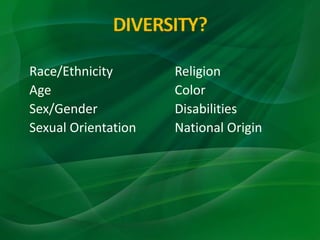
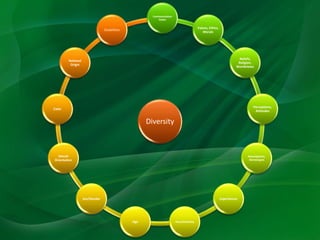
Race/Ethnicity
Age
Sex/Gender
Sexual Orientation
Religion
Color
Disabilities
National Origin
Diversity
Communication
Styles
Values, Ethics,
Morals
Beliefs,
Religion,
Worldviews
Perceptions,
Attitudes
Assumptions,
Stereotypes
Experiences
Race/Ethnicity
Age
Sex/Gender
Sexual
Orientation
Color
National
Origin
Disabilities
Valuing diversity in the workplace is about
recognizing, valuing and leveraging people’s
differences to enhance communication and
team effectiveness.
Increased interaction among employees in team
settings from different backgrounds
Global individuals
Cultural differences within societies significantly
impact how people interact
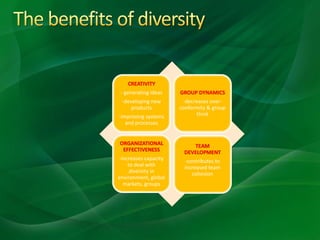
CREATIVITY
- generating ideas
-developing new
products
-improving systems
and processes
GROUP DYNAMICS
-decreases over-
conformity & group
think
ORGANIZATIONAL
EFFECTIVENESS
-increases capacity
to deal with
diversity in
environment, global
markets, groups
TEAM
DEVELOPMENT
-contributes to
increased team
cohesion
. . .
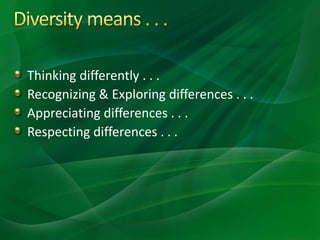
Thinking differently . . .
Recognizing & Exploring differences . . .
Appreciating differences . . .
Respecting differences . . .
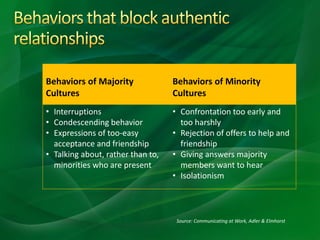
Behaviors of Majority
Cultures
Behaviors of Minority
Cultures
• Interruptions
• Condescending behavior
• Expressions of too-easy
acceptance and friendship
• Talking about, rather than to,
minorities who are present
• Confrontation too early and
too harshly
• Rejection of offers to help and
friendship
• Giving answers majority
members want to hear
• Isolationism
Source: Communicating at Work, Adler & Elmhorst
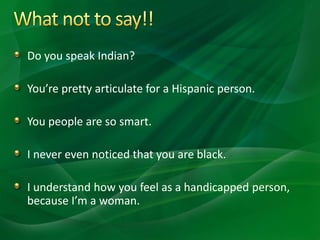
Do you speak Indian?
You’re pretty articulate for a Hispanic person.
You people are so smart.
I never even noticed that you are black.
I understand how you feel as a handicapped person,
because I’m a woman.
. . .
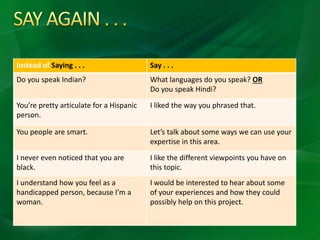
Instead of Saying . . . Say . . .
Do you speak Indian? What languages do you speak? OR
Do you speak Hindi?
You’re pretty articulate for a Hispanic
person.
I liked the way you phrased that.
You people are smart. Let’s talk about some ways we can use your
expertise in this area.
I never even noticed that you are
black.
I like the different viewpoints you have on
this topic.
I understand how you feel as a
handicapped person, because I’m a
woman.
I would be interested to hear about some
of your experiences and how they could
possibly help on this project.
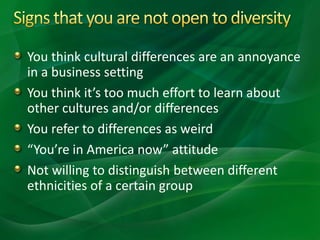
You think cultural differences are an annoyance
in a business setting
You think it’s too much effort to learn about
other cultures and/or differences
You refer to differences as weird
“You’re in America now” attitude
Not willing to distinguish between different
ethnicities of a certain group
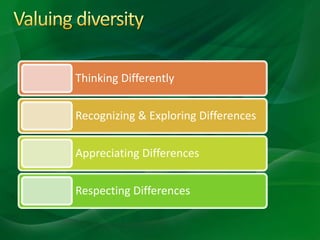
Thinking Differently
Recognizing & Exploring Differences
Appreciating Differences
Respecting Differences
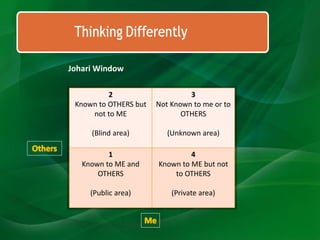
2
Known to OTHERS but
not to ME
(Blind area)
3
Not Known to me or to
OTHERS
(Unknown area)
1
Known to ME and
OTHERS
(Public area)
4
Known to ME but not
to OTHERS
(Private area)
Johari Window
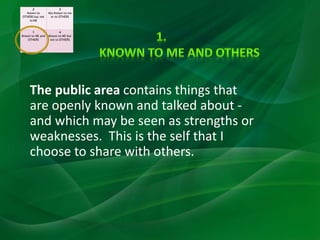
The public area contains things that
are openly known and talked about -
and which may be seen as strengths or
weaknesses. This is the self that I
choose to share with others.
2
Known to
OTHERS but not
to ME
3
Not Known to me
or to OTHERS
1
Known to ME and
OTHERS
4
Known to ME but
not to OTHERS
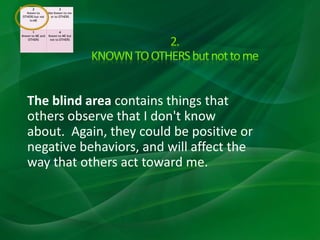
The blind area contains things that
others observe that I don't know
about. Again, they could be positive or
negative behaviors, and will affect the
way that others act toward me.
2
Known to
OTHERS but not
to ME
3
Not Known to me
or to OTHERS
1
Known to ME and
OTHERS
4
Known to ME but
not to OTHERS
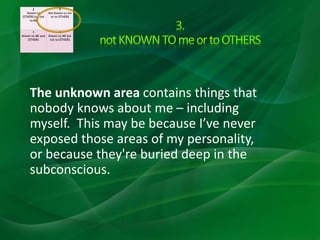
The unknown area contains things that
nobody knows about me – including
myself. This may be because I’ve never
exposed those areas of my personality,
or because they're buried deep in the
subconscious.
2
Known to
OTHERS but not
to ME
3
Not Known to me
or to OTHERS
1
Known to ME and
OTHERS
4
Known to ME but
not to OTHERS
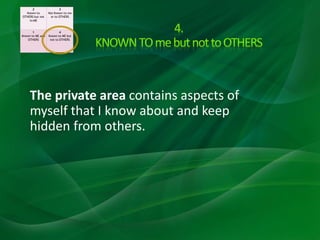
The private area contains aspects of
myself that I know about and keep
hidden from others.
2
Known to
OTHERS but not
to ME
3
Not Known to me
or to OTHERS
1
Known to ME and
OTHERS
4
Known to ME but
not to OTHERS
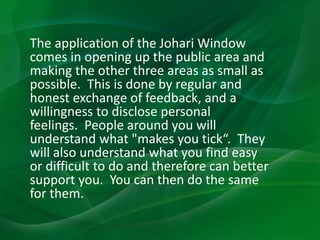
The application of the Johari Window
comes in opening up the public area and
making the other three areas as small as
possible. This is done by regular and
honest exchange of feedback, and a
willingness to disclose personal
feelings. People around you will
understand what "makes you tick“. They
will also understand what you find easy
or difficult to do and therefore can better
support you. You can then do the same
for them.
“First seek to understand then to be understood.”
- Stephen Covey
Salad bowl vs. melting pot…
Culture is communication….
Communication is culture….
Essential, not just desirable….
Culture is learned….not innate!
Demonstrating interest in learning about other
cultures/differences
Listening without interrupting
Taking risks (ask about differences)
Acknowledging sincere attempts (even clumsy
ones)
Dealing with others where they are, instead of
expecting them to be perfect
"Diversity is not about how we differ.
Diversity is about embracing one
another's uniqueness."
Ola Joseph
-Author
Treating people the way they want to be
treated
Work environment that is free of offensive
practices and conditions
Valuing every person’s unique contribution to
the team
Communication skills – having a self-awareness
of how you present yourself and how you are
perceived
Diversity – growth opportunity
Culture is learned – ask and explore
Based upon what you’ve learned today, what will
you do to help leverage diversity in your
department?

Valuing+Diversity.pptx

  • 1.
    Presented by The Universityof Texas Employee Assistance Program
  • 2.
    Objectives: Define diversity andits impact in the workplace Understand the benefits of diversity Learn how to leverage diversity to enhance teamwork, increase productivity, and maximize results
  • 3.
    What comes tomind when you hear the word
  • 4.
  • 5.
  • 6.
    Valuing diversity inthe workplace is about recognizing, valuing and leveraging people’s differences to enhance communication and team effectiveness.
  • 7.
    Increased interaction amongemployees in team settings from different backgrounds Global individuals Cultural differences within societies significantly impact how people interact
  • 8.
    CREATIVITY - generating ideas -developingnew products -improving systems and processes GROUP DYNAMICS -decreases over- conformity & group think ORGANIZATIONAL EFFECTIVENESS -increases capacity to deal with diversity in environment, global markets, groups TEAM DEVELOPMENT -contributes to increased team cohesion
  • 9.
    . . . Thinkingdifferently . . . Recognizing & Exploring differences . . . Appreciating differences . . . Respecting differences . . .
  • 10.
    Behaviors of Majority Cultures Behaviorsof Minority Cultures • Interruptions • Condescending behavior • Expressions of too-easy acceptance and friendship • Talking about, rather than to, minorities who are present • Confrontation too early and too harshly • Rejection of offers to help and friendship • Giving answers majority members want to hear • Isolationism Source: Communicating at Work, Adler & Elmhorst
  • 11.
    Do you speakIndian? You’re pretty articulate for a Hispanic person. You people are so smart. I never even noticed that you are black. I understand how you feel as a handicapped person, because I’m a woman.
  • 12.
    . . . Insteadof Saying . . . Say . . . Do you speak Indian? What languages do you speak? OR Do you speak Hindi? You’re pretty articulate for a Hispanic person. I liked the way you phrased that. You people are smart. Let’s talk about some ways we can use your expertise in this area. I never even noticed that you are black. I like the different viewpoints you have on this topic. I understand how you feel as a handicapped person, because I’m a woman. I would be interested to hear about some of your experiences and how they could possibly help on this project.
  • 13.
    You think culturaldifferences are an annoyance in a business setting You think it’s too much effort to learn about other cultures and/or differences You refer to differences as weird “You’re in America now” attitude Not willing to distinguish between different ethnicities of a certain group
  • 14.
    Thinking Differently Recognizing &Exploring Differences Appreciating Differences Respecting Differences
  • 15.
    2 Known to OTHERSbut not to ME (Blind area) 3 Not Known to me or to OTHERS (Unknown area) 1 Known to ME and OTHERS (Public area) 4 Known to ME but not to OTHERS (Private area) Johari Window
  • 16.
    The public areacontains things that are openly known and talked about - and which may be seen as strengths or weaknesses. This is the self that I choose to share with others. 2 Known to OTHERS but not to ME 3 Not Known to me or to OTHERS 1 Known to ME and OTHERS 4 Known to ME but not to OTHERS
  • 18.
    The blind areacontains things that others observe that I don't know about. Again, they could be positive or negative behaviors, and will affect the way that others act toward me. 2 Known to OTHERS but not to ME 3 Not Known to me or to OTHERS 1 Known to ME and OTHERS 4 Known to ME but not to OTHERS
  • 19.
    The unknown areacontains things that nobody knows about me – including myself. This may be because I’ve never exposed those areas of my personality, or because they're buried deep in the subconscious. 2 Known to OTHERS but not to ME 3 Not Known to me or to OTHERS 1 Known to ME and OTHERS 4 Known to ME but not to OTHERS
  • 20.
    The private areacontains aspects of myself that I know about and keep hidden from others. 2 Known to OTHERS but not to ME 3 Not Known to me or to OTHERS 1 Known to ME and OTHERS 4 Known to ME but not to OTHERS
  • 21.
    The application ofthe Johari Window comes in opening up the public area and making the other three areas as small as possible. This is done by regular and honest exchange of feedback, and a willingness to disclose personal feelings. People around you will understand what "makes you tick“. They will also understand what you find easy or difficult to do and therefore can better support you. You can then do the same for them.
  • 22.
    “First seek tounderstand then to be understood.” - Stephen Covey
  • 23.
    Salad bowl vs.melting pot… Culture is communication…. Communication is culture…. Essential, not just desirable…. Culture is learned….not innate!
  • 24.
    Demonstrating interest inlearning about other cultures/differences Listening without interrupting Taking risks (ask about differences) Acknowledging sincere attempts (even clumsy ones) Dealing with others where they are, instead of expecting them to be perfect
  • 25.
    "Diversity is notabout how we differ. Diversity is about embracing one another's uniqueness." Ola Joseph -Author
  • 26.
    Treating people theway they want to be treated Work environment that is free of offensive practices and conditions Valuing every person’s unique contribution to the team
  • 27.
    Communication skills –having a self-awareness of how you present yourself and how you are perceived Diversity – growth opportunity Culture is learned – ask and explore
  • 28.
    Based upon whatyou’ve learned today, what will you do to help leverage diversity in your department?

Editor's Notes

  • #2 For many people, diversity is a broad concept with many definitions.
  • #3 Today, we will explore diversity. We will discuss: Define diversity and its impact in the workplace Look at how diversity benefits your team Learn ways to effectively communicate with diverse groups of people
  • #4 We hear much about diversity. In fact, if you were to conduct a survey of 20 people and ask them to define diversity, you would most likely receive 20 different definitions. Take a moment and think about this: What comes to your mind when you hear the word DIVERSITY?
  • #5 When asked about diversity, hear are some of the things we’ve heard: Race/Ethnicity Age Sex/Gender Sexual Orientation Religion Color Disabilities National Origin Some of these items may have appeared on your list as well.
  • #6 Studies indicate that while differences such as race or sex are a part of diversity, there are additional aspects of diversity. Factors such as experiences, perceptions, and communication styles also play a role in diversity. Other factors include: culture. As we expand our definition of diversity, we begin to realize that our workplaces provide us with an opportunity to tap into those differences that will benefit teams and organizations as a whole.
  • #7 Valuing diversity in the workplace is about recognizing, valuing and leveraging people’s differences. There is a shared commitment among team members to utilize these differences to benefit their team. For example, a long tenured employee on your team may be able to provide additional insight into how to gain project buy-in from key stakeholders. Additionally, a team member who has a physical disability, can assist on an engineering project to determine areas that may inaccessible. Diversity then becomes more about leveraging differences to increase productivity.
  • #8 We’ve discussed a little about what diversity is but why is diversity so important? What place does it have in the workplace? We are finding that workplaces are more diverse now. Let’s take a look at some of the reasons impacting the growth of diversity: The team concept has become pervasive in our workplaces. As more employees from different backgrounds enter the workforce, these teams will need to work together effectively to accomplish goals. More and more organizations are expanding and becoming more global. People are moving outside of their country of origin for work purposes. Therefore, many organizations are employing people from different walks of life. Cultural differences impact how people interact with one another.
  • #9 Diversity benefits a team and organization in many ways. Creativity – when you have team members of varying backgrounds, experiences, perceptions and beliefs, it gives you an opportunity to have a greater flow of ideas. These ideas will be useful in the development of new products and improving processes and systems Group Dynamics – as groups work together, what may happen at times is what is referred to as groupthink. This occurs when a group would rather have uniformity and fails to assess all possible plans of action. An example of this is illustrated in The Challenger disaster when NASA officials disregarded engineer’s concerns and decided to launch the shuttle. Diversity decreases groupthink and its possible pitfalls. Organizational effectiveness – leveraging strengths and experiences in order to get work done more effectively Team Development – the more diversity is leveraged, the more a team builds cohesion. This in turn leads to more creativity which impacts group dynamics and organizational effectiveness
  • #10 Diversity means that we begin to look at things from various perspectives. As we do this, we begin to: Think differently – here you realize that leveraging differences can help on your teams and in meeting goals Recognizing & Exploring differences – as you begin to expand our definitions of what diversity is, you can begin to recognize them and begin to explore how they can benefit your team Appreciating differences – when we appreciate differences we realize that individual possess qualities that can further the goals of the organization Respecting differences – this occurs when we value every person's unique contribution to the team. People with differing backgrounds can bring new strengths to a organization.  
  • #11 Now that we’ve spent some time defining diversity and its benefits to a team, let’s shift gears and discuss how to build effective relationships in a diverse setting. As team members, we each have a role to play in creating an environment that appreciates and respects diversity. There are times, however, when certain behaviors may actually block relationships in teams. If you are a member of a majority culture in a group, some potential behaviors include: interruptions, condescending behavior, talking about, rather than to, minorities who are present. Consider this example of condescending behavior: Your first reaction to a physically challenged colleague might be sympathy or pity. You may in turn, lower your expectations regarding their abilities. However, lowering expectations can come across as patronizing. Similarly, as a member of a minority culture, there are behaviors that make it difficult to foster valuing diversity. If an Asian colleague rejections any offers of help because he/she doesn’t want to be seen as incompetent, this impedes team development or attainment of goals.
  • #12 Let’s take a deeper look at how the words we say may further block forming relationships with diverse team members. Let’s discuss how the following statements could be perceived and look at some alternate ways of phrasing each statement. Do you speak Indian? Indian is not a language. The person asking this question could be viewed as unknowledgeable and disrespectful. You’re pretty articulate for a Hispanic person. The underlying message communicated with this statement is the assumption that Hispanics are generally not articulate. You people are so smart. This is generally viewed as a derogatory statement that assumes that the speaker doesn’t view the person as an individual but instead as a collective group. I never even noticed that you are black. There are times when excessive efforts are made to demonstrate an attitude of equality. However, some statements can be viewed as condescending. I understand how you feel as a handicapped person, because I’m a woman. The speaker is trying to establish commonality but in doing so, can come across at patronizing. The handicapped person may feel as though the speaker couldn’t possible relate to his/her condition because they do not have a disability.
  • #13 So let’s take another look at the previous statements and talk about how they can be asked differently: Do you speak Indian? Instead ask: “What languages do you speak?” You can also ask about a specific language if you are knowledgeable about that culture. For example, “Do you speak Hindi?” You’re pretty articulate for a Hispanic person. You could state that you liked the way the individual phrased something. This shows an appreciation for his/her verbal communication skills without sounding condescending. You people are so smart. Again, point out ways how that person’s specific expertise or gifts in area could be utilized. I never even noticed that you are black. Comment instead that the different viewpoints the individual has on a topic was helpful. I understand how you feel as a handicapped person, because I’m a woman. In an appropriate manner, express a genuine interest in learning more about the person’s experiences. “I would be interested to hear about some of your experiences and how they could possibly help on this project” is one way to communicate this.
  • #14 So as we continue to look at possible barriers to diversity, let’s talk briefly about signs that you are not open to diversity. You think cultural differences are an annoyance in a business setting. For example, you may feel that the presence of different cultures on the job is of no benefit and not understand why we are talking about this diversity stuff again. You think it’s too much effort to learn about other cultures and/or differences. You may not understand why it is even necessary to learn about differences. “We are all here to do a job! What difference does it make?” You refer to differences as weird. Think about a time when a colleague may have brought in a food from his/her native land that you had never seen before. Did you automatically dismiss it as something strange and weird? “You’re in America now” attitude. Why do you have to learn about all this stuff? After all, it’s YOUR country. When in Rome…. Not willing to distinguish between different ethnicities of a certain group. A team member shares with you that she is Vietnamese. You think that “they all look alike anyway and constantly refer to her as Chinese.
  • #15 We’ve learned earlier about how diversity can benefit a team. Creativity and team cohesion (both of which impact productivity) are increased. We’ve identified some factors that can impede effective work between persons with diverse backgrounds. Now, let’s explore how we can push past those barriers and leverage diversity. When we value diversity, we are: Thinking Differently Recognizing & Exploring Differences Appreciating Differences Respecting Differences
  • #16 Thinking Differently – To begin to recognize the value of diversity, we must develop an awareness of our interactions with others. I want to introduce you to a tool used to increase self awareness. The Johari Window divides personal awareness into 4 types: Public area (things that I know about myself and that you know about me) Hidden area (things that you know about me but that I am unaware of) Unknown area (things that neither I know about myself, nor you know about me) Private area (things that I know about myself that you do not know) Let’s examine each awareness type………….
  • #17 The first window, the PUBLIC AREA, represents things about me that both I know and others know. This is the self that we choose to share with others. For example, I know my name, and so do you. This window not only represents factual information but my feelings, motives, behaviors, values, needs and beliefs, perceptions. Information that describes who I am. When I first meet a new person, the size of the opening of this first window is not very large, since there has been little time to exchange information. Authentic relationships are formed as more open information is exchanged and we begin to think differently about each other.
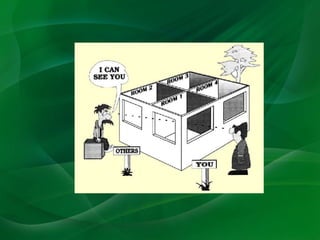
  • #18 As illustrated in the cartoon above, as the process of getting to know one another continues, the window is enlarged and there is a greater understanding and awareness by others about who I am.
  • #19 2. The second window, the BLIND AREA, contains things that others observe or know about me that I am not aware of. These can be positive or negative behaviors that affect the way others interact with me. So, for example, we could be eating at a restaurant, and I may have unknowingly gotten some food on my face. This information is in my blind window because you can see it, but I cannot. If you now tell me that I have something on my face, this opens the blind area. I may also have blind spots with respect to many other much more complex things. For example, perhaps in our ongoing conversation, you may notice that eye contact seems to be lacking. You may not say anything, since you may not want to embarrass me, or you may draw your own inferences that perhaps I am being insincere. Then the problem is, how can I get this information out in the open, since it may be affecting the level of trust that is developing between us? How can I learn more about myself? A continuous exchange between you and I where I request feedback and you give feedback is key in eliminating blind spots. This area also represents an opportunity to discuss preferences on how to give and receive feedback. This in turn will lead to greater knowledge of myself and help in my interactions with you and others.
  • #20 3. The third window, the UNKNOWN AREA, represents things that neither I know about myself, nor you know about me. For example, I may disclose a dream that I had, and as we both attempt to understand its significance, a new awareness may emerge, known to neither of us before the conversation took place. Being placed in new situations often reveal new information not previously known to self or others. Take the example of a researcher attending a workshop. During this workshop, the facilitator created a safe atmosphere of care and trust between the various participants. The researcher described himself as terrified of speaking in public, but was surprised to learn that in such an atmosphere, the task need not be so daunting. Prior to this event, he had viewed himself and others had also viewed him as being extremely shy. Thus, a novel situation can trigger new awareness and personal growth. The process helped moved him into the first (public) quadrant, thus enlarging its area. This once again assists in creating an environment where things are known to me and to others.
  • #21 4. The forth window, the PRIVATE AREA, contains those aspects of myself that I know about and keep hidden from others.   For example, I have not told you my favorite ice cream flavor. This information is in my “private" quadrant. As soon as I tell you that I love "Ben and Jerry's Cherry Garcia" flavored ice cream, I am effectively making this window smaller and enlarging the first window (public) area. Again, there are vast amounts of information, virtually my whole life's story, that has yet to be revealed to you. As we get to know and trust each other, I will then feel more comfortable disclosing more intimate details about myself. This process is called: "Self-disclosure.“  
  • #22 The application of the Johari Window comes in opening up the public area and making the other three areas as small as possible. The model is valuable in leverage diversity. It helps us THINK DIFFERENTLY because we develop a greater awareness of how our actions are perceived. As one’s level of confidence and trust develops, one may actively invite others to comment on one's blind spots. This is accomplished by regular and honest feedback and a willingness to disclose. As this regular feedback increases, team members are able to provide appropriate support to you. In turn, you will be able to do the same for them.
  • #23 Once you gain a greater understanding of your interactions with others, you will then be able to begin to recognize and explore differences. We can seek to understand the perceptions, values, culture of others and then have others understood those things about us.
  • #24 Culture greatly influences our approach to our lives, to others, and to our work. Salad bowl vs. Melting pot: We have all probably heard America described as a melting pot. That may not be a correct image as it assumes that we all melt into one collective culture and lose the identity of our original culture. Instead consider our culture as a salad bowl. In a salad bowl, you have the lettuce, tomato, carrots, cucumbers. Even after the items are mixed together, they all maintain their individual characteristics. The same could be said for culture. We co-exist and maintain individual aspects of our culture whether it be foods we eat, how we communicate, our values, beliefs. In Houston, San Francisco and many places around the world, there are pockets of culture. Vietnamese, Chinese, Hispanic are examples. Culture is Communication & Communication is Culture: How we communicate shows how open we are with different cultures. Our tone of voice, the words we use, our body language all dictate our sensitivity to other (not new) ways of doing things. Culture is ESSENTIAL, not just desirable: It’s no longer just desirable to be culturally-adept. It’s essential. We have to recognize the needs of our customers, co-workers. Culture is learned not innate: We don’t automatically know about culture. We have to be willing to learn.
  • #25 So here are some tangible ways we can recognize and explore differences: Demonstrating interest in learning about other cultures/differences: Ways to do this include – asking a trusted friend with a culture other than your own about their culture or read about communication styles Listening without interrupting: Everyone wants to be heard. Constant interruptions may send an unintended message to the speaker that you are not truly interested. Taking risks (ask about differences): As we stated previously, a lack of knowledge may be a barrier to leveraging diversity. Asking is always better than making assumptions about others. For example, you know that one of your team members is often quiet in staff meetings. After the meeting, you could comment that you noticed that he/she didn’t have much to contribute. During this conversation, you may discover that as an introvert, your coworker often needs time to process information from that meeting before speaking. Because you explored this difference, you know have a greater understanding of how this person works. Acknowledging sincere attempts (even clumsy ones): We all have experienced moments when we attempt to ask questions about a difference that may have had the unintended consequence of offending others. As the person on the receiving end of the question, it is important for us to understand that questions may not be phrased in the perfect way. That as we are learning each other as team members, we are also learning how others communicate. Dealing with others where they are, instead of expecting them to be perfect: Individuals are in a constant state of growth and development.
  • #26 Diversity is not about how we differ. Diversity is about embracing one another’s uniqueness. As we think differently, recognize and explore differences, an greater understanding of each other is developed. Viewing diversity as an opportunity can lead us to a greater appreciation of how those differences benefit our team and the organization as a whole.
  • #27  Respecting differences that benefit our team is key in leverage diversity. We do this by: Treating people the way they want to be treated Creating a work environment that is free of offensive practices and conditions Valuing every person’s unique contribution to the team Think about this: We typically spend 80% of our time with people at work. Wouldn’t we want to be in an environment where we feel valued, appreciated and respected for our talents?
  • #28 To Summarize: Communication skills – having a self-awareness of how you present yourself and how you are perceived. Open and honest feedback helps to eliminate those “blind spots” and open up new ways of thinking and interacting with others Diversity – Leveraging diversity benefits the team and the organization by increasing team cohesion and expanding creativity. As more global individuals become a part of our teams, appreciating and respecting differences becomes even more important. Culture is learned – Ask and explore!
  • #29  Based upon what you’ve learned today, what will you do to help leverage diversity in your department?