Value
Creation
Matrix
@joelfariss
00
Value creation is the function of every
organization. While the definition of value, and
who you are creating value for, varies across
sectors and industries, it is an imperative that
must be embraced for anyone who wants to
remain relevant to stakeholders and
shareholders alike.
The fundamental equation for value creation is
“who, what, and how,” those these variables will
change depending on the type of value being
created.
Value
Creation
Matrix
@joelfariss
01
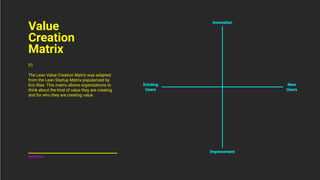
The Lean Value Creation Matrix was adapted
from the Lean Startup Matrix popularized by
Eric Ries. This matrix allows organizations to
think about the kind of value they are creating
and for who they are creating value.
Improvement
Innovation
New
Users
Existing
Users
Value
Creation
Matrix
@joelfariss
02
Modern management theory was born out of
the bottom left quadrant during the early 20th
century – post war managment theory
continued to build on post-industrial process
optimization, but has not changed significantly
in the recent shift to the knowledge economy.
In the last 30 years though, strategic
management practice has grown to include new
ways of creating value. The value of innovation
and creativity has grown as these new practices
become more relevant in an ever-changing
market landscape.
Improvement
Innovation
New
Users
Existing
Users
New
Wallet
Share
Operational
Efficiencies
New
Market
Share
Brand
Excellence
Value
Creation
Matrix
DiversificationMarket
Development
Market
Penetration
Product
Development
Improvement
Innovation
New
Users
Existing
Users
03
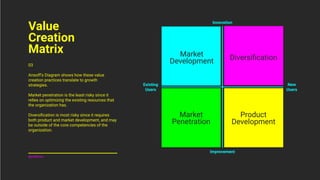
Ansoff’s Diagram shows how these value
creation practices translate to growth
strategies.
Market penetration is the least risky since it
relies on optimizing the existing resources that
the organization has.
Diversification is most risky since it requires
both product and market development, and may
be outside of the core competencies of the
organization.
@joelfariss
Value
Creation
Matrix
Bottom
Line
Improvement
Innovation
Top Line
New
Users
Existing
Users
04
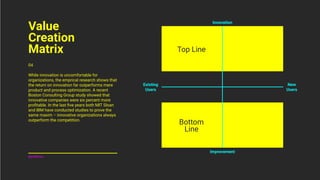
While innovation is uncomfortable for
organizations, the emprical research shows that
the return on innovation far outperforms mere
product and process optimization. A recent
Boston Consulting Group study showed that
innovative companies were six percent more
profitable. In the last five years both MIT Sloan
and IBM have conducted studies to prove the
same maxim – innovative organizations always
outperform the competition.
@joelfariss
Value
Creation
Matrix Blue
Ocean
Strategy
Red
Ocean
Strategy
Improvement
Innovation
New
Users
Existing
Users
05
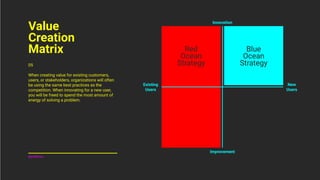
When creating value for existing customers,
users, or stakeholders, organizations will often
be using the same best practices as the
competition. When innovating for a new user,
you will be freed to spend the most amount of
energy of solving a problem.
@joelfariss
SOURCES / CREDITS
None of this thinking is my own, and is
borrowed and adapted from the following
thought leaders:
Eric Ries, Author of The Lean Startup
Michael E. Porter, Harvard Business School
Chan Kim, Author of Blue Ocean Strategy
Renée Mauborgne, Author of Blue Ocean Strategy
Igor Ansoff, father of strategic management
Strategyzer.com
Special thanks:
Jay Chilcote, Enterprise Innovation Strategist
@joelfariss

Value creation

  • 1.
    Value Creation Matrix @joelfariss 00 Value creation isthe function of every organization. While the definition of value, and who you are creating value for, varies across sectors and industries, it is an imperative that must be embraced for anyone who wants to remain relevant to stakeholders and shareholders alike. The fundamental equation for value creation is “who, what, and how,” those these variables will change depending on the type of value being created.
  • 2.
    Value Creation Matrix @joelfariss 01 The Lean ValueCreation Matrix was adapted from the Lean Startup Matrix popularized by Eric Ries. This matrix allows organizations to think about the kind of value they are creating and for who they are creating value. Improvement Innovation New Users Existing Users
  • 3.
    Value Creation Matrix @joelfariss 02 Modern management theorywas born out of the bottom left quadrant during the early 20th century – post war managment theory continued to build on post-industrial process optimization, but has not changed significantly in the recent shift to the knowledge economy. In the last 30 years though, strategic management practice has grown to include new ways of creating value. The value of innovation and creativity has grown as these new practices become more relevant in an ever-changing market landscape. Improvement Innovation New Users Existing Users New Wallet Share Operational Efficiencies New Market Share Brand Excellence
  • 4.
    Value Creation Matrix DiversificationMarket Development Market Penetration Product Development Improvement Innovation New Users Existing Users 03 Ansoff’s Diagram showshow these value creation practices translate to growth strategies. Market penetration is the least risky since it relies on optimizing the existing resources that the organization has. Diversification is most risky since it requires both product and market development, and may be outside of the core competencies of the organization. @joelfariss
  • 5.
    Value Creation Matrix Bottom Line Improvement Innovation Top Line New Users Existing Users 04 While innovationis uncomfortable for organizations, the emprical research shows that the return on innovation far outperforms mere product and process optimization. A recent Boston Consulting Group study showed that innovative companies were six percent more profitable. In the last five years both MIT Sloan and IBM have conducted studies to prove the same maxim – innovative organizations always outperform the competition. @joelfariss
  • 6.
    Value Creation Matrix Blue Ocean Strategy Red Ocean Strategy Improvement Innovation New Users Existing Users 05 When creatingvalue for existing customers, users, or stakeholders, organizations will often be using the same best practices as the competition. When innovating for a new user, you will be freed to spend the most amount of energy of solving a problem. @joelfariss
  • 7.
    SOURCES / CREDITS Noneof this thinking is my own, and is borrowed and adapted from the following thought leaders: Eric Ries, Author of The Lean Startup Michael E. Porter, Harvard Business School Chan Kim, Author of Blue Ocean Strategy Renée Mauborgne, Author of Blue Ocean Strategy Igor Ansoff, father of strategic management Strategyzer.com Special thanks: Jay Chilcote, Enterprise Innovation Strategist @joelfariss