YOUTH DEVELOPMENT
and what we are
asked to do
TODAY
Presented by
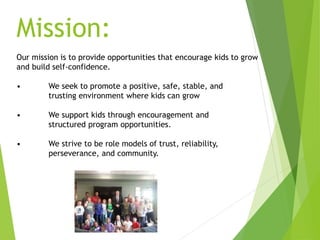
Our mission is to provide opportunities that encourage kids to grow
and build self-confidence.
• We seek to promote a positive, safe, stable, and
trusting environment where kids can grow
• We support kids through encouragement and
structured program opportunities.
• We strive to be role models of trust, reliability,
perseverance, and community.
Mission:
Vision:
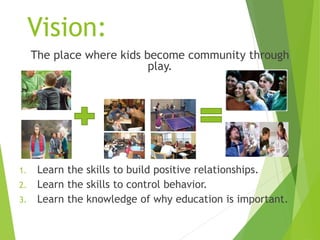
The place where kids become community through
play.
1. Learn the skills to build positive relationships.
2. Learn the skills to control behavior.
3. Learn the knowledge of why education is important.
Welcoming. All kids are welcomed and accepted into a non-
judgmental and safe environment
Fun. We will create a safe and fun environment where kids can
grow and shine.
Socially Responsible. We provide a positive environment that
strives to teach lessons of social responsibility.
Consistent. We are adult role models kids rely on.
Responsive. We will listen to what the kids want for programming and
activities.
Local. We are a local grassroots program that teaches the importance of
giving back.
Values:
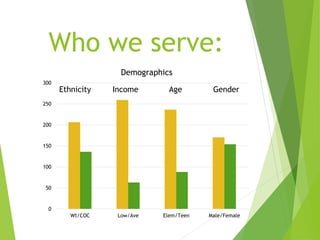
0
50
100
150
200
250
300
Wt/COC Low/Ave Elem/Teen Male/Female
Demographics
Who we serve:
Ethnicity Income Age Gender
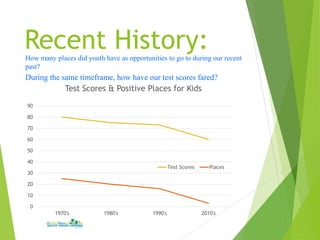
Recent History:
During the same timeframe, how have our test scores fared?
0
10
20
30
40
50
60
70
80
90
1970's 1980's 1990's 2010's
Test Scores & Positive Places for Kids
Test Scores Places
How many places did youth have as opportunities to go to during our recent
past?
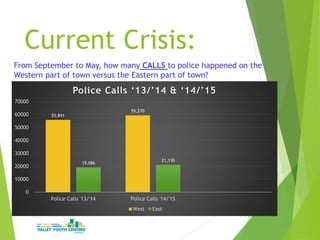
Current Crisis:
From September to May, how many CALLS to police happened on the
Western part of town versus the Eastern part of town?
55,841
59,270
19,086
21,130
0
10000
20000
30000
40000
50000
60000
70000
Police Calls '13/'14 Police Calls '14/'15
Police Calls ‘13/’14 & ‘14/’15
West East
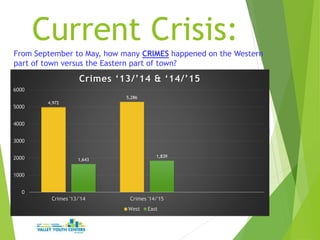
Current Crisis:
From September to May, how many CRIMES happened on the Western
part of town versus the Eastern part of town?
4,972
5,286
1,643
1,839
0
1000
2000
3000
4000
5000
6000
Crimes '13/'14 Crimes '14/'15
Crimes ‘13/’14 & ‘14/’15
West East
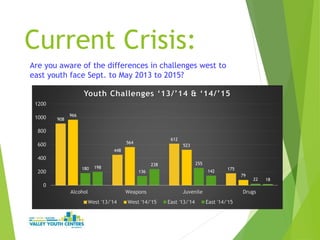
Current Crisis:
908
448
612
175
966
564
523
79
180
136
255
22
198
238
142
18
0
200
400
600
800
1000
1200
Alcohol Weapons Juvenile Drugs
Youth Challenges ‘13/’14 & ‘14/’15
West '13/'14 West '14/'15 East '13/'14 East '14/'15
Are you aware of the differences in challenges west to
east youth face Sept. to May 2013 to 2015?
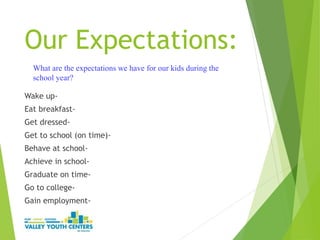
Our Expectations:
Wake up-
Eat breakfast-
Get dressed-
Get to school (on time)-
Behave at school-
Achieve in school-
Graduate on time-
Go to college-
Gain employment-
What are the expectations we have for our kids during the
school year?
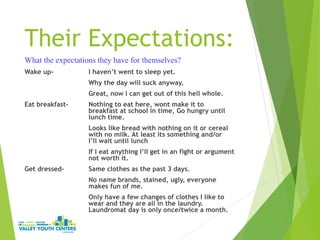
Their Expectations:
Wake up- I haven’t went to sleep yet.
Why the day will suck anyway.
Great, now I can get out of this hell whole.
Eat breakfast- Nothing to eat here, wont make it to
breakfast at school in time, Go hungry until
lunch time.
Looks like bread with nothing on it or cereal
with no milk. At least its something and/or
I’ll wait until lunch
If I eat anything I’ll get in an fight or argument
not worth it.
Get dressed- Same clothes as the past 3 days.
No name brands, stained, ugly, everyone
makes fun of me.
Only have a few changes of clothes I like to
wear and they are all in the laundry.
Laundromat day is only once/twice a month.
What the expectations they have for themselves?
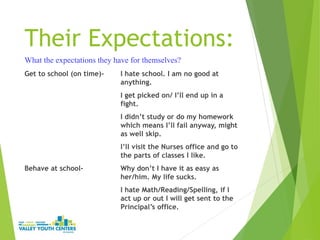
Their Expectations:
Get to school (on time)- I hate school. I am no good at
anything.
I get picked on/ I’ll end up in a
fight.
I didn’t study or do my homework
which means I’ll fail anyway, might
as well skip.
I’ll visit the Nurses office and go to
the parts of classes I like.
Behave at school- Why don’t I have it as easy as
her/him. My life sucks.
I hate Math/Reading/Spelling, if I
act up or out I will get sent to the
Principal’s office.
What the expectations they have for themselves?
Their Expectations:
Achieve in school- I hate school. I am no good at
anything.
I don’t get it and nobody at home is
there to help me.
I made it another night last night. I
wonder where I’ll be staying tonight.
Graduate, College, Employment-
What the expectations they have for themselves?
Their Environment
Basic Needs not being met
Adult behaviors not fit for
younger children
PTSD to Adults
Their Reality
 Drugs
 Alcohol
 Pregnancy
 On the Run
 Couch hopping
 Drop outs
 Suicide
What we do:
 Show kids caring
 The L-word or The H-word
 How to smile
 How to have fun.
We use positive relationships with
play to achieve these goal(s)
Benefits to Learning
Through Play
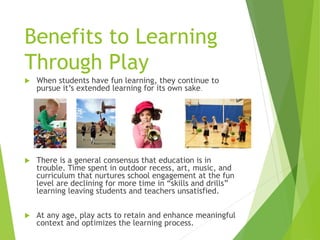
 When students have fun learning, they continue to
pursue it’s extended learning for its own sake.
 There is a general consensus that education is in
trouble. Time spent in outdoor recess, art, music, and
curriculum that nurtures school engagement at the fun
level are declining for more time in “skills and drills”
learning leaving students and teachers unsatisfied.
 At any age, play acts to retain and enhance meaningful
context and optimizes the learning process.
Why we do it:
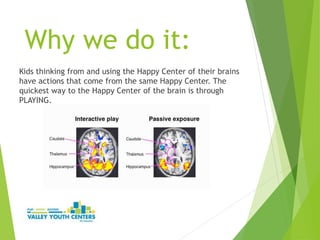
Kids thinking from and using the Happy Center of their brains
have actions that come from the same Happy Center. The
quickest way to the Happy Center of the brain is through
PLAYING.
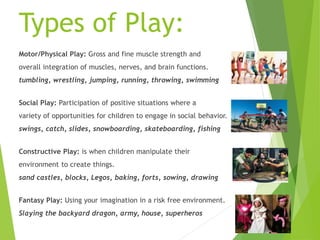
Types of Play:
Motor/Physical Play: Gross and fine muscle strength and
overall integration of muscles, nerves, and brain functions.
tumbling, wrestling, jumping, running, throwing, swimming
Social Play: Participation of positive situations where a
variety of opportunities for children to engage in social behavior.
swings, catch, slides, snowboarding, skateboarding, fishing
Constructive Play: is when children manipulate their
environment to create things.
sand castles, blocks, Legos, baking, forts, sowing, drawing
Fantasy Play: Using your imagination in a risk free environment.
Slaying the backyard dragon, army, house, superheros
Not convinced?
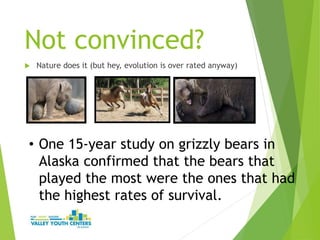
 Nature does it (but hey, evolution is over rated anyway)
• One 15-year study on grizzly bears in
Alaska confirmed that the bears that
played the most were the ones that had
the highest rates of survival.
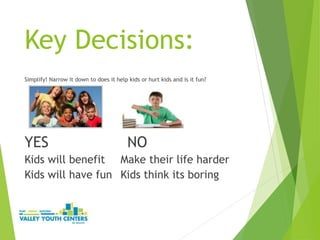
Key Decisions:
Simplify! Narrow it down to does it help kids or hurt kids and is it fun?
YES NO
Kids will benefit Make their life harder
Kids will have fun Kids think its boring
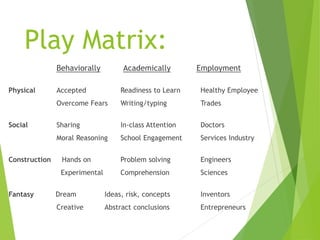
Play Matrix:
Behaviorally Academically Employment
Physical Accepted Readiness to Learn Healthy Employee
Overcome Fears Writing/typing Trades
Social Sharing In-class Attention Doctors
Moral Reasoning School Engagement Services Industry
Construction Hands on Problem solving Engineers
Experimental Comprehension Sciences
Fantasy Dream Ideas, risk, concepts Inventors
Creative Abstract conclusions Entrepreneurs
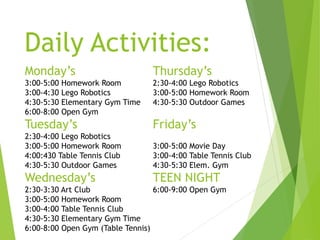
Daily Activities:
Monday’s Thursday’s
3:00-5:00 Homework Room 2:30-4:00 Lego Robotics
3:00-4:30 Lego Robotics 3:00-5:00 Homework Room
4:30-5:30 Elementary Gym Time 4:30-5:30 Outdoor Games
6:00-8:00 Open Gym
Tuesday’s Friday’s
2:30-4:00 Lego Robotics
3:00-5:00 Homework Room 3:00-5:00 Movie Day
4:00:430 Table Tennis Club 3:00-4:00 Table Tennis Club
4:30-5:30 Outdoor Games 4:30-5:30 Elem. Gym
Wednesday’s TEEN NIGHT
2:30-3:30 Art Club 6:00-9:00 Open Gym
3:00-5:00 Homework Room
3:00-4:00 Table Tennis Club
4:30-5:30 Elementary Gym Time
6:00-8:00 Open Gym (Table Tennis)
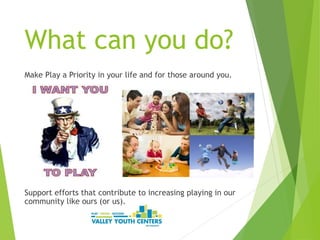
What can you do?
Make Play a Priority in your life and for those around you.
Support efforts that contribute to increasing playing in our
community like ours (or us).
Here’s How
 Financial Support
 Spreading the word about us and our cause.
 Magazine Recycling
 Silent Auction items
 Capital Campaigns
Thank you!
The Welch Center Inc. dba
Valley Youth Centers
720 N. Central Ave. Duluth, MN 55807
(218) 464-5071 x 100
www.valleyyouthcenters.org
Facebook- Valley Youth Center

Valley Youth Center Presentation

  • 1.
    YOUTH DEVELOPMENT and whatwe are asked to do TODAY Presented by
  • 2.
    Our mission isto provide opportunities that encourage kids to grow and build self-confidence. • We seek to promote a positive, safe, stable, and trusting environment where kids can grow • We support kids through encouragement and structured program opportunities. • We strive to be role models of trust, reliability, perseverance, and community. Mission:
  • 3.
    Vision: The place wherekids become community through play. 1. Learn the skills to build positive relationships. 2. Learn the skills to control behavior. 3. Learn the knowledge of why education is important.
  • 4.
    Welcoming. All kidsare welcomed and accepted into a non- judgmental and safe environment Fun. We will create a safe and fun environment where kids can grow and shine. Socially Responsible. We provide a positive environment that strives to teach lessons of social responsibility. Consistent. We are adult role models kids rely on. Responsive. We will listen to what the kids want for programming and activities. Local. We are a local grassroots program that teaches the importance of giving back. Values:
  • 5.
    0 50 100 150 200 250 300 Wt/COC Low/Ave Elem/TeenMale/Female Demographics Who we serve: Ethnicity Income Age Gender
  • 6.
    Recent History: During thesame timeframe, how have our test scores fared? 0 10 20 30 40 50 60 70 80 90 1970's 1980's 1990's 2010's Test Scores & Positive Places for Kids Test Scores Places How many places did youth have as opportunities to go to during our recent past?
  • 7.
    Current Crisis: From Septemberto May, how many CALLS to police happened on the Western part of town versus the Eastern part of town? 55,841 59,270 19,086 21,130 0 10000 20000 30000 40000 50000 60000 70000 Police Calls '13/'14 Police Calls '14/'15 Police Calls ‘13/’14 & ‘14/’15 West East
  • 8.
    Current Crisis: From Septemberto May, how many CRIMES happened on the Western part of town versus the Eastern part of town? 4,972 5,286 1,643 1,839 0 1000 2000 3000 4000 5000 6000 Crimes '13/'14 Crimes '14/'15 Crimes ‘13/’14 & ‘14/’15 West East
  • 9.
    Current Crisis: 908 448 612 175 966 564 523 79 180 136 255 22 198 238 142 18 0 200 400 600 800 1000 1200 Alcohol WeaponsJuvenile Drugs Youth Challenges ‘13/’14 & ‘14/’15 West '13/'14 West '14/'15 East '13/'14 East '14/'15 Are you aware of the differences in challenges west to east youth face Sept. to May 2013 to 2015?
  • 10.
    Our Expectations: Wake up- Eatbreakfast- Get dressed- Get to school (on time)- Behave at school- Achieve in school- Graduate on time- Go to college- Gain employment- What are the expectations we have for our kids during the school year?
  • 11.
    Their Expectations: Wake up-I haven’t went to sleep yet. Why the day will suck anyway. Great, now I can get out of this hell whole. Eat breakfast- Nothing to eat here, wont make it to breakfast at school in time, Go hungry until lunch time. Looks like bread with nothing on it or cereal with no milk. At least its something and/or I’ll wait until lunch If I eat anything I’ll get in an fight or argument not worth it. Get dressed- Same clothes as the past 3 days. No name brands, stained, ugly, everyone makes fun of me. Only have a few changes of clothes I like to wear and they are all in the laundry. Laundromat day is only once/twice a month. What the expectations they have for themselves?
  • 12.
    Their Expectations: Get toschool (on time)- I hate school. I am no good at anything. I get picked on/ I’ll end up in a fight. I didn’t study or do my homework which means I’ll fail anyway, might as well skip. I’ll visit the Nurses office and go to the parts of classes I like. Behave at school- Why don’t I have it as easy as her/him. My life sucks. I hate Math/Reading/Spelling, if I act up or out I will get sent to the Principal’s office. What the expectations they have for themselves?
  • 13.
    Their Expectations: Achieve inschool- I hate school. I am no good at anything. I don’t get it and nobody at home is there to help me. I made it another night last night. I wonder where I’ll be staying tonight. Graduate, College, Employment- What the expectations they have for themselves?
  • 14.
    Their Environment Basic Needsnot being met Adult behaviors not fit for younger children PTSD to Adults
  • 15.
    Their Reality  Drugs Alcohol  Pregnancy  On the Run  Couch hopping  Drop outs  Suicide
  • 16.
    What we do: Show kids caring  The L-word or The H-word  How to smile  How to have fun. We use positive relationships with play to achieve these goal(s)
  • 17.
    Benefits to Learning ThroughPlay  When students have fun learning, they continue to pursue it’s extended learning for its own sake.  There is a general consensus that education is in trouble. Time spent in outdoor recess, art, music, and curriculum that nurtures school engagement at the fun level are declining for more time in “skills and drills” learning leaving students and teachers unsatisfied.  At any age, play acts to retain and enhance meaningful context and optimizes the learning process.
  • 18.
    Why we doit: Kids thinking from and using the Happy Center of their brains have actions that come from the same Happy Center. The quickest way to the Happy Center of the brain is through PLAYING.
  • 19.
    Types of Play: Motor/PhysicalPlay: Gross and fine muscle strength and overall integration of muscles, nerves, and brain functions. tumbling, wrestling, jumping, running, throwing, swimming Social Play: Participation of positive situations where a variety of opportunities for children to engage in social behavior. swings, catch, slides, snowboarding, skateboarding, fishing Constructive Play: is when children manipulate their environment to create things. sand castles, blocks, Legos, baking, forts, sowing, drawing Fantasy Play: Using your imagination in a risk free environment. Slaying the backyard dragon, army, house, superheros
  • 20.
    Not convinced?  Naturedoes it (but hey, evolution is over rated anyway) • One 15-year study on grizzly bears in Alaska confirmed that the bears that played the most were the ones that had the highest rates of survival.
  • 21.
    Key Decisions: Simplify! Narrowit down to does it help kids or hurt kids and is it fun? YES NO Kids will benefit Make their life harder Kids will have fun Kids think its boring
  • 22.
    Play Matrix: Behaviorally AcademicallyEmployment Physical Accepted Readiness to Learn Healthy Employee Overcome Fears Writing/typing Trades Social Sharing In-class Attention Doctors Moral Reasoning School Engagement Services Industry Construction Hands on Problem solving Engineers Experimental Comprehension Sciences Fantasy Dream Ideas, risk, concepts Inventors Creative Abstract conclusions Entrepreneurs
  • 23.
    Daily Activities: Monday’s Thursday’s 3:00-5:00Homework Room 2:30-4:00 Lego Robotics 3:00-4:30 Lego Robotics 3:00-5:00 Homework Room 4:30-5:30 Elementary Gym Time 4:30-5:30 Outdoor Games 6:00-8:00 Open Gym Tuesday’s Friday’s 2:30-4:00 Lego Robotics 3:00-5:00 Homework Room 3:00-5:00 Movie Day 4:00:430 Table Tennis Club 3:00-4:00 Table Tennis Club 4:30-5:30 Outdoor Games 4:30-5:30 Elem. Gym Wednesday’s TEEN NIGHT 2:30-3:30 Art Club 6:00-9:00 Open Gym 3:00-5:00 Homework Room 3:00-4:00 Table Tennis Club 4:30-5:30 Elementary Gym Time 6:00-8:00 Open Gym (Table Tennis)
  • 24.
    What can youdo? Make Play a Priority in your life and for those around you. Support efforts that contribute to increasing playing in our community like ours (or us).
  • 25.
    Here’s How  FinancialSupport  Spreading the word about us and our cause.  Magazine Recycling  Silent Auction items  Capital Campaigns
  • 26.
    Thank you! The WelchCenter Inc. dba Valley Youth Centers 720 N. Central Ave. Duluth, MN 55807 (218) 464-5071 x 100 www.valleyyouthcenters.org Facebook- Valley Youth Center