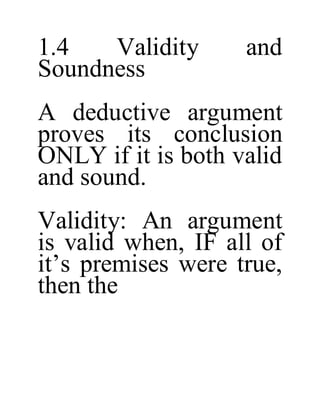
1.4 Validity and
Soundness
A deductive argument
proves its conclusion
ONLY if it is both valid
and sound.
Validity: An argument
is valid when, IF all of
it’s premises were true,
then the
conclusion would also
HAVE to be true.
In other words, a
“valid” argument is one
where the conclusion
necessarily follows
from
the premises. It is
IMPOSSIBLE for the
conclusion to be false if
the premises are true.
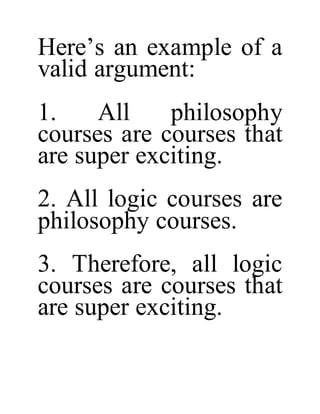
Here’s an example of a
valid argument:
1. All philosophy
courses are courses that
are super exciting.
2. All logic courses are
philosophy courses.
3. Therefore, all logic
courses are courses that
are super exciting.
Note #1: IF (1) and (2)
WERE true, then (3)
would also HAVE to be
true.
Note #2: Validity says
nothing about whether
or not any of the
premises ARE true. It
only
says that IF they are
true, then the
conclusion must follow.
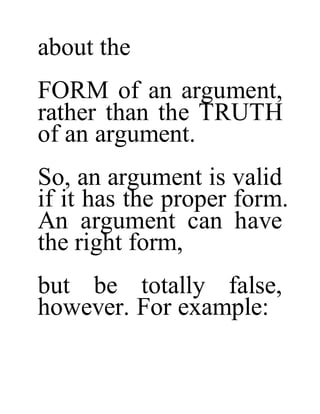
So, validity is more
about the
FORM of an argument,
rather than the TRUTH
of an argument.
So, an argument is valid
if it has the proper form.
An argument can have
the right form,
but be totally false,
however. For example:
1. Daffy Duck is a duck.
2. All ducks are
mammals.
3. Therefore, Daffy
Duck is a mammal.
The argument just given
is valid. But, premise 2
as well as the
conclusion are both
false.
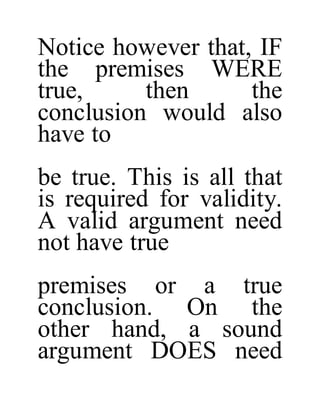
Notice however that, IF
the premises WERE
true, then the
conclusion would also
have to
be true. This is all that
is required for validity.
A valid argument need
not have true
premises or a true
conclusion. On the
other hand, a sound
argument DOES need
to
have true premises and
a true conclusion:
Soundness: An
argument is sound if it
meets these two criteria:
(1) It is valid.
(2) Its premises are true.
In other words, a sound
argument has the right
form AND it is true.
Note #3: A sound
argument will always
have a true conclusion.
This follows every time
these 2 criteria for
soundness are met.
Do you see why this is
the case? First, recall
that a sound argument
is both valid AND
has true premises. Now,
refer back to the
definition of “valid”.
For all valid arguments,
if
their premises are true,
then the conclusion
MUST also be true. So,
all sound arguments
have true conclusions.
Looking back to our
argument about Daffy
Duck, we can see that it
is valid, but not
sound. It is not sound
because it does not have
all true premises.
Namely, “All ducks are
mammals” is not true.
So, the argument about
Daffy Duck is valid, but
NOT sound. Here’s an
example of an
argument that is valid
AND sound:
1. All rabbits are
mammals.
2. Bugs Bunny is a
rabbit.
3. Therefore, Bugs
Bunny is a mammal.
In this argument, if the
premises are true, then
the conclusion is
necessarily true (so it is
valid). AND, as it turns
out, the premises ARE
true (all rabbits ARE in
fact mammals, and
Bugs Bunny IS in fact a
rabbit)—so the
conclusion must also be
true (so the argument is
sound).

Validity and soundness.doc

  • 1.
    1.4 Validity and Soundness Adeductive argument proves its conclusion ONLY if it is both valid and sound. Validity: An argument is valid when, IF all of it’s premises were true, then the
  • 2.
    conclusion would also HAVEto be true. In other words, a “valid” argument is one where the conclusion necessarily follows from the premises. It is IMPOSSIBLE for the conclusion to be false if the premises are true.
  • 3.
    Here’s an exampleof a valid argument: 1. All philosophy courses are courses that are super exciting. 2. All logic courses are philosophy courses. 3. Therefore, all logic courses are courses that are super exciting.
  • 4.
    Note #1: IF(1) and (2) WERE true, then (3) would also HAVE to be true. Note #2: Validity says nothing about whether or not any of the premises ARE true. It only says that IF they are true, then the conclusion must follow. So, validity is more
  • 5.
    about the FORM ofan argument, rather than the TRUTH of an argument. So, an argument is valid if it has the proper form. An argument can have the right form, but be totally false, however. For example:
  • 6.
    1. Daffy Duckis a duck. 2. All ducks are mammals. 3. Therefore, Daffy Duck is a mammal. The argument just given is valid. But, premise 2 as well as the conclusion are both false.
  • 7.
    Notice however that,IF the premises WERE true, then the conclusion would also have to be true. This is all that is required for validity. A valid argument need not have true premises or a true conclusion. On the other hand, a sound argument DOES need
  • 8.
    to have true premisesand a true conclusion: Soundness: An argument is sound if it meets these two criteria: (1) It is valid. (2) Its premises are true. In other words, a sound argument has the right form AND it is true.
  • 9.
    Note #3: Asound argument will always have a true conclusion. This follows every time these 2 criteria for soundness are met. Do you see why this is the case? First, recall that a sound argument is both valid AND has true premises. Now, refer back to the
  • 10.
    definition of “valid”. Forall valid arguments, if their premises are true, then the conclusion MUST also be true. So, all sound arguments have true conclusions. Looking back to our argument about Daffy Duck, we can see that it
  • 11.
    is valid, butnot sound. It is not sound because it does not have all true premises. Namely, “All ducks are mammals” is not true. So, the argument about Daffy Duck is valid, but NOT sound. Here’s an example of an
  • 12.
    argument that isvalid AND sound: 1. All rabbits are mammals. 2. Bugs Bunny is a rabbit. 3. Therefore, Bugs Bunny is a mammal. In this argument, if the premises are true, then the conclusion is
  • 13.
    necessarily true (soit is valid). AND, as it turns out, the premises ARE true (all rabbits ARE in fact mammals, and Bugs Bunny IS in fact a rabbit)—so the conclusion must also be true (so the argument is sound).