• An argumentis a reason to defend a thesis. To
argue is to support a thesis on reasons.
• Arguments are made up of a proposition,
called 'conclusion', and one or more
propositions, called ‘premises’.
• The conclusion of any argument is the thesis it
is intended to defend; the premises are the
reasons that support the conclusion.
What is an argument?
3.
• Premise 1:
IfGod doesn’t exist, life has no meaning.
• Premise 2:
But life has a meaning.
• Conclusion:
Therefore, God exists.
Example of an argument
4.
• An enthymemeis an argument in which some
premise is omitted (it is used in reasoning but not
made explicit).
Example of an enthymeme:
(P1) God is perfect.
(C) Therefore, God must exist.
Enthymemes
Implicit premise:
(P2) Everything that is perfect must exist.
5.
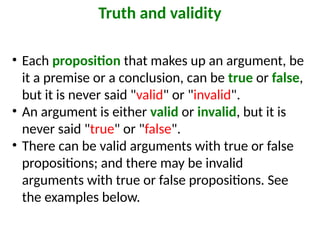
• Each propositionthat makes up an argument, be
it a premise or a conclusion, can be true or false,
but it is never said "valid" or "invalid".
• An argument is either valid or invalid, but it is
never said "true" or "false".
• There can be valid arguments with true or false
propositions; and there may be invalid
arguments with true or false propositions. See
the examples below.
Truth and validity
6.
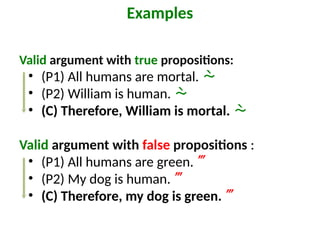
Valid argument withtrue propositions:
• (P1) All humans are mortal.
• (P2) William is human.
• (C) Therefore, William is mortal.
Valid argument with false propositions :
• (P1) All humans are green.
• (P2) My dog is human.
• (C) Therefore, my dog is green.
Examples
7.
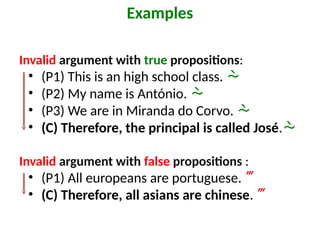
Invalid argument withtrue propositions:
• (P1) This is an high school class.
• (P2) My name is António.
• (P3) We are in Miranda do Corvo.
• (C) Therefore, the principal is called José.
Invalid argument with false propositions :
• (P1) All europeans are portuguese.
• (C) Therefore, all asians are chinese.
Examples
8.
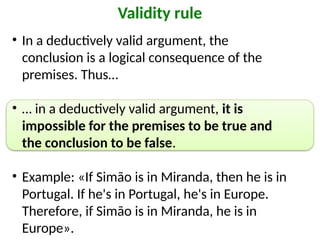
• In adeductively valid argument, the
conclusion is a logical consequence of the
premises. Thus…
• … in a deductively valid argument, it is
impossible for the premises to be true and
the conclusion to be false.
• Example: «If Simão is in Miranda, then he is in
Portugal. If he's in Portugal, he's in Europe.
Therefore, if Simão is in Miranda, he is in
Europe».
Validity rule
9.
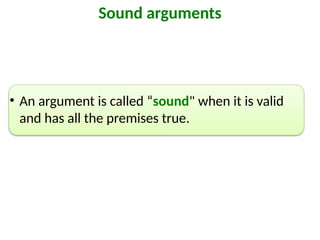
• An argumentis called “sound" when it is valid
and has all the premises true.
Sound arguments
10.
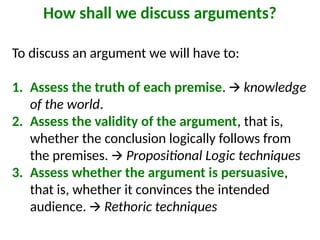
How shall wediscuss arguments?
To discuss an argument we will have to:
1. Assess the truth of each premise. 🡪 knowledge
of the world.
2. Assess the validity of the argument, that is,
whether the conclusion logically follows from
the premises. 🡪 Propositional Logic techniques
3. Assess whether the argument is persuasive,
that is, whether it convinces the intended
audience. 🡪 Rethoric techniques


![[POPPER,-Karl]-Conhecimento-Objetivo_-Uma-Abordagem evolucionária.pdf](https://cdn.slidesharecdn.com/ss_thumbnails/popper-karl-conhecimento-objetivo-uma-abordagemevolucionria-230609084038-b10bd936-thumbnail.jpg?width=640&height=640&fit=bounds)


![[Karl-Popper]-O-mito-do-contexto_-em-defesa-da-ciencia.pdf](https://cdn.slidesharecdn.com/ss_thumbnails/karl-popper-o-mito-do-contexto-em-defesa-da-ciencia-230601080939-5abc40d5-thumbnail.jpg?width=640&height=640&fit=bounds)


