Built Environment
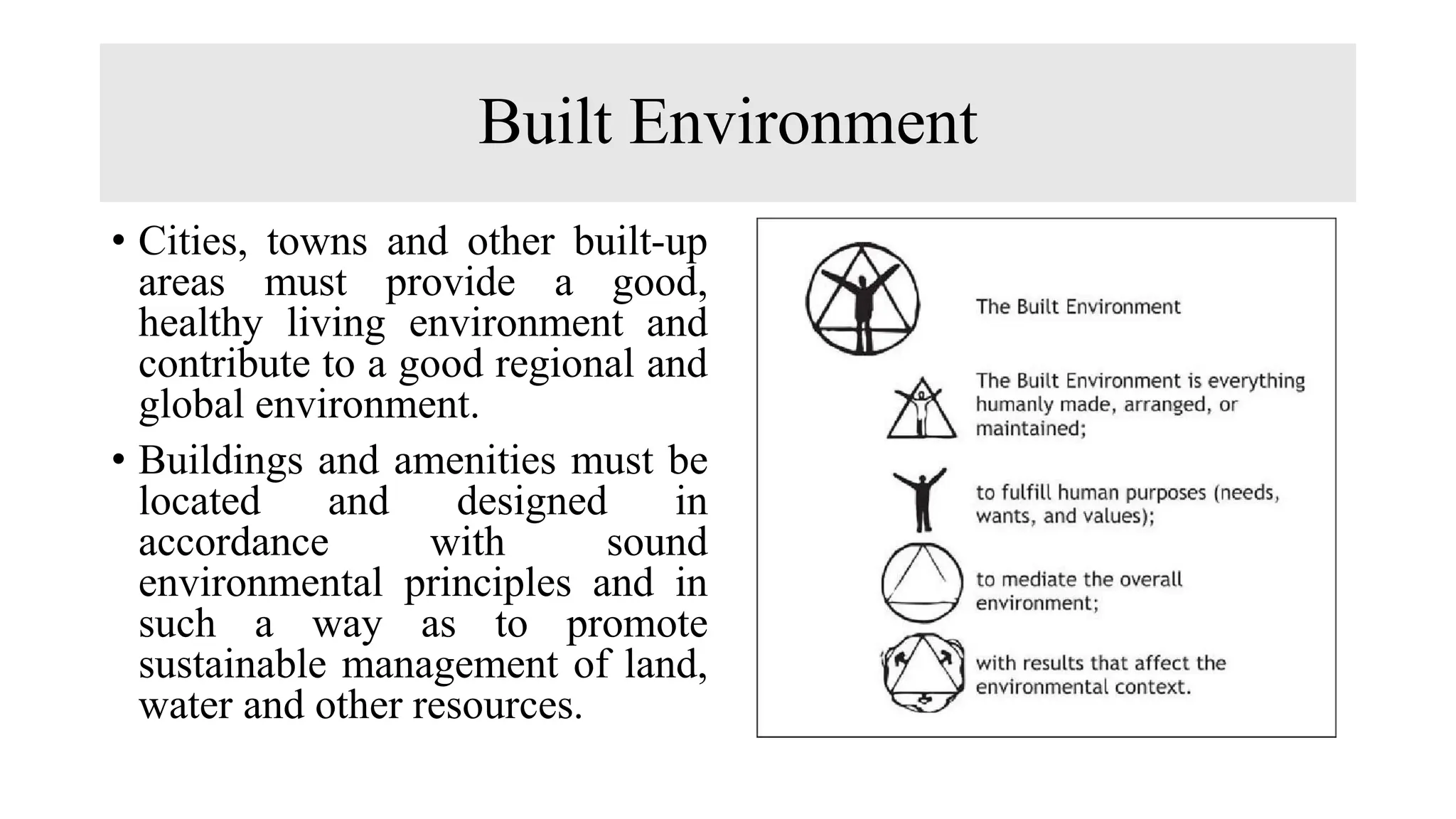
• Cities, towns and other built-up
areas must provide a good,
healthy living environment and
contribute to a good regional and
global environment.
• Buildings and amenities must be
located and designed in
accordance with sound
environmental principles and in
such a way as to promote
sustainable management of land,
water and other resources.
Need of Built Environment
• The human made space in which people live work and recreate on day
to day basis.
• offer a good living environment and contribute to sustainable
development.
Element of Built Environment
• The term built environment refers to aspects of our surroundings that
are built by humans, that is, distinguished from the natural
environment. It includes not only buildings, but the human-
made spaces between buildings, such as parks, and
the infrastructure that supports human activity such
as transportation networks, utilities networks, flood defenses,
telecommunications and so on.
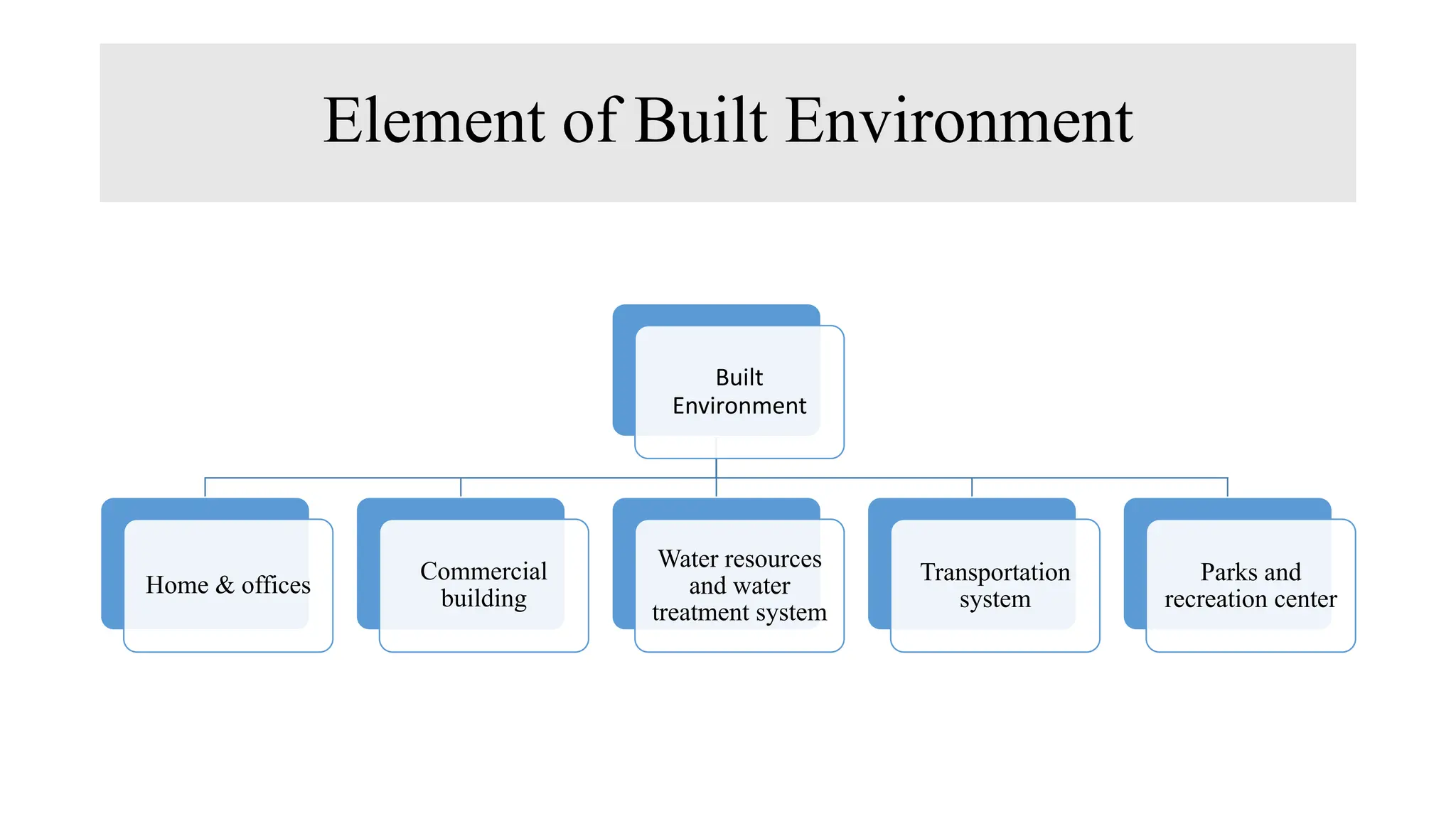
Element of Built Environment
Built
Environment
Home & offices
Commercial
building
Water resources
and water
treatment system
Transportation
system
Parks and
recreation center
Element of Built Environment
• Home & offices
• Commercial building
• Parks and recreation center
• Transportation system
• Water resources and water treatment system
Buildings
At their most basic level, buildings are used as spaces of shelter for
residential and business uses. They are one of the most clear elements of
the built environment because of their physical presence and purpose to
protect against the natural or "un-built" environment .
The location, design, and layout of buildings all have an impact on the
function and effectiveness of a building's service as an aspect of the
built environment. A building's location can influence its function, and
how frequently it is used by people. Additionally, the design of indoor
space, as determined by architects and designers, has a great impact on
how the space functions and the behavior it promotes.
Home & offices
Features of Home Built Environment:
• Layout of land area as per requirement
• Less consumption of electricity in day time
• Proper arrangement of living room and kitchen etc.
• Parking facility
• Use of solar panel in house.
Commercial building
• A high performance commercial building is a building that uses whole
building design to achieve energy, economic, and environmental sustain
able performance.
• Whole building design creates energy efficient building that save
money and also produces green buildings that are healthy place to live
and work.
• It helps to preserve our natural resources and can significantly reduce
building’s impact on the environment.
Transportation system
Transportation options within a community play a large role in
communities, both socially and physically. These options can include
roads, sidewalks, and public transportation infrastructure.
• Roads and highways
Roads allow pedestrians and people operating vehicles (whether cars,
buses, motorcycles, or bicycles) to reliably access all areas of an urban
or regional space. For millennia, road systems have served as the veins
of urban spaces, allowing people to travel efficiently between areas
within a city or region.
Transportation system
• Sidewalks: Sidewalks are an important feature of the built
environment that enable pedestrian mobility and increase walkability.
Urban road networks used to be primarily a place for the pedestrian,
but have become increasingly dominated by automobiles. The city
sidewalk, therefore, is a place safe for bipedal commuters.
• Public transportation :Public transportation is an essential part of
urban spaces and the built environment. Public transport raises
property values by improving access to surrounding resources, lowers
the cost of living by reducing the need for a car and improves an area's
environmental footprint by reducing carbon-rich greenhouse gas
emissions.
Parks and green space
• Parks provide a number of neighborhood benefits including promotion
of physical activity and environmental wellbeing .The location
and accessibility of parks also has a great positive influence on the
surrounding communities. For example, the addition green spaces to
urban space can combat air pollution, provide a break from otherwise
monotonous urban networks, and even impact city-wide temperatures
by reducing the Heat-island effect.
Water resources & system
• Water management is a key environmental issue in controlling of
floods and reducing droughts. management issues and
solutions develops an appreciation of the diverse, complex and current
themes of the water resources debate across the built environment,
urban development and management continuum.
• Natural sources of fresh water
1. Surface water
2. Water from glaciers
3. Under river flow
Water resources & system
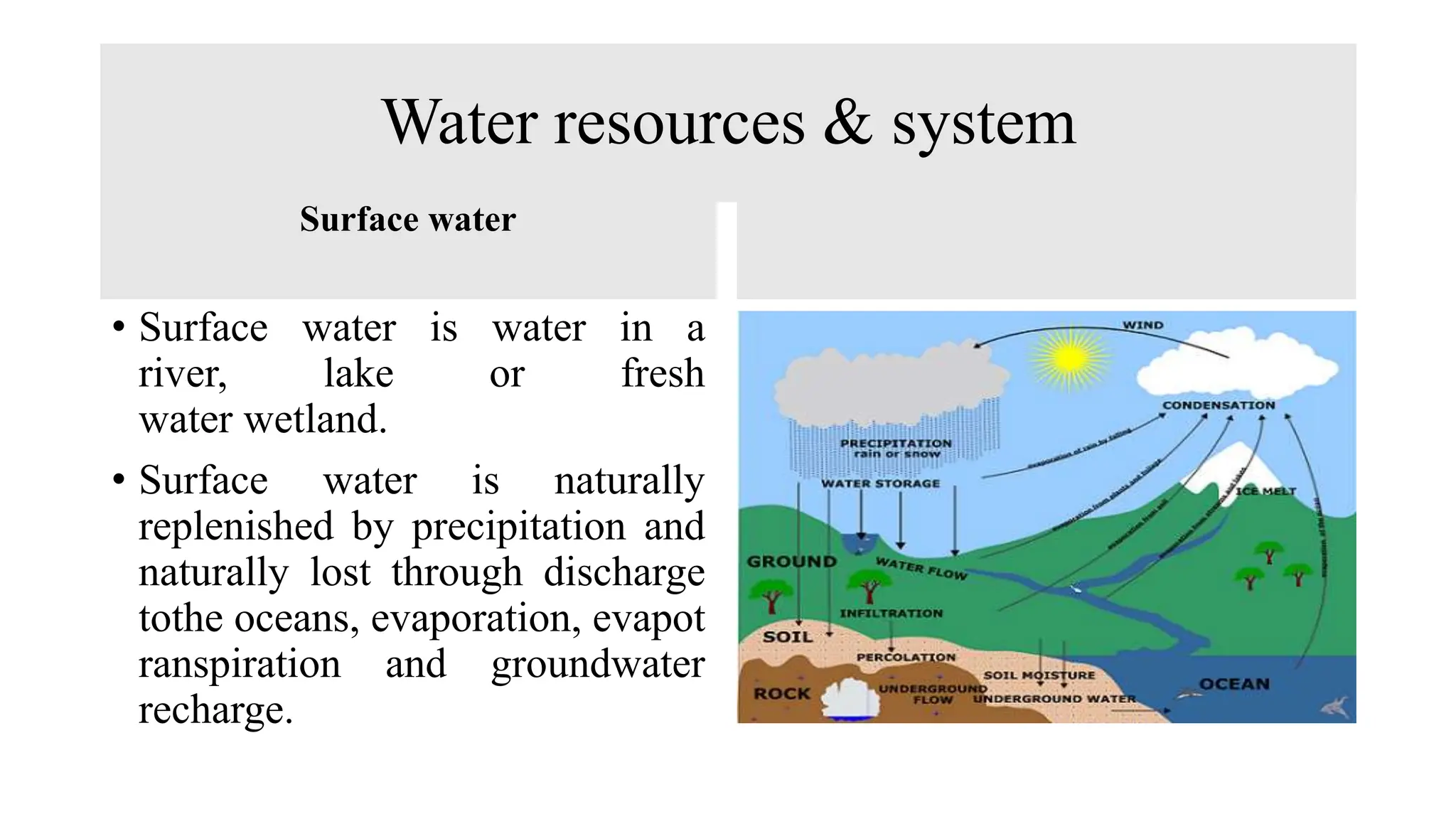
Surface water
• Surface water is water in a
river, lake or fresh
water wetland.
• Surface water is naturally
replenished by precipitation and
naturally lost through discharge
tothe oceans, evaporation, evapot
ranspiration and groundwater
recharge.
Water from glaciers
• Glacier runoff is considered to be surface water. The Himalayas,
which are often called "The Roof of the World", contain some of the
most extensive and rough high altitude areas on Earth as well as the
greatest area of glaciers .
• Ten of Asia's largest rivers flow from there, and more than a billion
people's livelihoods depend on them.
• To complicate matters, temperatures there are rising more rapidly than
the global average.
Artificial sources of usable water
• Wastewater reuse : it is the process of converting municipal wastewater
(sewage) or industrial wastewater into water that can be reused for a variety
of purposes.
• Types of reuse include: urban reuse, agricultural reuse (irrigation),
environmental reuse, industrial reuse, planned potable reuse.
• For example, reuse may include irrigation of gardens and agricultural fields
or replenishing surface water and groundwater .
• Reused water may also be directed toward fulfilling certain needs in
residences (e.g. toilet flushing, businesses, and industry, and could even be
treated to reach drinking water standards.
• The injection of reclaimed water into the water supply distribution system
is known as direct potable reuse, however, drinking reclaimed water is not a
typical practice
Sewage Water Treatment Plant
• It is the process to removing the containment from the waste water and
household sewage both industry waste water and domestic.it includes
physical , chemical and biological process to remove all type of
containment .
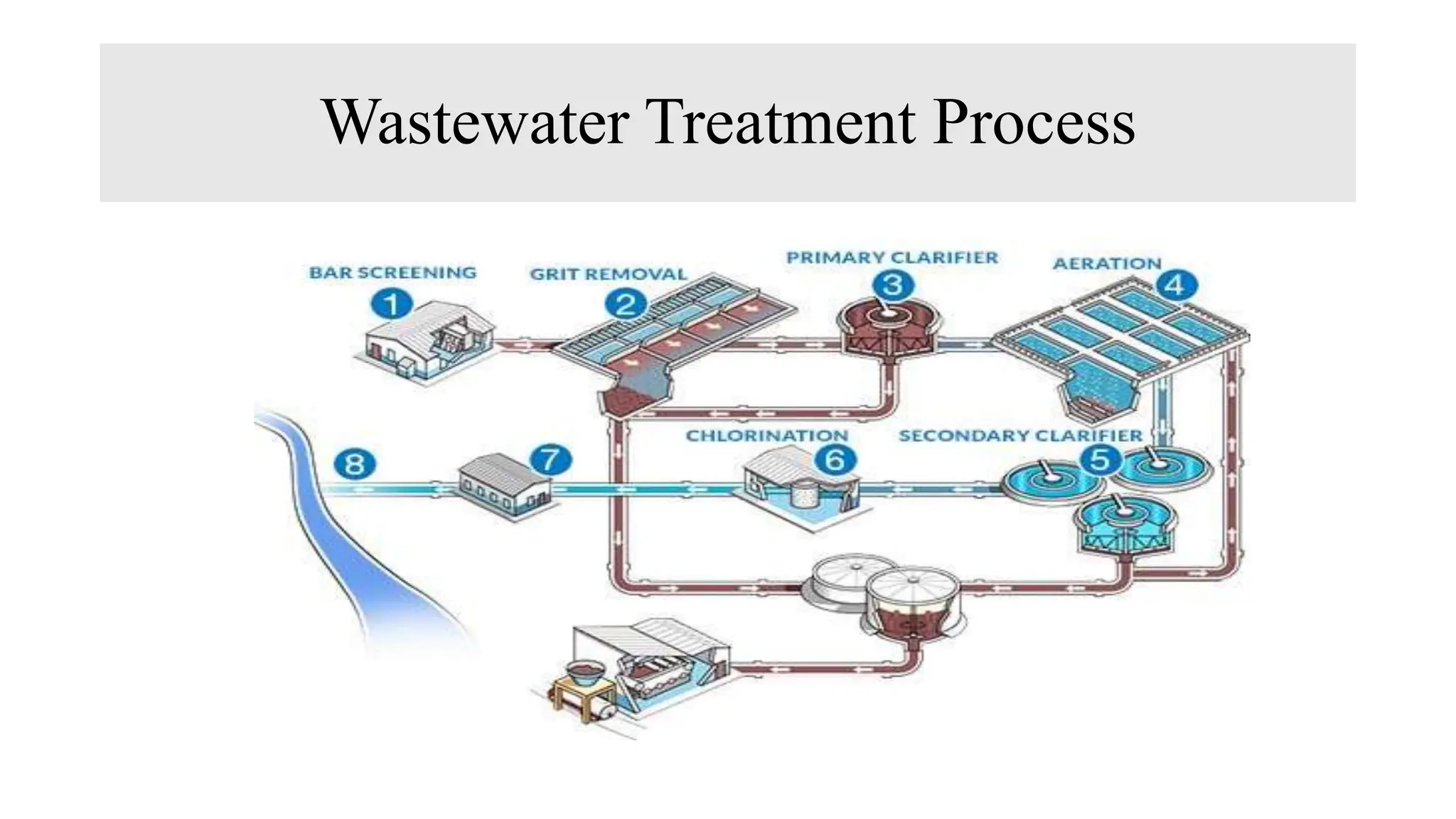
Wastewater Treatment Process
Stage One -Bar Screening
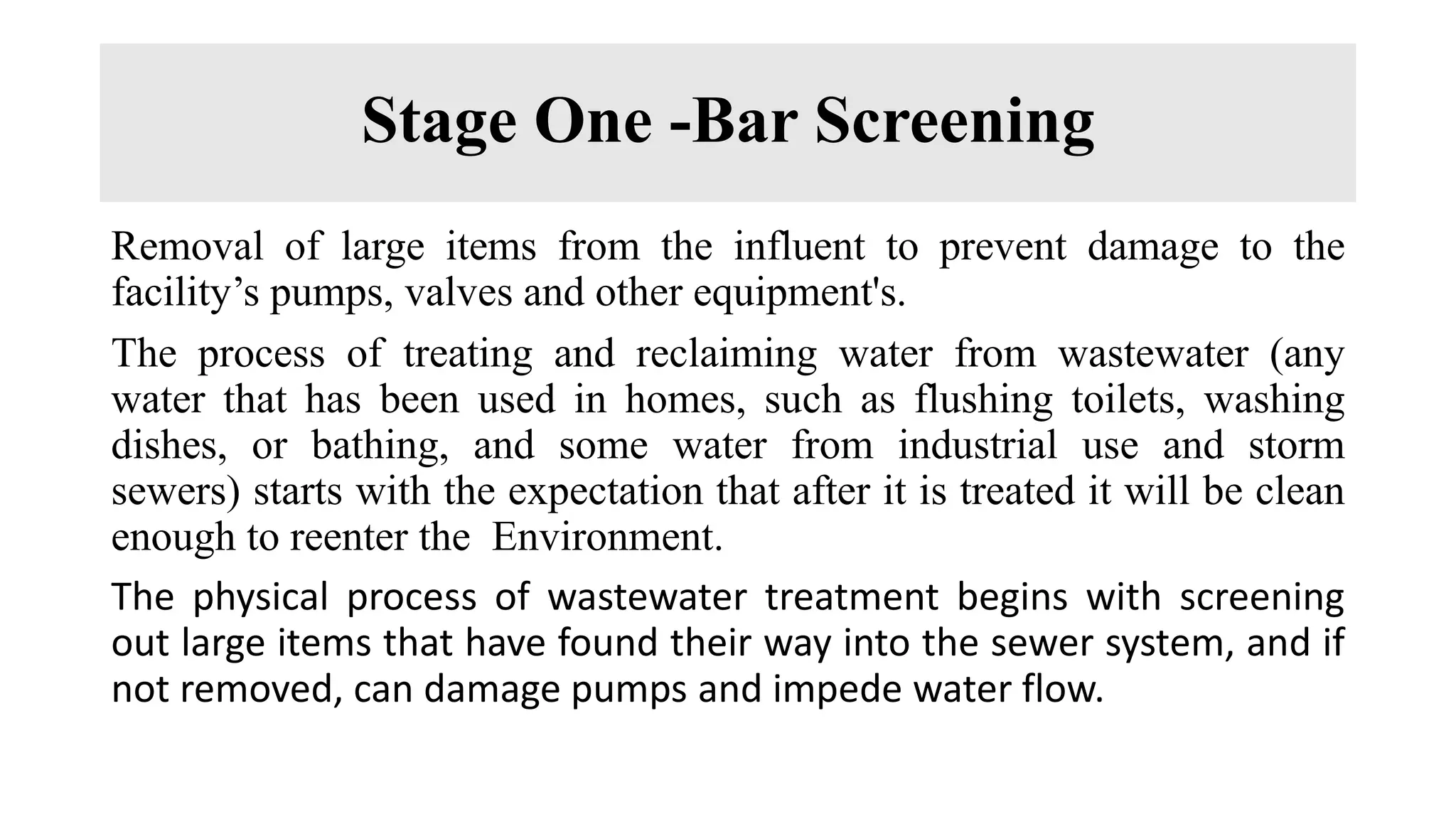
Removal of large items from the influent to prevent damage to the
facility’s pumps, valves and other equipment's.
The process of treating and reclaiming water from wastewater (any
water that has been used in homes, such as flushing toilets, washing
dishes, or bathing, and some water from industrial use and storm
sewers) starts with the expectation that after it is treated it will be clean
enough to reenter the Environment.
The physical process of wastewater treatment begins with screening
out large items that have found their way into the sewer system, and if
not removed, can damage pumps and impede water flow.
Stage Two- Screening
Removal of grit by flowing the influent over/through a grit chamber.
Fine grit that finds its way into the influent needs to be removed to
prevent the damage of pumps and equipment downstream (or impact
water flow). Too small to be screened out, this grit needs to be removed
from the grit chamber. There are several types of grit chambers
(horizontal, aerated or vortex) which control the flow of water, allowing
the heavier grit to fall to the bottom of the chamber; the water and
organic material continue to flow to the next stage in the process. The
grit is physically removed from the bottom of the chamber and
discarded.
Stage Three — Primary Clarifier
After grit removal, the influent enters large primary clarifiers that
separate out between 25% and 50% of the solids in the influent. These
large clarifiers allow for the heavy solids to sink to the bottom and the
cleaner influent to flow. The effectiveness of the primary clarification is
a matter of appropriate water flow. If the water flow is too fast, the
solids don’t have time to sink to the bottom resulting in negative impact
on water quality downstream. If the water flow is too slow, it impacts
the process up stream. The solids that fall to the bottom of the clarifier
are known as sludge and pumped out on regular basis.
Stage Four — Aeration
Aeration provides oxygen to bacteria for treating and stabilizing the
wastewater. Oxygen is needed by the bacteria to allow biodegradation to
occur. The supplied oxygen is utilized by bacteria in the wastewater to break
down the organic matter containing carbon to form carbon dioxide and water.
Aeration brings water and air in close contact in order to remove dissolved
gases and to oxidize dissolved metals, including iron, hydrogen sulfide, and
volatile organic chemicals (VOCs). This process is typically the first major
process at drinking water treatment plant, and occurs in the secondary
treatment processes of activated sludge treatment in wastewater treatment
plants. An evenly distributed oxygen supply in an aeration system is essential
to effective wastewater treatment for fostering microbial growth.
Stage Four — Aeration
A key parameter to measure in wastewater treatment is Biochemical
Oxygen Demand (BOD). BOD is a surrogate indicator for the amount of
organic material present and is used to determine the effectiveness of
organic material breakdown. There are a number of other tests used to
ensure optimal organic material breakdown such as measuring pH,
temperature, Dissolved Oxygen (DO), Total Suspended Solids (TSS),
Hydraulic Retention Time (flow rate), Solids Retention Time (amount of
time the bacteria is in the aeration chamber) and Mixed Liquor
Suspended Solids. Ongoing and accurate monitoring is crucial to ensure
the final required effluent BOD.
Stage Five — Secondary Clarifier
Treated wastewater is pumped into a secondary clarifier to allow any
remaining organic sediment to settle out of treated water flow.
As the influent exits the aeration process, it flows into a secondary
clarifier where, like the primary clarifier, any very small solids (or fines)
sink to the bottom of the tank. These small solids are called activated
sludge and consist mostly of active bacteria. Part of this activated sludge
is returned to the aeration tank to increase the bacterial concentration,
help in propagation, and accelerate the breakdown of organic material.
Stage Six — Chlorination (Disinfection)
Chlorine is added to kill any remaining bacteria in the contact chamber.
With the enhanced concentration of bacteria as part of the aeration
stage, there is a need to test the outgoing effluent for bacteria presence
or absence and to disinfect the water. This ensures that higher than
specified concentrations of bacteria are not released into the
environment. Chlorination is the most common and inexpensive type of
disinfection but ozone and UV disinfection are also increasing in
popularity. If chorine is used, it is important to test for free-chlorine
levels to ensure they are acceptable levels before being released into the
environment.
Stage Seven — Water Analysis & Testing
Testing for proper pH level, ammonia, nitrates, phosphates, dissolved
oxygen, and residual chlorine levels to conform to the plant’s NPDES
(National Pollutant Discharge Elimination System) permit are critical
to the plant’s performance.
Although testing is continuous throughout the wastewater treatment
process to ensure optimal water flow, clarification and aeration,
Stage Eight — Effluent Disposal
After meeting all permit specifications, clean water is reintroduced into
the environment.
Although testing is continuous throughout the wastewater treatment
process to ensure optimal water flow, clarification and aeration, final
testing is done to make sure the effluent leaving the plant meets permit
specifications.
Plants that don`t meet permit discharge levels are subject to fines and
possible incarceration of the operator in charge.
Ground Support System
• Upgrade the Green belt area
• Proper sanitary system (exact drainage of waste water from house)
• Proper collection waste materials
• Upgrade the public transportation system
• Clean the rivers and cannel .
• Less consumption of electricity and installation maximum number of
solar system.

01.pptxHuman Following Robot.pptxHuman Following Robot.pptxHuman Following Robot.pptxHuman Following Robot.pptxHuman Following Robot.pptxHuman Following Robot.pptx

  • 2.
    Built Environment • Cities,towns and other built-up areas must provide a good, healthy living environment and contribute to a good regional and global environment. • Buildings and amenities must be located and designed in accordance with sound environmental principles and in such a way as to promote sustainable management of land, water and other resources.
  • 3.
    Need of BuiltEnvironment • The human made space in which people live work and recreate on day to day basis. • offer a good living environment and contribute to sustainable development.
  • 4.
    Element of BuiltEnvironment • The term built environment refers to aspects of our surroundings that are built by humans, that is, distinguished from the natural environment. It includes not only buildings, but the human- made spaces between buildings, such as parks, and the infrastructure that supports human activity such as transportation networks, utilities networks, flood defenses, telecommunications and so on.
  • 5.
    Element of BuiltEnvironment Built Environment Home & offices Commercial building Water resources and water treatment system Transportation system Parks and recreation center
  • 6.
    Element of BuiltEnvironment • Home & offices • Commercial building • Parks and recreation center • Transportation system • Water resources and water treatment system
  • 7.
    Buildings At their mostbasic level, buildings are used as spaces of shelter for residential and business uses. They are one of the most clear elements of the built environment because of their physical presence and purpose to protect against the natural or "un-built" environment . The location, design, and layout of buildings all have an impact on the function and effectiveness of a building's service as an aspect of the built environment. A building's location can influence its function, and how frequently it is used by people. Additionally, the design of indoor space, as determined by architects and designers, has a great impact on how the space functions and the behavior it promotes.
  • 8.
    Home & offices Featuresof Home Built Environment: • Layout of land area as per requirement • Less consumption of electricity in day time • Proper arrangement of living room and kitchen etc. • Parking facility • Use of solar panel in house.
  • 9.
    Commercial building • Ahigh performance commercial building is a building that uses whole building design to achieve energy, economic, and environmental sustain able performance. • Whole building design creates energy efficient building that save money and also produces green buildings that are healthy place to live and work. • It helps to preserve our natural resources and can significantly reduce building’s impact on the environment.
  • 10.
    Transportation system Transportation optionswithin a community play a large role in communities, both socially and physically. These options can include roads, sidewalks, and public transportation infrastructure. • Roads and highways Roads allow pedestrians and people operating vehicles (whether cars, buses, motorcycles, or bicycles) to reliably access all areas of an urban or regional space. For millennia, road systems have served as the veins of urban spaces, allowing people to travel efficiently between areas within a city or region.
  • 11.
    Transportation system • Sidewalks:Sidewalks are an important feature of the built environment that enable pedestrian mobility and increase walkability. Urban road networks used to be primarily a place for the pedestrian, but have become increasingly dominated by automobiles. The city sidewalk, therefore, is a place safe for bipedal commuters. • Public transportation :Public transportation is an essential part of urban spaces and the built environment. Public transport raises property values by improving access to surrounding resources, lowers the cost of living by reducing the need for a car and improves an area's environmental footprint by reducing carbon-rich greenhouse gas emissions.
  • 12.
    Parks and greenspace • Parks provide a number of neighborhood benefits including promotion of physical activity and environmental wellbeing .The location and accessibility of parks also has a great positive influence on the surrounding communities. For example, the addition green spaces to urban space can combat air pollution, provide a break from otherwise monotonous urban networks, and even impact city-wide temperatures by reducing the Heat-island effect.
  • 13.
    Water resources &system • Water management is a key environmental issue in controlling of floods and reducing droughts. management issues and solutions develops an appreciation of the diverse, complex and current themes of the water resources debate across the built environment, urban development and management continuum. • Natural sources of fresh water 1. Surface water 2. Water from glaciers 3. Under river flow
  • 14.
    Water resources &system Surface water • Surface water is water in a river, lake or fresh water wetland. • Surface water is naturally replenished by precipitation and naturally lost through discharge tothe oceans, evaporation, evapot ranspiration and groundwater recharge.
  • 15.
    Water from glaciers •Glacier runoff is considered to be surface water. The Himalayas, which are often called "The Roof of the World", contain some of the most extensive and rough high altitude areas on Earth as well as the greatest area of glaciers . • Ten of Asia's largest rivers flow from there, and more than a billion people's livelihoods depend on them. • To complicate matters, temperatures there are rising more rapidly than the global average.
  • 16.
    Artificial sources ofusable water • Wastewater reuse : it is the process of converting municipal wastewater (sewage) or industrial wastewater into water that can be reused for a variety of purposes. • Types of reuse include: urban reuse, agricultural reuse (irrigation), environmental reuse, industrial reuse, planned potable reuse. • For example, reuse may include irrigation of gardens and agricultural fields or replenishing surface water and groundwater . • Reused water may also be directed toward fulfilling certain needs in residences (e.g. toilet flushing, businesses, and industry, and could even be treated to reach drinking water standards. • The injection of reclaimed water into the water supply distribution system is known as direct potable reuse, however, drinking reclaimed water is not a typical practice
  • 17.
    Sewage Water TreatmentPlant • It is the process to removing the containment from the waste water and household sewage both industry waste water and domestic.it includes physical , chemical and biological process to remove all type of containment .
  • 18.
  • 19.
    Stage One -BarScreening Removal of large items from the influent to prevent damage to the facility’s pumps, valves and other equipment's. The process of treating and reclaiming water from wastewater (any water that has been used in homes, such as flushing toilets, washing dishes, or bathing, and some water from industrial use and storm sewers) starts with the expectation that after it is treated it will be clean enough to reenter the Environment. The physical process of wastewater treatment begins with screening out large items that have found their way into the sewer system, and if not removed, can damage pumps and impede water flow.
  • 20.
    Stage Two- Screening Removalof grit by flowing the influent over/through a grit chamber. Fine grit that finds its way into the influent needs to be removed to prevent the damage of pumps and equipment downstream (or impact water flow). Too small to be screened out, this grit needs to be removed from the grit chamber. There are several types of grit chambers (horizontal, aerated or vortex) which control the flow of water, allowing the heavier grit to fall to the bottom of the chamber; the water and organic material continue to flow to the next stage in the process. The grit is physically removed from the bottom of the chamber and discarded.
  • 21.
    Stage Three —Primary Clarifier After grit removal, the influent enters large primary clarifiers that separate out between 25% and 50% of the solids in the influent. These large clarifiers allow for the heavy solids to sink to the bottom and the cleaner influent to flow. The effectiveness of the primary clarification is a matter of appropriate water flow. If the water flow is too fast, the solids don’t have time to sink to the bottom resulting in negative impact on water quality downstream. If the water flow is too slow, it impacts the process up stream. The solids that fall to the bottom of the clarifier are known as sludge and pumped out on regular basis.
  • 22.
    Stage Four —Aeration Aeration provides oxygen to bacteria for treating and stabilizing the wastewater. Oxygen is needed by the bacteria to allow biodegradation to occur. The supplied oxygen is utilized by bacteria in the wastewater to break down the organic matter containing carbon to form carbon dioxide and water. Aeration brings water and air in close contact in order to remove dissolved gases and to oxidize dissolved metals, including iron, hydrogen sulfide, and volatile organic chemicals (VOCs). This process is typically the first major process at drinking water treatment plant, and occurs in the secondary treatment processes of activated sludge treatment in wastewater treatment plants. An evenly distributed oxygen supply in an aeration system is essential to effective wastewater treatment for fostering microbial growth.
  • 23.
    Stage Four —Aeration A key parameter to measure in wastewater treatment is Biochemical Oxygen Demand (BOD). BOD is a surrogate indicator for the amount of organic material present and is used to determine the effectiveness of organic material breakdown. There are a number of other tests used to ensure optimal organic material breakdown such as measuring pH, temperature, Dissolved Oxygen (DO), Total Suspended Solids (TSS), Hydraulic Retention Time (flow rate), Solids Retention Time (amount of time the bacteria is in the aeration chamber) and Mixed Liquor Suspended Solids. Ongoing and accurate monitoring is crucial to ensure the final required effluent BOD.
  • 24.
    Stage Five —Secondary Clarifier Treated wastewater is pumped into a secondary clarifier to allow any remaining organic sediment to settle out of treated water flow. As the influent exits the aeration process, it flows into a secondary clarifier where, like the primary clarifier, any very small solids (or fines) sink to the bottom of the tank. These small solids are called activated sludge and consist mostly of active bacteria. Part of this activated sludge is returned to the aeration tank to increase the bacterial concentration, help in propagation, and accelerate the breakdown of organic material.
  • 25.
    Stage Six —Chlorination (Disinfection) Chlorine is added to kill any remaining bacteria in the contact chamber. With the enhanced concentration of bacteria as part of the aeration stage, there is a need to test the outgoing effluent for bacteria presence or absence and to disinfect the water. This ensures that higher than specified concentrations of bacteria are not released into the environment. Chlorination is the most common and inexpensive type of disinfection but ozone and UV disinfection are also increasing in popularity. If chorine is used, it is important to test for free-chlorine levels to ensure they are acceptable levels before being released into the environment.
  • 26.
    Stage Seven —Water Analysis & Testing Testing for proper pH level, ammonia, nitrates, phosphates, dissolved oxygen, and residual chlorine levels to conform to the plant’s NPDES (National Pollutant Discharge Elimination System) permit are critical to the plant’s performance. Although testing is continuous throughout the wastewater treatment process to ensure optimal water flow, clarification and aeration,
  • 27.
    Stage Eight —Effluent Disposal After meeting all permit specifications, clean water is reintroduced into the environment. Although testing is continuous throughout the wastewater treatment process to ensure optimal water flow, clarification and aeration, final testing is done to make sure the effluent leaving the plant meets permit specifications. Plants that don`t meet permit discharge levels are subject to fines and possible incarceration of the operator in charge.
  • 28.
    Ground Support System •Upgrade the Green belt area • Proper sanitary system (exact drainage of waste water from house) • Proper collection waste materials • Upgrade the public transportation system • Clean the rivers and cannel . • Less consumption of electricity and installation maximum number of solar system.