Cloud Computing in Government Sector: Indicators and Issues Vaishali Rana  Deputy Director(IT) Delhi Electricity Regulatory Commision  [email_address]
Cloud Computing  -  General View Style of Computing – Massive scalable IT related capabilities are provided “ as a service” using internet technologies. Service applications and data storage delivered online through powerful servers. Types of Cloud- Public, Private and Hybrid Cloud
Cloud Computing- Categories Infrastructure-as-a-Service Storage -as-a-Service Platform-as-a-Service Software-as-a-Service
Advantage of Cloud Computing Economies of Scale  and Competitive Advantage Shift from CAPEX to OPEX Organization can devote more time and energy to their core area. Cost Savings and optimum use of IT infrastructure. Increase efficiency of IT and other staff. Promotes data sharing and lowers  Data Duplication.
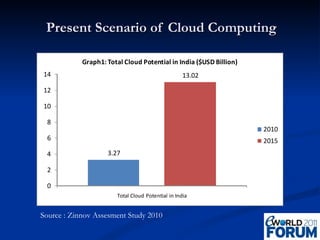
Present Scenario of Cloud Computing Source : Zinnov Assesment Study 2010
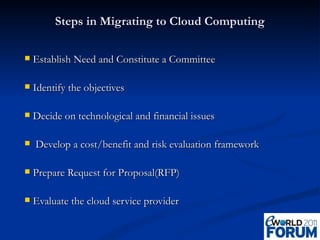
Steps in Migrating to Cloud Computing  Establish Need and Constitute a Committee Identify the objectives Decide on technological and financial issues Develop a cost/benefit and risk evaluation framework Prepare Request for Proposal(RFP) Evaluate the cloud service provider
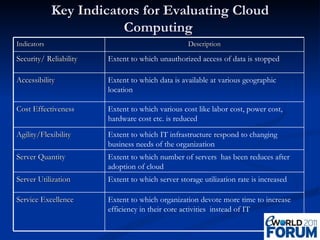
Key Indicators for Evaluating Cloud Computing  Indicators Description Security/ Reliability Extent to which unauthorized access of data is stopped  Accessibility Extent to which data is available at various geographic location Cost Effectiveness Extent to which various cost like labor cost, power cost, hardware cost etc. is reduced Agility/Flexibility Extent to which IT infrastructure respond to changing business needs of the organization Server Quantity Extent to which number of servers  has been reduces after adoption of cloud Server Utilization Extent to which server storage utilization rate is increased  Service Excellence Extent to which organization devote more time to increase efficiency in their core activities  instead of IT
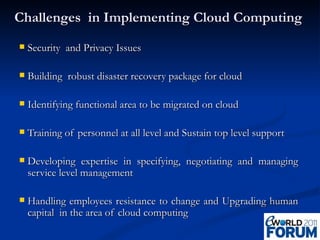
Challenges  in Implementing Cloud Computing  Security  and Privacy Issues Building  robust disaster recovery package for cloud Identifying functional area to be migrated on cloud Training of personnel at all level and Sustain top level support Developing expertise in specifying, negotiating and managing service level management Handling employees resistance to change and Upgrading human capital  in the area of cloud computing
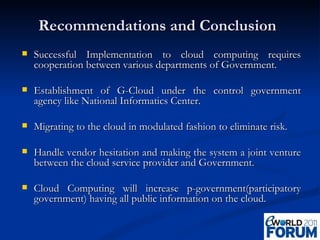
Recommendations and Conclusion Successful Implementation to cloud computing requires cooperation between various departments of Government. Establishment of G-Cloud under the control government agency like National Informatics Center. Migrating to the cloud in modulated fashion to eliminate risk. Handle vendor hesitation and making the system a joint venture between the cloud service provider and Government. Cloud Computing will increase p-government(participatory government) having all public information on the cloud.
 

Vaishali Rana

  • 1.
    Cloud Computing inGovernment Sector: Indicators and Issues Vaishali Rana Deputy Director(IT) Delhi Electricity Regulatory Commision [email_address]
  • 2.
    Cloud Computing - General View Style of Computing – Massive scalable IT related capabilities are provided “ as a service” using internet technologies. Service applications and data storage delivered online through powerful servers. Types of Cloud- Public, Private and Hybrid Cloud
  • 3.
    Cloud Computing- CategoriesInfrastructure-as-a-Service Storage -as-a-Service Platform-as-a-Service Software-as-a-Service
  • 4.
    Advantage of CloudComputing Economies of Scale and Competitive Advantage Shift from CAPEX to OPEX Organization can devote more time and energy to their core area. Cost Savings and optimum use of IT infrastructure. Increase efficiency of IT and other staff. Promotes data sharing and lowers Data Duplication.
  • 5.
    Present Scenario ofCloud Computing Source : Zinnov Assesment Study 2010
  • 6.
    Steps in Migratingto Cloud Computing Establish Need and Constitute a Committee Identify the objectives Decide on technological and financial issues Develop a cost/benefit and risk evaluation framework Prepare Request for Proposal(RFP) Evaluate the cloud service provider
  • 7.
    Key Indicators forEvaluating Cloud Computing Indicators Description Security/ Reliability Extent to which unauthorized access of data is stopped Accessibility Extent to which data is available at various geographic location Cost Effectiveness Extent to which various cost like labor cost, power cost, hardware cost etc. is reduced Agility/Flexibility Extent to which IT infrastructure respond to changing business needs of the organization Server Quantity Extent to which number of servers has been reduces after adoption of cloud Server Utilization Extent to which server storage utilization rate is increased Service Excellence Extent to which organization devote more time to increase efficiency in their core activities instead of IT
  • 8.
    Challenges inImplementing Cloud Computing Security and Privacy Issues Building robust disaster recovery package for cloud Identifying functional area to be migrated on cloud Training of personnel at all level and Sustain top level support Developing expertise in specifying, negotiating and managing service level management Handling employees resistance to change and Upgrading human capital in the area of cloud computing
  • 9.
    Recommendations and ConclusionSuccessful Implementation to cloud computing requires cooperation between various departments of Government. Establishment of G-Cloud under the control government agency like National Informatics Center. Migrating to the cloud in modulated fashion to eliminate risk. Handle vendor hesitation and making the system a joint venture between the cloud service provider and Government. Cloud Computing will increase p-government(participatory government) having all public information on the cloud.
  • 10.