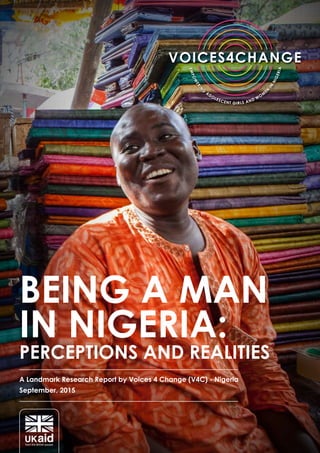
BEING A MAN
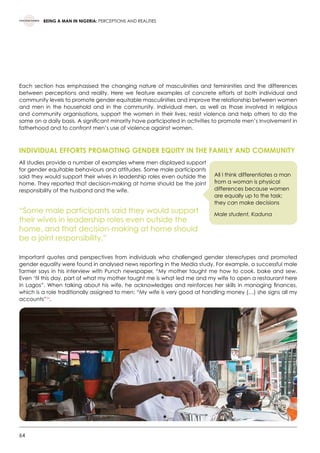
IN NIGERIA:
PERCEPTIONS AND REALITIES
A Landmark Research Report by Voices 4 Change (V4C) - Nigeria
September, 2015
About Voices 4 Change							 4
Acknowledgements								 5
List of Acronyms								 6
Glossary									 7
Executive Summary								 9
Introduction									 13
Regional contexts								 16
Section 1
What it means to be a man in Nigeria: Perceptions				 18
Perceptions - Societal expectations of men and women			 19
Perceptions - Men’s relationship with women 				 23
Perceptions - Division of responsibility and labour in the household		 25
Perceptions - Women and men’s roles in public life				 27
Section 2
Realities of being a man in Nigeria						 30
Realities - Men and women’s behaviour					 31
Realities - Interpersonal Relationship between men and women		 32
Realities - The division of responsibility and labour in the home		 36
Realities - Men and women’s role in public life				 39
Section 3
Factors influencing perceptions and behaviours				 41
Conflict	 	 	 	 	 	 	 	 	 42
Religion 									 45
Media										 48
Home and school environment						 53
Section 4
Impact of negative masculinities on men					 55
Impact of social expectations on men’s health and well-being		 56
Impact of social expectations on relationships between men and women	 59
Impact of social expectations on the community				 61
Section 5
Efforts to promote gender equitable attitudes and practices			 63
Individual efforts promoting gender equity in the family and community	 64
Community efforts at promoting gender equity				 66
Conclusions and Recommendations						 69
Conclusions									 70
Recommendations								 73
Annex 1 - Study aims and methodologies					 76
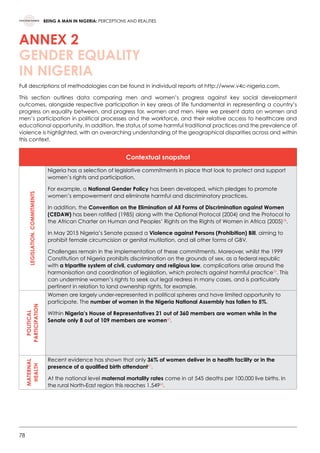
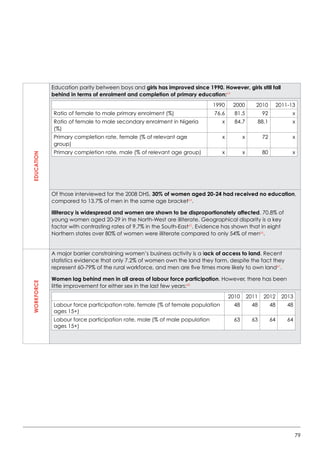
Annex 2 - Gender equality in Nigeria						 78
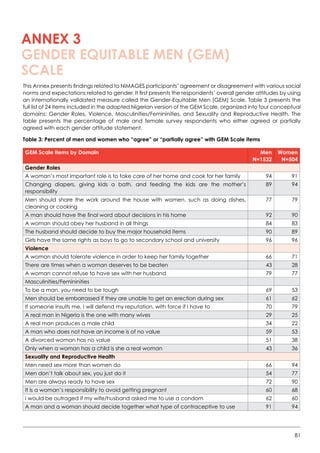
Annex 3 - Gender equitable men (GEM) scale				 81
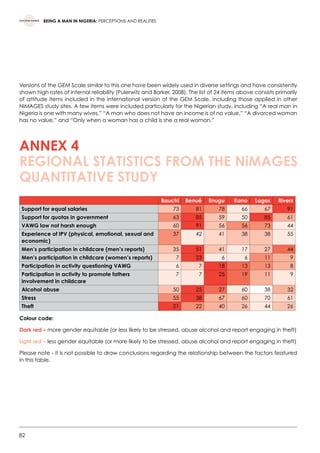
Annex 4 - Regional statistics from the NiMAGES quantitative study		 82
References									 83
Contents
4
BEING A MAN IN NIGERIA: PERCEPTIONS AND REALITIES
ABOUT VOICES 4 CHANGE
Voices 4 Change programme (V4C) Nigeria aims to strengthen the enabling environment for the
empowerment of adolescent girls and women in Nigeria. Funded by the UK’s Department for International
Development (DFID) and managed by a Palladium-led consortium, the programme is targeted at adolescent
girls and women and those around them, particularly boys, men and traditional and religious formal and
informal institutions. The goal of working with these stakeholders and institutions is to facilitate a desired shift
in negative and stereotypical attitudes and behaviours towards girls and women, and create an enabling
environment for positive gender relations and peaceful co-existence.  
The programme has five complimentary outputs:
Output 1
Work with adolescent girls and women to improve life skills, building networks, campaigning to promote
positive social norms;
Output 2
Use of traditional and new media to promote positive social norms and challenge discrimination;
Output 3
Work with key influencers (religious and traditional leaders and institutions) and men and boys to
promote positive gender norms;
Output 4
Target and work with political and legal institutions to inform policy change and implementation related
to gender equality and women’s empowerment;
Output 5
Generating research and evidence for informed planning, programming and policy engagements to
contribute to the goal of gender equality and women’s empowerment (GEWE).
5
ACKNOWLEDGEMENTS
V4C staff and management would like to thank DFID for providing the funds to conduct this Landmark Research
Report (LRR). We appreciate the technical guidance and support provided by Senior Social Development
Adviser, DFID, Simon Narbeth.
Firstly, we want to thank all the research participants and team that worked on the NiMAGES study: TNS RMS,
who worked with us to refine the IMAGES tools, collected and analysed the data  across the six states; Promundo
who allowed us to adapt and use the IMAGES standard tool and also provided the needed technical support;
Ruti Levtov and Brian Heilman for helping to review and finalize the report.
Secondly, we acknowledge the support of our partners in Kaduna and Lagos and the consultants Lanre
Arogundade and Sofia Santos who worked on the Media and Masculinity study.  Their hard work enabled us
to produce a report that will not only be useful in shaping media content in Nigeria, but help garner support
for institutional and capacity building for media practitioners, so they can enhance their understanding and
mainstreaming of masculinity and gender equality into their programmes.
Thirdly, the team from Christian Aid, Islamic Relief, Okekearu Ifeanyi, Ezra Chitando and all the religious leaders/
teachers and their congregations who facilitated and took part in the Religious and Masculinity study. We are
hopeful that the study will support a process of reflection and change needed in these religious institutions.
Fourthly, the team from the Nigeria Stability and Reconciliation Programme (NSRP) - Priscilla Ankut and Habiba
Makanjuola and Social Development Direct (SDD), especially Chitra Nagarajan, who led the Conflict and
Masculinity study. Their information and perception helped us see the intersection between masculinity,
conflict and violence and how they could be addressed.   
We especially appreciate the following groups and individuals who provided technical insights, reviews
and oversights for the studies; the Research Advisory Group (RAG) – with members drawn from government
agencies, the United Nations, academia, civil society groups, women’s groups and media – and the staff of
Social Development Direct, especially Sue Philips (Technical Director). We would also like to thank Philly Desai
V4C Social norms Adviser, and Patrick Welsh from Sonke Gender Justice. In addition, huge thanks to the team
that worked on the production of the report; Emma Bell, Munirat Ogunlayi, Jo Feather and Patience Ekeoba
for effectively pulling the reports together into one single narrative, the reviewers Michael Kaufman, Rachel
Marcus and Saudatu Mahdi. The graphic designer, photographer and printer who provided excellent design  
and well considered frame, layout and presentation format.
Internally, the LRR would not have been possible without the expert management of the V4C staff, especially
its Technical Director, Catherine Gaynor; Team Leader Caroline Enye and Deputy Team Leader Dr. Munirat
Ogunlayi. Their rigorous technical and administrative support gave wings to the planning and delivery of the
various research products and the final report.
Last but by no means least, are V4C’s Research and Evidence critical friends - Jo Feather and Samuel Oruruo,
who worked very closely with me and the researchers throughout the life cycle of the reports. Their contributions
greatly facilitated the effective coordination of the individual studies and the delivery of the LRR.  
Patience Ekeoba
Lead, Research and Evidence Output
Voices 4 Change programme
6
BEING A MAN IN NIGERIA: PERCEPTIONS AND REALITIES
LIST OF ACRONYMS
Acronym	 Meaning
CAN		 Christian Association of Nigeria
CDC		 Community Development Committees
CEDAW 	 Convention on the Elimination of All Forms of Discrimination against Women
CBO	 	 Community – based Organisation
GBV		 Gender Based Violence
GEM		 Gender Equitable Men (Scale)
FGD	 	 Focus Group Discussions
FGM/C		 Femal Genital Mutilation/Cutting
FCT	 	 The Federal Capital Territory
IDI		 In-depth Interviews
NiMAGES 	 Nigerian Men and Gender Equality Survey
IPV		 Intimate Partner Violence
JAS	 	 Jama’atu Ahli Sunnah Lidda’awati Wal-Jihad
LGA		 Local Government Area
NGO		 Non-governmental Organisation
OECD		 The Organisation for Economic Co-operation and Development
PBUH 	 	 Peace be Upon Him
SIGI		 Social Institutions and Gender Index
VAWG 		 Violence Against Women and Girls
V4C		 Voices 4 Change
7
Glossary
Masculinity (also called manliness or manhood) is a set of attributes, behaviours and roles generally
associated with boys and men. It is a combination of socially defined and biological factors. Masculine
traits include courage, independence and assertiveness. These traits vary by location and context, and are
influenced by social and cultural factors.1
Femininity (also called girlishness, womanliness or womanhood) is a set of attributes, behaviours, and roles
generally associated with girls and women. Femininity is often perceived as a social construct, combining
socially defined and biologically created factors. This makes it distinct from the definition of the biological
female sex as both men and women can exhibit feminine traits.2
Gender equality is the absence of discrimination on the basis of a person’s sex in opportunities and the equal
allocation of resources or benefits or in access to services.3
Gender equity entails the provision of fairness and justice in the distribution of benefits and responsibilities
between women and men. The concept recognises that women and men have different needs and power
and that these differences should be identified and addressed in a manner that rectifies the imbalances
between the sexes.4
Social norms are cultural products including values, customs, and traditions that represent individuals’ basic
knowledge of what others do and what others think they should do.5
Female genital mutilation/cutting (FGM/C): female genital mutilation for non - medical reasons, usually at
an early age. Mutilation ranges from partial to total, and includes the removal of genital organs, stitching for
cultural or other non-treatment reasons and is usually practiced several times through life (after birth or if the
girl/woman is the victim of sexual assault).6
Wife/Widow inheritance, also known as bride inheritance, is a cultural and social practice whereby a widow
is required to marry a kinsman of her late husband, often his brother. Examples of widow inheritance can be
found in ancient and biblical times in the form of levirate marriage.7
Intimate partner violence (IPV) includes acts of physical aggression, psychological abuse, forced intercourse
and other forms of sexual coercion, and various controlling behaviours such as isolating a person from family
and friends or restricting access to information and assistance.8
Gender equality
8
BEING A MAN IN NIGERIA: PERCEPTIONS AND REALITIES
Emotional IPV includes behaviour and action that deliberately insults, offends, upsets, belittles, intimidates
and/or humiliates a partner directly, or indirectly by hurting people their partner cares about, or damaging
things of importance or significance to them.9
Economic IPV includes behaviour and action that prohibits a partner from getting a job, going to work,
trading or earning money. Economic violence may also include taking a partner’s money against their
will or utilising limited resources for personal gain by purchasing items in conflict to required and necessary
household items.10
Physical IPV includes actual or threatened behaviour and action that physically hurts a partner, including
the use of weapons, slapping, throwing objects, pushing, hitting, burning and choking.11
Sexual violence: can be divided into three categories: (1) the use of physical force to compel a person to
engage in a sexual act unwillingly, whether or not the act is completed; (2) an attempted or completed
sexual act involving a person who, because of illness, disability, or the influence of alcohol or other drugs,
or because of intimidation or pressure, is unable to understand the nature or condition of the act, decline
participation, or communicate unwillingness to engage in the act; and (3) abusive sexual contact.
Violence against women and girls (VAWG) defined as ‘any act of gender-based violence that results in or
is likely to result in physical, sexual, psychological harm or suffering to women, including threats of such acts,
coercion or arbitrary deprivation of liberty, whether occurring in public or in private life’. (UN declaration on
the Elimination of Violence Against Women, 1993)
Gender-based violence (GBV): “physical, mental, or social abuse that is directed against a person because
of his or her gender or gender role in a society or culture. In these cases, a person has no choice to refuse
or pursue other options without severe social, physical, or psychological consequences”12
. GBV is any act…
that results in, or is likely to result in physical, sexual or psychological harm or suffering to women, including
threats of such acts, coercion or arbitrary deprivation of liberty, whether occurring in public or in private life.13
Child Marriage: Nigeria Child Act 2007, defines a child as one who is below the age of eighteen years.
Therefore, early marriage is defined as marriage to a child and in this case the consent of the child is not
considered.
Wife hospitality:
Violence against women/girls
9
EXECUTIVE SUMMARY
Understanding men’s attitudes and practices to family, community life
and relationships is crucial to improving and encouraging more equitable
relationships between men and women.
The Voices 4 Change programme in Nigeria contributes to growing national and global interest in better
understanding of men’s attitudes, by providing innovative research and evidence to support debate and
policy change and guide effective programme intervention.
The report is a synthesis of five studies – four qualitative and one quantitative – exploring how the culture
of masculinity impacts on the way women are viewed and treated by men – and how women themselves
regard the opposite sex.
Key findings of the studies, conducted in selected states in six geographical regions of Nigeria:
Overall findings
•	 Traditional gender attitudes and behavior may be changing in Nigeria as evidenced by responses
garnered during the studies.
•	 At the broadest level, widely held ideas about masculinity and femininity are powerful “root causes” of
gender inequality and violence against women in all its forms.  
•	 Gender equitable and non-violent masculinities can bring important benefits to men and women alike,
for example; better relationships, less stress, happier children, and future generations who reject violence
against women and children in all forms.  
•	 Positive, non-violent role models and education for men and boys (as well as women and girls) help
ensure better gender equitable attitudes and behaviours. If these behaviours are inculcated in childhood
and young adulthood, they last into adult life with family and possibly community-wide benefits.
•	 Rigid gender stereotypes of men and women create individual tensions, which find expression through
negative social vices and interpersonal conflict and violence.
Lessons for engaging men and women to improve gender equity
Perceptions of men’s and women’s behaviour:
•	 The majority of respondents in all five studies still believe men should be tough, intelligent, fearless and
responsible – though women are largely regarded by men and women as being led by their emotions,
making them weaker and more vulnerable than men.
Roles of men and women in the household:
•	Household decision-making dynamics are still often highly skewed in favour of men, but may gradually
be changing.
•	Participants overwhelmingly stated that it is a man’s role to provide economically for the family. However,
women’s increasing presence in the labour market is recognised as important for supporting their families
and men in their role as providers.
•	Many men participate in household work which seems to be largely supported by participants and
religious authorities. However, the tasks men report participating in the most are traditionally associated
with male heads of household, such as paying bills and repairing the house.
10
BEING A MAN IN NIGERIA: PERCEPTIONS AND REALITIES
•	Men’s involvement in parenting is still limited, but men with the most gender equitable attitudes reported
contributing more. Women and men in the study agreed that most men tend to play with their children
or discipline them on a regular basis, but not contribute consistently to childcare in other ways.
Traditional practices and violence against women:
•	Respondents in Nigeria overwhelmingly reject many traditional practices, including FGM, wife inheritance,
harmful widowhood practices and wife hospitality. Similarly, only about one third of respondents agreed
that early marriage “is important and should remain,” with women more likely to hold this view than men.
The education of girls is almost universally supported.
• Violence against women and girls is widely tolerated.
Over two thirds of all respondents agreed that “A woman should tolerate
violence to keep her family together”.
•	The prevalence of economic, emotional and physical intimate partner violence among participants is
very high. Men with the most gender-inequitable attitudes, older, informally employed and less educated
men, were more likely to report perpetrating violence against a partner.
Leadership:
•	There are contradictions in the views about women as leaders and the tendency to view men as ‘natural’
leaders instead of women. Although most men (and women) believe that women can be equally effective
leaders, male and female participants of group discussions displayed largely discriminatory views. For
example, considering women too emotional to lead.
Factors influencing masculinities:
•	Both Islamic and Christian religious teachings support gender equity and justice, although in practice
interpretations appear contradictory.
•	Dominant ideals of masculinity and femininity set standards that are difficult to reach, particularly in insecure
environments that can engender violence, greater insecurity, economic decline, high unemployment,
inequality and changed gender realities.
•	 Nigerian media promotes stereotypical ideas of men and women.
•	Children raised in non-violent homes are more likely to be peaceful, compared to those who witness and
experience physical, emotional and sexual violence in their homes and schools. Roughly three in four
respondents report being threatened with physical punishment in their childhood homes.
Impacts of masculinities:
•	 Men report high rates of low-self-esteem, work-related stress and alcohol abuse.
•	Widely held ideas about masculinity and femininity are powerful “root causes” of gender inequity and
violence against women and in the community.
Practising and promoting gender equitable attitudes and behaviours:
•	 There are concrete examples of individuals and communities in all states trying to promote gender
equitable masculinities and improve the relationship between women and men in the household and in
the community.
11
Recommendations
The following recommendations are designed for Nigerian activists, policymakers, researchers, religious
leaders and others working at programme, policy or research levels to adapt and expand their work with
men, boys, women and girls and Nigerian communities to advance a thriving, equitable gender-just future
for all.  
At Programme level:
1.	Prioritise promotion of community-level awareness through education and campaigns to address
prevailing social norms around violence, decision-making, leadership and undue expectations of male
identity and relationships.
2.	Increase capacity building of, and collaboration between, educational institutions, the media (and its
regulatory agencies), independent community–based organisations (CBOs) for youth, women and peace,
and traditional and religious institutions, to address negative gender social norms.
3.	Support the education system to advance more equitable views of masculinity at all curriculum levels
and address gender inequity, intolerance and perpetration of violence against children in school systems.
4.	Expand and enhance work with young men, including activists, religious and traditional leaders in the
community, who promote and model gender equitable masculine behaviour and popularise religious texts
and books that support equitable access and opportunities for men and women.
5.	Develop and roll-out social and economic activities for young people to address gaps in employment
and others ventures that can enhance wellbeing and reduce restlessness.
6.	Target and dedicate donor funding streams towards addressing underlying discriminatory gender norms.
7.	Promote women in leadership positions and as positive change agents, providing platforms for meaningful
policy influence and role modelling.
At Policy level:
1.	Reform policies and practices of informal and formal institutions to promote and enforce positive equitable
behaviours.  
2.	Establish and implement monitoring and evaluation frameworks and tools to support the effective
mainstreaming of masculinity and gender issues into policies.
3.	Review laws that undermine gender equity and support efforts to enforce existing legislation, for example
the Violence Against Persons Prohibition Law (VAPP) promotes equality of opportunity for both sexes.
4.	Acknowledge and consider the connections between conflict, masculinities, gender inequity and
violence against women, children and in the community.
12
BEING A MAN IN NIGERIA: PERCEPTIONS AND REALITIES
At Research level:
1.	Conduct further research and analysis to unpack the specifics of gender norms in the context of different
ethnicities, religions and regions.
2.	Explore links between gender equitable attitudes and behaviours, stress, relationship satisfaction and
community violence, alcohol abuse and childhood experience of violence. Undertake supplementary
qualitative research to explore the nature of these links.
3.	Undertake further studies to gain additional evidence where grey areas and contradictions exist, especially
regarding acceptance and support for women’s leadership.
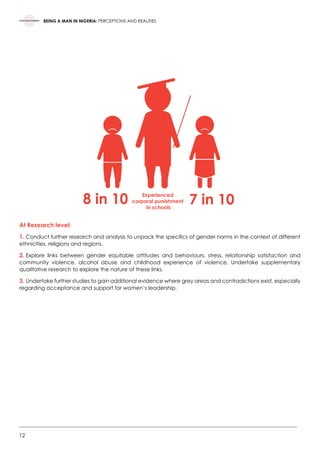
Experienced
corporal punishment
in schools
8 in 10 7 in 10
13
Introduction
Nigeria can improve the wellbeing and social relations of citizens by
addressing deep-rooted negative social norms about men and women.
Creating a new, more equitable culture will take sustained long term action by everyone with an interest
in reaping these rewards. The Organisation for Economic Co-operation and Development (OECD) Social
Institutions and Gender Index (SIGI) categorises Nigeria as highly inequitable (2014)14
. High levels of gender
inequity exist in Nigeria. Women benefit less than men from, and have lower participation rates in the
economy, education, politics, health, access to justice and almost all areas of human development15
.  
Such inequity is partly rooted in patriarchal beliefs and practices that promote the dominance of men - and
subordination of women. It presents a series of social expectations which dictate the qualities, behaviours,
characteristics, needs, and roles for men vis-à-vis women16
and people who contradict expectations are
often criticised and even penalised.
The inequitable ideas that underpin what it means to be a man and a woman in many societies don’t
just impact on women, but have consequences for men, their relationships with women and their families.  
Research consistently shows that men’s behaviour – whether it is related to physical violence (in and outside
the home), domestic work, caregiving, health-seeking behaviours, contraceptive use and HIV and STI
prevention among others - tends to be influenced by their conformity with rigid and/or inequitable social
norms traditionally tied to masculinity17
.  
A major challenge facing Nigeria the African continent, and the global community as a whole, is to dismantle
inequitable social expectations of women and men as well as the injustices that result from them.
Understanding men’s attitudes, their behaviours towards family, relationships and community life, as well as
the underlying factors that prompt and support their dominance over women and girls, is crucial in bringing
about this change.
Notions of masculinity must also be understood in relation to how women are viewed and treated by men
and how women view and treat men and boys so we can encourage gender equitable masculinities and
dismantle gender inequality barriers to accessing opportunities.
For years the lack of rigorous research to help us understand men’s perceptions of these issues has been a
major issue, both in Nigeria and globally.
Voices 4 Change (V4C) programme helps to meet this need by providing research and evidence to foster
public debate and policy change on these issues. This report combines the findings of five research studies
to shift the debate, attitudes and behaviours towards masculinity, femininity and gender equality in Nigeria.
The five studies, and six briefs which draw on their evidence, are available for further reading at http://www.
v4c-nigeria.com and include:
Two studies (quantitative and qualitative) using the Nigerian Men and Gender Equality Survey (NiMAGES)
- NiMAGES is a large composite report, carried out through in-depth individual surveys focusing on ideas
about masculinity and femininity, gender inequality, women in leadership, women in decision-making and
violence against women and girls in six states18
in the six geo-political zones of Nigeria.   
The Masculinity and Conflict study examines connections between masculinities, conflict and violence in
four states19
in Nigeria.
The Masculinity and Religion study explores the influence of Islam and Christianity on masculinities in five states20
.
14
BEING A MAN IN NIGERIA: PERCEPTIONS AND REALITIES
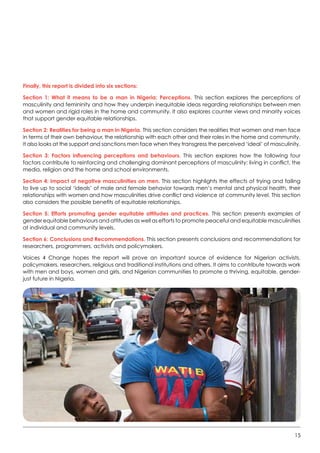
The Masculinity and Media study examines how mass media
presents and shapes perception and behaviour of men, boys,
women and girls drawing on media content analysis and interviews
in three states21
.  
The Landmark Research Report (LRR) combines these studies into
one narrative. It explores the connections between masculinities
and femininities as they are experienced in Nigeria and how this
impacts on men and women, their families and communities.
It argues that when women and men equally participate in
decision-making, leadership and other roles and responsibilities,
and have equal access and opportunities in areas of life such as
the home and community, it provides benefits for everyone.
However, achieving gender equitable masculinities and equality
of opportunity in Nigeria are hindered by widespread insecurity,
unemployment and inequality as well as current widespread
support for male dominance over women.  Shifting such dynamics
requires recognition and support for everyday individual efforts as
well as community and nationwide initiatives and commitments.   
This report is the first of its kind to look at men and masculinities
in Nigeria from different perspectives. More than 2,500 Nigerian
men and women participated in the studies conducted in nine
states, from all six geopolitical zones. They shared their opinions on
how men and women should behave, the roles they should play
in the home and the community and the relationships between
them. Participants also discussed how roles and relationships are
lived out in practice as well as how key influencing factors such
as religion, media, conflict, the home and school environment
may drive, undermine and challenge these ideas and related
behaviours.
Participants were also encouraged to consider the impact
of their ideas on men, their relationship with women and their
families and communities. Importantly, men and woman gave
examples where men have made concerted efforts to promote
more peaceful and equitable relations within households and
communities. Socio-demographic characteristics of the studies
included regional, religious, sex and age differences.   
As well as drawing on the five studies, we explore further recent
and relevant data to strengthen key points as appropriate.  
The specific objectives of the
research studies were to:
Explore how perceptions of
masculinity (and stereotypes) hinder
progress towards gender equity /
social justice, especially in relation
to women’s roles in decision-making
and leadership.
Ascertain how these notions
/ perceptions of masculinity
contribute to unequal power
relationships, violence against
women and girls, including harmful
traditional practices.
Establish how the following
factors contribute to reinforcing
gender inequible perceptions
of masculinity: living in conflict
situations, influence of the media
and religious influences.
Explore how these factors support
gender equitable notions of
masculinity including identifying
positive deviants and case studies.
Explore opportunities and barriers
to changing practices of formal
and informal institutions e.g. family,
media, religions that re-inforce
these notions of masculinity.
15
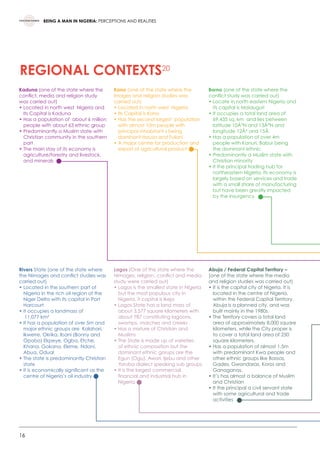
Finally, this report is divided into six sections:
Section 1: What it means to be a man in Nigeria: Perceptions. This section explores the perceptions of
masculinity and femininity and how they underpin inequitable ideas regarding relationships between men
and women and rigid roles in the home and community. It also explores counter views and minority voices
that support gender equitable relationships.
Section 2: Realities for being a man in Nigeria. This section considers the realities that women and men face
in terms of their own behaviour, the relationship with each other and their roles in the home and community.
It also looks at the support and sanctions men face when they transgress the perceived ‘ideal’ of masculinity.     
Section 3: Factors influencing perceptions and behaviours. This section explores how the following four
factors contribute to reinforcing and challenging dominant perceptions of masculinity: living in conflict, the
media, religion and the home and school environments.
Section 4: Impact of negative masculinities on men. This section highlights the effects of trying and failing
to live up to social ‘ideals’ of male and female behavior towards men’s mental and physical health, their
relationships with women and how masculinities drive conflict and violence at community level. This section
also considers the possible benefits of equitable relationships.
Section 5: Efforts promoting gender equitable attitudes and practices. This section presents examples of
gender equitable behaviours and attitudes as well as efforts to promote peaceful and equitable masculinities
at individual and community levels.   
Section 6: Conclusions and Recommendations. This section presents conclusions and recommendations for
researchers, programmers, activists and policymakers.
Voices 4 Change hopes the report will prove an important source of evidence for Nigerian activists,
policymakers, researchers, religious and traditional institutions and others. It aims to contribute towards work
with men and boys, women and girls, and Nigerian communities to promote a thriving, equitable, gender-
just future in Nigeria.
16
BEING A MAN IN NIGERIA: PERCEPTIONS AND REALITIES
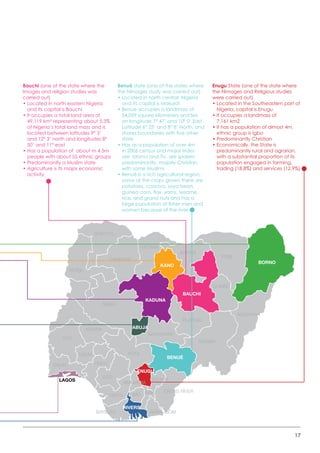
REGIONAL CONTEXTS20
Kaduna (one of the state where the
conflict, media and religion study
was carried out)
• Located in north west  Nigeria and
Its Capital is Kaduna
• Has a population of  about 6 million
people with about 63 ethnic group
• Predominantly a Muslim state with  
Christian community in the southern
part
• The main stay of its economy is
agriculture/forestry and livestock,
and minerals
Kano (one of the state where the
Images and religion studies was
carried out)
• Located in north west  Nigeria
• Its Capital is Kano
• Has the second largest  population
with almost 10m people with
principal inhabitant s being
dominant Hausa and Fulani
• A major centre for production and
export of agricultural product
Borno (one of the state where the
conflict study was carried out)
• Locate in north eastern Nigeria and
its capital is Maiduguri
• It occupies a total land area of
69,435 sq. km  and lies between
latitude 10°N and 13°N and
longitude 12° and 15Â
• Has a population of over 4m
people with Kanuri, Babur being
the dominant ethnic
• Predominantly a Muslim state with
Christian minority
• It the principal trading hub for
northeastern Nigeria. Its economy is
largely based on services and trade
with a small share of manufacturing
but have been greatly impacted
by the insurgency
Rivers State (one of the state where
the Nimages and conflict studies was
carried out)
• Located in the southern part of
Nigeria in the rich oil region of the
Niger Delta with its capital in Port
Harcourt
• It occupies a landmass of
11,077 km²
• It has a population of over 5m and
major ethnic groups are  Kalahari,
lkwerre, Okrika, lbani (Bonny and
Opobo) Ekpeye, Ogba, Etche,
Khana, Gokana, Eleme, Ndoni,
Abua, Odual
• The state is predominantly Christian
state
• It is economically significant as the
centre of Nigeria’s oil industry
Lagos (One of the state where the
Nimages, religion, conflict and media
study were carried out)
• Lagos is the smallest state in Nigeria
but the most populous city in
Nigeria, it capital is Ikeja 
• Lagos State has a land mass of
about 3,577 square kilometers with
about 787 constituting lagoons,
swamps, marches and creeks 
• Has a mixture of Christian and
Muslims 
• The State is made up of varieties
of ethnic composition but the
dominant ethnic gorups are the
Egun (Ogu), Awori, Ijebu and other
Yoruba dialect speaking sub groups 
• It is the largest commercial,
financial and industrial hub in
Nigeria
Abuja / Federal Capital Territory –
(one of the state where the media
and religion studies was carried out)
• It is the capital city of Nigeria. It is
located in the centre of Nigeria,
within the Federal Capital Territory.
Abuja is a planned city, and was
built mainly in the 1980s.
• The Territory covers a total land
area of approximately 8,000 square
kilometers, while the City proper is
to cover a total land area of 250
square kilometers.
• Has a population of almost 1.5m
with predominant Kwa people and  
other ethnic groups like Bassas,
Gades, Gwandaras, Koros and
Ganaganas,
• It’s has almost a balance of Muslim
and Christian
• It the principal a civil servant state
with some agricultural and trade
activities
17
BORNO
YOBE
JIGAWA
KANO
GOMBE
ADAMAWA
TARABA
PLATEAU
BAUCHI
KADUNA
ABUJA
KOGI
NASARAWA
ENUGU
ANAMBRA
BENUÉ
CROSS RIVER
BAYELSA
IMO
ABIA
EBONYI
RIVERS
AKWA-IBOM
KATSINA
ZAMFARA
SOKOTO
KEBBI
NIGER
KWARA
OYO
OGUN
LAGOS
OSUN
ONDO
EDO
DELTA
Bauchi (one of the state where the
Images and religion studies was
carried out)
• Located in north eastern Nigeria
and its capital is Bauchi
• It occupies a total land area of
49,119 km² representing about 5.3%
of Nigeria’s total land mass and is
located between latitudes 9° 3’
and 12° 3’ north and longitudes 8°
50’ and 11° east
• Has a population of  about m 4.5m
people with about 55 ethnic groups
• Predominantly a Muslim state
• Agriculture is its major economic
activity
Benué state (one of the states where
the Nimages study was carried out)
• Located in north central  Nigeria
and its capital is Makurdi
• Benue occupies a landmass of
34,059 square kilometers and lies
on longitude 7° 47’ and 10° 0’ East.
Latitude 6° 25’ and 8° 8’ North; and
shares boundaries with five other
state
• Has as a population of over 4m
in 2006 census and major trides
are  Idoma and Tiv, are spoken
predominantly. majorly Christian
with some Muslims
• Benué is a rich agricultural region;
some of the crops grown there are
potatoes, cassava, soya bean,
guinea corn, flax, yams, sesame,
rice, and grand nuts and has a
large population of fisher men and
women because of the river
Enugu State (one of the state where
the Nimages and Religious studies
were carried out)
• Located in the Southeastern part of
Nigeria, capital is Enugu
• It occupies a landmass of
7,161 km2
• It has a population of almost 4m,
ethnic group is Igbo
• Predominantly Christian
• Economically, the State is
predominantly rural and agrarian,
with a substantial proportion of its
population engaged in farming,
trading (18.8%) and services (12.9%)
18
BEING A MAN IN NIGERIA: PERCEPTIONS AND REALITIES
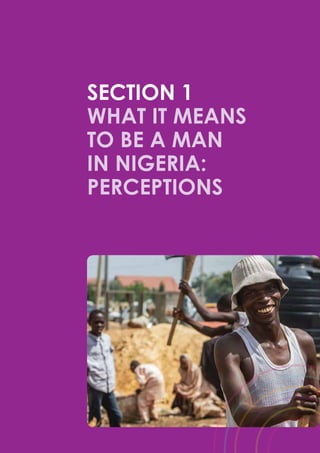
SECTION 1
What it means
to be a man
in Nigeria:
perceptions
19
SECTION 1
This section focuses on perceptions of what it means to be a man or a woman in Nigeria. It also covers
the extent to which different facets of dominant stereotypes are subscribed to, and how they underpin
perceptions of men and women’s roles and relationships. Ideas regarding men and women and their roles in
society are not necessarily fixed or universal, and to some degree have adapted to accommodate changes
in women and men’s behaviour. In Nigeria there are significant minority (and on some issues majority) voices
that do not subscribe to the dominant cultural ‘ideal’. Differences in perceptions between regional, religious,
gender, and age differences are discussed, where possible, throughout the report.
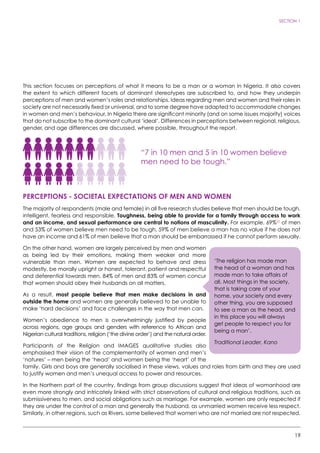
“7 in 10 men and 5 in 10 women believe
men need to be tough.”
PERCEPTIONS - SOCIETAL EXPECTATIONS OF MEN AND WOMEN
The majority of respondents (male and female) in all five research studies believe that men should be tough,
intelligent, fearless and responsible. Toughness, being able to provide for a family through access to work
and an income, and sexual performance are central to notions of masculinity. For example, 69%22
of men
and 53% of women believe men need to be tough, 59% of men believe a man has no value if he does not
have an income and 61% of men believe that a man should be embarrassed if he cannot perform sexually.
On the other hand, women are largely perceived by men and women
as being led by their emotions, making them weaker and more
vulnerable than men. Women are expected to behave and dress
modestly, be morally upright or honest, tolerant, patient and respectful
and deferential towards men. 84% of men and 83% of women concur
that women should obey their husbands on all matters.
As a result, most people believe that men make decisions in and
outside the home and women are generally believed to be unable to
make ‘hard decisions’ and face challenges in the way that men can.
Women’s obedience to men is overwhelmingly justified by people
across regions, age groups and genders with reference to African and
Nigerian cultural traditions, religion (‘the divine order’) and the natural order.
Participants of the Religion and IMAGES qualitative studies also
emphasised their vision of the complementarity of women and men’s
‘natures’ – men being the ‘head’ and women being the ‘heart’ of the
family. Girls and boys are generally socialised in these views, values and roles from birth and they are used
to justify women and men’s unequal access to power and resources.
In the Northern part of the country, findings from group discussions suggest that ideas of womanhood are
even more strongly and intricately linked with strict observations of cultural and religious traditions, such as
submissiveness to men, and social obligations such as marriage. For example, women are only respected if
they are under the control of a man and generally the husband, as unmarried women receive less respect.
Similarly, in other regions, such as Rivers, some believed that women who are not married are not respected.
‘The religion has made man
the head of a woman and has
made man to take affairs of
all. Most things in the society,
that is taking care of your
home, your society and every
other thing, you are supposed
to see a man as the head, and
in this place you will always
get people to respect you for
being a man’.
Traditional Leader, Kano
20
BEING A MAN IN NIGERIA: PERCEPTIONS AND REALITIES
These traditional ideas about men and women’s roles in the home and community will be further explored
in subsequent sections. However, we must note significant expressions of counter views to the dominant idea
of women’s vulnerability and weakness in comparison to men’s strength. Even though nearly all women and
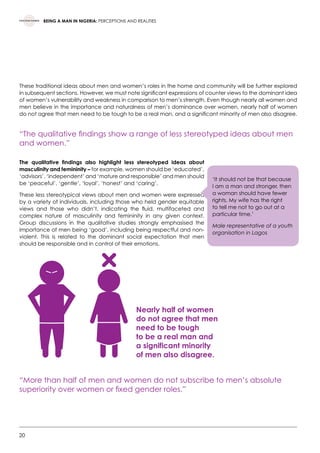
men believe in the importance and naturalness of men’s dominance over women, nearly half of women
do not agree that men need to be tough to be a real man, and a significant minority of men also disagree.
“The qualitative findings show a range of less stereotyped ideas about men
and women.”
The qualitative findings also highlight less stereotyped ideas about
masculinity and femininity – for example, women should be ‘educated’,
‘advisors’, ‘independent’ and ‘mature and responsible’ and men should
be ‘peaceful’, ‘gentle’, ‘loyal’, ‘honest’ and ‘caring’.
These less stereotypical views about men and women were expressed
by a variety of individuals, including those who held gender equitable
views and those who didn’t, indicating the fluid, multifaceted and
complex nature of masculinity and femininity in any given context.
Group discussions in the qualitative studies strongly emphasised the
importance of men being ‘good’, including being respectful and non-
violent. This is related to the dominant social expectation that men
should be responsible and in control of their emotions.
“More than half of men and women do not subscribe to men’s absolute
superiority over women or fixed gender roles.”
Nearly half of women
do not agree that men
need to be tough
to be a real man and
a significant minority
of men also disagree.
‘It should not be that because
I am a man and stronger, then
a woman should have fewer
rights. My wife has the right
to tell me not to go out at a
particular time.’
Male representative of a youth
organisation in Lagos
21
SECTION 1
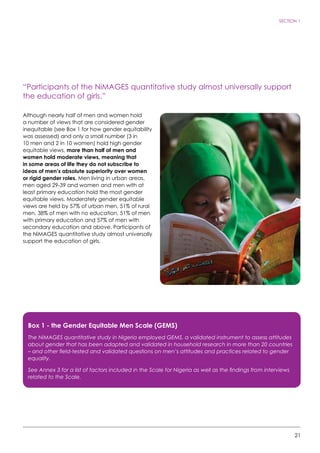
“Participants of the NiMAGES quantitative study almost universally support
the education of girls.”
Although nearly half of men and women hold
a number of views that are considered gender
inequitable (see Box 1 for how gender equitability
was assessed) and only a small number (3 in
10 men and 2 in 10 women) hold high gender
equitable views, more than half of men and
women hold moderate views, meaning that
in some areas of life they do not subscribe to
ideas of men’s absolute superiority over women
or rigid gender roles. Men living in urban areas,
men aged 29-39 and women and men with at
least primary education hold the most gender
equitable views. Moderately gender equitable
views are held by 57% of urban men, 51% of rural
men, 38% of men with no education, 51% of men
with primary education and 57% of men with
secondary education and above. Participants of
the NiMAGES quantitative study almost universally
support the education of girls.
Box 1 - the Gender Equitable Men Scale (GEMS)
The NiMAGES quantitative study in Nigeria employed GEMS, a validated instrument to assess attitudes
about gender that has been adapted and validated in household research in more than 20 countries
– and other field-tested and validated questions on men’s attitudes and practices related to gender
equality.
See Annex 3 for a list of factors included in the Scale for Nigeria as well as the findings from interviews
related to the Scale.
22
BEING A MAN IN NIGERIA: PERCEPTIONS AND REALITIES
“Participants overwhelmingly reject female genital cutting / mutilation, wife
inheritance, harmful widow practices and wife hospitality.”
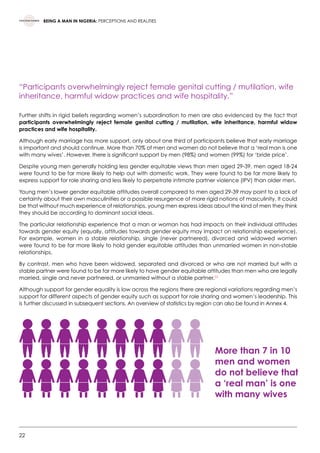
Further shifts in rigid beliefs regarding women’s subordination to men are also evidenced by the fact that
participants overwhelmingly reject female genital cutting / mutilation, wife inheritance, harmful widow
practices and wife hospitality.
Although early marriage has more support, only about one third of participants believe that early marriage
is important and should continue. More than 70% of men and women do not believe that a ‘real man is one
with many wives’. However, there is significant support by men (98%) and women (99%) for ‘bride price’.
Despite young men generally holding less gender equitable views than men aged 29-39, men aged 18-24
were found to be far more likely to help out with domestic work. They were found to be far more likely to
express support for role sharing and less likely to perpetrate intimate partner violence (IPV) than older men.
Young men’s lower gender equitable attitudes overall compared to men aged 29-39 may point to a lack of
certainty about their own masculinities or a possible resurgence of more rigid notions of masculinity. It could
be that without much experience of relationships, young men express ideas about the kind of men they think
they should be according to dominant social ideas.
The particular relationship experience that a man or woman has had impacts on their individual attitudes
towards gender equity (equally, attitudes towards gender equity may impact on relationship experience).
For example, women in a stable relationship, single (never partnered), divorced and widowed women
were found to be far more likely to hold gender equitable attitudes than unmarried women in non-stable
relationships.
By contrast, men who have been widowed, separated and divorced or who are not married but with a
stable partner were found to be far more likely to have gender equitable attitudes than men who are legally
married, single and never partnered, or unmarried without a stable partner.23
Although support for gender equality is low across the regions there are regional variations regarding men’s
support for different aspects of gender equity such as support for role sharing and women’s leadership. This
is further discussed in subsequent sections. An overview of statistics by region can also be found in Annex 4.
More than 7 in 10
men and women
do not believe that
a ‘real man’ is one
with many wives
23
SECTION 1
PERCEPTIONS: Men’s relationship with women.
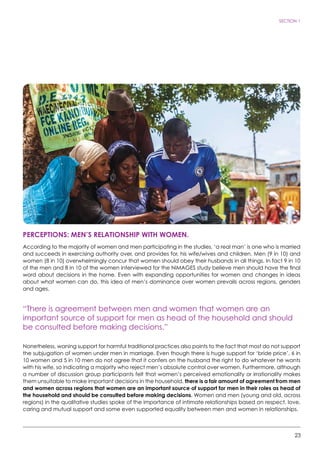
According to the majority of women and men participating in the studies, ‘a real man’ is one who is married
and succeeds in exercising authority over, and provides for, his wife/wives and children. Men (9 in 10) and
women (8 in 10) overwhelmingly concur that women should obey their husbands in all things. In fact 9 in 10
of the men and 8 in 10 of the women interviewed for the NiMAGES study believe men should have the final
word about decisions in the home. Even with expanding opportunities for women and changes in ideas
about what women can do, this idea of men’s dominance over women prevails across regions, genders
and ages.
“There is agreement between men and women that women are an
important source of support for men as head of the household and should
be consulted before making decisions.”
Nonetheless, waning support for harmful traditional practices also points to the fact that most do not support
the subjugation of women under men in marriage. Even though there is huge support for ‘bride price’, 6 in
10 women and 5 in 10 men do not agree that it confers on the husband the right to do whatever he wants
with his wife, so indicating a majority who reject men’s absolute control over women. Furthermore, although
a number of discussion group participants felt that women’s perceived emotionality or irrationality makes
them unsuitable to make important decisions in the household, there is a fair amount of agreement from men
and women across regions that women are an important source of support for men in their roles as head of
the household and should be consulted before making decisions. Women and men (young and old, across
regions) in the qualitative studies spoke of the importance of intimate relationships based on respect, love,
caring and mutual support and some even supported equality between men and women in relationships.
24
BEING A MAN IN NIGERIA: PERCEPTIONS AND REALITIES
“Almost 6 in 10 of men and over 7 in 10 of women do not think physical
violence against women is justified under ANY circumstances.”
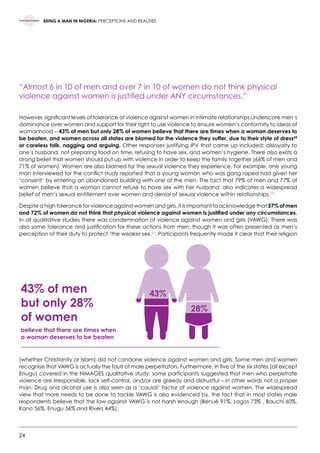
However, significant levels of tolerance of violence against women in intimate relationships underscore men’s
dominance over women and support for their right to use violence to ensure women’s conformity to ideas of
womanhood – 43% of men but only 28% of women believe that there are times when a woman deserves to
be beaten, and women across all states are blamed for the violence they suffer, due to their style of dress24
or careless talk, nagging and arguing. Other responses justifying IPV that came up included: disloyalty to
one’s husband, not preparing food on time, refusing to have sex, and women’s hygiene. There also exists a
strong belief that women should put up with violence in order to keep the family together (66% of men and
71% of women). Women are also blamed for the sexual violence they experience. For example, one young
man interviewed for the conflict study reported that a young woman who was gang raped had given her
‘consent’ by entering an abandoned building with one of the men. The fact that 79% of men and 77% of
women believe that a woman cannot refuse to have sex with her husband, also indicates a widespread
belief of men’s sexual entitlement over women and denial of sexual violence within relationships.24
Despite a high tolerance for violence against women and girls, it is important to acknowledge that 57% of men
and 72% of women do not think that physical violence against women is justified under any circumstances.
In all qualitative studies there was condemnation of violence against women and girls (VAWG). There was
also some tolerance and justification for these actions from men, though it was often presented as men’s
perception of their duty to protect ‘the weaker sex.25
. Participants frequently made it clear that their religion
(whether Christianity or Islam) did not condone violence against women and girls. Some men and women
recognise that VAWG is actually the fault of male perpetrators. Furthermore, in five of the six states (all except
Enugu) covered in the NiMAGES qualitative study, some participants suggested that men who perpetrate
violence are irresponsible, lack self-control, and/or are greedy and distrustful – in other words not a proper
man. Drug and alcohol use is also seen as a ‘causal’ factor of violence against women. The widespread
view that more needs to be done to tackle VAWG is also evidenced by, the fact that in most states male
respondents believe that the law against VAWG is not harsh enough (Benué 91%, Lagos 73% , Bauchi 60%,
Kano 56%, Enugu 56% and Rivers 44%).
43% of men
but only 28%
of women
believe that there are times when
a woman deserves to be beaten
43%
28%
25
SECTION 1
PERCEPTIONS - DIVISION OF RESPONSIBILITY AND LABOUR IN THE HOUSEHOLD
Both women and men across regions subscribe to rigid ideas of gender
roles in the home. Nearly all men and women (over 9 in 10 women and
men) believe that a woman’s most important role is to take care of her
home and family. Because of men’s perceived strength, resilience and
intelligence they are considered best placed to provide for the family.
More than half of men and women (59% of men and 53% of women)
believe that a man who does not have an income is of no value. Men
are also expected to provide security and protection for the family,
maintain the family’s reputation and guide other family members
on the ‘right’ path in life, particularly given (the) levels of crime and
conflict across Nigeria. Women are rarely perceived to be leaders in
the home and perceptions of women and restrictions on their mobility,
especially in Northern States, makes it difficult for them to have a role
in economic life.
“There is a difference of opinion about whether women or men should
be more responsible for maintaining the reputation of the family.”
There is, however, a difference of opinion regarding whether women or men are more responsible for
maintaining the reputation of the family. Conforming to socially dominant ideas of how women and men
should behave is key to ensuring a family’s reputation. In this sense both men and women are responsible.
The man as the head of the family has overall responsibility but women are vital in the socialisation of
children, as well as their care of the home in ensuring a family’s reputation. Women are seen as the moral
guardians and if they violate any rules they risk undermining the head of the family’s standing in the family
and community. The qualitative studies clearly show that women are often blamed for the bad behaviour
of young people if they are not at home to care for their children.
‘When a woman nags too
much…even if the man does
not mean it, he might slap you
and later apologize. The way
you talk and present issues at
times, you should be able to
co-ordinate yourself and know
when to talk.’
Young man, Rivers discussing
women’s behaviour
‘Maybe because of my
upbringing, I was taught that
a man that commits physical
violence against a woman is
a coward, I don’t do it maybe
because of my religion. I didn’t
see much of that when I was
growing up, so I don’t really
believe in it. It wasn’t normal
for me because I’ve not seen it
happen’.
Male, Lagos State
26
BEING A MAN IN NIGERIA: PERCEPTIONS AND REALITIES
There may be a process of social transformation at work regarding
perceptions of men and women’s roles and contributions to the family,
in relation to changing economic realities. For example, younger men,
both Christian and Muslim participating in the Religion study, believed
that women and men could perform the same roles. Older men, both
Christian and Muslim, were in support of sharing roles with women, but
stressed that women need to be submissive to, and have respect for men.
In the Conflict and Religion studies participants recognised that women’s
increasing presence in the labour market is an important way for them
to support men in their role as providers. However, most men believed
that women should seek permission from the man and not supplant
men in their role as head of the household and main provider of the
family. Concern was expressed by some men and women that if women
worked their children would be more likely to get into trouble. Nonetheless, some men in group discussions
expressed unconditional support for women’s economic independence.
“The fact that women are working more is seen as important to support men
in their role as ‘providers.’”
A few men in Rivers State believed that women can use their ‘feminine qualities’ and advantages available
to them to advance more than men in economic life. The statistics for women’s labour participation in
Nigeria (48% as opposed to men’s rate of 64%26
) do not support beliefs that women are advantaged in the
labour market, though this is a source of resentment for some men.
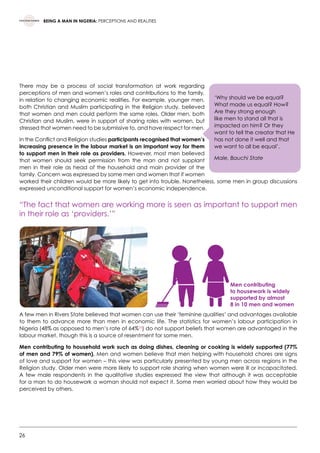
Men contributing to household work such as doing dishes, cleaning or cooking is widely supported (77%
of men and 79% of women). Men and women believe that men helping with household chores are signs
of love and support for women – this view was particularly presented by young men across regions in the
Religion study. Older men were more likely to support role sharing when women were ill or incapacitated.
A few male respondents in the qualitative studies expressed the view that although it was acceptable
for a man to do housework a woman should not expect it. Some men worried about how they would be
perceived by others.
‘Why should we be equal?
What made us equal? How?
Are they strong enough
like men to stand all that is
impacted on him? Or they
want to tell the creator that He
has not done it well and that
we want to all be equal’.
Male, Bauchi State
Men contributing
to housework is widely
supported by almost
8 in 10 men and women
27
SECTION 1
PERCEPTIONS - WOMEN AND MEN’S ROLES IN PUBLIC LIFE
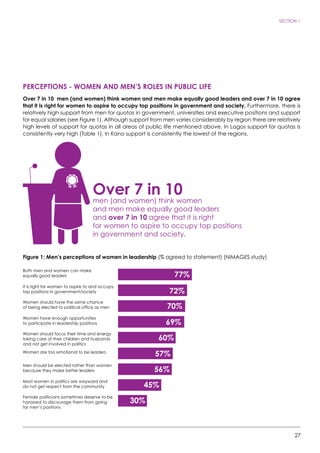
Over 7 in 10 men (and women) think women and men make equally good leaders and over 7 in 10 agree
that it is right for women to aspire to occupy top positions in government and society. Furthermore, there is
relatively high support from men for quotas in government, universities and executive positions and support
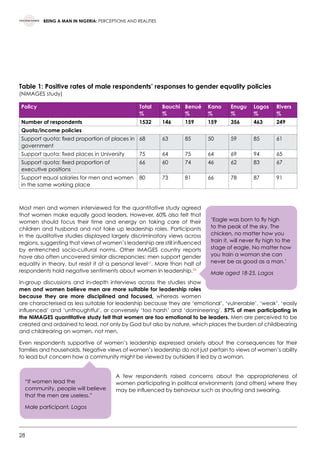
for equal salaries (see Figure 1). Although support from men varies considerably by region there are relatively
high levels of support for quotas in all areas of public life mentioned above. In Lagos support for quotas is
consistently very high (Table 1). In Kano support is consistently the lowest of the regions.
Figure 1: Men’s perceptions of women in leadership (% agreed to statement) (NiMAGES study)
Over 7 in 10
men (and women) think women
and men make equally good leaders
and over 7 in 10 agree that it is right
for women to aspire to occupy top positions
in government and society.
Both men and women can make
equally good leaders
It is right for women to aspire to and occupy
top positions in government/society
Women should have the same chance
of being elected to political office as men
Women have enough opportunities
to participate in leadership positions
Women should focus their time and energy
taking care of their children and husbands
and not get involved in politics
Women are too emotional to be leaders
Men should be elected rather than women
because they make better leaders
Most women in politics are wayward and
do not get respect from the community
Female politicians sometimes deserve to be
harassed to discourage them from going
for men’s positions
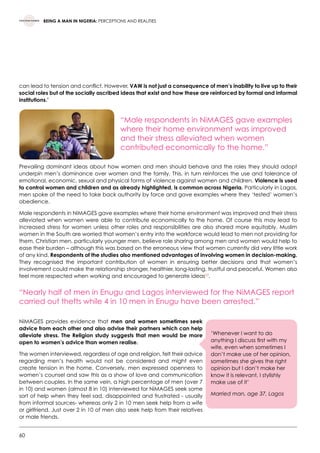
77%
72%
70%
69%
60%
57%
56%
45%
30%
28
BEING A MAN IN NIGERIA: PERCEPTIONS AND REALITIES
Table 1: Positive rates of male respondents’ responses to gender equality policies
(NiMAGES study)
Policy Total
%
Bauchi
%
Benué
%
Kano
%
Enugu
%
Lagos
%
Rivers
%
Number of respondents 1532 146 159 159 356 463 249
Quota/income policies
Support quota: fixed proportion of places in
government
68 63 85 50 59 85 61
Support quota: fixed places in University 75 64 75 64 69 94 65
Support quota: fixed proportion of
executive positions
66 60 74 46 62 83 67
Support equal salaries for men and women
in the same working place
80 73 81 66 78 87 91
Most men and women interviewed for the quantitative study agreed
that women make equally good leaders. However, 60% also felt that
women should focus their time and energy on taking care of their
children and husband and not take up leadership roles. Participants
in the qualitative studies displayed largely discriminatory views across
regions, suggesting that views of women’s leadership are still influenced
by entrenched socio-cultural norms. Other IMAGES country reports
have also often uncovered similar discrepancies: men support gender
equality in theory, but resist it at a personal level27
. More than half of
respondents hold negative sentiments about women in leadership.28
In-group discussions and in-depth interviews across the studies show
men and women believe men are more suitable for leadership roles
because they are more disciplined and focused, whereas women
are characterised as less suitable for leadership because they are ‘emotional’, ‘vulnerable’, ‘weak’, ‘easily
influenced’ and ‘unthoughtful’, or conversely ‘too harsh’ and ‘domineering’. 57% of men participating in
the NiMAGES quantitative study felt that women are too emotional to be leaders. Men are perceived to be
created and ordained to lead, not only by God but also by nature, which places the burden of childbearing
and childrearing on women, not men.
Even respondents supportive of women’s leadership expressed anxiety about the consequences for their
families and households. Negative views of women’s leadership do not just pertain to views of women’s ability
to lead but concern how a community might be viewed by outsiders if led by a woman.
A few respondents raised concerns about the appropriateness of
women participating in political environments (and others) where they
may be influenced by behaviour such as shouting and swearing.
‘Eagle was born to fly high
to the peak of the sky. The
chicken, no matter how you
train it, will never fly high to the
stage of eagle. No matter how
you train a woman she can
never be as good as a man.’
Male aged 18-25, Lagos
“If women lead the
community, people will believe
that the men are useless.”
Male participant, Lagos
29
SECTION 1
However, some male and female respondents did express views that
supported women’s leadership and cited examples of strong women
leaders and role models such as the President of Liberia, Ellen Sirleaf
Johnson, the former President of Malawi, Joyce Banda and the female
Vice Chancellor of Benué State University. Other figures such as Esther
and Deborah in the Bible, Khadijah - the Prophet’s wife in Islam,
Folorunsho Alakija a Nigerian businesswoman and Omotola Jalade
Ekeinde a Nigerian actress, singer and philanthropist were also cited.
One man from Lagos expressed the view that if women can run a home
they can run a society. Others cited particular qualities that women
bring to leadership roles – they are economical, can easily withstand
pressure, are fearless, strong and hard-working. However, women and
men recognise that there are limited opportunities for women to lead.
“Men and women believe men are more suitable
for leadership roles because they are more
disciplined and focused.”
Men are also generally considered responsible for peace and security in the community according to
respondents of the Conflict study.
Men were respected if they showed respect to others and gave their time to provide advice and help,
including guiding young people. Earning respect in the community was seen as very important by both
older and younger men. Participants in the Conflict study also thought women have a key role in caring for
communities, encouraging peace and community improvements or supporting other women through their
networks. However, it is seen as men’s duty to resolve conflict when it occurs.
“Men are also generally considered responsible for peace and security
in the community.”
‘You have some homes where
the woman starts working
and the kind of environment
she works in starts to influence
her. She will no longer be the
good woman she used to
be, she becomes a career
woman. The home is not her
priority anymore, career is
more important, she has gone
far in that career so even
her husband cannot bring
her back again. Then the
husband, the children, the
family members just take it as
their cross to carry’.
Male Leader, Kano State
‘At the end of the day women
foster peace in our society
and by that I mean they are
the ones that create inter-
community relationships. That is
how groups are being formed
and sustained by women’.
Male member of youth
organisation, Lagos
30
BEING A MAN IN NIGERIA: PERCEPTIONS AND REALITIES
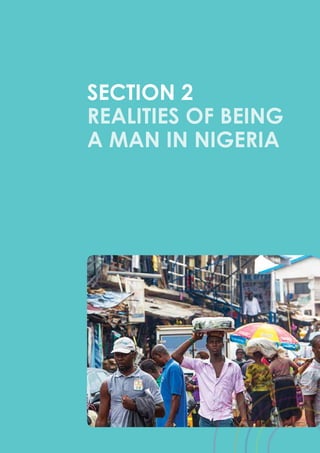
SECTION 2
Realities of Being
a Man in Nigeria
31
SECTION 2
Dominant ideas about masculinity and femininity set standards that are difficult to reach, particularly in a
context of violence, insecurity, economic decline, high unemployment, inequality and changing gender
realities. In practice men and women do not consistently adhere to dominant social ideas about behaviours,
their role in the household or decision-making, which provokes different reactions that can limit or encourage
gender equitable attitudes and behaviours.
This section explores the gaps between the perceptions discussed in Section One, and the lived realities of
men and women in their families and communities, related to violence, decision-making and leadership. It
shows that there are many examples of men’s behaviour that are actually at odds with perceptions of both
men and women. Many of these changes are positive, pointing in the direction of greater gender equality.
REALITIES – MEN AND WOMEN’S BEHAVIOUR
The section on perception highlights that men and women tend to have fairly rigid and stereotyped
ideas about how society expects them to behave. But do men and women live up to these perceived
expectations?
“Young men struggled to reconcile the need to prove themselves by
providing for a family in the current insecure economic and political
climate.”
Men were criticised by male and female respondents in the Conflict
study for not living up to family responsibilities and for engaging in risky
or violent behaviour (for example, alcohol and drug use, theft and
fights). Some participants of the NiMAGES study also recognised that
men can be irresponsible, hard and even wicked. As we will see in later
sections, young men in particular struggled to reconcile the need to
prove themselves as men by obtaining and providing for a family within
the current insecure economic and political climate.
Some participants of the Conflict study described how money and
wealth are more important for men now than previously. For example,
older men in Kaduna viewed men nowadays as being too pre-
occupied or corrupted by money and likely to engage in more risky
and potentially aggressive behaviour to get more money (see section
3 for more discussion on this). However, we will also explore in this and
later sections how some men have embraced more supportive roles in the home and in particular how they
have promoted peace in their communities.
“Women are becoming more visible in public, more vocal and more
educated.”
’An ideal man is supposed to
be a man with wisdom and
knowledge, a man that can
say things that will happen
to generations to come, but
today people are carried
away by influence of money,
riches and wealth’
Married man, civil servant, age
50, Kaduna
32
BEING A MAN IN NIGERIA: PERCEPTIONS AND REALITIES
Women are becoming more visible in public, more vocal and more educated. There are mixed reactions to
these changes - with a number of older male respondents in the NiMAGES and Conflict studies expressing
more progressive views than younger men (under the age of 29). That said, older women and men were
troubled by the fact that young women behave less demurely and modestly than their elders. Many
respondents also felt women are increasingly involved in violent activities in the community. A number of
examples were given of women supporting gang activities or using their romantic connections to take
revenge on people who have ‘insulted’ them. Some young women justified acting more aggressively, using
violence or verbal abuse, for example, needing to protect themselves, their businesses and reputations
when under threat. Interestingly more women than men said they would protect their reputation with force
if insulted.
REALITIES - INTERPERSONAL RELATIONSHIP BETWEEN MEN AND WOMEN
The section on perception explored social ideas regarding the relationship between women and men,
including who should make decisions in the home and circumstances where violence against women is
tolerated. But what are the reported experiences of women and men both in their parents’ and current
relationships?
“Men and women are making important decisions together - on investment
(almost 3 in 10), on use of contraception (between 6 and 7 in 10) and the
number of children to have”(almost 7 in 10).
Even though men and women said that men should have the final say
about household matters, a much higher percentage of respondents
report joint decisions in childhood and current households. Importantly,
qualitative findings show that men recognised the contribution joint
decision-making made to better relationships. This is explored further
in section 4.
Men and women recall similar decision-making dynamics in their
childhood homes with the majority saying their fathers ‘had the final
word’ about decisions related to large investments. Mothers wielded
most influence over decisions related to food and clothing. Parents
were most likely to collaborate on decision-making when it came to
children’s affairs, such as health, schooling and marriage. Although
even with regards to children, fathers were far more likely than their
mothers to wield individual influence.
There is a similar pattern of decision-making in current households
(where women and men are in intimate relationships), although joint
decision-making appears to be slightly higher in contemporary homes.
For example men say 21% of decisions regarding large investments were made jointly in their childhood
homes whereas 28% say this is the case in their current households. Men and women are making many
important decisions together - over 2 in 10 male and female respondents reported joint decision-making for
large investments, to high levels of joint decision-making on use of contraception (over 6 in 10 and over 7 in
Whenever I come back she
tables the discussion and we
discuss it between ourselves,
because if you want to have
peace, you have to give
women their own chance
because women too have
their own thinking. You don’t
monopolise everything, give
them their chances, hear what
they have to say, you share
everything, it’s not the matter
of being a man, you discuss,
we are in a democratic setting
Man, Kano State
33
SECTION 2
10 respectively) and number of children to have (over 6 in 10 and and nearly 7 in 10). Over half reported joint
decision-making on areas such as children’s schooling and spending time together. Fifty percent of women
and 45% of men reported joint decision-making regarding their partner’s ability to work outside the home.
Women had very little sole decision-making power, including over their own ability to work. In fact men still
wield considerable influence over areas that have a significant impact on women’s lives29
.
“Young people now have more power to choose their marriage partner.”
Despite reported high levels of joint decision-making in the home, group discussions suggest that men can be
perceived negatively when they show support for gender equity and involve women in decision-making. They
can be seen as “not a real man”, “weak”, a “mijin hajiya” (dominated husband) and controlled or charmed by
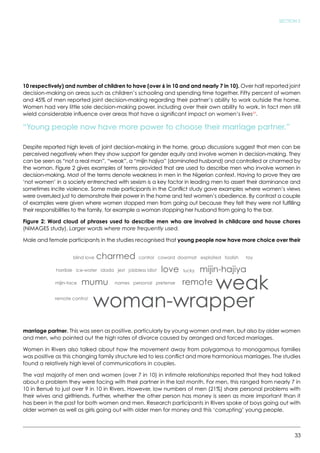
the woman. Figure 2 gives examples of terms provided that are used to describe men who involve women in
decision-making. Most of the terms denote weakness in men in the Nigerian context. Having to prove they are
‘not women’ in a society entrenched with sexism is a key factor in leading men to assert their dominance and
sometimes incite violence. Some male participants in the Conflict study gave examples where women’s views
were overruled just to demonstrate their power in the home and test women’s obedience. By contrast a couple
of examples were given where women stopped men from going out because they felt they were not fulfilling
their responsibilities to the family, for example a woman stopping her husband from going to the bar.
Figure 2: Word cloud of phrases used to describe men who are involved in childcare and house chores
(NiMAGES study). Larger words where more frequently used.
Male and female participants in the studies recognised that young people now have more choice over their
marriage partner. This was seen as positive, particularly by young women and men, but also by older women
and men, who pointed out the high rates of divorce caused by arranged and forced marriages.
Women in Rivers also talked about how the movement away from polygamous to monogamous families
was positive as this changing family structure led to less conflict and more harmonious marriages. The studies
found a relatively high level of communications in couples.
The vast majority of men and women (over 7 in 10) in intimate relationships reported that they had talked
about a problem they were facing with their partner in the last month. For men, this ranged from nearly 7 in
10 in Benué to just over 9 in 10 in Rivers. However, low numbers of men (21%) share personal problems with
their wives and girlfriends. Further, whether the other person has money is seen as more important than it
has been in the past for both women and men. Research participants in Rivers spoke of boys going out with
older women as well as girls going out with older men for money and this ‘corrupting’ young people.
blind love
lucky
mijin-tace names personal pretense
remote control
toycontrol coward doormat exploited foolish
horrible ice-water idada jest jobbless idiot
charmed
love
mumu
weak
woman-wrapper
remote
mijin-hajiya
34
BEING A MAN IN NIGERIA: PERCEPTIONS AND REALITIES
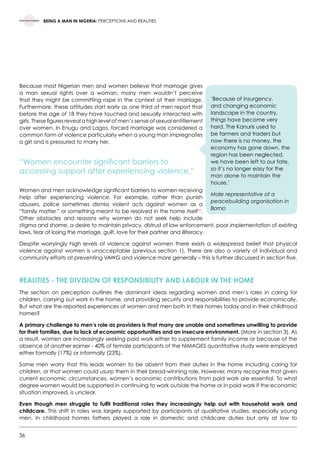
Despite some apparent improvements in the relationship between
women and men, study respondents affirm that wife battering, sexual
harassment and assault are common in all study locations, followed by
rape and verbal abuse (see Figure 3).
42% of women experienced physical, economic and/ or emotional IPV
and 40% of men say they have perpetrated IPV in their lifetimes. The
rate is highest in Rivers (53%) followed by Benué (42%), Enugu (41%),
Lagos and Kano (both at 38%) and Bauchi (37%)30,31
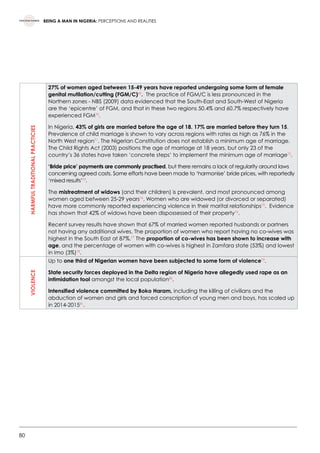
.
Men were more likely to report perpetrating violence if they were
older, less educated, informally employed, held less gender equitable
views, experienced work related stress and/or witnessed their mother
experiencing IPV. It is not possible in this current study to determine if VAWG is increasing in different regions
across Nigeria. The 2013 and 2008 Demographic and Household Surveys (DHS) in Nigeria both found that
28% of all women reported experiencing physical violence since the age of 15. The proportion of women
who experienced physical violence in the 12 months preceding the survey decreased from 15% in 2008 to
11% in 2013. However, young men and women participating in the Conflict study felt that violence, including
sexual violence against women had increased. Early marriage is also still common in Bauchi, Benué and
Kano and the level of support for such traditions as early marriage and FGM is much lower than levels found
in practice (see Annex 2 for more).
“Wife battering, sexual harassment
and assault are common in all study
locations.”
While Figure 3 does not provide a full picture of  the presence
of different types of violence in different States, it does
illustrate that some participants of the NiMAGES qualitative
study recognise that VAWG goes beyond hitting.
‘Marriage was done with or
without love, our grandparents
were forced to marry a person
they didn’t love, but these
days we choose whoever we
want to get married to’
Married woman, trader, age
48, Ikorodu in Lagos
35
SECTION 2
Figure 3: Common forms of violence against women and girls recognised by participants of the NiMAGES
qualitative study by region
Men also perpetrate high levels of sexual violence against women. 11% of men reported committing rape,
6% against a partner or girlfriend32
.
“Men perpetrate high levels of sexual violence against women: 11% of men
report committing rape, 6% against a partner or girlfriend.”
NORTH
Bauchi
• Wife battering, sexual
harassment and assault
• Rape
• Verbal abuse
• Early marriage
Benue
• Wife battering, sexual
harassment and assault
• Rape
• Verbal abuse
• Early marriage
• Child rape
• Refusal to take responsibility
for pregnancy
Kano
• Wife battering, sexual
harassment and assault
• Verbal abuse
• Early marriage
• Intimidation
• Starving wives
SOUTH
Enugu
• Wife battering, sexual
harassment and assault
• Rape
• Child rape
• Forced marriage
Lagos
• Wife battering, sexual
harassment and assault
• Rape
• Verbal abuse
• Early marriage
• Forced marriage
Rivers
• Wife battering, sexual
harassment and assault
• Rape
• Verbal abuse
• Child rape
• Intimidation
• Bullying
BORNO
YOBE
JIGAWA
KANO
GOMBE
ADAMAWA
TARABA
PLATEAU
BAUCHI
KADUNA
FCT
KOGI
NASARAWA
ENUGU
ANAMBRA
BENUE
CROSS RIVER
BAYELSA
IMO
ABIA
EBONYI
RIVERS
AKWA-IBOM
KATSINA
ZAMFARA
SOKOTO
KEBBI
NIGER
KWARA
OYO
OGUN
LAGOS
OSUN
ONDO
EDO
DELTA
36
BEING A MAN IN NIGERIA: PERCEPTIONS AND REALITIES
Because most Nigerian men and women believe that marriage gives
a man sexual rights over a woman, many men wouldn’t perceive
that they might be committing rape in the context of their marriage.
Furthermore, these attitudes start early as one third of men report that
before the age of 18 they have touched and sexually interacted with
girls. These figures reveal a high level of men’s sense of sexual entitlement
over women. In Enugu and Lagos, forced marriage was considered a
common form of violence particularly when a young man impregnates
a girl and is pressured to marry her.
“Women encounter significant barriers to
accessing support after experiencing violence.”
Women and men acknowledge significant barriers to women receiving
help after experiencing violence. For example, rather than punish
abusers, police sometimes dismiss violent acts against women as a
“family matter,” or something meant to be resolved in the home itself33
.
Other obstacles and reasons why women do not seek help include
stigma and shame, a desire to maintain privacy, distrust of law enforcement, poor implementation of existing
laws, fear of losing the marriage, guilt, love for their partner and illiteracy.
Despite worryingly high levels of violence against women there exists a widespread belief that physical
violence against women is unacceptable (previous section 1). There are also a variety of individual and
community efforts at preventing VAWG and violence more generally – this is further discussed in section five.
REALITIES - THE DIVISION OF RESPONSIBILITY AND LABOUR IN THE HOME
The section on perception outlines the dominant ideas regarding women and men’s roles in caring for
children, carrying out work in the home, and providing security and responsibilities to provide economically.
But what are the reported experiences of women and men both in their homes today and in their childhood
homes?
A primary challenge to men’s role as providers is that many are unable and sometimes unwilling to provide
for their families, due to lack of economic opportunities and an insecure environment. (More in section 3). As
a result, women are increasingly seeking paid work either to supplement family income or because of the
absence of another earner - 40% of female participants of the NiMAGES quantitative study were employed
either formally (17%) or informally (23%).
Some men worry that this leads women to be absent from their duties in the home including caring for
children, or that women could usurp them in their bread-winning role. However, many recognise that given
current economic circumstances, women’s economic contributions from paid work are essential. To what
degree women would be supported in continuing to work outside the home or in paid work if the economic
situation improved, is unclear.
Even though men struggle to fulfil traditional roles they increasingly help out with household work and
childcare. This shift in roles was largely supported by participants of qualitative studies, especially young
men. In childhood homes fathers played a role in domestic and childcare duties but only at low to
‘Because of insurgency,
and changing economic
landscape in the country,
things have become very
hard. The Kanuris used to
be farmers and traders but
now there is no money, the
economy has gone down, the
region has been neglected,
we have been left to our fate,
so it’s no longer easy for the
man alone to maintain the
house.’
Male representative of a
peacebuilding organisation in
Borno
37
SECTION 2
moderate levels. In homes where children saw their fathers playing a
role in domestic and childcare duties, they grew up doing the same.
Respondents were most likely to recall their fathers playing a role in care
for children; they were least likely to recall their fathers playing a role in
fetching water. More than half of respondents reported that their fathers
‘never’ or ‘hardly ever’ prepared food, washed clothes, cleaned the
house or fetched water. Nearly all respondents both women and men,
reported that they had been taught to participate in the entire range of
domestic tasks (included in the survey) as children.
“Younger men with a higher level of education
and those with more gender-equitable attitudes
are more likely to participate in domestic
activities.”
This may explain young men’s support for sharing domestic work.
Women were much more likely to have been taught how to cook food
and slightly more have been taught the remainder of the tasks. However, upward of 77% of men reported
being taught these particular household tasks.
Men and women report somewhat higher levels of men’s participation in a range of household tasks in their
current household compared to their experiences in their childhood home.
The tasks men report participating in most are those traditionally associated with men such as paying bills and
repairing the house. However, many men also reported playing an ‘equal’, ‘greater’ or more modest role in
duties traditionally seen as women’s work, such as fetching firewood and water.
Further, a quarter of men believe they play an equal or greater part in washing clothes and cleaning the
house (see Figure 4). For most domestic tasks women report men’s participation as lower than men’s own
reports. It is likely that a man perceives his occasional contribution to be more significant than his female
partner believes them to be. Younger men, men with higher educational levels and men who hold higher
levels of gender-equitable attitudes were more likely to report participating in household domestic activities.
‘Like my husband if I go to
work and come back late, he
helps me to cook and wash
the clothes in the laundry
room. And if I ask him to stop,
he will say I should go and
rest because I am very tired’
(married woman, caterer, age
38, Port Harcourt in Rivers).
‘Me and my brothers and
sisters do the work, my sisters
sweep, wash the dishes and
do the cooking, while we fetch
water and wash clothes.’
Young man, Borno
38
BEING A MAN IN NIGERIA: PERCEPTIONS AND REALITIES
Figure 4: Men and women’s reports that the man “plays an equal or greater role” in various domestic duties
(NiMAGES STUDY)
Less than 10% of women in Bauchi, Kano, Lagos and Rivers believe that men participate equally (or more) in
daily childcare, whereas men give participation rates from 2 in 10 in Kano to nearly 5 in 10 in Rivers. Except
in Benué and Enugu34
, women consistently report men’s participation in the daily care of children as lower
than men’s own reports in their current and childhood homes (see Figure 5). This discrepancy between the
views of the sexes is possibly due to women’s more accurate perception of men’s contributions, but also
because of where men’s activities are overwhelmingly concentrated – in disciplining and playing with their
children rather than engaging in the more arduous, tedious and continuous elements of childcare (such as
feeding, changing diapers and bathing).
“Less than 10% of women in Bauchi, Kano, Lagos and Rivers believe that
men participate equally (or more) in daily childcare.”
Both women and men report (at rates 60% and 65% respectively) that men regularly play with their children.
The men with the highest levels of education (secondary school or higher) and the most equitable gender
attitudes are also the men most likely to play an equal or greater role in childcare duties.
Figure 5: Percentage of male and female respondents reporting that they participate regularly in childcare.
(NiMAGES study)
Paying
bills
Repairing
damage
to the
house
Fetching
firewood,
gas or
kerosene
% of men (480 total) % of women (304 total)
Buying
food
Fetching
water
Washing
clothes
Cleaning
the
house
Cleaning
the
bathroom
or toilet
Preparing
food
0
20
40
60
80
100
910
21
12
25
9
25
32
45
55
484852
85
76
9491
16
Playing
with children
Cook
for child
Change
diapers
Give
a bath
0
10
20
30
40
50
60
70
80
Percentage of male respondents (310 total) reporting that
they participate regulary in childcare
(for children age 4 or younger) - IMAGES quantitives study
74
37
60
64
76
54
65
36
10
14 14
36
23 25 28
7
17 19 16
12
18
31
27
28
23
34
20
28
Bauchi Benue Enugu Kano Lagos Rivers Total
39
SECTION 2
REALITIES – MEN AND WOMEN’S ROLE IN PUBLIC LIFE
The section on perception outlines the dominant ideas regarding women and men’s roles in public life. What
are the reported experiences of women and how do men react to this?
“Women today are speaking up without encouragement and have proved
themselves ‘outstanding’ in their public roles.”
Findings show that men recognise and often support the fact that women are taking on more visible roles in
the community including participating in decision-making as well as community activities such as sanitation
and peacekeeping, particularly in Kaduna, Lagos and Rivers. A male government representative in Kaduna
for example, spoke of women having increased awareness of rights, that women are participating more
in community and family decision-making and this leads to better outcomes in the home and community.
A male peace-builder in Rivers reflected that, whereas 10 years ago women who were present did not
talk in town hall meetings, women today are talking without encouragement and have proved themselves
‘outstanding’ in their public roles.
He cites the examples of the House of Assembly representative from this constituency, as well as the ‘women’s
wing’ in the community which is ’becoming stronger and prominent’, leading to women no longer being
taken for granted in the community.
However, men still dominate in public spaces, for example in community
decision-making forums and student unions35
. In some regions,
particularly in the North, women are still not allowed in public spaces
(or even to move freely outside their homes) or to attend community
decision-making forums. If they do attend there is often an expectation
that they remain silent. The male peace-builder from Rivers quoted
above, commented that ‘only one in 15 community development
committees (CDCs) in his area had a woman member which denies
them the right to contribute to the development of their communities’.
In the studies, women expressed their desire to be more involved in
leadership and decision-making. However they recognised significant
barriers such as the need to ask men for permission and the belief that
they would not be taken seriously by men and society in general if they
took on such roles36
.
“In an area of Rivers state, only 1 in 15 community
development committees had a female member,
denying them the right to contribute.”
The Conflict study provides numerous examples of men’s roles in community decision-making and security.
In section 3, which explores the influence of conflict on men and masculinities, we will see how this can
boil over into violence, as well as procure peace. However, the study also offers examples illustrating the
nurturing, caring and arguably more positive side of their community role.
‘The roles of women in the
community include being
responsible for herself so that
when she has to lead she
will be able to lead right.
Moreover this is not the first
time a woman will be a leader
in any community, during the
time of Raji Rasaq, Ojikutu was
his deputy and a female. If
they do well in that leadership
position that means they are
from responsible homes’.
Religious leader, Lagos
40
BEING A MAN IN NIGERIA: PERCEPTIONS AND REALITIES
Examples in all states include how men provide free water, gifts to widows, scholarships for children and
other kinds of help for those in need. Women and men also spoke of women’s important role in caring
for communities, enabling community improvements and caring for other women. They do this by helping
those who have newly arrived to settle into their communities or to give them money to support their
businesses. Through using networks, women significantly contribute towards peace and positive community
development.
41
SECTION 3
FACTORS
INFLUENCING
PERCEPTIONS AND
BEHAVIOURS
42
BEING A MAN IN NIGERIA: PERCEPTIONS AND REALITIES
This section considers some of the most important factors influencing gender inequitable and equitable
perceptions and behaviours such as the media, religion and conflict37
. These topics are the focus areas of
the three studies commissioned to supplement the NiMAGES report on gender equality. We also include a
section on childhood experiences, as significant findings emerged from the NiMAGES study regarding the
importance of socialisation in forming ideas about men and women and their roles and value in society.
Other important influencing factors such as poverty, education, unemployment, inequality and globalisation
will be discussed where relevant.
CONFLICT
Conflict in Nigeria is worsening in intensity, prevalence and scope, with the country ranked 151 out of
162 countries in the Global Peace Index38
. Nigeria is currently experiencing insurgency in the North-East,
conflict over land and water in the Middle Belt, urban violence in cities such as Lagos, and tensions over
environmental degradation due to oil spills and gas flares in the Niger Delta. A key finding of the Conflict
study is that conflict can exacerbate violent masculinites by undermining men’s perceived roles in the family
and community”. “Hyper-masculinites can also exacerbate conflict.” (i.e. exaggerated stereotypical male
characteristics such as aggression)
“Conflict can exacerbate violent masculinites by undermining men’s
perceived roles in the family and community.”
Dominant social ‘ideals’ of masculinity and femininity set difficult-
to-reach standards, particularly given insecure environments that
can engender violence, further insecurity, economic decline, high
unemployment, inequality and changed gender realities.
Indeed, much divergence from these ‘ideals’ was observed in practice
in all the studies. Conflicts in and between communities have made it
difficult for men in all states to earn an income in order to obtain and
maintain a family.
In Borno, for example, the impact of the insurgency has made it
increasingly difficult due to the high likelihood of attacks. Land
occupied by Boko Haram forces (otherwise known as Jama’atu Ahli
Sunnah Lidda’awati Wal-Jihad (JAS)) has meant people are not able
to cultivate farmland.
Curfews and attacks on businesses have also affected livelihoods. Added
to this, prices of food and other necessities have drastically increased,
leading to deepening food insecurity. Also in Borno, ‘bride price’ has
become a blockage to marriage in the way that it has not been before,
due to the changing economic situation engendered by insecurity.
Respondentsdiscussedcommunitylevelviolenceinthecontextofmarkedinequality,poverty,unemployment
and injustice placing pressure on young men to act in violent ways. Inequality and unfair treatment were
seen as leading to a sense of injustice amongst those who were excluded and marginalised from power,
wealth and influence, and unable to fulfil their roles in the family and community as a result.
‘People of Bama cannot
enjoy democracy while this is
enjoyed in the state capital;
we will not see it outside the
metropolis and this brings
about inequality among
people… poor people are
marginalised, young people
are unemployed and older
people are not given their
basic necessities…If they are
marginalised they will join
violent groups to fight the
government of the day.’
Representative from women’s
group in Borno
43
SECTION 3
For example, in Rivers there is conflict over scarce land where older men were seen as misusing resources
and opportunities for their own ends. As a result some young men had lost respect for their elders. Changing
power dynamics as a result of conflict and violence was identified, particularly in Borno and Rivers where
some younger men’s involvement in violence meant they were viewed with fear by older people.
“Respondents discussed community level violence in the context of marked
inequality, poverty, unemployment and injustice placing pressure on young
men to act in violent ways.”
Women’s incomes were seen by some as having a positive influence in
reducing men’s financial burdens but women as providers also added
pressure on men. Although there is a strong norm against violence
young men recognised that sometimes their only option in an insecure
environment to protect their families involved engaging in criminal
and sometimes violent activities. (Section 4 highlights the high levels of
crime in the six states covered by NiMAGES). They expressed empathy
for young men’s lack of choice in this regard, generally viewing men
who stayed at home to avoid violence as ‘acting like women’ and
so not earning respect from women and men of the household and
community. This illustrates how negative views of women and their roles
can reinforce masculinities that lead to violence.
There is a distinct perceived lack of action on the part of state and
national governments in improving people’s lives in communities. There
was similar disillusionment with national security agencies, with many
respondents seeing them as perpetrators of human rights violations
such as arbitrary detention of men, sexual violence against women
and weak protectors of communities.
“Vigilante or community security groups are in some instances seen as key
to stopping violence.”
As a result men in the community who see themselves as protectors, have set up vigilante or community
security groups and in some instances were seen as key to stopping violence. Young men believed they
were treated with more respect if they joined such groups which ‘protected the community’, even if
through violence, creating incentives for joining. In fact others suggested that it was fear rather than respect
that group membership prompted, and involvement was seen as ensuring men would be more likely to
perpetrate violence and harass women in the home and community.
“There is a noticeable shift from elders or traditional leaders solving
community problems, to them being addressed by police or vigilante
groups.”
“In most cases, if I can access
police and I know you are
misbehaving, I will show my
power by calling on police to
arrest you. Also if you offend
me, all I have to do is buy boys
in the community marijuana or
alcohol and they will deal with
you. Afterwards, you will give
me respect when you see me
on the street.”  
Married man, age 39, Agege,
Lagos
44
BEING A MAN IN NIGERIA: PERCEPTIONS AND REALITIES
Participants also spoke of the shift from arbitration of community
problems by elders or traditional leaders, to use of the police or vigilante
groups. This was not always seen as positive as indicated above.
Although many traditional systems exclude women from positions of
leadership, the police and vigilante groups are not necessarily more
receptive to women’s security concerns. The types of masculinity
embodied by police and vigilante groups can often be more violent
than that of elders and traditional leaders who use arbitration. Indeed,
the current arbitration system seemed more open to violence, impunity
and use of connections.
However, young men in Rivers also expressed frustration with elders
stemming from perceived injustice and felt court resolutions rather than
settlement by elders had led to a more peaceful situation now than in the past39
.
“It is believed that those in power such as politicians, take advantage
of ‘humiliated and stranded’ youth to drive group violence for their own
political ends.”
Participants believe those with power, such as politicians, take advantage of ‘humiliated and stranded‘
youth to drive group violence for their own political ends40
. Given the violent nature of political contestation in
Rivers for the past two years and as politicians have recruited young men for use in elections, it is unsurprising
this came out most strongly there. However, in Borno too, Boko Haram gave money to young recruits, which
gave them access to goods such as motorbikes that they would not have otherwise had.
Many respondents felt men were naturally powerful (a view supported by participants in the other studies)
and were raised to fight in order to provide for, and protect their family and community. They were therefore
much more likely than women to get involved in violent behaviour, including gangs. However, examples of
women being involved in violence was also noted, notably standing behind men and supplying them during
stoning in Kaduna. Young women also spoke of participation in gangs, as well as using connections with
gangs for their own ends. One woman from Rivers who was interviewed in-depth described her involvement
in gang violence at school. She also described how selling alcohol on the streets meant she was often
provoked to defend herself by force, including against men who tried to cheat her out of money.
Although both women and men reported violence and conflict as having damaging economic and
psychosocial effects, as well as changing community relationships, their experiences differed. Men spoke
of being targeted by security forces and having to escape for fear they would be harassed, shot or arrested
with little chance of accessing justice or forced to join security groups. They also spoke about how fear
undermined their positions and questioned whether involvement in vigilante groups or exposure to violence
made them more prone to committing violence themselves.
Respondents felt women were disproportionately affected by violence due to their caregiving role and
left economically vulnerable when male relatives were killed. Women also experienced fear, restrictions of
movement and increased violence, including sexual harassment, rape and abuse by gangs and security
forces, for example, being targeted if their partners or children are involved in gangs.
Some people felt their communities were seeing decreasing levels of violence. This perception may have
been influenced by the timing of the research for the Conflict study, which took place in the immediate
‘It has changed because in
those days they would call
the feuding parties to an
arbitration panel and would
resolve the conflict for them
but that does not work out
these days.’
Married man, age 39, Agege,
Lagos
45
SECTION 3
aftermath of elections that were widely feared likely to trigger mass violence. That they did not was remarked
upon in all states. The research also cites examples of men who resisted involvement in violence and actively
worked for peace. In Lagos, people cited community peace groups as immediately intervening if there
were problems. Although violence was seen as persistent in Rivers, people pointed to varying successful
community efforts to address and prevent it. Experiences of conflict have also engendered some interesting
role shifts for men. For example in Borno, where the conflict is most acute, some men are involved in
comforting children traumatised by war.
“The studies reveal examples of men who resisted involvement in violence
and actively worked for peace.”
Those who worked for non-governmental organisations had the most progressive views and spoke of how
they were trying to effect change, including by educating boys and girls to be peace advocates and speak
out against violence against women and girls. This is discussed further in section 5.
RELIGION
Nigeria is nearly equally divided between Christianity and Islam. The
majority of Nigeria’s Muslims are concentrated in the northern part of
the country, while Christians dominate in the Middle Belt and south41
.
The study looking at the influence of religion on masculinities focused
on these two main religions. Approximately 10% of Nigerians practice
traditional religion. However, this was not covered in the study42
.
Participants of the Religion study (as well as the Conflict and NiMAGES
qualitative studies) overwhelmingly perceived that God created
man in his own image, to lead, protect and provide for his family and
community, spiritually and physically. Many participants referred to
scripture to justify their beliefs. Women support men in their roles by
cooking and caring for the family, and providing for the family in the
absence of a man. However, despite overwhelming support for role
distribution by gender, it was mostly agreed that neither Christianity nor
Islam explicitly specifies detailed roles for men and women, beyond
biological attributes. These roles and responsibilities are largely reported
to be ascribed by culture, rather than religion, a view that was repeated across different respondent groups.
“Many overwhelmingly perceived that God created man in his own image,
to lead, protect and provide for his family and community, spiritually and
physically.”
Contradictory views were expressed regarding religious support for men’s involvement in domestic work.
Women in Northern Nigeria, regardless of age or religion, perceived this to be an indication of support
from their husbands, as well as a fulfillment of their religious obligations. However, they noted that cultural
perceptions of men who perform domestic duties are to see them as weak. In contrast, Muslim women in
the South, mostly from the older age range, believed that domestic work performed by men was a new
mistaken trend of the younger generation. They did not believe this change in roles was supported by their
‘Even in the Quran you can
see that wherever God
mention a man at the same
time he mention a woman
“wattabi’ina wattabi’ati,
Walmuminina walmuminati”
and a lot of them compare
a man and a woman in the
Quran.’
The Federation of Muslim
Women’s Associations in
Nigeria (FOMWAN) President,
Kano State Chapter
46
BEING A MAN IN NIGERIA: PERCEPTIONS AND REALITIES
religion. Although younger women, men and older men indicated their support for men’s involvement in
domestic work, they did not provide a religious justification either way.
“Leadership is generally believed to be bestowed upon men by God.”
Leadership was a role generally believed to be ascribed to men by
God. A leader is seen as someone who has the fear of God, is religious,
and that God has chosen to guide people. For most Muslims, men and
women across age groups, it was believed that while religion does not
forbid women from holding leadership roles, they are not supposed to
lead men, including in the home or in religious practices.
Christians, regardless of age group, gender or location, largely felt that
either women or men can be leaders in the church or elsewhere if they
are qualified and committed to service provision. Female leaders in the
Bible such as Deborah and Esther were cited in support of this belief.
Additionally, in the Catholic Church, women cannot be ordained priests
and can only occupy ‘lay’ positions in the church. It was also believed
by some respondents that some characteristics of women disqualify
them from taking leadership roles in the church. Men are still expected
to be the head of the household.
Religion was frequently used to justify men’s dominance of women’s leadership roles throughout all the studies.
Yet when pressed directly, participants of the Religion study overwhelmingly stated their belief that culture, not
religion upholds men’s superiority over women. For example, the Koran states: “alimra’atu shakikatu filhayatul
rajulu, la hayatu illabihi wabi ha. (Her life entirely and his is the one that come together to form one particular
thing). This directly contradicts statements made by group members at other points in the discussion. This
makes understanding the role of religion in influencing gender equity and inequity challenging.
Contradictory statements could be down to a lack of knowledge of religious teachings, a mixing of religion
and culture, misuse of scriptures to justify pre-existing prejudices or possible reluctance on the part of
respondents to admit their religion can be used to justify discriminatory behaviour. Exploration of the role
of culture in upholding gender inequality was limited in the studies. However, one respondent gave an
example of how the cultural tradition of involving first born daughters in family decisions was overridden by
more strict evangelical religious doctrines barring their involvement.
Participants agreed that religion does not stop women from speaking out or taking action, especially if
they are being cheated. Examples of the Prophet’s wife in the Koran, and Esther in the Bible were cited as
evidence. Restrictions on women speaking out are considered a misinterpretation of the scriptures.
All respondents, regardless of age, gender, location or religion agreed that no religion supports violence
against women. Referencing the Koran, a male respondent said, “The Prophet (Peace be Upon Him) said
“wouldn’t one of you be shy to beat his wife during the day and later come to her in the night for sex?” (Male
JNI Secretary, Kaduna). In addition, Chapter 4, Suratul An-Nisa (meaning The Women) of the holy Quran was
dedicated to women, indicating God has a special place and respect for women which all should follow
(Male Muslim Leader, Lagos). In contrast, older Christian women from Lagos felt that VAWG was fostered  by
religious preachers encouraging women to bear with IPV and by the Bible itself promoting subordination
of women to their husbands. Although religion might not explicitly support VAWG, its mis-interpretation may
promote ideology that condones it.
‘According to the Prophet
(PBUH) “no people will ever
progress if they allow a woman
to serve as their leader”.
Women can be elected to
represent their interests but
they cannot take leadership
positions.’  
Chairman of the Council of
Ulama, Kano State
47
SECTION 3
“No religion supports violence against women.”
Religion does not forbid women holding the rights to resources. The
Hadith states “we should not be unjust as Allah is not unjust”. However, it
was stated that in Sharia law, women were entitled to smaller inheritance
because they stand to inherit from their immediate families and from
their husbands. Furthermore participants believe that the bible advises
that man should keep inheritance for his children, and that men inherit
permanent items such as land, whereas women inherit disposable items
such as gifts. Women are also not forbidden from accessing education.
According to the hadith “seek for knowledge even if it means going to
seek for it in China” and “seeking for knowledge is mandatory for every
Muslim man and woman” (FGD with Muslim young men, Kaduna; FGD
with older Muslim men, Kaduna).
Religion does not forbid women from accessing
opportunities for education.”
Religious leaders that promoted gender equity were mostly viewed with respect and as role models by study
respondents, provided they preached within the tenets of religion. It was reported, however, that preachers
in Kaduna and in Kano who preached in support of gender equity face resistance from other preachers in
the community. Additionally, some preachers in Kano and Enugu do preach equal rights for women and
men but not directly, due to fear of their fellow preachers.
It was believed by young Christian men in Enugu that Nigeria is not yet ready for religious preaching on
gender equality, which is why religious leaders were doing so with caution, using scripture and stressing
submissiveness of women, even within the discourse of gender equality. It is also believed by a male Pastor in
Lagos that gender equality could not be discussed in certain churches, as it would be seen as encouraging
men to be weak and unmanly. He also believed that tradition views gender equality as a problem that
could result in separation or divorce of couples.
In most groups regardless of age, gender, location or religion, there were mixed feelings about equality
in religious activities and spheres. We have also seen the emergence of men who relate to women on an
equal basis. However, in general, such equality was not supported by Muslim men, who back the perception
that women were not equal to men, using quotes from the Koran such as, “Arrijalu qawamuna alan nnisaa”
meaning “men guard over women” and “where you don’t find one male witness, you should get two female
witnesses” (group discussion with older Muslim men, Kaduna). In addition, while women were generally less
accepting of having unequal rights and privileges as men, most male respondents were of the opinion that
women accept male dominance as God’s will. Both male and female respondents stressed the need for
women to remain humble and respectful to men.
Nevertheless, respondents supported religious leaders teaching men to respect women more, to share roles
and responsibilities, promoting women and girls to speak out and sometimes manage resource allocation,
and promoting education for women and girls.  
‘The prophet (PBUH) was
commanded by Allah
“anytime you want to do
something that Allah has
not sent divined inspiration
to you, you must consult
your companions.” These
companions include women.
The prophet (PBUH) also said
“anybody that sought advice
shall never go astray”’
JNI Secretary, Kaduna
48
BEING A MAN IN NIGERIA: PERCEPTIONS AND REALITIES
MEDIA
One of the most important places for boys and men, girls and women to learn to make sense of their world
is through the media, including newspapers, television, radio, films and comics.
“The media demonstrates a strong potential influence over perceptions and
understanding of issues such as gender identities, relations and roles.”
Nigerians are major consumers of media and most citizens rely on the media for information, education and
entertainment. This demonstrates the potential power exerted by the media in shaping perceptions and
understanding of issues such as gender identities, religions and roles.
Within the context of a prospering Nigerian media industry, the study sought to understand the role of the
media in shaping perception and promoting gender equitable and inequitable ideas of masculinity and
femininity through reviewing a range of media products, and discussions with those who produce media
content as well as consume it.
“The media promotes male dominance and leadership and tends to under-
represent women in decision-making and leadership.”
Mass media in Nigeria, via traditional outlets, entertainment and advertisements, promote stereotypical
roles about what it means to be a man, presenting masculinity as fixed and inevitable. This was particularly
evident in the films and cartoons analysed, but less in news media and advertisements43
. The media promotes
male dominance and leadership and tends to under-represent women in decision-making and leadership.
It does this by reinforcing traditional gender roles assigned to men and women, for example: describing the
man by means of rational and professional-related adjectives, in leadership news stories, and by personal
and emotional related adjectives in relation to women (or conversely emphasising their masculine traits).
It mostly only focuses on gender issues when covering women’s leadership news stories. In one newspaper
only one out of six (29%) articles on male leaders explicitly mentioned gender issues compared to 67% of
articles on female leaders. This contributes to the common understanding that gender issues are mainly
women’s issues. Men were more likely to be mentioned in conjunction with leadership in sectors such as
Box 2: ‘Man in Power’
In the popular Nigerian film, the main character Desmond embodies the possibilities and contradictions
for men who strive for greater gender sensitivity. After being cast away by his community he returns as
a successful (i.e. rich) man. His community, regretting having turned their backs on him now kneel and
plead for forgiveness. A friend of Desmond lines up a group of beautiful and educated women so he
can cherry-pick his bride to be but he sends them away. Desmond gives money to the elders for health
centres, youth and women’s empowerment, and feels embarrassed when people kneel in front of him.
He regards his mother as the most important person in his life. However, while he promotes the idea
of female empowerment, he simultaneously reinforces the power of the men (in this case, the elder
council) in decision-making. He ends up enjoying the privileges of being perceived as a “real man”,
a successful man according to the dominant masculinity standards. (Media study, 2015)
49
SECTION 3
business and politics. Women were far more likely than men to be mentioned in fashion and jewellery and
non-profit sectors. The media review also did not find a single references to female leaders in the education,
religion, military, agriculture, technology and transport sectors (see Figure 6).
Figure 6: Media reporting of sectoral leadership by sex (%)45
(Media study)
The Media study also noted that films, cartoons and advertising promote dominant masculinities, reducing
women to submissive and dependent actors or sexual objects. For example, out of 22 Mr. and Mrs. Cartoons
studied, at least 16, amounting to (73%), had messages explicitly conveying non-gender equitable stereotypes.
(See Box 2 for an example from the film industry.) Women in films, cartoons and advertisements come across as
obsessed with money and suspicious about men’s fidelity, frivolous, fixated on fashion or how their body looks,
and willing, most of all, to please their husbands sexually or through cooking. Whereas successful men are
portrayed as responsible, inviolable and invariably rich. They are also presented as competent, professional
and as having a sense of entitlement to be the decision-makers and economic providers for their families.
They are also seen as being able to strongly influence the way women see themselves and as sexually active
individuals (sometimes unfaithful and promiscuous). For example, one advert for MTN (telecommunications)
offers the line that it is the obligation of a man to provide for women so that they can go shopping46
.
In both Lagos and Kaduna, participants of group discussions, irrespective of age and social background,
generally agreed on negative gender representation in the media. They gave examples of media content
that portrayed man as the head of the family, who must be obeyed by women, and portrayals of women
as the weaker sex. They also mentioned newspaper interviews that favour men, as women are often asked
private or personal questions; entertainment programmes, including music, that show female nudity; home
videos, where men play key roles as achievers while women are always in the kitchen; and images that
debase women and portray them as sex objects.
“Films and home videos tend to glorify violence against women.”
Research participants also felt that films and home videos tend to glorify violence against women by not
ensuring perpetrators are convicted for their actions, or not showing the harmful consequences for women
and society. They also cited examples of violence being glorified more generally – such as scenes in films
where young boys handle weapons including guns. Despite the above, some of the participants mentioned
instances where the media has helped to condemn or indirectly reject negative masculine behaviour. In this
Distribution of leadership news by leader gender
and leadership sector
PoliticsBusiness
HealthEducation
Religion
C
ulture
and
A
rts
M
iltary
sector
Sports
A
griculture
Fashion

jew
ellery
N
on-profitSector
Technology
TransportSector
Justice
Men Women
0
5
10
15
20
25
50
BEING A MAN IN NIGERIA: PERCEPTIONS AND REALITIES
regard, they commend the media for giving prominent coverage to some situations where women have
been victims of abuse.
The media content review however, concluded that film narratives often sensationalised violence, portraying
acts as isolated events or uncharacteristic of the perpetrator, rather than symptomatic of a wider social problem.
“Most believe there is a link between gender inequitable masculine images
in the media and incidents of violence targeted at women.”
Although the majority believe such portrayals often reflect social realities,
some argued that the facts are sometimes exaggerated. Only few
reported that the media encouraged negative behaviour, including
one man who said media stories had encouraged him to womanise.
However, most believe there is a link between gender inequitable
masculine images in the media and incidents of violence targeted at
women. Male and female students opined that media images reinforce
tendencies of boys and men to see themselves as the dominant sex, while
women tend to be compelled to assume subservient roles, despite the
growing presence of women in leadership positions in the country. There
is agreement that the consequences of stereotyped portrayals of men
and women in the media include the projection of harmful messages for
boys growing up, low esteem of children and submissiveness of women.
Most media professionals approached for the study are aware of the
role of the media in shaping perceptions on gender identities and roles
and make efforts to create programming aimed at promoting gender
equality. However, media professionals are often constrained from
promoting gender-equitable masculinities because of sexism in society
and the media industry. For example:
•	 Women are under-represented on editorial boards (see Figure 7) and ownership of media outlets. As
editorial boards decide on content, a gender imbalanced board constrains many media professionals
from promoting gender-equitable images.
•	 Male and female journalists and presenters are usually assigned different areas to cover depending on
their sex. Professional women are assigned women’s and children’s programmes and stories, while men
tend to cover men’s issues or coverage that may require working longer, later hours. This reinforces the
idea that women’s issues and children’s issues should be the concern of women and that men’s issues
should also be the sole responsibility of men.
•	 There is a widespread belief that content challenging gender stereotypes would not attract advertising
revenue. The research found a number of programmes that had been created to target men in a positive
way but that never got off the ground as a result of lack of advertising support.
•	 Gender equality programmes and existing regulation of the media regarding gender issues are mostly
focused on women, actively excluding men as part of the discussion or as agents for social change.
•	 Although legislation is a key tool for making the media gender sensitive and responsive, enforcement has
been a challenge as media content is hardly monitored in that respect.
It is extremely hard work to
be a producer. Working in
production means you have
to be extra strong because
you work overnight and extra
hours. It is not deliberate but
men seem to be more suitable.
Media professional
We assign female reporters
to cover events or stories on
women affairs in order to
consider religious and cultural
sensibilities of the community
we serve
News director
51
SECTION 3
Figure 7: Sex composition of editorial boards and newsrooms (Media study)
Some media content in Nigeria mirrors, or has the potential to mirror
gender equitable male images, for example, coverage of the
celebration of fathers’ day in churches and ‘Masculine Hour’ a radio
programme aired weekly on Fridays, with young boys and men as
the primary target. This programme discusses relationships and other
issues affecting men and is a favourite weekend programme with radio
listeners in Lagos.
“Gender equality programmes and existing media
regulation on gender issues are largely targeted at
women, excluding men and their issues from the
discussion, or as agents for social change.”
Even some advertising recognises that men and women can be portrayed as equals. In one
telecommunications advertisement of MTN the advert says that successful men and women always want
something better without distinguishing areas of success by gender.
Positive male and female images in local media affect audiences by shoring role models and inspiring
consumers to aspire for success in their chosen careers. The participants of group discussions cited important
role models for them, most of who imbued gender equitable attitudes and behaviours (see Figure 8). The
female role models were generally chosen because they have overcome gender challenges, demonstrated
strength of character, excelled in their chosen careers and rendered gender-supportive services. The male
role models are mostly men who the participants believe have exhibited positive gender or masculine
values and those who have been successful in their field of endeavours.
“Positive male and female images in local media affect audiences by
shoring role models and inspiring consumers to aspire for success in their
chosen careers.”
NewsroomsEditorial Boards
0
10
20
30
40
50
60
70
80
The media has influenced my
life in a very big way. I will say
my future career was decided
because of what I saw on TV.
I saw someone that I want
to be like and it has helped
accelerate my life. And it has
made me short-cut my life
instead of going the long way”
Female student in Kaduna
52
BEING A MAN IN NIGERIA: PERCEPTIONS AND REALITIES
Figure 8: Some examples of gender equitable role models cited by Media study participants
Male role models
Cited by male study participants:
Cited by female study participants:
Female role models
Cited by male study participants:
Cited by female study participants:
Ben Murray Bruce -
Media proprietor -“a
fighter for women and
children and for the unity
of Nigeria”
Mr. Raymond Dopkesi -
Proprietor of African
Independent Television (AIT)
Olu Jacobs
Actor (married to a
successful woman and a
good husband and father)
Christiane Amanpour –
the Chief International
Correspondent for CNN
Folusho Alakija – despite
limited education became
a fashion designer and one
of the richest women in the
world
Omotola Jalade
Ekeinde -  actress, singer,
philanthropist and former
model 
Funmi Akingbade  - writes
a column in The Punch
newspapers on sex and
relationships
Genevieve Nnaji – a teenage
mother who became one of
Nollywood’s most successful
actresses
Ellen Sirleaf-Johnson –
Liberian President
Barack Obama -
The first American black
senator and president and a
supporter of gender equity by
supporting his wife
Goodluck Jonathan -
Nigeria’s former President
53
HOME AND SCHOOL ENVIRONMENT
The NiMAGES study demonstrates that home and school environments are significant influencers in
developing men and women’s gender identities. Positive male role models for boys (and girls), a home
free of violence, and access to education are vital elements in establishing gender equitable attitudes and
behaviours. When fathers participate in domestic work and childcare, their sons are more likely to help in the
home in later life47
. Almost 6 in 10 men who frequently participate in traditionally feminine domestic tasks had
fathers who did as well, compared to 41% of men participating in such tasks who did not have domestically
active fathers. They are also more likely to agree that men should share work around the house with women
– 80% compared to 70%48
.
“Positive role models for both sexes, a violence-free home and access
to education are vital to establishing gender equitable attitudes and
behaviours.”
Many of the research participants witnessed violence against their mothers. For example, about a quarter of
respondents, both men and women, witnessed their mother being beaten by their father or another man in
their childhood home. Men are less likely to perpetrate violence against their intimate partners and women
less likely to experience IPV if their fathers were not violent with their mothers. 47% of men who witnessed
their mothers experiencing IPV were also violent compared to 27% of men who did not witness IPV in their
childhood homes. Women who witnessed IPV in childhood, are significantly associated with experiencing
IPV later in life49
. The report, State of the Worlds Fathers (2015), states that violence against children is more
likely to be present in homes where IPV is perpetrated.
The fact that education for girls is supported by most Nigerian women and men, and that education is
associated with more progressive views, underscores the important role it can play in developing progressive
ideas about men, women and their contributions to society. Male and female students from Lagos and
Kaduna interviewed for the Media study believed that men who support gender equality are more
enlightened and educated. Qualitative findings show however, that though girls’ education is supported,
it is not taken as seriously as that of boys. It also suggests that teacher and students have a more positive
SECTION 3
54
BEING A MAN IN NIGERIA: PERCEPTIONS AND REALITIES
view of boys’ abilities to learn. Further, educational establishments often perpetuate the idea that violence
against children is a legitimate form of punishment. For example, 80% of boys and 71% girls experienced
corporal punishment in schools. In the study on Conflict although schools were not seen to be teaching
violence, participants talked about conflict within and between schools, with the presence of gangs within,
or affiliated to schools, and use of violence to intimidate school authorities seemingly common.
“Men are less likely to commit and women less likely to experience IPV if
their fathers were not violent with their mothers at home.”
The NiMAGES study reveals that Nigerian children also experience high levels of violence at home. For
example 2 in 3 women and 3 in 4 men reported being spanked or slapped by parents or adults in their
childhood home. About 3 in 4 respondents report being threatened with physical punishment in their
childhood homes. It is interesting to view these findings in the light of recent statistics from the State of the
World’s Fathers report (2015), that reveal high levels of support from mothers and fathers for physical and
verbal punishment of children. Over 6 in 10 mothers and fathers surveyed in Nigeria think physical discipline
is necessary in bringing up a child. Just over 2 in 10 men in Nigeria who participated in the study think it is
never justified to beat one’s child50
.
Some respondents of the Conflict study described how important initiation or life events are in emphasising
the link between patriarchal forms of masculinity and violence. In Lagos and Kaduna, people talked of
Hausa and Fulani customs of beating boys to test maturity and manliness, with the young man required not
to show suffering. Respondents also talked of the role of hunting in determining manhood: ‘In Fulani and in
Hausa land they say if you want to prove that you are a man, you should go and hunt rare animals’ (male
member of vigilante group, age 55). It was not clear if these respondents were talking from experience or
from hearsay based on stereotypes of other ethnic groups. Nevertheless, it is instructive that perpetrating and
withstanding violence is seen as ‘separating the boys from the men’. It also valorises and glorifies violence
and the ability to ‘withstand’ it rather than encouraging approaches that are more peaceful.
Furthermore, sexual violence against children, although not condoned, is worryingly pervasive. Nine in every
10 males and females reported being raped as children. Even more respondents – approximately 2 in 10
men and women – reported that before they turned 18, “Someone touched [their] buttocks or genitals or
made [them] touch someone’s genitals when [they] did not want to.”51
Given the well-established lifelong
influence of childhood experiences of violence52
, the issues of physical violence, corporal punishment and
sexual violence experienced by children in Nigerian study sites are worthy of attention.
Section 5 provides examples of initiatives in Nigeria that encourage gender equitable fatherhood and work
with young people to build their self-esteem.
First, however we consider the impacts of masculinities on men, their relationships with women and on the
community as a whole.
55
SECTION 4
Impact
of Negative
Masculinities
on Men
56
BEING A MAN IN NIGERIA: PERCEPTIONS AND REALITIES SECTION 4
This section considers the impact of non-gender equitable masculinities (perceptions and realities) on men,
their relationships with women and on the community at large. It also examines whether, and if so how,
greater equality in relationships can bring benefits for all. Social norms that consider men to be the sole family
breadwinner engender feelings of failure when this is not possible particularly in contexts of unemployment,
poverty, insecurity and inequality.
Widely held ideas about masculinity and femininity are powerful “root causes” of gender inequity and
violence against women, as well as wider violence in the community. Conversely, men spoke about the
important role women played in alleviating their stress through their contributions to household economies
and decision-making.
Impact of social expectations on men’s health and well-being
Adherence to culturally dominant forms of masculinity – which often
urge men to practice strict emotional control and cultivate a sense of
invulnerability or indestructability – can adversely affect men’s physical
and mental health.
Social expectations that men should be strong and maintain and protect
a family in the context of poverty, insecurity and poverty generates
considerable pressure on men. Men report high levels of alcohol
consumption54
(Benué 25%, Enugu 27%, Rivers 32%, Lagos 38%, Bauchi
50%, Kano 60%) and experience high levels of stress and depression.
“Men report high levels of alcohol consumption
- between 25% and 60% across states - and
experience high levels of stress and depression. “
Over 6 in 10 men report regularly experiencing stress (70% in Lagos, 67%
Enugu, 61% Rivers, 60% Kano, 55% Bauchi, 38% in Benué) and a third
report being regularly depressed (similar levels across states).
Almost 3 in 10 men report regular low self-esteem. Men with no formal
education are the most likely to report suicidal thoughts, low self-esteem
and or negative feelings of well-being and men who report work-related
stress are also more likely to report depression. Respondents in the studies point out that when boys and men
are unable to attain a certain level of financial success or meet the financial responsibilities expected of
them, they see themselves as failures. This often results in frustration, stress and unhappiness, which can also
lead to violence.
Respondents in the Religion study believed that men and boys engage in risky behaviours (crime, alcohol and
drug use) as a way to prove their ‘manhood’ to their peers and women and girls, or as an outlet from the stress
of their ascribed roles and responsibilities. Pressure from family and society to be ‘successful’ also resulted in
men engaging in risky behaviour even at the risk of their own lives, or to the detriment of their self-respect,
health and integrity. Figure 9 illustrates how different the social expectations of a man can be from what men
themselves are feeling, on top of their challenges and opportunities.
“Yes, there was a period my
business wasn’t booming;
that was when we were in our
second (year) of marriage
and there were a lot of bills
and pressure everywhere and
it seems she was the only one
bringing in money. She just did
something, maybe she came
home late or took a decision I
felt I wasn’t comfortable with
and I started bursting out. She
was at the kitchen and I went
and slammed the kitchen door
and I walked out, but later I
regretted the action. It wasn’t
worth it, it’s not good to beat
your wife.”
Male, Lagos State
57
How I have been told I need to be/ act ...
• Well educated
• Not dependent on parents
• Married with dependents
• Responsible
• Paid well, doing respected work
• Provide for my wife and children
• Have authority in the home
• Make sure my children have good home training
• Provide security for those in my family and community
• Calm and in control
• Take care of the community
• Be respected by family, friends and community by having power,
   money, influence, advice to share.
What I think …
• It’s so hard! I’m not praying/ trying enough; must try even harder
• To be a man is to overcome challenges – does this mean I’m not a
proper man?
• It is so much easier for women
• A rich man is courting the girl I like. I can’t compete
• My wife and children are afraid of the violence. I should be
protecting them, not be afraid myself
• My wife brings in (more) money – how to show I still have authority
over her?
• My wife may be unfaithful
• It’s so unfair, my mates have the right connections so have gotten
good jobs
• How can I get them all to respect me?
• It’s wrong to be involved in violence but how else to provide?
Money needs to be clean but do I have any other choice?
What my reality is …
• Parents could not afford school fees so have lower level of
education than I would like
• Suffering from inequality, poverty, lack of connections or influence
• Unemployed/ not earning enough money – cannot get a job,
dependent on parents, cannot afford to get married, cannot
provide for family
• Rely on what wife brings in to support the family
• Finding it difficult to enforce authority at home without a job/
bringing in enough money to provide
• Insecurity – helpless in the face of conflict and violence and
likelihood of it affecting family and community
• Lack of respect – by my wife, our children, my friends, my parents
and anyone else in the community
• Negative influence of others – showing easy ways to make money,
tempting me to drink and take drugs
• Get so frustrated and angry, I can’t control myself sometimes and
lose my temper.
NIGERIAN
MAN
NIGERIAN
MAN
NIGERIAN
MAN
Figure 9: - Man surrounded by conflicting messages and experiences. (Source:Conflict study)
58
BEING A MAN IN NIGERIA: PERCEPTIONS AND REALITIES
“Many respondents of the Conflict study felt that men’s consumption of
alcohol and drugs led to household and community conflict and violence.”
Men involved in the Conflict study were clear about the pressures on them caused by the gap between
expectations and their realities. These include poverty, lack of connections where necessary to succeed,
dependence on parents, lack of positive role models in their parents and elders, feeling helpless in the face
of conflict and inequality and struggles for income, struggles over courtship or exerting dominance required
at home and desire to earn respect of wives, girlfriends, families and the community at large. This gulf led
to personal struggles, intensified by an overwhelming sentiment expressed by many participants that ‘real
Box 3: Resisting violence: The story of a 30+ year old married man from Rivers
This man used to have a business but now lacks capital to carry it further. He stopped school at class
three. His father never provided for him growing up even though he was head of the household. This
man did most of the household chores and took care of the children growing up as he was the oldest.
He used to be involved in violent groups particularly when he was in school (there was lots of inter-
school violence) and then in a vigilante group which also appears to have engaged in violence. He
believes he is a lot less hot-headed since getting married. He now tries to avoid violence and resolves
conflicts peacefully when he can. “For me I don’t want to go back that is why I say let God help me.
There are things that I am trying to do, and I pray those things work out so that I will not go back to my
former level. Most of the time you don’t know when troubles will come”. He believes if he gets a bit of
help with his business it will be easier to avoid violence. This man now helps the community deal with
community violence and has been involved in speaking to, punishing and arresting young men that
abuse women.
Conflict study
59
SECTION 4
men’ are able to overcome challenges and can succeed with hard work. No matter how hard they tried,
success continued to be elusive. Men also talked of struggles to control their anger and exert self-discipline
and control in the face of provocation by others. Box 3 illustrates the story of one participant in the Conflict
study as he tries to resist the pressures on him to engage in aggressive behaviour.
Alcohol consumption is also seen as a way for men to escape the stresses of life. The NiMAGES study found
that 2 in 10 men felt their alcohol consumption had led them to do something they regretted. Just over 1 in
every 10 men report failing to do something that was normally expected of them because of their alcohol
consumption.
Many respondents in the Conflict study also felt that men’s consumption of alcohol and drugs, particularly
in Kaduna, Lagos and Rivers, led to household and community level conflict and violence. A young woman
in Lagos who sells a local gin and herbs concoction claimed the reason street boys drank was ‘to step up,
for them to get high and be able to do whatever they want to do.’ In Kaduna, a male religious leader said
young men feel ‘they are not getting anything from the society and their feelings about society is negative
- that is why they go to whatever extent to intoxicate themselves because to them that is the only time
when they will feel ok. This adds to the problem, because once they are
intoxicated they are capable of committing any act.’
IMPACT OF SOCIAL EXPECTATIONS ON RELATIONSHIPS
BETWEEN MEN AND WOMEN
The existence of strict unequal gender norms and roles creates tension
withinrelationships.Respondentsdescribedhownotfulfillinggenderroles
causes tension between men and women. For example, men believed
that women are more likely to be promiscuous if their husbands fail to
provide financially. The difficulties of men needing to be, and be seen
as, the breadwinner given these challenges are a key driver of conflict
at the household level. Men were worried about the potential loss of
authority, control and respect that would follow from not being able to
provide, particularly if their wives took on ‘their role’ of family provider. In
order to offset this, women who earned more than their husbands often
had to be seen to be more submissive, remain respectful or ‘cover for
him’ by making it seem he was the one providing.
“Male respondents in all studies confirmed that
they respond to economic stress with violence
against both women and other men.”
Malerespondentsinallstudiesconfirmedthattheyrespondtoeconomic
stress with violence (against both women and other men). The NiMAGES
study shows a link between work-related stress and perpetration of IPV.
Some expressed the view that if women and men could live up to
their socially ascribed roles there would be peace in the home and
community and they believe that the promotion of gender equality
“Because a man cannot do
everything alone, in the Bible
God created Adam and saw
that Adam cannot carry the
load alone that is why God
created Eve too and Eve
was there to help Adam [...]
if you are married you are
responsible and some of the
responsibilities cannot be for
you alone but for the two of
you.” (Traditional leader, Rivers)
“You will share everything with
whoever you are dating. You
share your thoughts, money
and everything you have, then
the lady has that idea in her
head that she is coming into
a relationship to share things.
Now sharing things means you
have an idea or you have
something to share, share it
together and not above the
other person so when you are
making decisions it should be
equal.”
Male student, Lagos
60
BEING A MAN IN NIGERIA: PERCEPTIONS AND REALITIES
can lead to tension and conflict. However, VAW is not just a consequence of men’s inability to live up to their
social roles but of the socially ascribed ideas that exist and how these are reinforced by formal and informal
institutions.’
“Male respondents in NiMAGES gave examples
where their home environment was improved
and their stress alleviated when women
contributed economically to the home.”
Prevailing dominant ideas about how women and men should behave and the roles they should adopt
underpin men’s dominance over women and the family. This, in turn reinforces the use and tolerance of
emotional, economic, sexual and physical forms of violence against women and children. Violence is used
to control women and children and as already highlighted, is common across Nigeria. Particularly in Lagos,
men spoke of the need to take back authority by force and gave examples where they ‘tested’ women’s
obedience.
Male respondents in NiMAGES gave examples where their home environment was improved and their stress
alleviated when women were able to contribute economically to the home. Of course this may lead to
increased stress for women unless other roles and responsibilities are also shared more equitably. Muslim
women in the South are worried that women’s entry into the workforce would lead to men not providing for
them. Christian men, particularly younger men, believe role sharing among men and women would help to
ease their burden – although this was based on the erroneous view that women currently did very little work
of any kind. Respondents of the studies also mentioned advantages of involving women in decision-making.
They recognised the important contribution of women in ensuring better decisions and that women’s
involvement could make the relationship stronger, healthier, long-lasting, trustful and peaceful. Women also
feel more respected when working and encouraged to generate ideas53
.
“Nearly half of men in Enugu and Lagos interviewed for the NiMAGES report
carried out thefts while 4 in 10 men in Enugu have been arrested.”
NiMAGES provides evidence that men and women sometimes seek
advice from each other and also advise their partners which can help
alleviate stress. The Religion study suggests that men would be more
open to women’s advice than women realise.
The women interviewed, regardless of age and religion, felt their advice
regarding men’s health would not be considered and might even
create tension in the home. Conversely, men expressed openness to
women’s counsel and saw this as a show of love and communication
between couples. In the same vein, a high percentage of men (over 7
in 10) and women (almost 8 in 10) interviewed for NiMAGES seek some
sort of help when they feel sad, disappointed and frustrated - usually
from informal sources- whereas only 2 in 10 men seek help from a wife
or girlfriend. Just over 2 in 10 of men also seek help from their relatives
or male friends.
’Whenever I want to do
anything I discuss first with my
wife, even when sometimes I
don’t make use of her opinion,
sometimes she gives the right
opinion but I don’t make her
know it is relevant, I stylishly
make use of it’
Married man, age 37, Lagos
61
SECTION 4
IMPACT OF SOCIAL EXPECTATIONS ON THE COMMUNITY
In addition to non-equitable gender roles and ideas around masculinity and femininity impacting men
and women at the individual and household level, the studies found they also exacerbate conflict in the
community, in the context of inequality, poverty and unemployment. Section 3 describes how pressures to
provide for and protect a family and the community, as well as the lack of economic opportunities open to
men, (especially young) can lead them to engage in violent and criminal activities. However, the study also
found men taking on peace-building and community development roles in spite of the pressure arising from
the challenges listed.
“Significant numbers of men report never having participated in criminal
acts, especially not theft or physical fights.”
Nearly half of men in Enugu and Lagos that participated in NiMAGES have carried out thefts while 4 in 10
men in Enugu have been arrested (see Figure 10). Interestingly, none of the respondents in Rivers reported
owning a firearm, but said that gang and cult membership is relatively low. This contrasts with the finding of
the Conflict study which confirmed that cultism was widespread in Rivers and Lagos. In addition, people in
Rivers also believed that armed robbery was common.
Figure 9: Men’s reports of criminal activity, firearm ownership and imprisonment (percentage who report this
act/experience among all male respondents) (NiMAGES study)
The impact of crime and violence in communities limits the mobility of residents especially for women.
Rape, sexual violence and other forms of violence against women in the community were also said to
be (increasingly) common, particularly in Rivers and Lagos. As a result, female respondents in particular
expressed fear of going out in the community after a certain time. In Lagos, people believe society used
to be peaceful with people being able to go out late at night to visit friends and sell their goods, but that
this is no longer the case. ‘In the past, tailors sewed ‘til the following day without fear, but now we dare not
leave the shop opened at 6pm because the gangs operate anytime from then” (married woman, fashion
designer, age 45, Ikorodu in Lagos). In Rivers, female respondents also expressed fear of going out at night
and believed cultural practices that brought people together no longer take place due to political tensions
in the community.
Theft Fights Gang/
cult
Own
firearm
Arrested Prison
Bauchi
146
Benué
159
Enugu
159
Kano
356
Lagos
463
Rivers
249
Total
1532
0
10
20
30
40
50
62
BEING A MAN IN NIGERIA: PERCEPTIONS AND REALITIES
In spite of the above findings, significant numbers of men participating in NiMAGES report never having
participated in criminal or delinquent acts, particularly theft and fights. Also, in some communities,
men participate actively in peace building and community development. In Lagos, respondents cited
community peace groups that intervene immediately if there are problems. In Rivers, although violence was
seen as persistent, people pointed to varyingly successful community efforts to address and prevent it. The
research found examples of men who resisted involvement in violence and actively worked for peace. This
is discussed in the next section. “
Participants in all studies spoke about changing
attitudes towards men and women’s roles, and
value, and awareness of VAWG.”
Some respondents recognised and welcomed the role of women in
community decision-making and peace building and believed that
the increased empowerment of women and their presence in public
life would greatly benefit communities in this regard.
‘If you allow a woman to
contribute to the running of
the home and community,
you will discover that there
will be better outcomes of the
situation. So there is a general
advantage to this.’
Government representative,
male, Kaduna
63
SECTION 5
Efforts to
promote gender
equitable attitudes
and practices
64
BEING A MAN IN NIGERIA: PERCEPTIONS AND REALITIES
Each section has emphasised the changing nature of masculinities and femininities and the differences
between perceptions and reality. Here we feature examples of concrete efforts at both individual and
community levels to promote gender equitable masculinities and improve the relationship between women
and men in the household and in the community. Individual men, as well as those involved in religious
and community organisations, support the women in their lives, resist violence and help others to do the
same on a daily basis. A significant minority have participated in activities to promote men’s involvement in
fatherhood and to confront men’s use of violence against women.
	
INDIVIDUAL EFFORTS PROMOTING GENDER EQUITY IN THE FAMILY AND COMMUNITY
All studies provide a number of examples where men displayed support
for gender equitable behaviours and attitudes. Some male participants
said they would support their wives in leadership roles even outside the
home. They reported that decision-making at home should be the joint
responsibility of the husband and the wife.
“Some male participants said they would support
their wives in leadership roles even outside the
home, and that decision-making at home should
be a joint responsibility.”
Important quotes and perspectives from individuals who challenged gender stereotypes and promoted
gender equality were found in analysed news reporting in the Media study. For example, a successful male
farmer says in his interview with Punch newspaper, “My mother taught me how to cook, bake and sew.
Even ‘til this day, part of what my mother taught me is what led me and my wife to open a restaurant here
in Lagos”. When talking about his wife, he acknowledges and reinforces her skills in managing finances,
which is a role traditionally assigned to men: “My wife is very good at handling money (…) she signs all my
accounts”54
.
All I think differentiates a man
from a woman is physical
differences because women
are equally up to the task;
they can make decisions
Male student, Kaduna
65
SECTION 5
“Many men across the studies, regions and age groups also made it clear
that VAWG is wrong,”
including community and religious leaders. Apart from not engaging in VAWG in their homes and
communities, some members of the group discussions claimed they speak, or would speak out against
gendered violence in their communities if they had the opportunity. One man from Rivers shared his
experience of how he intervened and counselled a young man who was beating his sister. Adherence to
religious views and ‘moral’ upbringing were two preventive measures on VAWG mentioned during the in-
depth interviews with participants.
“Families, grandparents, in-laws and even neighbours are key participants in
resolving intra-family conflict that results in violence against women.”
Given the prevalent closed family structure in most parts of Nigeria, families, grandparents, in-laws and
even neighbours are key participants in resolving intra-family conflict that result in violence against women.
Although families tend to emphasise the importance of the women remaining with their husbands, examples
were given where families stepped in to remove women from the household when they were experiencing
consistent abuse. A young man in Lagos talked of how his mother’s family came to take their daughter
away as they felt his father ‘could not prove he is mature enough to control disagreement’ and they would
‘not wait until he beats her to death.’
Men gave examples of where they had resisted the urge towards using violence even when they could be
viewed as cowardly for not protecting their reputation. This resistance was often strengthened by experiences
of violence and knowledge about its devastating effects. Many men spoke about being violent in the past
but consciously trying to move away from this. A man involved in peace-building work in Kaduna talked
of how he used to incite violence and believe people should be unfriendly towards non-Muslims, but now
works towards inter-faith mediation and dialogue. A man in Rivers who was involved in gangs and is currently
part of a vigilante group talked about his struggle to avoid violence. He gave examples of confrontations
that could have ended in violence. He has struggled to control his anger as he feels violence is wrong, even
when used to protect people. However, violence and abuse against a wife or girlfriend by another was seen
as reasonable justification for retaliation.
As we have seen in other sections, those that support and practice gender equity are more likely to have
some level of education. Men who participate in domestic work and do not perpetrate IPV are more likely
to have had a positive male role model in the home (sharing domestic and care work and not perpetrating
IPV). Despite the pressures to engage in risky and violent activities, men who promote peace and respect in
the home and community are almost universally admired as role models themselves.
Some men also credited the influence of their mothers and religious leaders in their community with inspiring
them to promote peaceful and more equal relations. Witnessing women, through personal experience or
from the media, participating in economic work and leadership built an appreciation by men for women’s
abilities to fulfil these roles and contribute to the household. The mixed views expressed in group discussions
and one-to-one interviews, even by the same respondents on men and women’s roles and relations, shows
that change processes are not necessarily neat and linear. Significantly it also suggests that reflection through
discussion can catalyse insights regarding the value of greater gender equity.
66
BEING A MAN IN NIGERIA: PERCEPTIONS AND REALITIES
COMMUNITY EFFORTS AT PROMOTING GENDER EQUITY
During the course of the studies a number of community
responses to promote women’s empowerment, challenge
inequitable masculinities and reduce VAWG were noted.
“Participants of the qualitative studies
shared how their communities respond to
violence against women in different ways.”
Participants of the qualitative studies spoke about how their
communities respond to violence against women in different
ways. Fines and physical punishments of perpetrators of rape
were mentioned in most states. On many campuses, rules and
procedures are in place to check and control violent behaviour
against women and girls. In Benué State, it was reported that
churches reprimand men who hit their wives and church elders normally embarrass the husband(s) involved.
The Media study confirmed instances where the media has helped to condemn or has indirectly rejected non-
equitable violent masculine behaviour. For example Media reports on the Ejigbo women who were stripped
naked and beaten on the allegation that they stole pepper, led to the alleged perpetrators being arrested
and taken to court.
“Religious leaders defying the prevailing interpretations of Christianity and
Islam that support men’s dominance over women.”
Similarly, the Religion study highlighted the presence of male religious leaders defying the prevailing
interpretations of Christianity and Islam that support men’s dominance over women. These men are playing
an important role in supporting women’s leadership and challenging patriarchal interpretations of the sacred
texts. People spoke about how pastors taught men to love their wives and families, as well as help with
domestic chores as a sign of their love. The male religious leaders who support gender justice are seen as role
models and embody the aspirations of gender equitable masculinity. Many Christians and Muslims credited
their religion with helping them resist the urge to be violent. They also tried to engage in interfaith work to build
peace in communities where tensions exist. A young woman in Rivers spoke about a pastor who would try
to reach out and engage with ‘hoodlums’ who caused conflict in the community, preaching love to them.
The emergence of the Transformative Masculinity movement and the Positive Muslims movement within faith-
based organisations in Africa provides an encouraging example of wider interventions that are mobilising
men in faith communities to contribute towards the advancement of girls and women.
Campaigns promoting men’s involvement in fatherhood and addressing VAWG are also relatively widespread
across regions. Nearly 2 in 10 men in Enugu have participated in an activity questioning other men’s use of
VAWG – the average across six regions is about 1 in 10 (see Table 2). Further, almost 4 in 10 men in Enugu
have encountered campaigns promoting fathers involvement in child care and 1 in 4 in the region have
participated in activities to promote fathers’ involvement in childcare. Other regions (such as Bauchi, Benué
and Rivers) however, experience much lower rates of participation. Regions with higher levels of exposure
to campaigns witness higher levels of involvement in activities to promote fathers’ involvement in childcare.
67
SECTION 5
Table 2: Male respondents’ reported exposure and participation in VAWG and Fatherhood campaigns and
activities (NiMAGES study)
Campaign item Total
%
Bauch
%
Benué
%
Kano
%
Enugu
%
Lagos
%
Rivers
%
Total Number of Respondents 1532 146 159 159 356 463 249
Violence against women campaigns
Ever seen an advertisement questioning
VAW
40 30 20 18 52 57 50
Ever encountered a campaign questioning
VAW
37 27 19 24 50 52 37
Ever participated in an activity questioning
other men’s use of VAW
11 6 7 13 18 13 8
Fatherhood campaigns
Encountered campaign promoting fathers’
involvement in childcare
21 8 16 25 39 19 16
Participated in activity to promote fathers’
involvement in childcare
13 7 7 19 25 11 9
“Their work includes encouraging self worth in youth; promoting positive
fatherhood; encouraging the leadership of women (see Box 4); educating
boys and girls to be peace advocates and speaking out against violence
against women and girls. They also advocate for breaks in between giving
birth to improve women’s health.”
Non-governmental organisations (NGOs) and community based organisations (CBOs) are also creating
change as evidenced by examples given by NGO representatives for the studies. Their work includes
encouraging self worth in youth, promoting positive fatherhood, encouraging the leadership of women (see
Box 4), educating boys and girls to be peace advocates and speaking out against violence against women
and girls as well as advocating breaks between giving birth for improved health of women.
Box 4: Promoting women’s leadership in Rivers
“There is a project we are working on and we needed to form women development committees
(WDCs) around communities where I met the first female community development committee (CDC)
member. We discovered that it will be difficult to form WDC from CDC because most of the members
of CDCs are male. Instead of working with the CDCs we decided to work with the women leaders
in communities and we also called the CDCs to come with their women because the programme is
aimed at women. (Male representative of peace-building organisation in Rivers)”
68
BEING A MAN IN NIGERIA: PERCEPTIONS AND REALITIES
The Voices for Change programme is focused on changing individual attitudes and behaviours and social
and legal norms which disadvantage girls and young women. Implementation commenced in October
2013 and will run for four years, though the changes sought are generational.
As well as working with young women and girls (16-25 year olds) to build their self-esteem and social networks,
it also targets young men and boys in the same age range, along with key influencers (traditional, religious,
political and media). Working with men and boys is seen as an essential complement to work with girls
and young women, towards changing gender relations. Interventions include working directly and virtually
with groups of young women and young men to examine, understand and navigate gender relations and
stereotypes and to promote support for women’s involvement in decision making, women taking leadership
positions, and men and women speaking out against all forms of violence against women and girls.
There has been a positive response from religious leaders of Christian and Islamic faiths to V4C work with
them in exploring these issues and many have gone on to speak out to their followers on positive practices.
Work with the media has shown a real appetite for opportunities to explore masculinity and the male side
of the gender ‘coin’ and to apply this in the media. Work with established and new networks of young men
to incorporate gender equitable values and practices has exhibited a high level of enthusiasm for such
reflection and for taking action.
Many young men in post-secondary institutions have actively supported young women to pursue leadership
positions (with some examples of success already). Use is made of social and traditional media and
campaigns to spread positive gender messages. Other interventions focus on legal and policy change; and
(as with this report) on generation and dissemination of information on gendered social norms and realities
to increase public knowledge and society-wide momentum for change.
69
CONCLUSIONS
AND
RECOMMENDATIONS
70
BEING A MAN IN NIGERIA: PERCEPTIONS AND REALITIES
CONCLUSIONS
The five studies on men and masculinities paint a rich, varied picture of gender dynamics in Nigeria. The
attitudes, behaviours, and reflections of respondents demonstrate a multitude of ways in which the traditional
gender order may be changing. Other findings also clearly show that rigid, patriarchal gender norms and
dynamics still hold sway across the six states.
•	 At the broadest level, widely held ideas about masculinity and femininity are powerful “root causes” of
gender inequality and violence against women in all its forms.  
•	 Gender equitable and non-violent masculinities can bring important benefits to men and women alike,
for example; better relationships, less stress, happier children, and future generations who reject violence
against women and children in all forms.  
•	 Positive non-violent role models and education for men and boys (as well as women and girls) help ensure
better gender equitable attitudes and behaviours. If these behaviours are inculcated in childhood and
young adulthood, they last into adult life with family and possibly community-wide benefits.  
The summarised findings and recommendations below provide instructive lessons and opportunities to better
engage men and women in efforts to bring about gender equity across Nigeria.      
Perceptions of how men and women should behave:
•	Nearly 7 in 10 men and over 5 in 10 women believe men should be tough, intelligent, fearless and
responsible. Women are largely perceived by men and women as being led by their emotions, making
them weaker and more vulnerable than men. These ideas about men and women underpin stereotypical
ideas about men and women’s roles in the home and community.  However, nearly 5 in 10 women do not
agree that men need to be tough to be a real man and a significant minority of men also disagree.
•	Women, however, should be ‘educated’, ‘advisors’, ‘independent’ and ‘behave maturely and responsibly’
and men should be ‘peaceful’, ‘gentle’, ‘loyal’, ‘honest’ and ‘caring’.
•	Men living in urban areas, men aged 29-39 and women and men with at least primary education hold the
most gender equitable views. Young men (aged 18-28) are more likely to support men sharing domestic
tasks.   
Roles of men and women in the household:
•	Household decision-making dynamics are still often highly unequal, but may gradually be changing. A
significant number of respondents make decisions with their partners, for example 6 in 10 men and 7 in 10
women decide together about the use of contraception, and almost 7 in 10 do the same when planning
the number of children to have.
•	How men value women’s opinions in the household differs across regions, with men still dominating in
decision-making that significantly impacts upon women’s lives, such as working outside the home - 7 in
10 men in Enugu and Lagos, 3 in 10 in Kaduna and over 2 in 10 in Kano say that women’s opinions in the
home matter.
•	Most still believe it is a man’s role to provide economically for the family. However, women’s increasing
presence in the labour market is recognised as important for them to support their families and men in
their role as providers. The statistics for women’s labour participation in Nigeria - 48% as opposed to a
men’s rate of 64%55
- do not support beliefs that women are advantaged in the labour market.  There
is some evidence to suggest that the increased involvement of women is changing family dynamics.
Although some men worried their position in the family was being usurped, others recognised the important
contribution women who work outside the home make to the family.
71
•	Many men participate in household work which seems largely supported by participants and religious
authorities - almost 8 in 10 men and women support men contributing to household work such as dishes,
cleaning or cooking. Younger men, men with higher educational levels, and men who hold more gender-
equitable views were all more likely to report participating in domestic duties, emphasising the family-
wide benefits of equitable attitudes and educational attainment.
•	Men’s involvement in parenting is still limited - less than 10% of women believe men participate equally
in childcare - but men with the most gender equitable views and highest levels of education were most
likely to play an equal or greater role in childcare duties.
Traditional practices and violence against women:
•	Respondents overwhelmingly reject many traditional practices, including FGM, wife inheritance, harmful
widowhood practices, and wife hospitality. Likewise, only about one third of respondents agreed that
early marriage “is important and should continue.”
•	 Although violence against women and girls is widely tolerated and many blame women for it, almost 6
in 10 men and 7 in 10 women do not think that physical violence against women is justified under any
circumstances.
•	The prevalence of economic, sexual, emotional, and physical intimate partner violence among research
participants is high - over 4 in 10 men, but only just under 3 in 10 women, believe that there are times when
a woman deserves to be beaten. Men with the most gender-inequitable views - older, informally employed
and less educated - were more likely to report perpetrating violence against a partner. Witnessing their
mother experiencing IPV and work-related stress were also significantly associated with perpetration of IPV.
•	VAWG thrives in an atmosphere of silence. Drivers of this silence include stigma and shame, distrust of law
enforcement institutions, fear, security, and social pressures to “keep the family together.”
Leadership:
•	Although most men and women - believe that women can be equally good leaders and there are those
who wish to play such a role in their communities, participants displayed largely discriminatory views
regarding women’s ability to lead.
•	Exposure to role models is important in transforming men’s acceptability of women leaders. This exposure
is effective when it comes from personal experience, but also from the media.
Factors influencing masculinities:
•	Both Islam and Christianity practiced in Nigeria largely uphold gender inequitable ideas about men
and women. However, a number of religious leaders support greater equality in relationships, women’s
leadership roles in society, and oppose VAWG using religious texts to justify their views.  
•	Violent conflict can exacerbate dominant negative masculinities by undermining socially assigned roles
in the community and family. Due to conflict and insecurity, many men, particularly young men in all
regions, engage in violent and risky activities in order to provide security, gain resources and power or out
of sheer frustration and lack of options.  However, a number of men engage in peace promotion activities
at home and in communities, and are seen as role models in the community.
72
•	 The media in Nigeria tends to portray men as strong, successful, resourceful, violent or promiscuous, while
women are shown as beautiful, submissive, sexually available, jealous and overly image conscious.
Gender equality programmes and regulation of the media industry are mostly focused on and aimed at
women, and so actively exclude men as agents for social change.  However, role models who embody
gender equitable ideas and behaviours are present in the media and inspire audiences in their lives.
•	Children witness and experience high levels of physical, emotional and sexual violence in their homes and
schools, with girls three times more likely to report experiences of sexual violence than boys. Physical and
emotional violence are believed to be acceptable in bringing up children alongside corporal punishment
in schools. Boys raised in non-violent homes where their fathers frequently participate in a wide range
of household chores, are more likely to grow up to become peaceful, involved fathers and partners
themselves, with benefits spreading across families and generations.
Impacts of masculinities:
•	Almost 3 in 10 men report high rates of low self-esteem and stress particularly related to work. Social
norms that view men as being the sole breadwinner engender feelings of failure when this is not possible
particularly in contexts of unemployment, poverty, insecurity and inequality. Conversely, men spoke
about the important role women played in alleviating their stress through their contributions to household
economies and decision-making.
•	Widely held ideas about masculinity and femininity are powerful “root causes” of gender inequality and
violence against women and wider violence in the community.     
Promoting gender equitable attitudes and behaviours:
•	 There exist concrete examples of individuals and community groups practising and promoting more
equitable masculinities, and improving relationships between women and men in the household and the
community.
73
RECOMMENDATIONS
The following recommendations aim to guide Nigerian activists, policymakers, researchers and others
in expanding their work with men and boys, women and girls, and Nigerian communities as a whole to
advance a thriving, equitable and gender-just future.
They are deliberately broad, rather than overly prescriptive to enable a wide variety of stakeholders to
take part in the change process, as attitudinal and behaviour change requires collective efforts. The
recommendations illustrate how addressing gender inequitable attitudes and behaviours can contribute to
progressive development and ultimately to gender equality.
Programme design
In order to address these high levels of gender inequitable attitudes and behaviours, we need to facilitate
widespread community-level awareness, education, and mobilisation campaigns.
Recommendations for advocacy efforts, communication strategies and key messaging in a selection of
critical areas are outlined below:
Publicly condemn violence against women and girls (VAWG) and advance messaging around its
unacceptability, as well as awareness of male dominance over women as a key component of VAWG: most
people in Nigeria do not support VAWG in any context and this message should form the basis of prevention
and awareness campaigns at all levels. There should be further efforts to expand understanding of what
constitutes VAWG to include male domination of women – a factor that underpins women’s low levels of
development in comparison to men.
Promote the eradication of harmful traditional practices: findings show that these practices are unacceptable
in Nigerian society. This should lend significant leverage to advocacy campaigns aimed at eradicating
these harmful practices.
Support opportunities to promote women’s leadership, including role-modelling, work with early adopters
and developing case studies. Most people support women’s leadership and role models can be an important
way to extend that support, especially for many young women who want to play a greater leadership role.
Strong cultural barriers in the community need to be addressed to shift the social norm against women
playing leadership roles.  A combined approach using role models and case studies, arguments on the
rational benefits of women’s greater involvement, and emotional appeals around the potential positive
impact on men could work.
The public sector can lead by example in transforming these attitudes, particularly by giving more women a
platform for meaningful policy influence. Women achievers in the country must be decidedly celebrated as
Icons of Progress and best practice, mentors and change agents. This must not be celebrated as tokenism,
rather these figures should be positioned as positive agents of progress.  
Emphasise positive impact of men’s involvement in domestic chores. Most people support the idea of men
helping out with domestic work, and many men are already participating in related activity.  Campaigns
can emphasise the positive impact this can have on sustaining healthier relationships.
Address the negative health implications of social expectation on men. Men’s health campaigns should
also address the negative health implications of social expectations on men, women and the nation.
Emphasise the importance of fathers’ involvement in parenting. Men are already involved in many aspects
of childcare. Campaigns can emphasise the importance of fathers’ involvement for the development of
children.
74
BEING A MAN IN NIGERIA: PERCEPTIONS AND REALITIES
Publicise positive benefits of sharing decision-making in the home. A majority of men do value women’s views
and many important decisions are made collaboratively in relationships. Campaigns can emphasise the positive
impacts on relationships where decisions are shared and publicise the benefits of joint decision-making.
Work through role models and early adopters. Findings suggest that identifying influential and connected
figures may be a particularly effective way of addressing norm perceptions as a vehicle for social change.
Refine messages on social norms to explicitly focus on norm perception. This can help avoid reinforcing
negative behaviours.
Regionally differentiate and resource campaigns appropriately. Acknowledge regional variation and
context-specificity in light of the fact that greater resources would be required to make progress in the North
than the South, for example.
Recommendations on engaging communities and institutions:
-	 Increase capacity of educational institutions, the media, independent CSOs (for youth, women, peace),
and traditional and religious institutions to understand, address and promote gender equitable masculinities
and femininities. These bodies should be supported to present informed and balanced viewpoints to their
constituencies and create an alternative culture that favours women’s participation in decision-making and
leadership and takes a stance against any form of violence against women.
For example:
Support current efforts by religious and traditional leaders (RTLs) and institutions, the media, CSOs and the
education system to promote equitable masculinity and gender equality.
Review educational materials in secular and religious institutions to reflect gender equitable masculine and
feminine values and images.
-	 Support education systems to advance and integrate equitable masculinities in curricula at all levels.
Education systems can be particularly influential by advancing more equitable masculinities. Education for
boys (as well as girls) is important for ensuring not only improved gender equitable attitudes but behaviours
as well. However it is important to address gender inequality, tolerance and perpetration of violence against
children within the school system.
-	 Encourage development partners to collaborate with media regulators to sanction negative portrayals
of femininity and masculinity. Efforts should focus on enhancing capacity to ensure strict guidelines and
regulations to sanction negative portrayals of femininity and masculinity, as well as focusing on widening the
scope for female journalists to move out of reporting exclusively on gender, family and ‘women’s issues’, and
cover across other areas.
-	 Prioritise work with men and promoting alternative concepts of masculinity, which address barriers to
social norm change. This should involve engaging with young men, activists and RTLs, in the community
who promote and model gender equitable masculinities. Social and economic activities for young people
should be explored, promoted and supported.
-	Lobby for targeted and dedicated donor funding streams focused on addressing underlying discriminatory
gender norms. In order to evolve new programmes and sustain existing ones targeting men and boys, there
is a need for more targeted funding streams. This will create a more level playing field for men and women
and boys and girls to benefit from opportunities that programmes and society in general brings.
75
Policies
Support reforms in the policies and practices of informal and formal institutions to promote and enforce
desired equitable behaviour.
For example:
Engender an enabling environment in the private and public sector for working women and those aspiring
to join the formal sector by way of paid maternity leave, paid paternity leave, flexible working time for both
fathers and mothers, etc.
Address corporal punishment against children in the home and schools in recognition of the negative impact
it could have on children, not only in their early years but later in life. Provide services and programmes that
support young victims of violence – boys and girls.
Develop policies that recognise the connections between conflict, masculinities, gender inequality and
violence against women, children and within communities: activities around these policies should be
developed and implemented as required.
Create awareness on existing laws that prohibit violence against women: these should be continuously
promoted through appropriate channels and mechanisms.
Promote collaborative policy development efforts within institutions: this could include publicising the recent
success of the VAPP Bill, highlight any institutional changes in political parties, and point to universities or
colleges who are changing their policies to prevent discrimination. This would ensure that our successes in
these areas have a real impact on social norms perceptions in the community, reinforce our other messages
and activities, and contribute to a wider momentum for change.
Research
This research commissioned by V4C has highlighted a
number of critical areas that require further exploration.
Incorporate gender analysis and gendered approaches
that include men and boys as well as women and girls:
data should be disaggregated to unpack what gender
norms mean in the context of different ethnicities,
religions and regions.
Explore links between gender equitable attitudes and
behaviours, and stress, relationship satisfaction and
community violence.
Better understand men’s contradictory responses in
discussions of women’s leadership and decision-making.
Determine links between norms of masculinity and
alcohol abuse in Nigeria.
Map, and respond to changes in trends on issues relating
to masculinity and gender inequity in the next few years.
76
BEING A MAN IN NIGERIA: PERCEPTIONS AND REALITIES
ANNEX 1
STUDY AIMS
AND METHODOLOGIES
The Landmark Research Report pulls together key findings from the following studies:
Quantitative and qualitative studies of the International Men and Gender Equality Survey (NiMAGES)
(conducted by TNS RMS) aim to provide credible information on the realities of gender relations in Nigeria. The
studies focus on key issues: ideas about masculinity and femininity, gender inequality, women in leadership,
women in decision-making and violence against women and girls. Study participants represented a cross-
section of the societies in their respective sites, reflecting noteworthy characteristics of Nigerian society.
NiMAGES largely followed an international survey format using the GEM scale (tailored to Nigeria) that allowed
for cross country comparison. It was carried out with a total of 1532 men and 504 women between the ages of
18 and 65. Nigerian official population figures were used as the sampling frame and the sample was drawn to
represent the six geopolitical regions in Nigeria - Bauchi, Benué, Enugu, Kano, Lagos, and Rivers. Researchers
led four focus group discussions (FGDs) in each region, with an average of eight participants in each discussion,
for a total sample of approximately 192 focus group participants including both men and women.
Participants were recruited to meet certain demographic requirements. All focus groups were single-sex and
were convened across three demographic groups in all six geopolitical zones: (i) Students aged 18-25, (ii)
Young Adults aged 26-39, and (iii) Mature Adults aged 40-60. Additional focus group discussions also took
place in every region. Focus group discussions were complemented by a total of 17 in-depth interviews (IDIs),
with between two and five interviews occurring in each region in order to illuminate and enrich survey results.
In-depth interviews were carried out with a mix of political leaders, positive deviants (men who embody
progressive, equitable gender attitudes), traditional/religious leaders, women leaders, ministry of women
affairs personnel, and law enforcement officers.
Religion qualitative study (Christian Aid, in partnership with Islamic Relief World Wide) - aimed at gaining
more understanding on the relationship between Masculinity and Religion in Nigeria in Enugu, Kaduna, Edo,
Lagos and FCT. The study approach included a desk review of relevant documents and materials, focus
group discussions and key informant interviews (KIIs)/In-depth interviews (IDIs). A total of 226 respondents
participated in discussions. Participants were purposively selected and known to be keen, knowledgeable
and active adherents of their specific religions. Influencers (both peer and religious gate keepers) were utilised
in order to mobilise already selected participants for FGDs in adherence to distinctive selection criteria. FGDs
were conducted amongst Christian and Muslim older men (above 26 years), older women (above 26 years),
younger men (between ages 16 – 25 years) and younger women (between ages 16 – 25 years). FGD groups
were comprised of 7-11 discussants.
KII tools were tailored to specifically apply to religious or faith-based leaders’ respondents, institutions and others
as appropriate. Interviews were conducted for both male and female informants. One key consideration was
the availability of the informant at the time of research, extent of authority of informant to provide valid and
authentic information, spread of denomination or religious sect and value of the anticipated information
which may be used to triangulate what was received at FGD.
The Federal Capital Territory (FCT) in particular was chosen because some of the key informants based there,
such as the Cardinal of Catholic Church, Primate of Anglican Church, Christian Association of Nigeria (CAN)
president, CAN secretary/treasurer, as well as Secretary General of National Supreme Council for Islamic
Affairs.  The study was conducted only in the Capital Cities of Kaduna, Kano and Enugu states, however
in Lagos, given its unique nature, the study covered beyond the city capital of Lagos state. In Lagos and
Kaduna, participants were from both Christian and Islamic faith, while in Kano and Enugu it was only Muslims
and Christians respectively that participated.
77
Conflict qualitative study – (conducted by Nigeria Stability and Reconciliation Programme (NSRP) Social
Development Direct (SDD)) examines connections between masculinities, conflict and violence in four
states in Nigeria: Borno in the North East, Kaduna in the Middle Belt, Lagos in the South West and Rivers in the
South. This was a qualitative study, with Focus Group Discussions (FGDs), key informant interviews (KIIs) and
life narrative interviews conducted in each location. In each state, 48 participants took part in FGDs and
ten participants were interviewed one-to-one. Overall, in the four states, 231 people took part in the study.
Researchers conducted six FGDs of eight participants in each state; three in the rural local government area
(LGA) and three in the urban LGA.
Participants were selected to ensure a spread of income levels, occupations, areas in which they live and
levels of education. FGDs were further segmented by age across the following demographics: (i) 18-25
who were unmarried and without children, (ii) older men aged over 35 who were married, (iii) younger
women aged 18 to 25; (iv) older women aged over 35. Key informant interviews were conducted with (i)
government representatives, (ii) traditional or religious leaders, (iii) youth group representatives, (iv) women’s
group representatives, (iv) persons with disability, (v) peacebuilding organisation representatives, (vi)
representatives from security agencies, and (vii) representatives from vigilante/ community security groups.
In addition, two life narrative interviews in each state were conducted with a young man and a young
woman who had either been involved in or had experienced trauma as a result of violence.
Media study – (conducted by independent consultants Lanre Arogundade and Sofia Santos) examines how
mass media information and content promotes stereotypical roles and ideas about men and its impact on
male dominant expression, vulnerability and relationship with women and girls. The study also examined the
factors that enable or constrain media practitioners from promoting equitable masculine characters in the
media, as well as the promotion of positive male images and their acceptance and impact on the audiences.
The researchers examined a range of mass media content - films, news, cartoons and advertisements
featuring in the January 2015 editions of The Guardian, The Punch, Daily Sun, Daily Trust, Vanguard and This
Day newspapers, Field activities involving in-depth interviews (IDIs) with media professionals and community
stakeholders as well as Focus Group Discussions (FGDs) with media professionals and media audiences were
also undertaken in the three cities of Lagos, the commercial capital of Nigeria; Kaduna, the political capital
of northern Nigeria and Abuja, the Federal Capital territory.
A total of 70 men and women (34 in Lagos and 36 in Kaduna) took part in 8 FGDs held with student and
adult media users. The adult FGD media user participants, aged 26 and above, were drawn from diverse
ethnic, religion, social and professional backgrounds and were randomly selected. The young people,
conversely, were purposively selected from university students in the 16 to 26 age-bracket, since they were
likely to be major media users. The media user FGDs were organised on a single sex basis to ensure free and
unbiased expression of opinions and to prevent unproductive discussions from occurring. FGDs were further
conducted with a total of 21 media professionals (11 men and 10 women), consisting of newsroom managers,
editors, producers, presenters and reporters, in four broadcast media outlets in Abuja. The participants were
purposively selected to meet the established criteria that included different types of ownership, running of
gender or male focussed programs and wide audience base, as required by the focus of the study.  In order
to explore the effectiveness and challenges of regulating the gender related focus and content of films and
videos, a FGD was held with the National Films and Videos Censors Board (NFVCB) in Abuja. The Head of the
Censors and Classification Committee and four other Board staff members took part in the FGD.  IDIs were
carried out with key editors and the National Secretary of the Nigeria Union of Journalists (NUJ) in Abuja.
Two key gender stakeholders were purposively selected for IDIs: a Nigerian member of the United Nations
Network of Men Leaders56
  and the President of the Nigerian Association of Women Journalists (NAWOJ)57
,
along with three movie, drama and arts experts were selected for Individual In-depth Interviews.
78
BEING A MAN IN NIGERIA: PERCEPTIONS AND REALITIES
Full descriptions of methodologies can be found in individual reports at http://www.v4c-nigeria.com.
This section outlines data comparing men and women’s progress against key social development
outcomes, alongside respective participation in key areas of life fundamental in representing a country’s
progress on equality between, and progress for, women and men. Here we present data on women and
men’s participation in political processes and the workforce, and their relative access to healthcare and
educational opportunity. In addition, the status of some harmful traditional practices and the prevalence of
violence is highlighted, with an overarching understanding of the geographical disparities across and within
this context.
Contextual snapshot
LEGISLATION,COMMITMENTS
Nigeria has a selection of legislative commitments in place that look to protect and support
women’s rights and participation.
For example, a National Gender Policy has been developed, which pledges to promote
women’s empowerment and eliminate harmful and discriminatory practices.
In addition, the Convention on the Elimination of All Forms of Discrimination against Women
(CEDAW) has been ratified (1985) along with the Optional Protocol (2004) and the Protocol to
the African Charter on Human and Peoples’ Rights on the Rights of Women in Africa (2005)58
.  
In May 2015 Nigeria’s Senate passed a Violence against Persons (Prohibition) Bill, aiming to
prohibit female circumcision or genital mutilation, and all other forms of GBV.
Challenges remain in the implementation of these commitments. Moreover, whilst the 1999
Constitution of Nigeria prohibits discrimination on the grounds of sex, as a federal republic
with a tripartite system of civil, customary and religious law, complications arise around the
harmonisation and coordination of legislation, which protects against harmful practice59
. This
can undermine women’s rights to seek out legal redress in many cases, and is particularly
pertinent in relation to land ownership rights, for example.
POLITICAL
PARTICIPATION
Women are largely under-represented in political spheres and have limited opportunity to
participate. The number of women in the Nigeria National Assembly has fallen to 5%.
Within Nigeria’s House of Representatives 21 out of 360 members are women while in the
Senate only 8 out of 109 members are women60
.
MATERNAL
HEALTH
Recent evidence has shown that only 36% of women deliver in a health facility or in the
presence of a qualified birth attendant61
.  
At the national level maternal mortality rates come in at 545 deaths per 100,000 live births. In
the rural North-East region this reaches 1,54962
.
ANNEX 2
GENDER EQUALITY
IN NIGERIA
79
EDUCATION
Education parity between boys and girls has improved since 1990. However, girls still fall
behind in terms of enrolment and completion of primary education:63
1990 2000 2010 2011-13
Ratio of female to male primary enrolment (%) 76.6 81.5 92 x
Ratio of female to male secondary enrolment in Nigeria
(%)
x 84.7 88.1 x
Primary completion rate, female (% of relevant age
group)
x x 72 x
Primary completion rate, male (% of relevant age group) x x 80 x
Of those interviewed for the 2008 DHS, 30% of women aged 20-24 had received no education,
compared to 13.7% of men in the same age bracket64
.
Illiteracy is widespread and women are shown to be disproportionately affected. 70.8% of
young women aged 20-29 in the North-West are illiterate. Geographical disparity is a key
factor with contrasting rates of 9.7% in the South-East65
. Evidence has shown that in eight
Northern states over 80% of women were illiterate compared to only 54% of men66
.
WORKFORCE
A major barrier constraining women’s business activity is a lack of access to land. Recent
statistics evidence that only 7.2% of women own the land they farm, despite the fact they
represent 60-79% of the rural workforce, and men are five times more likely to own land67
.
Women lag behind men in all areas of labour force participation. However, there has been
little improvement for either sex in the last few years:68
2010 2011 2012 2013
Labour force participation rate, female (% of female population
ages 15+)
48 48 48 48
Labour force participation rate, male (% of male population
ages 15+)
63 63 64 64
80
BEING A MAN IN NIGERIA: PERCEPTIONS AND REALITIES
HARMFULTRADITIONALPRACTICIES
27% of women aged between 15-49 years have reported undergoing some form of female
genital mutilation/cutting (FGM/C)69
.  The practice of FGM/C is less pronounced in the
Northern zones - NBS (2009) data evidenced that the South-East and South-West of Nigeria
are the ‘epicentre’ of FGM, and that in these two regions 50.4% and 60.7% respectively have
experienced FGM70
.
In Nigeria, 43% of girls are married before the age of 18. 17% are married before they turn 15.
Prevalence of child marriage is shown to vary across regions with rates as high as 76% in the
North West region71
. The Nigerian Constitution does not establish a minimum age of marriage.
The Child Rights Act (2003) positions the age of marriage at 18 years, but only 23 of the
country’s 36 states have taken ‘concrete steps’ to implement the minimum age of marriage72
.
‘Bride price’ payments are commonly practised, but there remains a lack of regularity around laws
concerning agreed costs. Some efforts have been made to ‘harmonise’ bride prices, with reportedly
‘mixed results’73
.
The mistreatment of widows (and their children) is prevalent, and most pronounced among
women aged between 25-29 years74
. Women who are widowed (or divorced or separated)
have more commonly reported experiencing violence in their marital relationships75
.  Evidence
has shown that 42% of widows have been dispossessed of their property76
.
Recent survey results have shown that 67% of married women reported husbands or partners
not having any additional wives. The proportion of women who report having no co-wives was
highest in the South East at 87%.77
The proportion of co-wives has been shown to increase with
age, and the percentage of women with co-wives is highest in Zamfara state (53%) and lowest
in Imo (3%)78
.
VIOLENCE
Up to one third of Nigerian women have been subjected to some form of violence79
.
State security forces deployed in the Delta region of Nigeria have allegedly used rape as an
intimidation tool amongst the local population80
.
Intensified violence committed by Boko Haram, including the killing of civilians and the
abduction of women and girls and forced conscription of young men and boys, has scaled up
in 2014-201581
.
81
This Annex presents findings related to NiMAGES participants’ agreement or disagreement with various social
norms and expectations related to gender. It first presents the respondents’ overall gender attitudes by using
an internationally validated measure called the Gender-Equitable Men (GEM) Scale. Table 3 presents the
full list of 24 items included in the adapted Nigerian version of the GEM Scale, organized into four conceptual
domains: Gender Roles, Violence, Masculinities/Femininities, and Sexuality and Reproductive Health. The
table presents the percentage of male and female survey respondents who either agreed or partially
agreed with each gender attitude statement.
Table 3: Percent of men and women who “agree” or “partially agree” with GEM Scale items
GEM Scale Items by Domain Men
N=1532
Women
N=504
Gender Roles
A woman’s most important role is to take care of her home and cook for her family 94 91
Changing diapers, giving kids a bath, and feeding the kids are the mother’s
responsibility
89 94
Men should share the work around the house with women, such as doing dishes,
cleaning or cooking
77 79
A man should have the final word about decisions in his home 92 90
A woman should obey her husband in all things 84 83
The husband should decide to buy the major household items 90 89
Girls have the same rights as boys to go to secondary school and university 96 96
Violence
A woman should tolerate violence in order to keep her family together 66 71
There are times when a woman deserves to be beaten 43 28
A woman cannot refuse to have sex with her husband 79 77
Masculinities/Femininities
To be a man, you need to be tough 69 53
Men should be embarrassed if they are unable to get an erection during sex 61 62
If someone insults me, I will defend my reputation, with force if I have to 70 79
A real man in Nigeria is the one with many wives 29 25
A real man produces a male child 34 22
A man who does not have an income is of no value 59 53
A divorced woman has no value 51 38
Only when a woman has a child is she a real woman 43 36
Sexuality and Reproductive Health
Men need sex more than women do 66 94
Men don’t talk about sex, you just do it 54 77
Men are always ready to have sex 72 90
It is a woman’s responsibility to avoid getting pregnant 60 68
I would be outraged if my wife/husband asked me to use a condom 62 60
A man and a woman should decide together what type of contraceptive to use 91 94
ANNEX 3
GENDER EQUITABLE MEN (GEM)
SCALE
82
BEING A MAN IN NIGERIA: PERCEPTIONS AND REALITIES
Versions of the GEM Scale similar to this one have been widely used in diverse settings and have consistently
shown high rates of internal reliability (Pulerwitz and Barker, 2008). The list of 24 items above consists primarily
of attitude items included in the international version of the GEM Scale, including those applied in other
NiMAGES study sites. A few items were included particularly for the Nigerian study, including “A real man in
Nigeria is one with many wives,” “A man who does not have an income is of no value,” “A divorced woman
has no value,” and “Only when a woman has a child is she a real woman.”
Bauchi Benué Enugu Kano Lagos Rivers
Support for equal salaries 73 81 78 66 67 91
Support for quotas in government 63 85 59 50 85 61
VAWG law not harsh enough 60 91 56 56 73 44
Experience of IPV (physical, emotional, sexual and
economic)
37 42 41 38 38 55
Men’s participation in childcare (men’s reports) 35 51 41 17 27 44
Men’s participation in childcare (women’s reports) 7 23 6 6 11 9
Participation in activity questioning VAWG 6 7 18 13 13 8
Participation in activity to promote fathers
involvement in childcare
7 7 25 19 11 9
Alcohol abuse 50 25 27 60 38 32
Stress 55 38 67 60 70 61
Theft 21 22 40 26 44 26
Colour code:
Dark red – more gender equitable (or less likely to be stressed, abuse alcohol and report engaging in theft)
Light red – less gender equitable (or more likely to be stressed, abuse alcohol and report engaging in theft)
Please note - it is not possible to draw conclusions regarding the relationship between the factors featured
in this table.   
ANNEX 4
REGIONAL STATISTICS FROM THE NiMAGES
QUANTITATIVE STUDY
83
1
UNHCR, 2000
2
The Declaration on the Elimination of Violence Against Women (1993)
3
NiMAGES was conducted in Kano, Lagos, Bauchi, Benue, Enugu and Rivers States
4
Masculinity and Conflict study conducted in Lagos, Borno, Kano and Rivers States
5
Masculinity and Religion study conducted in Federal Capital Territory (Abuja), Lagos, Kaduna, Kano and
Enugu States
6
Masculinity and Media study conducted in Federal Capital Territory (Abuja), Lagos, Kaduna States
7
Ibid
8
Ibid
9
Ibid
10
Ibid
11
Ibid
12
UNHCR, 2000
13
The Declaration on the Elimination of Violence Against Women (1993)
14
http://genderindex.org/ranking      
15
See annex 2 for more information
16
Olukayode L. J. (2013) Women and the Leadership Paradigm: Bridging the Workplace Gender-Gap in
Nigeria;
Okolie-Osemene J. and Udeke, U. (2012) Perceptions on Gender Equity: Measuring the Security  Political
Implications for Nigeria . University of Ibadan and Imo State University Owerri, Nigeria
17
Marsiglio W. (1988) Adolescent male sexuality and heterosexual masculinity: a conceptual model and
review. Journal of Adolescent Research, 3:285–303; Kaufman M. (1993) Cracking the armour: power, pain
and the lives of men. Toronto, Viking; Rivers K, Aggleton P. (1998) Men and the HIV epidemic, gender and
the HIV epidemic. New York, HIV and Development Programme, United Nations Development Programme;
Kimmel M. (2000) The gendered society. Oxford, Oxford University Press; Barker G, Ricardo C. (2005) Young
men and the construction of masculinity in Sub-Saharan Africa: implications for HIV/AIDS, conflict and
violence. Washington, DC, World Bank; Barker, G., Contreras, J.M., Heilman, B., Singh, A.K., Verma, R.K., and
Nascimento, M. (2011) Evolving Men: Initial Results from the International Men and Gender Equality Survey
(NiMAGES). Washington, D.C.: International Center for Research on Women (ICRW) and Rio de Janeiro:
Instituto Promundo
18
NiMAGES was conducted in Kano, Lagos, Bauchi, Benue, Enugu and Rivers States  
19
Masculinity and Conflict study conducted in Lagos, Borno, Kano and Rivers States
20
Masculinity and Religion study conducted in Federal Capital Territory (Abuja), Lagos, Kaduna, Kano and
Enugu States
21
Masculinity and Media study conducted in Federal Capital Territory (Abuja), Lagos, Kaduna States   
References
84
BEING A MAN IN NIGERIA: PERCEPTIONS AND REALITIES
22
We recognise that focusing on 9 states has limitations in terms of representativeness of the situation in
Nigeria as a whole. However, all geo-political zones are represented. The information about each State was
taken from Wikipedia and Conflict study except where indicated.  
23
Unless otherwise stated statistics refer to data collected for the NiMAGES quantitative study
24
These findings were not explored further in the studies  
25
For example, the non-use of Hijab in the North or wearing skimpy dresses in the South
26
Nigeria’s criminal code does not recognise rape in marriage
27
The recent V4C KAP and Social Norms baseline survey (2015) also found high levels of disapproval of physical
violence against women among young men and women (age  16-25) with large regional differences –
94.8% of men in Lagos, 71.4% in Kaduna, 70.6% in Kano and 64% in Enugu
28
http://data.worldbank.org/indicator/SL.TLF.CACT.FE.ZS  
29
Barker et al. 2011 Ibid   
30
Interestingly the KAP and Social Norms Survey found high levels of support from men and women for
women leaders when they were known, respected and trusted, illustrating the importance of role models in
encouraging women’s leadership
31
The KAP and Social Norms baseline survey found stark regional differences regarding the value of women’s
opinions - 78.3% of men in Enugu, 74.1% in Lagos, 35.1% in Kaduna and 25.6% in Kano say that in their
households women’s opinions do matter
32
Detailed questions were asked of men and women’s experiences of VAW. However perceptions of VAW
can vary greatly between individuals. It is possible that more women have not experienced more violence
in Rivers as opposed to Bauchi
33
Seven percent (DHS, 2008; DHS, 2013) of women age 15-49 reported that they had experienced sexual
violence at some time
34
The KAP and Social Norms Survey found that women are far less likely to seek justice from informal and
formal courts, than men even though actually experiences of courts were similar between the sexes
35
Perhaps in Benue and Enugu men were reluctant to admit contributing to household work. However,
sample sizes  for each state were small
36
Other studies point to the significant exclusion of women from governance and decision-making in
Nigeria. See for example,   Ayeni, M. A., and Ajibogun A. G. (2013) Gender Issues and Democracy: The
Nigeria Experience. International Journal of Academic Research in Progressive Education and Development
January 2013, Vol. 2
37
The KAP and Social Norms Survey (2015) found that men were more supportive of women leaders than
women believed them to be
38
How masculinities drive conflict is further explored in section 4
39
This ranking (146 in 2012 and 148 in 2013) has been getting progressively higher: Institute for Economics and
Peace, Global Peace Index 2014, (Institute for Economics and Peace, 2014)
40
These findings are collaborated by the following qualitative study: Partners for Peace (P4P)  (2013) Qualitative
Research Report on Nigeria Drivers/Impacts of Conflict in the Niger Delta. Abuja: Foundation for Partnership
Initiatives in the Niger Delta (PIND)
41
P4P (Ibid) and Human Rights Watch have raised similar concerns – HRW (2007) report Criminal Politics:
Violence, ‘Godfathers,’ and Corruption in Nigeria, vol. 19, no. 16
85
42
https://en.wikipedia.org/wiki/Religion_in_Nigeria
43
https://www.cia.gov/library/publications/the-world-factbook/geos/ni.html
For example, experiences of violence / maltreatment in childhood is a risk factor for perpetration and
experiences of IPV in later life as well as a range of physical and mental health and economic impacts
(www.who.int; UNICEF, 2014. Ibid).
44
In total: six movies, twenty-two cartoons, and one hundred and ninety five advertisements  
45
On news reporting on leadership in the Punch, Guardian, Vanguard, Daily Trust, Thisday during January
2015
46
THISDAY, 26/1/2015, p. 47
47
The relationship is statistically significant. This positive relationship was also found in other NiMAGES studies
conducted in Brazil, Chile, Croatia, India, Mexico, Rwanda and South Africa. (Barker et al, 2011, Ibid)
48
Note: the relationship is statistically significant
49
This relationship between childhood experiences of domestic violence and adult experiences was also
found in other NiMAGES studies (Barker et al, 2011, Ibid)  
50
Levtov R, van der Gaag N, Greene M, Kaufman M, and Barker G (2015) State of the World’s Fathers: A
MenCare Advocacy Publication. Washington, DC: Promundo, Rutgers, Save the Children, Sonke Gender
Justice, and the MenEngage Alliance
51
The 2014 UNICEF study, Hidden in Plain Sight, estimates that globally around 120 million girls under the age
of 20 (about 1 in 10) have been subjected to forced sexual intercourse or other forced sexual acts at some
point of their lives. Globally girls are three time more likely to report experiences of sexual violence than boys
52
For example, experiences of violence / maltreatment in childhood is a risk factor for perpetration and
experiences of IPV in later life as well as a range of physical and mental health and economic impacts
(www.who.int; UNICEF, 2014. Ibid)
53
NiMAGES studies in other countries found that in all the countries except India, men who reported more
gender-equitable attitudes were more likely to report being sexually satisfied with their current female
partner. In India, Brazil and Croatia, women who reported that their male partner plays an equal or greater
role in one or more domestic duties also reported higher levels of overall relationship satisfaction and sexual
satisfaction. (Barker et al, 2011, Ibid)  
54
The Punch Newspaper (3/1/2015, p.48-49)
55
http://data.worldbank.org/indicator/SL.TLF.CACT.FE.ZS
56
Members of the UN Network of Men Leaders work to promote positive gender behaviour among men and
women. They are therefore regarded as gender ambassadors. The researchers felt that the experience
of the Nigerian member especially in relating with the media would be important in understanding the
challenges of promoting gender equitable masculinities and the role of the media
57
NAWOJ is the umbrella body for women journalists in Nigeria whose membership, like that of the parent
body – the NUJ – also spreads across all the states of the country and the federal capital territory. NAWOJ
acts as a gender-watchdog. It defends the professional rights of female journalists and advocates that
media professionals should shun stereotypes and biases while reporting women issues. The President of the
body is a gender expert who regularly undertakes trainings on gender reporting
58
As outlined in the OECD Development Centre’s Social Institutions and Gender Index (SIGI):http://
genderindex.org/country/nigeria
59
http://genderindex.org/country/nigeria
86
BEING A MAN IN NIGERIA: PERCEPTIONS AND REALITIES
60
https://www.gov.uk/government/uploads/system/uploads/attachment_data/file/67333/Gender-
Nigeria2012.pdf
61
https://www.gov.uk/government/uploads/system/uploads/attachment_data/file/67333/Gender-
Nigeria2012.pdf  
62
https://www.gov.uk/government/uploads/system/uploads/attachment_data/file/67333/Gender-
Nigeria2012.pdf  
63
https://www.gov.uk/government/uploads/system/uploads/attachment_data/file/67333/Gender-
Nigeria2012.pdf  
64
https://www.gov.uk/government/uploads/system/uploads/attachment_data/file/67333/Gender-
Nigeria2012.pdf   
65
http://data.worldbank.org/indicator/SL.TLF.CACT.FE.ZS
66
https://www.gov.uk/government/uploads/system/uploads/attachment_data/file/67333/Gender-
Nigeria2012.pdf  
67
https://www.gov.uk/government/uploads/system/uploads/attachment_data/file/67333/Gender-
Nigeria2012.pdf
68
http://data.worldbank.org/indicator/SL.TLF.CACT.FE.ZS
69
Multiple Indicator Cluster Survey 2011, https://mics-surveys-prod.s3.amazonaws.com/MICS4/West%20
and%20Central%20Africa/Nigeria/2011/Summary/Nigeria%202011%20MICS%20Summary_English.pdf
70
https://www.gov.uk/government/uploads/system/uploads/attachment_data/file/67333/Gender-
Nigeria2012.pdf
71
http://www.girlsnotbrides.org/child-marriage/nigeria/  
72
http://www.girlsnotbrides.org/child-marriage/nigeria/  
73
All Africa (2013); Premium Times (2012), cited in http://genderindex.org/country/nigeria
74
DHS 2013 - http://dhsprogram.com/pubs/pdf/FR293/FR293.pdf  
75
DHS 2013
76
DHS 2013
77
DHS 2013
78
DHS 2013
79
https://www.gov.uk/government/uploads/system/uploads/attachment_data/file/67333/Gender-
Nigeria2012.pdf
80
http://www.stoprapenow.org/uploads/advocacyresources/1282163655.pdf
81
https://www.hrw.org/world-report/2015/country-chapters/nigeria
BEING A MAN IN NIGERIA: PERCEPTIONS AND REALITIES
A Landmark Research Report by Voices 4 Change (V4C) - Nigeria
Spetember 2015

V4 c being-a-man-in-nigeria-perceptions-and-realities-25.09-2

  • 1.
    BEING A MAN INNIGERIA: PERCEPTIONS AND REALITIES A Landmark Research Report by Voices 4 Change (V4C) - Nigeria September, 2015
  • 2.
    About Voices 4Change 4 Acknowledgements 5 List of Acronyms 6 Glossary 7 Executive Summary 9 Introduction 13 Regional contexts 16 Section 1 What it means to be a man in Nigeria: Perceptions 18 Perceptions - Societal expectations of men and women 19 Perceptions - Men’s relationship with women 23 Perceptions - Division of responsibility and labour in the household 25 Perceptions - Women and men’s roles in public life 27 Section 2 Realities of being a man in Nigeria 30 Realities - Men and women’s behaviour 31 Realities - Interpersonal Relationship between men and women 32 Realities - The division of responsibility and labour in the home 36 Realities - Men and women’s role in public life 39 Section 3 Factors influencing perceptions and behaviours 41 Conflict 42 Religion 45 Media 48 Home and school environment 53 Section 4 Impact of negative masculinities on men 55 Impact of social expectations on men’s health and well-being 56 Impact of social expectations on relationships between men and women 59 Impact of social expectations on the community 61 Section 5 Efforts to promote gender equitable attitudes and practices 63 Individual efforts promoting gender equity in the family and community 64 Community efforts at promoting gender equity 66 Conclusions and Recommendations 69 Conclusions 70 Recommendations 73 Annex 1 - Study aims and methodologies 76 Annex 2 - Gender equality in Nigeria 78 Annex 3 - Gender equitable men (GEM) scale 81 Annex 4 - Regional statistics from the NiMAGES quantitative study 82 References 83 Contents
  • 3.
    4 BEING A MANIN NIGERIA: PERCEPTIONS AND REALITIES ABOUT VOICES 4 CHANGE Voices 4 Change programme (V4C) Nigeria aims to strengthen the enabling environment for the empowerment of adolescent girls and women in Nigeria. Funded by the UK’s Department for International Development (DFID) and managed by a Palladium-led consortium, the programme is targeted at adolescent girls and women and those around them, particularly boys, men and traditional and religious formal and informal institutions. The goal of working with these stakeholders and institutions is to facilitate a desired shift in negative and stereotypical attitudes and behaviours towards girls and women, and create an enabling environment for positive gender relations and peaceful co-existence. The programme has five complimentary outputs: Output 1 Work with adolescent girls and women to improve life skills, building networks, campaigning to promote positive social norms; Output 2 Use of traditional and new media to promote positive social norms and challenge discrimination; Output 3 Work with key influencers (religious and traditional leaders and institutions) and men and boys to promote positive gender norms; Output 4 Target and work with political and legal institutions to inform policy change and implementation related to gender equality and women’s empowerment; Output 5 Generating research and evidence for informed planning, programming and policy engagements to contribute to the goal of gender equality and women’s empowerment (GEWE).
  • 4.
    5 ACKNOWLEDGEMENTS V4C staff andmanagement would like to thank DFID for providing the funds to conduct this Landmark Research Report (LRR). We appreciate the technical guidance and support provided by Senior Social Development Adviser, DFID, Simon Narbeth. Firstly, we want to thank all the research participants and team that worked on the NiMAGES study: TNS RMS, who worked with us to refine the IMAGES tools, collected and analysed the data across the six states; Promundo who allowed us to adapt and use the IMAGES standard tool and also provided the needed technical support; Ruti Levtov and Brian Heilman for helping to review and finalize the report. Secondly, we acknowledge the support of our partners in Kaduna and Lagos and the consultants Lanre Arogundade and Sofia Santos who worked on the Media and Masculinity study. Their hard work enabled us to produce a report that will not only be useful in shaping media content in Nigeria, but help garner support for institutional and capacity building for media practitioners, so they can enhance their understanding and mainstreaming of masculinity and gender equality into their programmes. Thirdly, the team from Christian Aid, Islamic Relief, Okekearu Ifeanyi, Ezra Chitando and all the religious leaders/ teachers and their congregations who facilitated and took part in the Religious and Masculinity study. We are hopeful that the study will support a process of reflection and change needed in these religious institutions. Fourthly, the team from the Nigeria Stability and Reconciliation Programme (NSRP) - Priscilla Ankut and Habiba Makanjuola and Social Development Direct (SDD), especially Chitra Nagarajan, who led the Conflict and Masculinity study. Their information and perception helped us see the intersection between masculinity, conflict and violence and how they could be addressed. We especially appreciate the following groups and individuals who provided technical insights, reviews and oversights for the studies; the Research Advisory Group (RAG) – with members drawn from government agencies, the United Nations, academia, civil society groups, women’s groups and media – and the staff of Social Development Direct, especially Sue Philips (Technical Director). We would also like to thank Philly Desai V4C Social norms Adviser, and Patrick Welsh from Sonke Gender Justice. In addition, huge thanks to the team that worked on the production of the report; Emma Bell, Munirat Ogunlayi, Jo Feather and Patience Ekeoba for effectively pulling the reports together into one single narrative, the reviewers Michael Kaufman, Rachel Marcus and Saudatu Mahdi. The graphic designer, photographer and printer who provided excellent design and well considered frame, layout and presentation format. Internally, the LRR would not have been possible without the expert management of the V4C staff, especially its Technical Director, Catherine Gaynor; Team Leader Caroline Enye and Deputy Team Leader Dr. Munirat Ogunlayi. Their rigorous technical and administrative support gave wings to the planning and delivery of the various research products and the final report. Last but by no means least, are V4C’s Research and Evidence critical friends - Jo Feather and Samuel Oruruo, who worked very closely with me and the researchers throughout the life cycle of the reports. Their contributions greatly facilitated the effective coordination of the individual studies and the delivery of the LRR. Patience Ekeoba Lead, Research and Evidence Output Voices 4 Change programme
  • 5.
    6 BEING A MANIN NIGERIA: PERCEPTIONS AND REALITIES LIST OF ACRONYMS Acronym Meaning CAN Christian Association of Nigeria CDC Community Development Committees CEDAW Convention on the Elimination of All Forms of Discrimination against Women CBO Community – based Organisation GBV Gender Based Violence GEM Gender Equitable Men (Scale) FGD Focus Group Discussions FGM/C Femal Genital Mutilation/Cutting FCT The Federal Capital Territory IDI In-depth Interviews NiMAGES Nigerian Men and Gender Equality Survey IPV Intimate Partner Violence JAS Jama’atu Ahli Sunnah Lidda’awati Wal-Jihad LGA Local Government Area NGO Non-governmental Organisation OECD The Organisation for Economic Co-operation and Development PBUH Peace be Upon Him SIGI Social Institutions and Gender Index VAWG Violence Against Women and Girls V4C Voices 4 Change
  • 6.
    7 Glossary Masculinity (also calledmanliness or manhood) is a set of attributes, behaviours and roles generally associated with boys and men. It is a combination of socially defined and biological factors. Masculine traits include courage, independence and assertiveness. These traits vary by location and context, and are influenced by social and cultural factors.1 Femininity (also called girlishness, womanliness or womanhood) is a set of attributes, behaviours, and roles generally associated with girls and women. Femininity is often perceived as a social construct, combining socially defined and biologically created factors. This makes it distinct from the definition of the biological female sex as both men and women can exhibit feminine traits.2 Gender equality is the absence of discrimination on the basis of a person’s sex in opportunities and the equal allocation of resources or benefits or in access to services.3 Gender equity entails the provision of fairness and justice in the distribution of benefits and responsibilities between women and men. The concept recognises that women and men have different needs and power and that these differences should be identified and addressed in a manner that rectifies the imbalances between the sexes.4 Social norms are cultural products including values, customs, and traditions that represent individuals’ basic knowledge of what others do and what others think they should do.5 Female genital mutilation/cutting (FGM/C): female genital mutilation for non - medical reasons, usually at an early age. Mutilation ranges from partial to total, and includes the removal of genital organs, stitching for cultural or other non-treatment reasons and is usually practiced several times through life (after birth or if the girl/woman is the victim of sexual assault).6 Wife/Widow inheritance, also known as bride inheritance, is a cultural and social practice whereby a widow is required to marry a kinsman of her late husband, often his brother. Examples of widow inheritance can be found in ancient and biblical times in the form of levirate marriage.7 Intimate partner violence (IPV) includes acts of physical aggression, psychological abuse, forced intercourse and other forms of sexual coercion, and various controlling behaviours such as isolating a person from family and friends or restricting access to information and assistance.8 Gender equality
  • 7.
    8 BEING A MANIN NIGERIA: PERCEPTIONS AND REALITIES Emotional IPV includes behaviour and action that deliberately insults, offends, upsets, belittles, intimidates and/or humiliates a partner directly, or indirectly by hurting people their partner cares about, or damaging things of importance or significance to them.9 Economic IPV includes behaviour and action that prohibits a partner from getting a job, going to work, trading or earning money. Economic violence may also include taking a partner’s money against their will or utilising limited resources for personal gain by purchasing items in conflict to required and necessary household items.10 Physical IPV includes actual or threatened behaviour and action that physically hurts a partner, including the use of weapons, slapping, throwing objects, pushing, hitting, burning and choking.11 Sexual violence: can be divided into three categories: (1) the use of physical force to compel a person to engage in a sexual act unwillingly, whether or not the act is completed; (2) an attempted or completed sexual act involving a person who, because of illness, disability, or the influence of alcohol or other drugs, or because of intimidation or pressure, is unable to understand the nature or condition of the act, decline participation, or communicate unwillingness to engage in the act; and (3) abusive sexual contact. Violence against women and girls (VAWG) defined as ‘any act of gender-based violence that results in or is likely to result in physical, sexual, psychological harm or suffering to women, including threats of such acts, coercion or arbitrary deprivation of liberty, whether occurring in public or in private life’. (UN declaration on the Elimination of Violence Against Women, 1993) Gender-based violence (GBV): “physical, mental, or social abuse that is directed against a person because of his or her gender or gender role in a society or culture. In these cases, a person has no choice to refuse or pursue other options without severe social, physical, or psychological consequences”12 . GBV is any act… that results in, or is likely to result in physical, sexual or psychological harm or suffering to women, including threats of such acts, coercion or arbitrary deprivation of liberty, whether occurring in public or in private life.13 Child Marriage: Nigeria Child Act 2007, defines a child as one who is below the age of eighteen years. Therefore, early marriage is defined as marriage to a child and in this case the consent of the child is not considered. Wife hospitality: Violence against women/girls
  • 8.
    9 EXECUTIVE SUMMARY Understanding men’sattitudes and practices to family, community life and relationships is crucial to improving and encouraging more equitable relationships between men and women. The Voices 4 Change programme in Nigeria contributes to growing national and global interest in better understanding of men’s attitudes, by providing innovative research and evidence to support debate and policy change and guide effective programme intervention. The report is a synthesis of five studies – four qualitative and one quantitative – exploring how the culture of masculinity impacts on the way women are viewed and treated by men – and how women themselves regard the opposite sex. Key findings of the studies, conducted in selected states in six geographical regions of Nigeria: Overall findings • Traditional gender attitudes and behavior may be changing in Nigeria as evidenced by responses garnered during the studies. • At the broadest level, widely held ideas about masculinity and femininity are powerful “root causes” of gender inequality and violence against women in all its forms. • Gender equitable and non-violent masculinities can bring important benefits to men and women alike, for example; better relationships, less stress, happier children, and future generations who reject violence against women and children in all forms. • Positive, non-violent role models and education for men and boys (as well as women and girls) help ensure better gender equitable attitudes and behaviours. If these behaviours are inculcated in childhood and young adulthood, they last into adult life with family and possibly community-wide benefits. • Rigid gender stereotypes of men and women create individual tensions, which find expression through negative social vices and interpersonal conflict and violence. Lessons for engaging men and women to improve gender equity Perceptions of men’s and women’s behaviour: • The majority of respondents in all five studies still believe men should be tough, intelligent, fearless and responsible – though women are largely regarded by men and women as being led by their emotions, making them weaker and more vulnerable than men. Roles of men and women in the household: • Household decision-making dynamics are still often highly skewed in favour of men, but may gradually be changing. • Participants overwhelmingly stated that it is a man’s role to provide economically for the family. However, women’s increasing presence in the labour market is recognised as important for supporting their families and men in their role as providers. • Many men participate in household work which seems to be largely supported by participants and religious authorities. However, the tasks men report participating in the most are traditionally associated with male heads of household, such as paying bills and repairing the house.
  • 9.
    10 BEING A MANIN NIGERIA: PERCEPTIONS AND REALITIES • Men’s involvement in parenting is still limited, but men with the most gender equitable attitudes reported contributing more. Women and men in the study agreed that most men tend to play with their children or discipline them on a regular basis, but not contribute consistently to childcare in other ways. Traditional practices and violence against women: • Respondents in Nigeria overwhelmingly reject many traditional practices, including FGM, wife inheritance, harmful widowhood practices and wife hospitality. Similarly, only about one third of respondents agreed that early marriage “is important and should remain,” with women more likely to hold this view than men. The education of girls is almost universally supported. • Violence against women and girls is widely tolerated. Over two thirds of all respondents agreed that “A woman should tolerate violence to keep her family together”. • The prevalence of economic, emotional and physical intimate partner violence among participants is very high. Men with the most gender-inequitable attitudes, older, informally employed and less educated men, were more likely to report perpetrating violence against a partner. Leadership: • There are contradictions in the views about women as leaders and the tendency to view men as ‘natural’ leaders instead of women. Although most men (and women) believe that women can be equally effective leaders, male and female participants of group discussions displayed largely discriminatory views. For example, considering women too emotional to lead. Factors influencing masculinities: • Both Islamic and Christian religious teachings support gender equity and justice, although in practice interpretations appear contradictory. • Dominant ideals of masculinity and femininity set standards that are difficult to reach, particularly in insecure environments that can engender violence, greater insecurity, economic decline, high unemployment, inequality and changed gender realities. • Nigerian media promotes stereotypical ideas of men and women. • Children raised in non-violent homes are more likely to be peaceful, compared to those who witness and experience physical, emotional and sexual violence in their homes and schools. Roughly three in four respondents report being threatened with physical punishment in their childhood homes. Impacts of masculinities: • Men report high rates of low-self-esteem, work-related stress and alcohol abuse. • Widely held ideas about masculinity and femininity are powerful “root causes” of gender inequity and violence against women and in the community. Practising and promoting gender equitable attitudes and behaviours: • There are concrete examples of individuals and communities in all states trying to promote gender equitable masculinities and improve the relationship between women and men in the household and in the community.
  • 10.
    11 Recommendations The following recommendationsare designed for Nigerian activists, policymakers, researchers, religious leaders and others working at programme, policy or research levels to adapt and expand their work with men, boys, women and girls and Nigerian communities to advance a thriving, equitable gender-just future for all. At Programme level: 1. Prioritise promotion of community-level awareness through education and campaigns to address prevailing social norms around violence, decision-making, leadership and undue expectations of male identity and relationships. 2. Increase capacity building of, and collaboration between, educational institutions, the media (and its regulatory agencies), independent community–based organisations (CBOs) for youth, women and peace, and traditional and religious institutions, to address negative gender social norms. 3. Support the education system to advance more equitable views of masculinity at all curriculum levels and address gender inequity, intolerance and perpetration of violence against children in school systems. 4. Expand and enhance work with young men, including activists, religious and traditional leaders in the community, who promote and model gender equitable masculine behaviour and popularise religious texts and books that support equitable access and opportunities for men and women. 5. Develop and roll-out social and economic activities for young people to address gaps in employment and others ventures that can enhance wellbeing and reduce restlessness. 6. Target and dedicate donor funding streams towards addressing underlying discriminatory gender norms. 7. Promote women in leadership positions and as positive change agents, providing platforms for meaningful policy influence and role modelling. At Policy level: 1. Reform policies and practices of informal and formal institutions to promote and enforce positive equitable behaviours. 2. Establish and implement monitoring and evaluation frameworks and tools to support the effective mainstreaming of masculinity and gender issues into policies. 3. Review laws that undermine gender equity and support efforts to enforce existing legislation, for example the Violence Against Persons Prohibition Law (VAPP) promotes equality of opportunity for both sexes. 4. Acknowledge and consider the connections between conflict, masculinities, gender inequity and violence against women, children and in the community.
  • 11.
    12 BEING A MANIN NIGERIA: PERCEPTIONS AND REALITIES At Research level: 1. Conduct further research and analysis to unpack the specifics of gender norms in the context of different ethnicities, religions and regions. 2. Explore links between gender equitable attitudes and behaviours, stress, relationship satisfaction and community violence, alcohol abuse and childhood experience of violence. Undertake supplementary qualitative research to explore the nature of these links. 3. Undertake further studies to gain additional evidence where grey areas and contradictions exist, especially regarding acceptance and support for women’s leadership. Experienced corporal punishment in schools 8 in 10 7 in 10
  • 12.
    13 Introduction Nigeria can improvethe wellbeing and social relations of citizens by addressing deep-rooted negative social norms about men and women. Creating a new, more equitable culture will take sustained long term action by everyone with an interest in reaping these rewards. The Organisation for Economic Co-operation and Development (OECD) Social Institutions and Gender Index (SIGI) categorises Nigeria as highly inequitable (2014)14 . High levels of gender inequity exist in Nigeria. Women benefit less than men from, and have lower participation rates in the economy, education, politics, health, access to justice and almost all areas of human development15 . Such inequity is partly rooted in patriarchal beliefs and practices that promote the dominance of men - and subordination of women. It presents a series of social expectations which dictate the qualities, behaviours, characteristics, needs, and roles for men vis-à-vis women16 and people who contradict expectations are often criticised and even penalised. The inequitable ideas that underpin what it means to be a man and a woman in many societies don’t just impact on women, but have consequences for men, their relationships with women and their families. Research consistently shows that men’s behaviour – whether it is related to physical violence (in and outside the home), domestic work, caregiving, health-seeking behaviours, contraceptive use and HIV and STI prevention among others - tends to be influenced by their conformity with rigid and/or inequitable social norms traditionally tied to masculinity17 . A major challenge facing Nigeria the African continent, and the global community as a whole, is to dismantle inequitable social expectations of women and men as well as the injustices that result from them. Understanding men’s attitudes, their behaviours towards family, relationships and community life, as well as the underlying factors that prompt and support their dominance over women and girls, is crucial in bringing about this change. Notions of masculinity must also be understood in relation to how women are viewed and treated by men and how women view and treat men and boys so we can encourage gender equitable masculinities and dismantle gender inequality barriers to accessing opportunities. For years the lack of rigorous research to help us understand men’s perceptions of these issues has been a major issue, both in Nigeria and globally. Voices 4 Change (V4C) programme helps to meet this need by providing research and evidence to foster public debate and policy change on these issues. This report combines the findings of five research studies to shift the debate, attitudes and behaviours towards masculinity, femininity and gender equality in Nigeria. The five studies, and six briefs which draw on their evidence, are available for further reading at http://www. v4c-nigeria.com and include: Two studies (quantitative and qualitative) using the Nigerian Men and Gender Equality Survey (NiMAGES) - NiMAGES is a large composite report, carried out through in-depth individual surveys focusing on ideas about masculinity and femininity, gender inequality, women in leadership, women in decision-making and violence against women and girls in six states18 in the six geo-political zones of Nigeria. The Masculinity and Conflict study examines connections between masculinities, conflict and violence in four states19 in Nigeria. The Masculinity and Religion study explores the influence of Islam and Christianity on masculinities in five states20 .
  • 13.
    14 BEING A MANIN NIGERIA: PERCEPTIONS AND REALITIES The Masculinity and Media study examines how mass media presents and shapes perception and behaviour of men, boys, women and girls drawing on media content analysis and interviews in three states21 . The Landmark Research Report (LRR) combines these studies into one narrative. It explores the connections between masculinities and femininities as they are experienced in Nigeria and how this impacts on men and women, their families and communities. It argues that when women and men equally participate in decision-making, leadership and other roles and responsibilities, and have equal access and opportunities in areas of life such as the home and community, it provides benefits for everyone. However, achieving gender equitable masculinities and equality of opportunity in Nigeria are hindered by widespread insecurity, unemployment and inequality as well as current widespread support for male dominance over women. Shifting such dynamics requires recognition and support for everyday individual efforts as well as community and nationwide initiatives and commitments. This report is the first of its kind to look at men and masculinities in Nigeria from different perspectives. More than 2,500 Nigerian men and women participated in the studies conducted in nine states, from all six geopolitical zones. They shared their opinions on how men and women should behave, the roles they should play in the home and the community and the relationships between them. Participants also discussed how roles and relationships are lived out in practice as well as how key influencing factors such as religion, media, conflict, the home and school environment may drive, undermine and challenge these ideas and related behaviours. Participants were also encouraged to consider the impact of their ideas on men, their relationship with women and their families and communities. Importantly, men and woman gave examples where men have made concerted efforts to promote more peaceful and equitable relations within households and communities. Socio-demographic characteristics of the studies included regional, religious, sex and age differences. As well as drawing on the five studies, we explore further recent and relevant data to strengthen key points as appropriate. The specific objectives of the research studies were to: Explore how perceptions of masculinity (and stereotypes) hinder progress towards gender equity / social justice, especially in relation to women’s roles in decision-making and leadership. Ascertain how these notions / perceptions of masculinity contribute to unequal power relationships, violence against women and girls, including harmful traditional practices. Establish how the following factors contribute to reinforcing gender inequible perceptions of masculinity: living in conflict situations, influence of the media and religious influences. Explore how these factors support gender equitable notions of masculinity including identifying positive deviants and case studies. Explore opportunities and barriers to changing practices of formal and informal institutions e.g. family, media, religions that re-inforce these notions of masculinity.
  • 14.
    15 Finally, this reportis divided into six sections: Section 1: What it means to be a man in Nigeria: Perceptions. This section explores the perceptions of masculinity and femininity and how they underpin inequitable ideas regarding relationships between men and women and rigid roles in the home and community. It also explores counter views and minority voices that support gender equitable relationships. Section 2: Realities for being a man in Nigeria. This section considers the realities that women and men face in terms of their own behaviour, the relationship with each other and their roles in the home and community. It also looks at the support and sanctions men face when they transgress the perceived ‘ideal’ of masculinity. Section 3: Factors influencing perceptions and behaviours. This section explores how the following four factors contribute to reinforcing and challenging dominant perceptions of masculinity: living in conflict, the media, religion and the home and school environments. Section 4: Impact of negative masculinities on men. This section highlights the effects of trying and failing to live up to social ‘ideals’ of male and female behavior towards men’s mental and physical health, their relationships with women and how masculinities drive conflict and violence at community level. This section also considers the possible benefits of equitable relationships. Section 5: Efforts promoting gender equitable attitudes and practices. This section presents examples of gender equitable behaviours and attitudes as well as efforts to promote peaceful and equitable masculinities at individual and community levels. Section 6: Conclusions and Recommendations. This section presents conclusions and recommendations for researchers, programmers, activists and policymakers. Voices 4 Change hopes the report will prove an important source of evidence for Nigerian activists, policymakers, researchers, religious and traditional institutions and others. It aims to contribute towards work with men and boys, women and girls, and Nigerian communities to promote a thriving, equitable, gender- just future in Nigeria.
  • 15.
    16 BEING A MANIN NIGERIA: PERCEPTIONS AND REALITIES REGIONAL CONTEXTS20 Kaduna (one of the state where the conflict, media and religion study was carried out) • Located in north west Nigeria and Its Capital is Kaduna • Has a population of about 6 million people with about 63 ethnic group • Predominantly a Muslim state with Christian community in the southern part • The main stay of its economy is agriculture/forestry and livestock, and minerals Kano (one of the state where the Images and religion studies was carried out) • Located in north west Nigeria • Its Capital is Kano • Has the second largest population with almost 10m people with principal inhabitant s being dominant Hausa and Fulani • A major centre for production and export of agricultural product Borno (one of the state where the conflict study was carried out) • Locate in north eastern Nigeria and its capital is Maiduguri • It occupies a total land area of 69,435 sq. km and lies between latitude 10°N and 13°N and longitude 12° and 15 • Has a population of over 4m people with Kanuri, Babur being the dominant ethnic • Predominantly a Muslim state with Christian minority • It the principal trading hub for northeastern Nigeria. Its economy is largely based on services and trade with a small share of manufacturing but have been greatly impacted by the insurgency Rivers State (one of the state where the Nimages and conflict studies was carried out) • Located in the southern part of Nigeria in the rich oil region of the Niger Delta with its capital in Port Harcourt • It occupies a landmass of 11,077 km² • It has a population of over 5m and major ethnic groups are  Kalahari, lkwerre, Okrika, lbani (Bonny and Opobo) Ekpeye, Ogba, Etche, Khana, Gokana, Eleme, Ndoni, Abua, Odual • The state is predominantly Christian state • It is economically significant as the centre of Nigeria’s oil industry Lagos (One of the state where the Nimages, religion, conflict and media study were carried out) • Lagos is the smallest state in Nigeria but the most populous city in Nigeria, it capital is Ikeja  • Lagos State has a land mass of about 3,577 square kilometers with about 787 constituting lagoons, swamps, marches and creeks  • Has a mixture of Christian and Muslims  • The State is made up of varieties of ethnic composition but the dominant ethnic gorups are the Egun (Ogu), Awori, Ijebu and other Yoruba dialect speaking sub groups  • It is the largest commercial, financial and industrial hub in Nigeria Abuja / Federal Capital Territory – (one of the state where the media and religion studies was carried out) • It is the capital city of Nigeria. It is located in the centre of Nigeria, within the Federal Capital Territory. Abuja is a planned city, and was built mainly in the 1980s. • The Territory covers a total land area of approximately 8,000 square kilometers, while the City proper is to cover a total land area of 250 square kilometers. • Has a population of almost 1.5m with predominant Kwa people and other ethnic groups like Bassas, Gades, Gwandaras, Koros and Ganaganas, • It’s has almost a balance of Muslim and Christian • It the principal a civil servant state with some agricultural and trade activities
  • 16.
    17 BORNO YOBE JIGAWA KANO GOMBE ADAMAWA TARABA PLATEAU BAUCHI KADUNA ABUJA KOGI NASARAWA ENUGU ANAMBRA BENUÉ CROSS RIVER BAYELSA IMO ABIA EBONYI RIVERS AKWA-IBOM KATSINA ZAMFARA SOKOTO KEBBI NIGER KWARA OYO OGUN LAGOS OSUN ONDO EDO DELTA Bauchi (oneof the state where the Images and religion studies was carried out) • Located in north eastern Nigeria and its capital is Bauchi • It occupies a total land area of 49,119 km² representing about 5.3% of Nigeria’s total land mass and is located between latitudes 9° 3’ and 12° 3’ north and longitudes 8° 50’ and 11° east • Has a population of about m 4.5m people with about 55 ethnic groups • Predominantly a Muslim state • Agriculture is its major economic activity Benué state (one of the states where the Nimages study was carried out) • Located in north central Nigeria and its capital is Makurdi • Benue occupies a landmass of 34,059 square kilometers and lies on longitude 7° 47’ and 10° 0’ East. Latitude 6° 25’ and 8° 8’ North; and shares boundaries with five other state • Has as a population of over 4m in 2006 census and major trides are Idoma and Tiv, are spoken predominantly. majorly Christian with some Muslims • Benué is a rich agricultural region; some of the crops grown there are potatoes, cassava, soya bean, guinea corn, flax, yams, sesame, rice, and grand nuts and has a large population of fisher men and women because of the river Enugu State (one of the state where the Nimages and Religious studies were carried out) • Located in the Southeastern part of Nigeria, capital is Enugu • It occupies a landmass of 7,161 km2 • It has a population of almost 4m, ethnic group is Igbo • Predominantly Christian • Economically, the State is predominantly rural and agrarian, with a substantial proportion of its population engaged in farming, trading (18.8%) and services (12.9%)
  • 17.
    18 BEING A MANIN NIGERIA: PERCEPTIONS AND REALITIES SECTION 1 What it means to be a man in Nigeria: perceptions
  • 18.
    19 SECTION 1 This sectionfocuses on perceptions of what it means to be a man or a woman in Nigeria. It also covers the extent to which different facets of dominant stereotypes are subscribed to, and how they underpin perceptions of men and women’s roles and relationships. Ideas regarding men and women and their roles in society are not necessarily fixed or universal, and to some degree have adapted to accommodate changes in women and men’s behaviour. In Nigeria there are significant minority (and on some issues majority) voices that do not subscribe to the dominant cultural ‘ideal’. Differences in perceptions between regional, religious, gender, and age differences are discussed, where possible, throughout the report. “7 in 10 men and 5 in 10 women believe men need to be tough.” PERCEPTIONS - SOCIETAL EXPECTATIONS OF MEN AND WOMEN The majority of respondents (male and female) in all five research studies believe that men should be tough, intelligent, fearless and responsible. Toughness, being able to provide for a family through access to work and an income, and sexual performance are central to notions of masculinity. For example, 69%22 of men and 53% of women believe men need to be tough, 59% of men believe a man has no value if he does not have an income and 61% of men believe that a man should be embarrassed if he cannot perform sexually. On the other hand, women are largely perceived by men and women as being led by their emotions, making them weaker and more vulnerable than men. Women are expected to behave and dress modestly, be morally upright or honest, tolerant, patient and respectful and deferential towards men. 84% of men and 83% of women concur that women should obey their husbands on all matters. As a result, most people believe that men make decisions in and outside the home and women are generally believed to be unable to make ‘hard decisions’ and face challenges in the way that men can. Women’s obedience to men is overwhelmingly justified by people across regions, age groups and genders with reference to African and Nigerian cultural traditions, religion (‘the divine order’) and the natural order. Participants of the Religion and IMAGES qualitative studies also emphasised their vision of the complementarity of women and men’s ‘natures’ – men being the ‘head’ and women being the ‘heart’ of the family. Girls and boys are generally socialised in these views, values and roles from birth and they are used to justify women and men’s unequal access to power and resources. In the Northern part of the country, findings from group discussions suggest that ideas of womanhood are even more strongly and intricately linked with strict observations of cultural and religious traditions, such as submissiveness to men, and social obligations such as marriage. For example, women are only respected if they are under the control of a man and generally the husband, as unmarried women receive less respect. Similarly, in other regions, such as Rivers, some believed that women who are not married are not respected. ‘The religion has made man the head of a woman and has made man to take affairs of all. Most things in the society, that is taking care of your home, your society and every other thing, you are supposed to see a man as the head, and in this place you will always get people to respect you for being a man’. Traditional Leader, Kano
  • 19.
    20 BEING A MANIN NIGERIA: PERCEPTIONS AND REALITIES These traditional ideas about men and women’s roles in the home and community will be further explored in subsequent sections. However, we must note significant expressions of counter views to the dominant idea of women’s vulnerability and weakness in comparison to men’s strength. Even though nearly all women and men believe in the importance and naturalness of men’s dominance over women, nearly half of women do not agree that men need to be tough to be a real man, and a significant minority of men also disagree. “The qualitative findings show a range of less stereotyped ideas about men and women.” The qualitative findings also highlight less stereotyped ideas about masculinity and femininity – for example, women should be ‘educated’, ‘advisors’, ‘independent’ and ‘mature and responsible’ and men should be ‘peaceful’, ‘gentle’, ‘loyal’, ‘honest’ and ‘caring’. These less stereotypical views about men and women were expressed by a variety of individuals, including those who held gender equitable views and those who didn’t, indicating the fluid, multifaceted and complex nature of masculinity and femininity in any given context. Group discussions in the qualitative studies strongly emphasised the importance of men being ‘good’, including being respectful and non- violent. This is related to the dominant social expectation that men should be responsible and in control of their emotions. “More than half of men and women do not subscribe to men’s absolute superiority over women or fixed gender roles.” Nearly half of women do not agree that men need to be tough to be a real man and a significant minority of men also disagree. ‘It should not be that because I am a man and stronger, then a woman should have fewer rights. My wife has the right to tell me not to go out at a particular time.’ Male representative of a youth organisation in Lagos
  • 20.
    21 SECTION 1 “Participants ofthe NiMAGES quantitative study almost universally support the education of girls.” Although nearly half of men and women hold a number of views that are considered gender inequitable (see Box 1 for how gender equitability was assessed) and only a small number (3 in 10 men and 2 in 10 women) hold high gender equitable views, more than half of men and women hold moderate views, meaning that in some areas of life they do not subscribe to ideas of men’s absolute superiority over women or rigid gender roles. Men living in urban areas, men aged 29-39 and women and men with at least primary education hold the most gender equitable views. Moderately gender equitable views are held by 57% of urban men, 51% of rural men, 38% of men with no education, 51% of men with primary education and 57% of men with secondary education and above. Participants of the NiMAGES quantitative study almost universally support the education of girls. Box 1 - the Gender Equitable Men Scale (GEMS) The NiMAGES quantitative study in Nigeria employed GEMS, a validated instrument to assess attitudes about gender that has been adapted and validated in household research in more than 20 countries – and other field-tested and validated questions on men’s attitudes and practices related to gender equality. See Annex 3 for a list of factors included in the Scale for Nigeria as well as the findings from interviews related to the Scale.
  • 21.
    22 BEING A MANIN NIGERIA: PERCEPTIONS AND REALITIES “Participants overwhelmingly reject female genital cutting / mutilation, wife inheritance, harmful widow practices and wife hospitality.” Further shifts in rigid beliefs regarding women’s subordination to men are also evidenced by the fact that participants overwhelmingly reject female genital cutting / mutilation, wife inheritance, harmful widow practices and wife hospitality. Although early marriage has more support, only about one third of participants believe that early marriage is important and should continue. More than 70% of men and women do not believe that a ‘real man is one with many wives’. However, there is significant support by men (98%) and women (99%) for ‘bride price’. Despite young men generally holding less gender equitable views than men aged 29-39, men aged 18-24 were found to be far more likely to help out with domestic work. They were found to be far more likely to express support for role sharing and less likely to perpetrate intimate partner violence (IPV) than older men. Young men’s lower gender equitable attitudes overall compared to men aged 29-39 may point to a lack of certainty about their own masculinities or a possible resurgence of more rigid notions of masculinity. It could be that without much experience of relationships, young men express ideas about the kind of men they think they should be according to dominant social ideas. The particular relationship experience that a man or woman has had impacts on their individual attitudes towards gender equity (equally, attitudes towards gender equity may impact on relationship experience). For example, women in a stable relationship, single (never partnered), divorced and widowed women were found to be far more likely to hold gender equitable attitudes than unmarried women in non-stable relationships. By contrast, men who have been widowed, separated and divorced or who are not married but with a stable partner were found to be far more likely to have gender equitable attitudes than men who are legally married, single and never partnered, or unmarried without a stable partner.23 Although support for gender equality is low across the regions there are regional variations regarding men’s support for different aspects of gender equity such as support for role sharing and women’s leadership. This is further discussed in subsequent sections. An overview of statistics by region can also be found in Annex 4. More than 7 in 10 men and women do not believe that a ‘real man’ is one with many wives
  • 22.
    23 SECTION 1 PERCEPTIONS: Men’srelationship with women. According to the majority of women and men participating in the studies, ‘a real man’ is one who is married and succeeds in exercising authority over, and provides for, his wife/wives and children. Men (9 in 10) and women (8 in 10) overwhelmingly concur that women should obey their husbands in all things. In fact 9 in 10 of the men and 8 in 10 of the women interviewed for the NiMAGES study believe men should have the final word about decisions in the home. Even with expanding opportunities for women and changes in ideas about what women can do, this idea of men’s dominance over women prevails across regions, genders and ages. “There is agreement between men and women that women are an important source of support for men as head of the household and should be consulted before making decisions.” Nonetheless, waning support for harmful traditional practices also points to the fact that most do not support the subjugation of women under men in marriage. Even though there is huge support for ‘bride price’, 6 in 10 women and 5 in 10 men do not agree that it confers on the husband the right to do whatever he wants with his wife, so indicating a majority who reject men’s absolute control over women. Furthermore, although a number of discussion group participants felt that women’s perceived emotionality or irrationality makes them unsuitable to make important decisions in the household, there is a fair amount of agreement from men and women across regions that women are an important source of support for men in their roles as head of the household and should be consulted before making decisions. Women and men (young and old, across regions) in the qualitative studies spoke of the importance of intimate relationships based on respect, love, caring and mutual support and some even supported equality between men and women in relationships.
  • 23.
    24 BEING A MANIN NIGERIA: PERCEPTIONS AND REALITIES “Almost 6 in 10 of men and over 7 in 10 of women do not think physical violence against women is justified under ANY circumstances.” However, significant levels of tolerance of violence against women in intimate relationships underscore men’s dominance over women and support for their right to use violence to ensure women’s conformity to ideas of womanhood – 43% of men but only 28% of women believe that there are times when a woman deserves to be beaten, and women across all states are blamed for the violence they suffer, due to their style of dress24 or careless talk, nagging and arguing. Other responses justifying IPV that came up included: disloyalty to one’s husband, not preparing food on time, refusing to have sex, and women’s hygiene. There also exists a strong belief that women should put up with violence in order to keep the family together (66% of men and 71% of women). Women are also blamed for the sexual violence they experience. For example, one young man interviewed for the conflict study reported that a young woman who was gang raped had given her ‘consent’ by entering an abandoned building with one of the men. The fact that 79% of men and 77% of women believe that a woman cannot refuse to have sex with her husband, also indicates a widespread belief of men’s sexual entitlement over women and denial of sexual violence within relationships.24 Despite a high tolerance for violence against women and girls, it is important to acknowledge that 57% of men and 72% of women do not think that physical violence against women is justified under any circumstances. In all qualitative studies there was condemnation of violence against women and girls (VAWG). There was also some tolerance and justification for these actions from men, though it was often presented as men’s perception of their duty to protect ‘the weaker sex.25 . Participants frequently made it clear that their religion (whether Christianity or Islam) did not condone violence against women and girls. Some men and women recognise that VAWG is actually the fault of male perpetrators. Furthermore, in five of the six states (all except Enugu) covered in the NiMAGES qualitative study, some participants suggested that men who perpetrate violence are irresponsible, lack self-control, and/or are greedy and distrustful – in other words not a proper man. Drug and alcohol use is also seen as a ‘causal’ factor of violence against women. The widespread view that more needs to be done to tackle VAWG is also evidenced by, the fact that in most states male respondents believe that the law against VAWG is not harsh enough (Benué 91%, Lagos 73% , Bauchi 60%, Kano 56%, Enugu 56% and Rivers 44%). 43% of men but only 28% of women believe that there are times when a woman deserves to be beaten 43% 28%
  • 24.
    25 SECTION 1 PERCEPTIONS -DIVISION OF RESPONSIBILITY AND LABOUR IN THE HOUSEHOLD Both women and men across regions subscribe to rigid ideas of gender roles in the home. Nearly all men and women (over 9 in 10 women and men) believe that a woman’s most important role is to take care of her home and family. Because of men’s perceived strength, resilience and intelligence they are considered best placed to provide for the family. More than half of men and women (59% of men and 53% of women) believe that a man who does not have an income is of no value. Men are also expected to provide security and protection for the family, maintain the family’s reputation and guide other family members on the ‘right’ path in life, particularly given (the) levels of crime and conflict across Nigeria. Women are rarely perceived to be leaders in the home and perceptions of women and restrictions on their mobility, especially in Northern States, makes it difficult for them to have a role in economic life. “There is a difference of opinion about whether women or men should be more responsible for maintaining the reputation of the family.” There is, however, a difference of opinion regarding whether women or men are more responsible for maintaining the reputation of the family. Conforming to socially dominant ideas of how women and men should behave is key to ensuring a family’s reputation. In this sense both men and women are responsible. The man as the head of the family has overall responsibility but women are vital in the socialisation of children, as well as their care of the home in ensuring a family’s reputation. Women are seen as the moral guardians and if they violate any rules they risk undermining the head of the family’s standing in the family and community. The qualitative studies clearly show that women are often blamed for the bad behaviour of young people if they are not at home to care for their children. ‘When a woman nags too much…even if the man does not mean it, he might slap you and later apologize. The way you talk and present issues at times, you should be able to co-ordinate yourself and know when to talk.’ Young man, Rivers discussing women’s behaviour ‘Maybe because of my upbringing, I was taught that a man that commits physical violence against a woman is a coward, I don’t do it maybe because of my religion. I didn’t see much of that when I was growing up, so I don’t really believe in it. It wasn’t normal for me because I’ve not seen it happen’. Male, Lagos State
  • 25.
    26 BEING A MANIN NIGERIA: PERCEPTIONS AND REALITIES There may be a process of social transformation at work regarding perceptions of men and women’s roles and contributions to the family, in relation to changing economic realities. For example, younger men, both Christian and Muslim participating in the Religion study, believed that women and men could perform the same roles. Older men, both Christian and Muslim, were in support of sharing roles with women, but stressed that women need to be submissive to, and have respect for men. In the Conflict and Religion studies participants recognised that women’s increasing presence in the labour market is an important way for them to support men in their role as providers. However, most men believed that women should seek permission from the man and not supplant men in their role as head of the household and main provider of the family. Concern was expressed by some men and women that if women worked their children would be more likely to get into trouble. Nonetheless, some men in group discussions expressed unconditional support for women’s economic independence. “The fact that women are working more is seen as important to support men in their role as ‘providers.’” A few men in Rivers State believed that women can use their ‘feminine qualities’ and advantages available to them to advance more than men in economic life. The statistics for women’s labour participation in Nigeria (48% as opposed to men’s rate of 64%26 ) do not support beliefs that women are advantaged in the labour market, though this is a source of resentment for some men. Men contributing to household work such as doing dishes, cleaning or cooking is widely supported (77% of men and 79% of women). Men and women believe that men helping with household chores are signs of love and support for women – this view was particularly presented by young men across regions in the Religion study. Older men were more likely to support role sharing when women were ill or incapacitated. A few male respondents in the qualitative studies expressed the view that although it was acceptable for a man to do housework a woman should not expect it. Some men worried about how they would be perceived by others. ‘Why should we be equal? What made us equal? How? Are they strong enough like men to stand all that is impacted on him? Or they want to tell the creator that He has not done it well and that we want to all be equal’. Male, Bauchi State Men contributing to housework is widely supported by almost 8 in 10 men and women
  • 26.
    27 SECTION 1 PERCEPTIONS -WOMEN AND MEN’S ROLES IN PUBLIC LIFE Over 7 in 10 men (and women) think women and men make equally good leaders and over 7 in 10 agree that it is right for women to aspire to occupy top positions in government and society. Furthermore, there is relatively high support from men for quotas in government, universities and executive positions and support for equal salaries (see Figure 1). Although support from men varies considerably by region there are relatively high levels of support for quotas in all areas of public life mentioned above. In Lagos support for quotas is consistently very high (Table 1). In Kano support is consistently the lowest of the regions. Figure 1: Men’s perceptions of women in leadership (% agreed to statement) (NiMAGES study) Over 7 in 10 men (and women) think women and men make equally good leaders and over 7 in 10 agree that it is right for women to aspire to occupy top positions in government and society. Both men and women can make equally good leaders It is right for women to aspire to and occupy top positions in government/society Women should have the same chance of being elected to political office as men Women have enough opportunities to participate in leadership positions Women should focus their time and energy taking care of their children and husbands and not get involved in politics Women are too emotional to be leaders Men should be elected rather than women because they make better leaders Most women in politics are wayward and do not get respect from the community Female politicians sometimes deserve to be harassed to discourage them from going for men’s positions 77% 72% 70% 69% 60% 57% 56% 45% 30%
  • 27.
    28 BEING A MANIN NIGERIA: PERCEPTIONS AND REALITIES Table 1: Positive rates of male respondents’ responses to gender equality policies (NiMAGES study) Policy Total % Bauchi % Benué % Kano % Enugu % Lagos % Rivers % Number of respondents 1532 146 159 159 356 463 249 Quota/income policies Support quota: fixed proportion of places in government 68 63 85 50 59 85 61 Support quota: fixed places in University 75 64 75 64 69 94 65 Support quota: fixed proportion of executive positions 66 60 74 46 62 83 67 Support equal salaries for men and women in the same working place 80 73 81 66 78 87 91 Most men and women interviewed for the quantitative study agreed that women make equally good leaders. However, 60% also felt that women should focus their time and energy on taking care of their children and husband and not take up leadership roles. Participants in the qualitative studies displayed largely discriminatory views across regions, suggesting that views of women’s leadership are still influenced by entrenched socio-cultural norms. Other IMAGES country reports have also often uncovered similar discrepancies: men support gender equality in theory, but resist it at a personal level27 . More than half of respondents hold negative sentiments about women in leadership.28 In-group discussions and in-depth interviews across the studies show men and women believe men are more suitable for leadership roles because they are more disciplined and focused, whereas women are characterised as less suitable for leadership because they are ‘emotional’, ‘vulnerable’, ‘weak’, ‘easily influenced’ and ‘unthoughtful’, or conversely ‘too harsh’ and ‘domineering’. 57% of men participating in the NiMAGES quantitative study felt that women are too emotional to be leaders. Men are perceived to be created and ordained to lead, not only by God but also by nature, which places the burden of childbearing and childrearing on women, not men. Even respondents supportive of women’s leadership expressed anxiety about the consequences for their families and households. Negative views of women’s leadership do not just pertain to views of women’s ability to lead but concern how a community might be viewed by outsiders if led by a woman. A few respondents raised concerns about the appropriateness of women participating in political environments (and others) where they may be influenced by behaviour such as shouting and swearing. ‘Eagle was born to fly high to the peak of the sky. The chicken, no matter how you train it, will never fly high to the stage of eagle. No matter how you train a woman she can never be as good as a man.’ Male aged 18-25, Lagos “If women lead the community, people will believe that the men are useless.” Male participant, Lagos
  • 28.
    29 SECTION 1 However, somemale and female respondents did express views that supported women’s leadership and cited examples of strong women leaders and role models such as the President of Liberia, Ellen Sirleaf Johnson, the former President of Malawi, Joyce Banda and the female Vice Chancellor of Benué State University. Other figures such as Esther and Deborah in the Bible, Khadijah - the Prophet’s wife in Islam, Folorunsho Alakija a Nigerian businesswoman and Omotola Jalade Ekeinde a Nigerian actress, singer and philanthropist were also cited. One man from Lagos expressed the view that if women can run a home they can run a society. Others cited particular qualities that women bring to leadership roles – they are economical, can easily withstand pressure, are fearless, strong and hard-working. However, women and men recognise that there are limited opportunities for women to lead. “Men and women believe men are more suitable for leadership roles because they are more disciplined and focused.” Men are also generally considered responsible for peace and security in the community according to respondents of the Conflict study. Men were respected if they showed respect to others and gave their time to provide advice and help, including guiding young people. Earning respect in the community was seen as very important by both older and younger men. Participants in the Conflict study also thought women have a key role in caring for communities, encouraging peace and community improvements or supporting other women through their networks. However, it is seen as men’s duty to resolve conflict when it occurs. “Men are also generally considered responsible for peace and security in the community.” ‘You have some homes where the woman starts working and the kind of environment she works in starts to influence her. She will no longer be the good woman she used to be, she becomes a career woman. The home is not her priority anymore, career is more important, she has gone far in that career so even her husband cannot bring her back again. Then the husband, the children, the family members just take it as their cross to carry’. Male Leader, Kano State ‘At the end of the day women foster peace in our society and by that I mean they are the ones that create inter- community relationships. That is how groups are being formed and sustained by women’. Male member of youth organisation, Lagos
  • 29.
    30 BEING A MANIN NIGERIA: PERCEPTIONS AND REALITIES SECTION 2 Realities of Being a Man in Nigeria
  • 30.
    31 SECTION 2 Dominant ideasabout masculinity and femininity set standards that are difficult to reach, particularly in a context of violence, insecurity, economic decline, high unemployment, inequality and changing gender realities. In practice men and women do not consistently adhere to dominant social ideas about behaviours, their role in the household or decision-making, which provokes different reactions that can limit or encourage gender equitable attitudes and behaviours. This section explores the gaps between the perceptions discussed in Section One, and the lived realities of men and women in their families and communities, related to violence, decision-making and leadership. It shows that there are many examples of men’s behaviour that are actually at odds with perceptions of both men and women. Many of these changes are positive, pointing in the direction of greater gender equality. REALITIES – MEN AND WOMEN’S BEHAVIOUR The section on perception highlights that men and women tend to have fairly rigid and stereotyped ideas about how society expects them to behave. But do men and women live up to these perceived expectations? “Young men struggled to reconcile the need to prove themselves by providing for a family in the current insecure economic and political climate.” Men were criticised by male and female respondents in the Conflict study for not living up to family responsibilities and for engaging in risky or violent behaviour (for example, alcohol and drug use, theft and fights). Some participants of the NiMAGES study also recognised that men can be irresponsible, hard and even wicked. As we will see in later sections, young men in particular struggled to reconcile the need to prove themselves as men by obtaining and providing for a family within the current insecure economic and political climate. Some participants of the Conflict study described how money and wealth are more important for men now than previously. For example, older men in Kaduna viewed men nowadays as being too pre- occupied or corrupted by money and likely to engage in more risky and potentially aggressive behaviour to get more money (see section 3 for more discussion on this). However, we will also explore in this and later sections how some men have embraced more supportive roles in the home and in particular how they have promoted peace in their communities. “Women are becoming more visible in public, more vocal and more educated.” ’An ideal man is supposed to be a man with wisdom and knowledge, a man that can say things that will happen to generations to come, but today people are carried away by influence of money, riches and wealth’ Married man, civil servant, age 50, Kaduna
  • 31.
    32 BEING A MANIN NIGERIA: PERCEPTIONS AND REALITIES Women are becoming more visible in public, more vocal and more educated. There are mixed reactions to these changes - with a number of older male respondents in the NiMAGES and Conflict studies expressing more progressive views than younger men (under the age of 29). That said, older women and men were troubled by the fact that young women behave less demurely and modestly than their elders. Many respondents also felt women are increasingly involved in violent activities in the community. A number of examples were given of women supporting gang activities or using their romantic connections to take revenge on people who have ‘insulted’ them. Some young women justified acting more aggressively, using violence or verbal abuse, for example, needing to protect themselves, their businesses and reputations when under threat. Interestingly more women than men said they would protect their reputation with force if insulted. REALITIES - INTERPERSONAL RELATIONSHIP BETWEEN MEN AND WOMEN The section on perception explored social ideas regarding the relationship between women and men, including who should make decisions in the home and circumstances where violence against women is tolerated. But what are the reported experiences of women and men both in their parents’ and current relationships? “Men and women are making important decisions together - on investment (almost 3 in 10), on use of contraception (between 6 and 7 in 10) and the number of children to have”(almost 7 in 10). Even though men and women said that men should have the final say about household matters, a much higher percentage of respondents report joint decisions in childhood and current households. Importantly, qualitative findings show that men recognised the contribution joint decision-making made to better relationships. This is explored further in section 4. Men and women recall similar decision-making dynamics in their childhood homes with the majority saying their fathers ‘had the final word’ about decisions related to large investments. Mothers wielded most influence over decisions related to food and clothing. Parents were most likely to collaborate on decision-making when it came to children’s affairs, such as health, schooling and marriage. Although even with regards to children, fathers were far more likely than their mothers to wield individual influence. There is a similar pattern of decision-making in current households (where women and men are in intimate relationships), although joint decision-making appears to be slightly higher in contemporary homes. For example men say 21% of decisions regarding large investments were made jointly in their childhood homes whereas 28% say this is the case in their current households. Men and women are making many important decisions together - over 2 in 10 male and female respondents reported joint decision-making for large investments, to high levels of joint decision-making on use of contraception (over 6 in 10 and over 7 in Whenever I come back she tables the discussion and we discuss it between ourselves, because if you want to have peace, you have to give women their own chance because women too have their own thinking. You don’t monopolise everything, give them their chances, hear what they have to say, you share everything, it’s not the matter of being a man, you discuss, we are in a democratic setting Man, Kano State
  • 32.
    33 SECTION 2 10 respectively)and number of children to have (over 6 in 10 and and nearly 7 in 10). Over half reported joint decision-making on areas such as children’s schooling and spending time together. Fifty percent of women and 45% of men reported joint decision-making regarding their partner’s ability to work outside the home. Women had very little sole decision-making power, including over their own ability to work. In fact men still wield considerable influence over areas that have a significant impact on women’s lives29 . “Young people now have more power to choose their marriage partner.” Despite reported high levels of joint decision-making in the home, group discussions suggest that men can be perceived negatively when they show support for gender equity and involve women in decision-making. They can be seen as “not a real man”, “weak”, a “mijin hajiya” (dominated husband) and controlled or charmed by the woman. Figure 2 gives examples of terms provided that are used to describe men who involve women in decision-making. Most of the terms denote weakness in men in the Nigerian context. Having to prove they are ‘not women’ in a society entrenched with sexism is a key factor in leading men to assert their dominance and sometimes incite violence. Some male participants in the Conflict study gave examples where women’s views were overruled just to demonstrate their power in the home and test women’s obedience. By contrast a couple of examples were given where women stopped men from going out because they felt they were not fulfilling their responsibilities to the family, for example a woman stopping her husband from going to the bar. Figure 2: Word cloud of phrases used to describe men who are involved in childcare and house chores (NiMAGES study). Larger words where more frequently used. Male and female participants in the studies recognised that young people now have more choice over their marriage partner. This was seen as positive, particularly by young women and men, but also by older women and men, who pointed out the high rates of divorce caused by arranged and forced marriages. Women in Rivers also talked about how the movement away from polygamous to monogamous families was positive as this changing family structure led to less conflict and more harmonious marriages. The studies found a relatively high level of communications in couples. The vast majority of men and women (over 7 in 10) in intimate relationships reported that they had talked about a problem they were facing with their partner in the last month. For men, this ranged from nearly 7 in 10 in Benué to just over 9 in 10 in Rivers. However, low numbers of men (21%) share personal problems with their wives and girlfriends. Further, whether the other person has money is seen as more important than it has been in the past for both women and men. Research participants in Rivers spoke of boys going out with older women as well as girls going out with older men for money and this ‘corrupting’ young people. blind love lucky mijin-tace names personal pretense remote control toycontrol coward doormat exploited foolish horrible ice-water idada jest jobbless idiot charmed love mumu weak woman-wrapper remote mijin-hajiya
  • 33.
    34 BEING A MANIN NIGERIA: PERCEPTIONS AND REALITIES Despite some apparent improvements in the relationship between women and men, study respondents affirm that wife battering, sexual harassment and assault are common in all study locations, followed by rape and verbal abuse (see Figure 3). 42% of women experienced physical, economic and/ or emotional IPV and 40% of men say they have perpetrated IPV in their lifetimes. The rate is highest in Rivers (53%) followed by Benué (42%), Enugu (41%), Lagos and Kano (both at 38%) and Bauchi (37%)30,31 . Men were more likely to report perpetrating violence if they were older, less educated, informally employed, held less gender equitable views, experienced work related stress and/or witnessed their mother experiencing IPV. It is not possible in this current study to determine if VAWG is increasing in different regions across Nigeria. The 2013 and 2008 Demographic and Household Surveys (DHS) in Nigeria both found that 28% of all women reported experiencing physical violence since the age of 15. The proportion of women who experienced physical violence in the 12 months preceding the survey decreased from 15% in 2008 to 11% in 2013. However, young men and women participating in the Conflict study felt that violence, including sexual violence against women had increased. Early marriage is also still common in Bauchi, Benué and Kano and the level of support for such traditions as early marriage and FGM is much lower than levels found in practice (see Annex 2 for more). “Wife battering, sexual harassment and assault are common in all study locations.” While Figure 3 does not provide a full picture of the presence of different types of violence in different States, it does illustrate that some participants of the NiMAGES qualitative study recognise that VAWG goes beyond hitting. ‘Marriage was done with or without love, our grandparents were forced to marry a person they didn’t love, but these days we choose whoever we want to get married to’ Married woman, trader, age 48, Ikorodu in Lagos
  • 34.
    35 SECTION 2 Figure 3:Common forms of violence against women and girls recognised by participants of the NiMAGES qualitative study by region Men also perpetrate high levels of sexual violence against women. 11% of men reported committing rape, 6% against a partner or girlfriend32 . “Men perpetrate high levels of sexual violence against women: 11% of men report committing rape, 6% against a partner or girlfriend.” NORTH Bauchi • Wife battering, sexual harassment and assault • Rape • Verbal abuse • Early marriage Benue • Wife battering, sexual harassment and assault • Rape • Verbal abuse • Early marriage • Child rape • Refusal to take responsibility for pregnancy Kano • Wife battering, sexual harassment and assault • Verbal abuse • Early marriage • Intimidation • Starving wives SOUTH Enugu • Wife battering, sexual harassment and assault • Rape • Child rape • Forced marriage Lagos • Wife battering, sexual harassment and assault • Rape • Verbal abuse • Early marriage • Forced marriage Rivers • Wife battering, sexual harassment and assault • Rape • Verbal abuse • Child rape • Intimidation • Bullying BORNO YOBE JIGAWA KANO GOMBE ADAMAWA TARABA PLATEAU BAUCHI KADUNA FCT KOGI NASARAWA ENUGU ANAMBRA BENUE CROSS RIVER BAYELSA IMO ABIA EBONYI RIVERS AKWA-IBOM KATSINA ZAMFARA SOKOTO KEBBI NIGER KWARA OYO OGUN LAGOS OSUN ONDO EDO DELTA
  • 35.
    36 BEING A MANIN NIGERIA: PERCEPTIONS AND REALITIES Because most Nigerian men and women believe that marriage gives a man sexual rights over a woman, many men wouldn’t perceive that they might be committing rape in the context of their marriage. Furthermore, these attitudes start early as one third of men report that before the age of 18 they have touched and sexually interacted with girls. These figures reveal a high level of men’s sense of sexual entitlement over women. In Enugu and Lagos, forced marriage was considered a common form of violence particularly when a young man impregnates a girl and is pressured to marry her. “Women encounter significant barriers to accessing support after experiencing violence.” Women and men acknowledge significant barriers to women receiving help after experiencing violence. For example, rather than punish abusers, police sometimes dismiss violent acts against women as a “family matter,” or something meant to be resolved in the home itself33 . Other obstacles and reasons why women do not seek help include stigma and shame, a desire to maintain privacy, distrust of law enforcement, poor implementation of existing laws, fear of losing the marriage, guilt, love for their partner and illiteracy. Despite worryingly high levels of violence against women there exists a widespread belief that physical violence against women is unacceptable (previous section 1). There are also a variety of individual and community efforts at preventing VAWG and violence more generally – this is further discussed in section five. REALITIES - THE DIVISION OF RESPONSIBILITY AND LABOUR IN THE HOME The section on perception outlines the dominant ideas regarding women and men’s roles in caring for children, carrying out work in the home, and providing security and responsibilities to provide economically. But what are the reported experiences of women and men both in their homes today and in their childhood homes? A primary challenge to men’s role as providers is that many are unable and sometimes unwilling to provide for their families, due to lack of economic opportunities and an insecure environment. (More in section 3). As a result, women are increasingly seeking paid work either to supplement family income or because of the absence of another earner - 40% of female participants of the NiMAGES quantitative study were employed either formally (17%) or informally (23%). Some men worry that this leads women to be absent from their duties in the home including caring for children, or that women could usurp them in their bread-winning role. However, many recognise that given current economic circumstances, women’s economic contributions from paid work are essential. To what degree women would be supported in continuing to work outside the home or in paid work if the economic situation improved, is unclear. Even though men struggle to fulfil traditional roles they increasingly help out with household work and childcare. This shift in roles was largely supported by participants of qualitative studies, especially young men. In childhood homes fathers played a role in domestic and childcare duties but only at low to ‘Because of insurgency, and changing economic landscape in the country, things have become very hard. The Kanuris used to be farmers and traders but now there is no money, the economy has gone down, the region has been neglected, we have been left to our fate, so it’s no longer easy for the man alone to maintain the house.’ Male representative of a peacebuilding organisation in Borno
  • 36.
    37 SECTION 2 moderate levels.In homes where children saw their fathers playing a role in domestic and childcare duties, they grew up doing the same. Respondents were most likely to recall their fathers playing a role in care for children; they were least likely to recall their fathers playing a role in fetching water. More than half of respondents reported that their fathers ‘never’ or ‘hardly ever’ prepared food, washed clothes, cleaned the house or fetched water. Nearly all respondents both women and men, reported that they had been taught to participate in the entire range of domestic tasks (included in the survey) as children. “Younger men with a higher level of education and those with more gender-equitable attitudes are more likely to participate in domestic activities.” This may explain young men’s support for sharing domestic work. Women were much more likely to have been taught how to cook food and slightly more have been taught the remainder of the tasks. However, upward of 77% of men reported being taught these particular household tasks. Men and women report somewhat higher levels of men’s participation in a range of household tasks in their current household compared to their experiences in their childhood home. The tasks men report participating in most are those traditionally associated with men such as paying bills and repairing the house. However, many men also reported playing an ‘equal’, ‘greater’ or more modest role in duties traditionally seen as women’s work, such as fetching firewood and water. Further, a quarter of men believe they play an equal or greater part in washing clothes and cleaning the house (see Figure 4). For most domestic tasks women report men’s participation as lower than men’s own reports. It is likely that a man perceives his occasional contribution to be more significant than his female partner believes them to be. Younger men, men with higher educational levels and men who hold higher levels of gender-equitable attitudes were more likely to report participating in household domestic activities. ‘Like my husband if I go to work and come back late, he helps me to cook and wash the clothes in the laundry room. And if I ask him to stop, he will say I should go and rest because I am very tired’ (married woman, caterer, age 38, Port Harcourt in Rivers). ‘Me and my brothers and sisters do the work, my sisters sweep, wash the dishes and do the cooking, while we fetch water and wash clothes.’ Young man, Borno
  • 37.
    38 BEING A MANIN NIGERIA: PERCEPTIONS AND REALITIES Figure 4: Men and women’s reports that the man “plays an equal or greater role” in various domestic duties (NiMAGES STUDY) Less than 10% of women in Bauchi, Kano, Lagos and Rivers believe that men participate equally (or more) in daily childcare, whereas men give participation rates from 2 in 10 in Kano to nearly 5 in 10 in Rivers. Except in Benué and Enugu34 , women consistently report men’s participation in the daily care of children as lower than men’s own reports in their current and childhood homes (see Figure 5). This discrepancy between the views of the sexes is possibly due to women’s more accurate perception of men’s contributions, but also because of where men’s activities are overwhelmingly concentrated – in disciplining and playing with their children rather than engaging in the more arduous, tedious and continuous elements of childcare (such as feeding, changing diapers and bathing). “Less than 10% of women in Bauchi, Kano, Lagos and Rivers believe that men participate equally (or more) in daily childcare.” Both women and men report (at rates 60% and 65% respectively) that men regularly play with their children. The men with the highest levels of education (secondary school or higher) and the most equitable gender attitudes are also the men most likely to play an equal or greater role in childcare duties. Figure 5: Percentage of male and female respondents reporting that they participate regularly in childcare. (NiMAGES study) Paying bills Repairing damage to the house Fetching firewood, gas or kerosene % of men (480 total) % of women (304 total) Buying food Fetching water Washing clothes Cleaning the house Cleaning the bathroom or toilet Preparing food 0 20 40 60 80 100 910 21 12 25 9 25 32 45 55 484852 85 76 9491 16 Playing with children Cook for child Change diapers Give a bath 0 10 20 30 40 50 60 70 80 Percentage of male respondents (310 total) reporting that they participate regulary in childcare (for children age 4 or younger) - IMAGES quantitives study 74 37 60 64 76 54 65 36 10 14 14 36 23 25 28 7 17 19 16 12 18 31 27 28 23 34 20 28 Bauchi Benue Enugu Kano Lagos Rivers Total
  • 38.
    39 SECTION 2 REALITIES –MEN AND WOMEN’S ROLE IN PUBLIC LIFE The section on perception outlines the dominant ideas regarding women and men’s roles in public life. What are the reported experiences of women and how do men react to this? “Women today are speaking up without encouragement and have proved themselves ‘outstanding’ in their public roles.” Findings show that men recognise and often support the fact that women are taking on more visible roles in the community including participating in decision-making as well as community activities such as sanitation and peacekeeping, particularly in Kaduna, Lagos and Rivers. A male government representative in Kaduna for example, spoke of women having increased awareness of rights, that women are participating more in community and family decision-making and this leads to better outcomes in the home and community. A male peace-builder in Rivers reflected that, whereas 10 years ago women who were present did not talk in town hall meetings, women today are talking without encouragement and have proved themselves ‘outstanding’ in their public roles. He cites the examples of the House of Assembly representative from this constituency, as well as the ‘women’s wing’ in the community which is ’becoming stronger and prominent’, leading to women no longer being taken for granted in the community. However, men still dominate in public spaces, for example in community decision-making forums and student unions35 . In some regions, particularly in the North, women are still not allowed in public spaces (or even to move freely outside their homes) or to attend community decision-making forums. If they do attend there is often an expectation that they remain silent. The male peace-builder from Rivers quoted above, commented that ‘only one in 15 community development committees (CDCs) in his area had a woman member which denies them the right to contribute to the development of their communities’. In the studies, women expressed their desire to be more involved in leadership and decision-making. However they recognised significant barriers such as the need to ask men for permission and the belief that they would not be taken seriously by men and society in general if they took on such roles36 . “In an area of Rivers state, only 1 in 15 community development committees had a female member, denying them the right to contribute.” The Conflict study provides numerous examples of men’s roles in community decision-making and security. In section 3, which explores the influence of conflict on men and masculinities, we will see how this can boil over into violence, as well as procure peace. However, the study also offers examples illustrating the nurturing, caring and arguably more positive side of their community role. ‘The roles of women in the community include being responsible for herself so that when she has to lead she will be able to lead right. Moreover this is not the first time a woman will be a leader in any community, during the time of Raji Rasaq, Ojikutu was his deputy and a female. If they do well in that leadership position that means they are from responsible homes’. Religious leader, Lagos
  • 39.
    40 BEING A MANIN NIGERIA: PERCEPTIONS AND REALITIES Examples in all states include how men provide free water, gifts to widows, scholarships for children and other kinds of help for those in need. Women and men also spoke of women’s important role in caring for communities, enabling community improvements and caring for other women. They do this by helping those who have newly arrived to settle into their communities or to give them money to support their businesses. Through using networks, women significantly contribute towards peace and positive community development.
  • 40.
  • 41.
    42 BEING A MANIN NIGERIA: PERCEPTIONS AND REALITIES This section considers some of the most important factors influencing gender inequitable and equitable perceptions and behaviours such as the media, religion and conflict37 . These topics are the focus areas of the three studies commissioned to supplement the NiMAGES report on gender equality. We also include a section on childhood experiences, as significant findings emerged from the NiMAGES study regarding the importance of socialisation in forming ideas about men and women and their roles and value in society. Other important influencing factors such as poverty, education, unemployment, inequality and globalisation will be discussed where relevant. CONFLICT Conflict in Nigeria is worsening in intensity, prevalence and scope, with the country ranked 151 out of 162 countries in the Global Peace Index38 . Nigeria is currently experiencing insurgency in the North-East, conflict over land and water in the Middle Belt, urban violence in cities such as Lagos, and tensions over environmental degradation due to oil spills and gas flares in the Niger Delta. A key finding of the Conflict study is that conflict can exacerbate violent masculinites by undermining men’s perceived roles in the family and community”. “Hyper-masculinites can also exacerbate conflict.” (i.e. exaggerated stereotypical male characteristics such as aggression) “Conflict can exacerbate violent masculinites by undermining men’s perceived roles in the family and community.” Dominant social ‘ideals’ of masculinity and femininity set difficult- to-reach standards, particularly given insecure environments that can engender violence, further insecurity, economic decline, high unemployment, inequality and changed gender realities. Indeed, much divergence from these ‘ideals’ was observed in practice in all the studies. Conflicts in and between communities have made it difficult for men in all states to earn an income in order to obtain and maintain a family. In Borno, for example, the impact of the insurgency has made it increasingly difficult due to the high likelihood of attacks. Land occupied by Boko Haram forces (otherwise known as Jama’atu Ahli Sunnah Lidda’awati Wal-Jihad (JAS)) has meant people are not able to cultivate farmland. Curfews and attacks on businesses have also affected livelihoods. Added to this, prices of food and other necessities have drastically increased, leading to deepening food insecurity. Also in Borno, ‘bride price’ has become a blockage to marriage in the way that it has not been before, due to the changing economic situation engendered by insecurity. Respondentsdiscussedcommunitylevelviolenceinthecontextofmarkedinequality,poverty,unemployment and injustice placing pressure on young men to act in violent ways. Inequality and unfair treatment were seen as leading to a sense of injustice amongst those who were excluded and marginalised from power, wealth and influence, and unable to fulfil their roles in the family and community as a result. ‘People of Bama cannot enjoy democracy while this is enjoyed in the state capital; we will not see it outside the metropolis and this brings about inequality among people… poor people are marginalised, young people are unemployed and older people are not given their basic necessities…If they are marginalised they will join violent groups to fight the government of the day.’ Representative from women’s group in Borno
  • 42.
    43 SECTION 3 For example,in Rivers there is conflict over scarce land where older men were seen as misusing resources and opportunities for their own ends. As a result some young men had lost respect for their elders. Changing power dynamics as a result of conflict and violence was identified, particularly in Borno and Rivers where some younger men’s involvement in violence meant they were viewed with fear by older people. “Respondents discussed community level violence in the context of marked inequality, poverty, unemployment and injustice placing pressure on young men to act in violent ways.” Women’s incomes were seen by some as having a positive influence in reducing men’s financial burdens but women as providers also added pressure on men. Although there is a strong norm against violence young men recognised that sometimes their only option in an insecure environment to protect their families involved engaging in criminal and sometimes violent activities. (Section 4 highlights the high levels of crime in the six states covered by NiMAGES). They expressed empathy for young men’s lack of choice in this regard, generally viewing men who stayed at home to avoid violence as ‘acting like women’ and so not earning respect from women and men of the household and community. This illustrates how negative views of women and their roles can reinforce masculinities that lead to violence. There is a distinct perceived lack of action on the part of state and national governments in improving people’s lives in communities. There was similar disillusionment with national security agencies, with many respondents seeing them as perpetrators of human rights violations such as arbitrary detention of men, sexual violence against women and weak protectors of communities. “Vigilante or community security groups are in some instances seen as key to stopping violence.” As a result men in the community who see themselves as protectors, have set up vigilante or community security groups and in some instances were seen as key to stopping violence. Young men believed they were treated with more respect if they joined such groups which ‘protected the community’, even if through violence, creating incentives for joining. In fact others suggested that it was fear rather than respect that group membership prompted, and involvement was seen as ensuring men would be more likely to perpetrate violence and harass women in the home and community. “There is a noticeable shift from elders or traditional leaders solving community problems, to them being addressed by police or vigilante groups.” “In most cases, if I can access police and I know you are misbehaving, I will show my power by calling on police to arrest you. Also if you offend me, all I have to do is buy boys in the community marijuana or alcohol and they will deal with you. Afterwards, you will give me respect when you see me on the street.” Married man, age 39, Agege, Lagos
  • 43.
    44 BEING A MANIN NIGERIA: PERCEPTIONS AND REALITIES Participants also spoke of the shift from arbitration of community problems by elders or traditional leaders, to use of the police or vigilante groups. This was not always seen as positive as indicated above. Although many traditional systems exclude women from positions of leadership, the police and vigilante groups are not necessarily more receptive to women’s security concerns. The types of masculinity embodied by police and vigilante groups can often be more violent than that of elders and traditional leaders who use arbitration. Indeed, the current arbitration system seemed more open to violence, impunity and use of connections. However, young men in Rivers also expressed frustration with elders stemming from perceived injustice and felt court resolutions rather than settlement by elders had led to a more peaceful situation now than in the past39 . “It is believed that those in power such as politicians, take advantage of ‘humiliated and stranded’ youth to drive group violence for their own political ends.” Participants believe those with power, such as politicians, take advantage of ‘humiliated and stranded‘ youth to drive group violence for their own political ends40 . Given the violent nature of political contestation in Rivers for the past two years and as politicians have recruited young men for use in elections, it is unsurprising this came out most strongly there. However, in Borno too, Boko Haram gave money to young recruits, which gave them access to goods such as motorbikes that they would not have otherwise had. Many respondents felt men were naturally powerful (a view supported by participants in the other studies) and were raised to fight in order to provide for, and protect their family and community. They were therefore much more likely than women to get involved in violent behaviour, including gangs. However, examples of women being involved in violence was also noted, notably standing behind men and supplying them during stoning in Kaduna. Young women also spoke of participation in gangs, as well as using connections with gangs for their own ends. One woman from Rivers who was interviewed in-depth described her involvement in gang violence at school. She also described how selling alcohol on the streets meant she was often provoked to defend herself by force, including against men who tried to cheat her out of money. Although both women and men reported violence and conflict as having damaging economic and psychosocial effects, as well as changing community relationships, their experiences differed. Men spoke of being targeted by security forces and having to escape for fear they would be harassed, shot or arrested with little chance of accessing justice or forced to join security groups. They also spoke about how fear undermined their positions and questioned whether involvement in vigilante groups or exposure to violence made them more prone to committing violence themselves. Respondents felt women were disproportionately affected by violence due to their caregiving role and left economically vulnerable when male relatives were killed. Women also experienced fear, restrictions of movement and increased violence, including sexual harassment, rape and abuse by gangs and security forces, for example, being targeted if their partners or children are involved in gangs. Some people felt their communities were seeing decreasing levels of violence. This perception may have been influenced by the timing of the research for the Conflict study, which took place in the immediate ‘It has changed because in those days they would call the feuding parties to an arbitration panel and would resolve the conflict for them but that does not work out these days.’ Married man, age 39, Agege, Lagos
  • 44.
    45 SECTION 3 aftermath ofelections that were widely feared likely to trigger mass violence. That they did not was remarked upon in all states. The research also cites examples of men who resisted involvement in violence and actively worked for peace. In Lagos, people cited community peace groups as immediately intervening if there were problems. Although violence was seen as persistent in Rivers, people pointed to varying successful community efforts to address and prevent it. Experiences of conflict have also engendered some interesting role shifts for men. For example in Borno, where the conflict is most acute, some men are involved in comforting children traumatised by war. “The studies reveal examples of men who resisted involvement in violence and actively worked for peace.” Those who worked for non-governmental organisations had the most progressive views and spoke of how they were trying to effect change, including by educating boys and girls to be peace advocates and speak out against violence against women and girls. This is discussed further in section 5. RELIGION Nigeria is nearly equally divided between Christianity and Islam. The majority of Nigeria’s Muslims are concentrated in the northern part of the country, while Christians dominate in the Middle Belt and south41 . The study looking at the influence of religion on masculinities focused on these two main religions. Approximately 10% of Nigerians practice traditional religion. However, this was not covered in the study42 . Participants of the Religion study (as well as the Conflict and NiMAGES qualitative studies) overwhelmingly perceived that God created man in his own image, to lead, protect and provide for his family and community, spiritually and physically. Many participants referred to scripture to justify their beliefs. Women support men in their roles by cooking and caring for the family, and providing for the family in the absence of a man. However, despite overwhelming support for role distribution by gender, it was mostly agreed that neither Christianity nor Islam explicitly specifies detailed roles for men and women, beyond biological attributes. These roles and responsibilities are largely reported to be ascribed by culture, rather than religion, a view that was repeated across different respondent groups. “Many overwhelmingly perceived that God created man in his own image, to lead, protect and provide for his family and community, spiritually and physically.” Contradictory views were expressed regarding religious support for men’s involvement in domestic work. Women in Northern Nigeria, regardless of age or religion, perceived this to be an indication of support from their husbands, as well as a fulfillment of their religious obligations. However, they noted that cultural perceptions of men who perform domestic duties are to see them as weak. In contrast, Muslim women in the South, mostly from the older age range, believed that domestic work performed by men was a new mistaken trend of the younger generation. They did not believe this change in roles was supported by their ‘Even in the Quran you can see that wherever God mention a man at the same time he mention a woman “wattabi’ina wattabi’ati, Walmuminina walmuminati” and a lot of them compare a man and a woman in the Quran.’ The Federation of Muslim Women’s Associations in Nigeria (FOMWAN) President, Kano State Chapter
  • 45.
    46 BEING A MANIN NIGERIA: PERCEPTIONS AND REALITIES religion. Although younger women, men and older men indicated their support for men’s involvement in domestic work, they did not provide a religious justification either way. “Leadership is generally believed to be bestowed upon men by God.” Leadership was a role generally believed to be ascribed to men by God. A leader is seen as someone who has the fear of God, is religious, and that God has chosen to guide people. For most Muslims, men and women across age groups, it was believed that while religion does not forbid women from holding leadership roles, they are not supposed to lead men, including in the home or in religious practices. Christians, regardless of age group, gender or location, largely felt that either women or men can be leaders in the church or elsewhere if they are qualified and committed to service provision. Female leaders in the Bible such as Deborah and Esther were cited in support of this belief. Additionally, in the Catholic Church, women cannot be ordained priests and can only occupy ‘lay’ positions in the church. It was also believed by some respondents that some characteristics of women disqualify them from taking leadership roles in the church. Men are still expected to be the head of the household. Religion was frequently used to justify men’s dominance of women’s leadership roles throughout all the studies. Yet when pressed directly, participants of the Religion study overwhelmingly stated their belief that culture, not religion upholds men’s superiority over women. For example, the Koran states: “alimra’atu shakikatu filhayatul rajulu, la hayatu illabihi wabi ha. (Her life entirely and his is the one that come together to form one particular thing). This directly contradicts statements made by group members at other points in the discussion. This makes understanding the role of religion in influencing gender equity and inequity challenging. Contradictory statements could be down to a lack of knowledge of religious teachings, a mixing of religion and culture, misuse of scriptures to justify pre-existing prejudices or possible reluctance on the part of respondents to admit their religion can be used to justify discriminatory behaviour. Exploration of the role of culture in upholding gender inequality was limited in the studies. However, one respondent gave an example of how the cultural tradition of involving first born daughters in family decisions was overridden by more strict evangelical religious doctrines barring their involvement. Participants agreed that religion does not stop women from speaking out or taking action, especially if they are being cheated. Examples of the Prophet’s wife in the Koran, and Esther in the Bible were cited as evidence. Restrictions on women speaking out are considered a misinterpretation of the scriptures. All respondents, regardless of age, gender, location or religion agreed that no religion supports violence against women. Referencing the Koran, a male respondent said, “The Prophet (Peace be Upon Him) said “wouldn’t one of you be shy to beat his wife during the day and later come to her in the night for sex?” (Male JNI Secretary, Kaduna). In addition, Chapter 4, Suratul An-Nisa (meaning The Women) of the holy Quran was dedicated to women, indicating God has a special place and respect for women which all should follow (Male Muslim Leader, Lagos). In contrast, older Christian women from Lagos felt that VAWG was fostered by religious preachers encouraging women to bear with IPV and by the Bible itself promoting subordination of women to their husbands. Although religion might not explicitly support VAWG, its mis-interpretation may promote ideology that condones it. ‘According to the Prophet (PBUH) “no people will ever progress if they allow a woman to serve as their leader”. Women can be elected to represent their interests but they cannot take leadership positions.’ Chairman of the Council of Ulama, Kano State
  • 46.
    47 SECTION 3 “No religionsupports violence against women.” Religion does not forbid women holding the rights to resources. The Hadith states “we should not be unjust as Allah is not unjust”. However, it was stated that in Sharia law, women were entitled to smaller inheritance because they stand to inherit from their immediate families and from their husbands. Furthermore participants believe that the bible advises that man should keep inheritance for his children, and that men inherit permanent items such as land, whereas women inherit disposable items such as gifts. Women are also not forbidden from accessing education. According to the hadith “seek for knowledge even if it means going to seek for it in China” and “seeking for knowledge is mandatory for every Muslim man and woman” (FGD with Muslim young men, Kaduna; FGD with older Muslim men, Kaduna). Religion does not forbid women from accessing opportunities for education.” Religious leaders that promoted gender equity were mostly viewed with respect and as role models by study respondents, provided they preached within the tenets of religion. It was reported, however, that preachers in Kaduna and in Kano who preached in support of gender equity face resistance from other preachers in the community. Additionally, some preachers in Kano and Enugu do preach equal rights for women and men but not directly, due to fear of their fellow preachers. It was believed by young Christian men in Enugu that Nigeria is not yet ready for religious preaching on gender equality, which is why religious leaders were doing so with caution, using scripture and stressing submissiveness of women, even within the discourse of gender equality. It is also believed by a male Pastor in Lagos that gender equality could not be discussed in certain churches, as it would be seen as encouraging men to be weak and unmanly. He also believed that tradition views gender equality as a problem that could result in separation or divorce of couples. In most groups regardless of age, gender, location or religion, there were mixed feelings about equality in religious activities and spheres. We have also seen the emergence of men who relate to women on an equal basis. However, in general, such equality was not supported by Muslim men, who back the perception that women were not equal to men, using quotes from the Koran such as, “Arrijalu qawamuna alan nnisaa” meaning “men guard over women” and “where you don’t find one male witness, you should get two female witnesses” (group discussion with older Muslim men, Kaduna). In addition, while women were generally less accepting of having unequal rights and privileges as men, most male respondents were of the opinion that women accept male dominance as God’s will. Both male and female respondents stressed the need for women to remain humble and respectful to men. Nevertheless, respondents supported religious leaders teaching men to respect women more, to share roles and responsibilities, promoting women and girls to speak out and sometimes manage resource allocation, and promoting education for women and girls. ‘The prophet (PBUH) was commanded by Allah “anytime you want to do something that Allah has not sent divined inspiration to you, you must consult your companions.” These companions include women. The prophet (PBUH) also said “anybody that sought advice shall never go astray”’ JNI Secretary, Kaduna
  • 47.
    48 BEING A MANIN NIGERIA: PERCEPTIONS AND REALITIES MEDIA One of the most important places for boys and men, girls and women to learn to make sense of their world is through the media, including newspapers, television, radio, films and comics. “The media demonstrates a strong potential influence over perceptions and understanding of issues such as gender identities, relations and roles.” Nigerians are major consumers of media and most citizens rely on the media for information, education and entertainment. This demonstrates the potential power exerted by the media in shaping perceptions and understanding of issues such as gender identities, religions and roles. Within the context of a prospering Nigerian media industry, the study sought to understand the role of the media in shaping perception and promoting gender equitable and inequitable ideas of masculinity and femininity through reviewing a range of media products, and discussions with those who produce media content as well as consume it. “The media promotes male dominance and leadership and tends to under- represent women in decision-making and leadership.” Mass media in Nigeria, via traditional outlets, entertainment and advertisements, promote stereotypical roles about what it means to be a man, presenting masculinity as fixed and inevitable. This was particularly evident in the films and cartoons analysed, but less in news media and advertisements43 . The media promotes male dominance and leadership and tends to under-represent women in decision-making and leadership. It does this by reinforcing traditional gender roles assigned to men and women, for example: describing the man by means of rational and professional-related adjectives, in leadership news stories, and by personal and emotional related adjectives in relation to women (or conversely emphasising their masculine traits). It mostly only focuses on gender issues when covering women’s leadership news stories. In one newspaper only one out of six (29%) articles on male leaders explicitly mentioned gender issues compared to 67% of articles on female leaders. This contributes to the common understanding that gender issues are mainly women’s issues. Men were more likely to be mentioned in conjunction with leadership in sectors such as Box 2: ‘Man in Power’ In the popular Nigerian film, the main character Desmond embodies the possibilities and contradictions for men who strive for greater gender sensitivity. After being cast away by his community he returns as a successful (i.e. rich) man. His community, regretting having turned their backs on him now kneel and plead for forgiveness. A friend of Desmond lines up a group of beautiful and educated women so he can cherry-pick his bride to be but he sends them away. Desmond gives money to the elders for health centres, youth and women’s empowerment, and feels embarrassed when people kneel in front of him. He regards his mother as the most important person in his life. However, while he promotes the idea of female empowerment, he simultaneously reinforces the power of the men (in this case, the elder council) in decision-making. He ends up enjoying the privileges of being perceived as a “real man”, a successful man according to the dominant masculinity standards. (Media study, 2015)
  • 48.
    49 SECTION 3 business andpolitics. Women were far more likely than men to be mentioned in fashion and jewellery and non-profit sectors. The media review also did not find a single references to female leaders in the education, religion, military, agriculture, technology and transport sectors (see Figure 6). Figure 6: Media reporting of sectoral leadership by sex (%)45 (Media study) The Media study also noted that films, cartoons and advertising promote dominant masculinities, reducing women to submissive and dependent actors or sexual objects. For example, out of 22 Mr. and Mrs. Cartoons studied, at least 16, amounting to (73%), had messages explicitly conveying non-gender equitable stereotypes. (See Box 2 for an example from the film industry.) Women in films, cartoons and advertisements come across as obsessed with money and suspicious about men’s fidelity, frivolous, fixated on fashion or how their body looks, and willing, most of all, to please their husbands sexually or through cooking. Whereas successful men are portrayed as responsible, inviolable and invariably rich. They are also presented as competent, professional and as having a sense of entitlement to be the decision-makers and economic providers for their families. They are also seen as being able to strongly influence the way women see themselves and as sexually active individuals (sometimes unfaithful and promiscuous). For example, one advert for MTN (telecommunications) offers the line that it is the obligation of a man to provide for women so that they can go shopping46 . In both Lagos and Kaduna, participants of group discussions, irrespective of age and social background, generally agreed on negative gender representation in the media. They gave examples of media content that portrayed man as the head of the family, who must be obeyed by women, and portrayals of women as the weaker sex. They also mentioned newspaper interviews that favour men, as women are often asked private or personal questions; entertainment programmes, including music, that show female nudity; home videos, where men play key roles as achievers while women are always in the kitchen; and images that debase women and portray them as sex objects. “Films and home videos tend to glorify violence against women.” Research participants also felt that films and home videos tend to glorify violence against women by not ensuring perpetrators are convicted for their actions, or not showing the harmful consequences for women and society. They also cited examples of violence being glorified more generally – such as scenes in films where young boys handle weapons including guns. Despite the above, some of the participants mentioned instances where the media has helped to condemn or indirectly reject negative masculine behaviour. In this Distribution of leadership news by leader gender and leadership sector PoliticsBusiness HealthEducation Religion C ulture and A rts M iltary sector Sports A griculture Fashion jew ellery N on-profitSector Technology TransportSector Justice Men Women 0 5 10 15 20 25
  • 49.
    50 BEING A MANIN NIGERIA: PERCEPTIONS AND REALITIES regard, they commend the media for giving prominent coverage to some situations where women have been victims of abuse. The media content review however, concluded that film narratives often sensationalised violence, portraying acts as isolated events or uncharacteristic of the perpetrator, rather than symptomatic of a wider social problem. “Most believe there is a link between gender inequitable masculine images in the media and incidents of violence targeted at women.” Although the majority believe such portrayals often reflect social realities, some argued that the facts are sometimes exaggerated. Only few reported that the media encouraged negative behaviour, including one man who said media stories had encouraged him to womanise. However, most believe there is a link between gender inequitable masculine images in the media and incidents of violence targeted at women. Male and female students opined that media images reinforce tendencies of boys and men to see themselves as the dominant sex, while women tend to be compelled to assume subservient roles, despite the growing presence of women in leadership positions in the country. There is agreement that the consequences of stereotyped portrayals of men and women in the media include the projection of harmful messages for boys growing up, low esteem of children and submissiveness of women. Most media professionals approached for the study are aware of the role of the media in shaping perceptions on gender identities and roles and make efforts to create programming aimed at promoting gender equality. However, media professionals are often constrained from promoting gender-equitable masculinities because of sexism in society and the media industry. For example: • Women are under-represented on editorial boards (see Figure 7) and ownership of media outlets. As editorial boards decide on content, a gender imbalanced board constrains many media professionals from promoting gender-equitable images. • Male and female journalists and presenters are usually assigned different areas to cover depending on their sex. Professional women are assigned women’s and children’s programmes and stories, while men tend to cover men’s issues or coverage that may require working longer, later hours. This reinforces the idea that women’s issues and children’s issues should be the concern of women and that men’s issues should also be the sole responsibility of men. • There is a widespread belief that content challenging gender stereotypes would not attract advertising revenue. The research found a number of programmes that had been created to target men in a positive way but that never got off the ground as a result of lack of advertising support. • Gender equality programmes and existing regulation of the media regarding gender issues are mostly focused on women, actively excluding men as part of the discussion or as agents for social change. • Although legislation is a key tool for making the media gender sensitive and responsive, enforcement has been a challenge as media content is hardly monitored in that respect. It is extremely hard work to be a producer. Working in production means you have to be extra strong because you work overnight and extra hours. It is not deliberate but men seem to be more suitable. Media professional We assign female reporters to cover events or stories on women affairs in order to consider religious and cultural sensibilities of the community we serve News director
  • 50.
    51 SECTION 3 Figure 7:Sex composition of editorial boards and newsrooms (Media study) Some media content in Nigeria mirrors, or has the potential to mirror gender equitable male images, for example, coverage of the celebration of fathers’ day in churches and ‘Masculine Hour’ a radio programme aired weekly on Fridays, with young boys and men as the primary target. This programme discusses relationships and other issues affecting men and is a favourite weekend programme with radio listeners in Lagos. “Gender equality programmes and existing media regulation on gender issues are largely targeted at women, excluding men and their issues from the discussion, or as agents for social change.” Even some advertising recognises that men and women can be portrayed as equals. In one telecommunications advertisement of MTN the advert says that successful men and women always want something better without distinguishing areas of success by gender. Positive male and female images in local media affect audiences by shoring role models and inspiring consumers to aspire for success in their chosen careers. The participants of group discussions cited important role models for them, most of who imbued gender equitable attitudes and behaviours (see Figure 8). The female role models were generally chosen because they have overcome gender challenges, demonstrated strength of character, excelled in their chosen careers and rendered gender-supportive services. The male role models are mostly men who the participants believe have exhibited positive gender or masculine values and those who have been successful in their field of endeavours. “Positive male and female images in local media affect audiences by shoring role models and inspiring consumers to aspire for success in their chosen careers.” NewsroomsEditorial Boards 0 10 20 30 40 50 60 70 80 The media has influenced my life in a very big way. I will say my future career was decided because of what I saw on TV. I saw someone that I want to be like and it has helped accelerate my life. And it has made me short-cut my life instead of going the long way” Female student in Kaduna
  • 51.
    52 BEING A MANIN NIGERIA: PERCEPTIONS AND REALITIES Figure 8: Some examples of gender equitable role models cited by Media study participants Male role models Cited by male study participants: Cited by female study participants: Female role models Cited by male study participants: Cited by female study participants: Ben Murray Bruce - Media proprietor -“a fighter for women and children and for the unity of Nigeria” Mr. Raymond Dopkesi - Proprietor of African Independent Television (AIT) Olu Jacobs Actor (married to a successful woman and a good husband and father) Christiane Amanpour – the Chief International Correspondent for CNN Folusho Alakija – despite limited education became a fashion designer and one of the richest women in the world Omotola Jalade Ekeinde - actress, singer, philanthropist and former model  Funmi Akingbade  - writes a column in The Punch newspapers on sex and relationships Genevieve Nnaji – a teenage mother who became one of Nollywood’s most successful actresses Ellen Sirleaf-Johnson – Liberian President Barack Obama - The first American black senator and president and a supporter of gender equity by supporting his wife Goodluck Jonathan - Nigeria’s former President
  • 52.
    53 HOME AND SCHOOLENVIRONMENT The NiMAGES study demonstrates that home and school environments are significant influencers in developing men and women’s gender identities. Positive male role models for boys (and girls), a home free of violence, and access to education are vital elements in establishing gender equitable attitudes and behaviours. When fathers participate in domestic work and childcare, their sons are more likely to help in the home in later life47 . Almost 6 in 10 men who frequently participate in traditionally feminine domestic tasks had fathers who did as well, compared to 41% of men participating in such tasks who did not have domestically active fathers. They are also more likely to agree that men should share work around the house with women – 80% compared to 70%48 . “Positive role models for both sexes, a violence-free home and access to education are vital to establishing gender equitable attitudes and behaviours.” Many of the research participants witnessed violence against their mothers. For example, about a quarter of respondents, both men and women, witnessed their mother being beaten by their father or another man in their childhood home. Men are less likely to perpetrate violence against their intimate partners and women less likely to experience IPV if their fathers were not violent with their mothers. 47% of men who witnessed their mothers experiencing IPV were also violent compared to 27% of men who did not witness IPV in their childhood homes. Women who witnessed IPV in childhood, are significantly associated with experiencing IPV later in life49 . The report, State of the Worlds Fathers (2015), states that violence against children is more likely to be present in homes where IPV is perpetrated. The fact that education for girls is supported by most Nigerian women and men, and that education is associated with more progressive views, underscores the important role it can play in developing progressive ideas about men, women and their contributions to society. Male and female students from Lagos and Kaduna interviewed for the Media study believed that men who support gender equality are more enlightened and educated. Qualitative findings show however, that though girls’ education is supported, it is not taken as seriously as that of boys. It also suggests that teacher and students have a more positive SECTION 3
  • 53.
    54 BEING A MANIN NIGERIA: PERCEPTIONS AND REALITIES view of boys’ abilities to learn. Further, educational establishments often perpetuate the idea that violence against children is a legitimate form of punishment. For example, 80% of boys and 71% girls experienced corporal punishment in schools. In the study on Conflict although schools were not seen to be teaching violence, participants talked about conflict within and between schools, with the presence of gangs within, or affiliated to schools, and use of violence to intimidate school authorities seemingly common. “Men are less likely to commit and women less likely to experience IPV if their fathers were not violent with their mothers at home.” The NiMAGES study reveals that Nigerian children also experience high levels of violence at home. For example 2 in 3 women and 3 in 4 men reported being spanked or slapped by parents or adults in their childhood home. About 3 in 4 respondents report being threatened with physical punishment in their childhood homes. It is interesting to view these findings in the light of recent statistics from the State of the World’s Fathers report (2015), that reveal high levels of support from mothers and fathers for physical and verbal punishment of children. Over 6 in 10 mothers and fathers surveyed in Nigeria think physical discipline is necessary in bringing up a child. Just over 2 in 10 men in Nigeria who participated in the study think it is never justified to beat one’s child50 . Some respondents of the Conflict study described how important initiation or life events are in emphasising the link between patriarchal forms of masculinity and violence. In Lagos and Kaduna, people talked of Hausa and Fulani customs of beating boys to test maturity and manliness, with the young man required not to show suffering. Respondents also talked of the role of hunting in determining manhood: ‘In Fulani and in Hausa land they say if you want to prove that you are a man, you should go and hunt rare animals’ (male member of vigilante group, age 55). It was not clear if these respondents were talking from experience or from hearsay based on stereotypes of other ethnic groups. Nevertheless, it is instructive that perpetrating and withstanding violence is seen as ‘separating the boys from the men’. It also valorises and glorifies violence and the ability to ‘withstand’ it rather than encouraging approaches that are more peaceful. Furthermore, sexual violence against children, although not condoned, is worryingly pervasive. Nine in every 10 males and females reported being raped as children. Even more respondents – approximately 2 in 10 men and women – reported that before they turned 18, “Someone touched [their] buttocks or genitals or made [them] touch someone’s genitals when [they] did not want to.”51 Given the well-established lifelong influence of childhood experiences of violence52 , the issues of physical violence, corporal punishment and sexual violence experienced by children in Nigerian study sites are worthy of attention. Section 5 provides examples of initiatives in Nigeria that encourage gender equitable fatherhood and work with young people to build their self-esteem. First, however we consider the impacts of masculinities on men, their relationships with women and on the community as a whole.
  • 54.
  • 55.
    56 BEING A MANIN NIGERIA: PERCEPTIONS AND REALITIES SECTION 4 This section considers the impact of non-gender equitable masculinities (perceptions and realities) on men, their relationships with women and on the community at large. It also examines whether, and if so how, greater equality in relationships can bring benefits for all. Social norms that consider men to be the sole family breadwinner engender feelings of failure when this is not possible particularly in contexts of unemployment, poverty, insecurity and inequality. Widely held ideas about masculinity and femininity are powerful “root causes” of gender inequity and violence against women, as well as wider violence in the community. Conversely, men spoke about the important role women played in alleviating their stress through their contributions to household economies and decision-making. Impact of social expectations on men’s health and well-being Adherence to culturally dominant forms of masculinity – which often urge men to practice strict emotional control and cultivate a sense of invulnerability or indestructability – can adversely affect men’s physical and mental health. Social expectations that men should be strong and maintain and protect a family in the context of poverty, insecurity and poverty generates considerable pressure on men. Men report high levels of alcohol consumption54 (Benué 25%, Enugu 27%, Rivers 32%, Lagos 38%, Bauchi 50%, Kano 60%) and experience high levels of stress and depression. “Men report high levels of alcohol consumption - between 25% and 60% across states - and experience high levels of stress and depression. “ Over 6 in 10 men report regularly experiencing stress (70% in Lagos, 67% Enugu, 61% Rivers, 60% Kano, 55% Bauchi, 38% in Benué) and a third report being regularly depressed (similar levels across states). Almost 3 in 10 men report regular low self-esteem. Men with no formal education are the most likely to report suicidal thoughts, low self-esteem and or negative feelings of well-being and men who report work-related stress are also more likely to report depression. Respondents in the studies point out that when boys and men are unable to attain a certain level of financial success or meet the financial responsibilities expected of them, they see themselves as failures. This often results in frustration, stress and unhappiness, which can also lead to violence. Respondents in the Religion study believed that men and boys engage in risky behaviours (crime, alcohol and drug use) as a way to prove their ‘manhood’ to their peers and women and girls, or as an outlet from the stress of their ascribed roles and responsibilities. Pressure from family and society to be ‘successful’ also resulted in men engaging in risky behaviour even at the risk of their own lives, or to the detriment of their self-respect, health and integrity. Figure 9 illustrates how different the social expectations of a man can be from what men themselves are feeling, on top of their challenges and opportunities. “Yes, there was a period my business wasn’t booming; that was when we were in our second (year) of marriage and there were a lot of bills and pressure everywhere and it seems she was the only one bringing in money. She just did something, maybe she came home late or took a decision I felt I wasn’t comfortable with and I started bursting out. She was at the kitchen and I went and slammed the kitchen door and I walked out, but later I regretted the action. It wasn’t worth it, it’s not good to beat your wife.” Male, Lagos State
  • 56.
    57 How I havebeen told I need to be/ act ... • Well educated • Not dependent on parents • Married with dependents • Responsible • Paid well, doing respected work • Provide for my wife and children • Have authority in the home • Make sure my children have good home training • Provide security for those in my family and community • Calm and in control • Take care of the community • Be respected by family, friends and community by having power, money, influence, advice to share. What I think … • It’s so hard! I’m not praying/ trying enough; must try even harder • To be a man is to overcome challenges – does this mean I’m not a proper man? • It is so much easier for women • A rich man is courting the girl I like. I can’t compete • My wife and children are afraid of the violence. I should be protecting them, not be afraid myself • My wife brings in (more) money – how to show I still have authority over her? • My wife may be unfaithful • It’s so unfair, my mates have the right connections so have gotten good jobs • How can I get them all to respect me? • It’s wrong to be involved in violence but how else to provide? Money needs to be clean but do I have any other choice? What my reality is … • Parents could not afford school fees so have lower level of education than I would like • Suffering from inequality, poverty, lack of connections or influence • Unemployed/ not earning enough money – cannot get a job, dependent on parents, cannot afford to get married, cannot provide for family • Rely on what wife brings in to support the family • Finding it difficult to enforce authority at home without a job/ bringing in enough money to provide • Insecurity – helpless in the face of conflict and violence and likelihood of it affecting family and community • Lack of respect – by my wife, our children, my friends, my parents and anyone else in the community • Negative influence of others – showing easy ways to make money, tempting me to drink and take drugs • Get so frustrated and angry, I can’t control myself sometimes and lose my temper. NIGERIAN MAN NIGERIAN MAN NIGERIAN MAN Figure 9: - Man surrounded by conflicting messages and experiences. (Source:Conflict study)
  • 57.
    58 BEING A MANIN NIGERIA: PERCEPTIONS AND REALITIES “Many respondents of the Conflict study felt that men’s consumption of alcohol and drugs led to household and community conflict and violence.” Men involved in the Conflict study were clear about the pressures on them caused by the gap between expectations and their realities. These include poverty, lack of connections where necessary to succeed, dependence on parents, lack of positive role models in their parents and elders, feeling helpless in the face of conflict and inequality and struggles for income, struggles over courtship or exerting dominance required at home and desire to earn respect of wives, girlfriends, families and the community at large. This gulf led to personal struggles, intensified by an overwhelming sentiment expressed by many participants that ‘real Box 3: Resisting violence: The story of a 30+ year old married man from Rivers This man used to have a business but now lacks capital to carry it further. He stopped school at class three. His father never provided for him growing up even though he was head of the household. This man did most of the household chores and took care of the children growing up as he was the oldest. He used to be involved in violent groups particularly when he was in school (there was lots of inter- school violence) and then in a vigilante group which also appears to have engaged in violence. He believes he is a lot less hot-headed since getting married. He now tries to avoid violence and resolves conflicts peacefully when he can. “For me I don’t want to go back that is why I say let God help me. There are things that I am trying to do, and I pray those things work out so that I will not go back to my former level. Most of the time you don’t know when troubles will come”. He believes if he gets a bit of help with his business it will be easier to avoid violence. This man now helps the community deal with community violence and has been involved in speaking to, punishing and arresting young men that abuse women. Conflict study
  • 58.
    59 SECTION 4 men’ areable to overcome challenges and can succeed with hard work. No matter how hard they tried, success continued to be elusive. Men also talked of struggles to control their anger and exert self-discipline and control in the face of provocation by others. Box 3 illustrates the story of one participant in the Conflict study as he tries to resist the pressures on him to engage in aggressive behaviour. Alcohol consumption is also seen as a way for men to escape the stresses of life. The NiMAGES study found that 2 in 10 men felt their alcohol consumption had led them to do something they regretted. Just over 1 in every 10 men report failing to do something that was normally expected of them because of their alcohol consumption. Many respondents in the Conflict study also felt that men’s consumption of alcohol and drugs, particularly in Kaduna, Lagos and Rivers, led to household and community level conflict and violence. A young woman in Lagos who sells a local gin and herbs concoction claimed the reason street boys drank was ‘to step up, for them to get high and be able to do whatever they want to do.’ In Kaduna, a male religious leader said young men feel ‘they are not getting anything from the society and their feelings about society is negative - that is why they go to whatever extent to intoxicate themselves because to them that is the only time when they will feel ok. This adds to the problem, because once they are intoxicated they are capable of committing any act.’ IMPACT OF SOCIAL EXPECTATIONS ON RELATIONSHIPS BETWEEN MEN AND WOMEN The existence of strict unequal gender norms and roles creates tension withinrelationships.Respondentsdescribedhownotfulfillinggenderroles causes tension between men and women. For example, men believed that women are more likely to be promiscuous if their husbands fail to provide financially. The difficulties of men needing to be, and be seen as, the breadwinner given these challenges are a key driver of conflict at the household level. Men were worried about the potential loss of authority, control and respect that would follow from not being able to provide, particularly if their wives took on ‘their role’ of family provider. In order to offset this, women who earned more than their husbands often had to be seen to be more submissive, remain respectful or ‘cover for him’ by making it seem he was the one providing. “Male respondents in all studies confirmed that they respond to economic stress with violence against both women and other men.” Malerespondentsinallstudiesconfirmedthattheyrespondtoeconomic stress with violence (against both women and other men). The NiMAGES study shows a link between work-related stress and perpetration of IPV. Some expressed the view that if women and men could live up to their socially ascribed roles there would be peace in the home and community and they believe that the promotion of gender equality “Because a man cannot do everything alone, in the Bible God created Adam and saw that Adam cannot carry the load alone that is why God created Eve too and Eve was there to help Adam [...] if you are married you are responsible and some of the responsibilities cannot be for you alone but for the two of you.” (Traditional leader, Rivers) “You will share everything with whoever you are dating. You share your thoughts, money and everything you have, then the lady has that idea in her head that she is coming into a relationship to share things. Now sharing things means you have an idea or you have something to share, share it together and not above the other person so when you are making decisions it should be equal.” Male student, Lagos
  • 59.
    60 BEING A MANIN NIGERIA: PERCEPTIONS AND REALITIES can lead to tension and conflict. However, VAW is not just a consequence of men’s inability to live up to their social roles but of the socially ascribed ideas that exist and how these are reinforced by formal and informal institutions.’ “Male respondents in NiMAGES gave examples where their home environment was improved and their stress alleviated when women contributed economically to the home.” Prevailing dominant ideas about how women and men should behave and the roles they should adopt underpin men’s dominance over women and the family. This, in turn reinforces the use and tolerance of emotional, economic, sexual and physical forms of violence against women and children. Violence is used to control women and children and as already highlighted, is common across Nigeria. Particularly in Lagos, men spoke of the need to take back authority by force and gave examples where they ‘tested’ women’s obedience. Male respondents in NiMAGES gave examples where their home environment was improved and their stress alleviated when women were able to contribute economically to the home. Of course this may lead to increased stress for women unless other roles and responsibilities are also shared more equitably. Muslim women in the South are worried that women’s entry into the workforce would lead to men not providing for them. Christian men, particularly younger men, believe role sharing among men and women would help to ease their burden – although this was based on the erroneous view that women currently did very little work of any kind. Respondents of the studies also mentioned advantages of involving women in decision-making. They recognised the important contribution of women in ensuring better decisions and that women’s involvement could make the relationship stronger, healthier, long-lasting, trustful and peaceful. Women also feel more respected when working and encouraged to generate ideas53 . “Nearly half of men in Enugu and Lagos interviewed for the NiMAGES report carried out thefts while 4 in 10 men in Enugu have been arrested.” NiMAGES provides evidence that men and women sometimes seek advice from each other and also advise their partners which can help alleviate stress. The Religion study suggests that men would be more open to women’s advice than women realise. The women interviewed, regardless of age and religion, felt their advice regarding men’s health would not be considered and might even create tension in the home. Conversely, men expressed openness to women’s counsel and saw this as a show of love and communication between couples. In the same vein, a high percentage of men (over 7 in 10) and women (almost 8 in 10) interviewed for NiMAGES seek some sort of help when they feel sad, disappointed and frustrated - usually from informal sources- whereas only 2 in 10 men seek help from a wife or girlfriend. Just over 2 in 10 of men also seek help from their relatives or male friends. ’Whenever I want to do anything I discuss first with my wife, even when sometimes I don’t make use of her opinion, sometimes she gives the right opinion but I don’t make her know it is relevant, I stylishly make use of it’ Married man, age 37, Lagos
  • 60.
    61 SECTION 4 IMPACT OFSOCIAL EXPECTATIONS ON THE COMMUNITY In addition to non-equitable gender roles and ideas around masculinity and femininity impacting men and women at the individual and household level, the studies found they also exacerbate conflict in the community, in the context of inequality, poverty and unemployment. Section 3 describes how pressures to provide for and protect a family and the community, as well as the lack of economic opportunities open to men, (especially young) can lead them to engage in violent and criminal activities. However, the study also found men taking on peace-building and community development roles in spite of the pressure arising from the challenges listed. “Significant numbers of men report never having participated in criminal acts, especially not theft or physical fights.” Nearly half of men in Enugu and Lagos that participated in NiMAGES have carried out thefts while 4 in 10 men in Enugu have been arrested (see Figure 10). Interestingly, none of the respondents in Rivers reported owning a firearm, but said that gang and cult membership is relatively low. This contrasts with the finding of the Conflict study which confirmed that cultism was widespread in Rivers and Lagos. In addition, people in Rivers also believed that armed robbery was common. Figure 9: Men’s reports of criminal activity, firearm ownership and imprisonment (percentage who report this act/experience among all male respondents) (NiMAGES study) The impact of crime and violence in communities limits the mobility of residents especially for women. Rape, sexual violence and other forms of violence against women in the community were also said to be (increasingly) common, particularly in Rivers and Lagos. As a result, female respondents in particular expressed fear of going out in the community after a certain time. In Lagos, people believe society used to be peaceful with people being able to go out late at night to visit friends and sell their goods, but that this is no longer the case. ‘In the past, tailors sewed ‘til the following day without fear, but now we dare not leave the shop opened at 6pm because the gangs operate anytime from then” (married woman, fashion designer, age 45, Ikorodu in Lagos). In Rivers, female respondents also expressed fear of going out at night and believed cultural practices that brought people together no longer take place due to political tensions in the community. Theft Fights Gang/ cult Own firearm Arrested Prison Bauchi 146 Benué 159 Enugu 159 Kano 356 Lagos 463 Rivers 249 Total 1532 0 10 20 30 40 50
  • 61.
    62 BEING A MANIN NIGERIA: PERCEPTIONS AND REALITIES In spite of the above findings, significant numbers of men participating in NiMAGES report never having participated in criminal or delinquent acts, particularly theft and fights. Also, in some communities, men participate actively in peace building and community development. In Lagos, respondents cited community peace groups that intervene immediately if there are problems. In Rivers, although violence was seen as persistent, people pointed to varyingly successful community efforts to address and prevent it. The research found examples of men who resisted involvement in violence and actively worked for peace. This is discussed in the next section. “ Participants in all studies spoke about changing attitudes towards men and women’s roles, and value, and awareness of VAWG.” Some respondents recognised and welcomed the role of women in community decision-making and peace building and believed that the increased empowerment of women and their presence in public life would greatly benefit communities in this regard. ‘If you allow a woman to contribute to the running of the home and community, you will discover that there will be better outcomes of the situation. So there is a general advantage to this.’ Government representative, male, Kaduna
  • 62.
    63 SECTION 5 Efforts to promotegender equitable attitudes and practices
  • 63.
    64 BEING A MANIN NIGERIA: PERCEPTIONS AND REALITIES Each section has emphasised the changing nature of masculinities and femininities and the differences between perceptions and reality. Here we feature examples of concrete efforts at both individual and community levels to promote gender equitable masculinities and improve the relationship between women and men in the household and in the community. Individual men, as well as those involved in religious and community organisations, support the women in their lives, resist violence and help others to do the same on a daily basis. A significant minority have participated in activities to promote men’s involvement in fatherhood and to confront men’s use of violence against women. INDIVIDUAL EFFORTS PROMOTING GENDER EQUITY IN THE FAMILY AND COMMUNITY All studies provide a number of examples where men displayed support for gender equitable behaviours and attitudes. Some male participants said they would support their wives in leadership roles even outside the home. They reported that decision-making at home should be the joint responsibility of the husband and the wife. “Some male participants said they would support their wives in leadership roles even outside the home, and that decision-making at home should be a joint responsibility.” Important quotes and perspectives from individuals who challenged gender stereotypes and promoted gender equality were found in analysed news reporting in the Media study. For example, a successful male farmer says in his interview with Punch newspaper, “My mother taught me how to cook, bake and sew. Even ‘til this day, part of what my mother taught me is what led me and my wife to open a restaurant here in Lagos”. When talking about his wife, he acknowledges and reinforces her skills in managing finances, which is a role traditionally assigned to men: “My wife is very good at handling money (…) she signs all my accounts”54 . All I think differentiates a man from a woman is physical differences because women are equally up to the task; they can make decisions Male student, Kaduna
  • 64.
    65 SECTION 5 “Many menacross the studies, regions and age groups also made it clear that VAWG is wrong,” including community and religious leaders. Apart from not engaging in VAWG in their homes and communities, some members of the group discussions claimed they speak, or would speak out against gendered violence in their communities if they had the opportunity. One man from Rivers shared his experience of how he intervened and counselled a young man who was beating his sister. Adherence to religious views and ‘moral’ upbringing were two preventive measures on VAWG mentioned during the in- depth interviews with participants. “Families, grandparents, in-laws and even neighbours are key participants in resolving intra-family conflict that results in violence against women.” Given the prevalent closed family structure in most parts of Nigeria, families, grandparents, in-laws and even neighbours are key participants in resolving intra-family conflict that result in violence against women. Although families tend to emphasise the importance of the women remaining with their husbands, examples were given where families stepped in to remove women from the household when they were experiencing consistent abuse. A young man in Lagos talked of how his mother’s family came to take their daughter away as they felt his father ‘could not prove he is mature enough to control disagreement’ and they would ‘not wait until he beats her to death.’ Men gave examples of where they had resisted the urge towards using violence even when they could be viewed as cowardly for not protecting their reputation. This resistance was often strengthened by experiences of violence and knowledge about its devastating effects. Many men spoke about being violent in the past but consciously trying to move away from this. A man involved in peace-building work in Kaduna talked of how he used to incite violence and believe people should be unfriendly towards non-Muslims, but now works towards inter-faith mediation and dialogue. A man in Rivers who was involved in gangs and is currently part of a vigilante group talked about his struggle to avoid violence. He gave examples of confrontations that could have ended in violence. He has struggled to control his anger as he feels violence is wrong, even when used to protect people. However, violence and abuse against a wife or girlfriend by another was seen as reasonable justification for retaliation. As we have seen in other sections, those that support and practice gender equity are more likely to have some level of education. Men who participate in domestic work and do not perpetrate IPV are more likely to have had a positive male role model in the home (sharing domestic and care work and not perpetrating IPV). Despite the pressures to engage in risky and violent activities, men who promote peace and respect in the home and community are almost universally admired as role models themselves. Some men also credited the influence of their mothers and religious leaders in their community with inspiring them to promote peaceful and more equal relations. Witnessing women, through personal experience or from the media, participating in economic work and leadership built an appreciation by men for women’s abilities to fulfil these roles and contribute to the household. The mixed views expressed in group discussions and one-to-one interviews, even by the same respondents on men and women’s roles and relations, shows that change processes are not necessarily neat and linear. Significantly it also suggests that reflection through discussion can catalyse insights regarding the value of greater gender equity.
  • 65.
    66 BEING A MANIN NIGERIA: PERCEPTIONS AND REALITIES COMMUNITY EFFORTS AT PROMOTING GENDER EQUITY During the course of the studies a number of community responses to promote women’s empowerment, challenge inequitable masculinities and reduce VAWG were noted. “Participants of the qualitative studies shared how their communities respond to violence against women in different ways.” Participants of the qualitative studies spoke about how their communities respond to violence against women in different ways. Fines and physical punishments of perpetrators of rape were mentioned in most states. On many campuses, rules and procedures are in place to check and control violent behaviour against women and girls. In Benué State, it was reported that churches reprimand men who hit their wives and church elders normally embarrass the husband(s) involved. The Media study confirmed instances where the media has helped to condemn or has indirectly rejected non- equitable violent masculine behaviour. For example Media reports on the Ejigbo women who were stripped naked and beaten on the allegation that they stole pepper, led to the alleged perpetrators being arrested and taken to court. “Religious leaders defying the prevailing interpretations of Christianity and Islam that support men’s dominance over women.” Similarly, the Religion study highlighted the presence of male religious leaders defying the prevailing interpretations of Christianity and Islam that support men’s dominance over women. These men are playing an important role in supporting women’s leadership and challenging patriarchal interpretations of the sacred texts. People spoke about how pastors taught men to love their wives and families, as well as help with domestic chores as a sign of their love. The male religious leaders who support gender justice are seen as role models and embody the aspirations of gender equitable masculinity. Many Christians and Muslims credited their religion with helping them resist the urge to be violent. They also tried to engage in interfaith work to build peace in communities where tensions exist. A young woman in Rivers spoke about a pastor who would try to reach out and engage with ‘hoodlums’ who caused conflict in the community, preaching love to them. The emergence of the Transformative Masculinity movement and the Positive Muslims movement within faith- based organisations in Africa provides an encouraging example of wider interventions that are mobilising men in faith communities to contribute towards the advancement of girls and women. Campaigns promoting men’s involvement in fatherhood and addressing VAWG are also relatively widespread across regions. Nearly 2 in 10 men in Enugu have participated in an activity questioning other men’s use of VAWG – the average across six regions is about 1 in 10 (see Table 2). Further, almost 4 in 10 men in Enugu have encountered campaigns promoting fathers involvement in child care and 1 in 4 in the region have participated in activities to promote fathers’ involvement in childcare. Other regions (such as Bauchi, Benué and Rivers) however, experience much lower rates of participation. Regions with higher levels of exposure to campaigns witness higher levels of involvement in activities to promote fathers’ involvement in childcare.
  • 66.
    67 SECTION 5 Table 2:Male respondents’ reported exposure and participation in VAWG and Fatherhood campaigns and activities (NiMAGES study) Campaign item Total % Bauch % Benué % Kano % Enugu % Lagos % Rivers % Total Number of Respondents 1532 146 159 159 356 463 249 Violence against women campaigns Ever seen an advertisement questioning VAW 40 30 20 18 52 57 50 Ever encountered a campaign questioning VAW 37 27 19 24 50 52 37 Ever participated in an activity questioning other men’s use of VAW 11 6 7 13 18 13 8 Fatherhood campaigns Encountered campaign promoting fathers’ involvement in childcare 21 8 16 25 39 19 16 Participated in activity to promote fathers’ involvement in childcare 13 7 7 19 25 11 9 “Their work includes encouraging self worth in youth; promoting positive fatherhood; encouraging the leadership of women (see Box 4); educating boys and girls to be peace advocates and speaking out against violence against women and girls. They also advocate for breaks in between giving birth to improve women’s health.” Non-governmental organisations (NGOs) and community based organisations (CBOs) are also creating change as evidenced by examples given by NGO representatives for the studies. Their work includes encouraging self worth in youth, promoting positive fatherhood, encouraging the leadership of women (see Box 4), educating boys and girls to be peace advocates and speaking out against violence against women and girls as well as advocating breaks between giving birth for improved health of women. Box 4: Promoting women’s leadership in Rivers “There is a project we are working on and we needed to form women development committees (WDCs) around communities where I met the first female community development committee (CDC) member. We discovered that it will be difficult to form WDC from CDC because most of the members of CDCs are male. Instead of working with the CDCs we decided to work with the women leaders in communities and we also called the CDCs to come with their women because the programme is aimed at women. (Male representative of peace-building organisation in Rivers)”
  • 67.
    68 BEING A MANIN NIGERIA: PERCEPTIONS AND REALITIES The Voices for Change programme is focused on changing individual attitudes and behaviours and social and legal norms which disadvantage girls and young women. Implementation commenced in October 2013 and will run for four years, though the changes sought are generational. As well as working with young women and girls (16-25 year olds) to build their self-esteem and social networks, it also targets young men and boys in the same age range, along with key influencers (traditional, religious, political and media). Working with men and boys is seen as an essential complement to work with girls and young women, towards changing gender relations. Interventions include working directly and virtually with groups of young women and young men to examine, understand and navigate gender relations and stereotypes and to promote support for women’s involvement in decision making, women taking leadership positions, and men and women speaking out against all forms of violence against women and girls. There has been a positive response from religious leaders of Christian and Islamic faiths to V4C work with them in exploring these issues and many have gone on to speak out to their followers on positive practices. Work with the media has shown a real appetite for opportunities to explore masculinity and the male side of the gender ‘coin’ and to apply this in the media. Work with established and new networks of young men to incorporate gender equitable values and practices has exhibited a high level of enthusiasm for such reflection and for taking action. Many young men in post-secondary institutions have actively supported young women to pursue leadership positions (with some examples of success already). Use is made of social and traditional media and campaigns to spread positive gender messages. Other interventions focus on legal and policy change; and (as with this report) on generation and dissemination of information on gendered social norms and realities to increase public knowledge and society-wide momentum for change.
  • 68.
  • 69.
    70 BEING A MANIN NIGERIA: PERCEPTIONS AND REALITIES CONCLUSIONS The five studies on men and masculinities paint a rich, varied picture of gender dynamics in Nigeria. The attitudes, behaviours, and reflections of respondents demonstrate a multitude of ways in which the traditional gender order may be changing. Other findings also clearly show that rigid, patriarchal gender norms and dynamics still hold sway across the six states. • At the broadest level, widely held ideas about masculinity and femininity are powerful “root causes” of gender inequality and violence against women in all its forms. • Gender equitable and non-violent masculinities can bring important benefits to men and women alike, for example; better relationships, less stress, happier children, and future generations who reject violence against women and children in all forms. • Positive non-violent role models and education for men and boys (as well as women and girls) help ensure better gender equitable attitudes and behaviours. If these behaviours are inculcated in childhood and young adulthood, they last into adult life with family and possibly community-wide benefits. The summarised findings and recommendations below provide instructive lessons and opportunities to better engage men and women in efforts to bring about gender equity across Nigeria. Perceptions of how men and women should behave: • Nearly 7 in 10 men and over 5 in 10 women believe men should be tough, intelligent, fearless and responsible. Women are largely perceived by men and women as being led by their emotions, making them weaker and more vulnerable than men. These ideas about men and women underpin stereotypical ideas about men and women’s roles in the home and community. However, nearly 5 in 10 women do not agree that men need to be tough to be a real man and a significant minority of men also disagree. • Women, however, should be ‘educated’, ‘advisors’, ‘independent’ and ‘behave maturely and responsibly’ and men should be ‘peaceful’, ‘gentle’, ‘loyal’, ‘honest’ and ‘caring’. • Men living in urban areas, men aged 29-39 and women and men with at least primary education hold the most gender equitable views. Young men (aged 18-28) are more likely to support men sharing domestic tasks. Roles of men and women in the household: • Household decision-making dynamics are still often highly unequal, but may gradually be changing. A significant number of respondents make decisions with their partners, for example 6 in 10 men and 7 in 10 women decide together about the use of contraception, and almost 7 in 10 do the same when planning the number of children to have. • How men value women’s opinions in the household differs across regions, with men still dominating in decision-making that significantly impacts upon women’s lives, such as working outside the home - 7 in 10 men in Enugu and Lagos, 3 in 10 in Kaduna and over 2 in 10 in Kano say that women’s opinions in the home matter. • Most still believe it is a man’s role to provide economically for the family. However, women’s increasing presence in the labour market is recognised as important for them to support their families and men in their role as providers. The statistics for women’s labour participation in Nigeria - 48% as opposed to a men’s rate of 64%55 - do not support beliefs that women are advantaged in the labour market. There is some evidence to suggest that the increased involvement of women is changing family dynamics. Although some men worried their position in the family was being usurped, others recognised the important contribution women who work outside the home make to the family.
  • 70.
    71 • Many men participatein household work which seems largely supported by participants and religious authorities - almost 8 in 10 men and women support men contributing to household work such as dishes, cleaning or cooking. Younger men, men with higher educational levels, and men who hold more gender- equitable views were all more likely to report participating in domestic duties, emphasising the family- wide benefits of equitable attitudes and educational attainment. • Men’s involvement in parenting is still limited - less than 10% of women believe men participate equally in childcare - but men with the most gender equitable views and highest levels of education were most likely to play an equal or greater role in childcare duties. Traditional practices and violence against women: • Respondents overwhelmingly reject many traditional practices, including FGM, wife inheritance, harmful widowhood practices, and wife hospitality. Likewise, only about one third of respondents agreed that early marriage “is important and should continue.” • Although violence against women and girls is widely tolerated and many blame women for it, almost 6 in 10 men and 7 in 10 women do not think that physical violence against women is justified under any circumstances. • The prevalence of economic, sexual, emotional, and physical intimate partner violence among research participants is high - over 4 in 10 men, but only just under 3 in 10 women, believe that there are times when a woman deserves to be beaten. Men with the most gender-inequitable views - older, informally employed and less educated - were more likely to report perpetrating violence against a partner. Witnessing their mother experiencing IPV and work-related stress were also significantly associated with perpetration of IPV. • VAWG thrives in an atmosphere of silence. Drivers of this silence include stigma and shame, distrust of law enforcement institutions, fear, security, and social pressures to “keep the family together.” Leadership: • Although most men and women - believe that women can be equally good leaders and there are those who wish to play such a role in their communities, participants displayed largely discriminatory views regarding women’s ability to lead. • Exposure to role models is important in transforming men’s acceptability of women leaders. This exposure is effective when it comes from personal experience, but also from the media. Factors influencing masculinities: • Both Islam and Christianity practiced in Nigeria largely uphold gender inequitable ideas about men and women. However, a number of religious leaders support greater equality in relationships, women’s leadership roles in society, and oppose VAWG using religious texts to justify their views. • Violent conflict can exacerbate dominant negative masculinities by undermining socially assigned roles in the community and family. Due to conflict and insecurity, many men, particularly young men in all regions, engage in violent and risky activities in order to provide security, gain resources and power or out of sheer frustration and lack of options. However, a number of men engage in peace promotion activities at home and in communities, and are seen as role models in the community.
  • 71.
    72 • The mediain Nigeria tends to portray men as strong, successful, resourceful, violent or promiscuous, while women are shown as beautiful, submissive, sexually available, jealous and overly image conscious. Gender equality programmes and regulation of the media industry are mostly focused on and aimed at women, and so actively exclude men as agents for social change. However, role models who embody gender equitable ideas and behaviours are present in the media and inspire audiences in their lives. • Children witness and experience high levels of physical, emotional and sexual violence in their homes and schools, with girls three times more likely to report experiences of sexual violence than boys. Physical and emotional violence are believed to be acceptable in bringing up children alongside corporal punishment in schools. Boys raised in non-violent homes where their fathers frequently participate in a wide range of household chores, are more likely to grow up to become peaceful, involved fathers and partners themselves, with benefits spreading across families and generations. Impacts of masculinities: • Almost 3 in 10 men report high rates of low self-esteem and stress particularly related to work. Social norms that view men as being the sole breadwinner engender feelings of failure when this is not possible particularly in contexts of unemployment, poverty, insecurity and inequality. Conversely, men spoke about the important role women played in alleviating their stress through their contributions to household economies and decision-making. • Widely held ideas about masculinity and femininity are powerful “root causes” of gender inequality and violence against women and wider violence in the community. Promoting gender equitable attitudes and behaviours: • There exist concrete examples of individuals and community groups practising and promoting more equitable masculinities, and improving relationships between women and men in the household and the community.
  • 72.
    73 RECOMMENDATIONS The following recommendationsaim to guide Nigerian activists, policymakers, researchers and others in expanding their work with men and boys, women and girls, and Nigerian communities as a whole to advance a thriving, equitable and gender-just future. They are deliberately broad, rather than overly prescriptive to enable a wide variety of stakeholders to take part in the change process, as attitudinal and behaviour change requires collective efforts. The recommendations illustrate how addressing gender inequitable attitudes and behaviours can contribute to progressive development and ultimately to gender equality. Programme design In order to address these high levels of gender inequitable attitudes and behaviours, we need to facilitate widespread community-level awareness, education, and mobilisation campaigns. Recommendations for advocacy efforts, communication strategies and key messaging in a selection of critical areas are outlined below: Publicly condemn violence against women and girls (VAWG) and advance messaging around its unacceptability, as well as awareness of male dominance over women as a key component of VAWG: most people in Nigeria do not support VAWG in any context and this message should form the basis of prevention and awareness campaigns at all levels. There should be further efforts to expand understanding of what constitutes VAWG to include male domination of women – a factor that underpins women’s low levels of development in comparison to men. Promote the eradication of harmful traditional practices: findings show that these practices are unacceptable in Nigerian society. This should lend significant leverage to advocacy campaigns aimed at eradicating these harmful practices. Support opportunities to promote women’s leadership, including role-modelling, work with early adopters and developing case studies. Most people support women’s leadership and role models can be an important way to extend that support, especially for many young women who want to play a greater leadership role. Strong cultural barriers in the community need to be addressed to shift the social norm against women playing leadership roles. A combined approach using role models and case studies, arguments on the rational benefits of women’s greater involvement, and emotional appeals around the potential positive impact on men could work. The public sector can lead by example in transforming these attitudes, particularly by giving more women a platform for meaningful policy influence. Women achievers in the country must be decidedly celebrated as Icons of Progress and best practice, mentors and change agents. This must not be celebrated as tokenism, rather these figures should be positioned as positive agents of progress. Emphasise positive impact of men’s involvement in domestic chores. Most people support the idea of men helping out with domestic work, and many men are already participating in related activity. Campaigns can emphasise the positive impact this can have on sustaining healthier relationships. Address the negative health implications of social expectation on men. Men’s health campaigns should also address the negative health implications of social expectations on men, women and the nation. Emphasise the importance of fathers’ involvement in parenting. Men are already involved in many aspects of childcare. Campaigns can emphasise the importance of fathers’ involvement for the development of children.
  • 73.
    74 BEING A MANIN NIGERIA: PERCEPTIONS AND REALITIES Publicise positive benefits of sharing decision-making in the home. A majority of men do value women’s views and many important decisions are made collaboratively in relationships. Campaigns can emphasise the positive impacts on relationships where decisions are shared and publicise the benefits of joint decision-making. Work through role models and early adopters. Findings suggest that identifying influential and connected figures may be a particularly effective way of addressing norm perceptions as a vehicle for social change. Refine messages on social norms to explicitly focus on norm perception. This can help avoid reinforcing negative behaviours. Regionally differentiate and resource campaigns appropriately. Acknowledge regional variation and context-specificity in light of the fact that greater resources would be required to make progress in the North than the South, for example. Recommendations on engaging communities and institutions: - Increase capacity of educational institutions, the media, independent CSOs (for youth, women, peace), and traditional and religious institutions to understand, address and promote gender equitable masculinities and femininities. These bodies should be supported to present informed and balanced viewpoints to their constituencies and create an alternative culture that favours women’s participation in decision-making and leadership and takes a stance against any form of violence against women. For example: Support current efforts by religious and traditional leaders (RTLs) and institutions, the media, CSOs and the education system to promote equitable masculinity and gender equality. Review educational materials in secular and religious institutions to reflect gender equitable masculine and feminine values and images. - Support education systems to advance and integrate equitable masculinities in curricula at all levels. Education systems can be particularly influential by advancing more equitable masculinities. Education for boys (as well as girls) is important for ensuring not only improved gender equitable attitudes but behaviours as well. However it is important to address gender inequality, tolerance and perpetration of violence against children within the school system. - Encourage development partners to collaborate with media regulators to sanction negative portrayals of femininity and masculinity. Efforts should focus on enhancing capacity to ensure strict guidelines and regulations to sanction negative portrayals of femininity and masculinity, as well as focusing on widening the scope for female journalists to move out of reporting exclusively on gender, family and ‘women’s issues’, and cover across other areas. - Prioritise work with men and promoting alternative concepts of masculinity, which address barriers to social norm change. This should involve engaging with young men, activists and RTLs, in the community who promote and model gender equitable masculinities. Social and economic activities for young people should be explored, promoted and supported. - Lobby for targeted and dedicated donor funding streams focused on addressing underlying discriminatory gender norms. In order to evolve new programmes and sustain existing ones targeting men and boys, there is a need for more targeted funding streams. This will create a more level playing field for men and women and boys and girls to benefit from opportunities that programmes and society in general brings.
  • 74.
    75 Policies Support reforms inthe policies and practices of informal and formal institutions to promote and enforce desired equitable behaviour. For example: Engender an enabling environment in the private and public sector for working women and those aspiring to join the formal sector by way of paid maternity leave, paid paternity leave, flexible working time for both fathers and mothers, etc. Address corporal punishment against children in the home and schools in recognition of the negative impact it could have on children, not only in their early years but later in life. Provide services and programmes that support young victims of violence – boys and girls. Develop policies that recognise the connections between conflict, masculinities, gender inequality and violence against women, children and within communities: activities around these policies should be developed and implemented as required. Create awareness on existing laws that prohibit violence against women: these should be continuously promoted through appropriate channels and mechanisms. Promote collaborative policy development efforts within institutions: this could include publicising the recent success of the VAPP Bill, highlight any institutional changes in political parties, and point to universities or colleges who are changing their policies to prevent discrimination. This would ensure that our successes in these areas have a real impact on social norms perceptions in the community, reinforce our other messages and activities, and contribute to a wider momentum for change. Research This research commissioned by V4C has highlighted a number of critical areas that require further exploration. Incorporate gender analysis and gendered approaches that include men and boys as well as women and girls: data should be disaggregated to unpack what gender norms mean in the context of different ethnicities, religions and regions. Explore links between gender equitable attitudes and behaviours, and stress, relationship satisfaction and community violence. Better understand men’s contradictory responses in discussions of women’s leadership and decision-making. Determine links between norms of masculinity and alcohol abuse in Nigeria. Map, and respond to changes in trends on issues relating to masculinity and gender inequity in the next few years.
  • 75.
    76 BEING A MANIN NIGERIA: PERCEPTIONS AND REALITIES ANNEX 1 STUDY AIMS AND METHODOLOGIES The Landmark Research Report pulls together key findings from the following studies: Quantitative and qualitative studies of the International Men and Gender Equality Survey (NiMAGES) (conducted by TNS RMS) aim to provide credible information on the realities of gender relations in Nigeria. The studies focus on key issues: ideas about masculinity and femininity, gender inequality, women in leadership, women in decision-making and violence against women and girls. Study participants represented a cross- section of the societies in their respective sites, reflecting noteworthy characteristics of Nigerian society. NiMAGES largely followed an international survey format using the GEM scale (tailored to Nigeria) that allowed for cross country comparison. It was carried out with a total of 1532 men and 504 women between the ages of 18 and 65. Nigerian official population figures were used as the sampling frame and the sample was drawn to represent the six geopolitical regions in Nigeria - Bauchi, Benué, Enugu, Kano, Lagos, and Rivers. Researchers led four focus group discussions (FGDs) in each region, with an average of eight participants in each discussion, for a total sample of approximately 192 focus group participants including both men and women. Participants were recruited to meet certain demographic requirements. All focus groups were single-sex and were convened across three demographic groups in all six geopolitical zones: (i) Students aged 18-25, (ii) Young Adults aged 26-39, and (iii) Mature Adults aged 40-60. Additional focus group discussions also took place in every region. Focus group discussions were complemented by a total of 17 in-depth interviews (IDIs), with between two and five interviews occurring in each region in order to illuminate and enrich survey results. In-depth interviews were carried out with a mix of political leaders, positive deviants (men who embody progressive, equitable gender attitudes), traditional/religious leaders, women leaders, ministry of women affairs personnel, and law enforcement officers. Religion qualitative study (Christian Aid, in partnership with Islamic Relief World Wide) - aimed at gaining more understanding on the relationship between Masculinity and Religion in Nigeria in Enugu, Kaduna, Edo, Lagos and FCT. The study approach included a desk review of relevant documents and materials, focus group discussions and key informant interviews (KIIs)/In-depth interviews (IDIs). A total of 226 respondents participated in discussions. Participants were purposively selected and known to be keen, knowledgeable and active adherents of their specific religions. Influencers (both peer and religious gate keepers) were utilised in order to mobilise already selected participants for FGDs in adherence to distinctive selection criteria. FGDs were conducted amongst Christian and Muslim older men (above 26 years), older women (above 26 years), younger men (between ages 16 – 25 years) and younger women (between ages 16 – 25 years). FGD groups were comprised of 7-11 discussants. KII tools were tailored to specifically apply to religious or faith-based leaders’ respondents, institutions and others as appropriate. Interviews were conducted for both male and female informants. One key consideration was the availability of the informant at the time of research, extent of authority of informant to provide valid and authentic information, spread of denomination or religious sect and value of the anticipated information which may be used to triangulate what was received at FGD. The Federal Capital Territory (FCT) in particular was chosen because some of the key informants based there, such as the Cardinal of Catholic Church, Primate of Anglican Church, Christian Association of Nigeria (CAN) president, CAN secretary/treasurer, as well as Secretary General of National Supreme Council for Islamic Affairs. The study was conducted only in the Capital Cities of Kaduna, Kano and Enugu states, however in Lagos, given its unique nature, the study covered beyond the city capital of Lagos state. In Lagos and Kaduna, participants were from both Christian and Islamic faith, while in Kano and Enugu it was only Muslims and Christians respectively that participated.
  • 76.
    77 Conflict qualitative study– (conducted by Nigeria Stability and Reconciliation Programme (NSRP) Social Development Direct (SDD)) examines connections between masculinities, conflict and violence in four states in Nigeria: Borno in the North East, Kaduna in the Middle Belt, Lagos in the South West and Rivers in the South. This was a qualitative study, with Focus Group Discussions (FGDs), key informant interviews (KIIs) and life narrative interviews conducted in each location. In each state, 48 participants took part in FGDs and ten participants were interviewed one-to-one. Overall, in the four states, 231 people took part in the study. Researchers conducted six FGDs of eight participants in each state; three in the rural local government area (LGA) and three in the urban LGA. Participants were selected to ensure a spread of income levels, occupations, areas in which they live and levels of education. FGDs were further segmented by age across the following demographics: (i) 18-25 who were unmarried and without children, (ii) older men aged over 35 who were married, (iii) younger women aged 18 to 25; (iv) older women aged over 35. Key informant interviews were conducted with (i) government representatives, (ii) traditional or religious leaders, (iii) youth group representatives, (iv) women’s group representatives, (iv) persons with disability, (v) peacebuilding organisation representatives, (vi) representatives from security agencies, and (vii) representatives from vigilante/ community security groups. In addition, two life narrative interviews in each state were conducted with a young man and a young woman who had either been involved in or had experienced trauma as a result of violence. Media study – (conducted by independent consultants Lanre Arogundade and Sofia Santos) examines how mass media information and content promotes stereotypical roles and ideas about men and its impact on male dominant expression, vulnerability and relationship with women and girls. The study also examined the factors that enable or constrain media practitioners from promoting equitable masculine characters in the media, as well as the promotion of positive male images and their acceptance and impact on the audiences. The researchers examined a range of mass media content - films, news, cartoons and advertisements featuring in the January 2015 editions of The Guardian, The Punch, Daily Sun, Daily Trust, Vanguard and This Day newspapers, Field activities involving in-depth interviews (IDIs) with media professionals and community stakeholders as well as Focus Group Discussions (FGDs) with media professionals and media audiences were also undertaken in the three cities of Lagos, the commercial capital of Nigeria; Kaduna, the political capital of northern Nigeria and Abuja, the Federal Capital territory. A total of 70 men and women (34 in Lagos and 36 in Kaduna) took part in 8 FGDs held with student and adult media users. The adult FGD media user participants, aged 26 and above, were drawn from diverse ethnic, religion, social and professional backgrounds and were randomly selected. The young people, conversely, were purposively selected from university students in the 16 to 26 age-bracket, since they were likely to be major media users. The media user FGDs were organised on a single sex basis to ensure free and unbiased expression of opinions and to prevent unproductive discussions from occurring. FGDs were further conducted with a total of 21 media professionals (11 men and 10 women), consisting of newsroom managers, editors, producers, presenters and reporters, in four broadcast media outlets in Abuja. The participants were purposively selected to meet the established criteria that included different types of ownership, running of gender or male focussed programs and wide audience base, as required by the focus of the study. In order to explore the effectiveness and challenges of regulating the gender related focus and content of films and videos, a FGD was held with the National Films and Videos Censors Board (NFVCB) in Abuja. The Head of the Censors and Classification Committee and four other Board staff members took part in the FGD. IDIs were carried out with key editors and the National Secretary of the Nigeria Union of Journalists (NUJ) in Abuja. Two key gender stakeholders were purposively selected for IDIs: a Nigerian member of the United Nations Network of Men Leaders56 and the President of the Nigerian Association of Women Journalists (NAWOJ)57 , along with three movie, drama and arts experts were selected for Individual In-depth Interviews.
  • 77.
    78 BEING A MANIN NIGERIA: PERCEPTIONS AND REALITIES Full descriptions of methodologies can be found in individual reports at http://www.v4c-nigeria.com. This section outlines data comparing men and women’s progress against key social development outcomes, alongside respective participation in key areas of life fundamental in representing a country’s progress on equality between, and progress for, women and men. Here we present data on women and men’s participation in political processes and the workforce, and their relative access to healthcare and educational opportunity. In addition, the status of some harmful traditional practices and the prevalence of violence is highlighted, with an overarching understanding of the geographical disparities across and within this context. Contextual snapshot LEGISLATION,COMMITMENTS Nigeria has a selection of legislative commitments in place that look to protect and support women’s rights and participation. For example, a National Gender Policy has been developed, which pledges to promote women’s empowerment and eliminate harmful and discriminatory practices. In addition, the Convention on the Elimination of All Forms of Discrimination against Women (CEDAW) has been ratified (1985) along with the Optional Protocol (2004) and the Protocol to the African Charter on Human and Peoples’ Rights on the Rights of Women in Africa (2005)58 . In May 2015 Nigeria’s Senate passed a Violence against Persons (Prohibition) Bill, aiming to prohibit female circumcision or genital mutilation, and all other forms of GBV. Challenges remain in the implementation of these commitments. Moreover, whilst the 1999 Constitution of Nigeria prohibits discrimination on the grounds of sex, as a federal republic with a tripartite system of civil, customary and religious law, complications arise around the harmonisation and coordination of legislation, which protects against harmful practice59 . This can undermine women’s rights to seek out legal redress in many cases, and is particularly pertinent in relation to land ownership rights, for example. POLITICAL PARTICIPATION Women are largely under-represented in political spheres and have limited opportunity to participate. The number of women in the Nigeria National Assembly has fallen to 5%. Within Nigeria’s House of Representatives 21 out of 360 members are women while in the Senate only 8 out of 109 members are women60 . MATERNAL HEALTH Recent evidence has shown that only 36% of women deliver in a health facility or in the presence of a qualified birth attendant61 . At the national level maternal mortality rates come in at 545 deaths per 100,000 live births. In the rural North-East region this reaches 1,54962 . ANNEX 2 GENDER EQUALITY IN NIGERIA
  • 78.
    79 EDUCATION Education parity betweenboys and girls has improved since 1990. However, girls still fall behind in terms of enrolment and completion of primary education:63 1990 2000 2010 2011-13 Ratio of female to male primary enrolment (%) 76.6 81.5 92 x Ratio of female to male secondary enrolment in Nigeria (%) x 84.7 88.1 x Primary completion rate, female (% of relevant age group) x x 72 x Primary completion rate, male (% of relevant age group) x x 80 x Of those interviewed for the 2008 DHS, 30% of women aged 20-24 had received no education, compared to 13.7% of men in the same age bracket64 . Illiteracy is widespread and women are shown to be disproportionately affected. 70.8% of young women aged 20-29 in the North-West are illiterate. Geographical disparity is a key factor with contrasting rates of 9.7% in the South-East65 . Evidence has shown that in eight Northern states over 80% of women were illiterate compared to only 54% of men66 . WORKFORCE A major barrier constraining women’s business activity is a lack of access to land. Recent statistics evidence that only 7.2% of women own the land they farm, despite the fact they represent 60-79% of the rural workforce, and men are five times more likely to own land67 . Women lag behind men in all areas of labour force participation. However, there has been little improvement for either sex in the last few years:68 2010 2011 2012 2013 Labour force participation rate, female (% of female population ages 15+) 48 48 48 48 Labour force participation rate, male (% of male population ages 15+) 63 63 64 64
  • 79.
    80 BEING A MANIN NIGERIA: PERCEPTIONS AND REALITIES HARMFULTRADITIONALPRACTICIES 27% of women aged between 15-49 years have reported undergoing some form of female genital mutilation/cutting (FGM/C)69 . The practice of FGM/C is less pronounced in the Northern zones - NBS (2009) data evidenced that the South-East and South-West of Nigeria are the ‘epicentre’ of FGM, and that in these two regions 50.4% and 60.7% respectively have experienced FGM70 . In Nigeria, 43% of girls are married before the age of 18. 17% are married before they turn 15. Prevalence of child marriage is shown to vary across regions with rates as high as 76% in the North West region71 . The Nigerian Constitution does not establish a minimum age of marriage. The Child Rights Act (2003) positions the age of marriage at 18 years, but only 23 of the country’s 36 states have taken ‘concrete steps’ to implement the minimum age of marriage72 . ‘Bride price’ payments are commonly practised, but there remains a lack of regularity around laws concerning agreed costs. Some efforts have been made to ‘harmonise’ bride prices, with reportedly ‘mixed results’73 . The mistreatment of widows (and their children) is prevalent, and most pronounced among women aged between 25-29 years74 . Women who are widowed (or divorced or separated) have more commonly reported experiencing violence in their marital relationships75 . Evidence has shown that 42% of widows have been dispossessed of their property76 . Recent survey results have shown that 67% of married women reported husbands or partners not having any additional wives. The proportion of women who report having no co-wives was highest in the South East at 87%.77 The proportion of co-wives has been shown to increase with age, and the percentage of women with co-wives is highest in Zamfara state (53%) and lowest in Imo (3%)78 . VIOLENCE Up to one third of Nigerian women have been subjected to some form of violence79 . State security forces deployed in the Delta region of Nigeria have allegedly used rape as an intimidation tool amongst the local population80 . Intensified violence committed by Boko Haram, including the killing of civilians and the abduction of women and girls and forced conscription of young men and boys, has scaled up in 2014-201581 .
  • 80.
    81 This Annex presentsfindings related to NiMAGES participants’ agreement or disagreement with various social norms and expectations related to gender. It first presents the respondents’ overall gender attitudes by using an internationally validated measure called the Gender-Equitable Men (GEM) Scale. Table 3 presents the full list of 24 items included in the adapted Nigerian version of the GEM Scale, organized into four conceptual domains: Gender Roles, Violence, Masculinities/Femininities, and Sexuality and Reproductive Health. The table presents the percentage of male and female survey respondents who either agreed or partially agreed with each gender attitude statement. Table 3: Percent of men and women who “agree” or “partially agree” with GEM Scale items GEM Scale Items by Domain Men N=1532 Women N=504 Gender Roles A woman’s most important role is to take care of her home and cook for her family 94 91 Changing diapers, giving kids a bath, and feeding the kids are the mother’s responsibility 89 94 Men should share the work around the house with women, such as doing dishes, cleaning or cooking 77 79 A man should have the final word about decisions in his home 92 90 A woman should obey her husband in all things 84 83 The husband should decide to buy the major household items 90 89 Girls have the same rights as boys to go to secondary school and university 96 96 Violence A woman should tolerate violence in order to keep her family together 66 71 There are times when a woman deserves to be beaten 43 28 A woman cannot refuse to have sex with her husband 79 77 Masculinities/Femininities To be a man, you need to be tough 69 53 Men should be embarrassed if they are unable to get an erection during sex 61 62 If someone insults me, I will defend my reputation, with force if I have to 70 79 A real man in Nigeria is the one with many wives 29 25 A real man produces a male child 34 22 A man who does not have an income is of no value 59 53 A divorced woman has no value 51 38 Only when a woman has a child is she a real woman 43 36 Sexuality and Reproductive Health Men need sex more than women do 66 94 Men don’t talk about sex, you just do it 54 77 Men are always ready to have sex 72 90 It is a woman’s responsibility to avoid getting pregnant 60 68 I would be outraged if my wife/husband asked me to use a condom 62 60 A man and a woman should decide together what type of contraceptive to use 91 94 ANNEX 3 GENDER EQUITABLE MEN (GEM) SCALE
  • 81.
    82 BEING A MANIN NIGERIA: PERCEPTIONS AND REALITIES Versions of the GEM Scale similar to this one have been widely used in diverse settings and have consistently shown high rates of internal reliability (Pulerwitz and Barker, 2008). The list of 24 items above consists primarily of attitude items included in the international version of the GEM Scale, including those applied in other NiMAGES study sites. A few items were included particularly for the Nigerian study, including “A real man in Nigeria is one with many wives,” “A man who does not have an income is of no value,” “A divorced woman has no value,” and “Only when a woman has a child is she a real woman.” Bauchi Benué Enugu Kano Lagos Rivers Support for equal salaries 73 81 78 66 67 91 Support for quotas in government 63 85 59 50 85 61 VAWG law not harsh enough 60 91 56 56 73 44 Experience of IPV (physical, emotional, sexual and economic) 37 42 41 38 38 55 Men’s participation in childcare (men’s reports) 35 51 41 17 27 44 Men’s participation in childcare (women’s reports) 7 23 6 6 11 9 Participation in activity questioning VAWG 6 7 18 13 13 8 Participation in activity to promote fathers involvement in childcare 7 7 25 19 11 9 Alcohol abuse 50 25 27 60 38 32 Stress 55 38 67 60 70 61 Theft 21 22 40 26 44 26 Colour code: Dark red – more gender equitable (or less likely to be stressed, abuse alcohol and report engaging in theft) Light red – less gender equitable (or more likely to be stressed, abuse alcohol and report engaging in theft) Please note - it is not possible to draw conclusions regarding the relationship between the factors featured in this table. ANNEX 4 REGIONAL STATISTICS FROM THE NiMAGES QUANTITATIVE STUDY
  • 82.
    83 1 UNHCR, 2000 2 The Declarationon the Elimination of Violence Against Women (1993) 3 NiMAGES was conducted in Kano, Lagos, Bauchi, Benue, Enugu and Rivers States 4 Masculinity and Conflict study conducted in Lagos, Borno, Kano and Rivers States 5 Masculinity and Religion study conducted in Federal Capital Territory (Abuja), Lagos, Kaduna, Kano and Enugu States 6 Masculinity and Media study conducted in Federal Capital Territory (Abuja), Lagos, Kaduna States 7 Ibid 8 Ibid 9 Ibid 10 Ibid 11 Ibid 12 UNHCR, 2000 13 The Declaration on the Elimination of Violence Against Women (1993) 14 http://genderindex.org/ranking 15 See annex 2 for more information 16 Olukayode L. J. (2013) Women and the Leadership Paradigm: Bridging the Workplace Gender-Gap in Nigeria; Okolie-Osemene J. and Udeke, U. (2012) Perceptions on Gender Equity: Measuring the Security Political Implications for Nigeria . University of Ibadan and Imo State University Owerri, Nigeria 17 Marsiglio W. (1988) Adolescent male sexuality and heterosexual masculinity: a conceptual model and review. Journal of Adolescent Research, 3:285–303; Kaufman M. (1993) Cracking the armour: power, pain and the lives of men. Toronto, Viking; Rivers K, Aggleton P. (1998) Men and the HIV epidemic, gender and the HIV epidemic. New York, HIV and Development Programme, United Nations Development Programme; Kimmel M. (2000) The gendered society. Oxford, Oxford University Press; Barker G, Ricardo C. (2005) Young men and the construction of masculinity in Sub-Saharan Africa: implications for HIV/AIDS, conflict and violence. Washington, DC, World Bank; Barker, G., Contreras, J.M., Heilman, B., Singh, A.K., Verma, R.K., and Nascimento, M. (2011) Evolving Men: Initial Results from the International Men and Gender Equality Survey (NiMAGES). Washington, D.C.: International Center for Research on Women (ICRW) and Rio de Janeiro: Instituto Promundo 18 NiMAGES was conducted in Kano, Lagos, Bauchi, Benue, Enugu and Rivers States 19 Masculinity and Conflict study conducted in Lagos, Borno, Kano and Rivers States 20 Masculinity and Religion study conducted in Federal Capital Territory (Abuja), Lagos, Kaduna, Kano and Enugu States 21 Masculinity and Media study conducted in Federal Capital Territory (Abuja), Lagos, Kaduna States References
  • 83.
    84 BEING A MANIN NIGERIA: PERCEPTIONS AND REALITIES 22 We recognise that focusing on 9 states has limitations in terms of representativeness of the situation in Nigeria as a whole. However, all geo-political zones are represented. The information about each State was taken from Wikipedia and Conflict study except where indicated. 23 Unless otherwise stated statistics refer to data collected for the NiMAGES quantitative study 24 These findings were not explored further in the studies 25 For example, the non-use of Hijab in the North or wearing skimpy dresses in the South 26 Nigeria’s criminal code does not recognise rape in marriage 27 The recent V4C KAP and Social Norms baseline survey (2015) also found high levels of disapproval of physical violence against women among young men and women (age 16-25) with large regional differences – 94.8% of men in Lagos, 71.4% in Kaduna, 70.6% in Kano and 64% in Enugu 28 http://data.worldbank.org/indicator/SL.TLF.CACT.FE.ZS 29 Barker et al. 2011 Ibid 30 Interestingly the KAP and Social Norms Survey found high levels of support from men and women for women leaders when they were known, respected and trusted, illustrating the importance of role models in encouraging women’s leadership 31 The KAP and Social Norms baseline survey found stark regional differences regarding the value of women’s opinions - 78.3% of men in Enugu, 74.1% in Lagos, 35.1% in Kaduna and 25.6% in Kano say that in their households women’s opinions do matter 32 Detailed questions were asked of men and women’s experiences of VAW. However perceptions of VAW can vary greatly between individuals. It is possible that more women have not experienced more violence in Rivers as opposed to Bauchi 33 Seven percent (DHS, 2008; DHS, 2013) of women age 15-49 reported that they had experienced sexual violence at some time 34 The KAP and Social Norms Survey found that women are far less likely to seek justice from informal and formal courts, than men even though actually experiences of courts were similar between the sexes 35 Perhaps in Benue and Enugu men were reluctant to admit contributing to household work. However, sample sizes for each state were small 36 Other studies point to the significant exclusion of women from governance and decision-making in Nigeria. See for example, Ayeni, M. A., and Ajibogun A. G. (2013) Gender Issues and Democracy: The Nigeria Experience. International Journal of Academic Research in Progressive Education and Development January 2013, Vol. 2 37 The KAP and Social Norms Survey (2015) found that men were more supportive of women leaders than women believed them to be 38 How masculinities drive conflict is further explored in section 4 39 This ranking (146 in 2012 and 148 in 2013) has been getting progressively higher: Institute for Economics and Peace, Global Peace Index 2014, (Institute for Economics and Peace, 2014) 40 These findings are collaborated by the following qualitative study: Partners for Peace (P4P) (2013) Qualitative Research Report on Nigeria Drivers/Impacts of Conflict in the Niger Delta. Abuja: Foundation for Partnership Initiatives in the Niger Delta (PIND) 41 P4P (Ibid) and Human Rights Watch have raised similar concerns – HRW (2007) report Criminal Politics: Violence, ‘Godfathers,’ and Corruption in Nigeria, vol. 19, no. 16
  • 84.
    85 42 https://en.wikipedia.org/wiki/Religion_in_Nigeria 43 https://www.cia.gov/library/publications/the-world-factbook/geos/ni.html For example, experiencesof violence / maltreatment in childhood is a risk factor for perpetration and experiences of IPV in later life as well as a range of physical and mental health and economic impacts (www.who.int; UNICEF, 2014. Ibid). 44 In total: six movies, twenty-two cartoons, and one hundred and ninety five advertisements 45 On news reporting on leadership in the Punch, Guardian, Vanguard, Daily Trust, Thisday during January 2015 46 THISDAY, 26/1/2015, p. 47 47 The relationship is statistically significant. This positive relationship was also found in other NiMAGES studies conducted in Brazil, Chile, Croatia, India, Mexico, Rwanda and South Africa. (Barker et al, 2011, Ibid) 48 Note: the relationship is statistically significant 49 This relationship between childhood experiences of domestic violence and adult experiences was also found in other NiMAGES studies (Barker et al, 2011, Ibid) 50 Levtov R, van der Gaag N, Greene M, Kaufman M, and Barker G (2015) State of the World’s Fathers: A MenCare Advocacy Publication. Washington, DC: Promundo, Rutgers, Save the Children, Sonke Gender Justice, and the MenEngage Alliance 51 The 2014 UNICEF study, Hidden in Plain Sight, estimates that globally around 120 million girls under the age of 20 (about 1 in 10) have been subjected to forced sexual intercourse or other forced sexual acts at some point of their lives. Globally girls are three time more likely to report experiences of sexual violence than boys 52 For example, experiences of violence / maltreatment in childhood is a risk factor for perpetration and experiences of IPV in later life as well as a range of physical and mental health and economic impacts (www.who.int; UNICEF, 2014. Ibid) 53 NiMAGES studies in other countries found that in all the countries except India, men who reported more gender-equitable attitudes were more likely to report being sexually satisfied with their current female partner. In India, Brazil and Croatia, women who reported that their male partner plays an equal or greater role in one or more domestic duties also reported higher levels of overall relationship satisfaction and sexual satisfaction. (Barker et al, 2011, Ibid) 54 The Punch Newspaper (3/1/2015, p.48-49) 55 http://data.worldbank.org/indicator/SL.TLF.CACT.FE.ZS 56 Members of the UN Network of Men Leaders work to promote positive gender behaviour among men and women. They are therefore regarded as gender ambassadors. The researchers felt that the experience of the Nigerian member especially in relating with the media would be important in understanding the challenges of promoting gender equitable masculinities and the role of the media 57 NAWOJ is the umbrella body for women journalists in Nigeria whose membership, like that of the parent body – the NUJ – also spreads across all the states of the country and the federal capital territory. NAWOJ acts as a gender-watchdog. It defends the professional rights of female journalists and advocates that media professionals should shun stereotypes and biases while reporting women issues. The President of the body is a gender expert who regularly undertakes trainings on gender reporting 58 As outlined in the OECD Development Centre’s Social Institutions and Gender Index (SIGI):http:// genderindex.org/country/nigeria 59 http://genderindex.org/country/nigeria
  • 85.
    86 BEING A MANIN NIGERIA: PERCEPTIONS AND REALITIES 60 https://www.gov.uk/government/uploads/system/uploads/attachment_data/file/67333/Gender- Nigeria2012.pdf 61 https://www.gov.uk/government/uploads/system/uploads/attachment_data/file/67333/Gender- Nigeria2012.pdf 62 https://www.gov.uk/government/uploads/system/uploads/attachment_data/file/67333/Gender- Nigeria2012.pdf 63 https://www.gov.uk/government/uploads/system/uploads/attachment_data/file/67333/Gender- Nigeria2012.pdf 64 https://www.gov.uk/government/uploads/system/uploads/attachment_data/file/67333/Gender- Nigeria2012.pdf 65 http://data.worldbank.org/indicator/SL.TLF.CACT.FE.ZS 66 https://www.gov.uk/government/uploads/system/uploads/attachment_data/file/67333/Gender- Nigeria2012.pdf 67 https://www.gov.uk/government/uploads/system/uploads/attachment_data/file/67333/Gender- Nigeria2012.pdf 68 http://data.worldbank.org/indicator/SL.TLF.CACT.FE.ZS 69 Multiple Indicator Cluster Survey 2011, https://mics-surveys-prod.s3.amazonaws.com/MICS4/West%20 and%20Central%20Africa/Nigeria/2011/Summary/Nigeria%202011%20MICS%20Summary_English.pdf 70 https://www.gov.uk/government/uploads/system/uploads/attachment_data/file/67333/Gender- Nigeria2012.pdf 71 http://www.girlsnotbrides.org/child-marriage/nigeria/ 72 http://www.girlsnotbrides.org/child-marriage/nigeria/ 73 All Africa (2013); Premium Times (2012), cited in http://genderindex.org/country/nigeria 74 DHS 2013 - http://dhsprogram.com/pubs/pdf/FR293/FR293.pdf 75 DHS 2013 76 DHS 2013 77 DHS 2013 78 DHS 2013 79 https://www.gov.uk/government/uploads/system/uploads/attachment_data/file/67333/Gender- Nigeria2012.pdf 80 http://www.stoprapenow.org/uploads/advocacyresources/1282163655.pdf 81 https://www.hrw.org/world-report/2015/country-chapters/nigeria
  • 87.
    BEING A MANIN NIGERIA: PERCEPTIONS AND REALITIES A Landmark Research Report by Voices 4 Change (V4C) - Nigeria Spetember 2015