

UX Thinking
Dr. Herbert A. Meyer & Hias Wrba
Berlin 2017
(english language version)
UX Thinking
Modelle – 3 Dimensionen
an introduction
UX Thinking
Modelle – 3 Dimensionen
UX Thinking (UXT) strifes to bridge
the current divide between human-
centered design - and agile
development practices to help teams
build digital solutions that have a
lasting business impact.
Communities of Trust
UX Thinking - Ideas
Shared Understanding
Do your part to create an atmosphere of trust and psychological safety among those
you work with and use this as a basis for creating a shared understanding of what you
are trying to achieve and why.
Bricolage
Know, understand and constantly broaden your repertoire of methodologies and use
your intuition to improvise with it. Don’t be afraid to break rules - but do it consciously.
Critical Thinking
Never stop asking questions and acknowledging assumptions. Remain curious and
continue to challenge yourself and others. Use logic and reasoning to identify strengths
and weaknesses of alternative solutions to problems.
UX Thinking
3 dimensions shaping solutions
Technology
Solution
Relevant keywords
Companies, business goals,
organisational purpose, structures,
business processes, business
analysis…
Users, well-being, experiences,
needs, tasks, effectiveness,
efficiency, satisfaction…
frameworks, platforms, languages,
features, standards, architectures…
UX Thinking
3 dimensions shaping solutions
Trends
Lean Startup
Lean UX
New Work
Design Thinking
Human-Centered Design
Agile Development
Technology
Solution
UX Thinking
3 dimensions shaping solutions
Output
What we did build
Outcome
What it changed for our
users
Impact
What it changed for our
organisation
Technology
Solution
UX Thinking
Modelle – 3 Dimensionen
Strategize for impact
Design for outcome
Build for output
UX Thinking
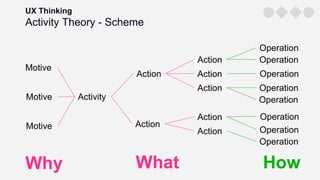
Activity Theory
To understand and design for outcomes we
need a theory which is able to describe
users motives, activities and actions.
It will help us analyse data from user
research and will make it easier to frame
our solution when we start to ideate.
UX Thinking
Activity Theory - Scheme
Activity
Motive
Motive
Motive
Action
Action
Action
Action
Action
Action
Action
Operation
Operation
Operation
Operation
Operation
Operation
Operation
Operation
Why What How
UX Thinking
Activity Theory – Motives (sensu Diefenbach & Hassenzahl)
Relatedness Autonomy Competence
SecurityStimulation Meaning Popularity
UX Thinking
Activity Theory - Example
Activity
Motive
Motive
Motive
Action
Action
Action
Action
Action
Action
Action
Operation
Operation
Operation
Operation
Operation
Operation
Operation
Operation
Why What How
Trip around
the world
with partner
Relatedness
Stimulation
Meaning
Information
retrieval on
Wikipedia
Typing
“Vietnam”
into search
box
Research
on Vietnam
UX Thinking
Modelle – 3 Dimensionen
If you break it on the
motivation and activity level
you won’t be able to fix it on
the operation level.
UX Thinking
Activity Theory – Artifacts
Activity
Motive
Motive
Motive
Action
Action
Action
Action
Handlung
Action
Action
Operation
Operation
Operation
Operation
Operation
Operation
Operation
Operation
Epics  User Stories  Interface
UX Thinking
Modelle – 3 Dimensionen
Good user stories describe
actions in the context of the
users needs – they must not
describe the solution on an
interface level.
Communities of Trust
UX Thinking - Phases
Research
Discover Define
Ideation
Generate Refine
Understanding possibilities
Agile
Development
Implementation
Project
Incubation
Strategy
Vision
Finding solutions
Communities of Trust
UX Thinking - Phases
Research
Discover Define
Ideation
Generate Refine
From product discovery to product delivery
Agile
Development
Implementation
Project
Incubation
Strategy
Vision
UX Thinking
Modelle – 3 Dimensionen
In all phases business, technology
and UX experts collaborate and
communicate closely with the
intention of creating a shared
understanding of the solution to build.
UX Thinking
In the future
4-day advanced training
• Two events planned for 2018 (May & September)
• Trainers: Dr. Herbert A. Meyer & Hias Wrba
• Target groups: Product Owner, Developer, UX, Management
Community of Practice
• We aim to build a community of practitioners around the
central UXT ideas to further the advancement of the approach
UX Thinking
Modelle – 3 Dimensionen
Focus on Vision Statements
UX Thinking
Vision Statement
A good vision for the solution furthers
shared understanding and serves as a
source of motivation and inspiration for the
whole team.
The vision is the benchmark for all further
deliverables.
UX Thinking
Vision Statements – The Basics
For whom?
For which group(s) of users are we creating our
solution? Who is our primary person?
In which field?
What activity is aided by our solution? What motives
play a role in the context of this activity?
What?
What are the key actions? Which needs play a role in
the context of these actions?
Motives &
Activities
Key Actions
User groups
UX Thinking
Modelle – 3 Dimensionen
Focus on Shared Understanding
UX Thinking
Shared Understanding
UX Thinking
Project Aristotle
A team of scientists at Google starts out to
answer the big question:
What is it that makes teams successful?
UX Thinking
Project Aristotle
• Combining the best people?
• Introverts work better with other
introverts?
• Teams are more effective when
everyone is friends away from work?
NOPE
NOPE
NOPE
WELL…
UX Thinking
Psychological Safety
Evidence for a collective intelligence factor in the
performance of groups
Studie Carnegie Mellon / MIT, Science 29, Oct. 2009
• High social sensitivity of all members
• A sense of confidence that the team will
not embarrass, reject or punish someone
for speaking up
• Every member speaks in roughly the same
proportion (moderated or not)
UX Thinking
Lencioni: The Five Dysfunctions of a Team
TrustAbsence of
ConflictFear of
CommitmentLack of
AccountabilityAvoidance of
ResultsInattention to
To be continued...
Kontakt:
hello@hiaswrba.net
@screaminHias
meyer@artop.de
@ekphorie

UX Thinking - an introduction

  • 1.
    UX Thinking Dr. HerbertA. Meyer & Hias Wrba Berlin 2017 (english language version)
  • 2.
    UX Thinking Modelle –3 Dimensionen an introduction
  • 3.
    UX Thinking Modelle –3 Dimensionen UX Thinking (UXT) strifes to bridge the current divide between human- centered design - and agile development practices to help teams build digital solutions that have a lasting business impact.
  • 4.
    Communities of Trust UXThinking - Ideas Shared Understanding Do your part to create an atmosphere of trust and psychological safety among those you work with and use this as a basis for creating a shared understanding of what you are trying to achieve and why. Bricolage Know, understand and constantly broaden your repertoire of methodologies and use your intuition to improvise with it. Don’t be afraid to break rules - but do it consciously. Critical Thinking Never stop asking questions and acknowledging assumptions. Remain curious and continue to challenge yourself and others. Use logic and reasoning to identify strengths and weaknesses of alternative solutions to problems.
  • 5.
    UX Thinking 3 dimensionsshaping solutions Technology Solution Relevant keywords Companies, business goals, organisational purpose, structures, business processes, business analysis… Users, well-being, experiences, needs, tasks, effectiveness, efficiency, satisfaction… frameworks, platforms, languages, features, standards, architectures…
  • 6.
    UX Thinking 3 dimensionsshaping solutions Trends Lean Startup Lean UX New Work Design Thinking Human-Centered Design Agile Development Technology Solution
  • 7.
    UX Thinking 3 dimensionsshaping solutions Output What we did build Outcome What it changed for our users Impact What it changed for our organisation Technology Solution
  • 8.
    UX Thinking Modelle –3 Dimensionen Strategize for impact Design for outcome Build for output
  • 9.
    UX Thinking Activity Theory Tounderstand and design for outcomes we need a theory which is able to describe users motives, activities and actions. It will help us analyse data from user research and will make it easier to frame our solution when we start to ideate.
  • 10.
    UX Thinking Activity Theory- Scheme Activity Motive Motive Motive Action Action Action Action Action Action Action Operation Operation Operation Operation Operation Operation Operation Operation Why What How
  • 11.
    UX Thinking Activity Theory– Motives (sensu Diefenbach & Hassenzahl) Relatedness Autonomy Competence SecurityStimulation Meaning Popularity
  • 12.
    UX Thinking Activity Theory- Example Activity Motive Motive Motive Action Action Action Action Action Action Action Operation Operation Operation Operation Operation Operation Operation Operation Why What How Trip around the world with partner Relatedness Stimulation Meaning Information retrieval on Wikipedia Typing “Vietnam” into search box Research on Vietnam
  • 13.
    UX Thinking Modelle –3 Dimensionen If you break it on the motivation and activity level you won’t be able to fix it on the operation level.
  • 14.
    UX Thinking Activity Theory– Artifacts Activity Motive Motive Motive Action Action Action Action Handlung Action Action Operation Operation Operation Operation Operation Operation Operation Operation Epics  User Stories  Interface
  • 15.
    UX Thinking Modelle –3 Dimensionen Good user stories describe actions in the context of the users needs – they must not describe the solution on an interface level.
  • 16.
    Communities of Trust UXThinking - Phases Research Discover Define Ideation Generate Refine Understanding possibilities Agile Development Implementation Project Incubation Strategy Vision Finding solutions
  • 17.
    Communities of Trust UXThinking - Phases Research Discover Define Ideation Generate Refine From product discovery to product delivery Agile Development Implementation Project Incubation Strategy Vision
  • 18.
    UX Thinking Modelle –3 Dimensionen In all phases business, technology and UX experts collaborate and communicate closely with the intention of creating a shared understanding of the solution to build.
  • 19.
    UX Thinking In thefuture 4-day advanced training • Two events planned for 2018 (May & September) • Trainers: Dr. Herbert A. Meyer & Hias Wrba • Target groups: Product Owner, Developer, UX, Management Community of Practice • We aim to build a community of practitioners around the central UXT ideas to further the advancement of the approach
  • 20.
    UX Thinking Modelle –3 Dimensionen Focus on Vision Statements
  • 21.
    UX Thinking Vision Statement Agood vision for the solution furthers shared understanding and serves as a source of motivation and inspiration for the whole team. The vision is the benchmark for all further deliverables.
  • 22.
    UX Thinking Vision Statements– The Basics For whom? For which group(s) of users are we creating our solution? Who is our primary person? In which field? What activity is aided by our solution? What motives play a role in the context of this activity? What? What are the key actions? Which needs play a role in the context of these actions? Motives & Activities Key Actions User groups
  • 23.
    UX Thinking Modelle –3 Dimensionen Focus on Shared Understanding
  • 24.
  • 25.
    UX Thinking Project Aristotle Ateam of scientists at Google starts out to answer the big question: What is it that makes teams successful?
  • 26.
    UX Thinking Project Aristotle •Combining the best people? • Introverts work better with other introverts? • Teams are more effective when everyone is friends away from work? NOPE NOPE NOPE WELL…
  • 27.
    UX Thinking Psychological Safety Evidencefor a collective intelligence factor in the performance of groups Studie Carnegie Mellon / MIT, Science 29, Oct. 2009 • High social sensitivity of all members • A sense of confidence that the team will not embarrass, reject or punish someone for speaking up • Every member speaks in roughly the same proportion (moderated or not)
  • 28.
    UX Thinking Lencioni: TheFive Dysfunctions of a Team TrustAbsence of ConflictFear of CommitmentLack of AccountabilityAvoidance of ResultsInattention to
  • 29.