UX Design & RedesignShanshanMa@shanshanma8/9/2011
Two Types of Design SituationsRedesign/optimize existing products – criticize thingsDesign new products – invent things
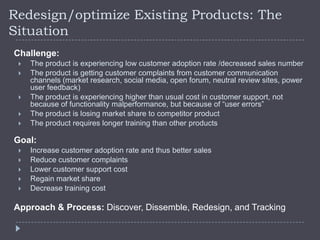
Redesign/optimize Existing Products: The SituationChallenge:The product is experiencing low customer adoption rate /decreased sales numberThe product is getting customer complaints from customer communication channels (market research, social media, open forum, neutral review sites, power user feedback)The product is experiencing higher than usual cost in customer support, not because of functionality malperformance, but because of “user errors”The product is losing market share to competitor productThe product requires longer training than other productsGoal:Increase customer adoption rate and thus better salesReduce customer complaintsLower customer support costRegain market shareDecrease training costApproach & Process: Discover, Dissemble, Redesign, and Tracking
Redesign/optimize Existing Products: The Approach2. Dissemble the problem & prioritizationMismatch between user workflow and existing workflowGap between user mental model and designer mental modelFind usability pitfalls and mistakes
Redesign/optimize Existing Products: The Approach3. RedesignPinpoint areas for improvementsFocus on areas that make the biggest impact on the user experienceFocus on areas that have the highest ROIFocus on THE BIG PICTURE
Redesign/optimize Existing Products: The Approach4. TrackingLaunch and effectively track optimization results (before vs. after)A/B testing (existing vs. new)
Design New Products: The SituationChallenge:Know the market, not knowing the users/consumers/customersKnow the market, know the users, have an idea, need to realize the idea and make the product come to lifeGoal:Leverage user knowledge to effectively drive product strategyPut users in the center of the design process to maximize the opportunities with the next generation of products. Develop winning productsApproach & Process: User Centered Design
The Design Process:Stakeholder workshopuser research (survey & interview)Persona developmentContent inventory and Information architectureSketch & wireframeWireframe testingVisual design and design testingDevelopment and pre-launch testingPost-launch testing
Design New Product: The Approach1. Foundational user research to understand target audiencePersona development (quantitative and qualitative user research)Task/workflow analysis; Use cases; StoriesStakeholder/team alignment exercise
Design New Product: The Approach2. Prototyping & UI designSketch & low-fi UI (wireframe)– to communicate ideas among designersHigh-fi UI (html, psd)– to communicate design to engineersInteractive & multimedia UI (html, flash)– to communicate product to stakeholders
Design New Product: The Approach3. Early testing & Iterative testingCognitive walkthroughInformal, quick & dirty testing Discount usability testingFace-to-face testing, remote and online testing
Design New Product: The Approach4. Pre-launch testing; post-launch testing; ongoing optimizationUser acceptance testingA/B testingOngoing new feature release and site updates
In SummaryFor successful UX redesign, use the right method to pinpoint the problem and come up with the optimized redesign solution.For successful UX design, use the user centered design methodology and seamlessly integrate the UX process into the product development process.
About Me@ShanshanMa: User Experience Designer
Thank you!

UX design & redesign

  • 1.
    UX Design &RedesignShanshanMa@shanshanma8/9/2011
  • 2.
    Two Types ofDesign SituationsRedesign/optimize existing products – criticize thingsDesign new products – invent things
  • 3.
    Redesign/optimize Existing Products:The SituationChallenge:The product is experiencing low customer adoption rate /decreased sales numberThe product is getting customer complaints from customer communication channels (market research, social media, open forum, neutral review sites, power user feedback)The product is experiencing higher than usual cost in customer support, not because of functionality malperformance, but because of “user errors”The product is losing market share to competitor productThe product requires longer training than other productsGoal:Increase customer adoption rate and thus better salesReduce customer complaintsLower customer support costRegain market shareDecrease training costApproach & Process: Discover, Dissemble, Redesign, and Tracking
  • 4.
    Redesign/optimize Existing Products:The Approach2. Dissemble the problem & prioritizationMismatch between user workflow and existing workflowGap between user mental model and designer mental modelFind usability pitfalls and mistakes
  • 5.
    Redesign/optimize Existing Products:The Approach3. RedesignPinpoint areas for improvementsFocus on areas that make the biggest impact on the user experienceFocus on areas that have the highest ROIFocus on THE BIG PICTURE
  • 6.
    Redesign/optimize Existing Products:The Approach4. TrackingLaunch and effectively track optimization results (before vs. after)A/B testing (existing vs. new)
  • 7.
    Design New Products:The SituationChallenge:Know the market, not knowing the users/consumers/customersKnow the market, know the users, have an idea, need to realize the idea and make the product come to lifeGoal:Leverage user knowledge to effectively drive product strategyPut users in the center of the design process to maximize the opportunities with the next generation of products. Develop winning productsApproach & Process: User Centered Design
  • 8.
    The Design Process:Stakeholderworkshopuser research (survey & interview)Persona developmentContent inventory and Information architectureSketch & wireframeWireframe testingVisual design and design testingDevelopment and pre-launch testingPost-launch testing
  • 9.
    Design New Product:The Approach1. Foundational user research to understand target audiencePersona development (quantitative and qualitative user research)Task/workflow analysis; Use cases; StoriesStakeholder/team alignment exercise
  • 10.
    Design New Product:The Approach2. Prototyping & UI designSketch & low-fi UI (wireframe)– to communicate ideas among designersHigh-fi UI (html, psd)– to communicate design to engineersInteractive & multimedia UI (html, flash)– to communicate product to stakeholders
  • 11.
    Design New Product:The Approach3. Early testing & Iterative testingCognitive walkthroughInformal, quick & dirty testing Discount usability testingFace-to-face testing, remote and online testing
  • 12.
    Design New Product:The Approach4. Pre-launch testing; post-launch testing; ongoing optimizationUser acceptance testingA/B testingOngoing new feature release and site updates
  • 13.
    In SummaryFor successfulUX redesign, use the right method to pinpoint the problem and come up with the optimized redesign solution.For successful UX design, use the user centered design methodology and seamlessly integrate the UX process into the product development process.
  • 14.
    About Me@ShanshanMa: UserExperience Designer
  • 15.