A Complete Guide to Building
a Ground-Breaking UX Design
Strategy
https://fibonalabs.com/
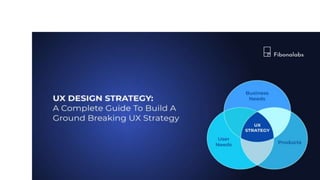
To provide users with the best user experience, we need to have a roadmap
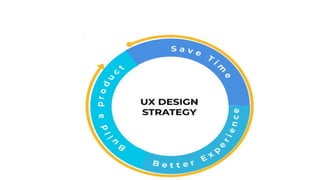
which connects business needs, products, and users. UX design strategy helps
you to create a clear roadmap to solve both business and user needs. With a
successful UX design strategy you can:
1. Build a product that your users are waiting for.
2. Save a lot of time in the development.
3. Provide a better experience.
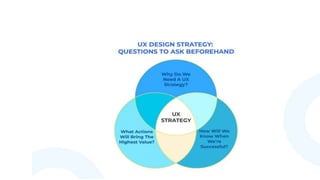
UX Design Strategy: Questions to Ask Beforehand
Before building a UX design strategy, you should have answers to the following
questions:
● Why do we need a UX strategy?: Think about the reasons before
building the UX design strategy. One of the reasons can be to meet user
expectations and build a customer-centric product that can improve brand
images, and sales and in the end generates revenue.
● What actions will bring the highest value?: To make the UX strategy
process work you need to understand the business and the product. You
need to come up with a solution that meets the needs of customers and
stakeholders.
How Will We Know When We’re Successful?
Before starting the UX Strategy process, define the metrics that can be used to
measure the success of the UX strategy.
Importance of UX Design Strategy
Through the perfect UX Strategy, you can ensure that the designers along with
stakeholders are trying to solve the problems that users are facing. Below I
have mentioned the reasons why business owners along with designers should
work on UX design Strategy.
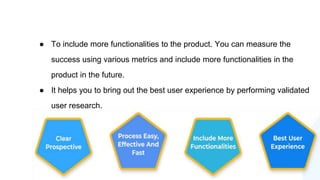
● To give a clear perspective about the problem that needs to solve through
the digital product, and also know about the product outcomes.
● To make the design process easy, effective, and fast. The UX strategy
process keeps the business owners, users, and designers on the same
● To include more functionalities to the product. You can measure the
success using various metrics and include more functionalities in the
product in the future.
● It helps you to bring out the best user experience by performing validated
user research.
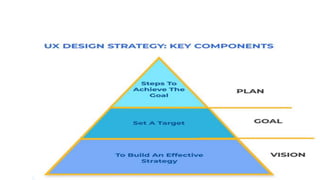
Key Components of UX Design Strategy
UX Strategy helps you to unveil the user's needs, what are you trying to build to
fulfil those needs, and how you are going to do it. Some key components take
centre stage while strategizing:
● Vision: To build an effective strategy for a digital product, you need to
know what and why we are building that product. A user-centric product
can be built on a clear vision. A strategic vision can be based on business
strategy and solving real problems faced by users.
● Goals and Key Performance Indicators: Once we have a vision, then we
will move on to set goals. Align stakeholders' and users' needs to set
goals. After the goal setting, define key performance indicators (KPIs) to
measure success.
● Plan: To achieve each goal within the time limit, you can divide each goal
into multiple objectives. Objectives can include user research, competitor
analysis, stakeholder interviews, design explorations, etc.
Steps to Build a UX Design Strategy
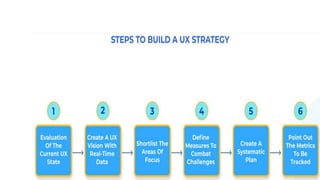
● Evaluation of the Current UX State: Let’s start with the first step i.e.,
evaluation of the current state of the UX. In this phase of UX strategy
process, the focus is mainly on three things:
➢ How effective is your business model? Here we figure out things like
our ability to retain our customers, user’s satisfaction of our products,
helpfulness of our business model, etc.
➢ Acknowledging the problems that already exist. A very important
aspect of this stage is to keep in mind the already existing problems, for
➢ Is the number of resources you have, enough? It is very important to
know whether the resources you have are enough or not for your business.
Sufficient number of resources plays an important part in a business’
success.
● Create a UX Vision with Real-Time Data: Once you have done the
analysis of your business’ current state, it is important for you to set goals
based on it. Let’s suppose you can focus on:
➢ Reducing app complexities
➢ Adding new features to the app yet maintaining its user-friendliness, and
● Shortlist the Areas of Focus: This stage helps you in giving eye to
details. In other words, here you identify the minute areas where focus is
required.
➢ Conduct retrospective meetings from different departments like sales,
engineering, design and make a list of customer’s need coming from these
areas. Now identify which feature should be given priority in terms of
commencing its designing.
➢ Next you can focus on your product’s outcome and figure out what needs
your attention. For example, should you work on increasing conversion
➢ Make a list of your competitors and identify their strong areas like their
company size, price range, how they do things differently, and extract their
positive points
➢ Examine which UX area should be prioritized based on customer
feedbacks.
After progressing till step 3, the UX strategy process heads towards
understanding the challenges, creating a plan, and figuring out the metrics that
need tracking.
● Define Measures to Combat Challenges: In this step you create guidelines
that help you overcome challenges as well as work in a streamlined
manner. Here you can create rules such as:
➢ Create timeline for particular task
➢ Keep track of all the activities etc.
● Create a Systematic Plan: All the above discusses steps lead you to a
systematic plan. With the help of the above analysis, you can create a
high-level plan. This plan comprises of a group of activities like:
1. Developing a design system
2. Commencing usability testing
3. Auditing the content and syncing it with UX strategy, and so much more.
● Point Out the Metrics to be Tracked: This is the final step for defining UX
strategies where your focus should be on identifying the metrics that need
to be tracked. It is advisable to keep track of the changes in the metrics
In turn this step helps you in knowing whether you are on the right track in
achieving your goals.
UX Design Strategy at Fibonalabs
At Fibonalabs, we build innovative and user-friendly products keeping in
consideration business goals, technical feasibility, and user challenges.
We strategically design your solution with the help of competitor analysis. We
keep ourselves up to date with competitors' product features, activities, and
services. With a detailed analysis of information, we can bring unique features
to the product. It allows us to build a strong UX design strategy for any product.
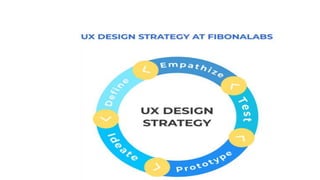
Our UX Strategy approach is divided into five phases that consist of various
methodologies.
Let's understand how UX Strategy processes progress with every phase:
● Empathize: This is the first step where we empathize with the design.
Here we discuss methodologies like desk research, quantitative research,
comparative research, and different user stories and scenarios. The time
given to this research varies from project to project.
● Define: In the define phase, we try to sort out the valuable information
from the bulk of data that we obtained after our research. We also define
● Ideate: This is a brainstorming phase where we decide how can we better
the existing design. With the help of user flows we define flowcharts that
help us in calculating different user scenarios. We also use information
architecture that helps users in adjusting to the functionality of the product.
● Prototype: In this phase, we begin taking care of the design system, i.e.,
the colour schemes to be used, the buttons to be added, a grouping of the
components in a layout, and so on. We use Hi-Fidelity wireframes that help
in understanding the actual look and feel of the final product.
● Test: This is the final phase of our UX Design strategy, where we test the
functions as well as the interface of the product created. We perform this
testing with real users to ensure that our design has resolved the existing
problems of the users.
Conclusion
Ground-breaking UX strategy backed by a solid UX strategy process, leads to a
successful digital product. You can uncover answers about users' needs,
business goals, and a roadmap to achieve them. If you are looking forward to
building a user-centric digital product, then UX design strategy can be the first
milestone that you need to cross.
THANK YOU

A Complete Guide to Building a Ground-Breaking UX Design Strategy

  • 1.
    A Complete Guideto Building a Ground-Breaking UX Design Strategy https://fibonalabs.com/
  • 3.
    To provide userswith the best user experience, we need to have a roadmap which connects business needs, products, and users. UX design strategy helps you to create a clear roadmap to solve both business and user needs. With a successful UX design strategy you can: 1. Build a product that your users are waiting for. 2. Save a lot of time in the development. 3. Provide a better experience.
  • 5.
    UX Design Strategy:Questions to Ask Beforehand Before building a UX design strategy, you should have answers to the following questions: ● Why do we need a UX strategy?: Think about the reasons before building the UX design strategy. One of the reasons can be to meet user expectations and build a customer-centric product that can improve brand images, and sales and in the end generates revenue.
  • 6.
    ● What actionswill bring the highest value?: To make the UX strategy process work you need to understand the business and the product. You need to come up with a solution that meets the needs of customers and stakeholders. How Will We Know When We’re Successful? Before starting the UX Strategy process, define the metrics that can be used to measure the success of the UX strategy.
  • 8.
    Importance of UXDesign Strategy Through the perfect UX Strategy, you can ensure that the designers along with stakeholders are trying to solve the problems that users are facing. Below I have mentioned the reasons why business owners along with designers should work on UX design Strategy. ● To give a clear perspective about the problem that needs to solve through the digital product, and also know about the product outcomes. ● To make the design process easy, effective, and fast. The UX strategy process keeps the business owners, users, and designers on the same
  • 9.
    ● To includemore functionalities to the product. You can measure the success using various metrics and include more functionalities in the product in the future. ● It helps you to bring out the best user experience by performing validated user research.
  • 10.
    Key Components ofUX Design Strategy UX Strategy helps you to unveil the user's needs, what are you trying to build to fulfil those needs, and how you are going to do it. Some key components take centre stage while strategizing: ● Vision: To build an effective strategy for a digital product, you need to know what and why we are building that product. A user-centric product can be built on a clear vision. A strategic vision can be based on business strategy and solving real problems faced by users.
  • 11.
    ● Goals andKey Performance Indicators: Once we have a vision, then we will move on to set goals. Align stakeholders' and users' needs to set goals. After the goal setting, define key performance indicators (KPIs) to measure success. ● Plan: To achieve each goal within the time limit, you can divide each goal into multiple objectives. Objectives can include user research, competitor analysis, stakeholder interviews, design explorations, etc.
  • 13.
    Steps to Builda UX Design Strategy ● Evaluation of the Current UX State: Let’s start with the first step i.e., evaluation of the current state of the UX. In this phase of UX strategy process, the focus is mainly on three things: ➢ How effective is your business model? Here we figure out things like our ability to retain our customers, user’s satisfaction of our products, helpfulness of our business model, etc. ➢ Acknowledging the problems that already exist. A very important aspect of this stage is to keep in mind the already existing problems, for
  • 14.
    ➢ Is thenumber of resources you have, enough? It is very important to know whether the resources you have are enough or not for your business. Sufficient number of resources plays an important part in a business’ success. ● Create a UX Vision with Real-Time Data: Once you have done the analysis of your business’ current state, it is important for you to set goals based on it. Let’s suppose you can focus on: ➢ Reducing app complexities ➢ Adding new features to the app yet maintaining its user-friendliness, and
  • 15.
    ● Shortlist theAreas of Focus: This stage helps you in giving eye to details. In other words, here you identify the minute areas where focus is required. ➢ Conduct retrospective meetings from different departments like sales, engineering, design and make a list of customer’s need coming from these areas. Now identify which feature should be given priority in terms of commencing its designing. ➢ Next you can focus on your product’s outcome and figure out what needs your attention. For example, should you work on increasing conversion
  • 16.
    ➢ Make alist of your competitors and identify their strong areas like their company size, price range, how they do things differently, and extract their positive points ➢ Examine which UX area should be prioritized based on customer feedbacks.
  • 18.
    After progressing tillstep 3, the UX strategy process heads towards understanding the challenges, creating a plan, and figuring out the metrics that need tracking. ● Define Measures to Combat Challenges: In this step you create guidelines that help you overcome challenges as well as work in a streamlined manner. Here you can create rules such as: ➢ Create timeline for particular task ➢ Keep track of all the activities etc.
  • 19.
    ● Create aSystematic Plan: All the above discusses steps lead you to a systematic plan. With the help of the above analysis, you can create a high-level plan. This plan comprises of a group of activities like: 1. Developing a design system 2. Commencing usability testing 3. Auditing the content and syncing it with UX strategy, and so much more. ● Point Out the Metrics to be Tracked: This is the final step for defining UX strategies where your focus should be on identifying the metrics that need to be tracked. It is advisable to keep track of the changes in the metrics
  • 20.
    In turn thisstep helps you in knowing whether you are on the right track in achieving your goals. UX Design Strategy at Fibonalabs At Fibonalabs, we build innovative and user-friendly products keeping in consideration business goals, technical feasibility, and user challenges. We strategically design your solution with the help of competitor analysis. We keep ourselves up to date with competitors' product features, activities, and services. With a detailed analysis of information, we can bring unique features to the product. It allows us to build a strong UX design strategy for any product.
  • 21.
    Our UX Strategyapproach is divided into five phases that consist of various methodologies. Let's understand how UX Strategy processes progress with every phase: ● Empathize: This is the first step where we empathize with the design. Here we discuss methodologies like desk research, quantitative research, comparative research, and different user stories and scenarios. The time given to this research varies from project to project. ● Define: In the define phase, we try to sort out the valuable information from the bulk of data that we obtained after our research. We also define
  • 22.
    ● Ideate: Thisis a brainstorming phase where we decide how can we better the existing design. With the help of user flows we define flowcharts that help us in calculating different user scenarios. We also use information architecture that helps users in adjusting to the functionality of the product. ● Prototype: In this phase, we begin taking care of the design system, i.e., the colour schemes to be used, the buttons to be added, a grouping of the components in a layout, and so on. We use Hi-Fidelity wireframes that help in understanding the actual look and feel of the final product.
  • 23.
    ● Test: Thisis the final phase of our UX Design strategy, where we test the functions as well as the interface of the product created. We perform this testing with real users to ensure that our design has resolved the existing problems of the users.
  • 25.
    Conclusion Ground-breaking UX strategybacked by a solid UX strategy process, leads to a successful digital product. You can uncover answers about users' needs, business goals, and a roadmap to achieve them. If you are looking forward to building a user-centric digital product, then UX design strategy can be the first milestone that you need to cross.
  • 26.