Ultraviolet Radiation Therapy
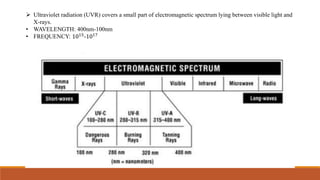
 Ultraviolet radiation (UVR) covers a small part of electromagnetic spectrum lying between visible light and
X-rays.
• WAVELENGTH: 400nm-100nm
• FREQUENCY: 1015-1017
TYPES OF UVR
• UVA
400-315nm
Effects: Erythema without pigmentation
• UVB
315-280nm
Effects: Erythema without pigmentation, formation of Vitamin D, skin tanning (blisters/burn)
• UVC
280-100nm
Kills bacteria, formation of Vitamin D, Blisters/burns
PRODUCTION
Therapeutic UV is usually produced by passage of a current through an ionized vapor- often
mercury vapor at low pressure or high temperatures
Devices commonly used are:
1. Air cooled
2. Water cooled
• Produced by mercury vapor lamps, which consists of quartz burner tube evacuated from
air and containing traces of argon gas and mercury under reduced pressure
• An electrode is inserted at each end of the burner tube
• Current is applied to the electrodes, mercury vaporizes and the passage of electrons
through the vapor establishes ultraviolet arc
• It is necessary to incorporate a cooling device into the lamp, especially if the lamp is used
close to or in contact with the patient
• Devices commonly use air cooling (using air circulating fan) or water cooling
(using a water jacket surrounding the burner continually circulating water)
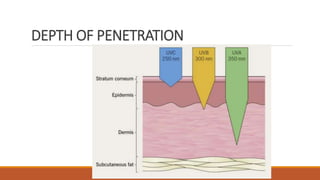
DEPTH OF PENETRATION
PHYSIOLOGICAL EFFECTS
IMMEDIATE/ACUTE EFFECTS
• Erythema
• Pigmentation
• Increased skin growth
• Vitamin D production
• Immunosuppressive effects
• Effects on eye
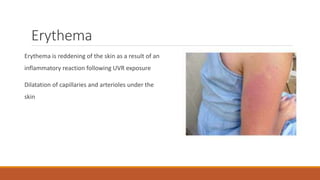
Erythema
Erythema is reddening of the skin as a result of an
inflammatory reaction following UVR exposure
Dilatation of capillaries and arterioles under the
skin
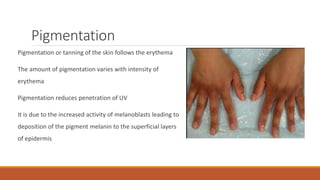
Pigmentation
Pigmentation or tanning of the skin follows the erythema
The amount of pigmentation varies with intensity of
erythema
Pigmentation reduces penetration of UV
It is due to the increased activity of melanoblasts leading to
deposition of the pigment melanin to the superficial layers
of epidermis
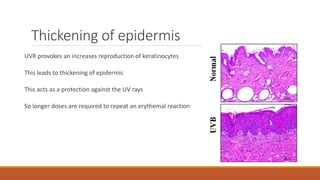
Thickening of epidermis
UVR provokes an increases reproduction of keratinocytes
This leads to thickening of epidermis
This acts as a protection against the UV rays
So longer doses are required to repeat an erythemal reaction
Vitamin D production
UVB can convert sterols in the skin into Vitamin D
Sub erythemal doses of UVB are adequate to promote Vitamin D synthesis
Immunosuppressive effects
• UV stimulates the proliferation of suppressor T cells
• T cells inhibit antibody production
• This immunosuppressive effects may contribute to the development of skin cancer
UVR dosage
Skin response depends upon:
• Quantity of UVR energy applied to the skin
• Biological responsiveness of skin
Quantity of UVR energy
1. Output of the lamp
Low volt (30-110V) High amplitude (5A)
High Volt (3000V) Low amplitude (15mA)
2. Distance between the lamp and skin
3. Angle at which radiation falls on the skin
4. Time for which radiations are applied on the skin
Biological responsiveness
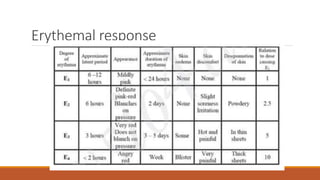
Erythemal response
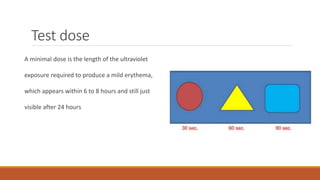
Test dose
A minimal dose is the length of the ultraviolet
exposure required to produce a mild erythema,
which appears within 6 to 8 hours and still just
visible after 24 hours
Test dose
Calculation of dosage
E1 is determined from the skin test and the other erythemal doses can be calculated as follows:
Sub erythemal 75% of E1
E2= 2.5 X E1
E3= 5 X E1
E4= 10 X E1
Double E4= 20 X E1
E4 and Double E4 are used on an open wound
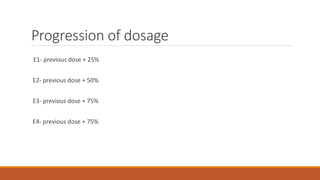
Progression of dosage
E1- previous dose + 25%
E2- previous dose + 50%
E3- previous dose + 75%
E4- previous dose + 75%
Frequency of Treatment
E1= Alternate days
E2= Twice a week
E3= 2 weeks apart
E4= Only very local areas, not frequently given
Therapeutic Uses
• Psoriasis
• Acne vulgaris
• Eczema
• Chronic infection/ Wound
• Vitiligo
• Protection for hypersensitive skin
• Vitamin D deficiency
• Pruritis
Psoriasis
• A skin condition which presents localized plaques
in which the rate of cell turnover from the basal
layer through to the superficial layer is too rapid
• The aim of ultraviolet radiation is to decrease the
rate of DNA synthesis in the cells of the skin and
thus slow down their proliferation
PUVA
Photo chemotherapy
• Psoralen-type drug is given to the patient 2 hours before, to make him/her sensitive to UVA
radiations
• This will produce an erythema at lower intensities than normal
• The drug 8-methoxy-psoralen is used to make the patient highly reactive to UVA once it has
been absorbed, for 6-8 hours
• As a peak of PUVA erythema occurs at 48-72 hours, treatment should be given twice a week
until clearance
• Approximately 12-18 exposures
Acne Vulgaris
• Chronic inflammatory condition of the
pilosebaceous unit especially affecting the face,
chest and back
• Usually E2 is used
Eczema
• An inflammatory response in the skin with associated edema,
itching with redness, scaling, vesicles and exudation of serum
on the skin
• It may be caused by contact dermatitis
• Mild ultraviolet treatment is given
Infected Wound
• Treated with high doses of UVR
• A Kromayer lamp is successful in inhibiting bacterial colony growth
• Dose must be E4
Non infected wound
• The aim of ultraviolet radiation is to stimulate growth of granulation tissue and thus speed up repair
• Can be used in surgical incisions, pressure areas, venous and arterial ulcers
• UVA, E3 dose is sufficient
Incipient pressure areas
UVR may be used to prevent pressure areas from breaking down
Stimulate the growth of epithelial cells and to destroy surface
bacteria
E1 dose progressed daily using the Kromayer lamp
In areas such as the heels or the elbows where the skin is thicker,
E2 may be used
Vitiligo
An autoimmune disease in which destruction of melanocytes in local
areas causes white patches to appear on the skin
Both UVA and UVB stimulate melanocyte activity
UVA seems to provoke a darker and long lasting tan although the
protective effects do not seem to be marked
UVB provokes more thickening
Vitamin D deficiency
Vitamin D3 is formed in the skin by the action of UVB and UVC
Natural sunlight can also be curative for vitamin D deficiency diseases
Contraindications
• Acute skin conditions
• Existing Ultraviolet erythema
• Skin damage due to ionizing radiations
• Photo allergy
• Acute febrile illness
• Recent skin grafts
Dangers
• Shock
• Eyes
• Overdosage
• Sensitization
References
1. Electrotherapy explained by Low and Reed
2. Textbook of Electrotherapy by Singh Jagmohan
3. Ultraviolet Radiation by Sagar Naik

UVR Presentation.pptx

  • 1.
  • 2.
     Ultraviolet radiation(UVR) covers a small part of electromagnetic spectrum lying between visible light and X-rays. • WAVELENGTH: 400nm-100nm • FREQUENCY: 1015-1017
  • 3.
    TYPES OF UVR •UVA 400-315nm Effects: Erythema without pigmentation • UVB 315-280nm Effects: Erythema without pigmentation, formation of Vitamin D, skin tanning (blisters/burn) • UVC 280-100nm Kills bacteria, formation of Vitamin D, Blisters/burns
  • 4.
    PRODUCTION Therapeutic UV isusually produced by passage of a current through an ionized vapor- often mercury vapor at low pressure or high temperatures Devices commonly used are: 1. Air cooled 2. Water cooled
  • 5.
    • Produced bymercury vapor lamps, which consists of quartz burner tube evacuated from air and containing traces of argon gas and mercury under reduced pressure • An electrode is inserted at each end of the burner tube • Current is applied to the electrodes, mercury vaporizes and the passage of electrons through the vapor establishes ultraviolet arc
  • 6.
    • It isnecessary to incorporate a cooling device into the lamp, especially if the lamp is used close to or in contact with the patient • Devices commonly use air cooling (using air circulating fan) or water cooling (using a water jacket surrounding the burner continually circulating water)
  • 7.
  • 8.
    PHYSIOLOGICAL EFFECTS IMMEDIATE/ACUTE EFFECTS •Erythema • Pigmentation • Increased skin growth • Vitamin D production • Immunosuppressive effects • Effects on eye
  • 9.
    Erythema Erythema is reddeningof the skin as a result of an inflammatory reaction following UVR exposure Dilatation of capillaries and arterioles under the skin
  • 10.
    Pigmentation Pigmentation or tanningof the skin follows the erythema The amount of pigmentation varies with intensity of erythema Pigmentation reduces penetration of UV It is due to the increased activity of melanoblasts leading to deposition of the pigment melanin to the superficial layers of epidermis
  • 11.
    Thickening of epidermis UVRprovokes an increases reproduction of keratinocytes This leads to thickening of epidermis This acts as a protection against the UV rays So longer doses are required to repeat an erythemal reaction
  • 12.
    Vitamin D production UVBcan convert sterols in the skin into Vitamin D Sub erythemal doses of UVB are adequate to promote Vitamin D synthesis
  • 13.
    Immunosuppressive effects • UVstimulates the proliferation of suppressor T cells • T cells inhibit antibody production • This immunosuppressive effects may contribute to the development of skin cancer
  • 14.
    UVR dosage Skin responsedepends upon: • Quantity of UVR energy applied to the skin • Biological responsiveness of skin
  • 15.
    Quantity of UVRenergy 1. Output of the lamp Low volt (30-110V) High amplitude (5A) High Volt (3000V) Low amplitude (15mA) 2. Distance between the lamp and skin 3. Angle at which radiation falls on the skin 4. Time for which radiations are applied on the skin
  • 16.
  • 17.
  • 18.
    Test dose A minimaldose is the length of the ultraviolet exposure required to produce a mild erythema, which appears within 6 to 8 hours and still just visible after 24 hours
  • 19.
  • 20.
    Calculation of dosage E1is determined from the skin test and the other erythemal doses can be calculated as follows: Sub erythemal 75% of E1 E2= 2.5 X E1 E3= 5 X E1 E4= 10 X E1 Double E4= 20 X E1 E4 and Double E4 are used on an open wound
  • 21.
    Progression of dosage E1-previous dose + 25% E2- previous dose + 50% E3- previous dose + 75% E4- previous dose + 75%
  • 22.
    Frequency of Treatment E1=Alternate days E2= Twice a week E3= 2 weeks apart E4= Only very local areas, not frequently given
  • 23.
    Therapeutic Uses • Psoriasis •Acne vulgaris • Eczema • Chronic infection/ Wound • Vitiligo • Protection for hypersensitive skin • Vitamin D deficiency • Pruritis
  • 24.
    Psoriasis • A skincondition which presents localized plaques in which the rate of cell turnover from the basal layer through to the superficial layer is too rapid • The aim of ultraviolet radiation is to decrease the rate of DNA synthesis in the cells of the skin and thus slow down their proliferation
  • 25.
    PUVA Photo chemotherapy • Psoralen-typedrug is given to the patient 2 hours before, to make him/her sensitive to UVA radiations • This will produce an erythema at lower intensities than normal • The drug 8-methoxy-psoralen is used to make the patient highly reactive to UVA once it has been absorbed, for 6-8 hours • As a peak of PUVA erythema occurs at 48-72 hours, treatment should be given twice a week until clearance • Approximately 12-18 exposures
  • 26.
    Acne Vulgaris • Chronicinflammatory condition of the pilosebaceous unit especially affecting the face, chest and back • Usually E2 is used
  • 27.
    Eczema • An inflammatoryresponse in the skin with associated edema, itching with redness, scaling, vesicles and exudation of serum on the skin • It may be caused by contact dermatitis • Mild ultraviolet treatment is given
  • 28.
    Infected Wound • Treatedwith high doses of UVR • A Kromayer lamp is successful in inhibiting bacterial colony growth • Dose must be E4
  • 29.
    Non infected wound •The aim of ultraviolet radiation is to stimulate growth of granulation tissue and thus speed up repair • Can be used in surgical incisions, pressure areas, venous and arterial ulcers • UVA, E3 dose is sufficient
  • 30.
    Incipient pressure areas UVRmay be used to prevent pressure areas from breaking down Stimulate the growth of epithelial cells and to destroy surface bacteria E1 dose progressed daily using the Kromayer lamp In areas such as the heels or the elbows where the skin is thicker, E2 may be used
  • 31.
    Vitiligo An autoimmune diseasein which destruction of melanocytes in local areas causes white patches to appear on the skin Both UVA and UVB stimulate melanocyte activity UVA seems to provoke a darker and long lasting tan although the protective effects do not seem to be marked UVB provokes more thickening
  • 32.
    Vitamin D deficiency VitaminD3 is formed in the skin by the action of UVB and UVC Natural sunlight can also be curative for vitamin D deficiency diseases
  • 33.
    Contraindications • Acute skinconditions • Existing Ultraviolet erythema • Skin damage due to ionizing radiations • Photo allergy • Acute febrile illness • Recent skin grafts
  • 34.
    Dangers • Shock • Eyes •Overdosage • Sensitization
  • 35.
    References 1. Electrotherapy explainedby Low and Reed 2. Textbook of Electrotherapy by Singh Jagmohan 3. Ultraviolet Radiation by Sagar Naik