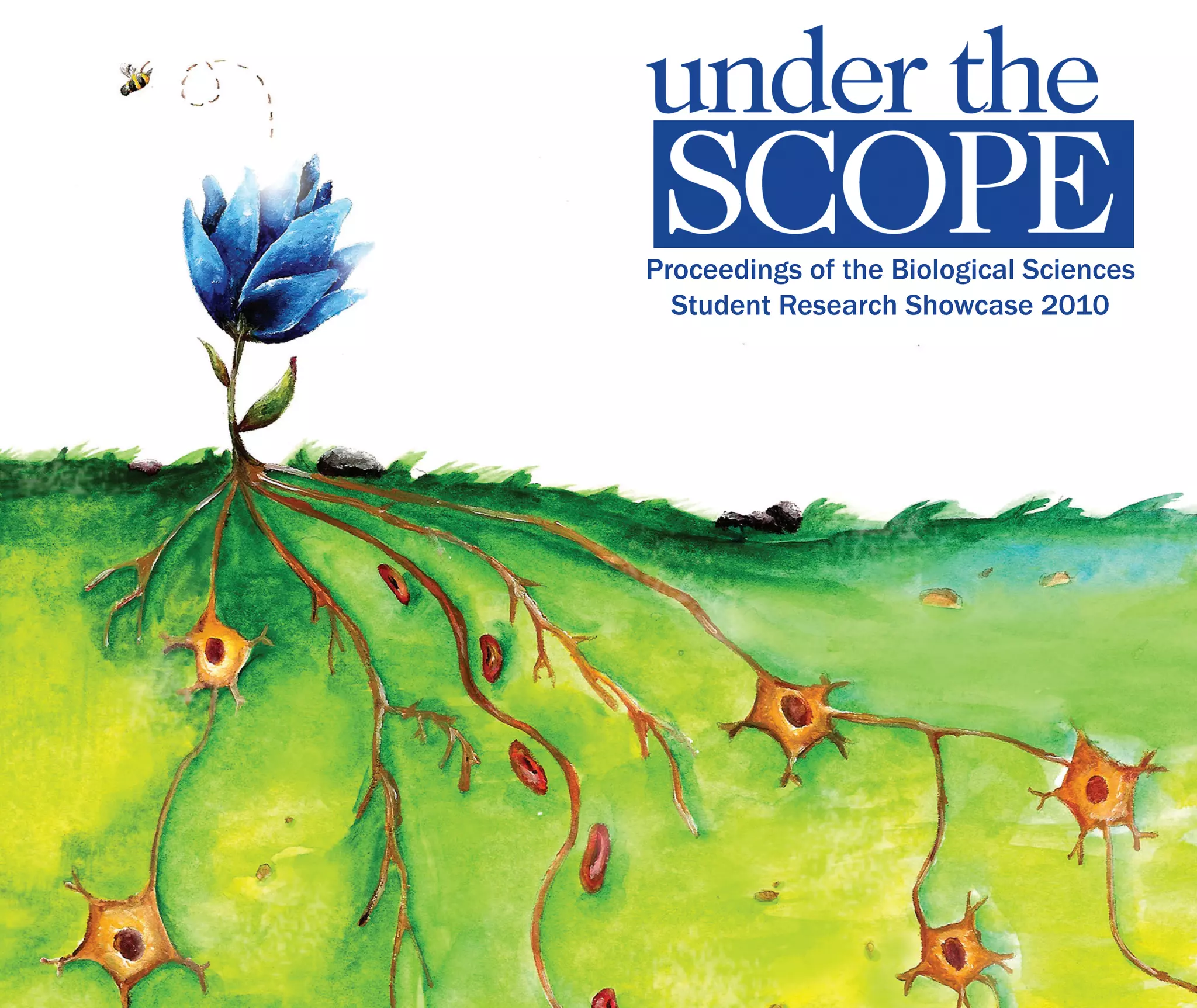
Proceedings of the Biological Sciences
Student Research Showcase 2010
B
ack in September, Dr. Gabriele Wienhausen
approached me and the research editors
of Saltman Quarterly with an intriguing
challenge: to convey the amazing research
contributions of undergraduates in a novel way,
one that would be easily understood by a lay
audience.
Eagerly, we sought to synthesize the research
presented at the 2010 Biological Sciences
Student Research Showcase into cohesive articles
and creative illustrations. We would bring the
accessibility and intrigue of Scientific American
and the Science Tuesday section of the New
York Times to UCSD. In short, we would take our
readers “under the scope” of exciting biological
research conducted by undergraduates right here,
on our university’s campus.
Biology affects everyone, though everyone has
a unique way of understanding the mechanisms
governing his or her life. To that end, Under the
Scope seeks to explain research not in overly
technical jargon but in terms of its relevance to
everyday life, and, to explore how other disciplines
can help us think of biology differently.
There is clearly a reason why this past year,
the UCS Division of Biological Sciences was
ranked number one in the National Research
Council’s assessment of over 5000 doctoral
programs. In my opinion, that reason goes beyond
the extraordinary strides we make in research to
also include the innovative spirit with which we
approach biology.
Under the Scope, an expansion of the Saltman
Quarterly Program, presents the work of student
researchers, student writers and student artists
alike. With this research brochure, it is our hope
to begin a new tradition within the university’s
already extant tradition of scholastic excellence
and innovation.
WRITERS
Amanda Schochet
Anelah McGinness
Angela Shen
Diana Ponce-Morado
Joseph Aleshaki
Kailin Duan
Kit Wu
Milli Desai
Rachel Maher
Sonia Kim
Varun Chaturvedi
Vidhi Jhaveri
EDITORIAL BOARD
Editor-in-Chief
Leila Haghighat
Senior Research Editor
Tina Lu
Junior Research Editor
Lawrence Ku
Production Editor
Nishita Shah
STAFF ADVISORS
Associate Dean for Education
Gabriele Wienhausen, Ph.D.
Undergraduate Advisor
Hermila Torres
Media Specialist
Katie Frehafer
ILLUSTRATORS
Cover
Jane Rho
Articles
Nicole Oliver
LETTER FROM THE EDITOR
FACULTY ADVISORY BOARD
Immunology & Virology
Steven Wasserman, Ph.D.
Cell Growth, Development & Control
Jim Wilhelm, Ph.D.
Conservation & Ecology
Heather Henter, Ph.D.
Physiology & Metabolism
Kathleen French, Ph.D.
Brain, Mind & Neurological Diseases
Andrew Chisholm, Ph.D.
Jill Leutgeb, Ph.D.
Leila Haghighat
Editor-in-Chief, Under the Scope
TABLE OF CONTENTS
Our Body’s Defenses
Exploiting the mechanisms by which viruses and other
pathogens attack our cells may lead to better defense
in the battles waged by our immune system
Unlikely Allies
Applying our knowledge of self-propagating stem cells
to cancerous cells helps us to better understand the
progression of cancer
Living Under the Sun
Understanding the complex relationships that
interconnect the many ecosystems in San Diego can
help us preserve our environment.
You Are What You Eat
Digging deeper into the physiological mechanisms
governing our metabolism may enable us to attack our
nation’s obesity problem in a whole new way
Mice, Memory and Multiple Sclerosis
Delving into the intricacies of the human nervous system
will unlock the mysteries of where memories form and
how disorders like multiple sclerosis may be treated
Biological Sciences Student Research Showcase 2010
Abstract List
4 12
5
12
16
7
9
16
20
7
4
7
9
4 UNDER THE SCOPE
OUR
Body’s
DEFENSES
T
he scene described may seem to have come straight out
of Lord of the Rings, but the human body is very much like
a castle. Every day, it protects itself against microscopic
enemies such as viruses, bacteria and cancer cells. This past year
at UCSD, much research has been conducted on how these
pathogens launch an attack and how the body responds in defense.
New research has allowed us to better understand the
structure and genetic makeup of pathogens in order to develop
counter-measures against them. In the Virgil Woods and Joseph
Vinetz labs, undergraduate researchers attempted to identify and
create models of proteins involved in facilitating infection and
use them to ultimately create a drug or other defense mechanism.
Both Henry Guan and Patrick Hancock used mass spectrometry
to identify different viral proteins as a step towards determining
their structure. In another study, Brian Wong attempted “to map
antibody epitopes in order to design immunogens that boost
effective antiviral immune response.” Scientists believe that
identifying viral proteins will be key to creating effective drugs
against deadly viruses.
Researchers elsewhere at UCSD are taking a different
approach to identifying viral proteins through their study of
proteases, which are enzymes that digest proteins. Kenneth
Petterson of the Vinetz lab focused specifically on a prevalent
human disease: malaria. According to his study, the protease
Plasmepsin X plays a key role in helping the malaria parasite,
Plasmodium falciparum, infect the body. Students involved in this
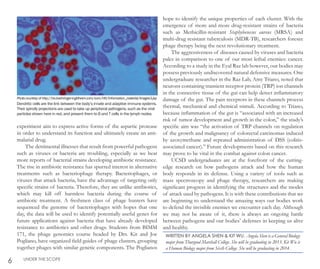
The enemies are approaching. Some are
stealthily camouflaged and have already breached the barriers
of the castle, but the battle has only just begun. The fortress,
armed and ready for defense, sends countless counterattacks on
the enemy while keeping the walls fortified.
5IMMUNOLOGY & VIROLOGY
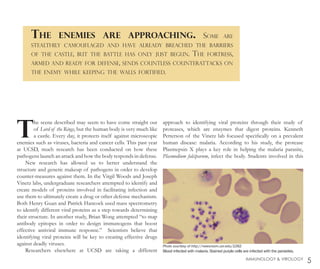
Photo courtesy of http://newsroom.ucr.edu/2262
Blood infected with malaria. Stained purple cells are infected with the parasites.
experiment aim to express active forms of the aspartic protease
in order to understand its function and ultimately create an anti-
malarial drug.
The detrimental illnesses that result from powerful pathogens
such as viruses or bacteria are troubling, especially as we hear
more reports of bacterial strains developing antibiotic resistance.
The rise in antibiotic resistance has spurred interest in alternative
treatments such as bacteriophage therapy. Bacteriophages, or
viruses that attack bacteria, have the advantage of targeting only
specific strains of bacteria. Therefore, they are unlike antibiotics,
which may kill off harmless bacteria during the course of
antibiotic treatment. A freshmen class of phage hunters have
sequenced the genome of bacteriophages with hopes that one
day, the data will be used to identify potentially useful genes for
future applications against bacteria that have already developed
resistance to antibiotics and other drugs. Students from BIMM
171, the phage genomics course headed by Drs. Kit and Joe
Pogliano, have organized field guides of phage clusters, grouping
together phages with similar genetic components. The Poglianos
6 UNDER THE SCOPE
Photocourtesyofhttp://hiv.boehringer-ingelheim.com/com/HIV/Information_material/Images3.jsp
Dendritic cells are the link between the body’s innate and adaptive immune systems.
Their spindly projections are used to take up peripheral pathogens, such as the viral
particles shown here in red, and present them to B and T cells in the lymph nodes.
hope to identify the unique properties of each cluster. With the
emergence of more and more drug-resistant strains of bacteria
such as Methicillin-resistant Staphylococcus aureus (MRSA) and
multi-drug resistant tuberculosis (MDR-TB), researchers foresee
phage therapy being the next revolutionary treatment.
The aggressiveness of diseases caused by viruses and bacteria
pales in comparison to one of our most lethal enemies: cancer.
According to a study in the Eyal Raz lab however, our bodies may
possess previously undiscovered natural defensive measures. One
undergraduate researcher in the Raz Lab, Amy Triano, noted that
neurons containing transient receptor protein (TRP) ion channels
in the connective tissue of the gut can help detect inflammatory
damage of the gut. The pain receptors in these channels process
thermal, mechanical and chemical stimuli. According to Triano,
because inflammation of the gut is “associated with an increased
risk of tumor development and growth in the colon,” the study’s
specific aim was “the activation of TRP channels on regulation
of the growth and malignancy of colorectal carcinomas induced
by azoxymethane and repeated administration of DSS (colitis-
associated cancer).” Future developments based on this research
may prove to be vital in the combat against colon cancer.
UCSD undergraduates are at the forefront of the cutting-
edge research on how pathogens attack and how the human
body responds in its defense. Using a variety of tools such as
mass spectroscopy and phage therapy, researchers are making
significant progress in identifying the structures and the modes
of attack used by pathogens. It is with these contributions that we
are beginning to understand the amazing ways our bodies work
to defend the invisible enemies we encounter each day. Although
we may not be aware of it, there is always an ongoing battle
between pathogens and our bodies’ defenses in keeping us alive
and healthy.
WRITTEN BY ANGELA SHEN & KIT WU. Angela Shen is a General Biology
major from Thurgood Marshall College. She will be graduating in 2013. Kit Wu is
a Human Biology major from Sixth College. She will be graduating in 2014.
Stem cells. Which keywords pop into your head right
now? Common answers include science, politics, cures,
treatments and cloning farm animals. Looking away from
the politicsand controversy, thesespecial cellshold the potential to
provide cures and treatments for a long list of diseases, including
Alzheimer’s and Parkinson’s diseases. Now another human disease
joins that group: cancer. The idea that cancer cells and cells with
stem-like properties may be related to each other is the basis of
a new and expanding field where researchers, including student
researchers at UCSD, try to utilize their knowledge of stem cell
biology to better understand the progression of different cancers.
Known for uncontrollable cell growths and metastasis, cancer
is currently treated with rounds of surgery, radiation therapy and
systemic treatments like chemotherapy. The issue with radiation
and systemic treatments is that they indiscriminately target rapidly-
dividing cells, including healthy tissue. Fortunately, recent findings
and proposed concepts shed some insight into the disease itself.
One such concept is the cancer stem cell hypothesis, which
states that there is a small subpopulation of cells in cancers that
have the ability to initiate and maintain malignant tumors. These
cells are thought to originate from progenitor cells with stem-like
qualities when key gene regulators are deregulated. These stem
cells have the ability to self-propagate and differentiate and are
thought to be involved with metastasis and chemo-resistance.
With increasing amounts of research invested in hashing out the
finer details of cancer, some studies at UCSD focus on discovering
and implementing drugs that may affect these cancer stem cells.
One example of this is a research study conducted by UCSD
undergraduate Katherine Blair, focusing on salinomycin and
its effect on cancer stem cells in head and neck squamous cell
carcinomas. Salinomycin is an antibiotic that functions as an
ionophore to transport potassium across the lipid bilayer of cell
UNLIKELY ALLIES
by bringing together stem cells and cancer cells in the lab,
UCSD researchers have opened the door for new and exciting
approaches to cancer research
7CELL GROWTH, DEVELOPMENT & CONTROL
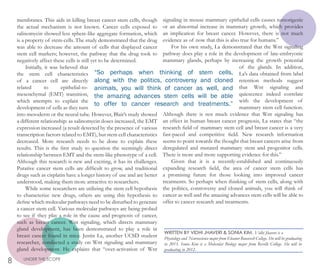
Photo courtesy of http://tgmouse.compmed.ucdavis.edu/jensen-mamm2000/BRCA-3/
BRCA-3.HTML
Microscopic view of cancer cells shows that the clusters of cells represent
cancerous cells.
membranes. This aids in killing breast cancer stem cells, though
the actual mechanism is not known. Cancer cells exposed to
salinomycin showed less sphere-like aggregate formation, which
is a property of stem-cells. The study demonstrated that the drug
was able to decrease the amount of cells that displayed cancer
stem cell markers; however, the pathway that the drug took to
negatively affect these cells is still yet to be determined.
Initially, it was believed that
the stem cell characteristics
of a cancer cell are directly
related to epithelial-to-
mesenchymal (EMT) transition,
which attempts to explain the
development of cells as they turn
into mesoderm or the neural tube. However, Blair’s study showed
a different relationship: as salinomycin doses increased, the EMT
expression increased (a result detected by the presence of various
transcription factors related to EMT), but stem cell characteristics
decreased. More research needs to be done to explain these
results. This is the first study to question the seemingly direct
relationship between EMT and the stem-like phenotype of a cell.
Although this research is new and exciting, it has its challenges.
Putative cancer stem cells are difficult to grow, and traditional
drugs such as cisplatin have a longer history of use and are better
understood, making them more attractive to researchers.
While some researchers are utilizing the stem cell hypothesis
to characterize new drugs, others are using this hypothesis to
define which molecular pathways need to be disturbed to generate
a cancer stem cell. Various molecular pathways are being probed
to see if they play a role in the cause and prognosis of cancer,
such as breast cancer. Wnt signaling, which directs mammary
gland development, has been demonstrated to play a role in
breast cancer found in mice. Justin La, another UCSD student
researcher, conducted a study on Wnt signaling and mammary
gland development. He explains that “over-activation of Wnt
signaling in mouse mammary epithelial cells causes tumorigenic
or an abnormal increase in mammary growth, which provides
an implication for breast cancer. However, there is not much
evidence as of now that this is also true for humans.”
For his own study, La demonstrated that the Wnt signaling
pathway does play a role in the development of late-embryonic
mammary glands, perhaps by increasing the growth potential
of the glands. In addition,
La’s data obtained from label
retention methods suggest
that Wnt signaling and
quiescence indeed correlate
with the development of
mammary stem cell function.
Although there is not much evidence that Wnt signaling has
an effect in human breast cancer prognosis, La states that “the
research field of mammary stem cell and breast cancer is a very
fast-paced and competitive field. New research information
seems to point towards the thought that breast cancers arise from
deregulated and mutated mammary stem and progenitor cells.
There is more and more supporting evidence for this.”
Given that it is a recently-established and continuously
expanding research field, the area of cancer stem cells has
a promising future for those looking into improved cancer
treatments. So perhaps when thinking of stem cells, along with
the politics, controversy and cloned animals, you will think of
cancer as well and the amazing advances stem cells will be able to
offer to cancer research and treatments.
“So perhaps when thinking of stem cells,
along with the politics, controversy and cloned
animals, you will think of cancer as well, and
the amazing advances stem cells will be able
to offer to cancer research and treatments.”
8 UNDER THE SCOPE
WRITTEN BY VIDHI JHAVERI & SONIA KIM. Vidhi Jhaveri is a
Physiology and Neuroscience major from Eleanor Roosevelt College. She will be graduating
in 2013. Sonia Kim is a Molecular Biology major from Revelle College. She will be
graduating in 2012.
Ecosystems provide humans with food, water and raw
materials that we depend on for commercial products. For
that reason, bees, phytoplankton and plant biodiversity
form a key part of multiple ecosystems. Bees provide humans
with food security by pollinating crops, which contribute to the
growthof plantbiodiversity,whilephytoplanktonareanimportant
component of the food chain and help maintain high oxygen
levels in the atmosphere. Their existence is crucial to human life
on earth. Students at UCSD are investigating ways to understand
the important ecosystems that we admire and rely upon. In the
larger scope, their findings may aid
in establishing effective and cost-
efficient conservation methods
to preserve living things and their
environment.
Simply put, ecology is the study
of the relationships between living
organisms and their surroundings.
Conservation is the protection of those relationships. On a
global scale, we can think of ecology as a giant interconnecting
web of energy that relies on innumerable elements. Scientists are
not certain about which factors of each ecosystem are ones that
are crucial to that ecosystem’s health and resilience in the face of
human influences. Students at UCSD are exploring every level
of this great flow of energy in an attempt to better understand
the mechanisms that drive ecosystem function. Understanding
the details of the energy web’s components, from the foraging
behavior of bees to the life histories of cacti, is essential to
preserving it.
Starting at the very bottom of the food chain, we have primary
producers, such as plants and phytoplankton, which consume
carbondioxideandreleaseoxygen. Thehealthof phytoplanktonis
critical for preserving all aquatic populations as well as maintaining
clean air, since phytoplankton reduce CO2
concentrations. Elliot
Weiss researched phytoplankton productivity by utilizing remote
sensing instruments, such as satellites, to analyze the ocean color
for insight on ocean health and climate.
On land, Marina LaForgia
examinedhowchangingconcentrations
of rainfall and nitrogen in soil affect
Southern Californian coastal sage
scrub and chaparral growth. Sage
scrub and chaparrals have adapted to
endure harsh seasonal rainfall patterns
in soils with limited nutrient availability. Future results from
LaForgia’s study will show whether these plants are resilient to
changes in precipitation, which can simulate potential effects due
to climate change and heavy pollution. Another adaptation that
many plants native to San Diego have is that their seeds do not
germinate during warm summer rains, when growing conditions
are not ideal. Rather, they only germinate after the cooler rains
in the fall. Exotic annual grasses, which are invading the San
living under the sun
“Students at UCSD are investigating ways
to understand the important ecosystems
that we admire and rely on...their findings
may aid in establishing effective and cost-
efficient conservation methods to preserve
livings things and their environment.”
9CONSERVATION & ECOLOGY
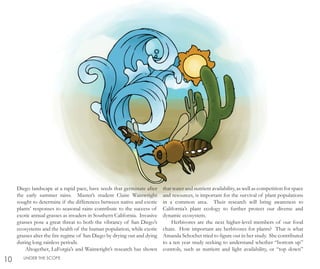
San Diego is home to a broad range of ecosystems. By conducting studies on terrestrial and
aquatic populations, UCSD students are identifying the keys for sustaining this diversity.
Diego landscape at a rapid pace, have seeds that germinate after
the early summer rains. Master’s student Claire Wainwright
sought to determine if the differences between native and exotic
plants’ responses to seasonal rains contribute to the success of
exotic annual grasses as invaders in Southern California. Invasive
grasses pose a great threat to both the vibrancy of San Diego’s
ecosystems and the health of the human population, while exotic
grasses alter the fire regime of San Diego by drying out and dying
during long rainless periods.
Altogether, LaForgia’s and Wainwright’s research has shown
that water and nutrient availability, as well as competition for space
and resources, is important for the survival of plant populations
in a common area. Their research will bring awareness to
California’s plant ecology to further protect our diverse and
dynamic ecosystem.
Herbivores are the next higher-level members of our food
chain. How important are herbivores for plants? That is what
Amanda Schochet tried to figure out in her study. She contributed
to a ten year study seeking to understand whether “bottom up”
controls, such as nutrient and light availability, or “top down”
10 UNDER THE SCOPE
controls, such as herbivory, plays a larger role in determining the
species composition and productivity of an herbaceous (non-
woody) plant community. This study is being conducted in
herbaceous communities across the whole world, in areas as far
away as China and Australia, so that ecologists can understand
how herbaceous plant communities work at both a local and
global scale.
Douglas Hooten studied other animals that eat primary
producers to get sugar, proteins and nutrients. He analyzed the
distribution of three different kinds of cactus in the Mojave and
Sonoran deserts that surround San Diego. This study contributes
to our understanding of desert ecology by providing important
information for cactus conservation. Cacti grow slowly, and,
because scientists do not fully understand their growth patterns
or how far they are distributed, they are unsure of how human
activities, such as clearing land, will effect cacti populations.
Hooten also studied the distribution of decaying cacti in each
species. Their rotting tissue is eaten by none other than the fruit
fly, the most beloved test subject of the biology world.
Interestingly, closely related species of desert fruit flies
are specially adapted to live on each cactus. Joel Schumacher
investigated the evolution of one such adaptation, odorant
receptors, which enable the flies to locate food and mates.
Using an approach based on molecular biology, Schumacher
sequenced the genes of two of the closely related fruit fly species.
Scientifically referred to as Drosophila melanogaster, fruit flies are
a critical genetic tool. Thus far, the genomes of twelve species
of Drosophila have been fully sequenced. Their fast generation
times make multigenerational studies, which would take hundreds
of years if they were done on humans, easy. The Sonoran flies
that Hooten and Schumacher studied have evolved to thrive
in extremely harsh desert conditions and live off of alcohols
produced by the flesh of rotting cacti, which are toxic to most
other organisms. Understanding the genes that allow the flies
to tolerate harsh conditions and toxic compounds as well as the
mechanisms that cause the flies to diverge into distinct species
can provide us with extraordinary genetic insight.
The honey bee is another insect that is critically important to
humans. Honey bees are a vital part of our agricultural industry—
most of the produce that we enjoy eating, like apples, grapes and
cucumbers, as well as some of our most economically important
crops, like soy beans and cotton, rely on bees to pollinate them.
However, honeybees have recently been plagued by a mysterious
disease called colony collapse disorder. The cause of the disease
is still unknown, but researchers suspect that a combination
of stresses, such as parasites, pathogens, pesticides and poor
beekeeping methods, contribute to the disease. UCSD master’s
student Daren Eiri investigated how sublethal doses of the
popular crop pesticide imidacloprid affect the health of honey
bee colonies. He found that bees exposed to imidacloprid are only
motivated to feed on nectars with high sucrose concentrations.
This “picky eater syndrome” may reduce the amount of nectar
honey bees bring back to their hives, which weakens the colony.
Finally, we reach the top of our web of energy, the “top of
the food chain.” In this group, we have an animal that has very
complex relationships with its ecosystem and that has affected
its surroundings more than any other animal: humans. No, there
were not any student experiments on humans this year, but every
experiment featured has an impact on us. The students that
shared their research at UCSD’s 2010 Biological Sciences Student
Research Showcase offer a glimpse into the exciting worlds of
ecology and conservation and give us a new perspective with
which to view San Diego County.
11CONSERVATION & ECOLOGY
WRITTEN BY RACHEL MAHER, DIANA PONCE-MORADO &
AMANDA SCHOCHET. Rachel Maher is a General Biology major from
Revelle College. She will be graduating in 2012. Diana Ponce-Morado is a General
Biology major from Thurgood Marshall College. She will be graduating in 2012.
Amanda Schochet is a Ecology, Evolution and Behavior major from Sixth College.
She will be graduating in 2011.
12 UNDER THE SCOPE
you are what you eat
This age-old statement has never been truer. By taking a closer
look at how our bodies digest and use the food we eat, UCSD
researchers are on their way to revolutionizing healthcare and
solving the nation’s obesity problem.
Michelle Obama, the First Lady of the United States,
has decided to highlight a major health issue as her
pet project. Following a trend of growing concern
about health and fitness, Michelle Obama’s “Let’s Move!”
campaign targets the problem of childhood obesity. According
to her campaign, “Obese children and teens have been found to
have risk factors for cardiovascular disease.” It reports that 60
percent of overweight children from ages 5 to 17 have at least
one cardiovascular disease risk factor and 25 percent of them
have two or more.
Many fast food restaurants, which typically sell cheap but
nutritionally unsound food, are located in financially poor
areas. Children from lower socioeconomic neighborhoods are
more likely to consume these unhealthy foods, and such obese
children often become obese adults. Obesity has been shown
to lead to ailments like diabetes and heart disease, and the
nutritional variation between demoraphic groups means that
these cardiovascular diseases are more prevalent in the poorer
populations, giving rise to health conditions that vary between
different social classes and races. Thus, understanding how the
cardiovascular system works goes beyond the idea of wanting to
save lives; combating cardiovascular and metabolic diseases would
also help even out the quality of health care received by different
social classes and would promote equal and healthy lifestyles
for all people. Michelle Obama’s campaign actively promotes
prevention. If successful, it would provide an effective way to
fight epidemics that plague so many Americans while also being
cost-effective because it prevents the diseases from occurring in
the first place.
This approach is gaining wider support. For example, major
cities within the United States are jumping on the bandwagon
of addressing health issues to both increase the well being of
their citizens and stem rising health care costs. In November
2010, San Francisco passed a law requiring fast food restaurants
13PHYSIOLOGY & METABOLISM
in the city to specify the nutritional content of their kids’ meals
before they can offer free toys with the meals. This effort to
combat childhood obesity shows that science clearly does mix
with politics.
However, combating these deadly diseases requires an
understanding of the underlying physiology and metabolism
of the human body. At UCSD, students are embarking on
various projects that contribute to Michelle Obama’s vision of
a healthier nation. The steps to disease prevention must begin
with the understanding of how our body’s mechanisms work,
which is exactly what students’ research at UCSD entails. The
two featured students below seek to understand a small aspect of
this immense universe of the cardiovascular system in relation to
the physiology and metabolism of our body.
Diabetes, a condition of elevated blood sugar, affects a
stunning number of Americans. In 2010, 11 percent of people
ages 20 to 65 had diabetes, and 27 percent of people age 65
and older had the condition. It occurs in two distinct variations
that have different causes. Type 1 diabetes is characterized by
the body’s inherent inability to produce insulin from the beta
cells of the pancreas, while the hallmark of Type II diabetes
is insulin resistance. Despite the difference in their underlying
pathophysiology, both Type I and Type II diabetes are often
exacerbated by diets rich in sugars and fats. Based on this
understanding, undergraduate researcher Di Fang found a unique
angle for tackling diabetes at Dr. Gen-Sheng Feng’s laboratory in
the UCSD School of Medicine.
Fang worked to discover how beta cells, the cells which
produce insulin, grow in the pancreas. The amount of sugar in our
blood must be kept under tight control because sugar is our main
chemical source of energy. The hormone insulin controls blood
sugar level by causing cells to remove glucose from the blood.
One common treatment for diabetes involves the administration
of exogenous insulin. Diabetics can take insulin from an outside
source to make up for the fact that their bodies have trouble
making or responding to it.
Fang’s research concentrated on an exciting new way to treat
Type I diabetes. Fang worked with an enzyme called Shp2, which
may have a positive effect on the regeneration of beta cells.
Previous research on the subject has shown that the population
of beta cells in the pancreas can increase if the body is under
metabolic stress. For example, the metabolism of a pregnant
woman changes to support the growing fetus. During this
modification of her metabolism, new beta cells may grow and
make her body better regulate blood sugar levels. Fang tried to
determine how these new beta cells are generated and focused
specifically on whether or not there is a “link between beta cell
viability and Shp2.”
Working with postdoctoral scholar Dr. Jing Wang, Fang
hypothesized that Shp2 may play a role in causing beta cells to
grow in mice. Previous research at her lab demonstrated decreased
insulin secretion in Shp2-deficient cells. This means that, when
beta cells lack the Shp2 enzyme, they produce less insulin, which
could indicate that Shp2 has a direct influence on the survival of
beta cells. Fang sought to determine whether treatment with Shp2
14 UNDER THE SCOPE
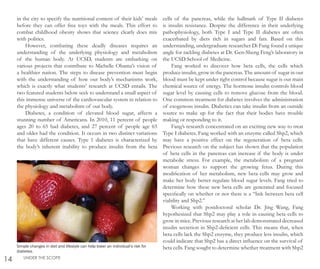
Simple changes in diet and lifestyle can help lower an individual’s risk for
diabetes.
stimulates beta cells to regenerate in mice that have had their beta
cells removed. If her results show that Shp2 stimulates beta cell
regeneration, the study could open the door to an entirely new
method of treating diabetes.
Already, there is much discussion about providing diabetics
with healthy beta cells, particularly through the use of embryonic
stem cells that may be induced to differentiate into beta cells.
However, Wang says that “there are several obstacles, including
ethicaldebates,totheirclinicaluse,creatinganeedfornewstrategies
to generate beta cells in adult pancreas.” If the Shp2 enzyme
proves to be essential in
the regeneration of beta
cells, this could usher in a
new way to treat diabetes
that may even replace
insulin therapy.
The “Let’s Move!”
initiative highlights the
interrelationship between
our diets, lifestyle and health. While diabetics can try to alleviate
their symptoms by controlling their sugar intake and exercising,
there is a certain limit to how much control they have over
their disease. This is where scientific research comes in. In the
future, new medicines or discoveries may help better manage
or even cure diabetes. Researchers like Fang and Wang help tie
together scientific research and the active changes that we can
make to improve our lifestyles and health to give us new ways of
approaching old diseases.
Yuichiro Sato, another undergraduate student conducting
research at UCSD, is investigating how biomarker proteins within
the blood induce severe inflammation in children, a defective
condition that is a precursor to acute Kawasaki Disease. Through
his research in Dr. Jane Burn’s laboratory at the UCSD School of
Medicine, Sato discovered that biomarkers can critically serve as
a laboratory test for Kawasaki Disease.
“Understanding the conditions of the illness and spreading
the knowledge to other people are essential parts in health care,”
said Sato. “Diagnosis is critical to detecting Kawasaki disease, and
misdiagnosis usually arises due to the lack of physical symptoms;
we just do not know enough.”
Based on his findings, Sato firmly believes his research can
help lead scientists to finding a cure for this lethal disease. “There
is so much out there in translational medicine and so many
mysteries within our body that we need to solve,” said Yuichiro.
“But the most important part of this particular research is that
it makes a difference, and
that is all that counts.”
The results of Sato’s
and Fang’s research show
how basic research in the
laboratory may point the
way to finding strategies
for clinical studies, targeted
therapies and specific
treatments for diabetes and many other cardiovascular diseases.
Student researchers are not only advancing the scientific
community but also the nation at large. The results of their
research provide essential tools for visionaries, like Michelle
Obama, who desire to change the way we consciously think about
our health and the biological mechanisms governing our bodies’
physiology and metabolism.
“Understanding how the cardiovascular system works
goes beyond the idea of wanting to save lives; combating
cardiovascular and metabolic diseases would also help to
even out the quality of health care received by different
social classes and would promote equal and healthy
lifestyles for all people.”
15PHYSIOLOGY & METABOLISM
WRITTEN BY VARUN CHATURVEDI, MILLI DESAI & KAILIN DUAN.
Varun Chaturvedi is a Physiology and Neuroscience major from Revelle College.
He will be graduating in 2014. Milli Desai is a Human Biology major from
Revelle College. She will be graduating in 2014. Kailin Duan is a Human Biology
major from Revelle College. She will be graduating in 2011.
16 UNDER THE SCOPE
Memory,
Mice and
Multiple Sclerosis
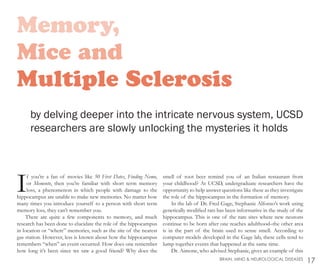
by delving deeper into the intricate nervous system, UCSD
researchers are slowly unlocking the mysteries it holds
If you’re a fan of movies like 50 First Dates, Finding Nemo,
or Memento, then you’re familiar with short term memory
loss, a phenomenon in which people with damage to the
hippocampus are unable to make new memories. No matter how
many times you introduce yourself to a person with short term
memory loss, they can’t remember you.
There are quite a few components to memory, and much
research has been done to elucidate the role of the hippocampus
in location or “where” memories, such as the site of the nearest
gas station. However, less is known about how the hippocampus
remembers “when” an event occurred. How does one remember
how long it’s been since we saw a good friend? Why does the
smell of root beer remind you of an Italian restaurant from
your childhood? At UCSD, undergraduate researchers have the
opportunity to help answer questions like these as they investigate
the role of the hippocampus in the formation of memory.
In the lab of Dr. Fred Gage, Stephanie Alfonso’s work using
genetically modified rats has been informative in the study of the
hippocampus. This is one of the rare sites where new neurons
continue to be born after one reaches adulthood–the other area
is in the part of the brain used to sense smell. According to
computer models developed in the Gage lab, these cells tend to
lump together events that happened at the same time.
Dr. Aimone, who advised Stephanie, gives an example of this
17BRAIN, MIND & NEUROLOGICAL DISEASES
time association: “Years ago, when I was an undergrad, I bought
the Beach Boys’ Pet Sounds album during the summer. Anytime I
hear songs from that album, memories come flooding back about
where I was living and my internship that summer.” This ability
to relate memories to music is only one example of the role of
the hippocampus.
To test this model, Stephanie conducted experiments with
mice chemically modified to lack the ability to create new brain
cells. These mice were expected to be incapable of associating
events that occur close in time. Indeed, while regular mice
preferred exploring the locations of objects that were shown to
them at the same time, the modified mice did not. The results
of this work suggest more questions, and Stephanie’s work is
yet another important clue in solving the mysteries of temporal
memory.
In the lab of Dr. Jill Leutgeb, Slayyeh Begum conducted
experiments in which rats performed the same foraging task twice
a day. For each rat, the only difference was the time of day the
task was performed. These studies focused on the activity in areas
of the hippocampus that specialize in “where” memories form.
There, they found a small group of brain cells that showed one
firing pattern at 9 a.m. and a
different pattern at 3 p.m. This
provides evidence that the part
of the hippocampus in charge
of remembering where things
are—the same part that taxi
cab drivers use to navigate the
streets of New York—may also
play a role in remembering what
time of day events happened.
Slayyeh’s work will provide evidence to support further studies
in the formation of time-related memories in the hippocampus.
Malfunctions of the mind can have very physical implications
as well. David Kyle didn’t think much of the numbness he was
feeling in his toes on the fateful morning of October 25, 2004.
After all, as an experienced triathlete, Kyle was used to recovering
from a variety of injuries he had endured throughout his career.
However, things soon began to turn for the worse when, within a
matter of weeks, the cycling veteran couldn’t feel a single muscle
below his waist.
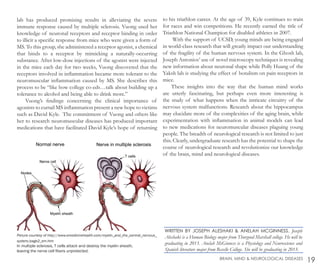
Kyle was diagnosed with multiple sclerosis (MS), an
autoimmune disease that occurs when the body’s immune system
attacks the fatty tissue called myelin that surrounds nerve fibers in
the central nervous system. As
a result, most MS victims are
left paralyzed since the neurons
in their muscles are unable to
conduct or receive signals from
the brain. Currently, there are
three main types of treatments
for MS patients: administering
medicine that manages
exacerbation or relapses of
the disease, modifying the disease itself or providing drugs that
modify the course of MS by altering or suppressing the activity
of the immune system.
Research conducted by Linda Vuong in Dr. Dennis Carson’s
“Vuong discovered that the receptors
involved in inflammation became more
tolerant to the neuromuscular inflammation
caused by MS. She describes this process to be
‘like how college co-eds…talk about building up a
tolerance to alcohol and being able to drink more.’”
18 UNDER THE SCOPE
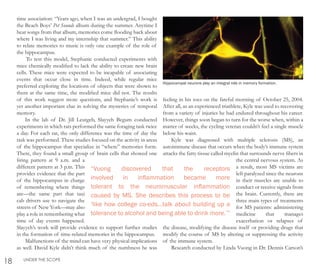
Hippocampal neurons play an integral role in memory formation.
lab has produced promising results in alleviating the severe
immune response caused by multiple sclerosis. Vuong used her
knowledge of neuronal receptors and receptor binding in order
to illicit a specific response from mice who were given a form of
MS. To this group, she administered a receptor agonist, a chemical
that binds to a receptor by mimicking a naturally-occurring
substance. After low-dose injections of the agonist were injected
in the mice each day for two weeks, Vuong discovered that the
receptors involved in inflammation became more tolerant to the
neuromuscular inflammation caused by MS. She describes this
process to be “like how college co-eds…talk about building up a
tolerance to alcohol and being able to drink more.”
Vuong’s findings concerning the clinical importance of
agonists to curtail MS inflammation present a new hope to victims
such as David Kyle. The commitment of Vuong and others like
her to research neuromuscular diseases has produced important
medications that have facilitated David Kyle’s hope of returning
to his triathlon career. At the age of 39, Kyle continues to train
for races and win competitions. He recently earned the title of
Triathlon National Champion for disabled athletes in 2007.
With the support of UCSD, young minds are being engaged
in world-class research that will greatly impact our understanding
of the fragility of the human nervous system. In the Ghosh lab,
Joseph Antonios’ use of novel microscopy techniques is revealing
new information about neuronal shape while Polly Huang of the
Yaksh lab is studying the effect of botulism on pain receptors in
mice.
These insights into the way that the human mind works
are utterly fascinating, but perhaps even more interesting is
the study of what happens when the intricate circuitry of the
nervous system malfunctions. Research about the hippocampus
may elucidate more of the complexities of the aging brain, while
experimentation with inflammation in animal models can lead
to new medications for neuromuscular diseases plaguing young
people. The breadth of neurological research is not limited to just
this. Clearly, undergraduate research has the potential to shape the
course of neurological research and revolutionize our knowledge
of the brain, mind and neurological diseases.
19BRAIN, MIND & NEUROLOGICAL DISEASES
Picture courtesy of http://www.emedicinehealth.com/myelin_and_the_central_nervous_
system/page2_em.htm
In multiple sclerosis, T cells attack and destroy the myelin sheath,
leaving the nerve cell fibers unprotected.
WRITTEN BY JOSEPH ALESHAKI & ANELAH MCGINNESS. Joseph
Aleshaki is a Human Biology major from Thurgood Marshall college. He will be
graduating in 2013. Anelah McGinness is a Physiology and Neuroscience and
Spanish literature major from Revelle College. She will be graduating in 2013.
20 UNDER THE SCOPE
2010
Biological
Sciences
Student
Research
Showcase
abstract list
Type-I IFN signaling is required for the maintenance
of Foxp3 expression and Treg cell function
Chang Kyung Kim
Dr. Eyal Raz
Canonical Wnt signaling and quiescence in
embryonic murine mammary gland branching
morphogenesis and stem cell function
Justin La
Dr. Geoffrey Wahl
Functional characterization of zebrafish granulocyte-
colony stimulating factor
Ryan Lau
Dr. David Traver
The role of TRP channel activaton in gut mucosal
inflammation and tumorigenesis
Amy Triano
Dr. Eyal Raz
Toscana virus nucleoprotein structure determination
employing amide Hydrogen/Deuterium Exchange
Mass Spectrometry
Henry Guan
Dr. Virgil Woods
Structural and biophysical characterization of
Lassavirus matrix protein Z using Hydrogen/
Deuterium Exchange Mass Spectrometry
Patrick Hancock
Dr. Virgil Woods
The effect of schlafens on notch signaling
Elaine Lin
Dr. Michael David
Immunology & Virology
(stem cells and the immune
system and AIDS)
21ABSTRACT LIST
Cell Growth, Development & Control
(cancer, cell signaling, sleep cycles
and circadian rhythms)
Epidermal growth factor receptor
overexpression contributes to the acquisition
of stem cell like properties in head and neck
squamous cell carcinoma and thyroid cancer
cell lines
Eric Abhold
Dr. Martin Haas
Functional significance of Mtm’s substrate
selectivity
Vignesh Raman
Dr. Amy Kiger
Bnip3 induces mitochondrial fragmentation
via down regulation of mitochondrial fusion
proteins
Rita Hanna
Dr. Asa Gustafsson
Selective targeting of head and neck
squamous cancer stem cells using
salinomycin
Katherine Blair
Dr. Martin Haas
Characterization of let-7 related microRNA
primary transcripts and expression patterns in
C. elegans
Victoria Burton
Dr. Amy Pasquinelli
Expression and characterization of
Plasmepsin X, a Plasmodium falciparum
aspartic protease
Kenneth Pettersen
Dr. Joseph Vinetz
Structural study of deadly viral glycoprotein
through Deuterium Exchange Mass
Spectrometry
Brian Wong
Dr. Virgil Woods
A field guide to the cluster A1 and E phage
isolated by the UCSD phage hunters
Roshmi Bhattacharya, Priya Chakrabarti,
Aaron Kappe, Victoria Selzer, Alexandra
Stanley, Oleg Stens, Yi Shuan Wu, Anne
Lamsa
Dr. Kit Pogliano and Dr. Joe Pogliano
A field guide to the cluster B1 and F1 phage
isolated by BIMM171 students
Jeremy Chang, Mahathee Chetlapalli, David
Horstman, Michael Pham, Andryus Planutis,
Kyle Szeto, Cliff Wu, Anne Lamsa
Dr. Kit Pogliano and Dr. Joe Pogliano
The unidentified phage of the UCSD phage
genomics course 2009-2010
Kristina Chun, Abby Conroy, Payal Desi,
Hubert Jenq, Brittany Khong, Catherine Kuo,
Joseph Steward, Anne Lamsa
Dr. Kit Pogliano and Dr. Joe Pogliano
Analysis of the Dot Product genome
Andrew Grainger, Zac Hann, Lawrence Ku,
Sean Lund, Amy Nguyen, Tasha Thompson,
Lisa Zeng, Anne Lamsa
Dr. Kit Pogliano and Dr. Joe Pogliano
Cytokines induce proliferation via an NCX-1
dependent mechanism
Edwin Yoo
Dr. Tomothy Bigby
Analysis of conditions for in vitro transcription
with human factors
Yanhua Chi
Dr. James Kadonaga
Bioinformatic analysis of bacterial mercury ion
transporters
Timothy Mok
Dr. Milton Saier
The role of TRPC and Na+
/Ca2+
exchanger in
mediating TGF946-induced pancreatic cancer
cell motility
Tiffany Ornelas
Dr. Jimmy Chow
Encapsidating mCherry into bacteriophage
Hong Kong 97 immature and mature capsid
Kristina Pedersen
Dr. Jack Johnson
Development of an ORF isolation protocol by
expression of genomic clones in Nicotiana
Tiffany Su
Dr. Steve Kay
Proline-23-Histidine (P23H) mutation in
rhodopsin protein
Mark Yu
Dr. Jonathan Lin
Inhibition of muscle phosphofructokinase-1
(PFK-1) and lactate dehydrogenase (LDH) by
ascorbate derivatives: a proposal for cancer
treatment
Duyen-Anh Pham
Dr. Percy Russell
22 UNDER THE SCOPE
Conservation and Ecology
(wetlands, marine ecology, climate
change and environmental studies)
Physiology & Metabolism
(diabetes, digestive diseases,
cardiovascular physiology and
reproduction)
Photophysiological acclimation of
Thalassiosira pseudonana under light
limitation
Elliot Weiss
Dr. Greg Mitchell
Spatial analysis of cactus plants and roots in
El Saguaral, Mexico
Douglas Hooton
Dr. Therese Markow
Variation in water use efficiency and soil
moisture conditions of eight coastal sage
scrub and chaparral species in relation to
eater and nitrogen treatments
Marina LaForgia
Dr. Elsa Cleland
Top-down versus bottom-up control on plant
productivity and diversity
Amanda Schochet
Dr. Elsa Cleland
Adaptive evolution of odorant receptors in
cactophilic Drosophila
Joel Schumacher
Dr. Luciano Matzkin
Cry5B: A crystal protein among a new and
powerful class of anthelmintics
Sophia Georghiou
Dr. Raffi Aroian
Detecting novel protein interactions with
Desmoplakin using yeast 2 hybrid protocols
Patrick Lee
Dr. Farah Sheikh
The role of Dynamin in flies as a model for
human centronuclear myopathy
Jen Nguyen
Dr. Amy Kiger
Tbx20 as a downstream target of bone-
morphogenetic protein (BMP) signaling in
zebrafish heart development
Richard Shehane
Dr. Deborah Yelon
Picky eater syndrome: The pesticide
imidacloprid on honey bee (Apis mellifera)
alters sucrose response threshold and,
potentially, colony health
Daren Eiri
Dr. James Nieh
Seasonal priority effects: implications for
invasion and restoration in California coastal
sage scrub
Claire Wainwright
Dr. Elsa Cleland
SON DNA-binding protein homologues is
crucial in zebrafish embryo development
Xu Yao
Dr. Dong-Er Zhang
Investigation of the intracellular trafficking
of ENaC subunits in colonic cell lines and
dysfunctions of intracellular trafficking in cells
exposed to the forskolin
Angela Yu
Dr. Kim Barrett
Pancreatic Shp2 tyrosine phosphatase
regulates beta cell mass in mice
Di Fang
Dr. Gen-Sheng Feng
The role of G-Protein coupled receptors in
regulating myofibroblast transformation
Steven He
Dr. Paul Insel
Knockout and overexpression studies of
human mitoNEET in synechococcus elongates
Christina Homer
Dr. Mel Okamura
Circadian regulation of the mouse Kiss1r gene
in GnRH neurons
Lara Kose
Dr. Pamela Mellon
Utilization of radiolabeled transcript to
perform nuclease assays to reveal detail
about function of Ire-1 in RNA splicing
Sari Lahham
Dr. Maho Niwa
23ABSTRACT LIST
Characterization of two enhancers upstream
of the Gonadotropin-releasing hormone
(GnRH) gene
Kathleen Yip
Dr. Pamela Mellon
The importance of matrix Metalloprotainase 9
in hypoxia-induced lung remodeling
Mary Nguyen
Dr. Gabriel Haddad
Markers of cardiomyocyte injury in acute
Kawasaki disease
Yuichiro Sato
Dr. Jane Burns
Brain, Mind & Neurological Diseases
(Alzheimer’s and autism)
A temporal code in the dentate gyrus: a
unique role for adult-born granule cells in the
formation of memories
Stephanie Alfonso
Dr. Fred Gage
DSCAM and its role in the developing nervous
system
Eunice Kym
Dr. Eduardo Macagno
Identification of mechanosensory genes in
Drosophila melanogaster
Anh Nguyen
Dr. Boaz Cook
Structure-function study of protein-protein
interactions between GIRK3 and the SNX27
PDZ domain
Christopher Childers
Dr. Paul Slesinger
Development of hippocampal mossy fiber
connectivity using serial-blockface scanning
electron microscopy
Joseph Antonios
Dr. Anirvan Ghosh
Hippocampal network encoding of time-of-day
in an episodic memory task
Slayyeh Begum
Dr. Jill Leutgeb
A functional magnetic resonance imaging
study of amygdalar activity in depressed
adolescents
Poonam Manwani
Dr. Tony Yang
Nicotinic receptors and the acetylcholine
binding protein
Phuong Thoi
Dr. Palmer Taylor
Establishing vertebrate model systems for the
study of Gle1-mediated motor neuron disease
Joseph Tsai
Dr. Samuel Pfaff
Toll-like receptor 7 tolerance in anti-
neuroinflammation in murine experimental
autoimmune encephalomyelitis
Linda Vuong
Dr. Dennis Carson
Up-regulation of chemokine receptor-like 2 in
an in vitro model of cerebral ischemia
Alice Chen
Dr. Gabriel Haddad
Mapping the mouse brain microvessel
proteome
Hyun Chun
Dr. Brian Eliceiri
Intrathecal botulinum neurotoxin B: effects on
spinal primary afferent sensory C-fibers and
nociception in the mouse.
Polly Huang
Dr. Tony Yaksh
an	 publication
Under the Scope
Division of Biological Sciences
University of California, San Diego
9500 Gilman Drive
La Jolla, CA 92093-0376
(858) 534-5635

uts-vol1

  • 1.
    Proceedings of theBiological Sciences Student Research Showcase 2010
  • 2.
    B ack in September,Dr. Gabriele Wienhausen approached me and the research editors of Saltman Quarterly with an intriguing challenge: to convey the amazing research contributions of undergraduates in a novel way, one that would be easily understood by a lay audience. Eagerly, we sought to synthesize the research presented at the 2010 Biological Sciences Student Research Showcase into cohesive articles and creative illustrations. We would bring the accessibility and intrigue of Scientific American and the Science Tuesday section of the New York Times to UCSD. In short, we would take our readers “under the scope” of exciting biological research conducted by undergraduates right here, on our university’s campus. Biology affects everyone, though everyone has a unique way of understanding the mechanisms governing his or her life. To that end, Under the Scope seeks to explain research not in overly technical jargon but in terms of its relevance to everyday life, and, to explore how other disciplines can help us think of biology differently. There is clearly a reason why this past year, the UCS Division of Biological Sciences was ranked number one in the National Research Council’s assessment of over 5000 doctoral programs. In my opinion, that reason goes beyond the extraordinary strides we make in research to also include the innovative spirit with which we approach biology. Under the Scope, an expansion of the Saltman Quarterly Program, presents the work of student researchers, student writers and student artists alike. With this research brochure, it is our hope to begin a new tradition within the university’s already extant tradition of scholastic excellence and innovation. WRITERS Amanda Schochet Anelah McGinness Angela Shen Diana Ponce-Morado Joseph Aleshaki Kailin Duan Kit Wu Milli Desai Rachel Maher Sonia Kim Varun Chaturvedi Vidhi Jhaveri EDITORIAL BOARD Editor-in-Chief Leila Haghighat Senior Research Editor Tina Lu Junior Research Editor Lawrence Ku Production Editor Nishita Shah STAFF ADVISORS Associate Dean for Education Gabriele Wienhausen, Ph.D. Undergraduate Advisor Hermila Torres Media Specialist Katie Frehafer ILLUSTRATORS Cover Jane Rho Articles Nicole Oliver LETTER FROM THE EDITOR FACULTY ADVISORY BOARD Immunology & Virology Steven Wasserman, Ph.D. Cell Growth, Development & Control Jim Wilhelm, Ph.D. Conservation & Ecology Heather Henter, Ph.D. Physiology & Metabolism Kathleen French, Ph.D. Brain, Mind & Neurological Diseases Andrew Chisholm, Ph.D. Jill Leutgeb, Ph.D. Leila Haghighat Editor-in-Chief, Under the Scope
  • 3.
    TABLE OF CONTENTS OurBody’s Defenses Exploiting the mechanisms by which viruses and other pathogens attack our cells may lead to better defense in the battles waged by our immune system Unlikely Allies Applying our knowledge of self-propagating stem cells to cancerous cells helps us to better understand the progression of cancer Living Under the Sun Understanding the complex relationships that interconnect the many ecosystems in San Diego can help us preserve our environment. You Are What You Eat Digging deeper into the physiological mechanisms governing our metabolism may enable us to attack our nation’s obesity problem in a whole new way Mice, Memory and Multiple Sclerosis Delving into the intricacies of the human nervous system will unlock the mysteries of where memories form and how disorders like multiple sclerosis may be treated Biological Sciences Student Research Showcase 2010 Abstract List 4 12 5 12 16 7 9 16 20 7 4 7 9
  • 4.
    4 UNDER THESCOPE OUR Body’s DEFENSES
  • 5.
    T he scene describedmay seem to have come straight out of Lord of the Rings, but the human body is very much like a castle. Every day, it protects itself against microscopic enemies such as viruses, bacteria and cancer cells. This past year at UCSD, much research has been conducted on how these pathogens launch an attack and how the body responds in defense. New research has allowed us to better understand the structure and genetic makeup of pathogens in order to develop counter-measures against them. In the Virgil Woods and Joseph Vinetz labs, undergraduate researchers attempted to identify and create models of proteins involved in facilitating infection and use them to ultimately create a drug or other defense mechanism. Both Henry Guan and Patrick Hancock used mass spectrometry to identify different viral proteins as a step towards determining their structure. In another study, Brian Wong attempted “to map antibody epitopes in order to design immunogens that boost effective antiviral immune response.” Scientists believe that identifying viral proteins will be key to creating effective drugs against deadly viruses. Researchers elsewhere at UCSD are taking a different approach to identifying viral proteins through their study of proteases, which are enzymes that digest proteins. Kenneth Petterson of the Vinetz lab focused specifically on a prevalent human disease: malaria. According to his study, the protease Plasmepsin X plays a key role in helping the malaria parasite, Plasmodium falciparum, infect the body. Students involved in this The enemies are approaching. Some are stealthily camouflaged and have already breached the barriers of the castle, but the battle has only just begun. The fortress, armed and ready for defense, sends countless counterattacks on the enemy while keeping the walls fortified. 5IMMUNOLOGY & VIROLOGY Photo courtesy of http://newsroom.ucr.edu/2262 Blood infected with malaria. Stained purple cells are infected with the parasites.
  • 6.
    experiment aim toexpress active forms of the aspartic protease in order to understand its function and ultimately create an anti- malarial drug. The detrimental illnesses that result from powerful pathogens such as viruses or bacteria are troubling, especially as we hear more reports of bacterial strains developing antibiotic resistance. The rise in antibiotic resistance has spurred interest in alternative treatments such as bacteriophage therapy. Bacteriophages, or viruses that attack bacteria, have the advantage of targeting only specific strains of bacteria. Therefore, they are unlike antibiotics, which may kill off harmless bacteria during the course of antibiotic treatment. A freshmen class of phage hunters have sequenced the genome of bacteriophages with hopes that one day, the data will be used to identify potentially useful genes for future applications against bacteria that have already developed resistance to antibiotics and other drugs. Students from BIMM 171, the phage genomics course headed by Drs. Kit and Joe Pogliano, have organized field guides of phage clusters, grouping together phages with similar genetic components. The Poglianos 6 UNDER THE SCOPE Photocourtesyofhttp://hiv.boehringer-ingelheim.com/com/HIV/Information_material/Images3.jsp Dendritic cells are the link between the body’s innate and adaptive immune systems. Their spindly projections are used to take up peripheral pathogens, such as the viral particles shown here in red, and present them to B and T cells in the lymph nodes. hope to identify the unique properties of each cluster. With the emergence of more and more drug-resistant strains of bacteria such as Methicillin-resistant Staphylococcus aureus (MRSA) and multi-drug resistant tuberculosis (MDR-TB), researchers foresee phage therapy being the next revolutionary treatment. The aggressiveness of diseases caused by viruses and bacteria pales in comparison to one of our most lethal enemies: cancer. According to a study in the Eyal Raz lab however, our bodies may possess previously undiscovered natural defensive measures. One undergraduate researcher in the Raz Lab, Amy Triano, noted that neurons containing transient receptor protein (TRP) ion channels in the connective tissue of the gut can help detect inflammatory damage of the gut. The pain receptors in these channels process thermal, mechanical and chemical stimuli. According to Triano, because inflammation of the gut is “associated with an increased risk of tumor development and growth in the colon,” the study’s specific aim was “the activation of TRP channels on regulation of the growth and malignancy of colorectal carcinomas induced by azoxymethane and repeated administration of DSS (colitis- associated cancer).” Future developments based on this research may prove to be vital in the combat against colon cancer. UCSD undergraduates are at the forefront of the cutting- edge research on how pathogens attack and how the human body responds in its defense. Using a variety of tools such as mass spectroscopy and phage therapy, researchers are making significant progress in identifying the structures and the modes of attack used by pathogens. It is with these contributions that we are beginning to understand the amazing ways our bodies work to defend the invisible enemies we encounter each day. Although we may not be aware of it, there is always an ongoing battle between pathogens and our bodies’ defenses in keeping us alive and healthy. WRITTEN BY ANGELA SHEN & KIT WU. Angela Shen is a General Biology major from Thurgood Marshall College. She will be graduating in 2013. Kit Wu is a Human Biology major from Sixth College. She will be graduating in 2014.
  • 7.
    Stem cells. Whichkeywords pop into your head right now? Common answers include science, politics, cures, treatments and cloning farm animals. Looking away from the politicsand controversy, thesespecial cellshold the potential to provide cures and treatments for a long list of diseases, including Alzheimer’s and Parkinson’s diseases. Now another human disease joins that group: cancer. The idea that cancer cells and cells with stem-like properties may be related to each other is the basis of a new and expanding field where researchers, including student researchers at UCSD, try to utilize their knowledge of stem cell biology to better understand the progression of different cancers. Known for uncontrollable cell growths and metastasis, cancer is currently treated with rounds of surgery, radiation therapy and systemic treatments like chemotherapy. The issue with radiation and systemic treatments is that they indiscriminately target rapidly- dividing cells, including healthy tissue. Fortunately, recent findings and proposed concepts shed some insight into the disease itself. One such concept is the cancer stem cell hypothesis, which states that there is a small subpopulation of cells in cancers that have the ability to initiate and maintain malignant tumors. These cells are thought to originate from progenitor cells with stem-like qualities when key gene regulators are deregulated. These stem cells have the ability to self-propagate and differentiate and are thought to be involved with metastasis and chemo-resistance. With increasing amounts of research invested in hashing out the finer details of cancer, some studies at UCSD focus on discovering and implementing drugs that may affect these cancer stem cells. One example of this is a research study conducted by UCSD undergraduate Katherine Blair, focusing on salinomycin and its effect on cancer stem cells in head and neck squamous cell carcinomas. Salinomycin is an antibiotic that functions as an ionophore to transport potassium across the lipid bilayer of cell UNLIKELY ALLIES by bringing together stem cells and cancer cells in the lab, UCSD researchers have opened the door for new and exciting approaches to cancer research 7CELL GROWTH, DEVELOPMENT & CONTROL Photo courtesy of http://tgmouse.compmed.ucdavis.edu/jensen-mamm2000/BRCA-3/ BRCA-3.HTML Microscopic view of cancer cells shows that the clusters of cells represent cancerous cells.
  • 8.
    membranes. This aidsin killing breast cancer stem cells, though the actual mechanism is not known. Cancer cells exposed to salinomycin showed less sphere-like aggregate formation, which is a property of stem-cells. The study demonstrated that the drug was able to decrease the amount of cells that displayed cancer stem cell markers; however, the pathway that the drug took to negatively affect these cells is still yet to be determined. Initially, it was believed that the stem cell characteristics of a cancer cell are directly related to epithelial-to- mesenchymal (EMT) transition, which attempts to explain the development of cells as they turn into mesoderm or the neural tube. However, Blair’s study showed a different relationship: as salinomycin doses increased, the EMT expression increased (a result detected by the presence of various transcription factors related to EMT), but stem cell characteristics decreased. More research needs to be done to explain these results. This is the first study to question the seemingly direct relationship between EMT and the stem-like phenotype of a cell. Although this research is new and exciting, it has its challenges. Putative cancer stem cells are difficult to grow, and traditional drugs such as cisplatin have a longer history of use and are better understood, making them more attractive to researchers. While some researchers are utilizing the stem cell hypothesis to characterize new drugs, others are using this hypothesis to define which molecular pathways need to be disturbed to generate a cancer stem cell. Various molecular pathways are being probed to see if they play a role in the cause and prognosis of cancer, such as breast cancer. Wnt signaling, which directs mammary gland development, has been demonstrated to play a role in breast cancer found in mice. Justin La, another UCSD student researcher, conducted a study on Wnt signaling and mammary gland development. He explains that “over-activation of Wnt signaling in mouse mammary epithelial cells causes tumorigenic or an abnormal increase in mammary growth, which provides an implication for breast cancer. However, there is not much evidence as of now that this is also true for humans.” For his own study, La demonstrated that the Wnt signaling pathway does play a role in the development of late-embryonic mammary glands, perhaps by increasing the growth potential of the glands. In addition, La’s data obtained from label retention methods suggest that Wnt signaling and quiescence indeed correlate with the development of mammary stem cell function. Although there is not much evidence that Wnt signaling has an effect in human breast cancer prognosis, La states that “the research field of mammary stem cell and breast cancer is a very fast-paced and competitive field. New research information seems to point towards the thought that breast cancers arise from deregulated and mutated mammary stem and progenitor cells. There is more and more supporting evidence for this.” Given that it is a recently-established and continuously expanding research field, the area of cancer stem cells has a promising future for those looking into improved cancer treatments. So perhaps when thinking of stem cells, along with the politics, controversy and cloned animals, you will think of cancer as well and the amazing advances stem cells will be able to offer to cancer research and treatments. “So perhaps when thinking of stem cells, along with the politics, controversy and cloned animals, you will think of cancer as well, and the amazing advances stem cells will be able to offer to cancer research and treatments.” 8 UNDER THE SCOPE WRITTEN BY VIDHI JHAVERI & SONIA KIM. Vidhi Jhaveri is a Physiology and Neuroscience major from Eleanor Roosevelt College. She will be graduating in 2013. Sonia Kim is a Molecular Biology major from Revelle College. She will be graduating in 2012.
  • 9.
    Ecosystems provide humanswith food, water and raw materials that we depend on for commercial products. For that reason, bees, phytoplankton and plant biodiversity form a key part of multiple ecosystems. Bees provide humans with food security by pollinating crops, which contribute to the growthof plantbiodiversity,whilephytoplanktonareanimportant component of the food chain and help maintain high oxygen levels in the atmosphere. Their existence is crucial to human life on earth. Students at UCSD are investigating ways to understand the important ecosystems that we admire and rely upon. In the larger scope, their findings may aid in establishing effective and cost- efficient conservation methods to preserve living things and their environment. Simply put, ecology is the study of the relationships between living organisms and their surroundings. Conservation is the protection of those relationships. On a global scale, we can think of ecology as a giant interconnecting web of energy that relies on innumerable elements. Scientists are not certain about which factors of each ecosystem are ones that are crucial to that ecosystem’s health and resilience in the face of human influences. Students at UCSD are exploring every level of this great flow of energy in an attempt to better understand the mechanisms that drive ecosystem function. Understanding the details of the energy web’s components, from the foraging behavior of bees to the life histories of cacti, is essential to preserving it. Starting at the very bottom of the food chain, we have primary producers, such as plants and phytoplankton, which consume carbondioxideandreleaseoxygen. Thehealthof phytoplanktonis critical for preserving all aquatic populations as well as maintaining clean air, since phytoplankton reduce CO2 concentrations. Elliot Weiss researched phytoplankton productivity by utilizing remote sensing instruments, such as satellites, to analyze the ocean color for insight on ocean health and climate. On land, Marina LaForgia examinedhowchangingconcentrations of rainfall and nitrogen in soil affect Southern Californian coastal sage scrub and chaparral growth. Sage scrub and chaparrals have adapted to endure harsh seasonal rainfall patterns in soils with limited nutrient availability. Future results from LaForgia’s study will show whether these plants are resilient to changes in precipitation, which can simulate potential effects due to climate change and heavy pollution. Another adaptation that many plants native to San Diego have is that their seeds do not germinate during warm summer rains, when growing conditions are not ideal. Rather, they only germinate after the cooler rains in the fall. Exotic annual grasses, which are invading the San living under the sun “Students at UCSD are investigating ways to understand the important ecosystems that we admire and rely on...their findings may aid in establishing effective and cost- efficient conservation methods to preserve livings things and their environment.” 9CONSERVATION & ECOLOGY San Diego is home to a broad range of ecosystems. By conducting studies on terrestrial and aquatic populations, UCSD students are identifying the keys for sustaining this diversity.
  • 10.
    Diego landscape ata rapid pace, have seeds that germinate after the early summer rains. Master’s student Claire Wainwright sought to determine if the differences between native and exotic plants’ responses to seasonal rains contribute to the success of exotic annual grasses as invaders in Southern California. Invasive grasses pose a great threat to both the vibrancy of San Diego’s ecosystems and the health of the human population, while exotic grasses alter the fire regime of San Diego by drying out and dying during long rainless periods. Altogether, LaForgia’s and Wainwright’s research has shown that water and nutrient availability, as well as competition for space and resources, is important for the survival of plant populations in a common area. Their research will bring awareness to California’s plant ecology to further protect our diverse and dynamic ecosystem. Herbivores are the next higher-level members of our food chain. How important are herbivores for plants? That is what Amanda Schochet tried to figure out in her study. She contributed to a ten year study seeking to understand whether “bottom up” controls, such as nutrient and light availability, or “top down” 10 UNDER THE SCOPE
  • 11.
    controls, such asherbivory, plays a larger role in determining the species composition and productivity of an herbaceous (non- woody) plant community. This study is being conducted in herbaceous communities across the whole world, in areas as far away as China and Australia, so that ecologists can understand how herbaceous plant communities work at both a local and global scale. Douglas Hooten studied other animals that eat primary producers to get sugar, proteins and nutrients. He analyzed the distribution of three different kinds of cactus in the Mojave and Sonoran deserts that surround San Diego. This study contributes to our understanding of desert ecology by providing important information for cactus conservation. Cacti grow slowly, and, because scientists do not fully understand their growth patterns or how far they are distributed, they are unsure of how human activities, such as clearing land, will effect cacti populations. Hooten also studied the distribution of decaying cacti in each species. Their rotting tissue is eaten by none other than the fruit fly, the most beloved test subject of the biology world. Interestingly, closely related species of desert fruit flies are specially adapted to live on each cactus. Joel Schumacher investigated the evolution of one such adaptation, odorant receptors, which enable the flies to locate food and mates. Using an approach based on molecular biology, Schumacher sequenced the genes of two of the closely related fruit fly species. Scientifically referred to as Drosophila melanogaster, fruit flies are a critical genetic tool. Thus far, the genomes of twelve species of Drosophila have been fully sequenced. Their fast generation times make multigenerational studies, which would take hundreds of years if they were done on humans, easy. The Sonoran flies that Hooten and Schumacher studied have evolved to thrive in extremely harsh desert conditions and live off of alcohols produced by the flesh of rotting cacti, which are toxic to most other organisms. Understanding the genes that allow the flies to tolerate harsh conditions and toxic compounds as well as the mechanisms that cause the flies to diverge into distinct species can provide us with extraordinary genetic insight. The honey bee is another insect that is critically important to humans. Honey bees are a vital part of our agricultural industry— most of the produce that we enjoy eating, like apples, grapes and cucumbers, as well as some of our most economically important crops, like soy beans and cotton, rely on bees to pollinate them. However, honeybees have recently been plagued by a mysterious disease called colony collapse disorder. The cause of the disease is still unknown, but researchers suspect that a combination of stresses, such as parasites, pathogens, pesticides and poor beekeeping methods, contribute to the disease. UCSD master’s student Daren Eiri investigated how sublethal doses of the popular crop pesticide imidacloprid affect the health of honey bee colonies. He found that bees exposed to imidacloprid are only motivated to feed on nectars with high sucrose concentrations. This “picky eater syndrome” may reduce the amount of nectar honey bees bring back to their hives, which weakens the colony. Finally, we reach the top of our web of energy, the “top of the food chain.” In this group, we have an animal that has very complex relationships with its ecosystem and that has affected its surroundings more than any other animal: humans. No, there were not any student experiments on humans this year, but every experiment featured has an impact on us. The students that shared their research at UCSD’s 2010 Biological Sciences Student Research Showcase offer a glimpse into the exciting worlds of ecology and conservation and give us a new perspective with which to view San Diego County. 11CONSERVATION & ECOLOGY WRITTEN BY RACHEL MAHER, DIANA PONCE-MORADO & AMANDA SCHOCHET. Rachel Maher is a General Biology major from Revelle College. She will be graduating in 2012. Diana Ponce-Morado is a General Biology major from Thurgood Marshall College. She will be graduating in 2012. Amanda Schochet is a Ecology, Evolution and Behavior major from Sixth College. She will be graduating in 2011.
  • 12.
  • 13.
    you are whatyou eat This age-old statement has never been truer. By taking a closer look at how our bodies digest and use the food we eat, UCSD researchers are on their way to revolutionizing healthcare and solving the nation’s obesity problem. Michelle Obama, the First Lady of the United States, has decided to highlight a major health issue as her pet project. Following a trend of growing concern about health and fitness, Michelle Obama’s “Let’s Move!” campaign targets the problem of childhood obesity. According to her campaign, “Obese children and teens have been found to have risk factors for cardiovascular disease.” It reports that 60 percent of overweight children from ages 5 to 17 have at least one cardiovascular disease risk factor and 25 percent of them have two or more. Many fast food restaurants, which typically sell cheap but nutritionally unsound food, are located in financially poor areas. Children from lower socioeconomic neighborhoods are more likely to consume these unhealthy foods, and such obese children often become obese adults. Obesity has been shown to lead to ailments like diabetes and heart disease, and the nutritional variation between demoraphic groups means that these cardiovascular diseases are more prevalent in the poorer populations, giving rise to health conditions that vary between different social classes and races. Thus, understanding how the cardiovascular system works goes beyond the idea of wanting to save lives; combating cardiovascular and metabolic diseases would also help even out the quality of health care received by different social classes and would promote equal and healthy lifestyles for all people. Michelle Obama’s campaign actively promotes prevention. If successful, it would provide an effective way to fight epidemics that plague so many Americans while also being cost-effective because it prevents the diseases from occurring in the first place. This approach is gaining wider support. For example, major cities within the United States are jumping on the bandwagon of addressing health issues to both increase the well being of their citizens and stem rising health care costs. In November 2010, San Francisco passed a law requiring fast food restaurants 13PHYSIOLOGY & METABOLISM
  • 14.
    in the cityto specify the nutritional content of their kids’ meals before they can offer free toys with the meals. This effort to combat childhood obesity shows that science clearly does mix with politics. However, combating these deadly diseases requires an understanding of the underlying physiology and metabolism of the human body. At UCSD, students are embarking on various projects that contribute to Michelle Obama’s vision of a healthier nation. The steps to disease prevention must begin with the understanding of how our body’s mechanisms work, which is exactly what students’ research at UCSD entails. The two featured students below seek to understand a small aspect of this immense universe of the cardiovascular system in relation to the physiology and metabolism of our body. Diabetes, a condition of elevated blood sugar, affects a stunning number of Americans. In 2010, 11 percent of people ages 20 to 65 had diabetes, and 27 percent of people age 65 and older had the condition. It occurs in two distinct variations that have different causes. Type 1 diabetes is characterized by the body’s inherent inability to produce insulin from the beta cells of the pancreas, while the hallmark of Type II diabetes is insulin resistance. Despite the difference in their underlying pathophysiology, both Type I and Type II diabetes are often exacerbated by diets rich in sugars and fats. Based on this understanding, undergraduate researcher Di Fang found a unique angle for tackling diabetes at Dr. Gen-Sheng Feng’s laboratory in the UCSD School of Medicine. Fang worked to discover how beta cells, the cells which produce insulin, grow in the pancreas. The amount of sugar in our blood must be kept under tight control because sugar is our main chemical source of energy. The hormone insulin controls blood sugar level by causing cells to remove glucose from the blood. One common treatment for diabetes involves the administration of exogenous insulin. Diabetics can take insulin from an outside source to make up for the fact that their bodies have trouble making or responding to it. Fang’s research concentrated on an exciting new way to treat Type I diabetes. Fang worked with an enzyme called Shp2, which may have a positive effect on the regeneration of beta cells. Previous research on the subject has shown that the population of beta cells in the pancreas can increase if the body is under metabolic stress. For example, the metabolism of a pregnant woman changes to support the growing fetus. During this modification of her metabolism, new beta cells may grow and make her body better regulate blood sugar levels. Fang tried to determine how these new beta cells are generated and focused specifically on whether or not there is a “link between beta cell viability and Shp2.” Working with postdoctoral scholar Dr. Jing Wang, Fang hypothesized that Shp2 may play a role in causing beta cells to grow in mice. Previous research at her lab demonstrated decreased insulin secretion in Shp2-deficient cells. This means that, when beta cells lack the Shp2 enzyme, they produce less insulin, which could indicate that Shp2 has a direct influence on the survival of beta cells. Fang sought to determine whether treatment with Shp2 14 UNDER THE SCOPE Simple changes in diet and lifestyle can help lower an individual’s risk for diabetes.
  • 15.
    stimulates beta cellsto regenerate in mice that have had their beta cells removed. If her results show that Shp2 stimulates beta cell regeneration, the study could open the door to an entirely new method of treating diabetes. Already, there is much discussion about providing diabetics with healthy beta cells, particularly through the use of embryonic stem cells that may be induced to differentiate into beta cells. However, Wang says that “there are several obstacles, including ethicaldebates,totheirclinicaluse,creatinganeedfornewstrategies to generate beta cells in adult pancreas.” If the Shp2 enzyme proves to be essential in the regeneration of beta cells, this could usher in a new way to treat diabetes that may even replace insulin therapy. The “Let’s Move!” initiative highlights the interrelationship between our diets, lifestyle and health. While diabetics can try to alleviate their symptoms by controlling their sugar intake and exercising, there is a certain limit to how much control they have over their disease. This is where scientific research comes in. In the future, new medicines or discoveries may help better manage or even cure diabetes. Researchers like Fang and Wang help tie together scientific research and the active changes that we can make to improve our lifestyles and health to give us new ways of approaching old diseases. Yuichiro Sato, another undergraduate student conducting research at UCSD, is investigating how biomarker proteins within the blood induce severe inflammation in children, a defective condition that is a precursor to acute Kawasaki Disease. Through his research in Dr. Jane Burn’s laboratory at the UCSD School of Medicine, Sato discovered that biomarkers can critically serve as a laboratory test for Kawasaki Disease. “Understanding the conditions of the illness and spreading the knowledge to other people are essential parts in health care,” said Sato. “Diagnosis is critical to detecting Kawasaki disease, and misdiagnosis usually arises due to the lack of physical symptoms; we just do not know enough.” Based on his findings, Sato firmly believes his research can help lead scientists to finding a cure for this lethal disease. “There is so much out there in translational medicine and so many mysteries within our body that we need to solve,” said Yuichiro. “But the most important part of this particular research is that it makes a difference, and that is all that counts.” The results of Sato’s and Fang’s research show how basic research in the laboratory may point the way to finding strategies for clinical studies, targeted therapies and specific treatments for diabetes and many other cardiovascular diseases. Student researchers are not only advancing the scientific community but also the nation at large. The results of their research provide essential tools for visionaries, like Michelle Obama, who desire to change the way we consciously think about our health and the biological mechanisms governing our bodies’ physiology and metabolism. “Understanding how the cardiovascular system works goes beyond the idea of wanting to save lives; combating cardiovascular and metabolic diseases would also help to even out the quality of health care received by different social classes and would promote equal and healthy lifestyles for all people.” 15PHYSIOLOGY & METABOLISM WRITTEN BY VARUN CHATURVEDI, MILLI DESAI & KAILIN DUAN. Varun Chaturvedi is a Physiology and Neuroscience major from Revelle College. He will be graduating in 2014. Milli Desai is a Human Biology major from Revelle College. She will be graduating in 2014. Kailin Duan is a Human Biology major from Revelle College. She will be graduating in 2011.
  • 16.
  • 17.
    Memory, Mice and Multiple Sclerosis bydelving deeper into the intricate nervous system, UCSD researchers are slowly unlocking the mysteries it holds If you’re a fan of movies like 50 First Dates, Finding Nemo, or Memento, then you’re familiar with short term memory loss, a phenomenon in which people with damage to the hippocampus are unable to make new memories. No matter how many times you introduce yourself to a person with short term memory loss, they can’t remember you. There are quite a few components to memory, and much research has been done to elucidate the role of the hippocampus in location or “where” memories, such as the site of the nearest gas station. However, less is known about how the hippocampus remembers “when” an event occurred. How does one remember how long it’s been since we saw a good friend? Why does the smell of root beer remind you of an Italian restaurant from your childhood? At UCSD, undergraduate researchers have the opportunity to help answer questions like these as they investigate the role of the hippocampus in the formation of memory. In the lab of Dr. Fred Gage, Stephanie Alfonso’s work using genetically modified rats has been informative in the study of the hippocampus. This is one of the rare sites where new neurons continue to be born after one reaches adulthood–the other area is in the part of the brain used to sense smell. According to computer models developed in the Gage lab, these cells tend to lump together events that happened at the same time. Dr. Aimone, who advised Stephanie, gives an example of this 17BRAIN, MIND & NEUROLOGICAL DISEASES
  • 18.
    time association: “Yearsago, when I was an undergrad, I bought the Beach Boys’ Pet Sounds album during the summer. Anytime I hear songs from that album, memories come flooding back about where I was living and my internship that summer.” This ability to relate memories to music is only one example of the role of the hippocampus. To test this model, Stephanie conducted experiments with mice chemically modified to lack the ability to create new brain cells. These mice were expected to be incapable of associating events that occur close in time. Indeed, while regular mice preferred exploring the locations of objects that were shown to them at the same time, the modified mice did not. The results of this work suggest more questions, and Stephanie’s work is yet another important clue in solving the mysteries of temporal memory. In the lab of Dr. Jill Leutgeb, Slayyeh Begum conducted experiments in which rats performed the same foraging task twice a day. For each rat, the only difference was the time of day the task was performed. These studies focused on the activity in areas of the hippocampus that specialize in “where” memories form. There, they found a small group of brain cells that showed one firing pattern at 9 a.m. and a different pattern at 3 p.m. This provides evidence that the part of the hippocampus in charge of remembering where things are—the same part that taxi cab drivers use to navigate the streets of New York—may also play a role in remembering what time of day events happened. Slayyeh’s work will provide evidence to support further studies in the formation of time-related memories in the hippocampus. Malfunctions of the mind can have very physical implications as well. David Kyle didn’t think much of the numbness he was feeling in his toes on the fateful morning of October 25, 2004. After all, as an experienced triathlete, Kyle was used to recovering from a variety of injuries he had endured throughout his career. However, things soon began to turn for the worse when, within a matter of weeks, the cycling veteran couldn’t feel a single muscle below his waist. Kyle was diagnosed with multiple sclerosis (MS), an autoimmune disease that occurs when the body’s immune system attacks the fatty tissue called myelin that surrounds nerve fibers in the central nervous system. As a result, most MS victims are left paralyzed since the neurons in their muscles are unable to conduct or receive signals from the brain. Currently, there are three main types of treatments for MS patients: administering medicine that manages exacerbation or relapses of the disease, modifying the disease itself or providing drugs that modify the course of MS by altering or suppressing the activity of the immune system. Research conducted by Linda Vuong in Dr. Dennis Carson’s “Vuong discovered that the receptors involved in inflammation became more tolerant to the neuromuscular inflammation caused by MS. She describes this process to be ‘like how college co-eds…talk about building up a tolerance to alcohol and being able to drink more.’” 18 UNDER THE SCOPE Hippocampal neurons play an integral role in memory formation.
  • 19.
    lab has producedpromising results in alleviating the severe immune response caused by multiple sclerosis. Vuong used her knowledge of neuronal receptors and receptor binding in order to illicit a specific response from mice who were given a form of MS. To this group, she administered a receptor agonist, a chemical that binds to a receptor by mimicking a naturally-occurring substance. After low-dose injections of the agonist were injected in the mice each day for two weeks, Vuong discovered that the receptors involved in inflammation became more tolerant to the neuromuscular inflammation caused by MS. She describes this process to be “like how college co-eds…talk about building up a tolerance to alcohol and being able to drink more.” Vuong’s findings concerning the clinical importance of agonists to curtail MS inflammation present a new hope to victims such as David Kyle. The commitment of Vuong and others like her to research neuromuscular diseases has produced important medications that have facilitated David Kyle’s hope of returning to his triathlon career. At the age of 39, Kyle continues to train for races and win competitions. He recently earned the title of Triathlon National Champion for disabled athletes in 2007. With the support of UCSD, young minds are being engaged in world-class research that will greatly impact our understanding of the fragility of the human nervous system. In the Ghosh lab, Joseph Antonios’ use of novel microscopy techniques is revealing new information about neuronal shape while Polly Huang of the Yaksh lab is studying the effect of botulism on pain receptors in mice. These insights into the way that the human mind works are utterly fascinating, but perhaps even more interesting is the study of what happens when the intricate circuitry of the nervous system malfunctions. Research about the hippocampus may elucidate more of the complexities of the aging brain, while experimentation with inflammation in animal models can lead to new medications for neuromuscular diseases plaguing young people. The breadth of neurological research is not limited to just this. Clearly, undergraduate research has the potential to shape the course of neurological research and revolutionize our knowledge of the brain, mind and neurological diseases. 19BRAIN, MIND & NEUROLOGICAL DISEASES Picture courtesy of http://www.emedicinehealth.com/myelin_and_the_central_nervous_ system/page2_em.htm In multiple sclerosis, T cells attack and destroy the myelin sheath, leaving the nerve cell fibers unprotected. WRITTEN BY JOSEPH ALESHAKI & ANELAH MCGINNESS. Joseph Aleshaki is a Human Biology major from Thurgood Marshall college. He will be graduating in 2013. Anelah McGinness is a Physiology and Neuroscience and Spanish literature major from Revelle College. She will be graduating in 2013.
  • 20.
    20 UNDER THESCOPE 2010 Biological Sciences Student Research Showcase abstract list Type-I IFN signaling is required for the maintenance of Foxp3 expression and Treg cell function Chang Kyung Kim Dr. Eyal Raz Canonical Wnt signaling and quiescence in embryonic murine mammary gland branching morphogenesis and stem cell function Justin La Dr. Geoffrey Wahl Functional characterization of zebrafish granulocyte- colony stimulating factor Ryan Lau Dr. David Traver The role of TRP channel activaton in gut mucosal inflammation and tumorigenesis Amy Triano Dr. Eyal Raz Toscana virus nucleoprotein structure determination employing amide Hydrogen/Deuterium Exchange Mass Spectrometry Henry Guan Dr. Virgil Woods Structural and biophysical characterization of Lassavirus matrix protein Z using Hydrogen/ Deuterium Exchange Mass Spectrometry Patrick Hancock Dr. Virgil Woods The effect of schlafens on notch signaling Elaine Lin Dr. Michael David Immunology & Virology (stem cells and the immune system and AIDS)
  • 21.
    21ABSTRACT LIST Cell Growth,Development & Control (cancer, cell signaling, sleep cycles and circadian rhythms) Epidermal growth factor receptor overexpression contributes to the acquisition of stem cell like properties in head and neck squamous cell carcinoma and thyroid cancer cell lines Eric Abhold Dr. Martin Haas Functional significance of Mtm’s substrate selectivity Vignesh Raman Dr. Amy Kiger Bnip3 induces mitochondrial fragmentation via down regulation of mitochondrial fusion proteins Rita Hanna Dr. Asa Gustafsson Selective targeting of head and neck squamous cancer stem cells using salinomycin Katherine Blair Dr. Martin Haas Characterization of let-7 related microRNA primary transcripts and expression patterns in C. elegans Victoria Burton Dr. Amy Pasquinelli Expression and characterization of Plasmepsin X, a Plasmodium falciparum aspartic protease Kenneth Pettersen Dr. Joseph Vinetz Structural study of deadly viral glycoprotein through Deuterium Exchange Mass Spectrometry Brian Wong Dr. Virgil Woods A field guide to the cluster A1 and E phage isolated by the UCSD phage hunters Roshmi Bhattacharya, Priya Chakrabarti, Aaron Kappe, Victoria Selzer, Alexandra Stanley, Oleg Stens, Yi Shuan Wu, Anne Lamsa Dr. Kit Pogliano and Dr. Joe Pogliano A field guide to the cluster B1 and F1 phage isolated by BIMM171 students Jeremy Chang, Mahathee Chetlapalli, David Horstman, Michael Pham, Andryus Planutis, Kyle Szeto, Cliff Wu, Anne Lamsa Dr. Kit Pogliano and Dr. Joe Pogliano The unidentified phage of the UCSD phage genomics course 2009-2010 Kristina Chun, Abby Conroy, Payal Desi, Hubert Jenq, Brittany Khong, Catherine Kuo, Joseph Steward, Anne Lamsa Dr. Kit Pogliano and Dr. Joe Pogliano Analysis of the Dot Product genome Andrew Grainger, Zac Hann, Lawrence Ku, Sean Lund, Amy Nguyen, Tasha Thompson, Lisa Zeng, Anne Lamsa Dr. Kit Pogliano and Dr. Joe Pogliano Cytokines induce proliferation via an NCX-1 dependent mechanism Edwin Yoo Dr. Tomothy Bigby Analysis of conditions for in vitro transcription with human factors Yanhua Chi Dr. James Kadonaga Bioinformatic analysis of bacterial mercury ion transporters Timothy Mok Dr. Milton Saier The role of TRPC and Na+ /Ca2+ exchanger in mediating TGF946-induced pancreatic cancer cell motility Tiffany Ornelas Dr. Jimmy Chow Encapsidating mCherry into bacteriophage Hong Kong 97 immature and mature capsid Kristina Pedersen Dr. Jack Johnson Development of an ORF isolation protocol by expression of genomic clones in Nicotiana Tiffany Su Dr. Steve Kay Proline-23-Histidine (P23H) mutation in rhodopsin protein Mark Yu Dr. Jonathan Lin Inhibition of muscle phosphofructokinase-1 (PFK-1) and lactate dehydrogenase (LDH) by ascorbate derivatives: a proposal for cancer treatment Duyen-Anh Pham Dr. Percy Russell
  • 22.
    22 UNDER THESCOPE Conservation and Ecology (wetlands, marine ecology, climate change and environmental studies) Physiology & Metabolism (diabetes, digestive diseases, cardiovascular physiology and reproduction) Photophysiological acclimation of Thalassiosira pseudonana under light limitation Elliot Weiss Dr. Greg Mitchell Spatial analysis of cactus plants and roots in El Saguaral, Mexico Douglas Hooton Dr. Therese Markow Variation in water use efficiency and soil moisture conditions of eight coastal sage scrub and chaparral species in relation to eater and nitrogen treatments Marina LaForgia Dr. Elsa Cleland Top-down versus bottom-up control on plant productivity and diversity Amanda Schochet Dr. Elsa Cleland Adaptive evolution of odorant receptors in cactophilic Drosophila Joel Schumacher Dr. Luciano Matzkin Cry5B: A crystal protein among a new and powerful class of anthelmintics Sophia Georghiou Dr. Raffi Aroian Detecting novel protein interactions with Desmoplakin using yeast 2 hybrid protocols Patrick Lee Dr. Farah Sheikh The role of Dynamin in flies as a model for human centronuclear myopathy Jen Nguyen Dr. Amy Kiger Tbx20 as a downstream target of bone- morphogenetic protein (BMP) signaling in zebrafish heart development Richard Shehane Dr. Deborah Yelon Picky eater syndrome: The pesticide imidacloprid on honey bee (Apis mellifera) alters sucrose response threshold and, potentially, colony health Daren Eiri Dr. James Nieh Seasonal priority effects: implications for invasion and restoration in California coastal sage scrub Claire Wainwright Dr. Elsa Cleland SON DNA-binding protein homologues is crucial in zebrafish embryo development Xu Yao Dr. Dong-Er Zhang Investigation of the intracellular trafficking of ENaC subunits in colonic cell lines and dysfunctions of intracellular trafficking in cells exposed to the forskolin Angela Yu Dr. Kim Barrett Pancreatic Shp2 tyrosine phosphatase regulates beta cell mass in mice Di Fang Dr. Gen-Sheng Feng The role of G-Protein coupled receptors in regulating myofibroblast transformation Steven He Dr. Paul Insel Knockout and overexpression studies of human mitoNEET in synechococcus elongates Christina Homer Dr. Mel Okamura Circadian regulation of the mouse Kiss1r gene in GnRH neurons Lara Kose Dr. Pamela Mellon Utilization of radiolabeled transcript to perform nuclease assays to reveal detail about function of Ire-1 in RNA splicing Sari Lahham Dr. Maho Niwa
  • 23.
    23ABSTRACT LIST Characterization oftwo enhancers upstream of the Gonadotropin-releasing hormone (GnRH) gene Kathleen Yip Dr. Pamela Mellon The importance of matrix Metalloprotainase 9 in hypoxia-induced lung remodeling Mary Nguyen Dr. Gabriel Haddad Markers of cardiomyocyte injury in acute Kawasaki disease Yuichiro Sato Dr. Jane Burns Brain, Mind & Neurological Diseases (Alzheimer’s and autism) A temporal code in the dentate gyrus: a unique role for adult-born granule cells in the formation of memories Stephanie Alfonso Dr. Fred Gage DSCAM and its role in the developing nervous system Eunice Kym Dr. Eduardo Macagno Identification of mechanosensory genes in Drosophila melanogaster Anh Nguyen Dr. Boaz Cook Structure-function study of protein-protein interactions between GIRK3 and the SNX27 PDZ domain Christopher Childers Dr. Paul Slesinger Development of hippocampal mossy fiber connectivity using serial-blockface scanning electron microscopy Joseph Antonios Dr. Anirvan Ghosh Hippocampal network encoding of time-of-day in an episodic memory task Slayyeh Begum Dr. Jill Leutgeb A functional magnetic resonance imaging study of amygdalar activity in depressed adolescents Poonam Manwani Dr. Tony Yang Nicotinic receptors and the acetylcholine binding protein Phuong Thoi Dr. Palmer Taylor Establishing vertebrate model systems for the study of Gle1-mediated motor neuron disease Joseph Tsai Dr. Samuel Pfaff Toll-like receptor 7 tolerance in anti- neuroinflammation in murine experimental autoimmune encephalomyelitis Linda Vuong Dr. Dennis Carson Up-regulation of chemokine receptor-like 2 in an in vitro model of cerebral ischemia Alice Chen Dr. Gabriel Haddad Mapping the mouse brain microvessel proteome Hyun Chun Dr. Brian Eliceiri Intrathecal botulinum neurotoxin B: effects on spinal primary afferent sensory C-fibers and nociception in the mouse. Polly Huang Dr. Tony Yaksh
  • 24.
    an publication Under theScope Division of Biological Sciences University of California, San Diego 9500 Gilman Drive La Jolla, CA 92093-0376 (858) 534-5635