6/22/2010


No Money? No Staff?
No Problem!


                                      Presented by:
                                      Penny C. Reeh
                             Indigo Resource Group
                               Fredericksburg, Texas


Learning Objectives
• Understand the five basic rules of resource
  allocation
• Implement priority-based planning
• Develop promotion strategies that are
  appropriate to your event
• Learn at least 10 simple to use ideas to stretch
  your promotional budget


Five Basic Rules of
Resource Allocation

1. Accept that you cannot be all things to all
   people.
   ● Increasing competition for entertainment
   dollars.

   ● The smaller the budget, the more focused
     a festival must be in its approach.


                                                              1
6/22/2010


Five Basic Rules of
Resource Allocation

     2. Know your product intimately.
        ● Strengths
        ● Weaknesses
        ● Opportunities
        ● Threats


Five Basic Rules of
Resource Allocation
3.   Understand your customer.
      ● Demographic, geographic and
        psychographic data.
      ● What are their needs and expectations?
      ● What motivates their travel decisions?
      ● Who is in the travel party?


Five Basic Rules of
Resource Allocation
4. Cheap is good…free is better.

     ● Understand the pros and cons of
       the promotional tools at your disposal.
     ● Use your creativity to set you apart
       from the pack.
     ● Learn from the big boys, then do it leaner
        and meaner.
     ● Look around for dance partners.


                                                           2
6/22/2010


Five Basic Rules of
Resource Allocation
5. Only commit to what yields results.
      ● Do not tolerate any sacred cows.
      ● Break the “But we’ve always done it that way”
       mentality.
      ● There is no such thing as mistakes, only
        lessons learned.
      ● If it works improve it. If it doesn’t work, fix it
        or ditch it.


Understanding the Pros and Cons of
Promotional Vehicles

  •     Advertising – Print and electronic
  •     Direct Mail
  •     Internet
  •     Publicity/Media
        Relations
  •     Word of Mouth


Advantages of Advertising
 • Ability to reach large, but targeted audiences
 • Chance to demonstrate your event
 • Control of the message – You say what, to whom, how often
   and in what way


                                                                      3
6/22/2010


The Rules of Advertising
Have Changed


 TELEVISION
 • Declining viewership in certain groups
 • Channel fragmentation
 • TiVo
 • Programming challenges


The Rules of Advertising
Have Changed

 RADIO
 • Channel fragmentation
 • Satellite Radio/iPod
 • Frequency needed to effectively deliver the message


The Rules of Advertising
Have Changed

 NEWSPAPER
 • Declining readership
 • Competition from online news
   sources
 • Local/regional newspapers may be
   the exception for festivals


                                                                4
6/22/2010


The Rules of Advertising
Have Changed

 MAGAZINE
 • Micro-niche formula
 • Competition from online news
   sources


The Rules of Advertising
Have Changed

 ADDITIONAL CHALLENGES
 • Learning to talk to younger consumers.
 • Shifting demographic populations.
 • Growing wariness of advertising in general.


How do I pick the right advertising venues
for my product?
   •   Compare the readership or viewership to
       what you know about your customer.

   •   Talk to other advertisers.

   •   Evaluate the editorial content of the
       publication/show.

   •   Test the source with a smaller “buy”.

   •   Track advertising response and conversion.


                                                           5
6/22/2010


Meet them and
understand them.


 Understand how media sources differ.
 • Television
 • Radio
 • Newspaper
 • Magazine
 • Travel Writer
 • E-zine


Meet them and
understand them.

  Learn their preference and formats.
  • Read, watch and listen
  • Focus on what the media covers
  • Focus on “their” causes (Fans 4 San Antonio)
  • Editorial trends
  • Who advertises


Meet them and
understand them.


  Actively build relationships.
  • Join broadcast and/or press associations
  • Invite the media to participate in your event
  • Get involved in their events


                                                           6
6/22/2010


Understand their
culture.


 • Deadlines, rating, time, space, sales and plenty of
   stress are a way of life
 • Scandal, death, war, crime, life….and
   celebrations….fit the bill
 • Pitching stories can be a home run or strike out
 • Not all reporters are created equal (learn who writes
   or reports about what)


Getting your
message ready.

  • Is your story unique?
  • Is your story timely?
  • Can it be tied to a
    current trend?
  • Is there a way to
    localize the story?
  • Is there a visual
    element?


Getting your
message ready.

  Develop multiple story angles.
 • Financial/                 • Food/wine
   economic impact            • Home and Garden
 • Lifestyle                  • Entertainment
 • Human Interest             • Education
 • Environment                • Technology
 • Sports                     • Calendars


                                                                  7
6/22/2010


Pack your toolkit.


    Websites are essential.
          ▫       Include your URL on everything
          ▫       Create a media vault
          ▫       Virtual media room – access to images, press
                  credentials, news release archive, fact sheet, etc.


Getting your
message ready.

     Telling your story.
              ▫    Timing is everything. Take advantage of slow news days.
                   (Elvis turkey and trial stories)
              ▫    Think visual – even for radio and newspaper – and
                   package everything the media needs to just show up
                   and report
              ▫    Make a list of everything you think a reporter may ask
                   you (especially anything controversial)
              ▫    Be available. This can make you a reporter’s best friend.


Contact the media.


•     Communicate on a routine basis
      ▫       Learn their preferred method of receiving
              information (phone, fax, email, regular mail)
      ▫       Conduct media blitzes
      ▫       Offer media vault
              services


                                                                                      8
6/22/2010


Capturing attention.


 • Appeal to the tummy (reporters never turn down
   food)
 • Do something unusual, even crazy
 • Provide an “at ease” spokesperson
 • Understand the potential pitfalls of a celebrity
   spokesperson
 • You are there to promote, but don’t oversell
 • Deliver what you promise


Does your website do enough?


  •   Is it continuously updated?
  •   Does it periodically change looks?
  •   Is it intuitive?
  •   Is there an interactive element?
  •   Can you buy stuff?
  •   Is it search engine optimized?
  •   Is it fun?


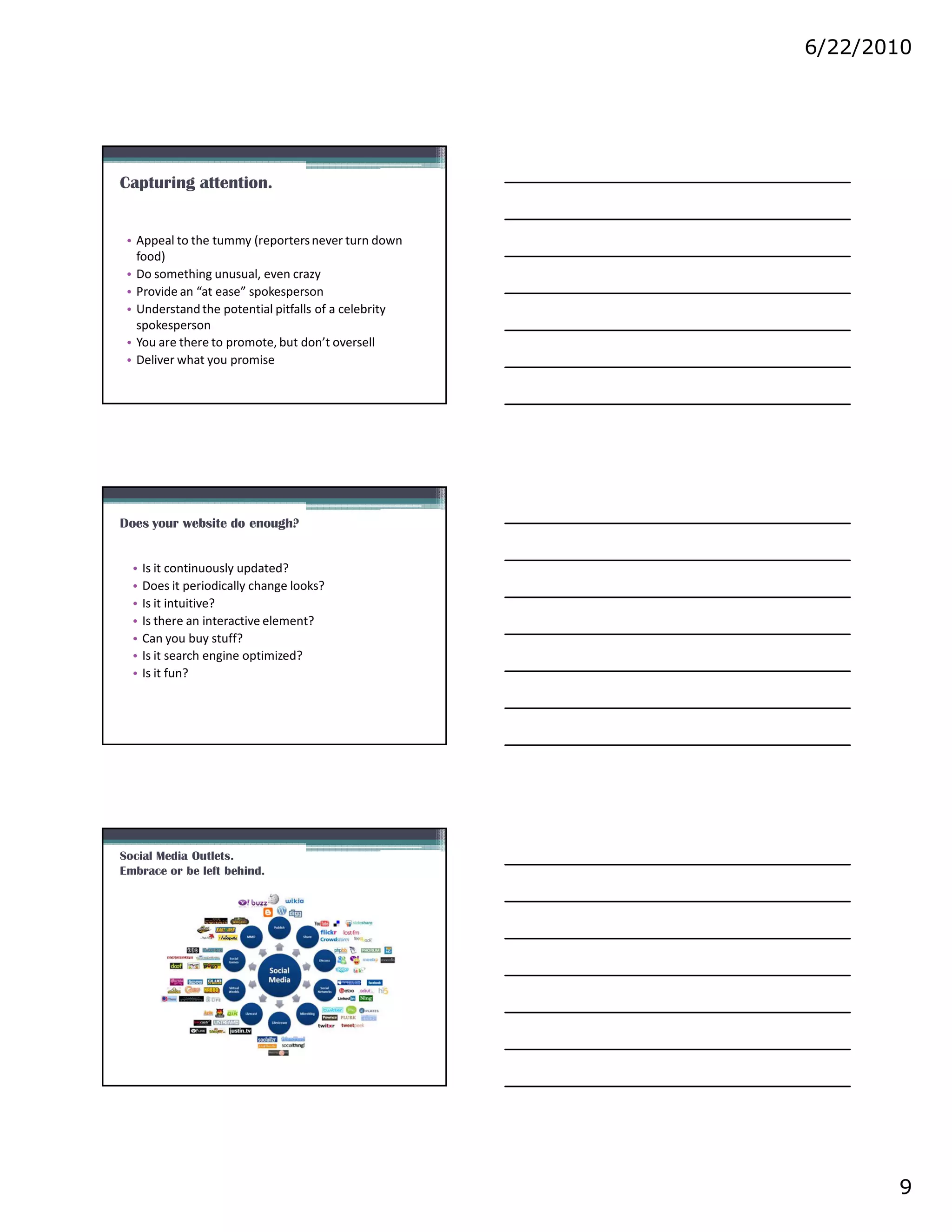
Social Media Outlets.
Embrace or be left behind.


                                                             9
6/22/2010


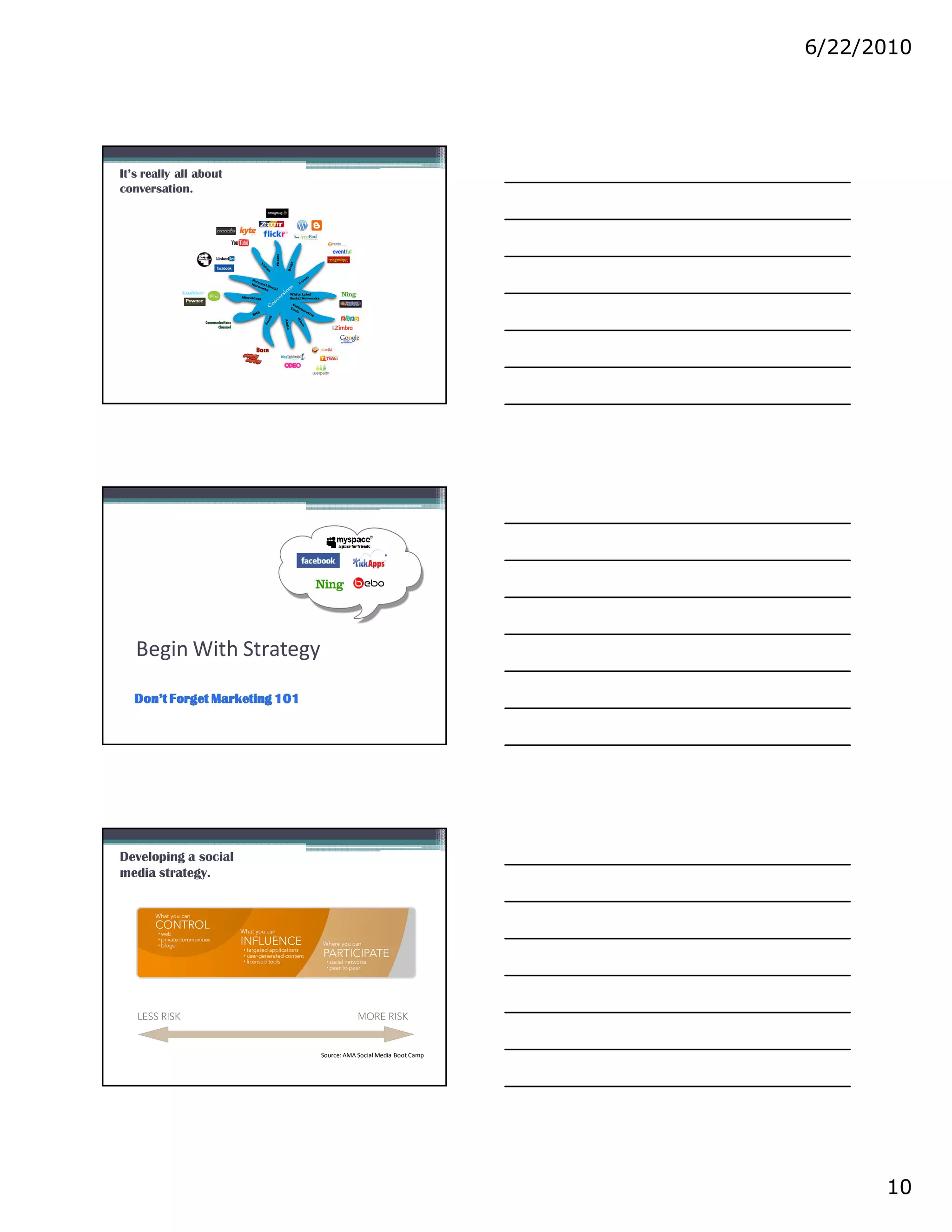
It’s really all about
conversation.


   Begin With Strategy


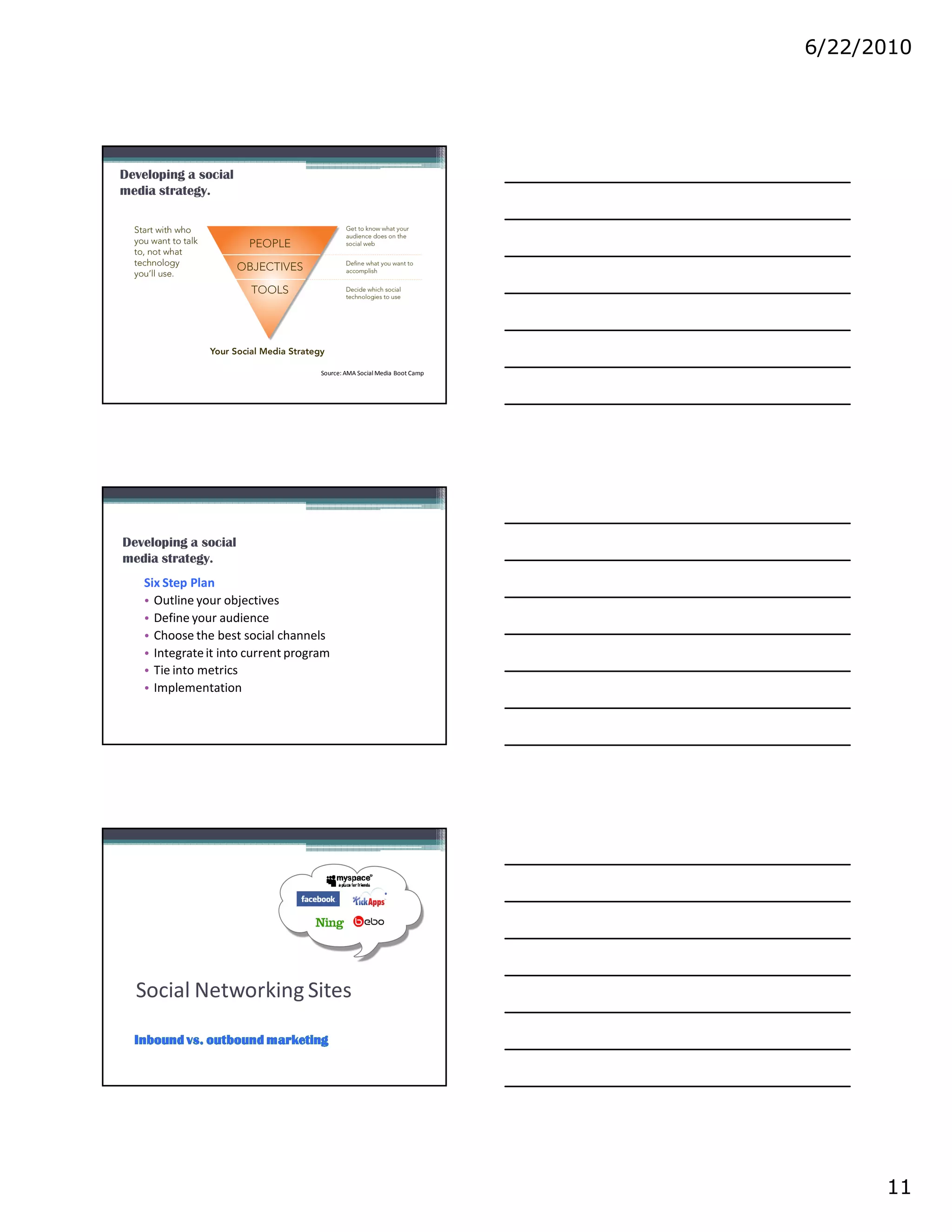
Developing a social
media strategy.


                         Source: AMA Social Media Boot Camp


                                                                    10
6/22/2010


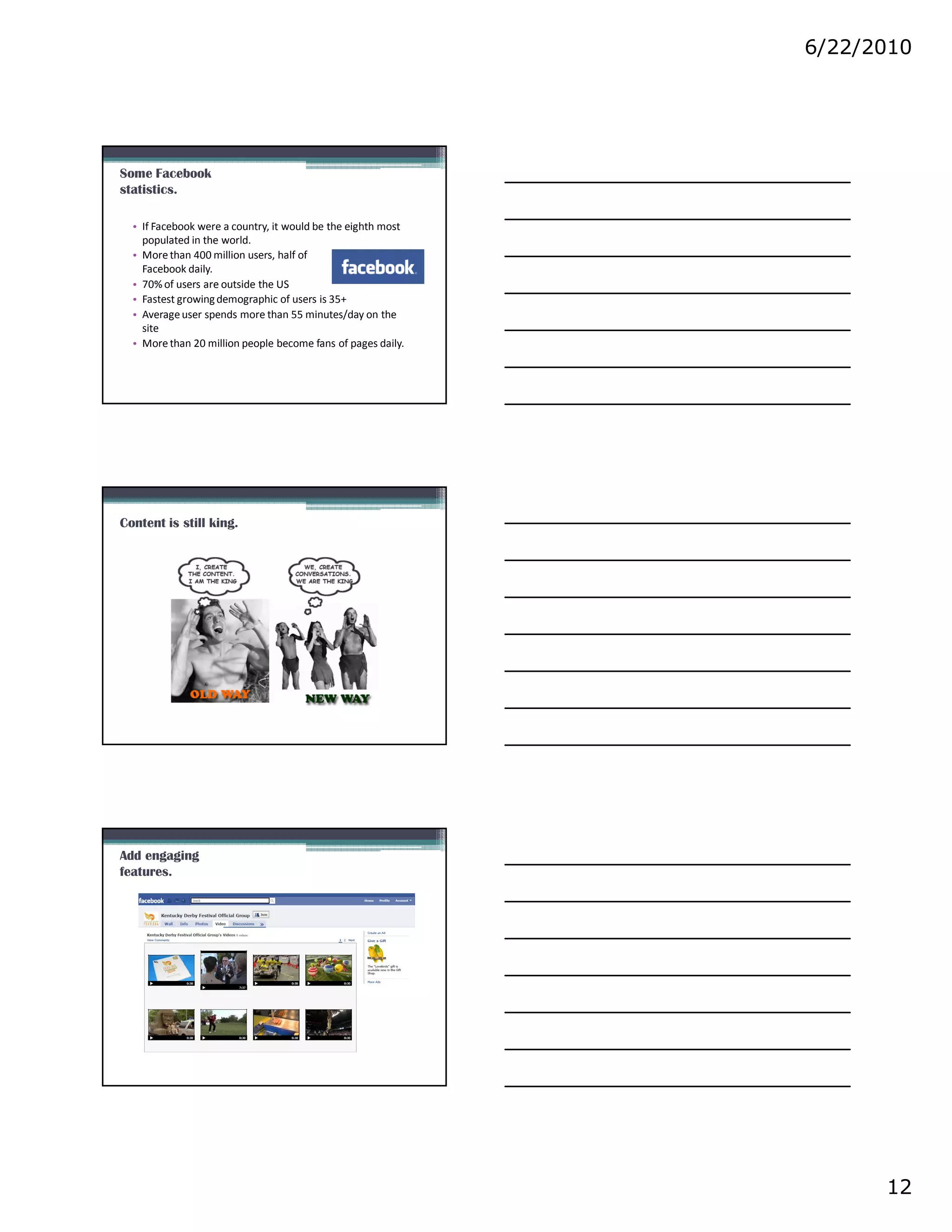
Developing a social
media strategy.


                                     Source: AMA Social Media Boot Camp


Developing a social
media strategy.
    Six Step Plan
    • Outline your objectives
    • Define your audience
    • Choose the best social channels
    • Integrate it into current program
    • Tie into metrics
    • Implementation


  Social Networking Sites


                                                                                11
6/22/2010


Some Facebook
statistics.

  • If Facebook were a country, it would be the eighth most
    populated in the world.
  • More than 400 million users, half of            which use
    Facebook daily.
  • 70% of users are outside the US
  • Fastest growing demographic of users is 35+
  • Average user spends more than 55 minutes/day on the
    site
  • More than 20 million people become fans of pages daily.


Content is still king.


Add engaging
features.


                                                                      12
6/22/2010


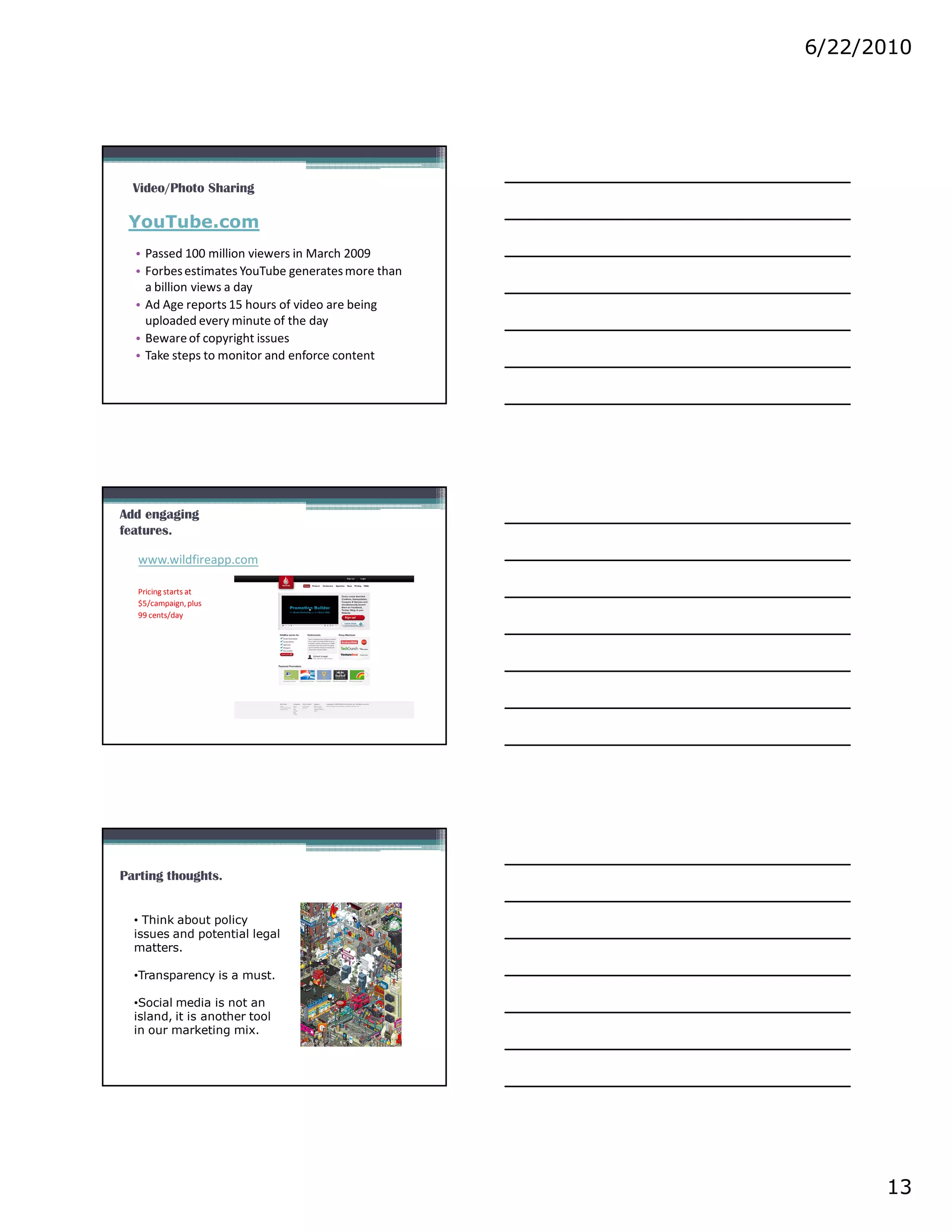
  Video/Photo Sharing

 YouTube.com
  • Passed 100 million viewers in March 2009
  • Forbes estimates YouTube generates more than
    a billion views a day
  • Ad Age reports 15 hours of video are being
    uploaded every minute of the day
  • Beware of copyright issues
  • Take steps to monitor and enforce content


Add engaging
features.

   www.wildfireapp.com

   Pricing starts at
   $5/campaign, plus
   99 cents/day


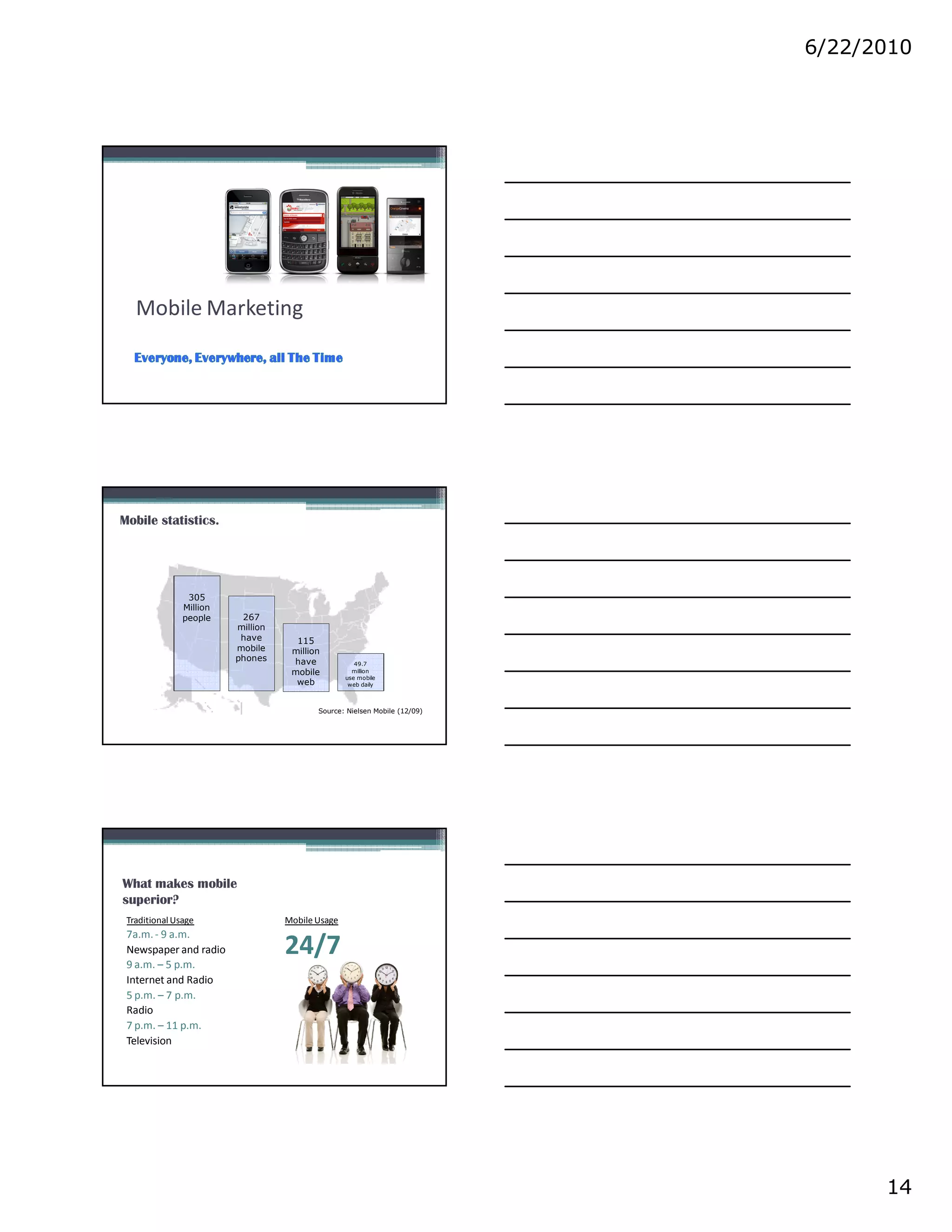
Parting thoughts.


  • Think about policy
  issues and potential legal
  matters.

  •Transparency is a must.

  •Social media is not an
  island, it is another tool
  in our marketing mix.


                                                         13
6/22/2010


   Mobile Marketing


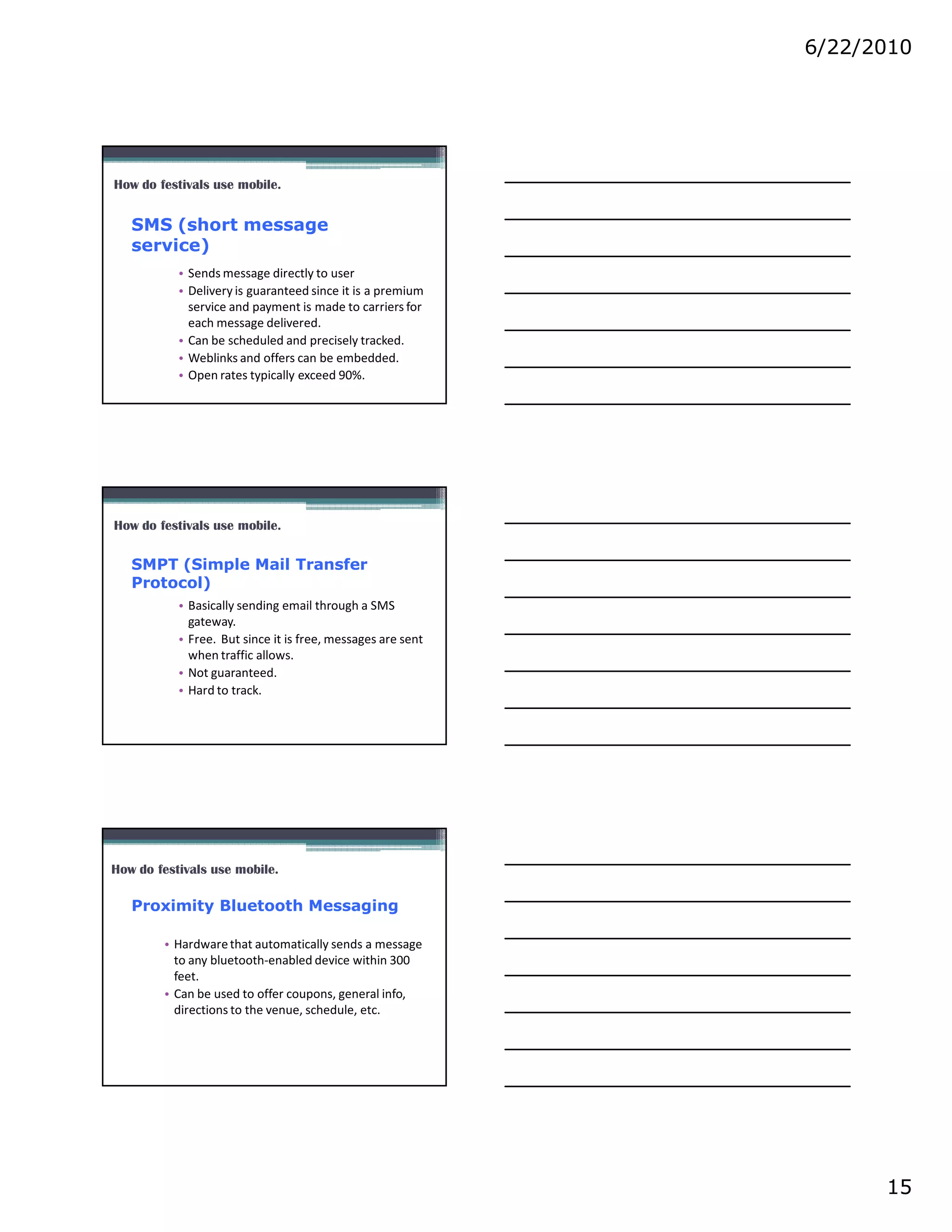
Mobile statistics.


                305
               Million
               people     267
                         million
                          have       115
                         mobile     million
                         phones     have             49.7
                                    mobile          million
                                                  use mobile
                                     web           web daily


                                          Source: Nielsen Mobile (12/09)


What makes mobile
superior?
 Traditional Usage                 Mobile Usage
 7a.m. - 9 a.m.
 Newspaper and radio
 9 a.m. – 5 p.m.
                                   24/7
 Internet and Radio
 5 p.m. – 7 p.m.
 Radio
 7 p.m. – 11 p.m.
 Television


                                                                                 14
6/22/2010


How do festivals use mobile.


   SMS (short message
   service)
           • Sends message directly to user
           • Delivery is guaranteed since it is a premium
             service and payment is made to carriers for
             each message delivered.
           • Can be scheduled and precisely tracked.
           • Weblinks and offers can be embedded.
           • Open rates typically exceed 90%.


How do festivals use mobile.

   SMPT (Simple Mail Transfer
   Protocol)
           • Basically sending email through a SMS
             gateway.
           • Free. But since it is free, messages are sent
             when traffic allows.
           • Not guaranteed.
           • Hard to track.


How do festivals use mobile.

   Proximity Bluetooth Messaging

        • Hardware that automatically sends a message
          to any bluetooth-enabled device within 300
          feet.
        • Can be used to offer coupons, general info,
          directions to the venue, schedule, etc.


                                                                   15
6/22/2010


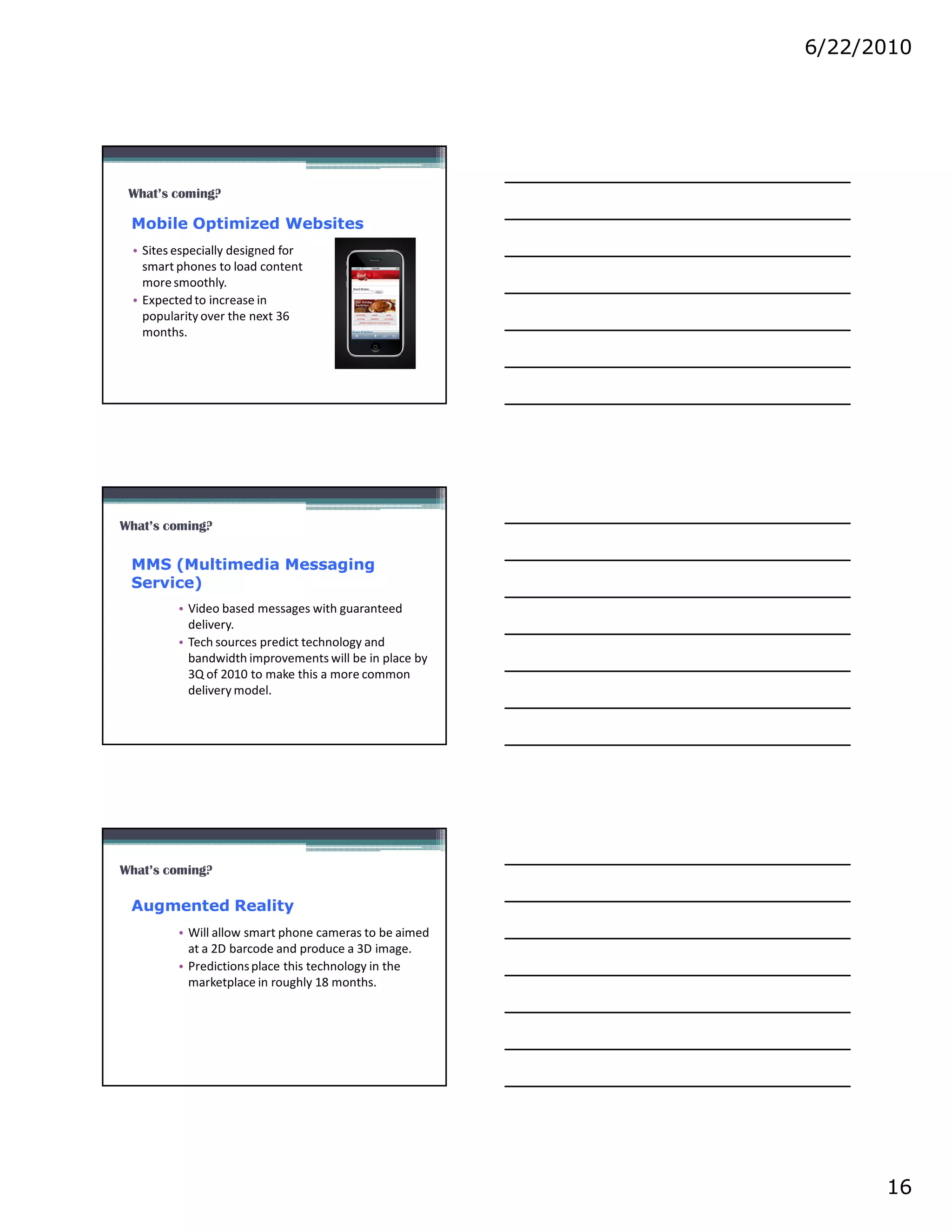
 What’s coming?

 Mobile Optimized Websites
 • Sites especially designed for
   smart phones to load content
   more smoothly.
 • Expected to increase in
   popularity over the next 36
   months.


What’s coming?

 MMS (Multimedia Messaging
 Service)
         • Video based messages with guaranteed
           delivery.
         • Tech sources predict technology and
           bandwidth improvements will be in place by
           3Q of 2010 to make this a more common
           delivery model.


What’s coming?

 Augmented Reality
         • Will allow smart phone cameras to be aimed
           at a 2D barcode and produce a 3D image.
         • Predictions place this technology in the
           marketplace in roughly 18 months.


                                                              16
6/22/2010


  E-Mail Marketing


Email made easy.

Distribute & track, plus cool
add-ons.
                       www.constantcontact.com
                       Pricing starts at $15/mo.

                       www.realmagnet.com
                       Initial set-up fee (based on
                       features enabled) + fee per email
                       delivered


Email made easy.


Microsoft Publisher

 • Allows WYSIWYG design
 • Easy to embed links and graphics
 • Integrates with Outlook address book
   functions


                                                                 17
6/22/2010


Always remember…

     Not-for-profit is a
     tax status, not a
     business plan.


   Stay In Touch!

                              Penny C. Reeh
                     Indigo Resource Group
                               P.O. Box 1025
                 Fredericksburg, Texas 78624
                              830.990.0180
                       pennyreeh@ktc.com


                                                     18

Penny Reeh

  • 1.
    6/22/2010 No Money? NoStaff? No Problem! Presented by: Penny C. Reeh Indigo Resource Group Fredericksburg, Texas Learning Objectives • Understand the five basic rules of resource allocation • Implement priority-based planning • Develop promotion strategies that are appropriate to your event • Learn at least 10 simple to use ideas to stretch your promotional budget Five Basic Rules of Resource Allocation 1. Accept that you cannot be all things to all people. ● Increasing competition for entertainment dollars. ● The smaller the budget, the more focused a festival must be in its approach. 1
  • 2.
    6/22/2010 Five Basic Rulesof Resource Allocation 2. Know your product intimately. ● Strengths ● Weaknesses ● Opportunities ● Threats Five Basic Rules of Resource Allocation 3. Understand your customer. ● Demographic, geographic and psychographic data. ● What are their needs and expectations? ● What motivates their travel decisions? ● Who is in the travel party? Five Basic Rules of Resource Allocation 4. Cheap is good…free is better. ● Understand the pros and cons of the promotional tools at your disposal. ● Use your creativity to set you apart from the pack. ● Learn from the big boys, then do it leaner and meaner. ● Look around for dance partners. 2
  • 3.
    6/22/2010 Five Basic Rulesof Resource Allocation 5. Only commit to what yields results. ● Do not tolerate any sacred cows. ● Break the “But we’ve always done it that way” mentality. ● There is no such thing as mistakes, only lessons learned. ● If it works improve it. If it doesn’t work, fix it or ditch it. Understanding the Pros and Cons of Promotional Vehicles • Advertising – Print and electronic • Direct Mail • Internet • Publicity/Media Relations • Word of Mouth Advantages of Advertising • Ability to reach large, but targeted audiences • Chance to demonstrate your event • Control of the message – You say what, to whom, how often and in what way 3
  • 4.
    6/22/2010 The Rules ofAdvertising Have Changed TELEVISION • Declining viewership in certain groups • Channel fragmentation • TiVo • Programming challenges The Rules of Advertising Have Changed RADIO • Channel fragmentation • Satellite Radio/iPod • Frequency needed to effectively deliver the message The Rules of Advertising Have Changed NEWSPAPER • Declining readership • Competition from online news sources • Local/regional newspapers may be the exception for festivals 4
  • 5.
    6/22/2010 The Rules ofAdvertising Have Changed MAGAZINE • Micro-niche formula • Competition from online news sources The Rules of Advertising Have Changed ADDITIONAL CHALLENGES • Learning to talk to younger consumers. • Shifting demographic populations. • Growing wariness of advertising in general. How do I pick the right advertising venues for my product? • Compare the readership or viewership to what you know about your customer. • Talk to other advertisers. • Evaluate the editorial content of the publication/show. • Test the source with a smaller “buy”. • Track advertising response and conversion. 5
  • 6.
    6/22/2010 Meet them and understandthem. Understand how media sources differ. • Television • Radio • Newspaper • Magazine • Travel Writer • E-zine Meet them and understand them. Learn their preference and formats. • Read, watch and listen • Focus on what the media covers • Focus on “their” causes (Fans 4 San Antonio) • Editorial trends • Who advertises Meet them and understand them. Actively build relationships. • Join broadcast and/or press associations • Invite the media to participate in your event • Get involved in their events 6
  • 7.
    6/22/2010 Understand their culture. •Deadlines, rating, time, space, sales and plenty of stress are a way of life • Scandal, death, war, crime, life….and celebrations….fit the bill • Pitching stories can be a home run or strike out • Not all reporters are created equal (learn who writes or reports about what) Getting your message ready. • Is your story unique? • Is your story timely? • Can it be tied to a current trend? • Is there a way to localize the story? • Is there a visual element? Getting your message ready. Develop multiple story angles. • Financial/ • Food/wine economic impact • Home and Garden • Lifestyle • Entertainment • Human Interest • Education • Environment • Technology • Sports • Calendars 7
  • 8.
    6/22/2010 Pack your toolkit. Websites are essential. ▫ Include your URL on everything ▫ Create a media vault ▫ Virtual media room – access to images, press credentials, news release archive, fact sheet, etc. Getting your message ready. Telling your story. ▫ Timing is everything. Take advantage of slow news days. (Elvis turkey and trial stories) ▫ Think visual – even for radio and newspaper – and package everything the media needs to just show up and report ▫ Make a list of everything you think a reporter may ask you (especially anything controversial) ▫ Be available. This can make you a reporter’s best friend. Contact the media. • Communicate on a routine basis ▫ Learn their preferred method of receiving information (phone, fax, email, regular mail) ▫ Conduct media blitzes ▫ Offer media vault services 8
  • 9.
    6/22/2010 Capturing attention. •Appeal to the tummy (reporters never turn down food) • Do something unusual, even crazy • Provide an “at ease” spokesperson • Understand the potential pitfalls of a celebrity spokesperson • You are there to promote, but don’t oversell • Deliver what you promise Does your website do enough? • Is it continuously updated? • Does it periodically change looks? • Is it intuitive? • Is there an interactive element? • Can you buy stuff? • Is it search engine optimized? • Is it fun? Social Media Outlets. Embrace or be left behind. 9
  • 10.
    6/22/2010 It’s really allabout conversation. Begin With Strategy Developing a social media strategy. Source: AMA Social Media Boot Camp 10
  • 11.
    6/22/2010 Developing a social mediastrategy. Source: AMA Social Media Boot Camp Developing a social media strategy. Six Step Plan • Outline your objectives • Define your audience • Choose the best social channels • Integrate it into current program • Tie into metrics • Implementation Social Networking Sites 11
  • 12.
    6/22/2010 Some Facebook statistics. • If Facebook were a country, it would be the eighth most populated in the world. • More than 400 million users, half of which use Facebook daily. • 70% of users are outside the US • Fastest growing demographic of users is 35+ • Average user spends more than 55 minutes/day on the site • More than 20 million people become fans of pages daily. Content is still king. Add engaging features. 12
  • 13.
    6/22/2010 Video/PhotoSharing YouTube.com • Passed 100 million viewers in March 2009 • Forbes estimates YouTube generates more than a billion views a day • Ad Age reports 15 hours of video are being uploaded every minute of the day • Beware of copyright issues • Take steps to monitor and enforce content Add engaging features. www.wildfireapp.com Pricing starts at $5/campaign, plus 99 cents/day Parting thoughts. • Think about policy issues and potential legal matters. •Transparency is a must. •Social media is not an island, it is another tool in our marketing mix. 13
  • 14.
    6/22/2010 Mobile Marketing Mobile statistics. 305 Million people 267 million have 115 mobile million phones have 49.7 mobile million use mobile web web daily Source: Nielsen Mobile (12/09) What makes mobile superior? Traditional Usage Mobile Usage 7a.m. - 9 a.m. Newspaper and radio 9 a.m. – 5 p.m. 24/7 Internet and Radio 5 p.m. – 7 p.m. Radio 7 p.m. – 11 p.m. Television 14
  • 15.
    6/22/2010 How do festivalsuse mobile. SMS (short message service) • Sends message directly to user • Delivery is guaranteed since it is a premium service and payment is made to carriers for each message delivered. • Can be scheduled and precisely tracked. • Weblinks and offers can be embedded. • Open rates typically exceed 90%. How do festivals use mobile. SMPT (Simple Mail Transfer Protocol) • Basically sending email through a SMS gateway. • Free. But since it is free, messages are sent when traffic allows. • Not guaranteed. • Hard to track. How do festivals use mobile. Proximity Bluetooth Messaging • Hardware that automatically sends a message to any bluetooth-enabled device within 300 feet. • Can be used to offer coupons, general info, directions to the venue, schedule, etc. 15
  • 16.
    6/22/2010 What’s coming? Mobile Optimized Websites • Sites especially designed for smart phones to load content more smoothly. • Expected to increase in popularity over the next 36 months. What’s coming? MMS (Multimedia Messaging Service) • Video based messages with guaranteed delivery. • Tech sources predict technology and bandwidth improvements will be in place by 3Q of 2010 to make this a more common delivery model. What’s coming? Augmented Reality • Will allow smart phone cameras to be aimed at a 2D barcode and produce a 3D image. • Predictions place this technology in the marketplace in roughly 18 months. 16
  • 17.
    6/22/2010 E-MailMarketing Email made easy. Distribute & track, plus cool add-ons. www.constantcontact.com Pricing starts at $15/mo. www.realmagnet.com Initial set-up fee (based on features enabled) + fee per email delivered Email made easy. Microsoft Publisher • Allows WYSIWYG design • Easy to embed links and graphics • Integrates with Outlook address book functions 17
  • 18.
    6/22/2010 Always remember… Not-for-profit is a tax status, not a business plan. Stay In Touch! Penny C. Reeh Indigo Resource Group P.O. Box 1025 Fredericksburg, Texas 78624 830.990.0180 pennyreeh@ktc.com 18