MCCDC-MRD
COMBAT LOAD REPORT
LCDR Demetri Economos USN
Marine Corps Combat Development Command
Materiel Requirements Division
Quantico, Virginia
31 DEC 2003
1. Purpose. To provide Director, Materiel Requirements
Division the current anthropometrical data for height and
weight, the optimum combat load in assault, march, and existence
scenarios (as a function of % body weight for the average
Marine), and recommend a combat load weight and balance figure
for future combat systems based on the optimum loads calculated
for the USMC.
2. Background. Overloading causes fatigue, heat stress,
injury, and performance degradation.
0
40
80
120
160
Greeks
Rom
ansByzantines
A
nglo
SaxonsN
apoleanic
U
S
CivilW
ar
W
W
I
W
W
II
K
orea
V
ietnam
Falklands1982
Grenada
1983
K
uw
ait1991JRTC
2001Iraq
2003
A
fghanistan
'03
Weight(lbs)
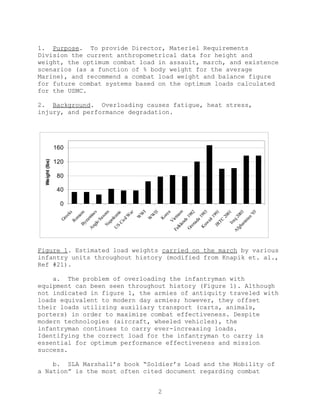
Figure 1. Estimated load weights carried on the march by various
infantry units throughout history (modified from Knapik et. al.,
Ref #21).
a. The problem of overloading the infantryman with
equipment can been seen throughout history (Figure 1). Although
not indicated in figure 1, the armies of antiquity traveled with
loads equivalent to modern day armies; however, they offset
their loads utilizing auxiliary transport (carts, animals,
porters) in order to maximize combat effectiveness. Despite
modern technologies (aircraft, wheeled vehicles), the
infantryman continues to carry ever-increasing loads.
Identifying the correct load for the infantryman to carry is
essential for optimum performance effectiveness and mission
success.
b. SLA Marshall’s book “Soldier’s Load and the Mobility of
a Nation” is the most often cited document regarding combat
2
loading of the infantryman. The premise of his analysis combines
average body weight of soldiers and the percentage of that mean
weight for the optimum load to be carried by the soldier. At the
time of his book (1950) he estimated the average soldier weighed
153.6 pounds and (from his analysis, moderate experimentation,
and experience) concluded that 33% of the body weight of an
average soldier could be carried optimally (equates to 50.7
pounds).
c. More scientific anthropometrical studies have been
performed and indicate that military personnel have increased in
size and weight since the time of Marshall’s book. The last
known study of this type for the Marine Corps was the 1971 MCDEC
(Marine Corps Development and Education Command) evaluation of
components of the 1970 MARCES (Marine Combat Electronic System)
Report (Project 30-69-07). In parts of its conclusions, it
stated that the mean average body weight and height for the USMC
as 158 pounds and 68.7 inches, respectively.
d. Up-to-date anthropometrical values become an important
factor when contemplating the development of future combat
systems where weight and occupancy volume become essential
variables in the design and lift capabilities of these future
systems. To that end, the MCCDC-MRD commissioned a study to:
(1) determine the current 50%-ile body weight and height
the Marine Corps.
(2) review the current load scenario definitions for
accuracy.
(3) recommend load weights for the load scenarios.
(4) recommend a combat load weight and balance figure
for combat development.
3. Study Method.
a. Exhaustive literature review covering DoD publications,
military standards, military doctrine publications, scientific
research publications, and commercial periodicals on the issue
of combat loading.
b. Collect height and weight data from the Marsh Center
USMC Manpower database, Quantico, VA and crosscheck with PFT
rosters from commands in Quantico, Virginia, and the School of
Infantry-East Coast, Camp LeJeune, N.C.
3
c. Calculate the USMC mean average for height and weight.
d. Calculate the optimum load weight for the load scenarios.
e. Calculate load weight and balance figure.
4. Results. All literature reviewed arrived at the same
conclusion: the infantryman is overloaded.
a. Current Army doctrinal publications FM 21-18 (Foot
Marches) and FM 7-10 (Infantry Rifle Company) prescribe weights
of 48 and 72 pounds for the fighting and approach march loads,
respectively. In a scenario defined as Emergency Approach March
Load, higher loads of up to 120 pounds are allowed in conditions
where approach marches are through terrain impassable to
vehicles, or ground/air transport are not available, or when the
mission demands that soldiers be employed as porters (note:
enemy contact should be avoided at the higher load). Although
the rationale behind the numbers was not indicated, it can be
assumed that either Army science or published military standards
influenced the Army’s doctrine.
b. In order to identify the source of the Army’s numbers,
the Department of Defense Design Criteria Standard: Human
Engineering (MIL-STD-1472F) was reviewed. This standard
establishes general human engineering criteria for design and
development of military systems, equipment and facilities. It
recommends no more than 30% of body weight for close combat, and
no more than 45% for marching. Comparing the percentage of body
weight recommended for the load scenarios versus the actual
loads recommended by the Army leads to the conclusion that the
Army based its loads from the MIL-STD and that it assumed an
average soldier weight of 160 pounds (160 x 30% = 48; 160 x 45%
= 72). The MIL-STD-1472F does not define a standard for the
emergency approach march load scenario, but it can be calculated
from the Army’s publication as 75% of the soldier’s body weight,
assuming the 160 pound solider as the average.
c. The next question is how did the Army arrive to its
conclusion that the average soldier weighs 160 pounds? Review of
the Military Handbook: Anthropometry of U.S. Military Personnel
(DOD-HDBK-743A) found a listing of every conceivable
anthropometrical measurement for military personnel of which
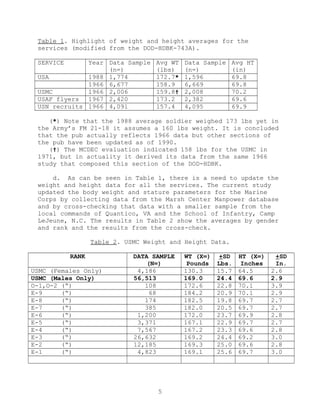
stature and body weights are included. Table 1 highlights the
last known weight and height measurements for the military:
4
Table 1. Highlight of weight and height averages for the
services (modified from the DOD-HDBK-743A).
SERVICE Year Data Sample
(n=)
Avg WT
(lbs)
Data Sample
(n=)
Avg HT
(in)
USA 1988 1,774 172.7* 1,596 69.8
1966 6,677 158.9 6,669 69.8
USMC 1966 2,006 159.8† 2,008 70.2
USAF flyers 1967 2,420 173.2 2,382 69.6
USN recruits 1966 4,091 157.4 4,095 69.9
(*) Note that the 1988 average soldier weighed 173 lbs yet in
the Army’s FM 21-18 it assumes a 160 lbs weight. It is concluded
that the pub actually reflects 1966 data but other sections of
the pub have been updated as of 1990.
(†) The MCDEC evaluation indicated 158 lbs for the USMC in
1971, but in actuality it derived its data from the same 1966
study that composed this section of the DOD-HDBK.
d. As can be seen in Table 1, there is a need to update the
weight and height data for all the services. The current study
updated the body weight and stature parameters for the Marine
Corps by collecting data from the Marsh Center Manpower database
and by cross-checking that data with a smaller sample from the
local commands of Quantico, VA and the School of Infantry, Camp
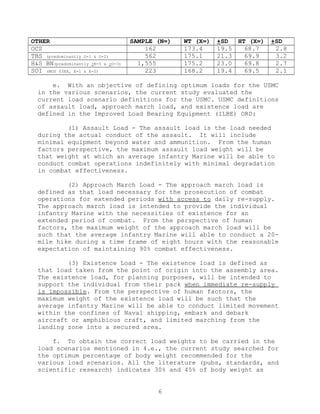
LeJeune, N.C. The results in Table 2 show the averages by gender
and rank and the results from the cross-check.
Table 2. USMC Weight and Height Data.
RANK DATA SAMPLE
(N=)
WT (X=)
Pounds
+SD
Lbs.
HT (X=)
Inches
+SD
In.
USMC (Females Only) 4,186 130.3 15.7 64.5 2.6
USMC (Males Only) 56,513 169.0 24.4 69.6 2.9
O-1,O-2 (“) 108 172.6 22.8 70.1 3.9
E-9 (“) 68 184.2 20.9 70.1 2.9
E-8 (“) 174 182.5 19.8 69.7 2.7
E-7 (“) 385 182.0 20.5 69.7 2.7
E-6 (“) 1,200 172.0 23.7 69.9 2.8
E-5 (“) 3,371 167.1 22.9 69.7 2.7
E-4 (“) 7,567 167.2 23.3 69.6 2.8
E-3 (“) 26,632 169.2 24.4 69.2 3.0
E-2 (“) 12,185 169.3 25.0 69.6 2.8
E-1 (“) 4,823 169.1 25.6 69.7 3.0
5
OTHER SAMPLE (N=) WT (X=) +SD HT (X=) +SD
OCS 162 173.4 19.5 68.7 2.8
TBS (predominantly O-1 & O-2) 562 175.1 21.3 69.9 3.2
H&S BN(predominantly >E-5 & >O-3) 1,555 175.2 23.0 69.8 2.7
SOI (MOS 03XX, E-1 & E-2) 223 168.2 19.4 69.5 2.1
e. With an objective of defining optimum loads for the USMC
in the various scenarios, the current study evaluated the
current load scenario definitions for the USMC. USMC definitions
of assault load, approach march load, and existence load are
defined in the Improved Load Bearing Equipment (ILBE) ORD:
(1) Assault Load - The assault load is the load needed
during the actual conduct of the assault. It will include
minimal equipment beyond water and ammunition. From the human
factors perspective, the maximum assault load weight will be
that weight at which an average infantry Marine will be able to
conduct combat operations indefinitely with minimal degradation
in combat effectiveness.
(2) Approach March Load - The approach march load is
defined as that load necessary for the prosecution of combat
operations for extended periods with access to daily re-supply.
The approach march load is intended to provide the individual
infantry Marine with the necessities of existence for an
extended period of combat. From the perspective of human
factors, the maximum weight of the approach march load will be
such that the average infantry Marine will able to conduct a 20-
mile hike during a time frame of eight hours with the reasonable
expectation of maintaining 90% combat effectiveness.
(3) Existence Load - The existence load is defined as
that load taken from the point of origin into the assembly area.
The existence load, for planning purposes, will be intended to
support the individual from their pack when immediate re-supply
is impossible. From the perspective of human factors, the
maximum weight of the existence load will be such that the
average infantry Marine will be able to conduct limited movement
within the confines of Naval shipping, embark and debark
aircraft or amphibious craft, and limited marching from the
landing zone into a secured area.
f. To obtain the correct load weights to be carried in the
load scenarios mentioned in 4.e., the current study searched for
the optimum percentage of body weight recommended for the
various load scenarios. All the literature (pubs, standards, and
scientific research) indicates 30% and 45% of body weight as
6
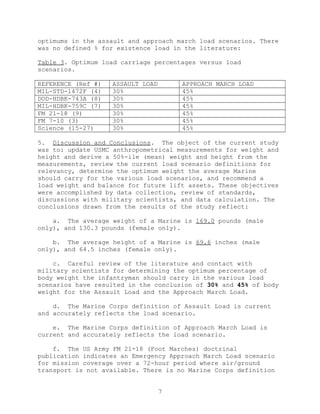
optimums in the assault and approach march load scenarios. There
was no defined % for existence load in the literature:
Table 3. Optimum load carriage percentages versus load
scenarios.
REFERENCE (Ref #) ASSAULT LOAD APPROACH MARCH LOAD
MIL-STD-1472F (4) 30% 45%
DOD-HDBK-743A (8) 30% 45%
MIL-HDBK-759C (7) 30% 45%
FM 21-18 (9) 30% 45%
FM 7-10 (3) 30% 45%
Science (15-27) 30% 45%
5. Discussion and Conclusions. The object of the current study
was to: update USMC anthropometrical measurements for weight and
height and derive a 50%-ile (mean) weight and height from the
measurements, review the current load scenario definitions for
relevancy, determine the optimum weight the average Marine
should carry for the various load scenarios, and recommend a
load weight and balance for future lift assets. These objectives
were accomplished by data collection, review of standards,
discussions with military scientists, and data calculation. The
conclusions drawn from the results of the study reflect:
a. The average weight of a Marine is 169.0 pounds (male
only), and 130.3 pounds (female only).
b. The average height of a Marine is 69.6 inches (male
only), and 64.5 inches (female only).
c. Careful review of the literature and contact with
military scientists for determining the optimum percentage of
body weight the infantryman should carry in the various load
scenarios have resulted in the conclusion of 30% and 45% of body
weight for the Assault Load and the Approach March Load.
d. The Marine Corps definition of Assault Load is current
and accurately reflects the load scenario.
e. The Marine Corps definition of Approach March Load is
current and accurately reflects the load scenario.
f. The US Army FM 21-18 (Foot Marches) doctrinal
publication indicates an Emergency Approach March Load scenario
for mission coverage over a 72-hour period where air/ground
transport is not available. There is no Marine Corps definition
7
for the Emergency Approach March Load. This is a potential
deficiency. It is suggested that the Marine Corps consider
adopting a modified version of the Army concept. The following
definition for a Sustained March Load is offered as an
intermediate between Approach March Load and Existence Load:
(1) Sustained March Load - that load which may be
necessary to accomplish the mission, including items necessary
to sustain or protect over a period of approximately 72 hrs when
air and ground transport are not available. Larger packs must be
carried and contact with the enemy should not be expected as the
heavier packs could negatively affect combat effectiveness. From
the human factors perspective, well-conditioned Marines can
easily carry the Sustained March Load.
g. Assuming the addition of a Sustained March Load
definition, it is suggested the Marine Corps modify the current
definition of Existence Load to the following (modification is
italicized and bolded):
(1) Existence Load - defined as that load taken from the
point of origin into the assembly area. The existence load, for
planning purposes, will be intended to support the individual
from their pack when immediate re-supply is impossible. Due to
the heavier loads carried, enemy contact should be avoided. From
the perspective of human factors, the maximum weight of the
existence load will be such that the average infantry Marine
will be able to conduct limited movement within the confines of
Naval shipping, embark and debark aircraft or amphibious craft,
and limited marching from the landing zone into a secured area.
h. Careful review of the literature and contact with
military scientists gave no indication that an optimum
percentage of body weight had been defined for a Sustained March
Load or an Existence Load. This is a deficiency. In lieu of
concrete experimentation, it is suggested that the Marine Corps
consider 60% and 75% as the optimum percentage of body weight
for carriage in the Sustained March Load and Existence Load
(respectively). These numbers are based on data extrapolation
from Army load carriage experiments and derivative conclusions
from the Army doctrinal publications.
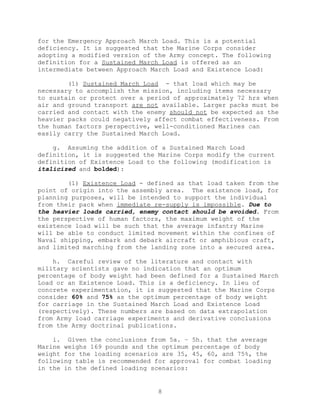
i. Given the conclusions from 5a. – 5h. that the average
Marine weighs 169 pounds and the optimum percentage of body
weight for the loading scenarios are 35, 45, 60, and 75%, the
following table is recommended for approval for combat loading
in the in the defined loading scenarios:
8
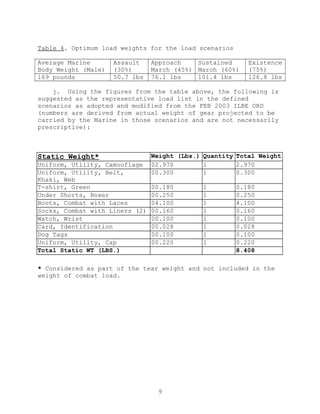
Table 4. Optimum load weights for the load scenarios
Average Marine
Body Weight (Male)
Assault
(30%)
Approach
March (45%)
Sustained
March (60%)
Existence
(75%)
169 pounds 50.7 lbs 76.1 lbs 101.4 lbs 126.8 lbs
j. Using the figures from the table above, the following is
suggested as the representative load list in the defined
scenarios as adopted and modified from the FEB 2003 ILBE ORD
(numbers are derived from actual weight of gear projected to be
carried by the Marine in those scenarios and are not necessarily
prescriptive):
Static Weight* Weight (Lbs.) Quantity Total Weight
Uniform, Utility, Camouflage 02.970 1 2.970
Uniform, Utility, Belt,
Khaki, Web
00.300 1 0.300
T-shirt, Green 00.180 1 0.180
Under Shorts, Boxer 00.250 1 0.250
Boots, Combat with Laces 04.100 1 4.100
Socks, Combat with Liners (2) 00.160 1 0.160
Watch, Wrist 00.100 1 0.100
Card, Identification 00.028 1 0.028
Dog Tags 00.100 1 0.100
Uniform, Utility, Cap 00.220 1 0.220
Total Static WT (LBS.) 8.408
* Considered as part of the tear weight and not included in the
weight of combat load.
9
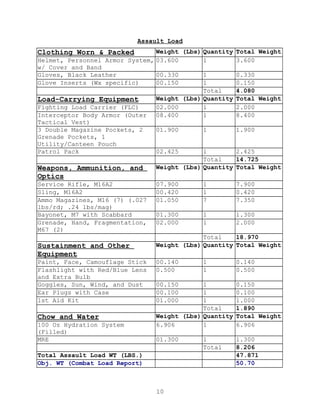
Assault Load
Clothing Worn & Packed Weight (Lbs) Quantity Total Weight
Helmet, Personnel Armor System,
w/ Cover and Band
03.600 1 3.600
Gloves, Black Leather 00.330 1 0.330
Glove Inserts (Wx specific) 00.150 1 0.150
Total 4.080
Load-Carrying Equipment Weight (Lbs) Quantity Total Weight
Fighting Load Carrier (FLC) 02.000 1 2.000
Interceptor Body Armor (Outer
Tactical Vest)
08.400 1 8.400
3 Double Magazine Pockets, 2
Grenade Pockets, 1
Utility/Canteen Pouch
01.900 1 1.900
Patrol Pack 02.425 1 2.425
Total 14.725
Weapons, Ammunition, and
Optics
Weight (Lbs) Quantity Total Weight
Service Rifle, M16A2 07.900 1 7.900
Sling, M16A2 00.420 1 0.420
Ammo Magazines, M16 (7) (.027
lbs/rd; .24 lbs/mag)
01.050 7 7.350
Bayonet, M7 with Scabbard 01.300 1 1.300
Grenade, Hand, Fragmentation,
M67 (2)
02.000 1 2.000
Total 18.970
Sustainment and Other
Equipment
Weight (Lbs) Quantity Total Weight
Paint, Face, Camouflage Stick 00.140 1 0.140
Flashlight with Red/Blue Lens
and Extra Bulb
0.500 1 0.500
Goggles, Sun, Wind, and Dust 00.150 1 0.150
Ear Plugs with Case 00.100 1 0.100
1st Aid Kit 01.000 1 1.000
Total 1.890
Chow and Water Weight (Lbs) Quantity Total Weight
100 Oz Hydration System
(Filled)
6.906 1 6.906
MRE 01.300 1 1.300
Total 8.206
Total Assault Load WT (LBS.) 47.871
Obj. WT (Combat Load Report) 50.70
10
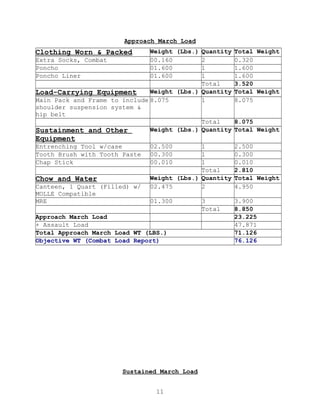
Approach March Load
Clothing Worn & Packed Weight (Lbs.) Quantity Total Weight
Extra Socks, Combat 00.160 2 0.320
Poncho 01.600 1 1.600
Poncho Liner 01.600 1 1.600
Total 3.520
Load-Carrying Equipment Weight (Lbs.) Quantity Total Weight
Main Pack and Frame to include
shoulder suspension system &
hip belt
8.075 1 8.075
Total 8.075
Sustainment and Other
Equipment
Weight (Lbs.) Quantity Total Weight
Entrenching Tool w/case 02.500 1 2.500
Tooth Brush with Tooth Paste 00.300 1 0.300
Chap Stick 00.010 1 0.010
Total 2.810
Chow and Water Weight (Lbs.) Quantity Total Weight
Canteen, 1 Quart (Filled) w/
MOLLE Compatible
02.475 2 4.950
MRE 01.300 3 3.900
Total 8.850
Approach March Load 23.225
+ Assault Load 47.871
Total Approach March Load WT (LBS.) 71.126
Objective WT (Combat Load Report) 76.126
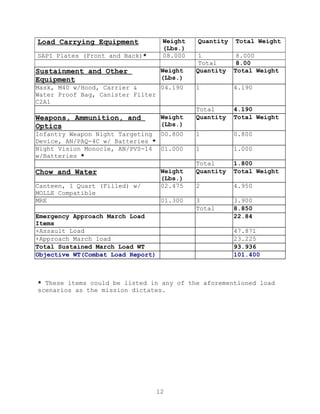
Sustained March Load
11
Load Carrying Equipment Weight
(Lbs.)
Quantity Total Weight
SAPI Plates (Front and Back)* 08.000 1 8.000
Total 8.00
Sustainment and Other
Equipment
Weight
(Lbs.)
Quantity Total Weight
Mask, M40 w/Hood, Carrier &
Water Proof Bag, Canister Filter
C2A1
04.190 1 4.190
Total 4.190
Weapons, Ammunition, and
Optics
Weight
(Lbs.)
Quantity Total Weight
Infantry Weapon Night Targeting
Device, AN/PAQ-4C w/ Batteries *
00.800 1 0.800
Night Vision Monocle, AN/PVS-14
w/Batteries *
01.000 1 1.000
Total 1.800
Chow and Water Weight
(Lbs.)
Quantity Total Weight
Canteen, 1 Quart (Filled) w/
MOLLE Compatible
02.475 2 4.950
MRE 01.300 3 3.900
Total 8.850
Emergency Approach March Load
Items
22.84
+Assault Load 47.871
+Approach March load 23.225
Total Sustained March Load WT 93.936
Objective WT(Combat Load Report) 101.400
* These items could be listed in any of the aforementioned load
scenarios as the mission dictates.
12
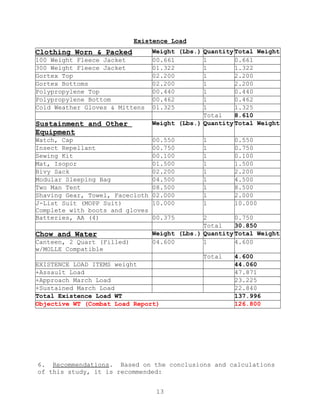
Existence Load
Clothing Worn & Packed Weight (Lbs.) Quantity Total Weight
100 Weight Fleece Jacket 00.661 1 0.661
300 Weight Fleece Jacket 01.322 1 1.322
Gortex Top 02.200 1 2.200
Gortex Bottoms 02.200 1 2.200
Polypropylene Top 00.440 1 0.440
Polypropylene Bottom 00.462 1 0.462
Cold Weather Gloves & Mittens 01.325 1 1.325
Total 8.610
Sustainment and Other
Equipment
Weight (Lbs.) Quantity Total Weight
Watch, Cap 00.550 1 0.550
Insect Repellant 00.750 1 0.750
Sewing Kit 00.100 1 0.100
Mat, Isopor 01.500 1 1.500
Bivy Sack 02.200 1 2.200
Modular Sleeping Bag 04.500 1 4.500
Two Man Tent 08.500 1 8.500
Shaving Gear, Towel, Facecloth 02.000 1 2.000
J-List Suit (MOPP Suit)
Complete with boots and gloves
10.000 1 10.000
Batteries, AA (4) 00.375 2 0.750
Total 30.850
Chow and Water Weight (Lbs.) Quantity Total Weight
Canteen, 2 Quart (Filled)
w/MOLLE Compatible
04.600 1 4.600
Total 4.600
EXISTENCE LOAD ITEMS weight 44.060
+Assault Load 47.871
+Approach March Load 23.225
+Sustained March Load 22.840
Total Existence Load WT 137.996
Objective WT (Combat Load Report) 126.800
6. Recommendations. Based on the conclusions and calculations
of this study, it is recommended:
13
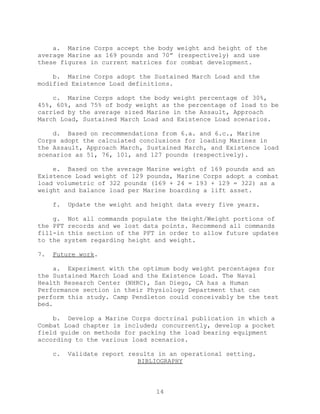
a. Marine Corps accept the body weight and height of the
average Marine as 169 pounds and 70” (respectively) and use
these figures in current matrices for combat development.
b. Marine Corps adopt the Sustained March Load and the
modified Existence Load definitions.
c. Marine Corps adopt the body weight percentage of 30%,
45%, 60%, and 75% of body weight as the percentage of load to be
carried by the average sized Marine in the Assault, Approach
March Load, Sustained March Load and Existence Load scenarios.
d. Based on recommendations from 6.a. and 6.c., Marine
Corps adopt the calculated conclusions for loading Marines in
the Assault, Approach March, Sustained March, and Existence load
scenarios as 51, 76, 101, and 127 pounds (respectively).
e. Based on the average Marine weight of 169 pounds and an
Existence Load weight of 129 pounds, Marine Corps adopt a combat
load volumetric of 322 pounds (169 + 24 = 193 + 129 = 322) as a
weight and balance load per Marine boarding a lift asset.
f. Update the weight and height data every five years.
g. Not all commands populate the Height/Weight portions of
the PFT records and we lost data points. Recommend all commands
fill-in this section of the PFT in order to allow future updates
to the system regarding height and weight.
7. Future work.
a. Experiment with the optimum body weight percentages for
the Sustained March Load and the Existence Load. The Naval
Health Research Center (NHRC), San Diego, CA has a Human
Performance section in their Physiology Department that can
perform this study. Camp Pendleton could conceivably be the test
bed.
b. Develop a Marine Corps doctrinal publication in which a
Combat Load chapter is included; concurrently, develop a pocket
field guide on methods for packing the load bearing equipment
according to the various load scenarios.
c. Validate report results in an operational setting.
BIBLIOGRAPHY
14
Military Publications, Standards, Reports, Handbooks:
1. Army Chief of Staff (2002) “Combined Arms Operations in
Urban Terrain” Field Manual (FM) 3-06.11. HQ, Department of the
Army, Washington, D.C. 28 FEB 2002.
2. Ehrlich, R.J. (2001) “Chapter 11: Soldier’s Load and Combat
Readiness” Joint Readiness Training Center Newsletter, No. 01-15
(JUL 01), Center for Army Lessons Learned (CALL), US Army
Training and Doctrine Command (TRADOC) Fort Leaven worth, KS
66027-1350; pp 71-76. downloaded from : http://call.army.mil 20
SEP 2003.
3. Army Chief of Staff (2000) “The Infantry Rifle Company.”
Field Manual (FM) 7-10 . HQ, Department of the Army, Washington,
D.C., 31 OCT 2000.
4. Department of Defense (1999) “Design Criteria Standard:
Human Engineering.” Military Standard 1472F (MIL-STD-1472F). 23
AUG 1999.
5. Ministry of Defence (1997) “Human Factors for Designers of
Equipment Part 3: Body Strength and Stamina.” Defence Standard
(DEF-STAN) 00-25 (Part 3)/Issue 2. Ministry of Defence,
Directorate of Standardization, Glasgow, G2 8EX; 24 Jan 1997.
6. Ministry of Defence (1997) “Human Factors for Designers of
Equipment Part 2:Body Size.” DEF-STAN-00-25 (Part 2)/Issue 2.
Ministry of Defence, Directorate of Standardization, Glasgow, G2
8EX; 14 FEB 1997.
7. Department of Defense (1995) “Handbook for Human
Engineering Design Guidelines.” Military Handbook 759C (MIL-
HDBK-759C).
31 JUL 1995.
8. Department of Defense (1991) “Military Handbook
Anthropometry of U.S. Military Personnel (Metric).” Department
of Defense Handbook 743A (DOD-HDBK-743A). 13 FEB 1991.
9. Army Chief of Staff (1990) “Foot Marches.” Field Manual (FM)
21-18. HQ, Department of the Army, Washington, D.C., 01 JUN 1990.
10. Army Chief of Staff (19XX) “The Infantry Battalion.” Field
Manual (FM) 7-20. HQ, Department of the Army, Washington, D.C.,
DD MMM YYYY.
15
11. Army Chief of Staff (1982) “Jungle Operations.” Field
Manual (FM) 90-5. HQ, Department of the Army, Washington, D.C.,
16 AUG 1982.
12. US Marine Corps (1971) Evaluation of MARCES Platoon Load
Distribution Report. Marine Corps Development and Education
Command, Quantico, VA; 21 JAN 1971.
13. US Marine Corps (1970) Marine Combat Electronic System
(MARCES) Platoon Final Report: The Platoon and Its Operations
(Volume 2). HQ, Marine Corps, Washington, D.C.; 30 JAN 1970.
14. Army Chief of Staff (1967) “Principles Governing the Design
of the Individual Equipment of the Combat Soldier.” Technical
Bulletin (TB) 34-9-253. HQ, Department of the Army, Washington,
D.C.
Science Publications, Technical Reports, Press Releases, Books,
and Staff Papers:
15. Santee, W.R.; L.A. Blanchard; K.L. Speckman; J.A. Gonzalez;
R.F. Wallace (2003) “Load Carriage model Development and Testing
with Field Data.” USARIEM TECH NOTE TN03-3. Biophysics and
Biomedical Modeling Division; US Army Research Institute of
Environmental Medicine, Natick, MA.
16. Fronduti-Polcyn, A.; C.K. Bensel; E. A. Harman; J.P. Obusek;
C. Pandorf; P. Frykman (2002) “Effects of Weights Carried by
Soldiers: Combined Analysis of Four Studies on Maximal
Performance, Physiology, and Biomechanics.” Techincal Report:
Natick/TR-02/010. US Army Medical Research and Materiel Command;
US Army Research Institute of Environmental Medicine, Natick, MA.
17. Whitaker, J. (2001) “New Rucksack Helps Soldiers Tailor
Load.” SBCOM-Natick Press Release No:01-50. US Army Soldier
Systems Center-Natick; US Army Soldier and Biological Chemical
Command, Natick MA; 19 SEP 2001.
18. Whitaker, J. (2001) “Physiological Monitors Key to Peak
Performance.” SBCOM-Natick Press Release No: 01-58. US Army
Soldier Systems Center-Natick; US Army Soldier and Biological
Chemical Command, Natick MA; 08 NOV 2001.
19. Butler, P.J.; C.J. Patterson (2000) “ The Effects fo
Environment, Terrain, and Load on Infantry Soldier Performance.”
16
ARL-MR-478. Weapons and Materials Research Directorate; Army
Research Laboratory, Aberdeen Proving Ground, MD.
20. Harman, E.; P. Frykman; C. Pandorf; W. Tharion; R. Mello; J.
Obusek; J. Kirk (1999) “Physiological, Biomedical, and
Mechanical Performance Comparisons of Soldiers Carrying Loads
using US Marine Corps Modular Lightweight Load-Carrying
Equipment (MOLLE) and US Army Modular Load System (MLS)
Prototypes.” Tech Report T99-4. US Army Medical Research and
Materiel Command; US Army Research Institute of Environmental
Medicine, Natick, MA.
21. Knapik, J.; K. Reynolds (1997) “Load Carriage in Militray
Operations: A Review of Historical, Physiological,
Biomechanical, and Medical Aspects.” Tech Report:19971014-055.
Army Research Laboratory Aberdeen Proving Ground, MD; US Army
Research Institute of Environmental Medicine, Natick, MA.
22. Townsend, S.J. (1994) “The Factors of Soldier’s Load.”
Defense Technical Information Center (DTIC) AD-A284-389. Defense
Technical Information Center, FT Belvoir, VA.
23. Knapik, J; R. Johnson; P. Ang; H. Meiselman; C.K. Bensel; W.
Johnson; B. Flynn; W. Hanlon (1993) “Road March Performance of
Special Operations Soldiers Carrying Various Loads and Load
Distributions.” Tech Report No. T 14-93. US Army Medical
Research and Materiel Command; US Army Research Institute of
Environmental Medicine, Natick, MA.
24. Ezell, W.L. (1992) “Battlefield Mobility and the Soldier’s
Load.” Command and Staff Paper. Marine Corps University,
Quantico, VA.
25. Buckalew, L.W. (1990) “Soldier Performance as a Funciton of
Stress and Load: A Review.” ARI Research Report 1545. Field
Unit, FT. Hood, TX; US Army Research Institute for the
Behavioral and Social Sciences.
26. Knapik, J (1989) “Loads Carried by Soldiers: Historical,
Physiological, biomechanical, and Medical Aspects.” Tech Report
T19-89. US Army Medical Research and Materiel Command; US Army
Research Institute of Environmental Medicine, Natick, MA.
27. Anonymous (1985) “Infantryman’s Combat Load” Command and
Staff Paper. Marine Corps University, Quantico, VA.
17
28. Marshall, S.L.A. (1950) Soldier’s Load and the Mobility of a
Nation. The Marine Corps Association, Quantico, VA (Jan 1980).
Periodicals:
29. Regalado, A. (2003) “Gearing Up: Girding the Grunt for War.”
Wall Street Journal. 07 FEB 2003, PG. B.1.
30. Rorke, T. (2003) “Army Looks to Lighten Soldier’s Combat
Load.” Belvior Eagle. May 2003.
31. Zoroya, G. (2003) “101st
Ready for Enemy Territory; Army
Airborne Assault Unit Carries Variety of Weapons and Heavy
Burden.” USA TODAY. 19 MAR 2003, pg. A.06.
32. Brill Jr., A.P. (2002) “The Last Ounce of Combat Readiness.”
Navy League of the United States. Downloaded from URL:
http://www.navyleague.org
33. “What Joe Carries.” 13 JUL 2001. Downloaded from URL:
http://call.army.mil/products/sop/adams/chapter16.htm
34. Kennedy, H. (2001) “Army Striving to Lighten Load for Combat
Soldiers.” National Defense. JUL 2001, pg. 30.
35. Goodman Jr., G.W. (1999) “ Revolutionary Soldier: US Army’s
Land Warrior Program Turns the Corner and Shows Far-Reaching
Potential.” Armed Forces Journal International. OCT 1999, pg. 56.
36. Solgere, A. (1999) “A Soldier’s Load…Revisited.” Marine
Corps Gazette. Vol. 83 No. 10 (OCT 1999).
37. Luddy, J. (1996) “A Lighter Burden to Bear: Program
Priorities Focus on the Individual Marine.” Marines Online. AUG
1996.
38. Porter, S.C. (1992) “The Soldier’s Load.” Infantry. Vol 82
#3 (May-Jun) 1992.
39. Inghram, D.C. (1987) “Lightening the Combat Load.” Marine
Corps Gazette. 1987, Vol. 71 (3).
18

Usmc combat load report 2003

  • 1.
    MCCDC-MRD COMBAT LOAD REPORT LCDRDemetri Economos USN Marine Corps Combat Development Command Materiel Requirements Division Quantico, Virginia 31 DEC 2003
  • 2.
    1. Purpose. Toprovide Director, Materiel Requirements Division the current anthropometrical data for height and weight, the optimum combat load in assault, march, and existence scenarios (as a function of % body weight for the average Marine), and recommend a combat load weight and balance figure for future combat systems based on the optimum loads calculated for the USMC. 2. Background. Overloading causes fatigue, heat stress, injury, and performance degradation. 0 40 80 120 160 Greeks Rom ansByzantines A nglo SaxonsN apoleanic U S CivilW ar W W I W W II K orea V ietnam Falklands1982 Grenada 1983 K uw ait1991JRTC 2001Iraq 2003 A fghanistan '03 Weight(lbs) Figure 1. Estimated load weights carried on the march by various infantry units throughout history (modified from Knapik et. al., Ref #21). a. The problem of overloading the infantryman with equipment can been seen throughout history (Figure 1). Although not indicated in figure 1, the armies of antiquity traveled with loads equivalent to modern day armies; however, they offset their loads utilizing auxiliary transport (carts, animals, porters) in order to maximize combat effectiveness. Despite modern technologies (aircraft, wheeled vehicles), the infantryman continues to carry ever-increasing loads. Identifying the correct load for the infantryman to carry is essential for optimum performance effectiveness and mission success. b. SLA Marshall’s book “Soldier’s Load and the Mobility of a Nation” is the most often cited document regarding combat 2
  • 3.
    loading of theinfantryman. The premise of his analysis combines average body weight of soldiers and the percentage of that mean weight for the optimum load to be carried by the soldier. At the time of his book (1950) he estimated the average soldier weighed 153.6 pounds and (from his analysis, moderate experimentation, and experience) concluded that 33% of the body weight of an average soldier could be carried optimally (equates to 50.7 pounds). c. More scientific anthropometrical studies have been performed and indicate that military personnel have increased in size and weight since the time of Marshall’s book. The last known study of this type for the Marine Corps was the 1971 MCDEC (Marine Corps Development and Education Command) evaluation of components of the 1970 MARCES (Marine Combat Electronic System) Report (Project 30-69-07). In parts of its conclusions, it stated that the mean average body weight and height for the USMC as 158 pounds and 68.7 inches, respectively. d. Up-to-date anthropometrical values become an important factor when contemplating the development of future combat systems where weight and occupancy volume become essential variables in the design and lift capabilities of these future systems. To that end, the MCCDC-MRD commissioned a study to: (1) determine the current 50%-ile body weight and height the Marine Corps. (2) review the current load scenario definitions for accuracy. (3) recommend load weights for the load scenarios. (4) recommend a combat load weight and balance figure for combat development. 3. Study Method. a. Exhaustive literature review covering DoD publications, military standards, military doctrine publications, scientific research publications, and commercial periodicals on the issue of combat loading. b. Collect height and weight data from the Marsh Center USMC Manpower database, Quantico, VA and crosscheck with PFT rosters from commands in Quantico, Virginia, and the School of Infantry-East Coast, Camp LeJeune, N.C. 3
  • 4.
    c. Calculate theUSMC mean average for height and weight. d. Calculate the optimum load weight for the load scenarios. e. Calculate load weight and balance figure. 4. Results. All literature reviewed arrived at the same conclusion: the infantryman is overloaded. a. Current Army doctrinal publications FM 21-18 (Foot Marches) and FM 7-10 (Infantry Rifle Company) prescribe weights of 48 and 72 pounds for the fighting and approach march loads, respectively. In a scenario defined as Emergency Approach March Load, higher loads of up to 120 pounds are allowed in conditions where approach marches are through terrain impassable to vehicles, or ground/air transport are not available, or when the mission demands that soldiers be employed as porters (note: enemy contact should be avoided at the higher load). Although the rationale behind the numbers was not indicated, it can be assumed that either Army science or published military standards influenced the Army’s doctrine. b. In order to identify the source of the Army’s numbers, the Department of Defense Design Criteria Standard: Human Engineering (MIL-STD-1472F) was reviewed. This standard establishes general human engineering criteria for design and development of military systems, equipment and facilities. It recommends no more than 30% of body weight for close combat, and no more than 45% for marching. Comparing the percentage of body weight recommended for the load scenarios versus the actual loads recommended by the Army leads to the conclusion that the Army based its loads from the MIL-STD and that it assumed an average soldier weight of 160 pounds (160 x 30% = 48; 160 x 45% = 72). The MIL-STD-1472F does not define a standard for the emergency approach march load scenario, but it can be calculated from the Army’s publication as 75% of the soldier’s body weight, assuming the 160 pound solider as the average. c. The next question is how did the Army arrive to its conclusion that the average soldier weighs 160 pounds? Review of the Military Handbook: Anthropometry of U.S. Military Personnel (DOD-HDBK-743A) found a listing of every conceivable anthropometrical measurement for military personnel of which stature and body weights are included. Table 1 highlights the last known weight and height measurements for the military: 4
  • 5.
    Table 1. Highlightof weight and height averages for the services (modified from the DOD-HDBK-743A). SERVICE Year Data Sample (n=) Avg WT (lbs) Data Sample (n=) Avg HT (in) USA 1988 1,774 172.7* 1,596 69.8 1966 6,677 158.9 6,669 69.8 USMC 1966 2,006 159.8† 2,008 70.2 USAF flyers 1967 2,420 173.2 2,382 69.6 USN recruits 1966 4,091 157.4 4,095 69.9 (*) Note that the 1988 average soldier weighed 173 lbs yet in the Army’s FM 21-18 it assumes a 160 lbs weight. It is concluded that the pub actually reflects 1966 data but other sections of the pub have been updated as of 1990. (†) The MCDEC evaluation indicated 158 lbs for the USMC in 1971, but in actuality it derived its data from the same 1966 study that composed this section of the DOD-HDBK. d. As can be seen in Table 1, there is a need to update the weight and height data for all the services. The current study updated the body weight and stature parameters for the Marine Corps by collecting data from the Marsh Center Manpower database and by cross-checking that data with a smaller sample from the local commands of Quantico, VA and the School of Infantry, Camp LeJeune, N.C. The results in Table 2 show the averages by gender and rank and the results from the cross-check. Table 2. USMC Weight and Height Data. RANK DATA SAMPLE (N=) WT (X=) Pounds +SD Lbs. HT (X=) Inches +SD In. USMC (Females Only) 4,186 130.3 15.7 64.5 2.6 USMC (Males Only) 56,513 169.0 24.4 69.6 2.9 O-1,O-2 (“) 108 172.6 22.8 70.1 3.9 E-9 (“) 68 184.2 20.9 70.1 2.9 E-8 (“) 174 182.5 19.8 69.7 2.7 E-7 (“) 385 182.0 20.5 69.7 2.7 E-6 (“) 1,200 172.0 23.7 69.9 2.8 E-5 (“) 3,371 167.1 22.9 69.7 2.7 E-4 (“) 7,567 167.2 23.3 69.6 2.8 E-3 (“) 26,632 169.2 24.4 69.2 3.0 E-2 (“) 12,185 169.3 25.0 69.6 2.8 E-1 (“) 4,823 169.1 25.6 69.7 3.0 5
  • 6.
    OTHER SAMPLE (N=)WT (X=) +SD HT (X=) +SD OCS 162 173.4 19.5 68.7 2.8 TBS (predominantly O-1 & O-2) 562 175.1 21.3 69.9 3.2 H&S BN(predominantly >E-5 & >O-3) 1,555 175.2 23.0 69.8 2.7 SOI (MOS 03XX, E-1 & E-2) 223 168.2 19.4 69.5 2.1 e. With an objective of defining optimum loads for the USMC in the various scenarios, the current study evaluated the current load scenario definitions for the USMC. USMC definitions of assault load, approach march load, and existence load are defined in the Improved Load Bearing Equipment (ILBE) ORD: (1) Assault Load - The assault load is the load needed during the actual conduct of the assault. It will include minimal equipment beyond water and ammunition. From the human factors perspective, the maximum assault load weight will be that weight at which an average infantry Marine will be able to conduct combat operations indefinitely with minimal degradation in combat effectiveness. (2) Approach March Load - The approach march load is defined as that load necessary for the prosecution of combat operations for extended periods with access to daily re-supply. The approach march load is intended to provide the individual infantry Marine with the necessities of existence for an extended period of combat. From the perspective of human factors, the maximum weight of the approach march load will be such that the average infantry Marine will able to conduct a 20- mile hike during a time frame of eight hours with the reasonable expectation of maintaining 90% combat effectiveness. (3) Existence Load - The existence load is defined as that load taken from the point of origin into the assembly area. The existence load, for planning purposes, will be intended to support the individual from their pack when immediate re-supply is impossible. From the perspective of human factors, the maximum weight of the existence load will be such that the average infantry Marine will be able to conduct limited movement within the confines of Naval shipping, embark and debark aircraft or amphibious craft, and limited marching from the landing zone into a secured area. f. To obtain the correct load weights to be carried in the load scenarios mentioned in 4.e., the current study searched for the optimum percentage of body weight recommended for the various load scenarios. All the literature (pubs, standards, and scientific research) indicates 30% and 45% of body weight as 6
  • 7.
    optimums in theassault and approach march load scenarios. There was no defined % for existence load in the literature: Table 3. Optimum load carriage percentages versus load scenarios. REFERENCE (Ref #) ASSAULT LOAD APPROACH MARCH LOAD MIL-STD-1472F (4) 30% 45% DOD-HDBK-743A (8) 30% 45% MIL-HDBK-759C (7) 30% 45% FM 21-18 (9) 30% 45% FM 7-10 (3) 30% 45% Science (15-27) 30% 45% 5. Discussion and Conclusions. The object of the current study was to: update USMC anthropometrical measurements for weight and height and derive a 50%-ile (mean) weight and height from the measurements, review the current load scenario definitions for relevancy, determine the optimum weight the average Marine should carry for the various load scenarios, and recommend a load weight and balance for future lift assets. These objectives were accomplished by data collection, review of standards, discussions with military scientists, and data calculation. The conclusions drawn from the results of the study reflect: a. The average weight of a Marine is 169.0 pounds (male only), and 130.3 pounds (female only). b. The average height of a Marine is 69.6 inches (male only), and 64.5 inches (female only). c. Careful review of the literature and contact with military scientists for determining the optimum percentage of body weight the infantryman should carry in the various load scenarios have resulted in the conclusion of 30% and 45% of body weight for the Assault Load and the Approach March Load. d. The Marine Corps definition of Assault Load is current and accurately reflects the load scenario. e. The Marine Corps definition of Approach March Load is current and accurately reflects the load scenario. f. The US Army FM 21-18 (Foot Marches) doctrinal publication indicates an Emergency Approach March Load scenario for mission coverage over a 72-hour period where air/ground transport is not available. There is no Marine Corps definition 7
  • 8.
    for the EmergencyApproach March Load. This is a potential deficiency. It is suggested that the Marine Corps consider adopting a modified version of the Army concept. The following definition for a Sustained March Load is offered as an intermediate between Approach March Load and Existence Load: (1) Sustained March Load - that load which may be necessary to accomplish the mission, including items necessary to sustain or protect over a period of approximately 72 hrs when air and ground transport are not available. Larger packs must be carried and contact with the enemy should not be expected as the heavier packs could negatively affect combat effectiveness. From the human factors perspective, well-conditioned Marines can easily carry the Sustained March Load. g. Assuming the addition of a Sustained March Load definition, it is suggested the Marine Corps modify the current definition of Existence Load to the following (modification is italicized and bolded): (1) Existence Load - defined as that load taken from the point of origin into the assembly area. The existence load, for planning purposes, will be intended to support the individual from their pack when immediate re-supply is impossible. Due to the heavier loads carried, enemy contact should be avoided. From the perspective of human factors, the maximum weight of the existence load will be such that the average infantry Marine will be able to conduct limited movement within the confines of Naval shipping, embark and debark aircraft or amphibious craft, and limited marching from the landing zone into a secured area. h. Careful review of the literature and contact with military scientists gave no indication that an optimum percentage of body weight had been defined for a Sustained March Load or an Existence Load. This is a deficiency. In lieu of concrete experimentation, it is suggested that the Marine Corps consider 60% and 75% as the optimum percentage of body weight for carriage in the Sustained March Load and Existence Load (respectively). These numbers are based on data extrapolation from Army load carriage experiments and derivative conclusions from the Army doctrinal publications. i. Given the conclusions from 5a. – 5h. that the average Marine weighs 169 pounds and the optimum percentage of body weight for the loading scenarios are 35, 45, 60, and 75%, the following table is recommended for approval for combat loading in the in the defined loading scenarios: 8
  • 9.
    Table 4. Optimumload weights for the load scenarios Average Marine Body Weight (Male) Assault (30%) Approach March (45%) Sustained March (60%) Existence (75%) 169 pounds 50.7 lbs 76.1 lbs 101.4 lbs 126.8 lbs j. Using the figures from the table above, the following is suggested as the representative load list in the defined scenarios as adopted and modified from the FEB 2003 ILBE ORD (numbers are derived from actual weight of gear projected to be carried by the Marine in those scenarios and are not necessarily prescriptive): Static Weight* Weight (Lbs.) Quantity Total Weight Uniform, Utility, Camouflage 02.970 1 2.970 Uniform, Utility, Belt, Khaki, Web 00.300 1 0.300 T-shirt, Green 00.180 1 0.180 Under Shorts, Boxer 00.250 1 0.250 Boots, Combat with Laces 04.100 1 4.100 Socks, Combat with Liners (2) 00.160 1 0.160 Watch, Wrist 00.100 1 0.100 Card, Identification 00.028 1 0.028 Dog Tags 00.100 1 0.100 Uniform, Utility, Cap 00.220 1 0.220 Total Static WT (LBS.) 8.408 * Considered as part of the tear weight and not included in the weight of combat load. 9
  • 10.
    Assault Load Clothing Worn& Packed Weight (Lbs) Quantity Total Weight Helmet, Personnel Armor System, w/ Cover and Band 03.600 1 3.600 Gloves, Black Leather 00.330 1 0.330 Glove Inserts (Wx specific) 00.150 1 0.150 Total 4.080 Load-Carrying Equipment Weight (Lbs) Quantity Total Weight Fighting Load Carrier (FLC) 02.000 1 2.000 Interceptor Body Armor (Outer Tactical Vest) 08.400 1 8.400 3 Double Magazine Pockets, 2 Grenade Pockets, 1 Utility/Canteen Pouch 01.900 1 1.900 Patrol Pack 02.425 1 2.425 Total 14.725 Weapons, Ammunition, and Optics Weight (Lbs) Quantity Total Weight Service Rifle, M16A2 07.900 1 7.900 Sling, M16A2 00.420 1 0.420 Ammo Magazines, M16 (7) (.027 lbs/rd; .24 lbs/mag) 01.050 7 7.350 Bayonet, M7 with Scabbard 01.300 1 1.300 Grenade, Hand, Fragmentation, M67 (2) 02.000 1 2.000 Total 18.970 Sustainment and Other Equipment Weight (Lbs) Quantity Total Weight Paint, Face, Camouflage Stick 00.140 1 0.140 Flashlight with Red/Blue Lens and Extra Bulb 0.500 1 0.500 Goggles, Sun, Wind, and Dust 00.150 1 0.150 Ear Plugs with Case 00.100 1 0.100 1st Aid Kit 01.000 1 1.000 Total 1.890 Chow and Water Weight (Lbs) Quantity Total Weight 100 Oz Hydration System (Filled) 6.906 1 6.906 MRE 01.300 1 1.300 Total 8.206 Total Assault Load WT (LBS.) 47.871 Obj. WT (Combat Load Report) 50.70 10
  • 11.
    Approach March Load ClothingWorn & Packed Weight (Lbs.) Quantity Total Weight Extra Socks, Combat 00.160 2 0.320 Poncho 01.600 1 1.600 Poncho Liner 01.600 1 1.600 Total 3.520 Load-Carrying Equipment Weight (Lbs.) Quantity Total Weight Main Pack and Frame to include shoulder suspension system & hip belt 8.075 1 8.075 Total 8.075 Sustainment and Other Equipment Weight (Lbs.) Quantity Total Weight Entrenching Tool w/case 02.500 1 2.500 Tooth Brush with Tooth Paste 00.300 1 0.300 Chap Stick 00.010 1 0.010 Total 2.810 Chow and Water Weight (Lbs.) Quantity Total Weight Canteen, 1 Quart (Filled) w/ MOLLE Compatible 02.475 2 4.950 MRE 01.300 3 3.900 Total 8.850 Approach March Load 23.225 + Assault Load 47.871 Total Approach March Load WT (LBS.) 71.126 Objective WT (Combat Load Report) 76.126 Sustained March Load 11
  • 12.
    Load Carrying EquipmentWeight (Lbs.) Quantity Total Weight SAPI Plates (Front and Back)* 08.000 1 8.000 Total 8.00 Sustainment and Other Equipment Weight (Lbs.) Quantity Total Weight Mask, M40 w/Hood, Carrier & Water Proof Bag, Canister Filter C2A1 04.190 1 4.190 Total 4.190 Weapons, Ammunition, and Optics Weight (Lbs.) Quantity Total Weight Infantry Weapon Night Targeting Device, AN/PAQ-4C w/ Batteries * 00.800 1 0.800 Night Vision Monocle, AN/PVS-14 w/Batteries * 01.000 1 1.000 Total 1.800 Chow and Water Weight (Lbs.) Quantity Total Weight Canteen, 1 Quart (Filled) w/ MOLLE Compatible 02.475 2 4.950 MRE 01.300 3 3.900 Total 8.850 Emergency Approach March Load Items 22.84 +Assault Load 47.871 +Approach March load 23.225 Total Sustained March Load WT 93.936 Objective WT(Combat Load Report) 101.400 * These items could be listed in any of the aforementioned load scenarios as the mission dictates. 12
  • 13.
    Existence Load Clothing Worn& Packed Weight (Lbs.) Quantity Total Weight 100 Weight Fleece Jacket 00.661 1 0.661 300 Weight Fleece Jacket 01.322 1 1.322 Gortex Top 02.200 1 2.200 Gortex Bottoms 02.200 1 2.200 Polypropylene Top 00.440 1 0.440 Polypropylene Bottom 00.462 1 0.462 Cold Weather Gloves & Mittens 01.325 1 1.325 Total 8.610 Sustainment and Other Equipment Weight (Lbs.) Quantity Total Weight Watch, Cap 00.550 1 0.550 Insect Repellant 00.750 1 0.750 Sewing Kit 00.100 1 0.100 Mat, Isopor 01.500 1 1.500 Bivy Sack 02.200 1 2.200 Modular Sleeping Bag 04.500 1 4.500 Two Man Tent 08.500 1 8.500 Shaving Gear, Towel, Facecloth 02.000 1 2.000 J-List Suit (MOPP Suit) Complete with boots and gloves 10.000 1 10.000 Batteries, AA (4) 00.375 2 0.750 Total 30.850 Chow and Water Weight (Lbs.) Quantity Total Weight Canteen, 2 Quart (Filled) w/MOLLE Compatible 04.600 1 4.600 Total 4.600 EXISTENCE LOAD ITEMS weight 44.060 +Assault Load 47.871 +Approach March Load 23.225 +Sustained March Load 22.840 Total Existence Load WT 137.996 Objective WT (Combat Load Report) 126.800 6. Recommendations. Based on the conclusions and calculations of this study, it is recommended: 13
  • 14.
    a. Marine Corpsaccept the body weight and height of the average Marine as 169 pounds and 70” (respectively) and use these figures in current matrices for combat development. b. Marine Corps adopt the Sustained March Load and the modified Existence Load definitions. c. Marine Corps adopt the body weight percentage of 30%, 45%, 60%, and 75% of body weight as the percentage of load to be carried by the average sized Marine in the Assault, Approach March Load, Sustained March Load and Existence Load scenarios. d. Based on recommendations from 6.a. and 6.c., Marine Corps adopt the calculated conclusions for loading Marines in the Assault, Approach March, Sustained March, and Existence load scenarios as 51, 76, 101, and 127 pounds (respectively). e. Based on the average Marine weight of 169 pounds and an Existence Load weight of 129 pounds, Marine Corps adopt a combat load volumetric of 322 pounds (169 + 24 = 193 + 129 = 322) as a weight and balance load per Marine boarding a lift asset. f. Update the weight and height data every five years. g. Not all commands populate the Height/Weight portions of the PFT records and we lost data points. Recommend all commands fill-in this section of the PFT in order to allow future updates to the system regarding height and weight. 7. Future work. a. Experiment with the optimum body weight percentages for the Sustained March Load and the Existence Load. The Naval Health Research Center (NHRC), San Diego, CA has a Human Performance section in their Physiology Department that can perform this study. Camp Pendleton could conceivably be the test bed. b. Develop a Marine Corps doctrinal publication in which a Combat Load chapter is included; concurrently, develop a pocket field guide on methods for packing the load bearing equipment according to the various load scenarios. c. Validate report results in an operational setting. BIBLIOGRAPHY 14
  • 15.
    Military Publications, Standards,Reports, Handbooks: 1. Army Chief of Staff (2002) “Combined Arms Operations in Urban Terrain” Field Manual (FM) 3-06.11. HQ, Department of the Army, Washington, D.C. 28 FEB 2002. 2. Ehrlich, R.J. (2001) “Chapter 11: Soldier’s Load and Combat Readiness” Joint Readiness Training Center Newsletter, No. 01-15 (JUL 01), Center for Army Lessons Learned (CALL), US Army Training and Doctrine Command (TRADOC) Fort Leaven worth, KS 66027-1350; pp 71-76. downloaded from : http://call.army.mil 20 SEP 2003. 3. Army Chief of Staff (2000) “The Infantry Rifle Company.” Field Manual (FM) 7-10 . HQ, Department of the Army, Washington, D.C., 31 OCT 2000. 4. Department of Defense (1999) “Design Criteria Standard: Human Engineering.” Military Standard 1472F (MIL-STD-1472F). 23 AUG 1999. 5. Ministry of Defence (1997) “Human Factors for Designers of Equipment Part 3: Body Strength and Stamina.” Defence Standard (DEF-STAN) 00-25 (Part 3)/Issue 2. Ministry of Defence, Directorate of Standardization, Glasgow, G2 8EX; 24 Jan 1997. 6. Ministry of Defence (1997) “Human Factors for Designers of Equipment Part 2:Body Size.” DEF-STAN-00-25 (Part 2)/Issue 2. Ministry of Defence, Directorate of Standardization, Glasgow, G2 8EX; 14 FEB 1997. 7. Department of Defense (1995) “Handbook for Human Engineering Design Guidelines.” Military Handbook 759C (MIL- HDBK-759C). 31 JUL 1995. 8. Department of Defense (1991) “Military Handbook Anthropometry of U.S. Military Personnel (Metric).” Department of Defense Handbook 743A (DOD-HDBK-743A). 13 FEB 1991. 9. Army Chief of Staff (1990) “Foot Marches.” Field Manual (FM) 21-18. HQ, Department of the Army, Washington, D.C., 01 JUN 1990. 10. Army Chief of Staff (19XX) “The Infantry Battalion.” Field Manual (FM) 7-20. HQ, Department of the Army, Washington, D.C., DD MMM YYYY. 15
  • 16.
    11. Army Chiefof Staff (1982) “Jungle Operations.” Field Manual (FM) 90-5. HQ, Department of the Army, Washington, D.C., 16 AUG 1982. 12. US Marine Corps (1971) Evaluation of MARCES Platoon Load Distribution Report. Marine Corps Development and Education Command, Quantico, VA; 21 JAN 1971. 13. US Marine Corps (1970) Marine Combat Electronic System (MARCES) Platoon Final Report: The Platoon and Its Operations (Volume 2). HQ, Marine Corps, Washington, D.C.; 30 JAN 1970. 14. Army Chief of Staff (1967) “Principles Governing the Design of the Individual Equipment of the Combat Soldier.” Technical Bulletin (TB) 34-9-253. HQ, Department of the Army, Washington, D.C. Science Publications, Technical Reports, Press Releases, Books, and Staff Papers: 15. Santee, W.R.; L.A. Blanchard; K.L. Speckman; J.A. Gonzalez; R.F. Wallace (2003) “Load Carriage model Development and Testing with Field Data.” USARIEM TECH NOTE TN03-3. Biophysics and Biomedical Modeling Division; US Army Research Institute of Environmental Medicine, Natick, MA. 16. Fronduti-Polcyn, A.; C.K. Bensel; E. A. Harman; J.P. Obusek; C. Pandorf; P. Frykman (2002) “Effects of Weights Carried by Soldiers: Combined Analysis of Four Studies on Maximal Performance, Physiology, and Biomechanics.” Techincal Report: Natick/TR-02/010. US Army Medical Research and Materiel Command; US Army Research Institute of Environmental Medicine, Natick, MA. 17. Whitaker, J. (2001) “New Rucksack Helps Soldiers Tailor Load.” SBCOM-Natick Press Release No:01-50. US Army Soldier Systems Center-Natick; US Army Soldier and Biological Chemical Command, Natick MA; 19 SEP 2001. 18. Whitaker, J. (2001) “Physiological Monitors Key to Peak Performance.” SBCOM-Natick Press Release No: 01-58. US Army Soldier Systems Center-Natick; US Army Soldier and Biological Chemical Command, Natick MA; 08 NOV 2001. 19. Butler, P.J.; C.J. Patterson (2000) “ The Effects fo Environment, Terrain, and Load on Infantry Soldier Performance.” 16
  • 17.
    ARL-MR-478. Weapons andMaterials Research Directorate; Army Research Laboratory, Aberdeen Proving Ground, MD. 20. Harman, E.; P. Frykman; C. Pandorf; W. Tharion; R. Mello; J. Obusek; J. Kirk (1999) “Physiological, Biomedical, and Mechanical Performance Comparisons of Soldiers Carrying Loads using US Marine Corps Modular Lightweight Load-Carrying Equipment (MOLLE) and US Army Modular Load System (MLS) Prototypes.” Tech Report T99-4. US Army Medical Research and Materiel Command; US Army Research Institute of Environmental Medicine, Natick, MA. 21. Knapik, J.; K. Reynolds (1997) “Load Carriage in Militray Operations: A Review of Historical, Physiological, Biomechanical, and Medical Aspects.” Tech Report:19971014-055. Army Research Laboratory Aberdeen Proving Ground, MD; US Army Research Institute of Environmental Medicine, Natick, MA. 22. Townsend, S.J. (1994) “The Factors of Soldier’s Load.” Defense Technical Information Center (DTIC) AD-A284-389. Defense Technical Information Center, FT Belvoir, VA. 23. Knapik, J; R. Johnson; P. Ang; H. Meiselman; C.K. Bensel; W. Johnson; B. Flynn; W. Hanlon (1993) “Road March Performance of Special Operations Soldiers Carrying Various Loads and Load Distributions.” Tech Report No. T 14-93. US Army Medical Research and Materiel Command; US Army Research Institute of Environmental Medicine, Natick, MA. 24. Ezell, W.L. (1992) “Battlefield Mobility and the Soldier’s Load.” Command and Staff Paper. Marine Corps University, Quantico, VA. 25. Buckalew, L.W. (1990) “Soldier Performance as a Funciton of Stress and Load: A Review.” ARI Research Report 1545. Field Unit, FT. Hood, TX; US Army Research Institute for the Behavioral and Social Sciences. 26. Knapik, J (1989) “Loads Carried by Soldiers: Historical, Physiological, biomechanical, and Medical Aspects.” Tech Report T19-89. US Army Medical Research and Materiel Command; US Army Research Institute of Environmental Medicine, Natick, MA. 27. Anonymous (1985) “Infantryman’s Combat Load” Command and Staff Paper. Marine Corps University, Quantico, VA. 17
  • 18.
    28. Marshall, S.L.A.(1950) Soldier’s Load and the Mobility of a Nation. The Marine Corps Association, Quantico, VA (Jan 1980). Periodicals: 29. Regalado, A. (2003) “Gearing Up: Girding the Grunt for War.” Wall Street Journal. 07 FEB 2003, PG. B.1. 30. Rorke, T. (2003) “Army Looks to Lighten Soldier’s Combat Load.” Belvior Eagle. May 2003. 31. Zoroya, G. (2003) “101st Ready for Enemy Territory; Army Airborne Assault Unit Carries Variety of Weapons and Heavy Burden.” USA TODAY. 19 MAR 2003, pg. A.06. 32. Brill Jr., A.P. (2002) “The Last Ounce of Combat Readiness.” Navy League of the United States. Downloaded from URL: http://www.navyleague.org 33. “What Joe Carries.” 13 JUL 2001. Downloaded from URL: http://call.army.mil/products/sop/adams/chapter16.htm 34. Kennedy, H. (2001) “Army Striving to Lighten Load for Combat Soldiers.” National Defense. JUL 2001, pg. 30. 35. Goodman Jr., G.W. (1999) “ Revolutionary Soldier: US Army’s Land Warrior Program Turns the Corner and Shows Far-Reaching Potential.” Armed Forces Journal International. OCT 1999, pg. 56. 36. Solgere, A. (1999) “A Soldier’s Load…Revisited.” Marine Corps Gazette. Vol. 83 No. 10 (OCT 1999). 37. Luddy, J. (1996) “A Lighter Burden to Bear: Program Priorities Focus on the Individual Marine.” Marines Online. AUG 1996. 38. Porter, S.C. (1992) “The Soldier’s Load.” Infantry. Vol 82 #3 (May-Jun) 1992. 39. Inghram, D.C. (1987) “Lightening the Combat Load.” Marine Corps Gazette. 1987, Vol. 71 (3). 18