Using the Splunk Java SDK

       Presented by Damien Dallimore
       Developer Evangelist at Splunk

Copyright © 2012 Splunk Inc.
About me
•       Developer Evangelist at Splunk since July 2012
    •     http://dev.splunk.com
    •     http://splunk-base.splunk.com
    •     Slides available for my “Splunking the JVM” session
•       Splunk Community Member
    •     Splunk4JMX
    •     SplunkJavaLogging
    •     SplunkBase Answers
•       Splunk Architect and Administrator
•       Coder, hacker, architect of Enterprise Java solutions around the globe in
        many different industries(aviation, core banking, card payments etc…)
•       Yes, I do have an accent , so please restrain all your sheep, Lord of the
        Rings and Kim Dotcom heckles until beer o’clock 


                                            2
Agenda
•       Overview of the Splunk Platform
•       REST API & SDKs
•       Java SDK overview
•       Code, Code, Code !
•       Thinking outside the Square
    •     Alternate JVM Languages
    •     Making it easier for developers to log to Splunk
    •     Splunk is not just for Production
•       Questions (feel free to yell out at any time also)
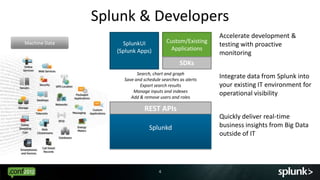
Splunk & Developers
                                                           Accelerate development &
Machine Data        SplunkUI             Custom/Existing
                                                           testing with proactive
                  (Splunk Apps)            Applications
                                                           monitoring
                                               SDKs
                          Search, chart and graph
                    Save and schedule searches as alerts
                                                           Integrate data from Splunk into
                           Export search results           your existing IT environment for
                        Manage inputs and indexes
                       Add & remove users and roles
                                                           operational visibility

                             REST APIs
                                                           Quickly deliver real-time
                                Splunkd                    business insights from Big Data
                                                           outside of IT


                                     4
REST API & SDKs
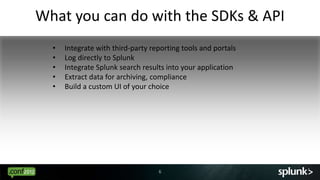
What you can do with the SDKs & API
  •   Integrate with third-party reporting tools and portals
  •   Log directly to Splunk
  •   Integrate Splunk search results into your application
  •   Extract data for archiving, compliance
  •   Build a custom UI of your choice


                                   6
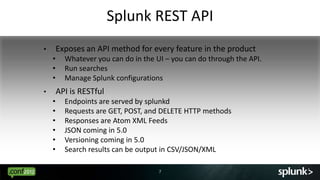
Splunk REST API
•       Exposes an API method for every feature in the product
    •     Whatever you can do in the UI – you can do through the API.
    •     Run searches
    •     Manage Splunk configurations
•       API is RESTful
    •     Endpoints are served by splunkd
    •     Requests are GET, POST, and DELETE HTTP methods
    •     Responses are Atom XML Feeds
    •     JSON coming in 5.0
    •     Versioning coming in 5.0
    •     Search results can be output in CSV/JSON/XML

                                      7
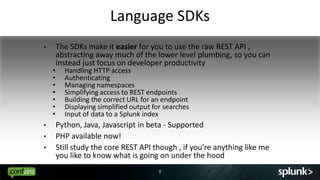
Language SDKs
•       The SDKs make it easier for you to use the raw REST API ,
        abstracting away much of the lower level plumbing, so you can
        instead just focus on developer productivity
    •     Handling HTTP access
    •     Authenticating
    •     Managing namespaces
    •     Simplifying access to REST endpoints
    •     Building the correct URL for an endpoint
    •     Displaying simplified output for searches
    •     Input of data to a Splunk index
•       Python, Java, Javascript in beta - Supported
•       PHP available now!
•       Still study the core REST API though , if you’re anything like me
        you like to know what is going on under the hood
                                         8
Java SDK overview
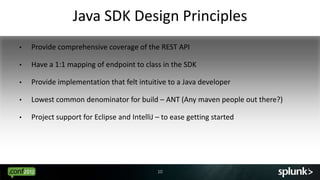
Java SDK Design Principles
•   Provide comprehensive coverage of the REST API

•   Have a 1:1 mapping of endpoint to class in the SDK

•   Provide implementation that felt intuitive to a Java developer

•   Lowest common denominator for build – ANT (Any maven people out there?)

•   Project support for Eclipse and IntelliJ – to ease getting started


                                             10
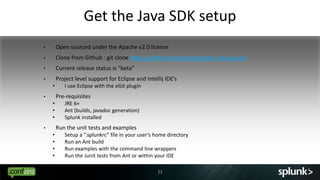
Get the Java SDK setup
•       Open sourced under the Apache v2.0 license
•       Clone from Github : git clone https://github.com/splunk/splunk-sdk-java.git
•       Current release status is “beta”
•       Project level support for Eclipse and Intellij IDE’s
    •      I use Eclipse with the eGit plugin
•       Pre-requisites
    •      JRE 6+
    •      Ant (builds, javadoc generation)
    •      Splunk installed
•       Run the unit tests and examples
    •      Setup a “.splunkrc” file in your user’s home directory
    •      Run an Ant build
    •      Run examples with the command line wrappers
    •      Run the Junit tests from Ant or within your IDE

                                                   11
Key Java SDK Concepts
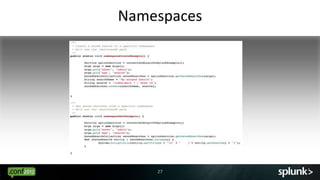
•       Namespaces
    •     owner : splunk username
    •     app : app context
    •     sharing : user | app | global | system
    •     Defaults to current user and default app
•       Service class
    •     Instantiate an object to connect and login
    •     Entry point for REST API calls
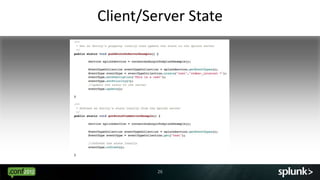
•       Client/Server state
    •     Need to maintain state explicitly
          •   update() : to push changes to splunkd
          •   refresh() : to get changes from splunkd

                                         12
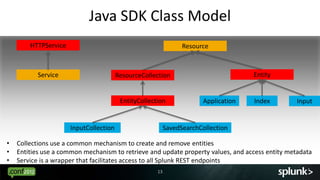
Java SDK Class Model
        HTTPService                                              Resource


          Service                       ResourceCollection                            Entity


                                         EntityCollection               Application   Index      Input


                      InputCollection                      SavedSearchCollection

•   Collections use a common mechanism to create and remove entities
•   Entities use a common mechanism to retrieve and update property values, and access entity metadata
•   Service is a wrapper that facilitates access to all Splunk REST endpoints
                                                      13
public String codeTime(){
  return “Lets Rock n Roll”;
}
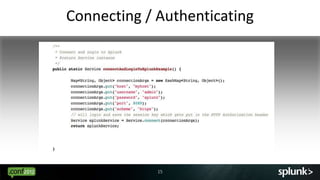
Connecting / Authenticating


             15
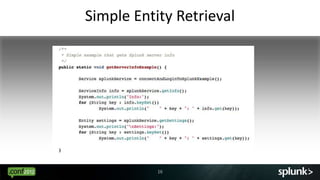
Simple Entity Retrieval


           16
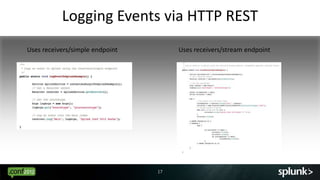
Logging Events via HTTP REST
Uses receivers/simple endpoint        Uses receivers/stream endpoint


                                 17
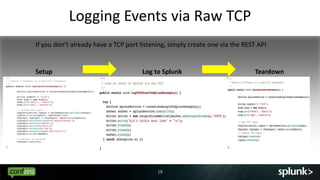
Logging Events via Raw TCP
If you don’t already have a TCP port listening, simply create one via the REST API


Setup                                Log to Splunk                            Teardown


                                           18
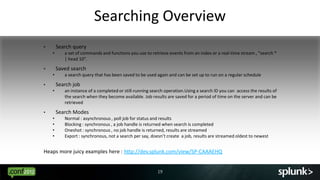
Searching Overview
•       Search query
    •      a set of commands and functions you use to retrieve events from an index or a real-time stream , "search *
           | head 10".

•       Saved search
    •      a search query that has been saved to be used again and can be set up to run on a regular schedule
•       Search job
    •      an instance of a completed or still-running search operation.Using a search ID you can access the results of
           the search when they become available. Job results are saved for a period of time on the server and can be
           retrieved
•       Search Modes
    •      Normal : asynchronous , poll job for status and results
    •      Blocking : synchronous , a job handle is returned when search is completed
    •      Oneshot : synchronous , no job handle is returned, results are streamed
    •      Export : synchronous, not a search per say, doesn’t create a job, results are streamed oldest to newest


Heaps more juicy examples here : http://dev.splunk.com/view/SP-CAAAEHQ


                                                          19
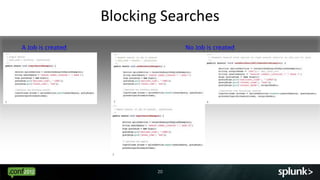
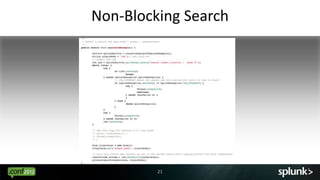
Blocking Searches
A Job is created                No Job is created


                           20
Non-Blocking Search


         21
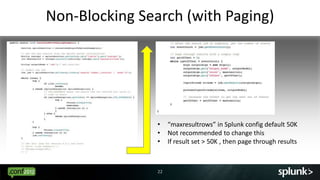
Non-Blocking Search (with Paging)


                •    “maxresultrows” in Splunk config default 50K
                •    Not recommended to change this
                •    If result set > 50K , then page through results


                22
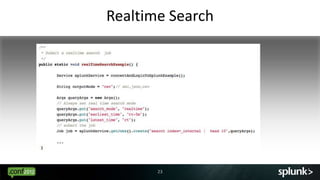
Realtime Search


       23
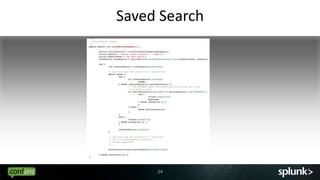
Saved Search


     24
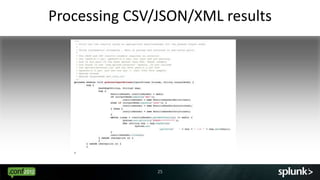
Processing CSV/JSON/XML results


               25
Client/Server State


         26
Namespaces


    27
Thinking outside the square
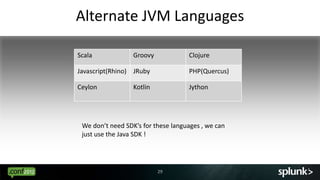
Alternate JVM Languages

Scala             Groovy            Clojure

Javascript(Rhino) JRuby             PHP(Quercus)

Ceylon            Kotlin            Jython


 We don’t need SDK’s for these languages , we can
 just use the Java SDK !


                           29
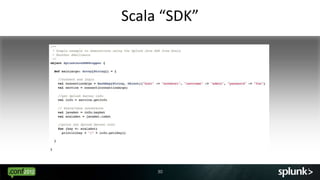
Scala “SDK”


     30
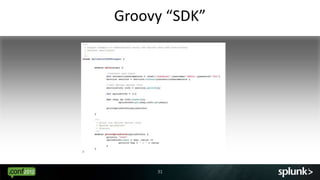
Groovy “SDK”


     31
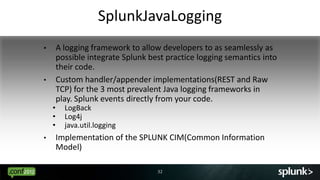
SplunkJavaLogging
•       A logging framework to allow developers to as seamlessly as
        possible integrate Splunk best practice logging semantics into
        their code.
•       Custom handler/appender implementations(REST and Raw
        TCP) for the 3 most prevalent Java logging frameworks in
        play. Splunk events directly from your code.
    •     LogBack
    •     Log4j
    •     java.util.logging
•       Implementation of the SPLUNK CIM(Common Information
        Model)

                                    32
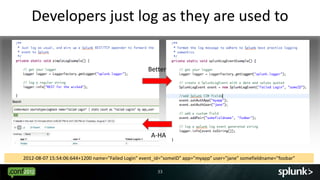
Developers just log as they are used to


                                                   Better


                                                     A-HA


2012-08-07 15:54:06:644+1200 name="Failed Login" event_id="someID" app="myapp" user="jane" somefieldname="foobar"

                                                       33
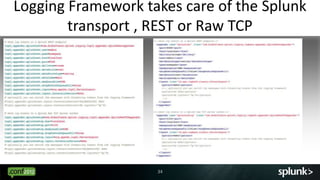
Logging Framework takes care of the Splunk
        transport , REST or Raw TCP


                    34
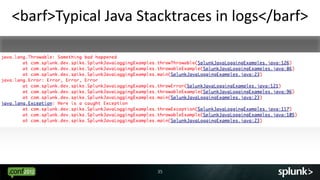
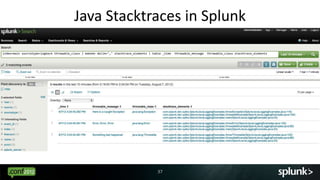
<barf>Typical Java Stacktraces in logs</barf>


                      35
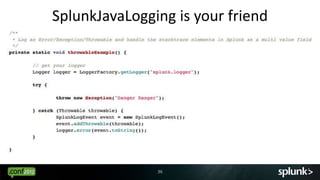
SplunkJavaLogging is your friend


               36
Java Stacktraces in Splunk


            37
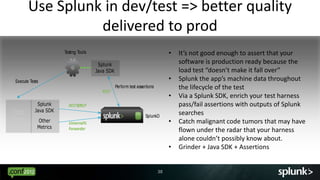
Use Splunk in dev/test => better quality
                  delivered to prod
                       Testing Tools                                             •   It’s not good enough to assert that your
                                        Splunk
                                                                                     software is production ready because the
                                       Java SDK                                      load test “doesn’t make it fall over”
 Execute Tests                                                                   •   Splunk the app’s machine data throughout
                                          REST
                                                  Perform test assertions            the lifecycle of the test
                                                                                 •   Via a Splunk SDK, enrich your test harness
             Splunk      REST% TCP
                             /%                                                      pass/fail assertions with outputs of Splunk
Your        Java SDK
                                                                    SplunkD
                                                                                     searches
App          Other       Universal%                                              •   Catch malignant code tumors that may have
             Metrics     Forwarder                                                   flown under the radar that your harness
                                                                                     alone couldn’t possibly know about.
                                                                                 •   Grinder + Java SDK + Assertions


                                                                            38
Contact Details
Always more than happy to be contacted for questions,
feedback, collaborations, ideas that will change the world etc…


Email : ddallimore@splunk.com
SplunkBase: damiend
Github: damiendallimore
Twitter : @damiendallimore
Blog : http://blogs.splunk.com/dev
Splunk Dev Platform Team : devinfo@splunk.com
                               39
Links
Gists for all code examples : https://gist.github.com/damiendallimore
Java SDK Homepage : http://dev.splunk.com/view/java-sdk/SP-CAAAECN
Java SDK Github repository : https://github.com/splunk/splunk-sdk-java
SplunkJavaLogging : https://github.com/damiendallimore/SplunkJavaLogging
Splunk Best Practice Logging : http://dev.splunk.com/view/logging-best-
practices/SP-CAAADP6
Splunk REST API :
http://docs.splunk.com/Documentation/Splunk/latest/RESTAPI/RESTcontents


                                 40
//Thanks for coming !
System.exit(5150);

Using the Splunk Java SDK

  • 1.
    Using the SplunkJava SDK Presented by Damien Dallimore Developer Evangelist at Splunk Copyright © 2012 Splunk Inc.
  • 2.
    About me • Developer Evangelist at Splunk since July 2012 • http://dev.splunk.com • http://splunk-base.splunk.com • Slides available for my “Splunking the JVM” session • Splunk Community Member • Splunk4JMX • SplunkJavaLogging • SplunkBase Answers • Splunk Architect and Administrator • Coder, hacker, architect of Enterprise Java solutions around the globe in many different industries(aviation, core banking, card payments etc…) • Yes, I do have an accent , so please restrain all your sheep, Lord of the Rings and Kim Dotcom heckles until beer o’clock  2
  • 3.
    Agenda • Overview of the Splunk Platform • REST API & SDKs • Java SDK overview • Code, Code, Code ! • Thinking outside the Square • Alternate JVM Languages • Making it easier for developers to log to Splunk • Splunk is not just for Production • Questions (feel free to yell out at any time also)
  • 4.
    Splunk & Developers Accelerate development & Machine Data SplunkUI Custom/Existing testing with proactive (Splunk Apps) Applications monitoring SDKs Search, chart and graph Save and schedule searches as alerts Integrate data from Splunk into Export search results your existing IT environment for Manage inputs and indexes Add & remove users and roles operational visibility REST APIs Quickly deliver real-time Splunkd business insights from Big Data outside of IT 4
  • 5.
  • 6.
    What you cando with the SDKs & API • Integrate with third-party reporting tools and portals • Log directly to Splunk • Integrate Splunk search results into your application • Extract data for archiving, compliance • Build a custom UI of your choice 6
  • 7.
    Splunk REST API • Exposes an API method for every feature in the product • Whatever you can do in the UI – you can do through the API. • Run searches • Manage Splunk configurations • API is RESTful • Endpoints are served by splunkd • Requests are GET, POST, and DELETE HTTP methods • Responses are Atom XML Feeds • JSON coming in 5.0 • Versioning coming in 5.0 • Search results can be output in CSV/JSON/XML 7
  • 8.
    Language SDKs • The SDKs make it easier for you to use the raw REST API , abstracting away much of the lower level plumbing, so you can instead just focus on developer productivity • Handling HTTP access • Authenticating • Managing namespaces • Simplifying access to REST endpoints • Building the correct URL for an endpoint • Displaying simplified output for searches • Input of data to a Splunk index • Python, Java, Javascript in beta - Supported • PHP available now! • Still study the core REST API though , if you’re anything like me you like to know what is going on under the hood 8
  • 9.
  • 10.
    Java SDK DesignPrinciples • Provide comprehensive coverage of the REST API • Have a 1:1 mapping of endpoint to class in the SDK • Provide implementation that felt intuitive to a Java developer • Lowest common denominator for build – ANT (Any maven people out there?) • Project support for Eclipse and IntelliJ – to ease getting started 10
  • 11.
    Get the JavaSDK setup • Open sourced under the Apache v2.0 license • Clone from Github : git clone https://github.com/splunk/splunk-sdk-java.git • Current release status is “beta” • Project level support for Eclipse and Intellij IDE’s • I use Eclipse with the eGit plugin • Pre-requisites • JRE 6+ • Ant (builds, javadoc generation) • Splunk installed • Run the unit tests and examples • Setup a “.splunkrc” file in your user’s home directory • Run an Ant build • Run examples with the command line wrappers • Run the Junit tests from Ant or within your IDE 11
  • 12.
    Key Java SDKConcepts • Namespaces • owner : splunk username • app : app context • sharing : user | app | global | system • Defaults to current user and default app • Service class • Instantiate an object to connect and login • Entry point for REST API calls • Client/Server state • Need to maintain state explicitly • update() : to push changes to splunkd • refresh() : to get changes from splunkd 12
  • 13.
    Java SDK ClassModel HTTPService Resource Service ResourceCollection Entity EntityCollection Application Index Input InputCollection SavedSearchCollection • Collections use a common mechanism to create and remove entities • Entities use a common mechanism to retrieve and update property values, and access entity metadata • Service is a wrapper that facilitates access to all Splunk REST endpoints 13
  • 14.
    public String codeTime(){ return “Lets Rock n Roll”; }
  • 15.
  • 16.
  • 17.
    Logging Events viaHTTP REST Uses receivers/simple endpoint Uses receivers/stream endpoint 17
  • 18.
    Logging Events viaRaw TCP If you don’t already have a TCP port listening, simply create one via the REST API Setup Log to Splunk Teardown 18
  • 19.
    Searching Overview • Search query • a set of commands and functions you use to retrieve events from an index or a real-time stream , "search * | head 10". • Saved search • a search query that has been saved to be used again and can be set up to run on a regular schedule • Search job • an instance of a completed or still-running search operation.Using a search ID you can access the results of the search when they become available. Job results are saved for a period of time on the server and can be retrieved • Search Modes • Normal : asynchronous , poll job for status and results • Blocking : synchronous , a job handle is returned when search is completed • Oneshot : synchronous , no job handle is returned, results are streamed • Export : synchronous, not a search per say, doesn’t create a job, results are streamed oldest to newest Heaps more juicy examples here : http://dev.splunk.com/view/SP-CAAAEHQ 19
  • 20.
    Blocking Searches A Jobis created No Job is created 20
  • 21.
  • 22.
    Non-Blocking Search (withPaging) • “maxresultrows” in Splunk config default 50K • Not recommended to change this • If result set > 50K , then page through results 22
  • 23.
  • 24.
  • 25.
  • 26.
  • 27.
  • 28.
  • 29.
    Alternate JVM Languages Scala Groovy Clojure Javascript(Rhino) JRuby PHP(Quercus) Ceylon Kotlin Jython We don’t need SDK’s for these languages , we can just use the Java SDK ! 29
  • 30.
  • 31.
  • 32.
    SplunkJavaLogging • A logging framework to allow developers to as seamlessly as possible integrate Splunk best practice logging semantics into their code. • Custom handler/appender implementations(REST and Raw TCP) for the 3 most prevalent Java logging frameworks in play. Splunk events directly from your code. • LogBack • Log4j • java.util.logging • Implementation of the SPLUNK CIM(Common Information Model) 32
  • 33.
    Developers just logas they are used to Better A-HA 2012-08-07 15:54:06:644+1200 name="Failed Login" event_id="someID" app="myapp" user="jane" somefieldname="foobar" 33
  • 34.
    Logging Framework takescare of the Splunk transport , REST or Raw TCP 34
  • 35.
  • 36.
  • 37.
  • 38.
    Use Splunk indev/test => better quality delivered to prod Testing Tools • It’s not good enough to assert that your Splunk software is production ready because the Java SDK load test “doesn’t make it fall over” Execute Tests • Splunk the app’s machine data throughout REST Perform test assertions the lifecycle of the test • Via a Splunk SDK, enrich your test harness Splunk REST% TCP /% pass/fail assertions with outputs of Splunk Your Java SDK SplunkD searches App Other Universal% • Catch malignant code tumors that may have Metrics Forwarder flown under the radar that your harness alone couldn’t possibly know about. • Grinder + Java SDK + Assertions 38
  • 39.
    Contact Details Always morethan happy to be contacted for questions, feedback, collaborations, ideas that will change the world etc… Email : ddallimore@splunk.com SplunkBase: damiend Github: damiendallimore Twitter : @damiendallimore Blog : http://blogs.splunk.com/dev Splunk Dev Platform Team : devinfo@splunk.com 39
  • 40.
    Links Gists for allcode examples : https://gist.github.com/damiendallimore Java SDK Homepage : http://dev.splunk.com/view/java-sdk/SP-CAAAECN Java SDK Github repository : https://github.com/splunk/splunk-sdk-java SplunkJavaLogging : https://github.com/damiendallimore/SplunkJavaLogging Splunk Best Practice Logging : http://dev.splunk.com/view/logging-best- practices/SP-CAAADP6 Splunk REST API : http://docs.splunk.com/Documentation/Splunk/latest/RESTAPI/RESTcontents 40
  • 41.
    //Thanks for coming! System.exit(5150);

Editor's Notes

  • #20 For those searches that stream the results (oneshot and export), the search results are not saved. If the stream is interrupted for any reason, the results are not recoverable without running the search again.
  • #22 There is code in the develop branch (which we should probably push into main before .conf) that obviates the need for job.refresh()isDone() and isReady() refresh behind your back.
  • #23 In order to get all events, you have to use the export endpoint. But the export endpoint has different behavior than a normal job. An export cannot be &quot;restarted&quot; when getting events if the network hiccups. A search job can just do another getResults() with the appropriate offset — this is because the export endpoint doesn&apos;t save the results like a search job does. But a search job has a limited number of events it will store on the server — which can be affected by status_buckets — but there is no way to guarantee the upper limit. With the default status_buckets we can get to 500K events. Itay and I experimented with hundreds of stratus_buckets but were only to get up to about 1M events, out of 13M available events.