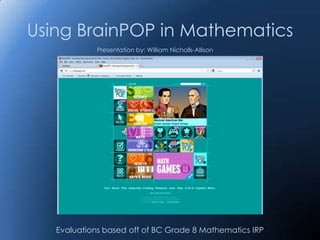
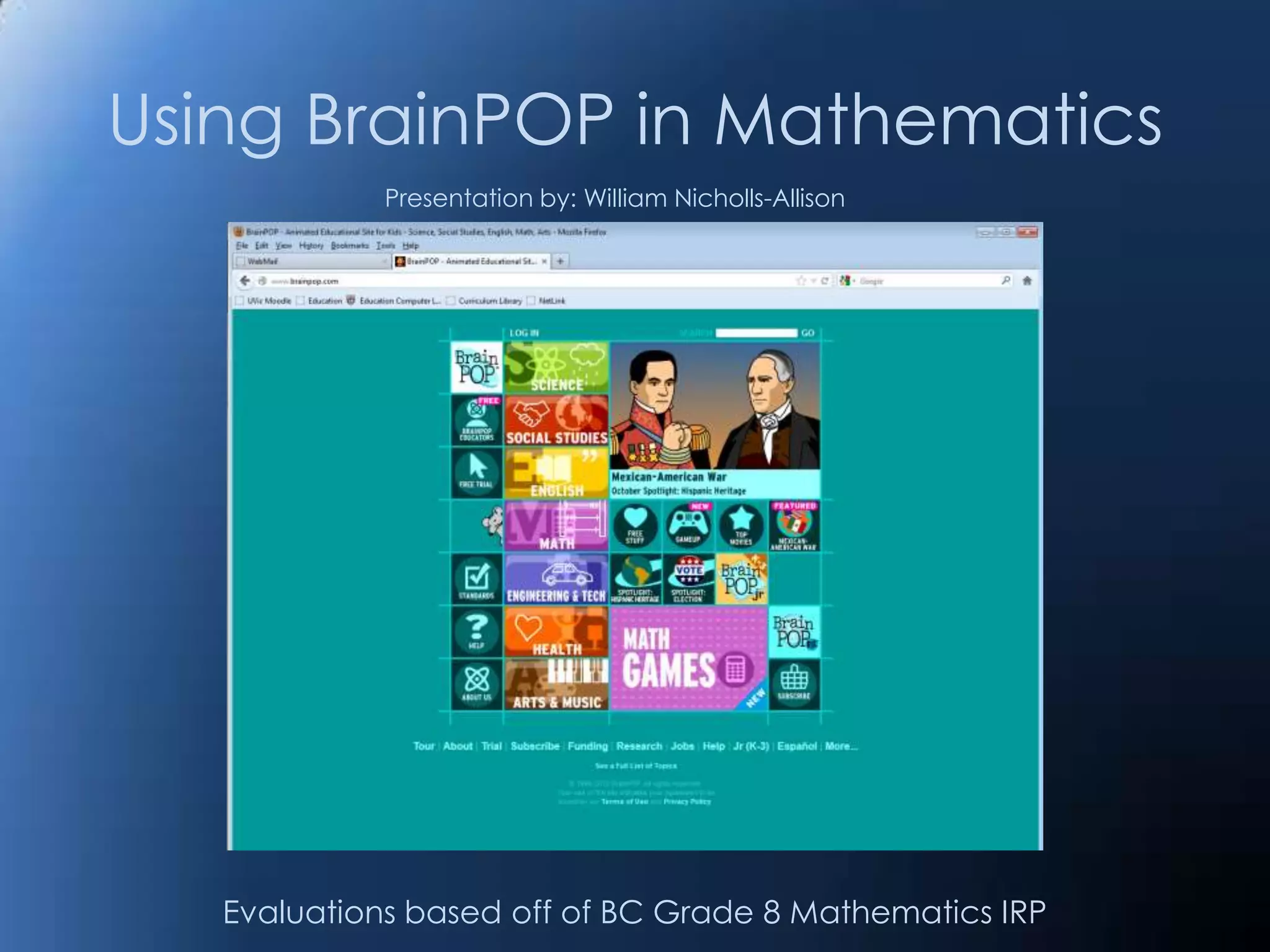

Using BrainPOP in Mathematics
             Presentation by: William Nicholls-Allison


   Evaluations based off of BC Grade 8 Mathematics IRP
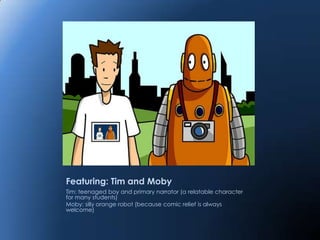
Featuring: Tim and Moby
Tim: teenaged boy and primary narrator (a relatable character
for many students)
Moby: silly orange robot (because comic relief is always
welcome)
@Home and on the go
@Home (or computer lab)   for iPad
• Tonnes of movies in     • Simple interface
  many subject areas      • Hundreds of free
• Searchable by subject      quizzes
• BrainPOP Educators      • Tracks progress over
  (more later)               time
• Encourages learning     • Monthly spotlight
  with technology         • Great for use in 1:1
                             programs
Evaluation
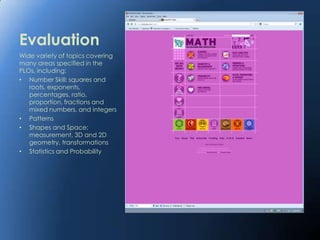
Wide variety of topics covering
many areas specified in the
PLOs, including:
• Number Skill: squares and
   roots, exponents,
   percentages, ratio,
   proportion, fractions and
   mixed numbers, and integers
• Patterns
• Shapes and Space:
   measurement, 3D and 2D
   geometry, transformations
• Statistics and Probability
Evaluation
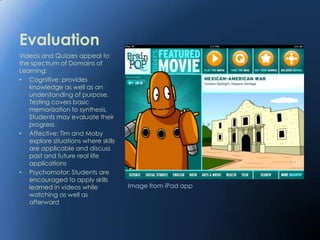
Videos and Quizzes appeal to
the spectrum of Domains of
Learning:
• Cognitive: provides
   knowledge as well as an
   understanding of purpose.
   Testing covers basic
   memorization to synthesis.
   Students may evaluate their
   progress
• Affective: Tim and Moby
   explore situations where skills
   are applicable and discuss
   past and future real life
   applications
• Psychomotor: Students are
   encouraged to apply skills
   learned in videos while           Image from iPad app
   watching as well as
   afterward
Criticism
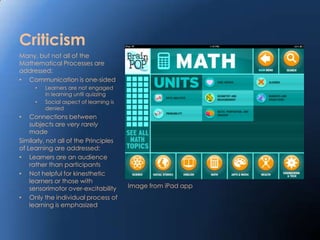
Many, but not all of the
Mathematical Processes are
addressed:
• Communication is one-sided
     •   Learners are not engaged
         in learning until quizzing
     •   Social aspect of learning is
         denied
•   Connections between
    subjects are very rarely
    made
Similarly, not all of the Principles
of Learning are addressed:
• Learners are an audience
    rather than participants
• Not helpful for kinesthetic
    learners or those with
    sensorimotor over-excitability      Image from iPad app
• Only the individual process of
    learning is emphasized
Solutions
Do away with homework! In
stead, have students watch
videos at home and engage in
group discussion/application on
the subject during class time.
In discussion:
• Connect ideas learned in
    videos with previously
    learned material
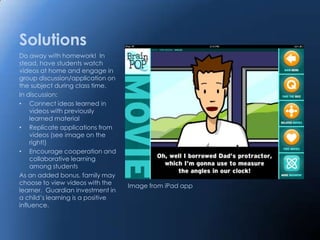
• Replicate applications from
    videos (see image on the
    right!)
• Encourage cooperation and
    collaborative learning
    among students
As an added bonus, family may
choose to view videos with the     Image from iPad app
learner. Guardian investment in
a child’s learning is a positive
influence.
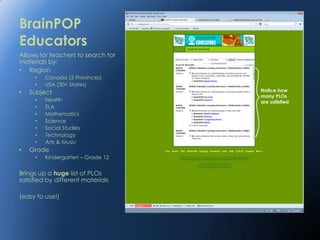
BrainPOP
Educators
Allows for teachers to search for
materials by:
• Region
     •   Canada (3 Provinces)
     •   USA (30+ States)
•   Subject
     •   Health
     •   ELA
     •   Mathematics
     •   Science
     •   Social Studies
     •   Technology
     •   Arts & Music
•   Grade
     •   Kindergarten – Grade 12


Brings up a huge list of PLOs
satisfied by different materials

(easy to use!)
Subscription
 Support for different age ranges!            Leaping Language Boundaries!


• BrainPOP Jr. (K-3)                      • BrainPOP Español
  $8.45/month or $85/year                   $8.45/month or $85/year
• BrainPOP                                • BrainPOP ESL
  $9.95/month or $99/year                   $7.45/month or $75/year


                                For the iPad!
                 •   BrainPOP Full Access
                     $6.99/month
                 •   BrainPop Explorer (4 rotating videos a
                     day)
                     $1.99/month
                 •   Free app includes several free videos
                     per subject and a rotating monthly
                     video
Subscription
• Discounts are also given on the basis of
  class size:
  – Homeschool use
  – Classroom use
  – School use
  – School district use
  – Virtual school use
Check it out!
Don’t just take my word, watch a video for yourself!


           Tim has an accent in this video
           because it’s from BrainPOP UK


           Click to start
…and that’s the end of the
         story!
  Download the free app from the
  AppStore to check it out and see
      if it would work for your
              classroom!

Using brain pop in mathematics

  • 1.
    Using BrainPOP inMathematics Presentation by: William Nicholls-Allison Evaluations based off of BC Grade 8 Mathematics IRP
  • 2.
    Featuring: Tim andMoby Tim: teenaged boy and primary narrator (a relatable character for many students) Moby: silly orange robot (because comic relief is always welcome)
  • 3.
    @Home and onthe go @Home (or computer lab) for iPad • Tonnes of movies in • Simple interface many subject areas • Hundreds of free • Searchable by subject quizzes • BrainPOP Educators • Tracks progress over (more later) time • Encourages learning • Monthly spotlight with technology • Great for use in 1:1 programs
  • 4.
    Evaluation Wide variety oftopics covering many areas specified in the PLOs, including: • Number Skill: squares and roots, exponents, percentages, ratio, proportion, fractions and mixed numbers, and integers • Patterns • Shapes and Space: measurement, 3D and 2D geometry, transformations • Statistics and Probability
  • 5.
    Evaluation Videos and Quizzesappeal to the spectrum of Domains of Learning: • Cognitive: provides knowledge as well as an understanding of purpose. Testing covers basic memorization to synthesis. Students may evaluate their progress • Affective: Tim and Moby explore situations where skills are applicable and discuss past and future real life applications • Psychomotor: Students are encouraged to apply skills learned in videos while Image from iPad app watching as well as afterward
  • 6.
    Criticism Many, but notall of the Mathematical Processes are addressed: • Communication is one-sided • Learners are not engaged in learning until quizzing • Social aspect of learning is denied • Connections between subjects are very rarely made Similarly, not all of the Principles of Learning are addressed: • Learners are an audience rather than participants • Not helpful for kinesthetic learners or those with sensorimotor over-excitability Image from iPad app • Only the individual process of learning is emphasized
  • 7.
    Solutions Do away withhomework! In stead, have students watch videos at home and engage in group discussion/application on the subject during class time. In discussion: • Connect ideas learned in videos with previously learned material • Replicate applications from videos (see image on the right!) • Encourage cooperation and collaborative learning among students As an added bonus, family may choose to view videos with the Image from iPad app learner. Guardian investment in a child’s learning is a positive influence.
  • 8.
    BrainPOP Educators Allows for teachersto search for materials by: • Region • Canada (3 Provinces) • USA (30+ States) • Subject • Health • ELA • Mathematics • Science • Social Studies • Technology • Arts & Music • Grade • Kindergarten – Grade 12 Brings up a huge list of PLOs satisfied by different materials (easy to use!)
  • 9.
    Subscription Support fordifferent age ranges! Leaping Language Boundaries! • BrainPOP Jr. (K-3) • BrainPOP Español $8.45/month or $85/year $8.45/month or $85/year • BrainPOP • BrainPOP ESL $9.95/month or $99/year $7.45/month or $75/year For the iPad! • BrainPOP Full Access $6.99/month • BrainPop Explorer (4 rotating videos a day) $1.99/month • Free app includes several free videos per subject and a rotating monthly video
  • 10.
    Subscription • Discounts arealso given on the basis of class size: – Homeschool use – Classroom use – School use – School district use – Virtual school use
  • 11.
    Check it out! Don’tjust take my word, watch a video for yourself! Tim has an accent in this video because it’s from BrainPOP UK Click to start
  • 12.
    …and that’s theend of the story! Download the free app from the AppStore to check it out and see if it would work for your classroom!