Using a Collaborative
Network of Distributed
Cameras for Object
Tracking
Samuel Orn
Senior Machine Learning and
Computer Vision Engineer
Invision AI
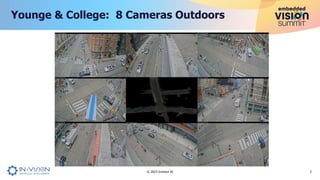
Younge & College: 8 Cameras Outdoors
2
© 2023 Invision AI
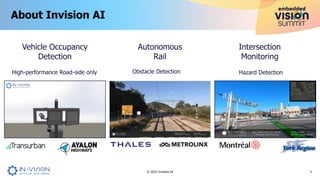
About Invision AI
3
© 2023 Invision AI
Intersection
Monitoring
Vehicle Occupancy
Detection
Hazard Detection
High-performance Road-side only
Autonomous
Rail
Obstacle Detection
We want our Collaborative Network of Distributed Cameras for
Object Tracking to have the following properties:
• Scalability with respect to the number of tracked objects
• Scalability with respect to tracking area
• Reasonable installation constraints (power and network
requirements)
• Privacy preserving
Desired Properties of the System
4
© 2023 Invision AI
5
© 2023 Invision AI
Part 1: Mapping and Calibration
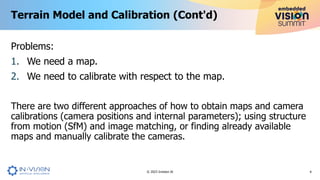
Problems:
1. We need a map.
2. We need to calibrate with respect to the map.
There are two different approaches of how to obtain maps and camera
calibrations (camera positions and internal parameters); using structure
from motion (SfM) and image matching, or finding already available
maps and manually calibrate the cameras.
Terrain Model and Calibration (Cont'd)
6
© 2023 Invision AI
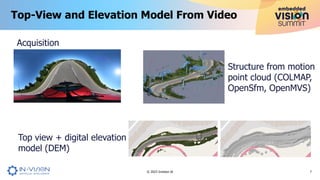
Top-View and Elevation Model From Video
7
© 2023 Invision AI
Acquisition
Structure from motion
point cloud (COLMAP,
OpenSfm, OpenMVS)
Top view + digital elevation
model (DEM)
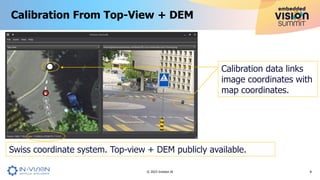
Calibration From Top-View + DEM
8
© 2023 Invision AI
Swiss coordinate system. Top-view + DEM publicly available.
Calibration data links
image coordinates with
map coordinates.
9
© 2023 Invision AI
Part 2: Tracking Algorithm
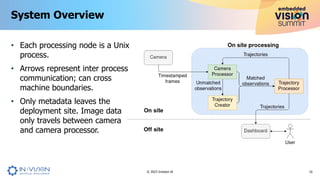
• Each processing node is a Unix
process.
• Arrows represent inter process
communication; can cross
machine boundaries.
• Only metadata leaves the
deployment site. Image data
only travels between camera
and camera processor.
System Overview
10
© 2023 Invision AI
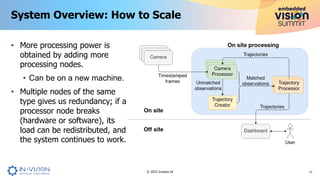
• More processing power is
obtained by adding more
processing nodes.
• Can be on a new machine.
• Multiple nodes of the same
type gives us redundancy; if a
processor node breaks
(hardware or software), its
load can be redistributed, and
the system continues to work.
System Overview: How to Scale
11
© 2023 Invision AI
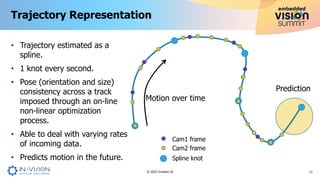
• Trajectory estimated as a
spline.
• 1 knot every second.
• Pose (orientation and size)
consistency across a track
imposed through an on-line
non-linear optimization
process.
• Able to deal with varying rates
of incoming data.
• Predicts motion in the future.
Trajectory Representation
12
© 2023 Invision AI
Cam2 frame
Spline knot
Prediction
Motion over time
Cam1 frame
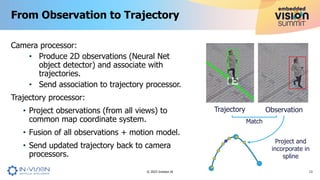
Camera processor:
• Produce 2D observations (Neural Net
object detector) and associate with
trajectories.
• Send association to trajectory processor.
Trajectory processor:
• Project observations (from all views) to
common map coordinate system.
• Fusion of all observations + motion model.
• Send updated trajectory back to camera
processors.
From Observation to Trajectory
13
© 2023 Invision AI
Trajectory Observation
Match
Project and
incorporate in
spline
14
© 2023 Invision AI
Part 3: Demos
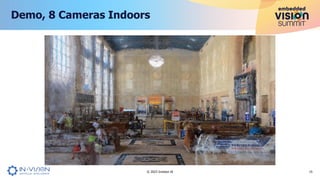
Demo, 8 Cameras Indoors
15
© 2023 Invision AI
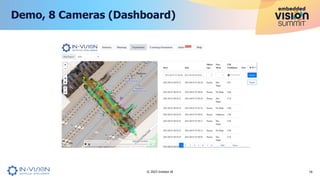
Demo, 8 Cameras (Dashboard)
16
© 2023 Invision AI
17
© 2023 Invision AI
Remaining Challenges and Conclusion
• Installation constraints means it is not always possible to use a
wired network:
• Could we do networking with radio + mesh network?
• The system needs a lot of compute; how to get a low energy,
affordable NN inference system?
• Anything else than NVidia Jetson products?
• Calibration of the system is time consuming. Are there better
solutions out there for automatic calibration?
Questions and Challenges
18
© 2023 Invision AI
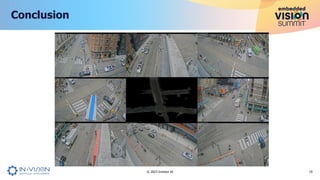
Conclusion
19
© 2023 Invision AI
References and resources
Contact us!
samuel.orn@invision.ai
20
© 2023 Invision AI
Software and libraries
COLMAP
https://colmap.github.io/
OpenSfM
https://opensfm.org/
PDAL
https://pdal.io/

“Using a Collaborative Network of Distributed Cameras for Object Tracking,” a Presentation from Invision AI

  • 1.
    Using a Collaborative Networkof Distributed Cameras for Object Tracking Samuel Orn Senior Machine Learning and Computer Vision Engineer Invision AI
  • 2.
    Younge & College:8 Cameras Outdoors 2 © 2023 Invision AI
  • 3.
    About Invision AI 3 ©2023 Invision AI Intersection Monitoring Vehicle Occupancy Detection Hazard Detection High-performance Road-side only Autonomous Rail Obstacle Detection
  • 4.
    We want ourCollaborative Network of Distributed Cameras for Object Tracking to have the following properties: • Scalability with respect to the number of tracked objects • Scalability with respect to tracking area • Reasonable installation constraints (power and network requirements) • Privacy preserving Desired Properties of the System 4 © 2023 Invision AI
  • 5.
    5 © 2023 InvisionAI Part 1: Mapping and Calibration
  • 6.
    Problems: 1. We needa map. 2. We need to calibrate with respect to the map. There are two different approaches of how to obtain maps and camera calibrations (camera positions and internal parameters); using structure from motion (SfM) and image matching, or finding already available maps and manually calibrate the cameras. Terrain Model and Calibration (Cont'd) 6 © 2023 Invision AI
  • 7.
    Top-View and ElevationModel From Video 7 © 2023 Invision AI Acquisition Structure from motion point cloud (COLMAP, OpenSfm, OpenMVS) Top view + digital elevation model (DEM)
  • 8.
    Calibration From Top-View+ DEM 8 © 2023 Invision AI Swiss coordinate system. Top-view + DEM publicly available. Calibration data links image coordinates with map coordinates.
  • 9.
    9 © 2023 InvisionAI Part 2: Tracking Algorithm
  • 10.
    • Each processingnode is a Unix process. • Arrows represent inter process communication; can cross machine boundaries. • Only metadata leaves the deployment site. Image data only travels between camera and camera processor. System Overview 10 © 2023 Invision AI
  • 11.
    • More processingpower is obtained by adding more processing nodes. • Can be on a new machine. • Multiple nodes of the same type gives us redundancy; if a processor node breaks (hardware or software), its load can be redistributed, and the system continues to work. System Overview: How to Scale 11 © 2023 Invision AI
  • 12.
    • Trajectory estimatedas a spline. • 1 knot every second. • Pose (orientation and size) consistency across a track imposed through an on-line non-linear optimization process. • Able to deal with varying rates of incoming data. • Predicts motion in the future. Trajectory Representation 12 © 2023 Invision AI Cam2 frame Spline knot Prediction Motion over time Cam1 frame
  • 13.
    Camera processor: • Produce2D observations (Neural Net object detector) and associate with trajectories. • Send association to trajectory processor. Trajectory processor: • Project observations (from all views) to common map coordinate system. • Fusion of all observations + motion model. • Send updated trajectory back to camera processors. From Observation to Trajectory 13 © 2023 Invision AI Trajectory Observation Match Project and incorporate in spline
  • 14.
    14 © 2023 InvisionAI Part 3: Demos
  • 15.
    Demo, 8 CamerasIndoors 15 © 2023 Invision AI
  • 16.
    Demo, 8 Cameras(Dashboard) 16 © 2023 Invision AI
  • 17.
    17 © 2023 InvisionAI Remaining Challenges and Conclusion
  • 18.
    • Installation constraintsmeans it is not always possible to use a wired network: • Could we do networking with radio + mesh network? • The system needs a lot of compute; how to get a low energy, affordable NN inference system? • Anything else than NVidia Jetson products? • Calibration of the system is time consuming. Are there better solutions out there for automatic calibration? Questions and Challenges 18 © 2023 Invision AI
  • 19.
  • 20.
    References and resources Contactus! samuel.orn@invision.ai 20 © 2023 Invision AI Software and libraries COLMAP https://colmap.github.io/ OpenSfM https://opensfm.org/ PDAL https://pdal.io/