





Establishing a learning
     organisation
Ushahidi and iHub Research
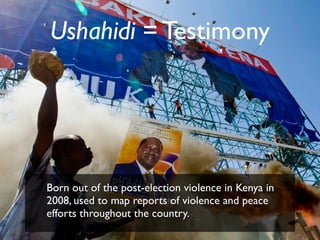
Ushahidi = Testimony


Born out of the post-election violence in Kenya in
2008, used to map reports of violence and peace
efforts throughout the country.
Research @ushahidi
an ethnographer’s perspective
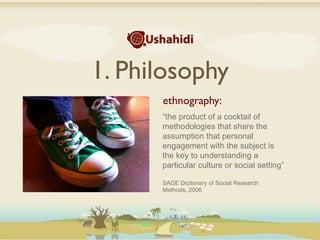
1. Philosophy
      ethnography:
      “the product of a cocktail of
      methodologies that share the
      assumption that personal
      engagement with the subject is
      the key to understanding a
      particular culture or social setting”

      SAGE Dictionary of Social Research
      Methods, 2006
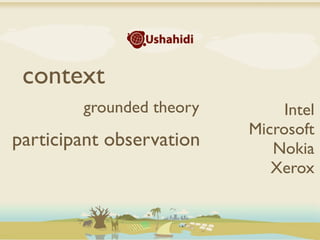
context
context
     grounded theory
context
        grounded theory
participant observation
context
        grounded theory        Intel
                          Microsoft
participant observation      Nokia
                             Xerox
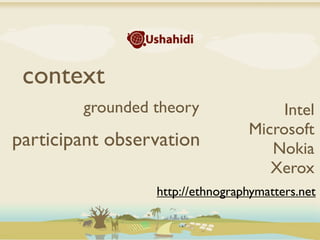
context
        grounded theory               Intel
                                 Microsoft
participant observation             Nokia
                                    Xerox
                 http://ethnographymatters.net
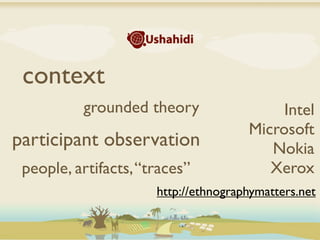
context
          grounded theory                  Intel
                                      Microsoft
participant observation                  Nokia
 people, artifacts, “traces”             Xerox
                      http://ethnographymatters.net
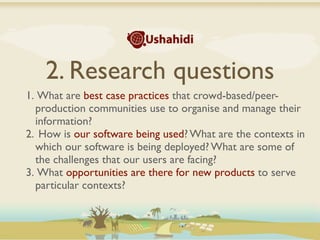
2. Research questions
1. What are best case practices that crowd-based/peer-
  production communities use to organise and manage their
  information?
2. How is our software being used? What are the contexts in
  which our software is being deployed? What are some of
  the challenges that our users are facing?
3. What opportunities are there for new products to serve
  particular contexts?
3. Projects
1. Understanding sources: a Wikimedia Foundation
  collaboration (funded by Hivos and OSI)
2. Crowdsourcing verification: an Ushahidi/SwiftRiver
  ongoing project to understand next steps for
  Ushahidi verification tools
3. Future projects: trust; identity; collaboration; social
  mapping
How Ushahidi deployers “do” verification
“Getting verified information becomes really critical during crises like Kenya. This was
really problematic because people were sending text messages to start rumors...”
David Kobia, Ushahidi Technology Director

“Our verification was based on reputation of reporting organizations and associated
individuals (marginalizing the voices of the unknown crowd)”
Jessica Heinzelman, Standby Task Force, Libya Crisis Map

“We had to work to try and convince the officials that the map was a resource they should
be endorsing, and as I recall it, one of their chief objections was the "verified" status of
the reports - they didn't want to endorse a map that had "verified" reports that weren't
actually verified by them.” Nigel McNie, Christchurch Recovery Map


                                                                                verified
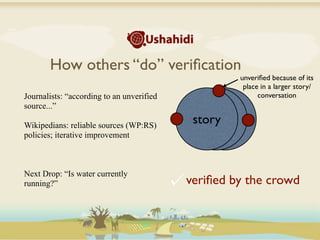
How others “do” verification
                                                    unverified because of its
                                                     place in a larger story/
Journalists: “according to an unverified                  conversation
source...”

Wikipedians: reliable sources (WP:RS)
                                            story
policies; iterative improvement


Next Drop: “Is water currently
running?”                                  verified by the crowd
4. Challenges
1. How do we create feedback loops so that
   developers respond iteratively to research findings?
2. How do we understand use and context in multi-
   sited, international and sometimes-anonymous
   settings?
3. How do we create opportunities for learning from
   research communities when we have limited
   resources?
5. Ways to get involved
1. Join the Ushahidi research mailing list at
http://groups.google.com/group/ushahidi-research and
post relevant papers, events and questions

2. Join the Mendeley group and add papers to the group
http://www.mendeley.com/groups/1583283/ushahidi/

3. Propose/host thematic research seminars for 2012
Asante
hford@ushahidi.com
   twitter: hfordsa

Ushahidi research: Establishing a learning organisation

  • 1.
    Establishing a learning organisation Ushahidi and iHub Research
  • 2.
    Ushahidi = Testimony Bornout of the post-election violence in Kenya in 2008, used to map reports of violence and peace efforts throughout the country.
  • 6.
  • 7.
    1. Philosophy ethnography: “the product of a cocktail of methodologies that share the assumption that personal engagement with the subject is the key to understanding a particular culture or social setting” SAGE Dictionary of Social Research Methods, 2006
  • 9.
  • 10.
    context grounded theory
  • 11.
    context grounded theory participant observation
  • 12.
    context grounded theory Intel Microsoft participant observation Nokia Xerox
  • 13.
    context grounded theory Intel Microsoft participant observation Nokia Xerox http://ethnographymatters.net
  • 14.
    context grounded theory Intel Microsoft participant observation Nokia people, artifacts, “traces” Xerox http://ethnographymatters.net
  • 15.
    2. Research questions 1.What are best case practices that crowd-based/peer- production communities use to organise and manage their information? 2. How is our software being used? What are the contexts in which our software is being deployed? What are some of the challenges that our users are facing? 3. What opportunities are there for new products to serve particular contexts?
  • 16.
    3. Projects 1. Understandingsources: a Wikimedia Foundation collaboration (funded by Hivos and OSI) 2. Crowdsourcing verification: an Ushahidi/SwiftRiver ongoing project to understand next steps for Ushahidi verification tools 3. Future projects: trust; identity; collaboration; social mapping
  • 17.
    How Ushahidi deployers“do” verification “Getting verified information becomes really critical during crises like Kenya. This was really problematic because people were sending text messages to start rumors...” David Kobia, Ushahidi Technology Director “Our verification was based on reputation of reporting organizations and associated individuals (marginalizing the voices of the unknown crowd)” Jessica Heinzelman, Standby Task Force, Libya Crisis Map “We had to work to try and convince the officials that the map was a resource they should be endorsing, and as I recall it, one of their chief objections was the "verified" status of the reports - they didn't want to endorse a map that had "verified" reports that weren't actually verified by them.” Nigel McNie, Christchurch Recovery Map verified
  • 18.
    How others “do”verification unverified because of its place in a larger story/ Journalists: “according to an unverified conversation source...” Wikipedians: reliable sources (WP:RS) story policies; iterative improvement Next Drop: “Is water currently running?” verified by the crowd
  • 19.
    4. Challenges 1. Howdo we create feedback loops so that developers respond iteratively to research findings? 2. How do we understand use and context in multi- sited, international and sometimes-anonymous settings? 3. How do we create opportunities for learning from research communities when we have limited resources?
  • 20.
    5. Ways toget involved 1. Join the Ushahidi research mailing list at http://groups.google.com/group/ushahidi-research and post relevant papers, events and questions 2. Join the Mendeley group and add papers to the group http://www.mendeley.com/groups/1583283/ushahidi/ 3. Propose/host thematic research seminars for 2012
  • 21.

Editor's Notes