CanadaHannah DeWittHistory 141
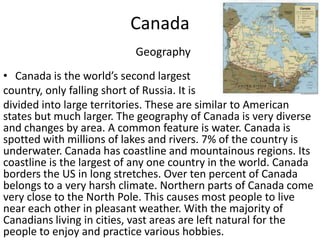
CanadaGeographyCanada is the world’s second largest country, only falling short of Russia. It is divided into large territories. These are similar to American states but much larger. The geography of Canada is very diverse and changes by area. A common feature is water. Canada is spotted with millions of lakes and rivers. 7% of the country is underwater. Canada has coastline and mountainous regions. Its coastline is the largest of any one country in the world. Canada borders the US in long stretches. Over ten percent of Canada belongs to a very harsh climate. Northern parts of Canada come very close to the North Pole. This causes most people to live near each other in pleasant weather. With the majority of Canadians living in cities, vast areas are left natural for the people to enjoy and practice various hobbies.
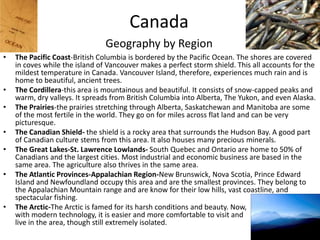
CanadaGeography by RegionThe Pacific Coast-British Columbia is bordered by the Pacific Ocean. The shores are covered in coves while the island of Vancouver makes a perfect storm shield. This all accounts for the mildest temperature in Canada. Vancouver Island, therefore, experiences much rain and is home to beautiful, ancient trees.The Cordillera-this area is mountainous and beautiful. It consists of snow-capped peaks and warm, dry valleys. It spreads from British Columbia into Alberta, The Yukon, and even Alaska. The Prairies-the prairies stretching through Alberta, Saskatchewan and Manitoba are some of the most fertile in the world. They go on for miles across flat land and can be very picturesque. The Canadian Shield- the shield is a rocky area that surrounds the Hudson Bay. A good part of Canadian culture stems from this area. It also houses many precious minerals. The Great Lakes-St. Lawrence Lowlands- South Quebec and Ontario are home to 50% of Canadians and the largest cities. Most industrial and economic business are based in the same area. The agriculture also thrives in the same area.The Atlantic Provinces-Appalachian Region-New Brunswick, Nova Scotia, Prince Edward Island and Newfoundland occupy this area and are the smallest provinces. They belong to the Appalachian Mountain range and are know for their low hills, vast coastline, and spectacular fishing.The Arctic-The Arctic is famed for its harsh conditions and beauty. Now,                                             with modern technology, it is easier and more comfortable to visit and                                               live in the area, though still extremely isolated.
CanadaHistory The history of Canada is unique. It includes two separate people at cultures that eventually joined together into one country. French and English settlers each took claims to parts of Canada and established colonies for their mother countries. The history of Canada is full of the British and French attacking each other and trading land pieces in various ways. To this day, the English and French populations live very separately in their own communities with both languages being spoken throughout the country.
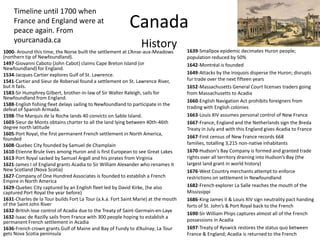
CanadaTimeline until 1700 whenFrance and England were at peace again. From yourcanada.ca History1639-Smallpox epidemic decimates Huron people; population reduced by 50%1642-Montréal is founded1649-Attacks by the Iroquois disperse the Huron; disrupts fur trade over the next fifteen years1652-Massachusetts General Court licenses traders going from Massachusetts to Acadia1660-English Navigation Act prohibits foreigners from trading with English colonies1663-Louis XIV assumes personal control of New France1667-France, England and the Netherlands sign the Breda Treaty in July and with this England gives Acadia to France1667-First census of New France records 668 families, totalling 3,215 non-native inhabitants1670-Hudson’s Bay Company is formed and granted trade rights over all territory draining into Hudson’s Bay (the largest land grant in world history)1676-West Country merchants attempt to enforce restrictions on settlement in Newfoundland1682-French explorer La Salle reaches the mouth of the Mississippi1686-King James II & Louis XIV sign neutrality pact handing forts of St. John’s & Port Royal back to the French1690-Sir William Phips captures almost all of the French possessions in Acadia1697-Treaty of Ryswick restores the status quo between France & England; Acadia is returned to the French1000- Around this time, the Norse built the settlement at L’Anse-aux-Meadows (northern tip of Newfoundland).1497-Giovanni Caboto (John Cabot) claims Cape Breton Island (or Newfoundland) for England.1534-Jacques Cartier explores Gulf of St. Lawrence.1541-Cartier and Sieur de Roberval found a settlement on St. Lawrence River, but it fails.1583-Sir Humphrey Gilbert, brother-in-law of Sir Walter Raleigh, sails for Newfoundland from England.1588-English fishing fleet delays sailing to Newfoundland to participate in the defeat of Spanish Armada.1598-The Marquis de la Roche lands 40 convicts on Sable Island.1603-Sieur de Monts obtains charter to all the land lying between 40th-46th degree north latitude1605-Port Royal, the first permanent French settlement in North America, founded1608-Quebec City founded by Samuel de Champlain1610-Etienne Brule lives among Huron and is first European to see Great Lakes1613-Port Royal sacked by Samuel Argall and his pirates from Virginia1621-James I of England grants Acadia to Sir William Alexander who renames it New Scotland (Nova Scotia)1627-Company of One Hundred Associates is founded to establish a French Empire in North America1629-Quebec City captured by an English fleet led by David Kirke, (he also captured Port Royal the year before)1631-Charles de la Tour builds Fort La Tour (a.k.a. Fort Saint Marie) at the mouth of the Saint John River1632-British lose control of Acadia due to the Treaty of Saint-Germain-en-Laye1632-Isaac de Razilly sails from France with 300 people hoping to establish a permanent French settlement in Acadia1636-French crown grants Gulf of Maine and Bay of Fundy to d’Aulnay; La Tour gets Nova Scotia peninsula
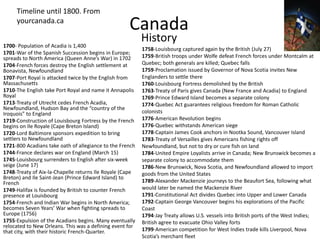
CanadaTimeline until 1800. From yourcanada.ca History1700- Population of Acadia is 1,4001701-War of the Spanish Succession begins in Europe; spreads to North America (Queen Anne’s War) in 17021704-French forces destroy the English settlement at Bonavista, Newfoundland1707-Port Royal is attacked twice by the English from Massachusetts1710-The English take Port Royal and name it Annapolis Royal1713-Treaty of Utrecht cedes French Acadia, Newfoundland, Hudson Bay and the “country of the Iroquois” to England1719-Construction of Louisbourg Fortress by the French begins on Ile Royale (Cape Breton Island)1720-Lord Baltimore sponsors expedition to bring settlers to Newfoundland1721-800 Acadians take oath of allegiance to the French1744-France declares war on England (March 15)1745-Louisbourg surrenders to English after six-week seige (June 17)1748-Treaty of Aix-la-Chapelle returns Ile Royale (Cape Breton) and Ile Saint-Jean (Prince Edward Island) to French1749-Halifax is founded by British to counter French presence at Louisbourg1754-French and Indian War begins in North America; becomes Seven Years’ War when fighting spreads to Europe (1756)1755-Expulsion of the Acadians begins. Many eventually relocated to New Orleans. This was a defining event for that city, with their historic French-Quarter.1758-Louisbourg captured again by the British (July 27)1759-British troops under Wolfe defeat French forces under Montcalm at Quebec; both generals are killed; Quebec falls1759-Proclamation issued by Governor of Nova Scotia invites New Englanders to settle there1760-Louisbourg Fortress demolished by the British1763-Treaty of Paris gives Canada (New France and Acadia) to England1769-Prince Edward Island becomes a separate colony1774-Quebec Act guarantees religious freedom for Roman Catholic colonists1776-American Revolution begins1776-Quebec withstands American siege1778-Captain James Cook anchors in Nootka Sound, Vancouver Island1783-Treaty of Versailles gives Americans fishing rights off Newfoundland, but not to dry or cure fish on land1784-United Empire Loyalists arrive in Canada; New Brunswick becomes a separate colony to accommodate them1786-New Brunswick, Nova Scotia, and Newfoundland allowed to import goods from the United States1789-Alexander Mackenzie journeys to the Beaufort Sea, following what would later be named the Mackenzie River1791-Constitutional Act divides Quebec into Upper and Lower Canada1792-Captain George Vancouver begins his explorations of the Pacific Coast1794-Jay Treaty allows U.S. vessels into British ports of the West Indies; British agree to evacuate Ohio Valley forts1799-American competition for West Indies trade kills Liverpool, Nova Scotia’s merchant fleet
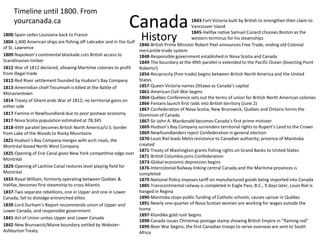
CanadaTimeline until 1800. From yourcanada.ca 1843-Fort Victoria built by British to strengthen their claim to Vancouver Island1845-Halifax native Samuel Cunard chooses Boston as the western terminus for his steamshipsHistory1800-Spain cedes Louisiana back to France1804-1,400 American ships are fishing off Labrador and in the Gulf of St. Lawrence1809-Napoleon’s continental blockade cuts British access to Scandinavian timber1812-War of 1812 declared, allowing Maritime colonies to profit from illegal trade1812-Red River settlement founded by Hudson’s Bay Company1813-Amerindian chief Tecumseh is killed at the Battle of Moraviantown1814-Treaty of Ghent ends War of 1812; no territorial gains on either side1817-Famine in Newfoundland due to poor postwar economy1817-Nova Scotia population estimated at 78,3451818-49th parallel becomes British North America/U.S. border from Lake of the Woods to Rocky Mountains1821-Hudson’s Bay Company merges with arch rivals, the Montréal-based North West Company1825-Opening of Erie Canal gives New York competitive edge over Montréal1829-Opening of Lachine Canal restores level playing field for Montréal1833-Royal William, formerly operating between Québec & Halifax, becomes first steamship to cross Atlantic1837-Two separate rebellions, one in Upper and one in Lower Canada, fail to dislodge entrenched elites1839-Lord Durham’s Report recommends union of Upper and Lower Canada, and responsible government1841-Act of Union unites Upper and Lower Canada1842-New Brunswick/Maine boundary settled by Webster-Ashburton Treaty1846-British Prime Minister Robert Peel announces Free Trade, ending old Colonial mercantile trade system1848-Responsible government established in Nova Scotia and Canada1849-The boundary at the 49th parallel is extended to the Pacific Ocean (bisecting Point Roberts!)1854-Reciprocity (free trade) begins between British North America and the United States1857-Queen Victoria names Ottawa as Canada’s capital1861-American Civil War begins1864-Québec Conference sets out the terms of union for British North American colonies1866-Fenians launch first raids into British territory (June 2)1867-Confederation of Nova Scotia, New Brunswick, Québec and Ontario forms the Dominion of Canada1867-Sir John A. Macdonald becomes Canada’s first prime minister1869-Hudson’s Bay Company surrenders territorial rights to Rupert’s Land to the Crown1869-Newfoundlanders reject Confederation in general election1870-Louis Riel leads Metis resistance to Canadian authority; province of Manitoba created1871-Treaty of Washington grants fishing rights on Grand Banks to United States1871-British Columbia joins Confederation1873-Global economic depression begins1876-Intercolonial Railway linking central Canada and the Maritime provinces is completed1879-National Policy imposes tariff on manufactured goods being imported into Canada1885-Transcontinental railway is completed in Eagle Pass, B.C.; 9 days later, Louis Riel is hanged in Regina1890-Manitoba stops public funding of Catholic schools; causes uproar in Québec1891-Nearly one-quarter of Nova Scotian women are working for wages outside the home1897-Klondike gold rush begins1898-Canada issues Christmas postage stamp showing British Empire in “flaming red”1899-Boer War begins; the first Canadian troops to serve overseas are sent to South Africa
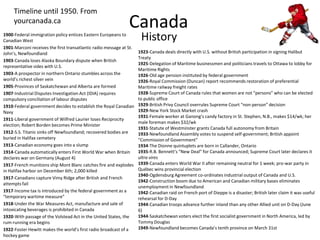
CanadaTimeline until 1950. From yourcanada.ca History1900-Federal immigration policy entices Eastern Europeans to Canadian West1901-Marconi receives the first transatlantic radio message at St. John’s, Newfoundland1903-Canada loses Alaska Boundary dispute when British representative sides with U.S.1903-A prospector in northern Ontario stumbles across the world’s richest silver vein1905-Provinces of Saskatchewan and Alberta are formed1907-Industrial Disputes Investigation Act (IDIA) requires compulsory conciliation of labour disputes1910-Federal government decides to establish the Royal Canadian Navy1911-Liberal government of Wilfred Laurier loses Reciprocity election; Robert Borden becomes Prime Minister1912-S.S. Titanic sinks off Newfoundland; recovered bodies are buried in Halifax cemetery1913-Canadian economy goes into a slump1914-Canada automatically enters First World War when Britain declares war on Germany (August 4)1917-French munitions ship Mont Blanc catches fire and explodes in Halifax harbor on December 6th; 2,000 killed1917-Canadians capture Vimy Ridge after British and French attempts fail1917-Income tax is introduced by the federal government as a “temporary wartime measure”1918-Under the War Measures Act, manufacture and sale of intoxicating beverages is prohibited in Canada1920-With passage of the Volstead Act in the United States, the rum-running era begins1922-Foster Hewitt makes the world’s first radio broadcast of a hockey game1923-Canada deals directly with U.S. without British participation in signing Halibut Treaty1925-Delegation of Maritime businessmen and politicians travels to Ottawa to lobby for Maritime Rights1926-Old age pension instituted by federal government1926-Royal Commission (Duncan) report recommends restoration of preferential Maritime railway freight rates1928-Supreme Court of Canada rules that women are not “persons” who can be elected to public office1929-British Privy Council overrules Supreme Court “non-person” decision1929-New York Stock Market crash1931-Female worker at Ganong’s candy factory in St. Stephen, N.B., makes $14/wk; her male foreman makes $32/wk1931-Statute of Westminster grants Canada full autonomy from Britain1933-Newfoundland Assembly votes to suspend self-government; British appoint “Commission of Government”1934-The Dionne quintuplets are born in Callander, Ontario1935-R.B. Bennett’s “New Deal” for Canada announced; Supreme Court later declares it ultra vires1939-Canada enters World War II after remaining neutral for 1 week; pro-war party in Québec wins provincial election1940-Ogdensburg Agreement co-ordinates industrial output of Canada and U.S.1942-Construction boom due to American and Canadian military bases eliminates unemployment in Newfoundland1942-Canadian raid on French port of Dieppe is a disaster; British later claim it was useful rehearsal for D-Day1944-Canadian troops advance further inland than any other Allied unit on D-Day (June 6)1944-Saskatchewan voters elect the first socialist government in North America, led by Tommy Douglas1949-Newfoundland becomes Canada’s tenth province on March 31st
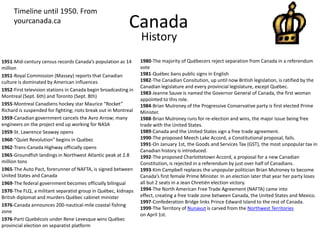
CanadaTimeline until 1950. From yourcanada.ca History1980-The majority of Québecers reject separation from Canada in a referendum vote1981-Québec bans public signs in English1982-The Canadian Consitution, up until now British legislation, is ratified by the Canadian legislature and every provincial legislature, except Québec.1983-Jeanne Sauve is named the Governor General of Canada, the first woman appointed to this role.1984-Brian Mulroney of the Progressive Conservative party is first elected Prime Minister.1988-Brian Mulroney runs for re-election and wins, the major issue being free trade with the United States.1989-Canada and the United States sign a free trade agreement.1990-The proposed Meech Lake Accord, a Constitutional proposal, fails.1991-On January 1st, the Goods and Services Tax (GST), the most unpopular tax in Canadian history is introduced.1992-The proposed Charlottetown Accord, a proposal for a new Canadian Constitution, is rejected in a referendum by just over half of Canadians.1993-Kim Campbell replaces the unpopular politician Brian Mulroney to become Canada’s first female Prime Minister. In an election later that year her party loses all but 2 seats in a Jean Chretién election victory.1994-The North American Free Trade Agreement (NAFTA) came into effect, creating a free trade zone between Canada, the United States and Mexico.1997-Confederation Bridge links Prince Edward Island to the rest of Canada.1999-The Territory of Nunavut is carved from the Northwest Territorieson April 1st.1951-Mid-century census records Canada’s population as 14 million1951-Royal Commission (Massey) reports that Canadian culture is dominated by American influences1952-First television stations in Canada begin broadcasting in Montreal (Sept. 6th) and Toronto (Sept. 8th)1955-Montreal Canadiens hockey star Maurice “Rocket” Richard is suspended for fighting; riots break out in Montreal1959-Canadian government cancels the Avro Arrow; many engineers on the project end up working for NASA1959-St. Lawrence Seaway opens1960-“Quiet Revolution” begins in Québec1962-Trans-Canada Highway officially opens1965-Groundfish landings in Northwest Atlantic peak at 2.8 million tons1965-The Auto Pact, forerunner of NAFTA, is signed between United States and Canada1969-The federal government becomes officially bilingual1970-The FLQ, a militant separatist group in Québec, kidnaps British diplomat and murders Québec cabinet minister1976-Canada announces 200-nautical-mile coastal fishing zone1976-Parti Quebécois under Rene Levesque wins Québec provincial election on separatist platform
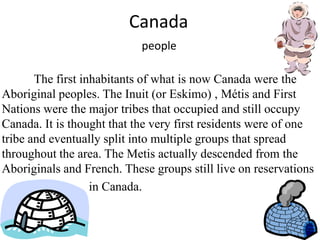
CanadapeopleThe first inhabitants of what is now Canada were the Aboriginal peoples. The Inuit (or Eskimo) , Métis and First Nations were the major tribes that occupied and still occupy Canada. It is thought that the very first residents were of one tribe and eventually split into multiple groups that spread throughout the area. The Metis actually descended from the Aboriginals and French. These groups still live on reservations                              in Canada.
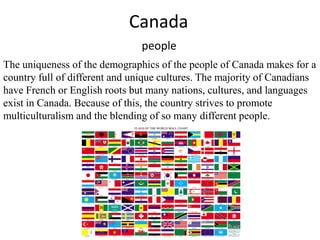
CanadapeopleThe uniqueness of the demographics of the people of Canada makes for a country full of different and unique cultures. The majority of Canadians have French or English roots but many nations, cultures, and languages exist in Canada. Because of this, the country strives to promote multiculturalism and the blending of so many different people.
CanadaCulture	Because of the different people that inhabit Canada, the cultures in Canada are rich and varied. The pasts of many nations come together to create a country that flourishes. Canada is a country stereotyped for its obsession with hockey, the great skiing and snow sports, maple syrup, and back woods ways. The country has taken ideas from each motherland and, more recently, the United States to build itself as an advanced nation that is independent and full of natural beauty.
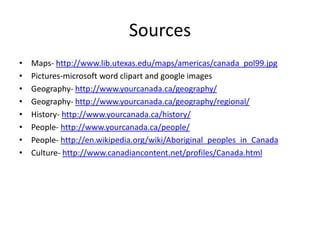
CanadaCultureCanada is a beautiful nation that is characterized by its many parts. Each area is different and holds its own traditions, language, and people. It is seen as one of two things: a nation that has fully embraced multiculturalism or one that has deep English and French routes but incorporates U.S ideas and those of any immigrants.
SourcesMaps- http://www.lib.utexas.edu/maps/americas/canada_pol99.jpgPictures-microsoft word clipart and google imagesGeography- http://www.yourcanada.ca/geography/Geography- http://www.yourcanada.ca/geography/regional/History- http://www.yourcanada.ca/history/People- http://www.yourcanada.ca/people/People- http://en.wikipedia.org/wiki/Aboriginal_peoples_in_CanadaCulture- http://www.canadiancontent.net/profiles/Canada.html

Ush canada2 '11

  • 1.
  • 2.
    CanadaGeographyCanada is theworld’s second largest country, only falling short of Russia. It is divided into large territories. These are similar to American states but much larger. The geography of Canada is very diverse and changes by area. A common feature is water. Canada is spotted with millions of lakes and rivers. 7% of the country is underwater. Canada has coastline and mountainous regions. Its coastline is the largest of any one country in the world. Canada borders the US in long stretches. Over ten percent of Canada belongs to a very harsh climate. Northern parts of Canada come very close to the North Pole. This causes most people to live near each other in pleasant weather. With the majority of Canadians living in cities, vast areas are left natural for the people to enjoy and practice various hobbies.
  • 3.
    CanadaGeography by RegionThePacific Coast-British Columbia is bordered by the Pacific Ocean. The shores are covered in coves while the island of Vancouver makes a perfect storm shield. This all accounts for the mildest temperature in Canada. Vancouver Island, therefore, experiences much rain and is home to beautiful, ancient trees.The Cordillera-this area is mountainous and beautiful. It consists of snow-capped peaks and warm, dry valleys. It spreads from British Columbia into Alberta, The Yukon, and even Alaska. The Prairies-the prairies stretching through Alberta, Saskatchewan and Manitoba are some of the most fertile in the world. They go on for miles across flat land and can be very picturesque. The Canadian Shield- the shield is a rocky area that surrounds the Hudson Bay. A good part of Canadian culture stems from this area. It also houses many precious minerals. The Great Lakes-St. Lawrence Lowlands- South Quebec and Ontario are home to 50% of Canadians and the largest cities. Most industrial and economic business are based in the same area. The agriculture also thrives in the same area.The Atlantic Provinces-Appalachian Region-New Brunswick, Nova Scotia, Prince Edward Island and Newfoundland occupy this area and are the smallest provinces. They belong to the Appalachian Mountain range and are know for their low hills, vast coastline, and spectacular fishing.The Arctic-The Arctic is famed for its harsh conditions and beauty. Now, with modern technology, it is easier and more comfortable to visit and live in the area, though still extremely isolated.
  • 4.
    CanadaHistory The historyof Canada is unique. It includes two separate people at cultures that eventually joined together into one country. French and English settlers each took claims to parts of Canada and established colonies for their mother countries. The history of Canada is full of the British and French attacking each other and trading land pieces in various ways. To this day, the English and French populations live very separately in their own communities with both languages being spoken throughout the country.
  • 5.
    CanadaTimeline until 1700whenFrance and England were at peace again. From yourcanada.ca History1639-Smallpox epidemic decimates Huron people; population reduced by 50%1642-Montréal is founded1649-Attacks by the Iroquois disperse the Huron; disrupts fur trade over the next fifteen years1652-Massachusetts General Court licenses traders going from Massachusetts to Acadia1660-English Navigation Act prohibits foreigners from trading with English colonies1663-Louis XIV assumes personal control of New France1667-France, England and the Netherlands sign the Breda Treaty in July and with this England gives Acadia to France1667-First census of New France records 668 families, totalling 3,215 non-native inhabitants1670-Hudson’s Bay Company is formed and granted trade rights over all territory draining into Hudson’s Bay (the largest land grant in world history)1676-West Country merchants attempt to enforce restrictions on settlement in Newfoundland1682-French explorer La Salle reaches the mouth of the Mississippi1686-King James II & Louis XIV sign neutrality pact handing forts of St. John’s & Port Royal back to the French1690-Sir William Phips captures almost all of the French possessions in Acadia1697-Treaty of Ryswick restores the status quo between France & England; Acadia is returned to the French1000- Around this time, the Norse built the settlement at L’Anse-aux-Meadows (northern tip of Newfoundland).1497-Giovanni Caboto (John Cabot) claims Cape Breton Island (or Newfoundland) for England.1534-Jacques Cartier explores Gulf of St. Lawrence.1541-Cartier and Sieur de Roberval found a settlement on St. Lawrence River, but it fails.1583-Sir Humphrey Gilbert, brother-in-law of Sir Walter Raleigh, sails for Newfoundland from England.1588-English fishing fleet delays sailing to Newfoundland to participate in the defeat of Spanish Armada.1598-The Marquis de la Roche lands 40 convicts on Sable Island.1603-Sieur de Monts obtains charter to all the land lying between 40th-46th degree north latitude1605-Port Royal, the first permanent French settlement in North America, founded1608-Quebec City founded by Samuel de Champlain1610-Etienne Brule lives among Huron and is first European to see Great Lakes1613-Port Royal sacked by Samuel Argall and his pirates from Virginia1621-James I of England grants Acadia to Sir William Alexander who renames it New Scotland (Nova Scotia)1627-Company of One Hundred Associates is founded to establish a French Empire in North America1629-Quebec City captured by an English fleet led by David Kirke, (he also captured Port Royal the year before)1631-Charles de la Tour builds Fort La Tour (a.k.a. Fort Saint Marie) at the mouth of the Saint John River1632-British lose control of Acadia due to the Treaty of Saint-Germain-en-Laye1632-Isaac de Razilly sails from France with 300 people hoping to establish a permanent French settlement in Acadia1636-French crown grants Gulf of Maine and Bay of Fundy to d’Aulnay; La Tour gets Nova Scotia peninsula
  • 6.
    CanadaTimeline until 1800.From yourcanada.ca History1700- Population of Acadia is 1,4001701-War of the Spanish Succession begins in Europe; spreads to North America (Queen Anne’s War) in 17021704-French forces destroy the English settlement at Bonavista, Newfoundland1707-Port Royal is attacked twice by the English from Massachusetts1710-The English take Port Royal and name it Annapolis Royal1713-Treaty of Utrecht cedes French Acadia, Newfoundland, Hudson Bay and the “country of the Iroquois” to England1719-Construction of Louisbourg Fortress by the French begins on Ile Royale (Cape Breton Island)1720-Lord Baltimore sponsors expedition to bring settlers to Newfoundland1721-800 Acadians take oath of allegiance to the French1744-France declares war on England (March 15)1745-Louisbourg surrenders to English after six-week seige (June 17)1748-Treaty of Aix-la-Chapelle returns Ile Royale (Cape Breton) and Ile Saint-Jean (Prince Edward Island) to French1749-Halifax is founded by British to counter French presence at Louisbourg1754-French and Indian War begins in North America; becomes Seven Years’ War when fighting spreads to Europe (1756)1755-Expulsion of the Acadians begins. Many eventually relocated to New Orleans. This was a defining event for that city, with their historic French-Quarter.1758-Louisbourg captured again by the British (July 27)1759-British troops under Wolfe defeat French forces under Montcalm at Quebec; both generals are killed; Quebec falls1759-Proclamation issued by Governor of Nova Scotia invites New Englanders to settle there1760-Louisbourg Fortress demolished by the British1763-Treaty of Paris gives Canada (New France and Acadia) to England1769-Prince Edward Island becomes a separate colony1774-Quebec Act guarantees religious freedom for Roman Catholic colonists1776-American Revolution begins1776-Quebec withstands American siege1778-Captain James Cook anchors in Nootka Sound, Vancouver Island1783-Treaty of Versailles gives Americans fishing rights off Newfoundland, but not to dry or cure fish on land1784-United Empire Loyalists arrive in Canada; New Brunswick becomes a separate colony to accommodate them1786-New Brunswick, Nova Scotia, and Newfoundland allowed to import goods from the United States1789-Alexander Mackenzie journeys to the Beaufort Sea, following what would later be named the Mackenzie River1791-Constitutional Act divides Quebec into Upper and Lower Canada1792-Captain George Vancouver begins his explorations of the Pacific Coast1794-Jay Treaty allows U.S. vessels into British ports of the West Indies; British agree to evacuate Ohio Valley forts1799-American competition for West Indies trade kills Liverpool, Nova Scotia’s merchant fleet
  • 7.
    CanadaTimeline until 1800.From yourcanada.ca 1843-Fort Victoria built by British to strengthen their claim to Vancouver Island1845-Halifax native Samuel Cunard chooses Boston as the western terminus for his steamshipsHistory1800-Spain cedes Louisiana back to France1804-1,400 American ships are fishing off Labrador and in the Gulf of St. Lawrence1809-Napoleon’s continental blockade cuts British access to Scandinavian timber1812-War of 1812 declared, allowing Maritime colonies to profit from illegal trade1812-Red River settlement founded by Hudson’s Bay Company1813-Amerindian chief Tecumseh is killed at the Battle of Moraviantown1814-Treaty of Ghent ends War of 1812; no territorial gains on either side1817-Famine in Newfoundland due to poor postwar economy1817-Nova Scotia population estimated at 78,3451818-49th parallel becomes British North America/U.S. border from Lake of the Woods to Rocky Mountains1821-Hudson’s Bay Company merges with arch rivals, the Montréal-based North West Company1825-Opening of Erie Canal gives New York competitive edge over Montréal1829-Opening of Lachine Canal restores level playing field for Montréal1833-Royal William, formerly operating between Québec & Halifax, becomes first steamship to cross Atlantic1837-Two separate rebellions, one in Upper and one in Lower Canada, fail to dislodge entrenched elites1839-Lord Durham’s Report recommends union of Upper and Lower Canada, and responsible government1841-Act of Union unites Upper and Lower Canada1842-New Brunswick/Maine boundary settled by Webster-Ashburton Treaty1846-British Prime Minister Robert Peel announces Free Trade, ending old Colonial mercantile trade system1848-Responsible government established in Nova Scotia and Canada1849-The boundary at the 49th parallel is extended to the Pacific Ocean (bisecting Point Roberts!)1854-Reciprocity (free trade) begins between British North America and the United States1857-Queen Victoria names Ottawa as Canada’s capital1861-American Civil War begins1864-Québec Conference sets out the terms of union for British North American colonies1866-Fenians launch first raids into British territory (June 2)1867-Confederation of Nova Scotia, New Brunswick, Québec and Ontario forms the Dominion of Canada1867-Sir John A. Macdonald becomes Canada’s first prime minister1869-Hudson’s Bay Company surrenders territorial rights to Rupert’s Land to the Crown1869-Newfoundlanders reject Confederation in general election1870-Louis Riel leads Metis resistance to Canadian authority; province of Manitoba created1871-Treaty of Washington grants fishing rights on Grand Banks to United States1871-British Columbia joins Confederation1873-Global economic depression begins1876-Intercolonial Railway linking central Canada and the Maritime provinces is completed1879-National Policy imposes tariff on manufactured goods being imported into Canada1885-Transcontinental railway is completed in Eagle Pass, B.C.; 9 days later, Louis Riel is hanged in Regina1890-Manitoba stops public funding of Catholic schools; causes uproar in Québec1891-Nearly one-quarter of Nova Scotian women are working for wages outside the home1897-Klondike gold rush begins1898-Canada issues Christmas postage stamp showing British Empire in “flaming red”1899-Boer War begins; the first Canadian troops to serve overseas are sent to South Africa
  • 8.
    CanadaTimeline until 1950.From yourcanada.ca History1900-Federal immigration policy entices Eastern Europeans to Canadian West1901-Marconi receives the first transatlantic radio message at St. John’s, Newfoundland1903-Canada loses Alaska Boundary dispute when British representative sides with U.S.1903-A prospector in northern Ontario stumbles across the world’s richest silver vein1905-Provinces of Saskatchewan and Alberta are formed1907-Industrial Disputes Investigation Act (IDIA) requires compulsory conciliation of labour disputes1910-Federal government decides to establish the Royal Canadian Navy1911-Liberal government of Wilfred Laurier loses Reciprocity election; Robert Borden becomes Prime Minister1912-S.S. Titanic sinks off Newfoundland; recovered bodies are buried in Halifax cemetery1913-Canadian economy goes into a slump1914-Canada automatically enters First World War when Britain declares war on Germany (August 4)1917-French munitions ship Mont Blanc catches fire and explodes in Halifax harbor on December 6th; 2,000 killed1917-Canadians capture Vimy Ridge after British and French attempts fail1917-Income tax is introduced by the federal government as a “temporary wartime measure”1918-Under the War Measures Act, manufacture and sale of intoxicating beverages is prohibited in Canada1920-With passage of the Volstead Act in the United States, the rum-running era begins1922-Foster Hewitt makes the world’s first radio broadcast of a hockey game1923-Canada deals directly with U.S. without British participation in signing Halibut Treaty1925-Delegation of Maritime businessmen and politicians travels to Ottawa to lobby for Maritime Rights1926-Old age pension instituted by federal government1926-Royal Commission (Duncan) report recommends restoration of preferential Maritime railway freight rates1928-Supreme Court of Canada rules that women are not “persons” who can be elected to public office1929-British Privy Council overrules Supreme Court “non-person” decision1929-New York Stock Market crash1931-Female worker at Ganong’s candy factory in St. Stephen, N.B., makes $14/wk; her male foreman makes $32/wk1931-Statute of Westminster grants Canada full autonomy from Britain1933-Newfoundland Assembly votes to suspend self-government; British appoint “Commission of Government”1934-The Dionne quintuplets are born in Callander, Ontario1935-R.B. Bennett’s “New Deal” for Canada announced; Supreme Court later declares it ultra vires1939-Canada enters World War II after remaining neutral for 1 week; pro-war party in Québec wins provincial election1940-Ogdensburg Agreement co-ordinates industrial output of Canada and U.S.1942-Construction boom due to American and Canadian military bases eliminates unemployment in Newfoundland1942-Canadian raid on French port of Dieppe is a disaster; British later claim it was useful rehearsal for D-Day1944-Canadian troops advance further inland than any other Allied unit on D-Day (June 6)1944-Saskatchewan voters elect the first socialist government in North America, led by Tommy Douglas1949-Newfoundland becomes Canada’s tenth province on March 31st
  • 9.
    CanadaTimeline until 1950.From yourcanada.ca History1980-The majority of Québecers reject separation from Canada in a referendum vote1981-Québec bans public signs in English1982-The Canadian Consitution, up until now British legislation, is ratified by the Canadian legislature and every provincial legislature, except Québec.1983-Jeanne Sauve is named the Governor General of Canada, the first woman appointed to this role.1984-Brian Mulroney of the Progressive Conservative party is first elected Prime Minister.1988-Brian Mulroney runs for re-election and wins, the major issue being free trade with the United States.1989-Canada and the United States sign a free trade agreement.1990-The proposed Meech Lake Accord, a Constitutional proposal, fails.1991-On January 1st, the Goods and Services Tax (GST), the most unpopular tax in Canadian history is introduced.1992-The proposed Charlottetown Accord, a proposal for a new Canadian Constitution, is rejected in a referendum by just over half of Canadians.1993-Kim Campbell replaces the unpopular politician Brian Mulroney to become Canada’s first female Prime Minister. In an election later that year her party loses all but 2 seats in a Jean Chretién election victory.1994-The North American Free Trade Agreement (NAFTA) came into effect, creating a free trade zone between Canada, the United States and Mexico.1997-Confederation Bridge links Prince Edward Island to the rest of Canada.1999-The Territory of Nunavut is carved from the Northwest Territorieson April 1st.1951-Mid-century census records Canada’s population as 14 million1951-Royal Commission (Massey) reports that Canadian culture is dominated by American influences1952-First television stations in Canada begin broadcasting in Montreal (Sept. 6th) and Toronto (Sept. 8th)1955-Montreal Canadiens hockey star Maurice “Rocket” Richard is suspended for fighting; riots break out in Montreal1959-Canadian government cancels the Avro Arrow; many engineers on the project end up working for NASA1959-St. Lawrence Seaway opens1960-“Quiet Revolution” begins in Québec1962-Trans-Canada Highway officially opens1965-Groundfish landings in Northwest Atlantic peak at 2.8 million tons1965-The Auto Pact, forerunner of NAFTA, is signed between United States and Canada1969-The federal government becomes officially bilingual1970-The FLQ, a militant separatist group in Québec, kidnaps British diplomat and murders Québec cabinet minister1976-Canada announces 200-nautical-mile coastal fishing zone1976-Parti Quebécois under Rene Levesque wins Québec provincial election on separatist platform
  • 10.
    CanadapeopleThe first inhabitantsof what is now Canada were the Aboriginal peoples. The Inuit (or Eskimo) , Métis and First Nations were the major tribes that occupied and still occupy Canada. It is thought that the very first residents were of one tribe and eventually split into multiple groups that spread throughout the area. The Metis actually descended from the Aboriginals and French. These groups still live on reservations in Canada.
  • 11.
    CanadapeopleThe uniqueness ofthe demographics of the people of Canada makes for a country full of different and unique cultures. The majority of Canadians have French or English roots but many nations, cultures, and languages exist in Canada. Because of this, the country strives to promote multiculturalism and the blending of so many different people.
  • 12.
    CanadaCulture Because of thedifferent people that inhabit Canada, the cultures in Canada are rich and varied. The pasts of many nations come together to create a country that flourishes. Canada is a country stereotyped for its obsession with hockey, the great skiing and snow sports, maple syrup, and back woods ways. The country has taken ideas from each motherland and, more recently, the United States to build itself as an advanced nation that is independent and full of natural beauty.
  • 13.
    CanadaCultureCanada is abeautiful nation that is characterized by its many parts. Each area is different and holds its own traditions, language, and people. It is seen as one of two things: a nation that has fully embraced multiculturalism or one that has deep English and French routes but incorporates U.S ideas and those of any immigrants.
  • 14.
    SourcesMaps- http://www.lib.utexas.edu/maps/americas/canada_pol99.jpgPictures-microsoft wordclipart and google imagesGeography- http://www.yourcanada.ca/geography/Geography- http://www.yourcanada.ca/geography/regional/History- http://www.yourcanada.ca/history/People- http://www.yourcanada.ca/people/People- http://en.wikipedia.org/wiki/Aboriginal_peoples_in_CanadaCulture- http://www.canadiancontent.net/profiles/Canada.html