ESCAPING CMS

TUNNEL VISION
E R I C S E M B R AT
ABOUT ME
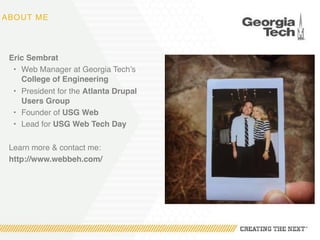
Eric Sembrat
• Web Manager at Georgia Tech’s
College of Engineering
• President for the Atlanta Drupal
Users Group
• Founder of USG Web
• Lead for USG Web Tech Day
Learn more & contact me:
http://www.webbeh.com/
TODAY’S TASK
HAVE YOU EVER BEEN
ASKED TO DO THIS?
HAVE YOU HEARD?
Can we use {CMS system} to
do {something your CMS
shouldn’t do}?
HAVE YOU HEARD?
Why can’t {CMS system} act
like {another CMS system}?
HAVE YOU HEARD?
Can you recreate {software
package} in {your CMS
system}?
THESE AREN’T GOOD SIGNS!
These kinds of questions signal a
reliance and insistence on a platform
rather than looking to see if the platform
actually fits the project need.
I WAS ASKED LAST YEAR…
Reliance on a platform is not
sustainable.
I WAS ASKED LAST YEAR…
Someone asked me at USG Web Tech Day
2016:
How do you keep up with {all
the CMS systems} you work
with?
I WAS ASKED LAST YEAR…
Someone asked me at USG Web Tech Day
2016:
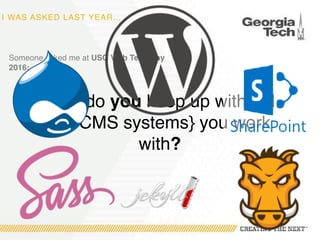
How do you keep up with {all
the CMS systems} you work
with?
IT IS A LOT…
Yes, learning lots of tools is non-trivial
and there are learning curves for each
platform.
Not to mention migration curves and
release updates.
However, as I have learned at my
employment in higher education, is the
truth that one size never fits all your
needs.
More importantly, most tools ease in
usability once you overcome an
introductory learning curve.
IT IS A LOT…
More importantly, these introduction
learning curves far exceed the custom
code maintenance and expansion to
retrofit your platform to mimic another.
In this case, an ecosystem of platforms can
meet the needs of your end-users without
overworking and draining your
development resources.
LET’S TAKE A LOOK AT THE 

WEB ECOSYSTEM
IT IS A LOT…
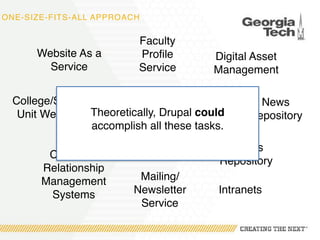
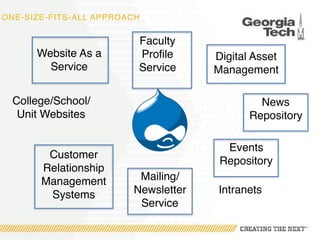
Let’s take an example of a content
management system and see what it could
be retrofitted to do.
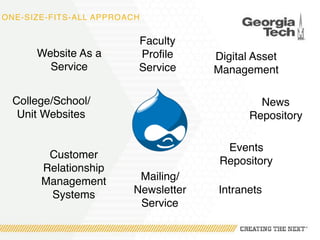
ONE-SIZE-FITS-ALL APPROACH
Website As a
Service
Digital Asset
Management
News
Repository
Events
Repository
Faculty
Profile
Service
Intranets
College/School/
Unit Websites
Customer
Relationship
Management
Systems
Mailing/
Newsletter
Service
ONE-SIZE-FITS-ALL APPROACH
Website As a
Service
Digital Asset
Management
News
Repository
Events
Repository
Faculty
Profile
Service
Intranets
College/School/
Unit Websites
Customer
Relationship
Management
Systems
Mailing/
Newsletter
Service
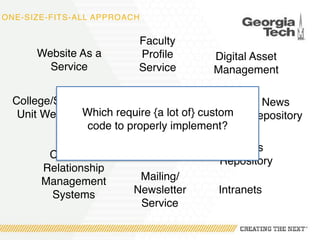
Theoretically, Drupal could
accomplish all these tasks.
ONE-SIZE-FITS-ALL APPROACH
Website As a
Service
Digital Asset
Management
News
Repository
Events
Repository
Faculty
Profile
Service
Intranets
College/School/
Unit Websites
Customer
Relationship
Management
Systems
Mailing/
Newsletter
Service
Which require {a lot of} custom
code to properly implement?
ONE-SIZE-FITS-ALL APPROACH
Website As a
Service
Digital Asset
Management
News
Repository
Events
Repository
Faculty
Profile
Service
Intranets
College/School/
Unit Websites
Customer
Relationship
Management
Systems
Mailing/
Newsletter
Service
ONE-SIZE-FITS-ALL APPROACH
Website As a
Service
Digital Asset
Management
News
Repository
Events
Repository
Faculty
Profile
Service
Intranets
College/School/
Unit Websites
Customer
Relationship
Management
Systems
Mailing/
Newsletter
Service
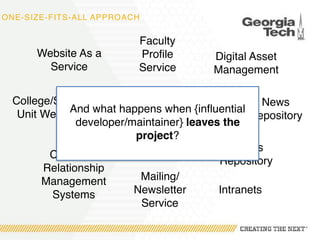
And what happens when {influential
developer/maintainer} leaves the
project?
ONE-SIZE-FITS-ALL APPROACH
Website As a
Service
Digital Asset
Management
News
Repository
Events
Repository
Faculty
Profile
Service
Intranets
College/School/
Unit Websites
Customer
Relationship
Management
Systems
Mailing/
Newsletter
Service
And what happens when {influential
developer/maintainer} leaves the
project?
A LOT OF US AREN’T THAT LUCKY…
Large development teams with varied
and distributed web expertise are not
common in our university system.
Yes, you can build likely all the projects
you can with custom code.
But eventually, someone else (not
you) has to step in to continue to
support the product.
A LOT OF US AREN’T THAT LUCKY…
Plan your
escape
(today).
SO, LET’S THINK OF WEB PLATFORMS AS JUST
THAT..
We should think of a Content
Management System (CMS) or web app
as just that - a platform.
The platform is made for {X}, {Y}, {Z},
but not necessarily {A}, {B}, or {C}.
Our Web Ecosystem, then, is a
combination of platforms leveraged for
particular purposes.
These platforms are meant to survive,
even after you have left the project.
A PLATFORM IS MADE UP OF THREE
ASPECTS…
Purpose: What is its purpose in life?
What can it do?
Flexibility: What can it be easily shaped
to do? What does the platform support?
Knowledge: What does it take to gain
expertise in the platform? What
software, languages, and tools help you
conquer it?
A PLATFORM IS MADE UP OF THREE
ASPECTS…
Where do you find these answers for a
platform you’re evaluating?
Look at what your peers are doing.
Ask in a community-of-practice.
Scour documentation on the platform.
Read case studies on {your project
need}.
Perform your own case study.
Test with a proof-of-concept.
EXAMPLE: GEORGIA TECH
GEORGIA INSTITUTE OF TECHNOLOGY
For platforms…
GEORGIA INSTITUTE OF TECHNOLOGY
Georgia Tech has been singularly
Drupal since its adoption in 2009/2010.
No prior CMS or toolset centrally
leveraged prior.
GEORGIA INSTITUTE OF TECHNOLOGY
Various tools have been built using
Drupal:
Centralized news/events service.
Daily email distribution service.
Pseudo custom layouts creation tool.
Slideshow
College Digital Asset Management tools.
Project Management tools.
Application workflows.
Wikis.
Intranets.
GEORGIA INSTITUTE OF TECHNOLOGY
However, staffing changes in 2014 and
2015 began to reveal some troubling
trends in web development.
Custom-supported services and tools
were becoming more fragile to updates
and upgrades.
Central services were seeing degraded
service and extended upgrade windows.
Projects were being shelved due to a
lack of expertise in maintenance.
GEORGIA INSTITUTE OF TECHNOLOGY
A perfect example being the website-as-
a-service offering, called Drupal
Express.
Initial offering promised features,
variants, and scaling-ease for Drupal
usage.
Staffing changes occurred on the
project.
Real offering was a one-size-fits-all that
didn’t include any of the scaling-ease
beyond pre-established work.
GEORGIA INSTITUTE OF TECHNOLOGY
Today, Drupal Express looks very much
as it was when it was introduced in
2014.
Upgrade paths for migrating the design
of the product into a Drupal 8-equivalent
are missing.
GEORGIA INSTITUTE OF TECHNOLOGY
However, during this same time,
academic units on campus were piloting
additional platforms and systems for
web projects.
Based on needs-assessments on
campus, focused on mitigating an issue
with long-term branding support.
GEORGIA INSTITUTE OF TECHNOLOGY
Two points were considered:

Multisite: Lots of websites under one
codebase. Drupal can do this, but it is a
rigid mess.
Static: Providing a template-able
platform for layering content. Easy for
migrating static websites without
reinventing HTML or learning a CMS.
GEORGIA INSTITUTE OF TECHNOLOGY
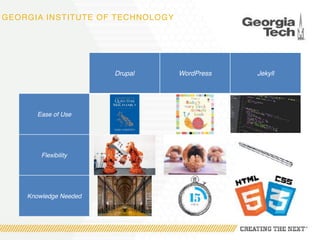
Drupal WordPress Jekyll
Ease of Use
Flexibility
Knowledge Needed
GEORGIA INSTITUTE OF TECHNOLOGY
Development time on the Multisite was
not trivial.
However, the platform is very much a
‘set it and forget it’ model, especially as
a free service.
WordPress’ sandboxed plugin model
scaffolds well for feature requests.
GEORGIA INSTITUTE OF TECHNOLOGY
For tools…
GEORGIA INSTITUTE OF TECHNOLOGY
Georgia Tech is heavily decentralized
and silo’ed.
That being said, many web development
practices still echo 2000’s best-
practices.
However, there are unit-steered
movements to accelerate tools for
development.
GEORGIA INSTITUTE OF TECHNOLOGY
Sass/Less/PostCSS - CSS processing
and reusability is niche work on campus
but provides chunked styling on
demand.
Grunt/Gulp - JS and project delivery
and compilation for projects using
cutting-edge features.
Twig/Symfony - Drupal 8 heavily
leverages these tools for theme/plugin
development.
Github - Our biggest success for code
repository and sharing.
SO, HOW DO I BEGIN?
GEORGIA INSTITUTE OF TECHNOLOGY
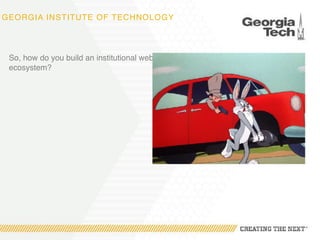
So, how do you build an institutional web
ecosystem?
HAVE YOU HEARD?
1. Take a survey of your
currently-used platforms.
HAVE YOU HEARD?
2. Take a similar survey of
your current/upcoming needs
and projects.
HAVE YOU HEARD?
3. Consider the health and
maintainability of each list
item, and if it’s the right tool
for the right job.
PASSING YOUR PLATFORM
KNOWLEDGE ON
TITLE
A secondary goal of adopting the Web
Ecosystem strategy is to codify your
experiences, knowledge learned, and
takeaways into your local web
development community.
For larger institutions, this is your IT or
web professional group.
For smaller institutions, this is your
regional professional groups (USG Web,
for example).
TITLE
The purpose of this is both to pass on
the knowledge to a larger group from
your experiences, but also to
document your project and
successes/failures.
This can take the form of a mailing list
community, a Wiki/documentation
repository, a document portal, a blog, or
even a tweet(s).
TITLE
PLEASE DOCUMENT 

YOUR WORK
QUESTIONS?
QUESTIONS?

USG Web Tech Day 2017 - CMS Tunnel Vision

  • 1.
  • 3.
    ABOUT ME Eric Sembrat •Web Manager at Georgia Tech’s College of Engineering • President for the Atlanta Drupal Users Group • Founder of USG Web • Lead for USG Web Tech Day Learn more & contact me: http://www.webbeh.com/
  • 4.
  • 5.
    HAVE YOU EVERBEEN ASKED TO DO THIS?
  • 6.
    HAVE YOU HEARD? Canwe use {CMS system} to do {something your CMS shouldn’t do}?
  • 7.
    HAVE YOU HEARD? Whycan’t {CMS system} act like {another CMS system}?
  • 8.
    HAVE YOU HEARD? Canyou recreate {software package} in {your CMS system}?
  • 9.
    THESE AREN’T GOODSIGNS! These kinds of questions signal a reliance and insistence on a platform rather than looking to see if the platform actually fits the project need.
  • 10.
    I WAS ASKEDLAST YEAR… Reliance on a platform is not sustainable.
  • 11.
    I WAS ASKEDLAST YEAR… Someone asked me at USG Web Tech Day 2016: How do you keep up with {all the CMS systems} you work with?
  • 12.
    I WAS ASKEDLAST YEAR… Someone asked me at USG Web Tech Day 2016: How do you keep up with {all the CMS systems} you work with?
  • 13.
    IT IS ALOT… Yes, learning lots of tools is non-trivial and there are learning curves for each platform. Not to mention migration curves and release updates. However, as I have learned at my employment in higher education, is the truth that one size never fits all your needs. More importantly, most tools ease in usability once you overcome an introductory learning curve.
  • 14.
    IT IS ALOT… More importantly, these introduction learning curves far exceed the custom code maintenance and expansion to retrofit your platform to mimic another. In this case, an ecosystem of platforms can meet the needs of your end-users without overworking and draining your development resources.
  • 15.
    LET’S TAKE ALOOK AT THE 
 WEB ECOSYSTEM
  • 16.
    IT IS ALOT… Let’s take an example of a content management system and see what it could be retrofitted to do.
  • 17.
    ONE-SIZE-FITS-ALL APPROACH Website Asa Service Digital Asset Management News Repository Events Repository Faculty Profile Service Intranets College/School/ Unit Websites Customer Relationship Management Systems Mailing/ Newsletter Service
  • 18.
    ONE-SIZE-FITS-ALL APPROACH Website Asa Service Digital Asset Management News Repository Events Repository Faculty Profile Service Intranets College/School/ Unit Websites Customer Relationship Management Systems Mailing/ Newsletter Service Theoretically, Drupal could accomplish all these tasks.
  • 19.
    ONE-SIZE-FITS-ALL APPROACH Website Asa Service Digital Asset Management News Repository Events Repository Faculty Profile Service Intranets College/School/ Unit Websites Customer Relationship Management Systems Mailing/ Newsletter Service Which require {a lot of} custom code to properly implement?
  • 20.
    ONE-SIZE-FITS-ALL APPROACH Website Asa Service Digital Asset Management News Repository Events Repository Faculty Profile Service Intranets College/School/ Unit Websites Customer Relationship Management Systems Mailing/ Newsletter Service
  • 21.
    ONE-SIZE-FITS-ALL APPROACH Website Asa Service Digital Asset Management News Repository Events Repository Faculty Profile Service Intranets College/School/ Unit Websites Customer Relationship Management Systems Mailing/ Newsletter Service And what happens when {influential developer/maintainer} leaves the project?
  • 22.
    ONE-SIZE-FITS-ALL APPROACH Website Asa Service Digital Asset Management News Repository Events Repository Faculty Profile Service Intranets College/School/ Unit Websites Customer Relationship Management Systems Mailing/ Newsletter Service And what happens when {influential developer/maintainer} leaves the project?
  • 23.
    A LOT OFUS AREN’T THAT LUCKY… Large development teams with varied and distributed web expertise are not common in our university system. Yes, you can build likely all the projects you can with custom code. But eventually, someone else (not you) has to step in to continue to support the product.
  • 24.
    A LOT OFUS AREN’T THAT LUCKY… Plan your escape (today).
  • 25.
    SO, LET’S THINKOF WEB PLATFORMS AS JUST THAT.. We should think of a Content Management System (CMS) or web app as just that - a platform. The platform is made for {X}, {Y}, {Z}, but not necessarily {A}, {B}, or {C}. Our Web Ecosystem, then, is a combination of platforms leveraged for particular purposes. These platforms are meant to survive, even after you have left the project.
  • 26.
    A PLATFORM ISMADE UP OF THREE ASPECTS… Purpose: What is its purpose in life? What can it do? Flexibility: What can it be easily shaped to do? What does the platform support? Knowledge: What does it take to gain expertise in the platform? What software, languages, and tools help you conquer it?
  • 27.
    A PLATFORM ISMADE UP OF THREE ASPECTS… Where do you find these answers for a platform you’re evaluating? Look at what your peers are doing. Ask in a community-of-practice. Scour documentation on the platform. Read case studies on {your project need}. Perform your own case study. Test with a proof-of-concept.
  • 28.
  • 29.
    GEORGIA INSTITUTE OFTECHNOLOGY For platforms…
  • 30.
    GEORGIA INSTITUTE OFTECHNOLOGY Georgia Tech has been singularly Drupal since its adoption in 2009/2010. No prior CMS or toolset centrally leveraged prior.
  • 31.
    GEORGIA INSTITUTE OFTECHNOLOGY Various tools have been built using Drupal: Centralized news/events service. Daily email distribution service. Pseudo custom layouts creation tool. Slideshow College Digital Asset Management tools. Project Management tools. Application workflows. Wikis. Intranets.
  • 32.
    GEORGIA INSTITUTE OFTECHNOLOGY However, staffing changes in 2014 and 2015 began to reveal some troubling trends in web development. Custom-supported services and tools were becoming more fragile to updates and upgrades. Central services were seeing degraded service and extended upgrade windows. Projects were being shelved due to a lack of expertise in maintenance.
  • 33.
    GEORGIA INSTITUTE OFTECHNOLOGY A perfect example being the website-as- a-service offering, called Drupal Express. Initial offering promised features, variants, and scaling-ease for Drupal usage. Staffing changes occurred on the project. Real offering was a one-size-fits-all that didn’t include any of the scaling-ease beyond pre-established work.
  • 34.
    GEORGIA INSTITUTE OFTECHNOLOGY Today, Drupal Express looks very much as it was when it was introduced in 2014. Upgrade paths for migrating the design of the product into a Drupal 8-equivalent are missing.
  • 35.
    GEORGIA INSTITUTE OFTECHNOLOGY However, during this same time, academic units on campus were piloting additional platforms and systems for web projects. Based on needs-assessments on campus, focused on mitigating an issue with long-term branding support.
  • 36.
    GEORGIA INSTITUTE OFTECHNOLOGY Two points were considered:
 Multisite: Lots of websites under one codebase. Drupal can do this, but it is a rigid mess. Static: Providing a template-able platform for layering content. Easy for migrating static websites without reinventing HTML or learning a CMS.
  • 37.
    GEORGIA INSTITUTE OFTECHNOLOGY Drupal WordPress Jekyll Ease of Use Flexibility Knowledge Needed
  • 38.
    GEORGIA INSTITUTE OFTECHNOLOGY Development time on the Multisite was not trivial. However, the platform is very much a ‘set it and forget it’ model, especially as a free service. WordPress’ sandboxed plugin model scaffolds well for feature requests.
  • 39.
    GEORGIA INSTITUTE OFTECHNOLOGY For tools…
  • 40.
    GEORGIA INSTITUTE OFTECHNOLOGY Georgia Tech is heavily decentralized and silo’ed. That being said, many web development practices still echo 2000’s best- practices. However, there are unit-steered movements to accelerate tools for development.
  • 41.
    GEORGIA INSTITUTE OFTECHNOLOGY Sass/Less/PostCSS - CSS processing and reusability is niche work on campus but provides chunked styling on demand. Grunt/Gulp - JS and project delivery and compilation for projects using cutting-edge features. Twig/Symfony - Drupal 8 heavily leverages these tools for theme/plugin development. Github - Our biggest success for code repository and sharing.
  • 42.
    SO, HOW DOI BEGIN?
  • 43.
    GEORGIA INSTITUTE OFTECHNOLOGY So, how do you build an institutional web ecosystem?
  • 44.
    HAVE YOU HEARD? 1.Take a survey of your currently-used platforms.
  • 45.
    HAVE YOU HEARD? 2.Take a similar survey of your current/upcoming needs and projects.
  • 46.
    HAVE YOU HEARD? 3.Consider the health and maintainability of each list item, and if it’s the right tool for the right job.
  • 47.
  • 48.
    TITLE A secondary goalof adopting the Web Ecosystem strategy is to codify your experiences, knowledge learned, and takeaways into your local web development community. For larger institutions, this is your IT or web professional group. For smaller institutions, this is your regional professional groups (USG Web, for example).
  • 49.
    TITLE The purpose ofthis is both to pass on the knowledge to a larger group from your experiences, but also to document your project and successes/failures. This can take the form of a mailing list community, a Wiki/documentation repository, a document portal, a blog, or even a tweet(s).
  • 50.
  • 51.
  • 52.