Everything You Need to
Know to Plan Your Drupal
8 Site Migration
Eric Sembrat

Kevin Pittman
Eric Scott Sembrat
Web Manager @ Georgia Tech
Ph.D. Student @ Georgia State
President @ Atlanta Drupal Users Group
Founder @ USGweb
twitter: @esembrat

web: webbeh.com
Kevin Pittman
Senior Web Developer @ Georgia Tech
email: webdev@iac.gatech.edu
web: webdev.iac.gatech.edu
And Now, For
Our Goals
Today
A Few Assumptions
This presentation assumes that you are familiar
with a few things:
• Drupal 7 architecture, common plugins, and
best-practices.
• Common content management system
hierarchy and design.
We will do our best to translate any tricky
Drupalese down to something more universal.
Our Goals
Our primary goals for today are:
• Providing an introduction into Drupal 8’s major
changes.
• Providing information on how Drupal 7
content can be migrated to Drupal 8.
Key Major
Changes in
Drupal 8
It’s Drupal 8!
First big release in Drupal since 2011.
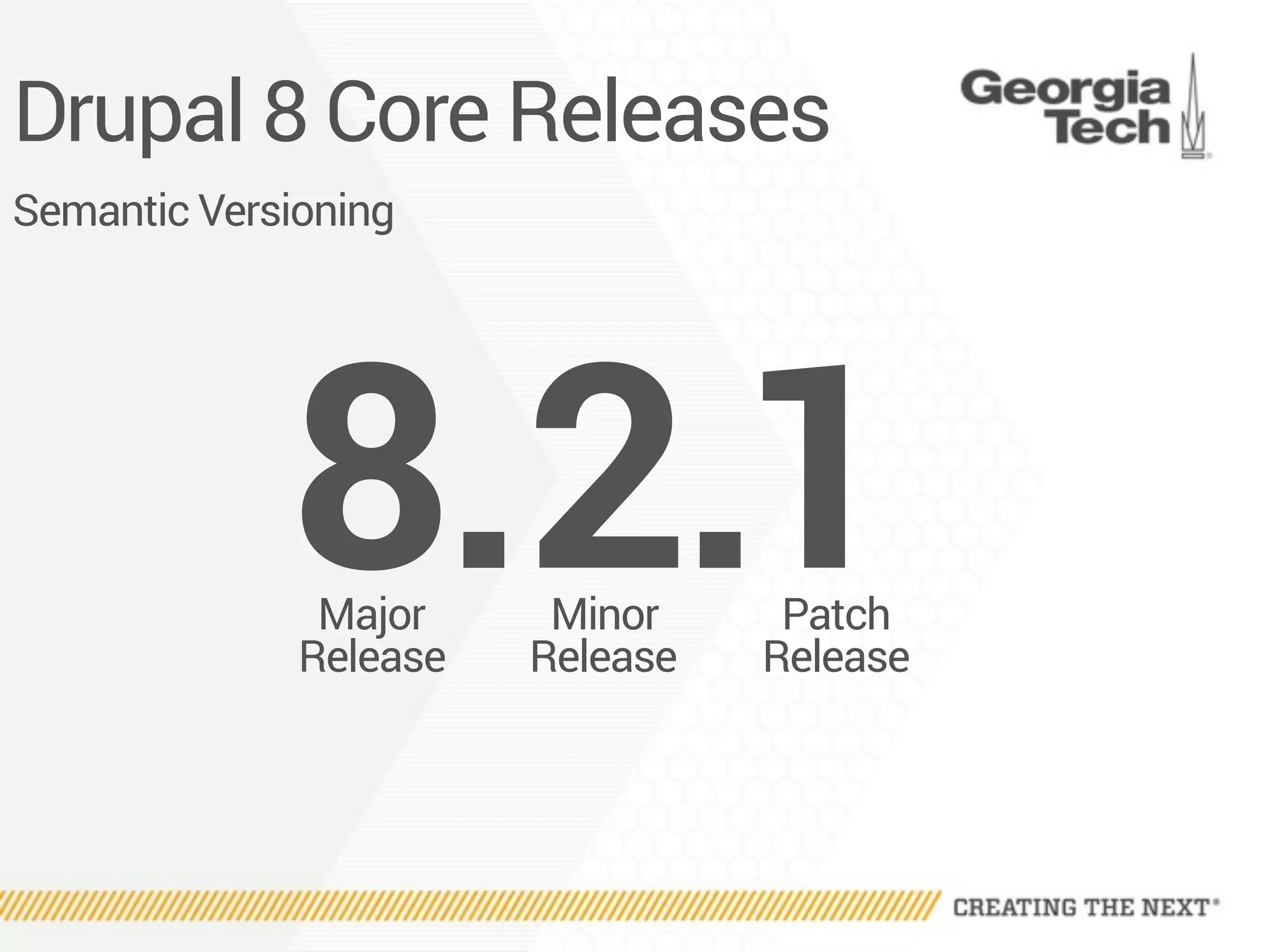
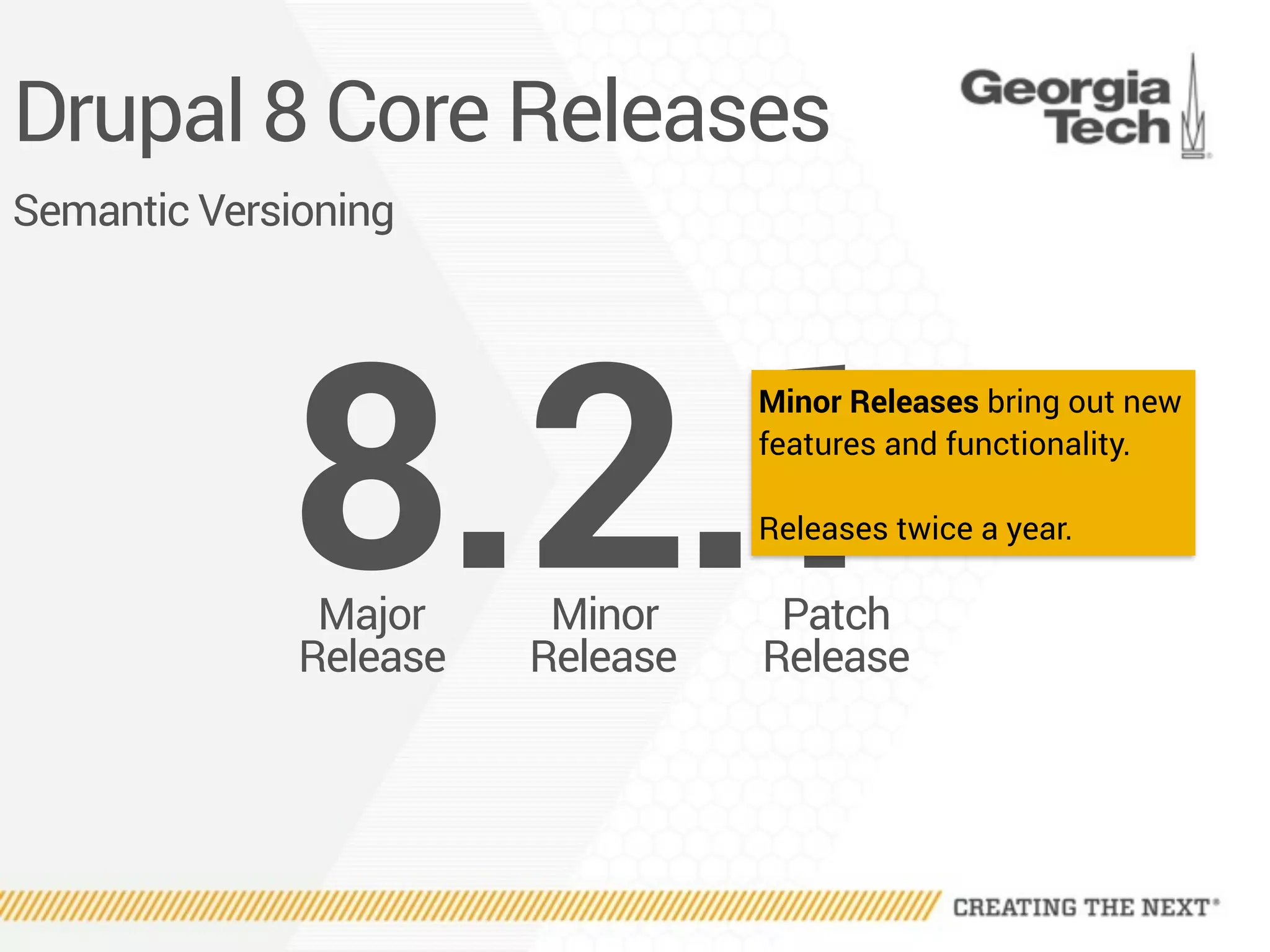
Drupal 8 Core Releases
Semantic Versioning
8.2.1Major 

Release
Minor
Release
Patch
Release
Drupal 8 Core Releases
Semantic Versioning
8.2.1Major 

Release
Minor
Release
Patch
Release
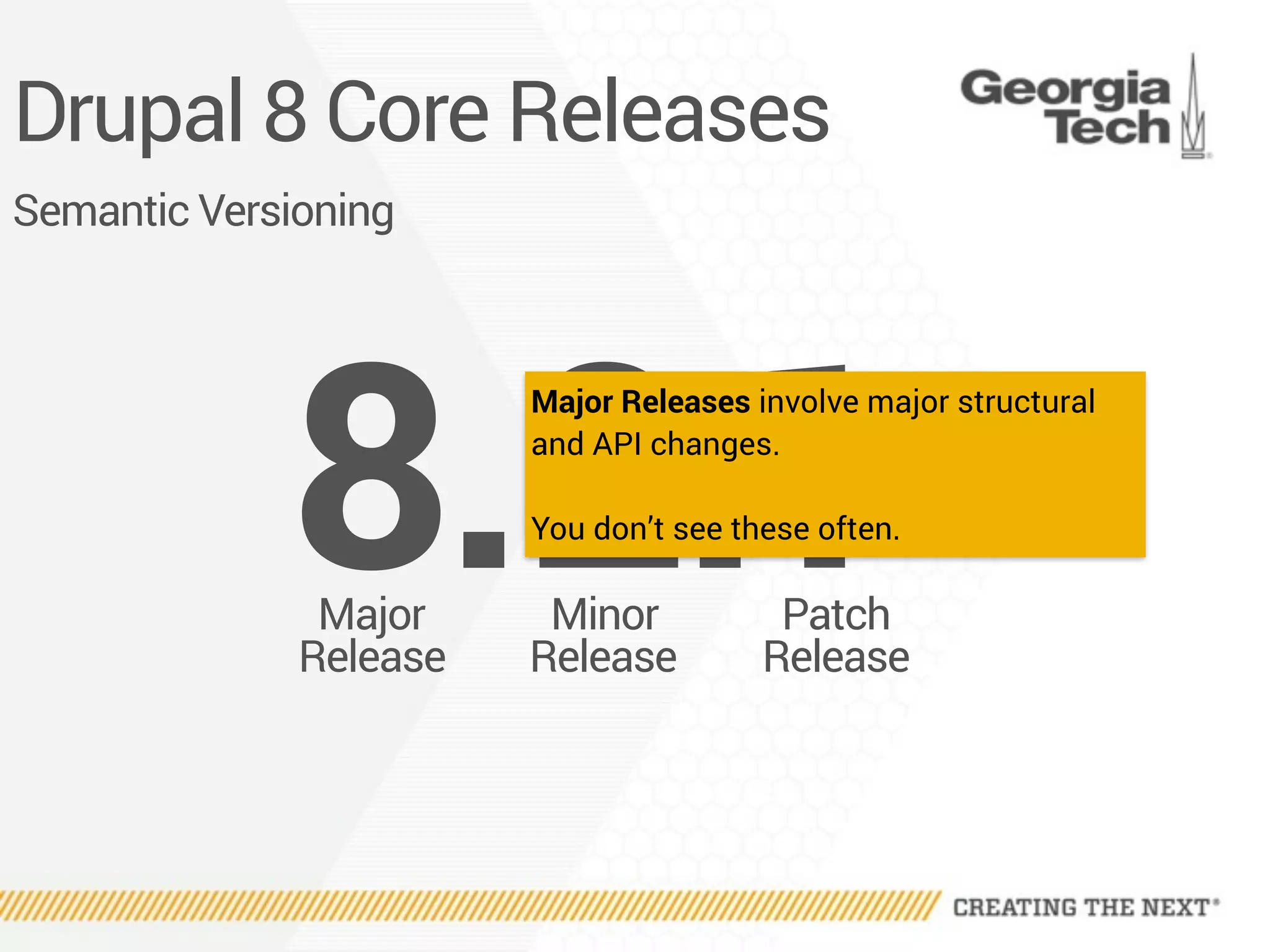
Major Releases involve major structural
and API changes.
You don’t see these often.
Drupal 8 Core Releases
Semantic Versioning
8.2.1Major 

Release
Minor
Release
Patch
Release
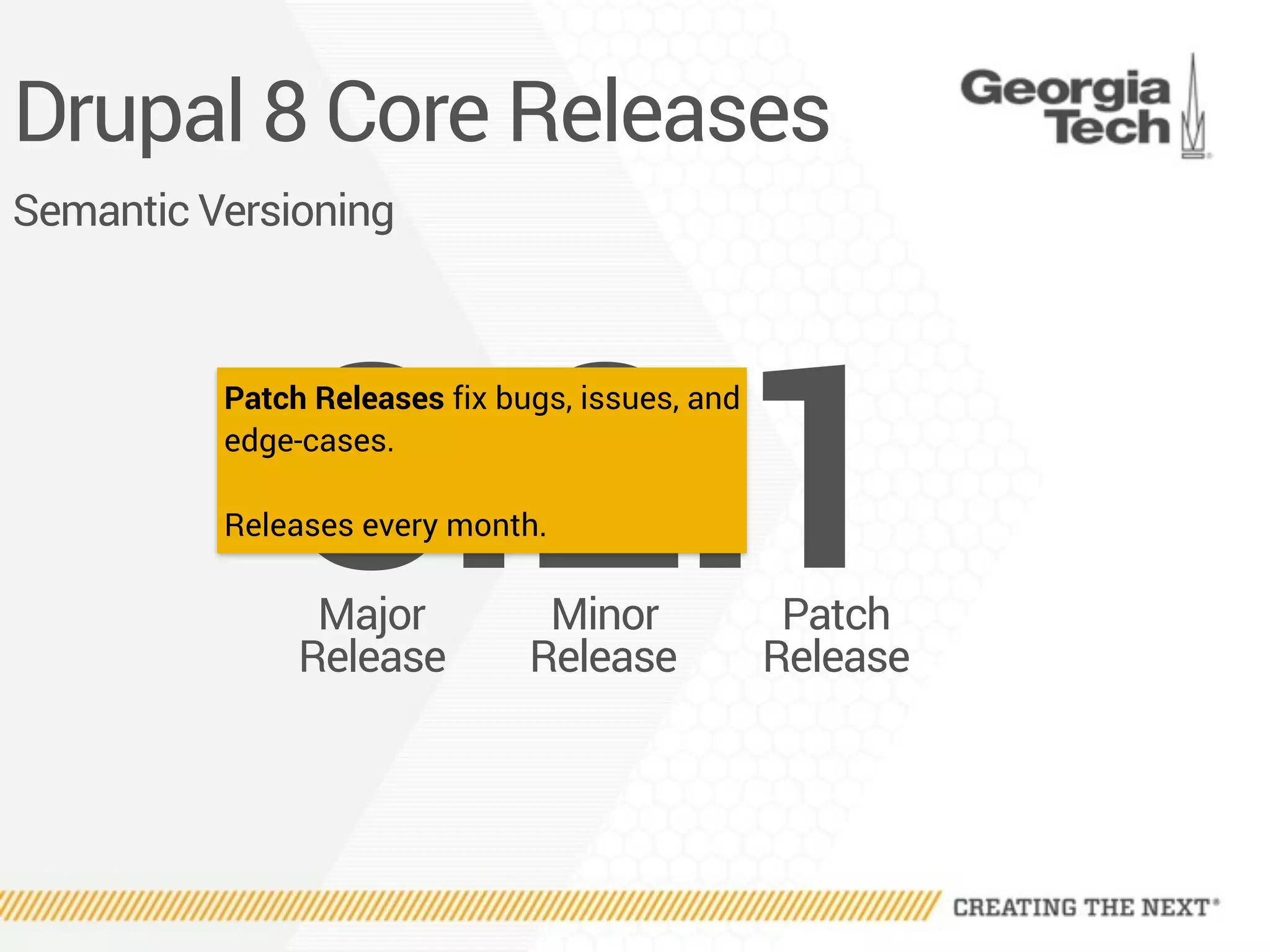
Minor Releases bring out new
features and functionality.
Releases twice a year.
Drupal 8 Core Releases
Semantic Versioning
8.2.1Major 

Release
Minor
Release
Patch
Release
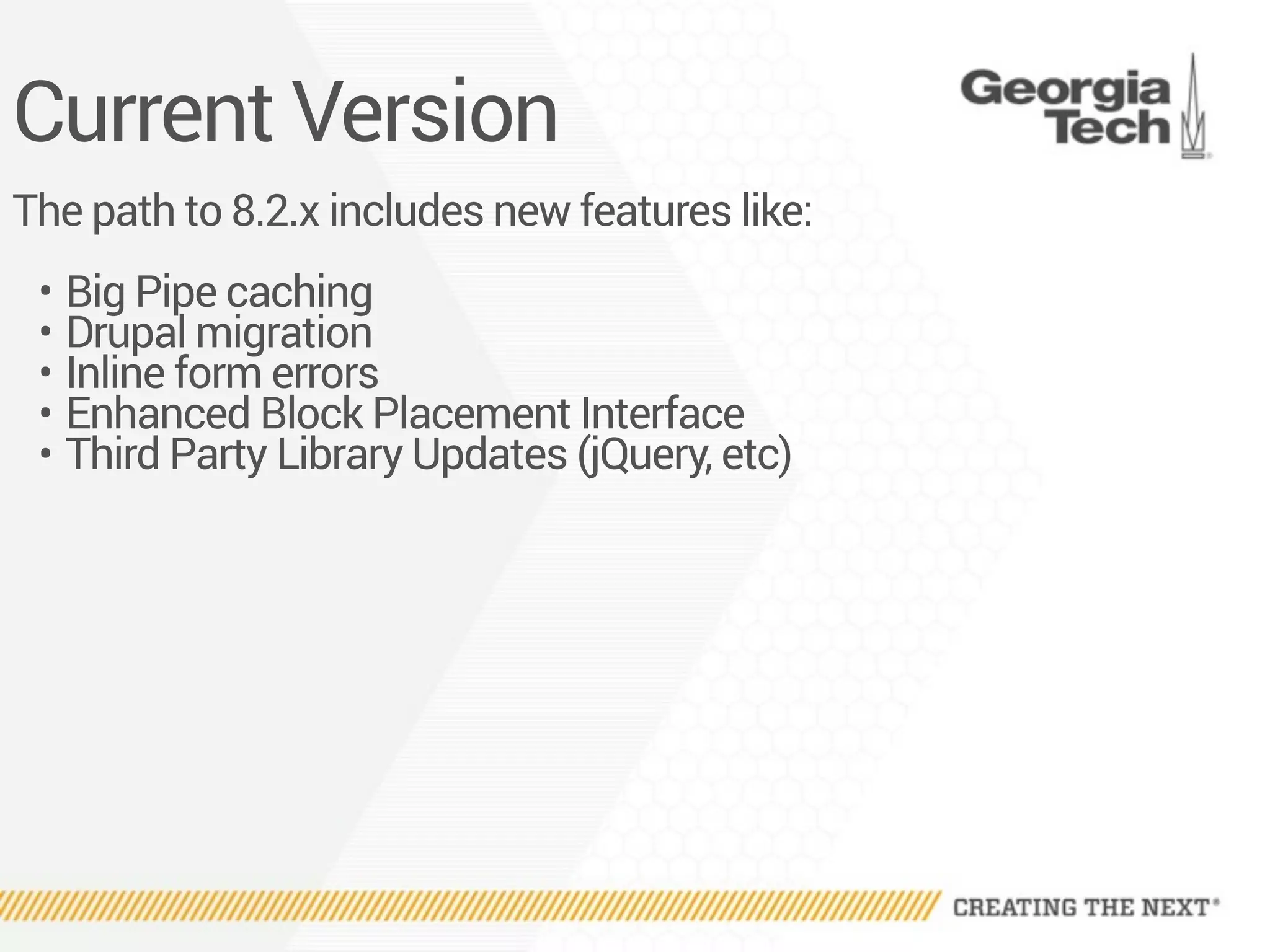
Patch Releases fix bugs, issues, and
edge-cases.
Releases every month.
Current Version
The path to 8.2.x includes new features like:
• Big Pipe caching
• Drupal migration
• Inline form errors
• Enhanced Block Placement Interface
• Third Party Library Updates (jQuery, etc)
BigPipe
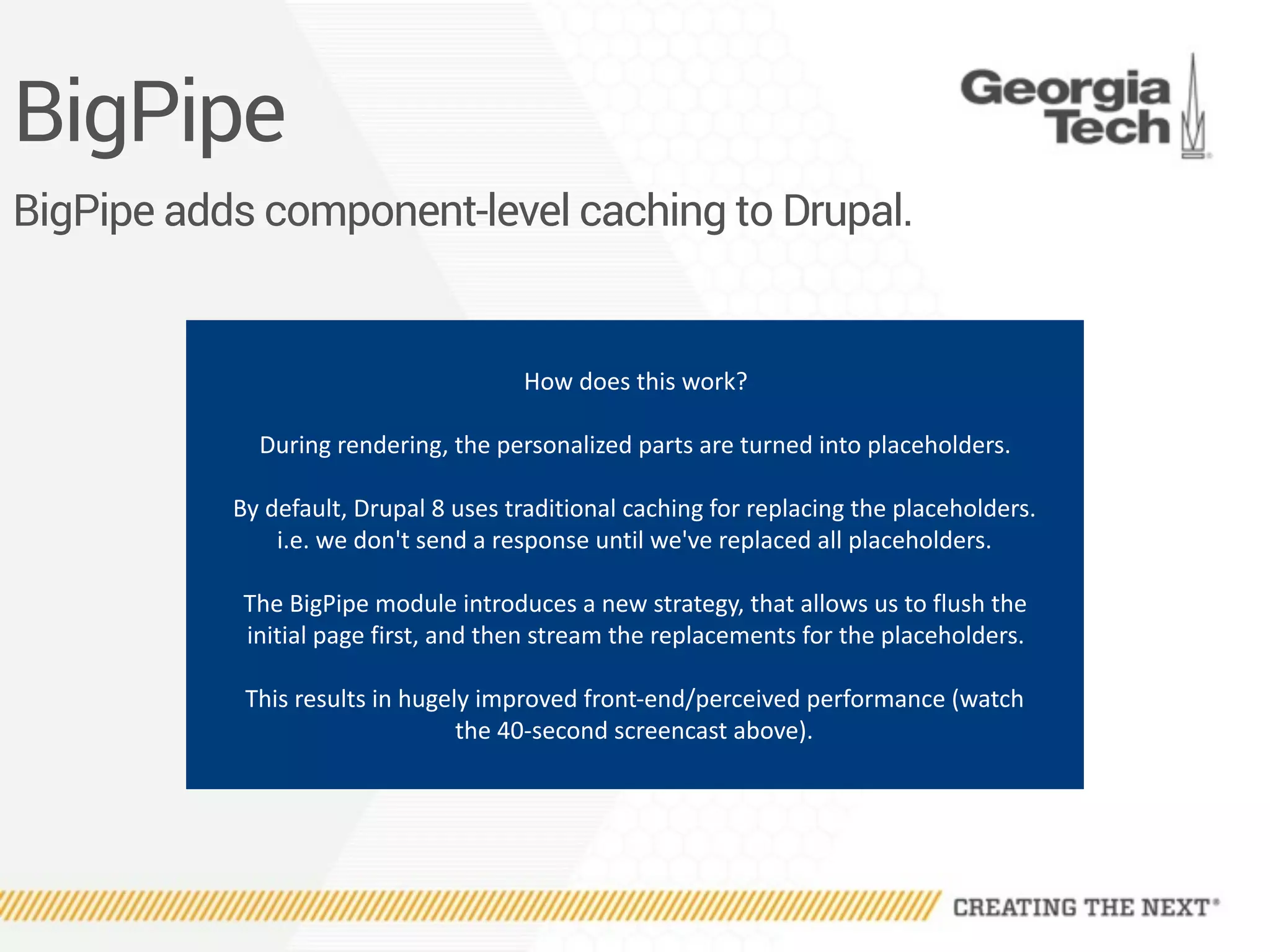
BigPipe adds component-level caching to Drupal.
How	does	this	work?	
During	rendering,	the	personalized	parts	are	turned	into	placeholders.	
By	default,	Drupal	8	uses	traditional	caching	for	replacing	the	placeholders.	
i.e.	we	don't	send	a	response	until	we've	replaced	all	placeholders.	
The	BigPipe	module	introduces	a	new	strategy,	that	allows	us	to	flush	the	
initial	page	first,	and	then	stream	the	replacements	for	the	placeholders.	
This	results	in	hugely	improved	front-end/perceived	performance	(watch	
the	40-second	screencast	above).
Third Party Support
Drupal 8 wholly supports third party libraries, with
the intent to make Drupal more flexible to web
trends and changes.
Making up Drupal 7’s ‘jQuery Update’ snafu.
• Symfony (module development)
• Twig (theme development)
• jQuery
Symfony
Symfony is a PHP framework of reusable
components to which Drupal 8 is built off of.
An ideal platform for creating products (not
websites).
Headless Drupal applications can now be a
reality with Symfony.
Twig
A template engine for PHP leveraged by the
Symfony framework.
Intended to mesh seamlessly with Drupal 8’s
Symfony backend.
Proposed to be cleaner code and structure than
PHPTemplate.
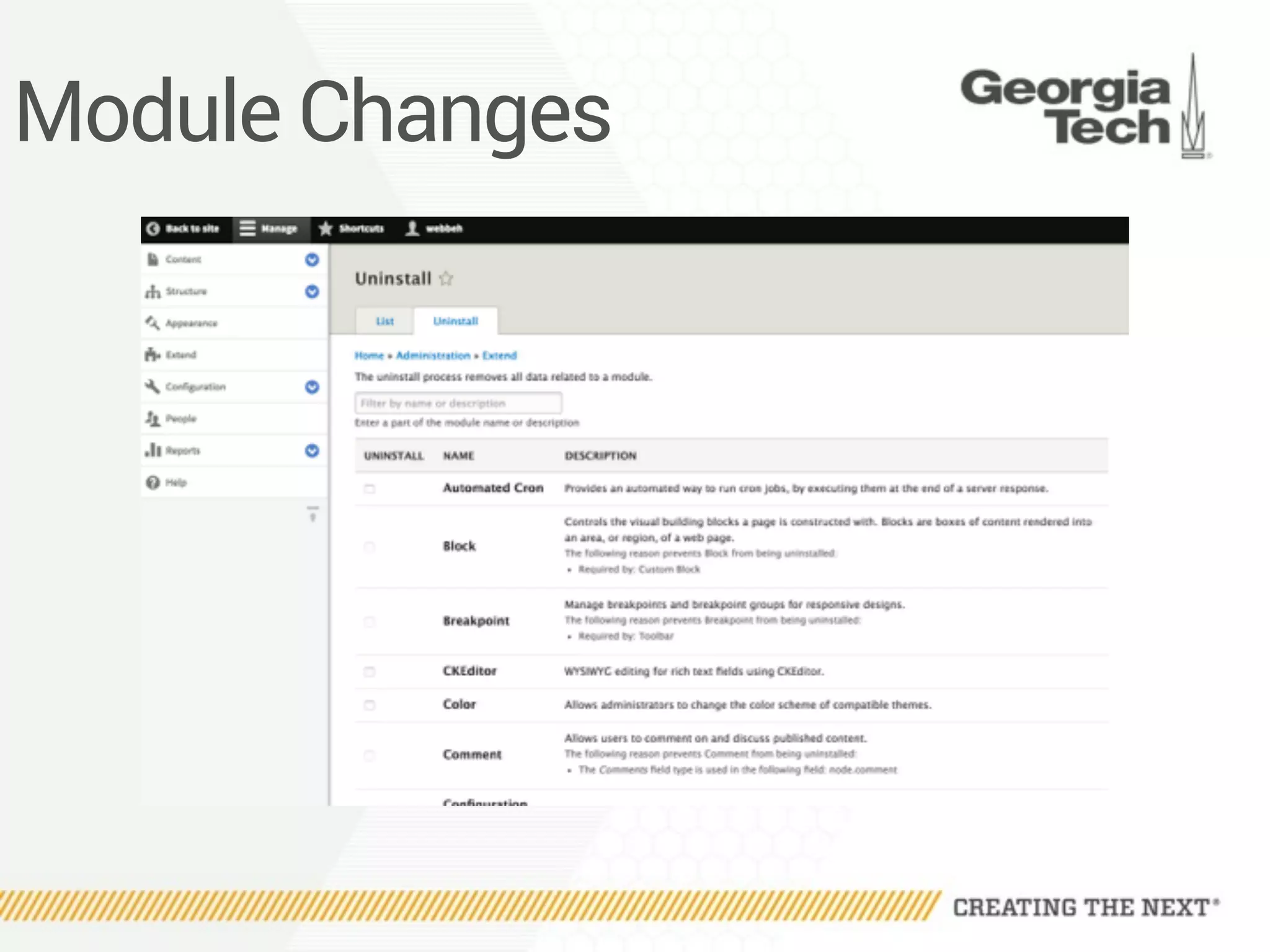
Module Changes
Overall, modules look and act the same as they
did in Drupal 7.
The only major change is in Uninstallation.
Module Changes
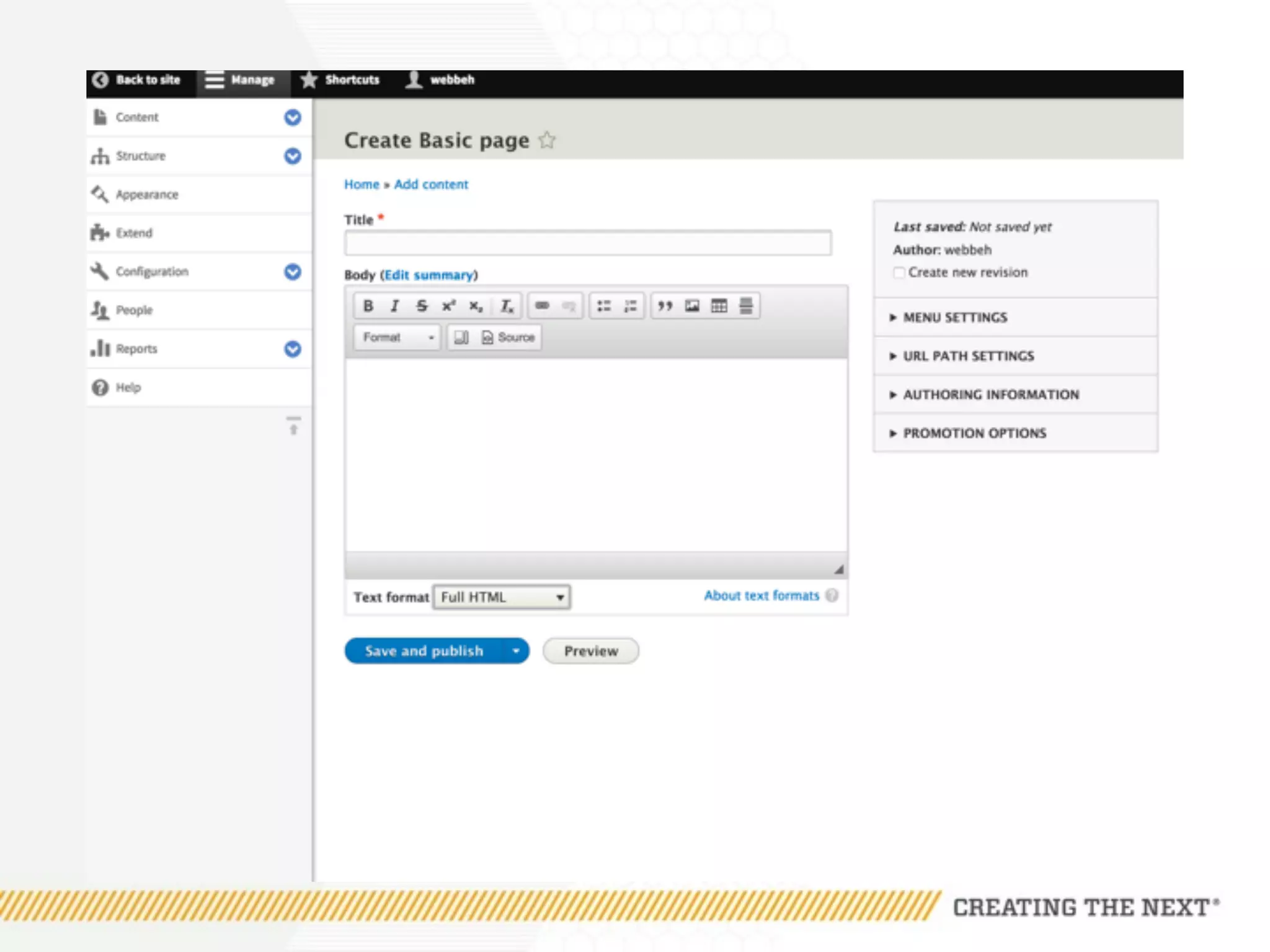
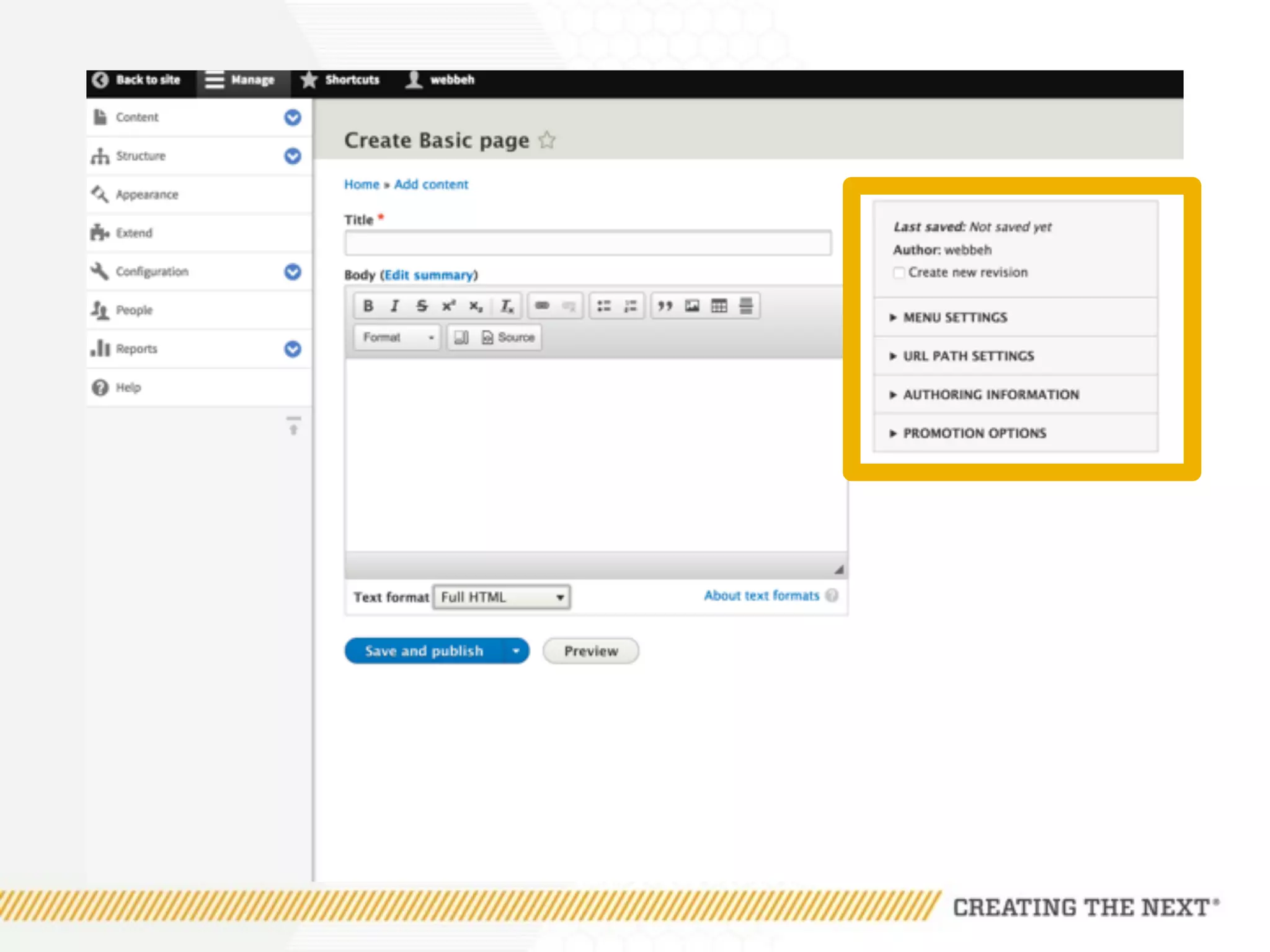
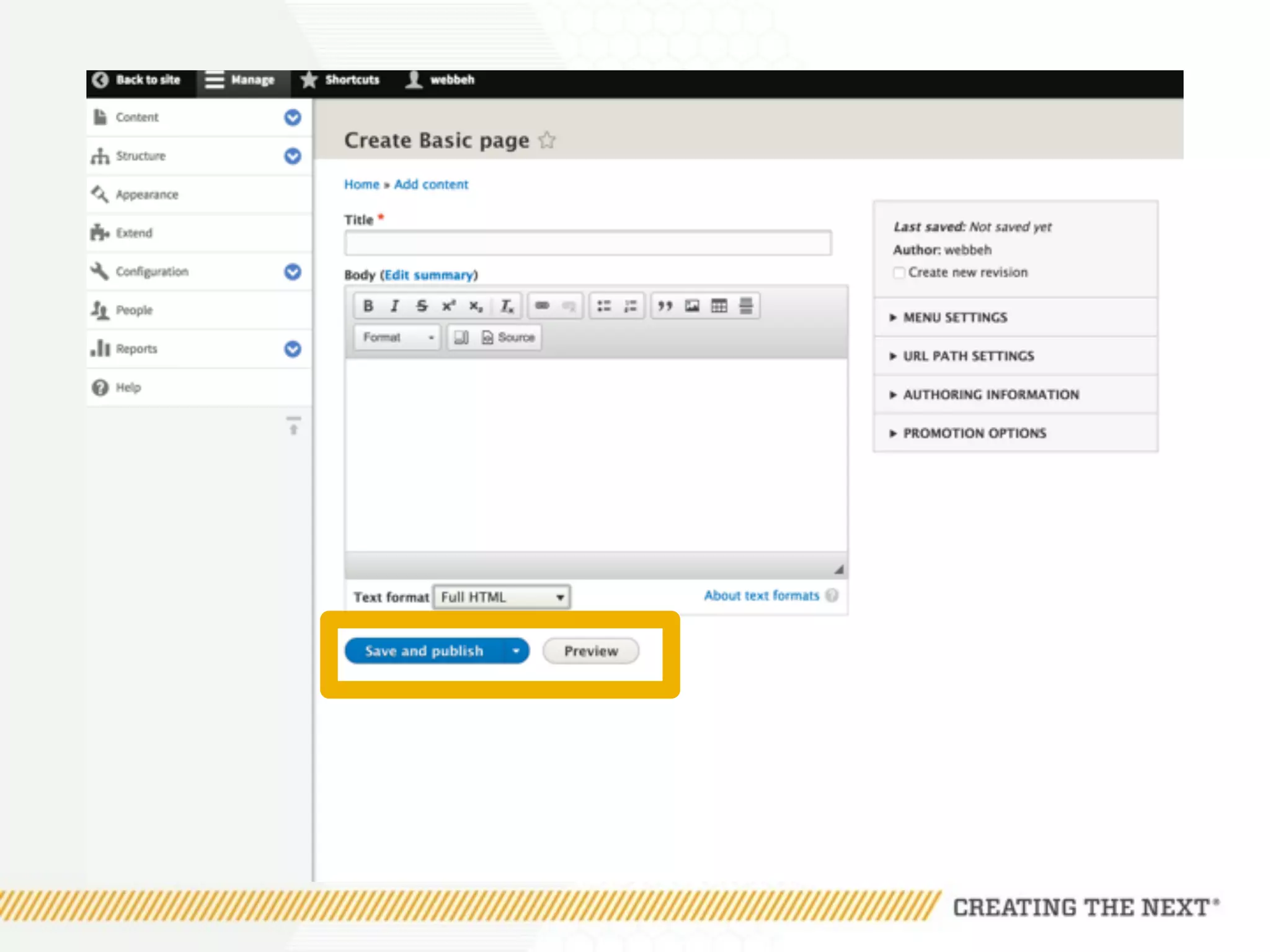
The Content 

Editing 

Experience
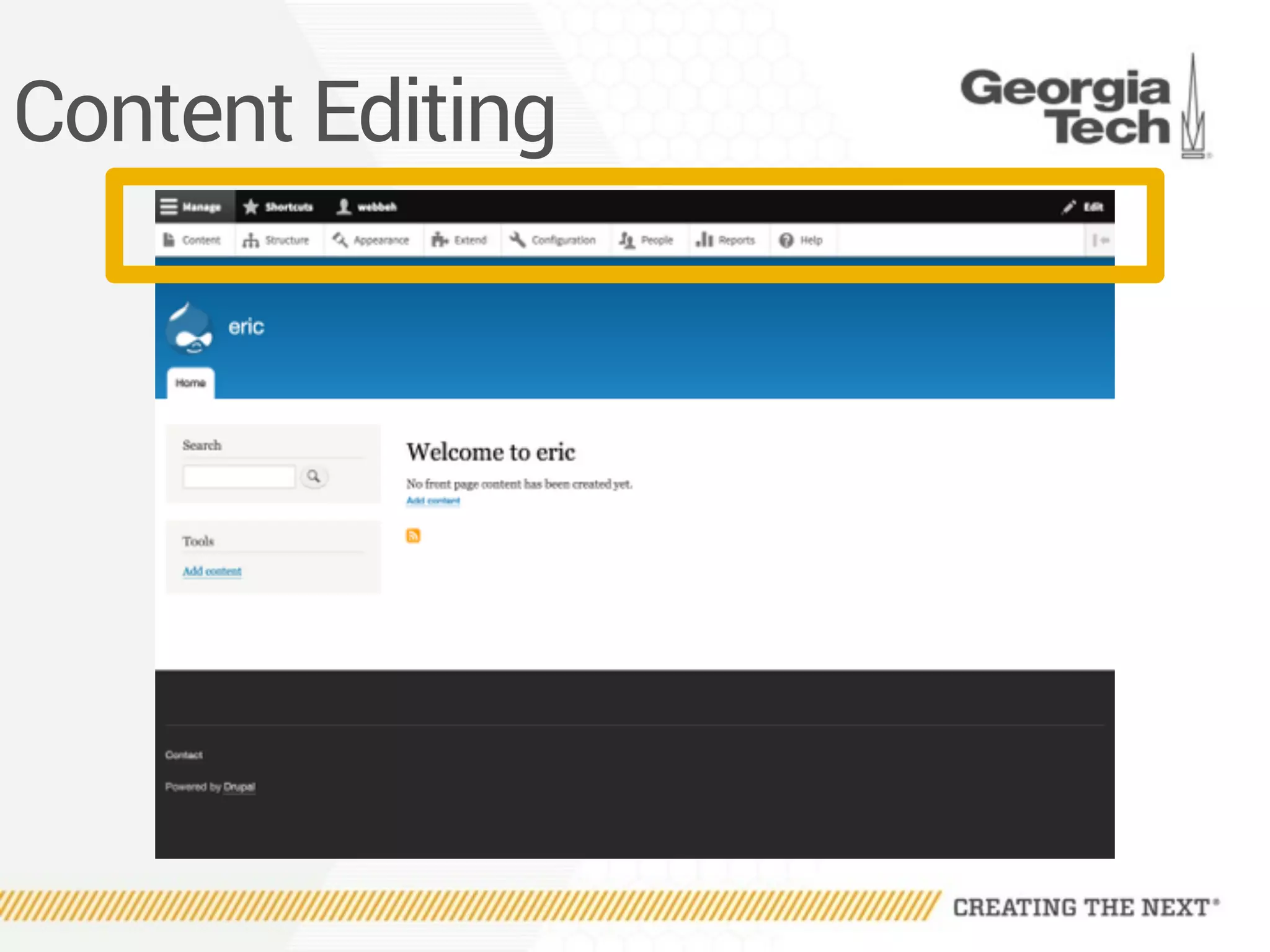
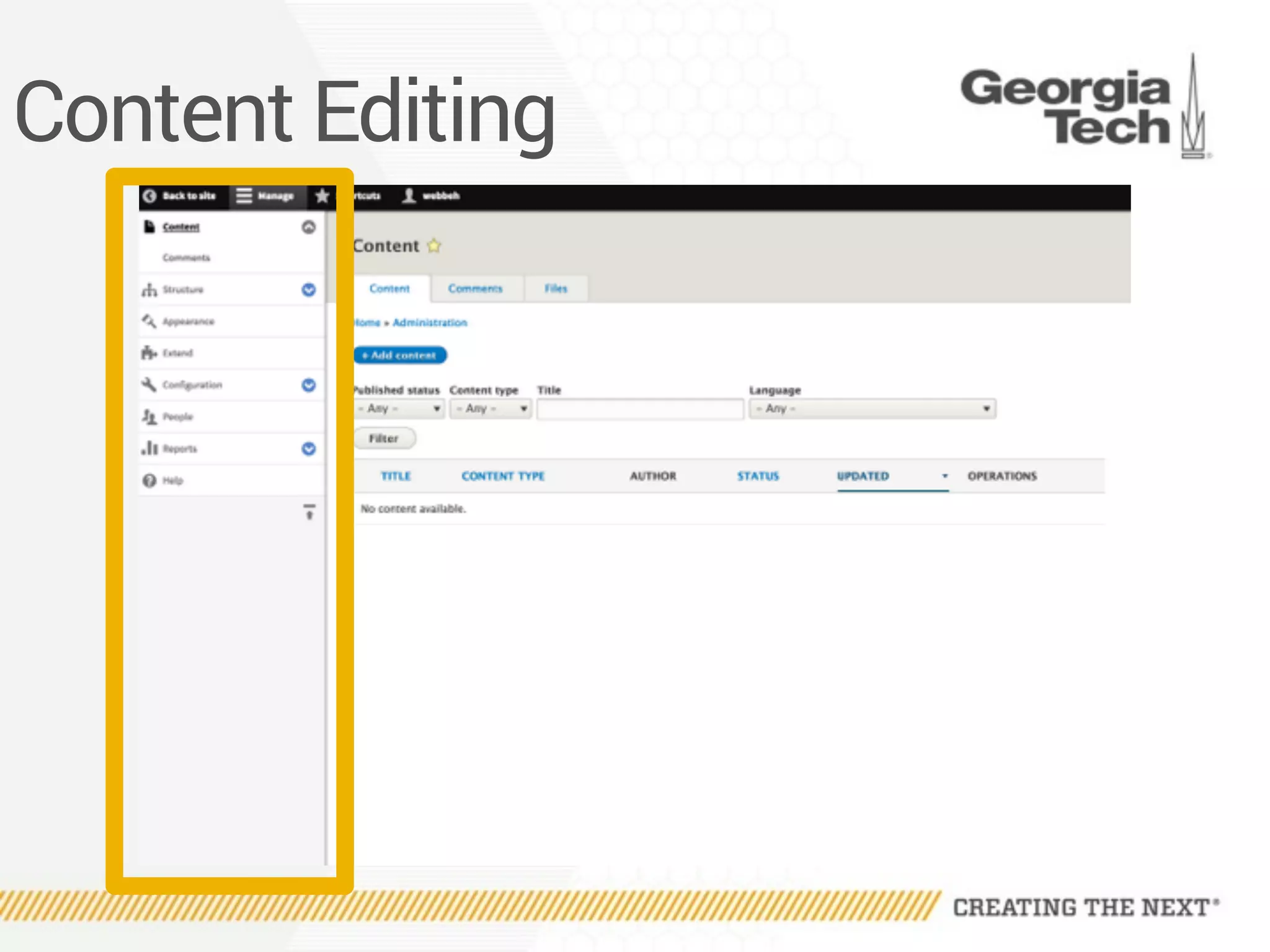
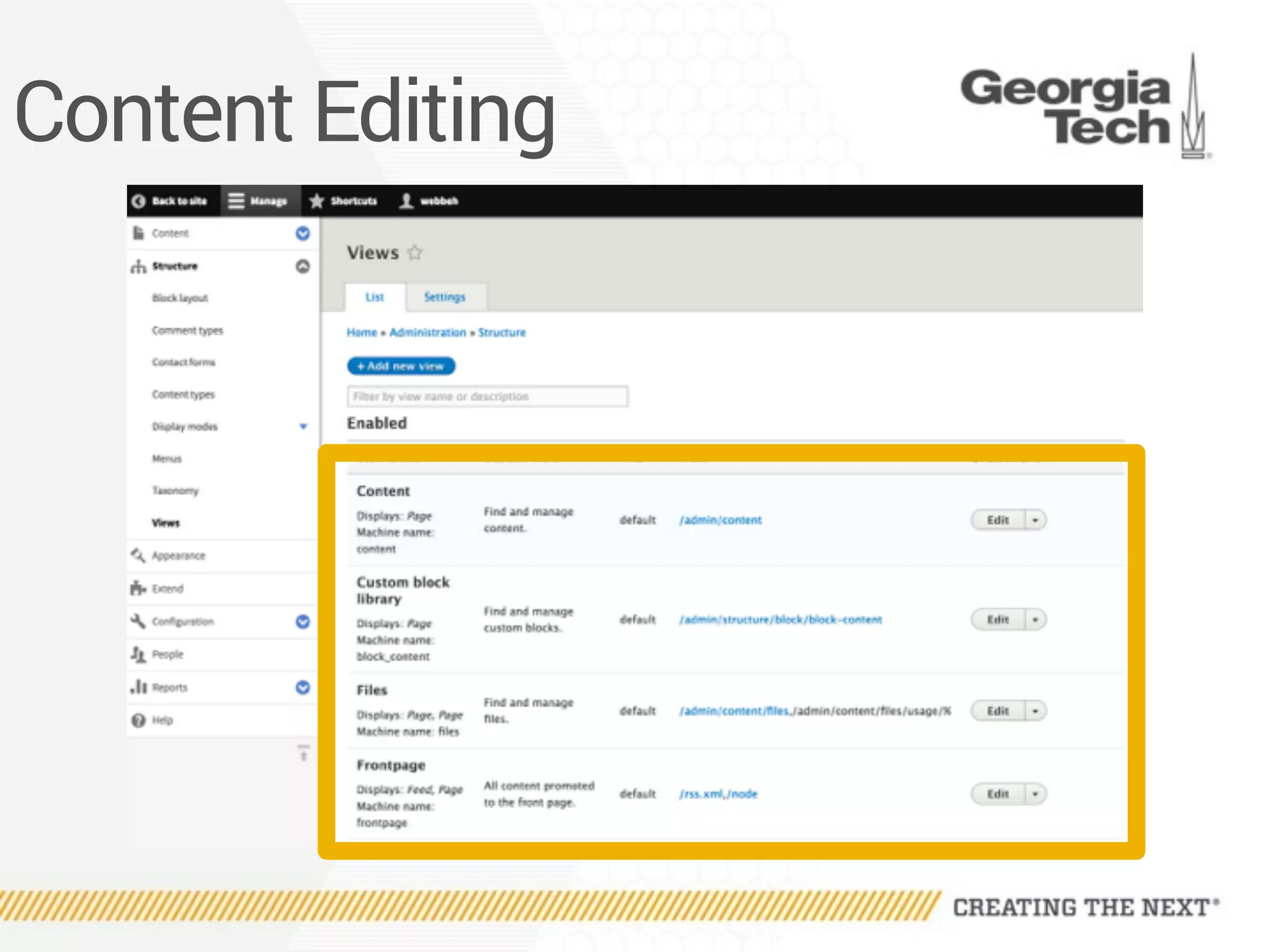
Content Editing
Content Editing
Content Editing
Content Editing
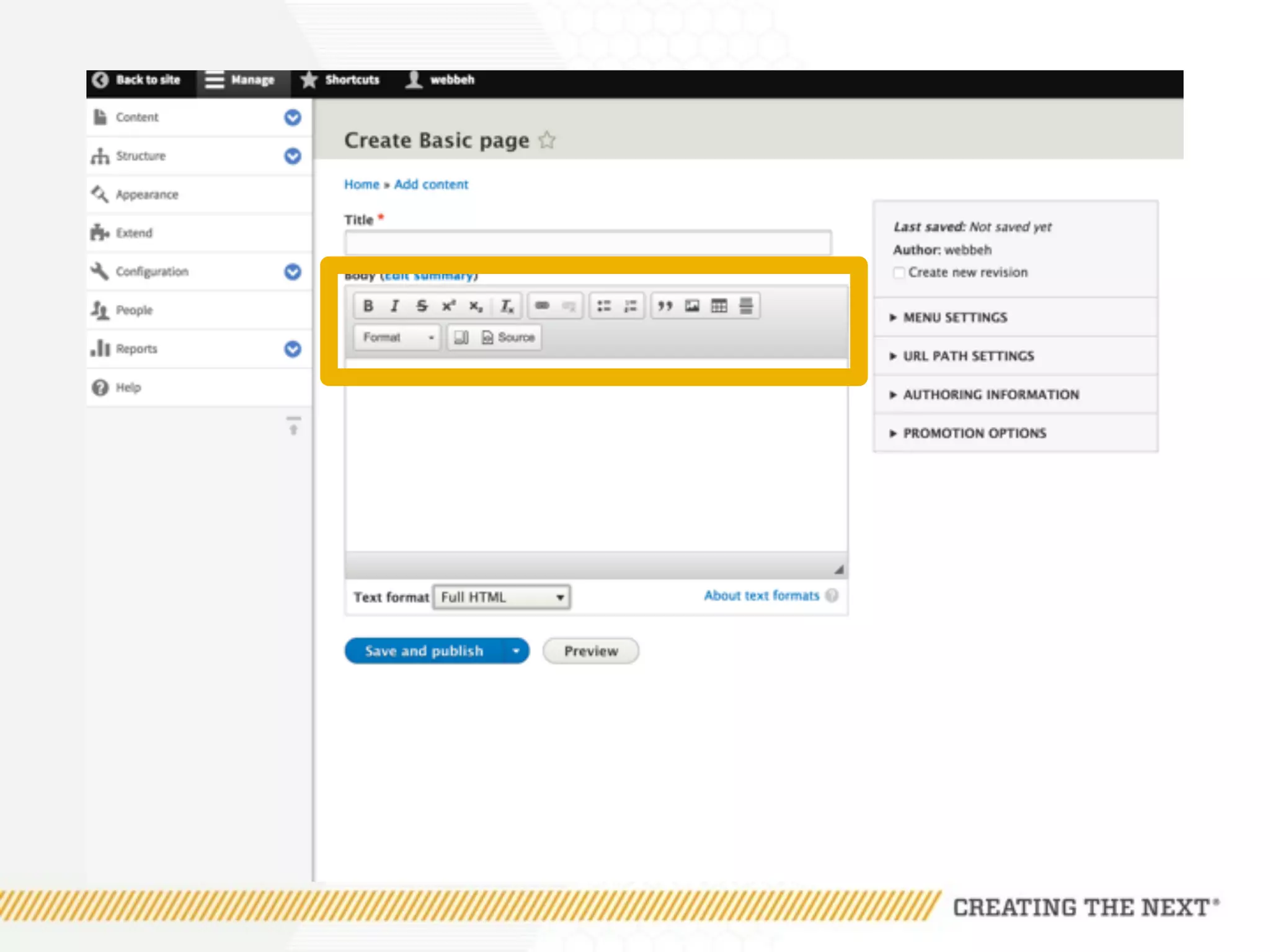
Enter:
WYSIWYG
CKEditor
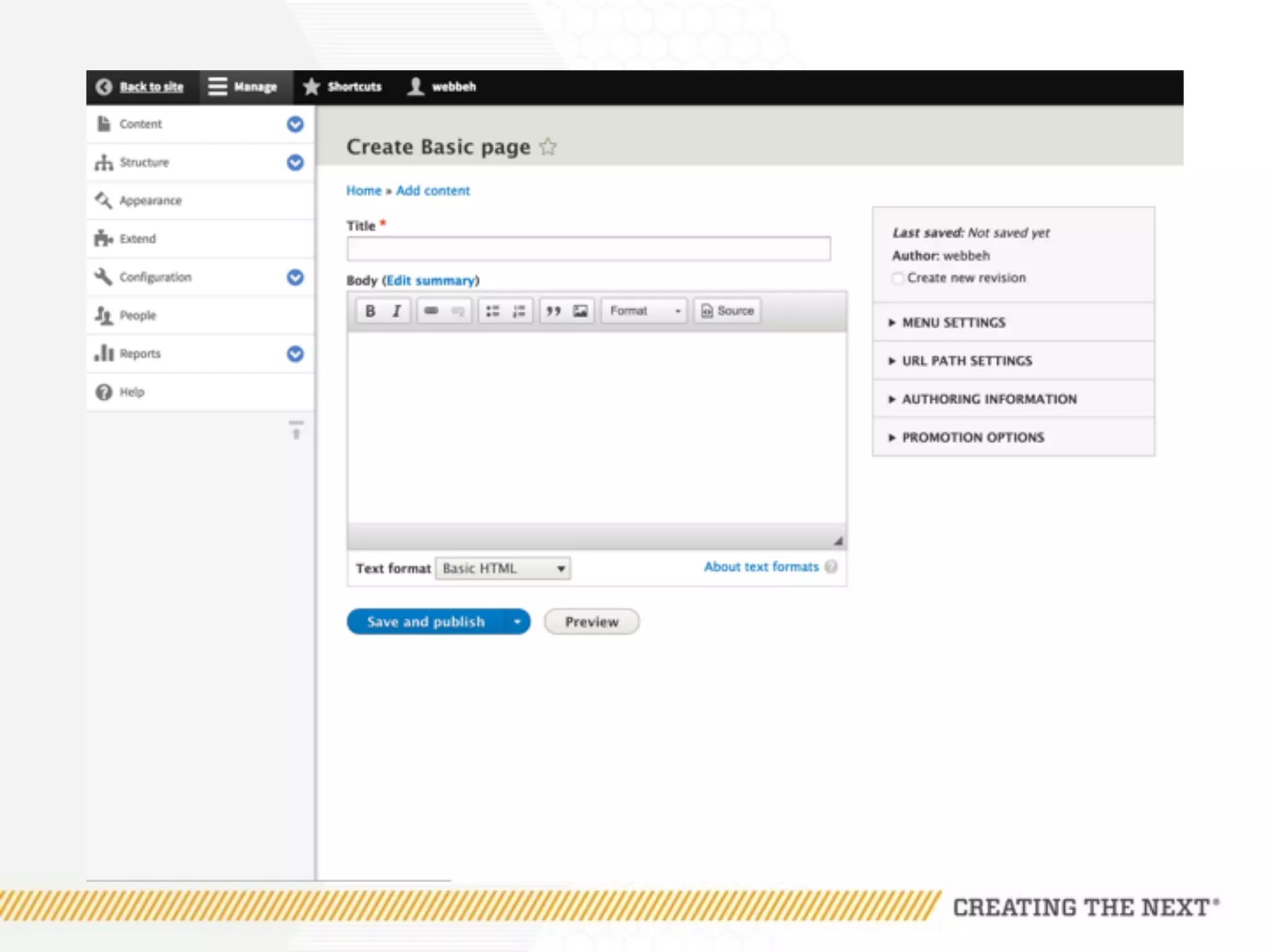
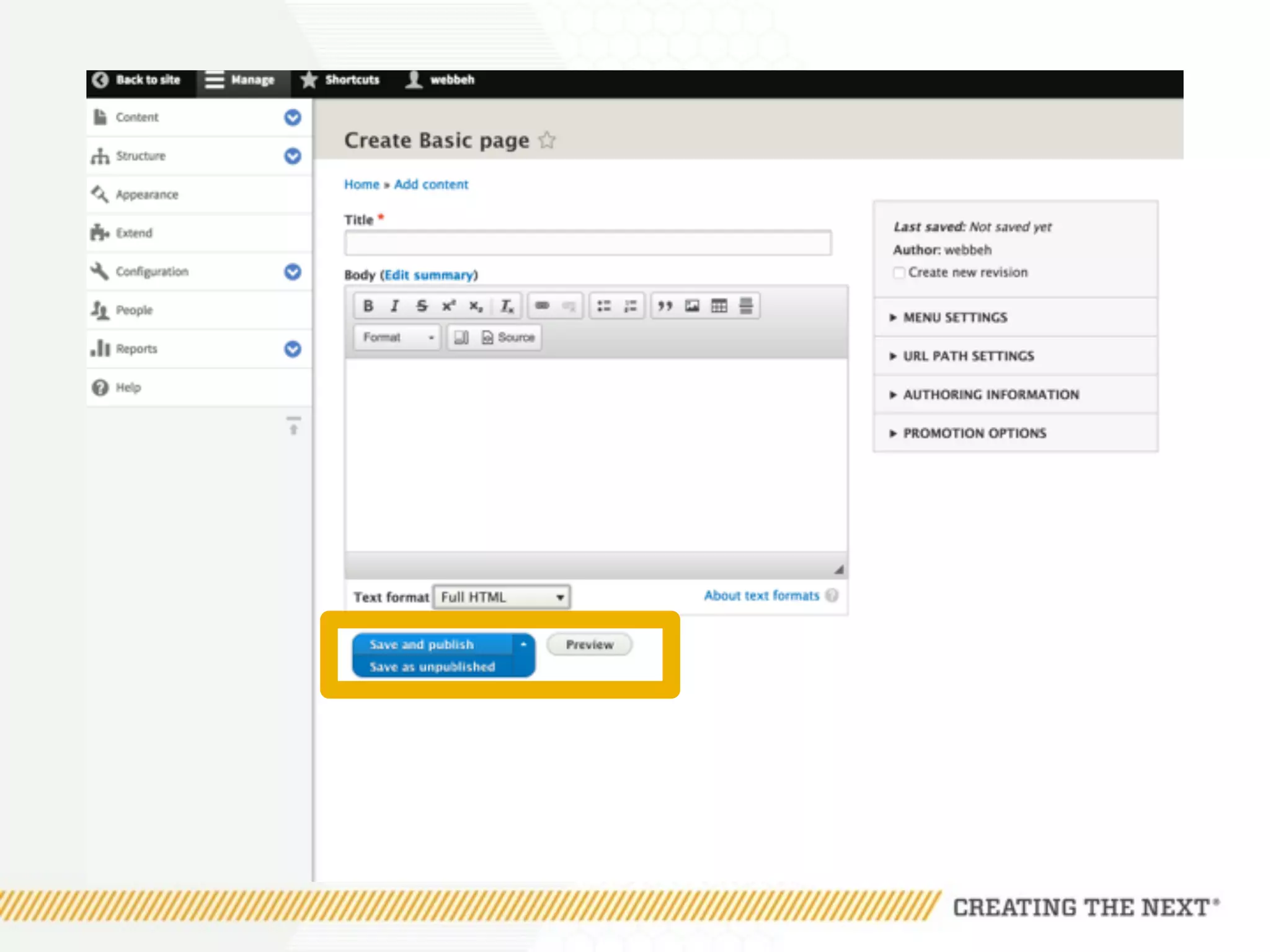
Drupal has a WYSIWYG
Drupal 8 finally comes pre-installed with a
WYSIWYG text-editor.
CKeditor is the chosen default editor.
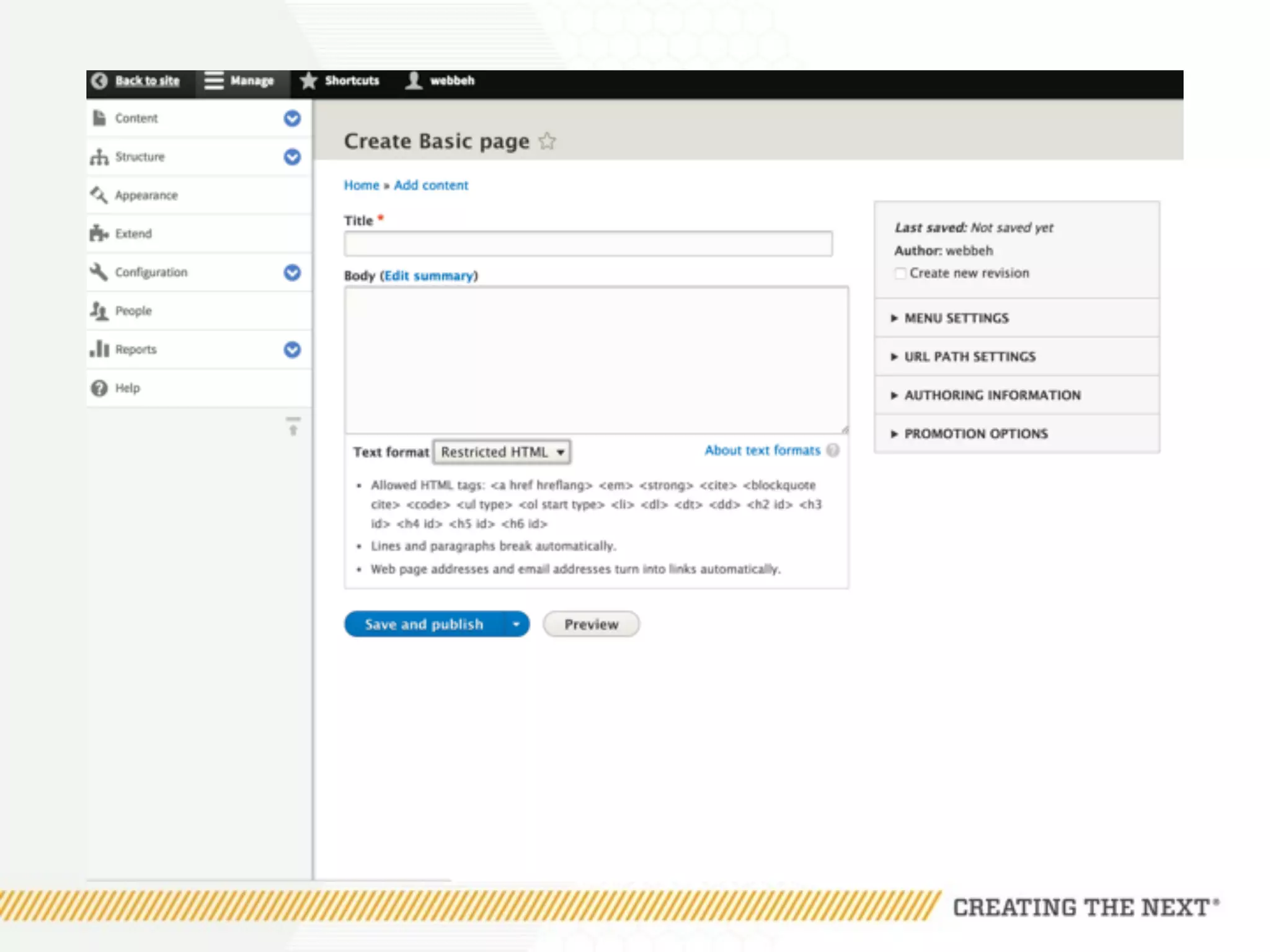
Still Drupal
If you’re expecting Drupal to act more like
WordPress out of the box, Drupal 8 isn’t there yet.
However, Drupal is making strides in making the
editor experience less-tedious out-of-the-box.
Module
Migration
Strategy
Introduction to the Tool
Drupal 8 no longer supports in-place major
upgrades. Instead, a Migrate tool is provided to
import content and settings from a Drupal 6 or 7
website.
Migrate is still experimental as of Drupal 8.2 - it's
usable, but may not copy everything you want or
exaclty the way you'd like things copied
Tool: Preparation
Clone your D7 database to your D8 server. Optionally clone the
filesystem as well.
Install a fresh copy of Drupal 8, but do not configure anything
yet!
Install and enable all modules used on the D7 site that have D8
equivalents. Do not configure any of these modules!
Enable all three Migrate modules (found under CORE -
EXPERIMENTAL): Migrate, Migrate - Drupal, Migrate - Drupal UI
Tool: Operation
Inobvious Steps:
Make sure you are logged in as user #1 (other accounts, even
w/admin, do not work)
Navigate to /upgrade on your Drupal 8 site
Tool: Operation
Enter mySQL DB username and password that can access your
D7 database
Enter local or remote path to your D7 filesystem
Review upgrade paths available - these can't be changed here;
determined by modules enabled
If all looks good, start the migration process, then go get a cup
of coffee (or two or three ...)
Tool: Limitations
Some specific migration paths that aren't available yet:
Views (Hopefully coming in 8.3.x)
Books (Status unknown)
You can bring in your book nodes, but none of the hierarchy
configuration
Blogs (Module is now contrib; status unknown)
PHP Code text filter (Why are you still using this??? ;-)
API: Changes
Much harder for module maintainer to port modules to D8.
Even today, some popular modules still haven't been ported.
Webform - Alternates Available:
Contact Storage: https://www.drupal.org/project/
contact_storage (Plus Field Group, CSV Serialization, Markup,
Field Validation, Contact Storage Export)
YAML Form: https://www.drupal.org/project/yamlform
API: Changes
Ported modules do not always have same features as D7
versions
Be aware that some modules have new names
Administration Menu (admin_menu) -> Admin Toolbar
(admin_toolbar)
Many Drupal 7 modules may never be ported
Custom modules must be rewritten to work with Drupal 8
Module Migration Planning
Assess your D7 site's modules - make a spreadsheet and research each
one for D8 upgrade paths
No direct path available? Determine if the module can simply be
discarded. If not:
• Port it yourself (you'll need some good PHP coding experience)
• Pay someone to port it (you'll need $$$)
• Find an alternative module that does roughly the same thing (you
may lose data or have to manually migrate your data).
No easy solution, but for the future, avoid using modules that don't have
a solid history
Porting Your Custom Modules:
API Changes
Config files now written in YAML
Many hook_* API calls are gone
Blocks, filters, etc. are now written into autoloader class files
Plan on it taking a while to port a module to Drupal 8
Porting Your Custom Modules:
API Changes (Gotchas)
All output must be returned as a render array
Plain HTML can be sent as #markup, but is filtered to protect
against XSS vulnerabilities
May need to whitelist additional HTML tags and/or enable
additional URL protocols
• See http://webdev.iac.gatech.edu/drupal-8-migration for
details
Twig based rendering is recommended, but not required. Has
its own quirks.
Porting Themes
Themes use the Module API, so everything said above applies
to themes
Templating now done using the Twig language
May be easier to set up a subtheme of a core D8 theme and
then add your customizations to that subtheme
Questions?

October 2016 - USG Rock Eagle - Everything You Need to Know to Plan Your Drupal 8 Site Migration

  • 1.
    Everything You Needto Know to Plan Your Drupal 8 Site Migration Eric Sembrat
 Kevin Pittman
  • 2.
    Eric Scott Sembrat WebManager @ Georgia Tech Ph.D. Student @ Georgia State President @ Atlanta Drupal Users Group Founder @ USGweb twitter: @esembrat
 web: webbeh.com
  • 3.
    Kevin Pittman Senior WebDeveloper @ Georgia Tech email: webdev@iac.gatech.edu web: webdev.iac.gatech.edu
  • 4.
    And Now, For OurGoals Today
  • 5.
    A Few Assumptions Thispresentation assumes that you are familiar with a few things: • Drupal 7 architecture, common plugins, and best-practices. • Common content management system hierarchy and design. We will do our best to translate any tricky Drupalese down to something more universal.
  • 6.
    Our Goals Our primarygoals for today are: • Providing an introduction into Drupal 8’s major changes. • Providing information on how Drupal 7 content can be migrated to Drupal 8.
  • 7.
  • 8.
    It’s Drupal 8! Firstbig release in Drupal since 2011.
  • 9.
    Drupal 8 CoreReleases Semantic Versioning 8.2.1Major 
 Release Minor Release Patch Release
  • 10.
    Drupal 8 CoreReleases Semantic Versioning 8.2.1Major 
 Release Minor Release Patch Release Major Releases involve major structural and API changes. You don’t see these often.
  • 11.
    Drupal 8 CoreReleases Semantic Versioning 8.2.1Major 
 Release Minor Release Patch Release Minor Releases bring out new features and functionality. Releases twice a year.
  • 12.
    Drupal 8 CoreReleases Semantic Versioning 8.2.1Major 
 Release Minor Release Patch Release Patch Releases fix bugs, issues, and edge-cases. Releases every month.
  • 13.
    Current Version The pathto 8.2.x includes new features like: • Big Pipe caching • Drupal migration • Inline form errors • Enhanced Block Placement Interface • Third Party Library Updates (jQuery, etc)
  • 14.
    BigPipe BigPipe adds component-levelcaching to Drupal. How does this work? During rendering, the personalized parts are turned into placeholders. By default, Drupal 8 uses traditional caching for replacing the placeholders. i.e. we don't send a response until we've replaced all placeholders. The BigPipe module introduces a new strategy, that allows us to flush the initial page first, and then stream the replacements for the placeholders. This results in hugely improved front-end/perceived performance (watch the 40-second screencast above).
  • 15.
    Third Party Support Drupal8 wholly supports third party libraries, with the intent to make Drupal more flexible to web trends and changes. Making up Drupal 7’s ‘jQuery Update’ snafu. • Symfony (module development) • Twig (theme development) • jQuery
  • 16.
    Symfony Symfony is aPHP framework of reusable components to which Drupal 8 is built off of. An ideal platform for creating products (not websites). Headless Drupal applications can now be a reality with Symfony.
  • 17.
    Twig A template enginefor PHP leveraged by the Symfony framework. Intended to mesh seamlessly with Drupal 8’s Symfony backend. Proposed to be cleaner code and structure than PHPTemplate.
  • 18.
    Module Changes Overall, moduleslook and act the same as they did in Drupal 7. The only major change is in Uninstallation.
  • 19.
  • 20.
  • 21.
  • 22.
  • 23.
  • 24.
  • 25.
  • 26.
    Drupal has aWYSIWYG Drupal 8 finally comes pre-installed with a WYSIWYG text-editor. CKeditor is the chosen default editor.
  • 34.
    Still Drupal If you’reexpecting Drupal to act more like WordPress out of the box, Drupal 8 isn’t there yet. However, Drupal is making strides in making the editor experience less-tedious out-of-the-box.
  • 35.
  • 36.
    Introduction to theTool Drupal 8 no longer supports in-place major upgrades. Instead, a Migrate tool is provided to import content and settings from a Drupal 6 or 7 website. Migrate is still experimental as of Drupal 8.2 - it's usable, but may not copy everything you want or exaclty the way you'd like things copied
  • 37.
    Tool: Preparation Clone yourD7 database to your D8 server. Optionally clone the filesystem as well. Install a fresh copy of Drupal 8, but do not configure anything yet! Install and enable all modules used on the D7 site that have D8 equivalents. Do not configure any of these modules! Enable all three Migrate modules (found under CORE - EXPERIMENTAL): Migrate, Migrate - Drupal, Migrate - Drupal UI
  • 38.
    Tool: Operation Inobvious Steps: Makesure you are logged in as user #1 (other accounts, even w/admin, do not work) Navigate to /upgrade on your Drupal 8 site
  • 39.
    Tool: Operation Enter mySQLDB username and password that can access your D7 database Enter local or remote path to your D7 filesystem Review upgrade paths available - these can't be changed here; determined by modules enabled If all looks good, start the migration process, then go get a cup of coffee (or two or three ...)
  • 40.
    Tool: Limitations Some specificmigration paths that aren't available yet: Views (Hopefully coming in 8.3.x) Books (Status unknown) You can bring in your book nodes, but none of the hierarchy configuration Blogs (Module is now contrib; status unknown) PHP Code text filter (Why are you still using this??? ;-)
  • 41.
    API: Changes Much harderfor module maintainer to port modules to D8. Even today, some popular modules still haven't been ported. Webform - Alternates Available: Contact Storage: https://www.drupal.org/project/ contact_storage (Plus Field Group, CSV Serialization, Markup, Field Validation, Contact Storage Export) YAML Form: https://www.drupal.org/project/yamlform
  • 42.
    API: Changes Ported modulesdo not always have same features as D7 versions Be aware that some modules have new names Administration Menu (admin_menu) -> Admin Toolbar (admin_toolbar) Many Drupal 7 modules may never be ported Custom modules must be rewritten to work with Drupal 8
  • 43.
    Module Migration Planning Assessyour D7 site's modules - make a spreadsheet and research each one for D8 upgrade paths No direct path available? Determine if the module can simply be discarded. If not: • Port it yourself (you'll need some good PHP coding experience) • Pay someone to port it (you'll need $$$) • Find an alternative module that does roughly the same thing (you may lose data or have to manually migrate your data). No easy solution, but for the future, avoid using modules that don't have a solid history
  • 44.
    Porting Your CustomModules: API Changes Config files now written in YAML Many hook_* API calls are gone Blocks, filters, etc. are now written into autoloader class files Plan on it taking a while to port a module to Drupal 8
  • 45.
    Porting Your CustomModules: API Changes (Gotchas) All output must be returned as a render array Plain HTML can be sent as #markup, but is filtered to protect against XSS vulnerabilities May need to whitelist additional HTML tags and/or enable additional URL protocols • See http://webdev.iac.gatech.edu/drupal-8-migration for details Twig based rendering is recommended, but not required. Has its own quirks.
  • 46.
    Porting Themes Themes usethe Module API, so everything said above applies to themes Templating now done using the Twig language May be easier to set up a subtheme of a core D8 theme and then add your customizations to that subtheme
  • 47.