Users and geo
 R a f f i K r i k o r i a n
          @ r a f f i
Talk ing about user  s and geo with
@t hinkvitamin in t he Geolocation
Onlin  e Conference!
13 Jan via Twitter for iPhone


  from Twitter Headquarters
  795 Folsom Street
  San Francisco, CA
   View Tweets at this place
Who am I?

Engineering Manager of the Twitter Platform Services team

Built the original geo services on the @twitterapi

 Coordinate support for Tweets

 Built initial implementation of Rockdove at Twitter - our
 locations database
What are we going to talk
         about?

Take a look at some geo enabled applications

Try to understand the implicit “here”

What is location privacy? How does sharing work?

What are some opportunities in the geo space?
What are we going to talk
         about?

Take a look at some geo enabled applications

Try to understand the implicit “here”

What is location privacy? How does sharing work?

What are some opportunities in the geo space?
         PLEASE INTERRUPT ME WITH
               QUESTIONS!!!!
People want to talk
about where they are
People want to
discover what’s
  around them
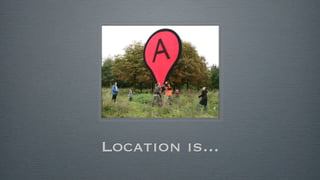
Location is...

Location is context
  and Relevancy
Location is globally
  applicable, but
 locally relevant
Walking down memory
        lane
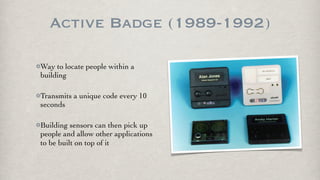
Active Badge (1989-1992)

Way to locate people within a
building

Transmits a unique code every 10
seconds

Building sensors can then pick up
people and allow other applications
to be built on top of it
Dodgeball (2000-2005-2009)

Users use SMS to indicate location
(pre-cursor to “check-in”)

Dodgeball would notify of crushes
and friends who were nearby

Closed in February of 2009 but
ideas clearly live on in Google
Latitude
PacManhattan (2004)

Urban game recreating Pac-man in
NYC by NYU ITP students

Player dressed as Pac-man would
run around Washington Square
Park collecting dots while Ghosts
tried to catch him/her

Used cell phone contact to
controllers back at NYU
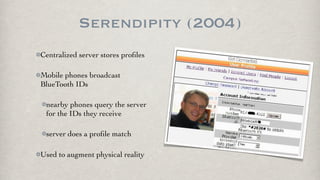
Serendipity (2004)
Centralized server stores profiles

Mobile phones broadcast
BlueTooth IDs

 nearby phones query the server
 for the IDs they receive

 server does a profile match

Used to augment physical reality
Loopt (2005-)
GPS sharing system to see where
your friends/contacts are

Background application that
updates location

Has the ability to turn location on
and off on a friend by friend basis

Has social aspects of seeing and
messaging friends; Loopt Mix for
more non-friend social networking
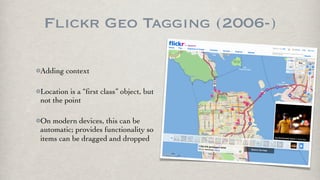
Flickr Geo Tagging (2006-)

Adding context

Location is a “first class” object, but
not the point

On modern devices, this can be
automatic; provides functionality so
items can be dragged and dropped
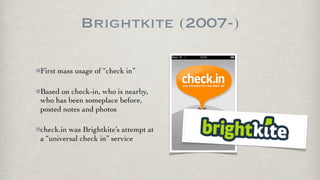
Brightkite (2007-)

First mass usage of “check in”

Based on check-in, who is nearby,
who has been someplace before,
posted notes and photos

check.in was Brightkite’s attempt at
a “universal check in” service
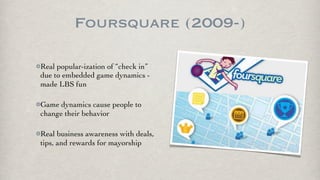
Foursquare (2009-)

Real popular-ization of “check in”
due to embedded game dynamics -
made LBS fun

Game dynamics cause people to
change their behavior

Real business awareness with deals,
tips, and rewards for mayorship
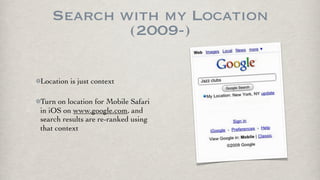
Search with my Location
           (2009-)

Location is just context

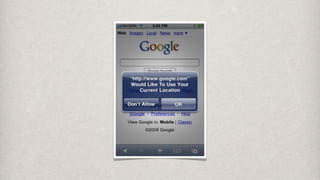
Turn on location for Mobile Safari
in iOS on www.google.com, and
search results are re-ranked using
that context
Facebook Places (2010-)

“Check-in” becomes a verb in
Facebook

Most notable because of juggernaut
which is Facebook

Facebook Deals is a loyalty card
mechanism built upon Places
Location in the @twitterapi
       user object
1st attempt at geo on the             {
                                          ...
@twitterapi                               "display_url":null,
                                          "profile_text_color":"333333",
                                          "followers_count":5997,
Expose a text field in the user            "expanded_url":null,
object called “location”                  "is_translator":false,
                                          "following":false,
                                          "verified":false,
                                          "profile_sidebar_fill_color":"DDEEF6",
Free form text                            "location":"San Francisco, California",
                                          "profile_background_tile":false,
                                          "time_zone":"Pacific Time (US & Canada)",
If geo-codeable, then include it in       ...
search                                }
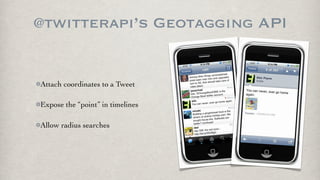
@twitterapi’s Geotagging API


Attach coordinates to a Tweet

Expose the “point” in timelines

Allow radius searches
@twitterapi’s Geoplace API

Attach a named place to a Tweet

Have entire model for how to
expose and describe a place

Richer data for users
Location is about
    context
Location is really
   dangerous
Location is really
            dangerous
Context can be hard to infer - mistaken assumptions can be
dangerous and problematic

Who is storing the data?

 How is the history managed?

 Who has control over the data?

 How is that data shared?

Is the application provider a subpoena target?
A lot of data already out
           there

Clipper card (transit card for subway system)

FastPass (electronic toll pass device)

Cellphone data

Google searches made from my phone
What makes a place?
37o46’56.5”N,
122o24’1.7”W
37o46’56.5”N,   122o24’1.7”W
37.78215,-122.40040
          !=
    37.78,-122.40
Dropping precision
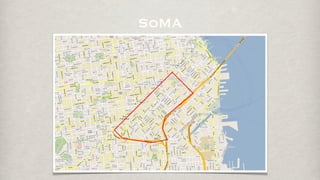
“SoMA”
SoMA
Roma or Rome /
    or Tokyo
5a110d312052166f or
      2487956
Sharing Location
Understanding the user’s
        “intent”

Why are we sharing the location?

Are we trying to actually share current / real location?

Rarely (but there are examples) do people share location for
location’s sake
Public models


Complete publication of
locational information

Controlled “fuzziness” of
shared data
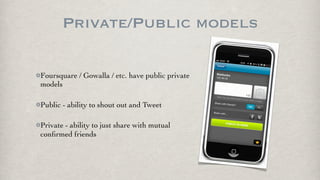
Private/Public models

Foursquare / Gowalla / etc. have public private
models

Public - ability to shout out and Tweet

Private - ability to just share with mutual
confirmed friends
Temporary shares


Granting access to account

No concerns about user
“forgetting” who has access
to this data
Who/What has the ability to
  share your location?

What applications can share your location?

You may be extremely careful, but are the people you are with
careful?

A user’s locational privacy may not be in control of that user
What do your users
   want to do?
What do your users want to
           do?
You have to evaluate this for yourself, obviously

Trends towards

 location as a pervasive context / find cool things near by /
 alerts

 need more location contextual data out there to do this

 more attempts to crack the mythical “social networking” one

 data mining
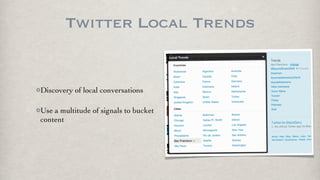
Twitter Local Trends


Discovery of local conversations

Use a multitude of signals to bucket
content
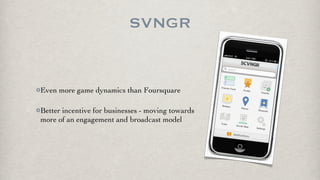
SVNGR


Even more game dynamics than Foursquare

Better incentive for businesses - moving towards
more of an engagement and broadcast model
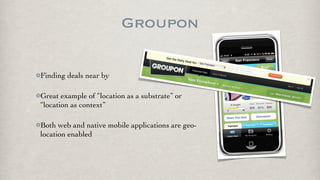
Groupon

Finding deals near by

Great example of “location as a substrate” or
“location as context”

Both web and native mobile applications are geo-
location enabled
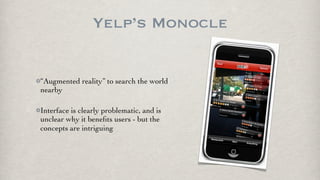
Yelp’s Monocle


“Augmented reality” to search the world
nearby

Interface is clearly problematic, and is
unclear why it benefits users - but the
concepts are intriguing
@emergency_in_sf

“Follow some of the larger emergencies in
San Francisco as they happen!”

Could be seriously enhanced to only do
delivery to those people who are actually
affected (or are strangely interested in
emergencies)
Questions?      Follow me!
             twitter.com/raffi

Users and Geo

  • 1.
    Users and geo R a f f i K r i k o r i a n @ r a f f i
  • 2.
    Talk ing aboutuser s and geo with @t hinkvitamin in t he Geolocation Onlin e Conference! 13 Jan via Twitter for iPhone from Twitter Headquarters 795 Folsom Street San Francisco, CA View Tweets at this place
  • 3.
    Who am I? EngineeringManager of the Twitter Platform Services team Built the original geo services on the @twitterapi Coordinate support for Tweets Built initial implementation of Rockdove at Twitter - our locations database
  • 4.
    What are wegoing to talk about? Take a look at some geo enabled applications Try to understand the implicit “here” What is location privacy? How does sharing work? What are some opportunities in the geo space?
  • 5.
    What are wegoing to talk about? Take a look at some geo enabled applications Try to understand the implicit “here” What is location privacy? How does sharing work? What are some opportunities in the geo space? PLEASE INTERRUPT ME WITH QUESTIONS!!!!
  • 6.
    People want totalk about where they are
  • 7.
    People want to discoverwhat’s around them
  • 8.
  • 9.
    Location is context and Relevancy
  • 10.
    Location is globally applicable, but locally relevant
  • 11.
  • 12.
    Active Badge (1989-1992) Wayto locate people within a building Transmits a unique code every 10 seconds Building sensors can then pick up people and allow other applications to be built on top of it
  • 13.
    Dodgeball (2000-2005-2009) Users useSMS to indicate location (pre-cursor to “check-in”) Dodgeball would notify of crushes and friends who were nearby Closed in February of 2009 but ideas clearly live on in Google Latitude
  • 14.
    PacManhattan (2004) Urban gamerecreating Pac-man in NYC by NYU ITP students Player dressed as Pac-man would run around Washington Square Park collecting dots while Ghosts tried to catch him/her Used cell phone contact to controllers back at NYU
  • 15.
    Serendipity (2004) Centralized serverstores profiles Mobile phones broadcast BlueTooth IDs nearby phones query the server for the IDs they receive server does a profile match Used to augment physical reality
  • 16.
    Loopt (2005-) GPS sharingsystem to see where your friends/contacts are Background application that updates location Has the ability to turn location on and off on a friend by friend basis Has social aspects of seeing and messaging friends; Loopt Mix for more non-friend social networking
  • 17.
    Flickr Geo Tagging(2006-) Adding context Location is a “first class” object, but not the point On modern devices, this can be automatic; provides functionality so items can be dragged and dropped
  • 18.
    Brightkite (2007-) First massusage of “check in” Based on check-in, who is nearby, who has been someplace before, posted notes and photos check.in was Brightkite’s attempt at a “universal check in” service
  • 19.
    Foursquare (2009-) Real popular-izationof “check in” due to embedded game dynamics - made LBS fun Game dynamics cause people to change their behavior Real business awareness with deals, tips, and rewards for mayorship
  • 20.
    Search with myLocation (2009-) Location is just context Turn on location for Mobile Safari in iOS on www.google.com, and search results are re-ranked using that context
  • 21.
    Facebook Places (2010-) “Check-in”becomes a verb in Facebook Most notable because of juggernaut which is Facebook Facebook Deals is a loyalty card mechanism built upon Places
  • 27.
    Location in the@twitterapi user object 1st attempt at geo on the { ... @twitterapi "display_url":null, "profile_text_color":"333333", "followers_count":5997, Expose a text field in the user "expanded_url":null, object called “location” "is_translator":false, "following":false, "verified":false, "profile_sidebar_fill_color":"DDEEF6", Free form text "location":"San Francisco, California", "profile_background_tile":false, "time_zone":"Pacific Time (US & Canada)", If geo-codeable, then include it in ... search }
  • 28.
    @twitterapi’s Geotagging API Attachcoordinates to a Tweet Expose the “point” in timelines Allow radius searches
  • 29.
    @twitterapi’s Geoplace API Attacha named place to a Tweet Have entire model for how to expose and describe a place Richer data for users
  • 30.
  • 35.
  • 36.
    Location is really dangerous Context can be hard to infer - mistaken assumptions can be dangerous and problematic Who is storing the data? How is the history managed? Who has control over the data? How is that data shared? Is the application provider a subpoena target?
  • 37.
    A lot ofdata already out there Clipper card (transit card for subway system) FastPass (electronic toll pass device) Cellphone data Google searches made from my phone
  • 38.
  • 39.
  • 40.
    37o46’56.5”N, 122o24’1.7”W
  • 41.
    37.78215,-122.40040 != 37.78,-122.40
  • 42.
  • 43.
  • 44.
  • 45.
    Roma or Rome/ or Tokyo
  • 46.
  • 47.
  • 48.
    Understanding the user’s “intent” Why are we sharing the location? Are we trying to actually share current / real location? Rarely (but there are examples) do people share location for location’s sake
  • 49.
    Public models Complete publicationof locational information Controlled “fuzziness” of shared data
  • 50.
    Private/Public models Foursquare /Gowalla / etc. have public private models Public - ability to shout out and Tweet Private - ability to just share with mutual confirmed friends
  • 52.
    Temporary shares Granting accessto account No concerns about user “forgetting” who has access to this data
  • 53.
    Who/What has theability to share your location? What applications can share your location? You may be extremely careful, but are the people you are with careful? A user’s locational privacy may not be in control of that user
  • 57.
    What do yourusers want to do?
  • 58.
    What do yourusers want to do? You have to evaluate this for yourself, obviously Trends towards location as a pervasive context / find cool things near by / alerts need more location contextual data out there to do this more attempts to crack the mythical “social networking” one data mining
  • 59.
    Twitter Local Trends Discoveryof local conversations Use a multitude of signals to bucket content
  • 60.
    SVNGR Even more gamedynamics than Foursquare Better incentive for businesses - moving towards more of an engagement and broadcast model
  • 61.
    Groupon Finding deals nearby Great example of “location as a substrate” or “location as context” Both web and native mobile applications are geo- location enabled
  • 62.
    Yelp’s Monocle “Augmented reality”to search the world nearby Interface is clearly problematic, and is unclear why it benefits users - but the concepts are intriguing
  • 63.
    @emergency_in_sf “Follow some ofthe larger emergencies in San Francisco as they happen!” Could be seriously enhanced to only do delivery to those people who are actually affected (or are strangely interested in emergencies)
  • 64.
    Questions? Follow me! twitter.com/raffi