User Experience
Research-Practice
Interaction
Keith Instone
#UXRPI
instone.org/uxrpi-connectingdots
1
Keith Instone @keithinstone #UXRPI
2
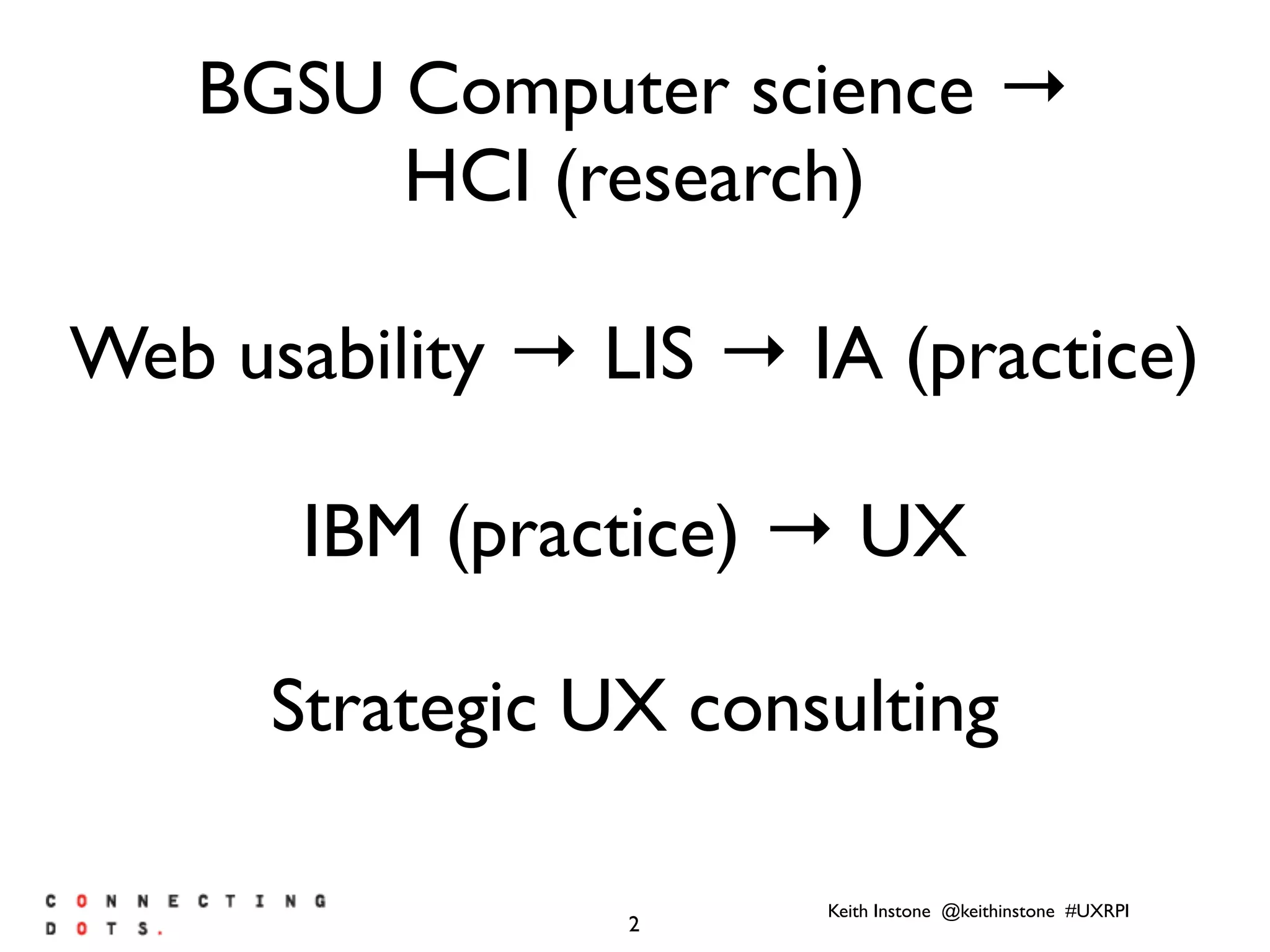
BGSU Computer science โ†’
HCI (research)
Web usability โ†’ LIS โ†’ IA (practice)
IBM (practice) โ†’ UX
Strategic UX consulting
Keith Instone @keithinstone #UXRPI
3
The Disciplined Designer
educators.aiga.org/the-disciplined-designer
[INFORMATION ARCHITECTURE][USER EXPERIENCE] [INTERACTION DESIGN]
Keith Instone @keithinstone #UXRPI
4
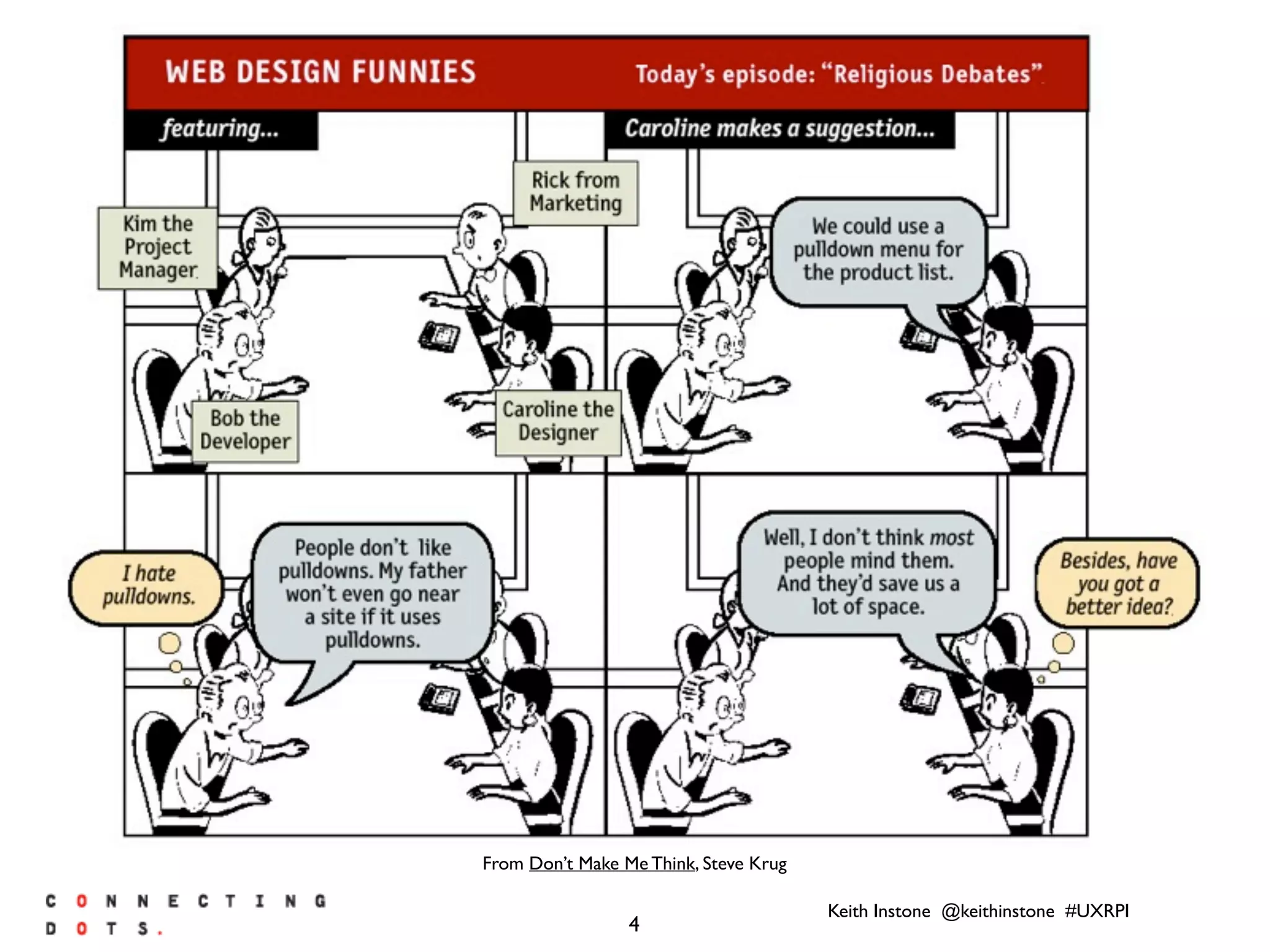
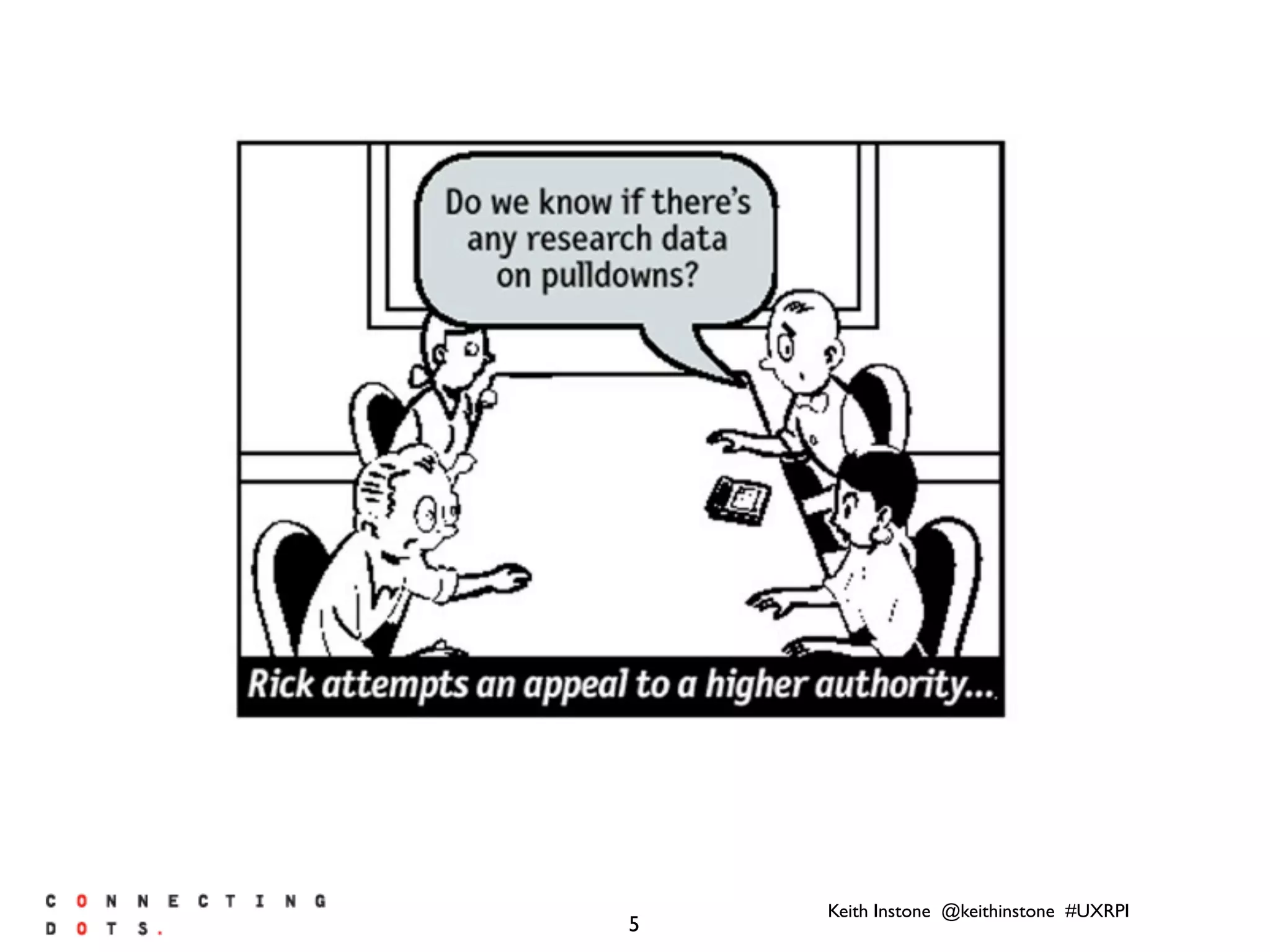
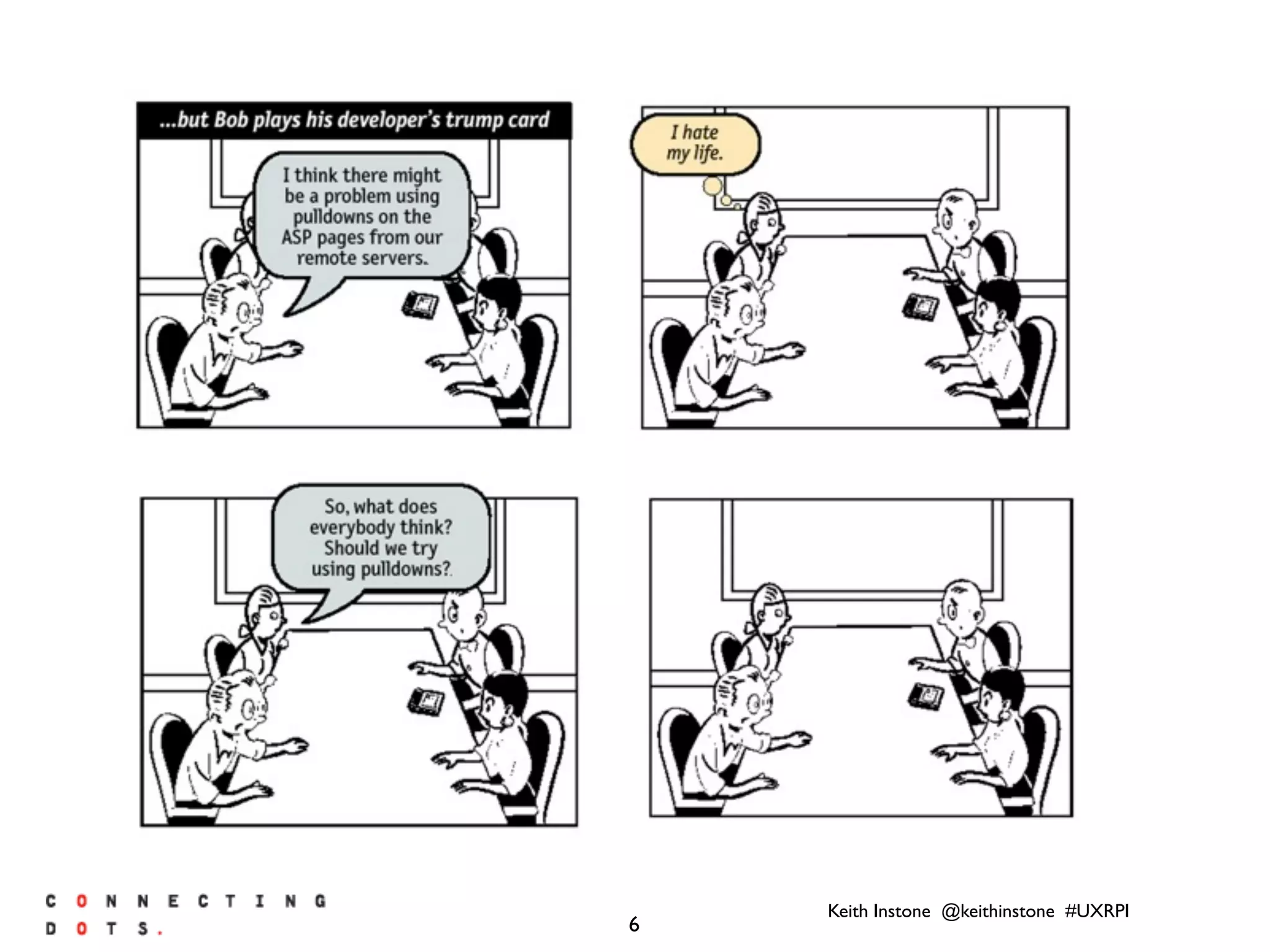
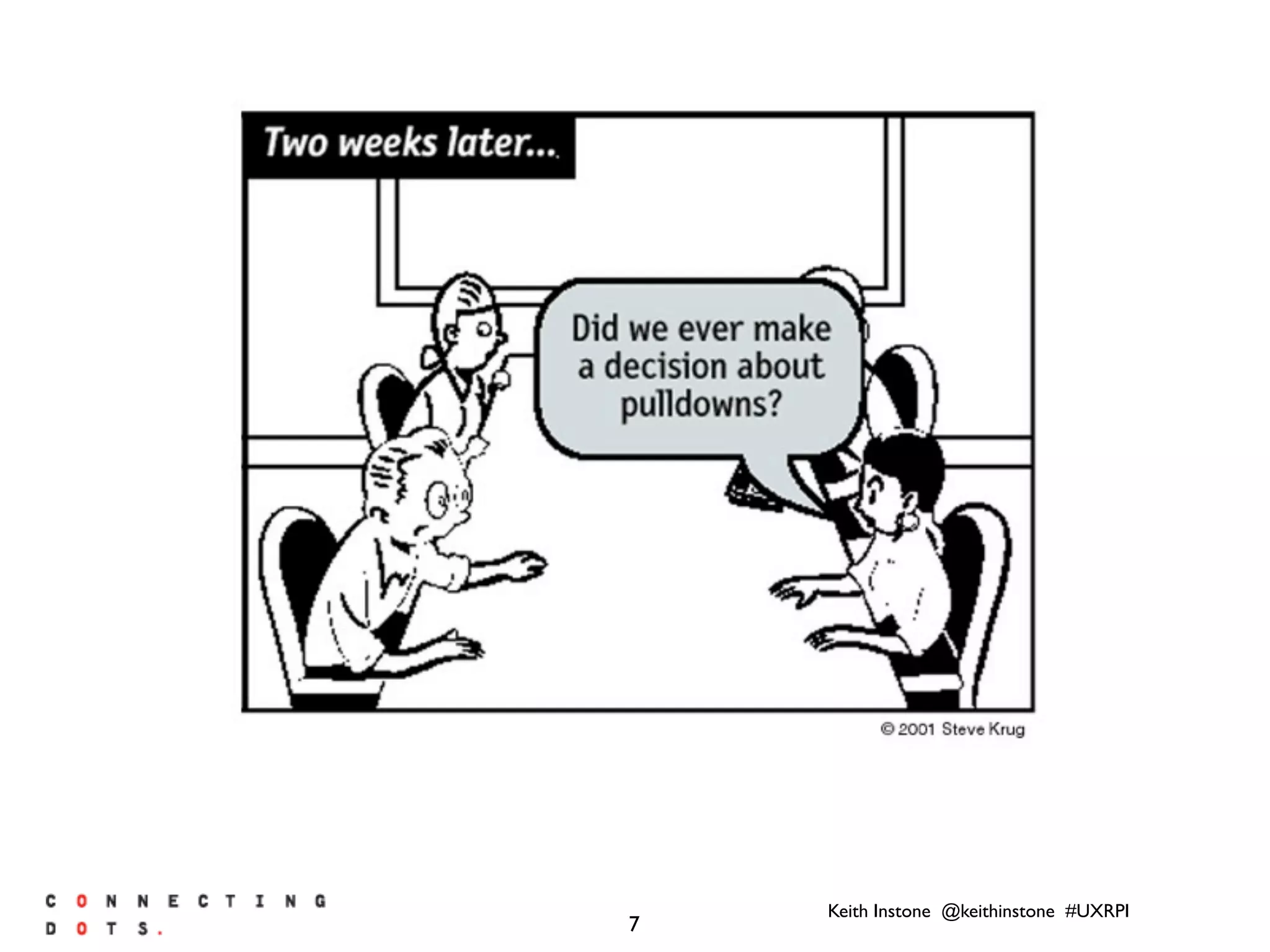
From Donโ€™t Make Me Think, Steve Krug
Keith Instone @keithinstone #UXRPI
5
Keith Instone @keithinstone #UXRPI
6
Keith Instone @keithinstone #UXRPI
7
Keith Instone @keithinstone #UXRPI
8
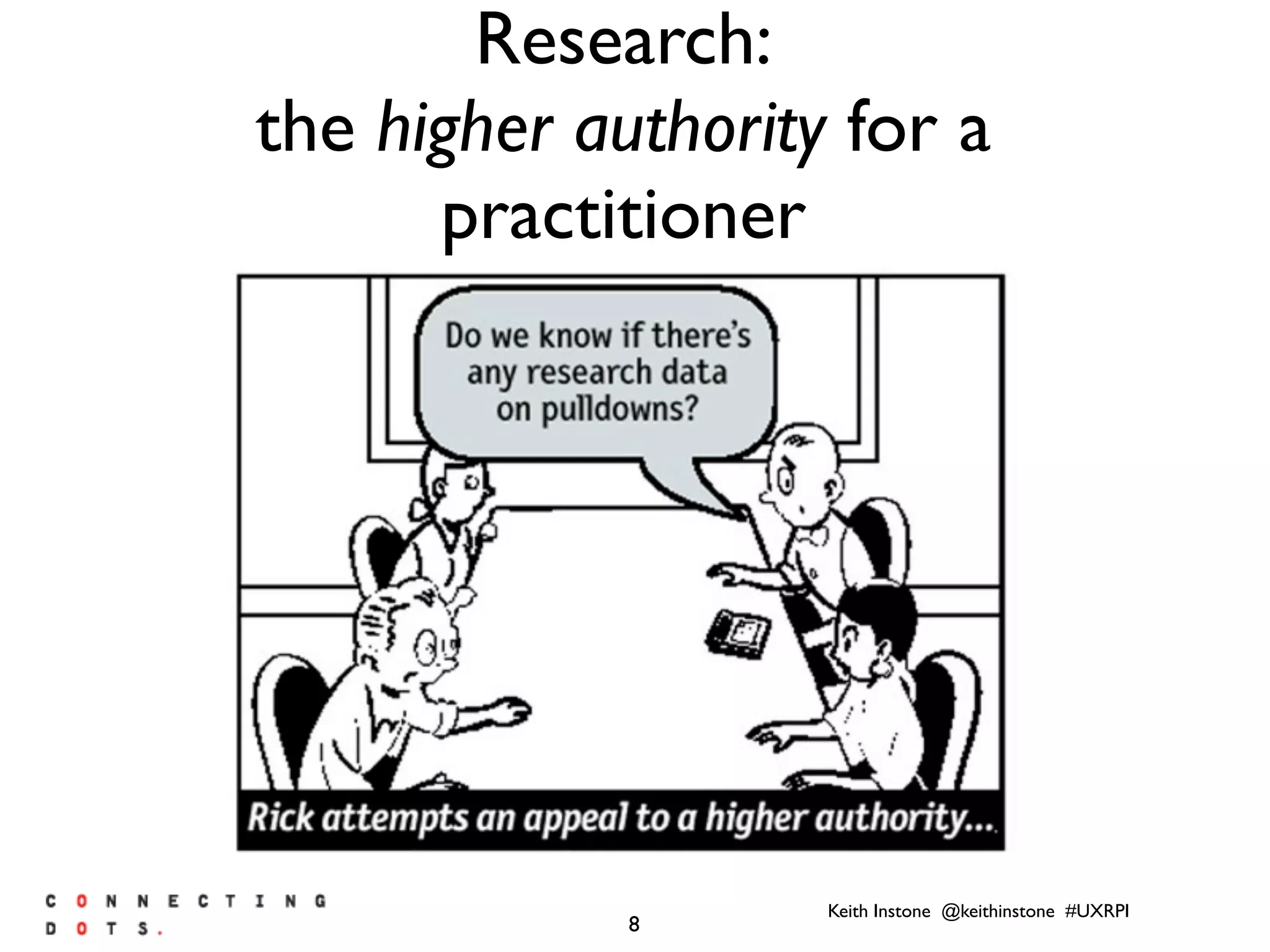
Research:
the higher authority for a
practitioner
Keith Instone @keithinstone #UXRPI
9
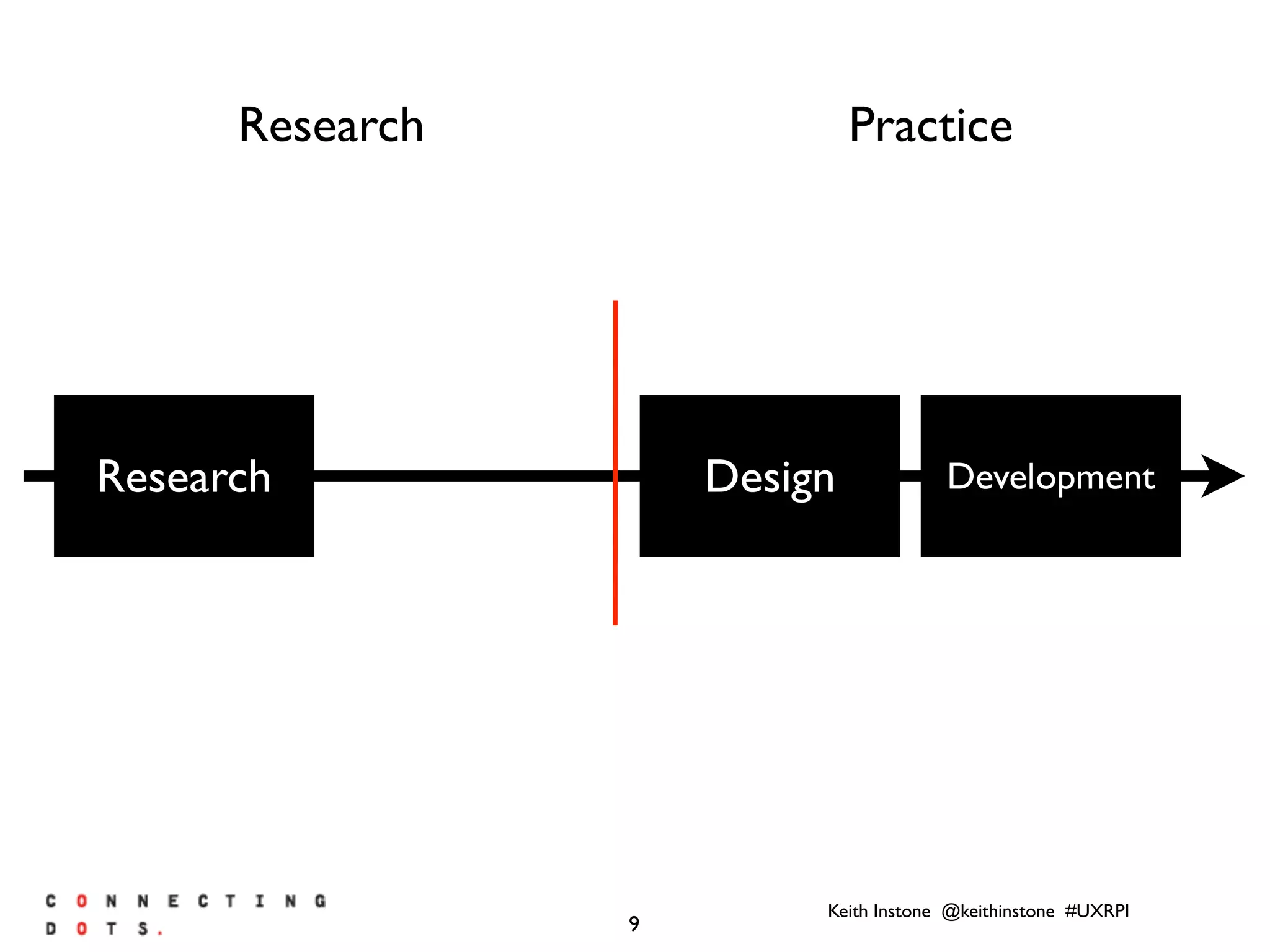
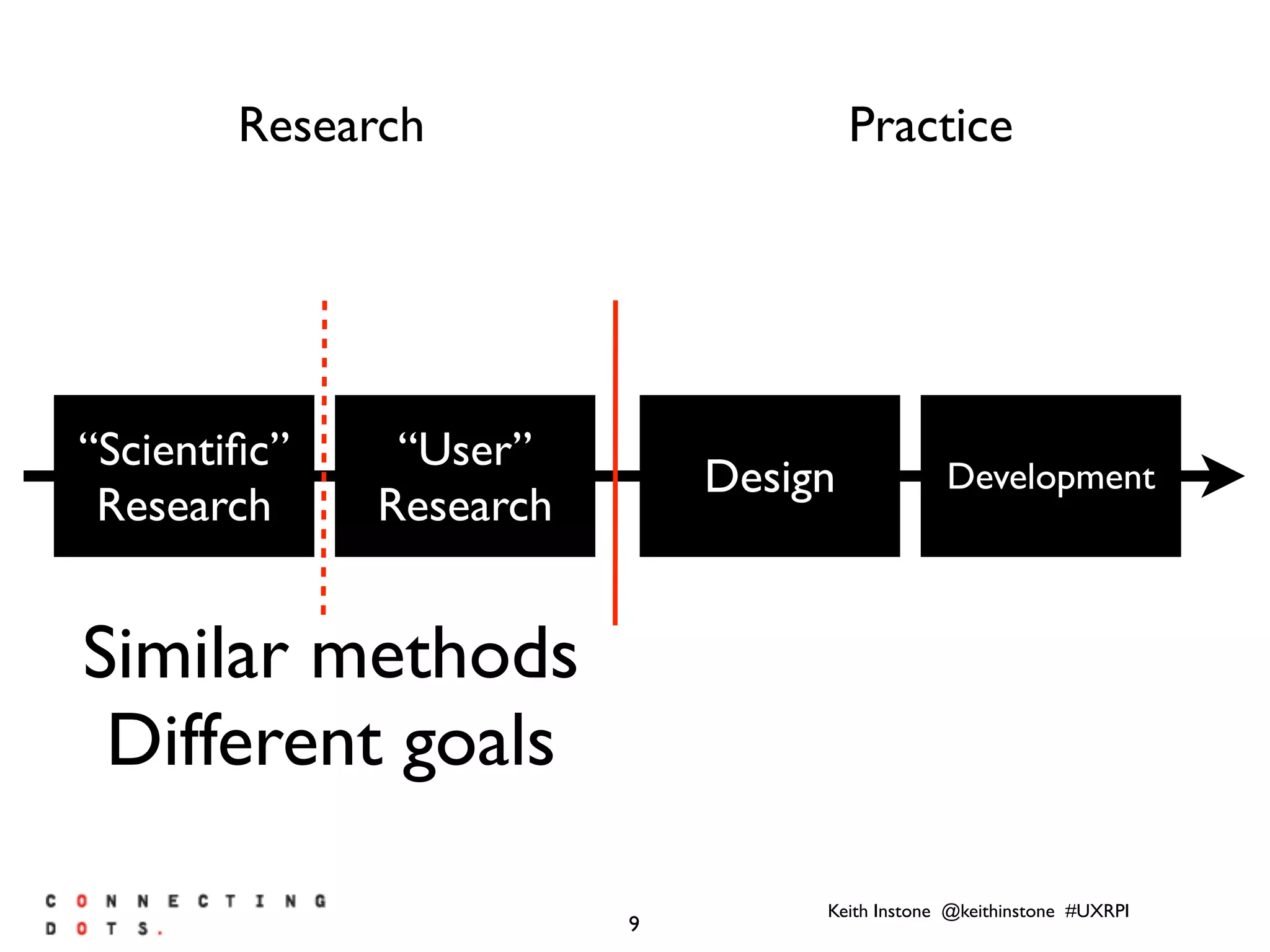
Research Design Development
Research Practice
Keith Instone @keithinstone #UXRPI
9
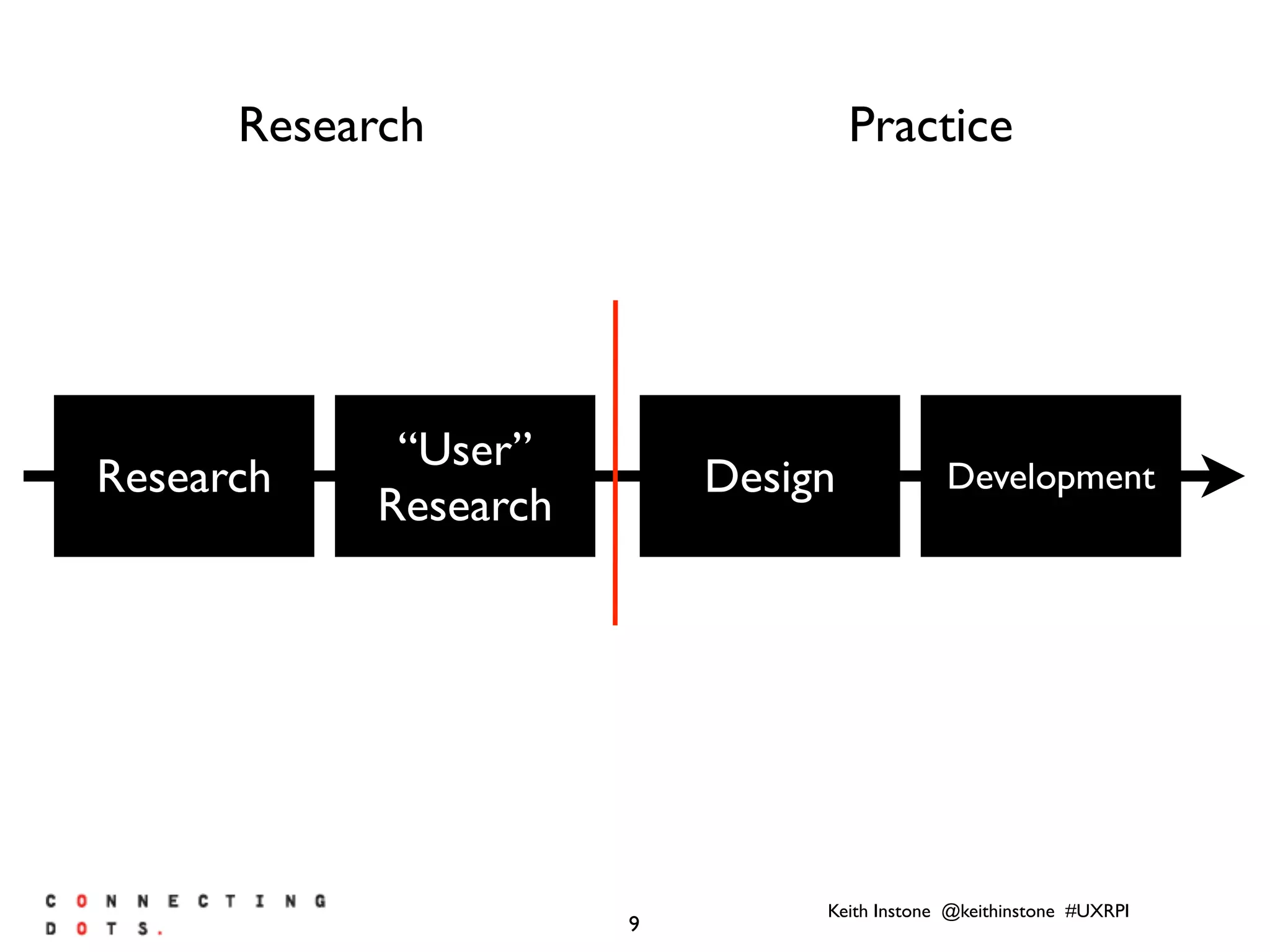
Research
โ€œUserโ€
Research
Design Development
Research Practice
Keith Instone @keithinstone #UXRPI
9
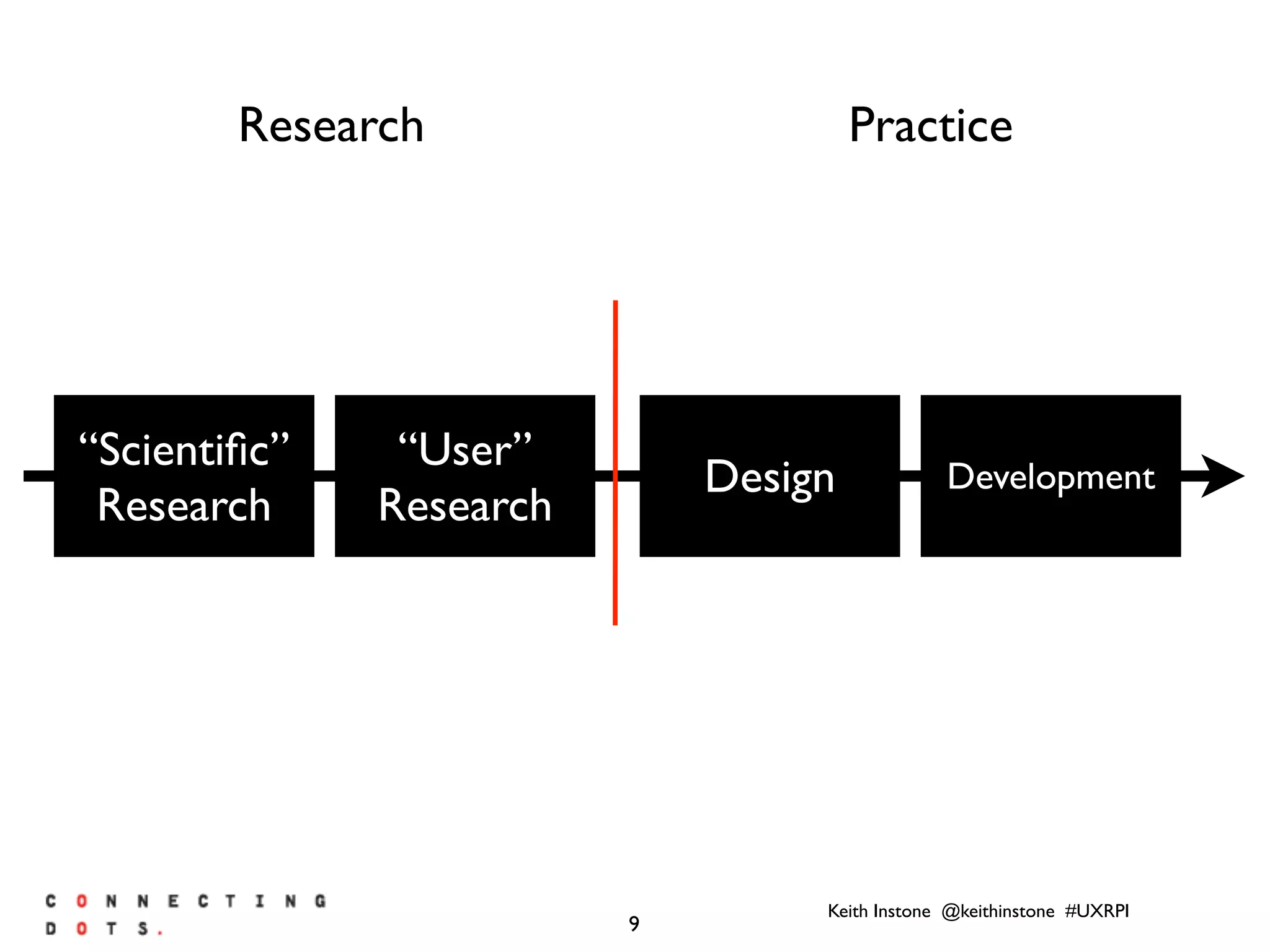
Research
โ€œUserโ€
Research
Design Development
โ€œScienti๏ฌcโ€
Research
Research Practice
Keith Instone @keithinstone #UXRPI
9
Research
โ€œUserโ€
Research
Design Development
โ€œScienti๏ฌcโ€
Research
Research Practice
Similar methods
Different goals
Keith Instone @keithinstone #UXRPI
10
Keith Instone @keithinstone #UXRPI
10
Keith Instone @keithinstone #UXRPI
11
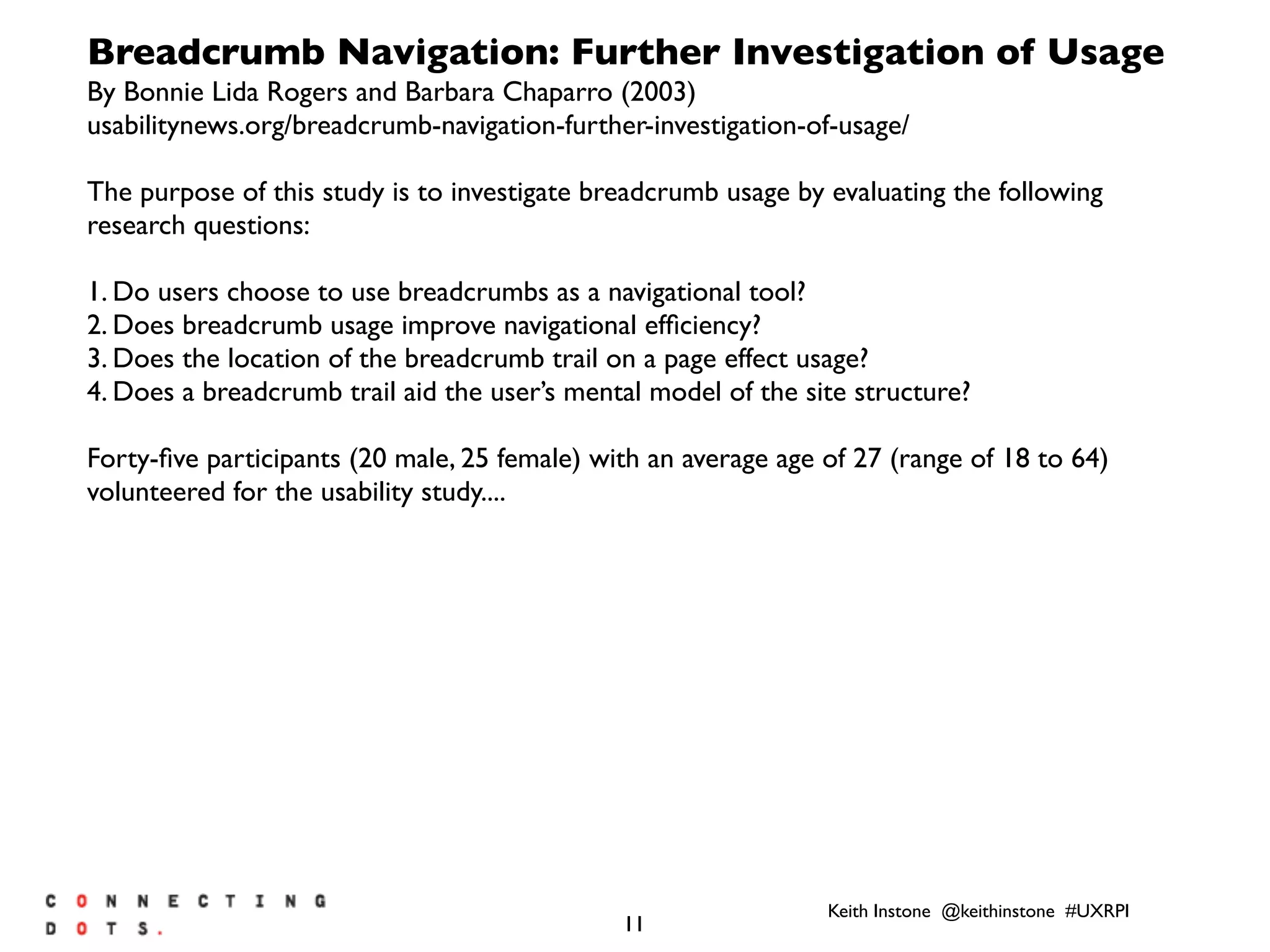
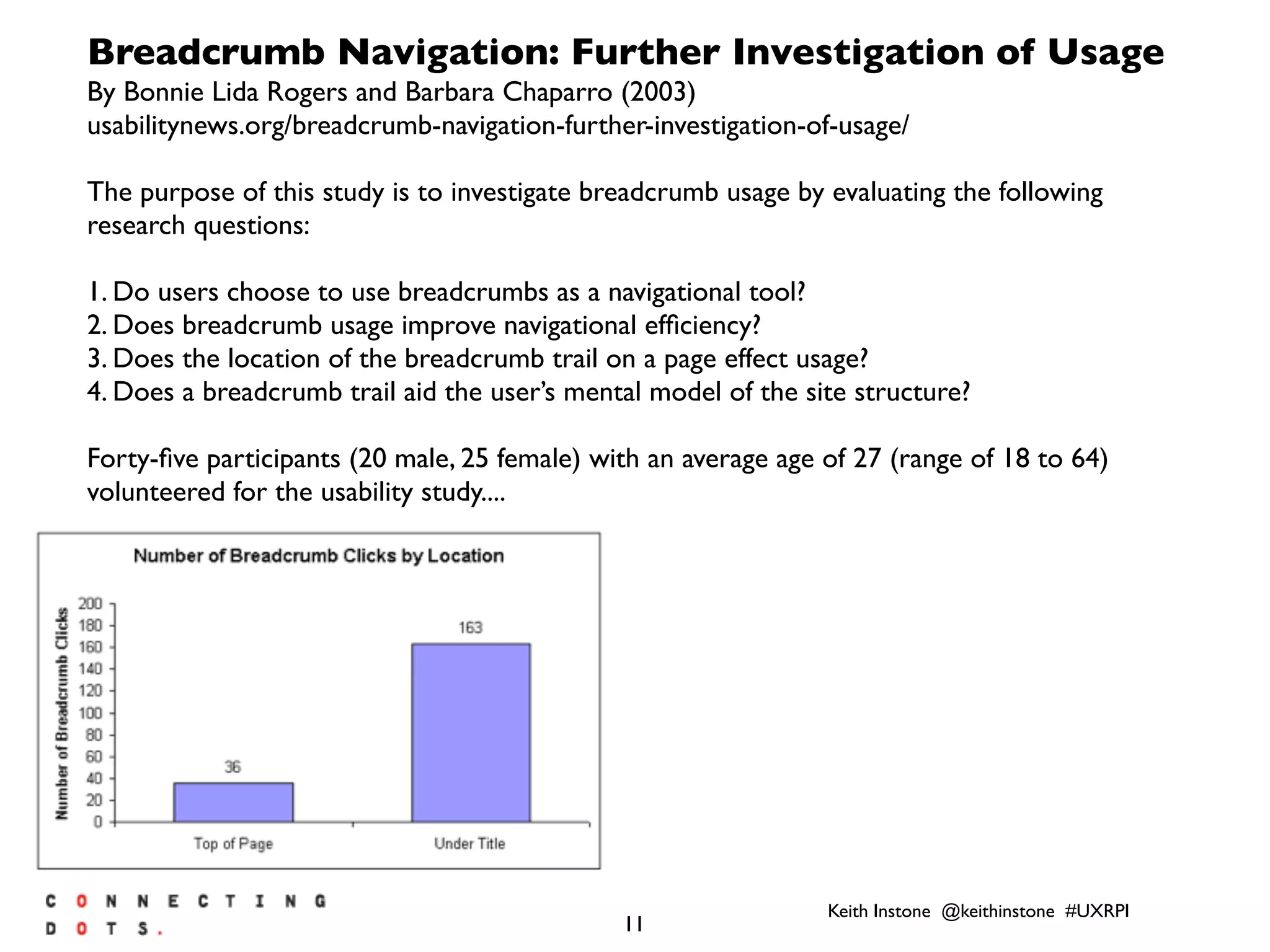
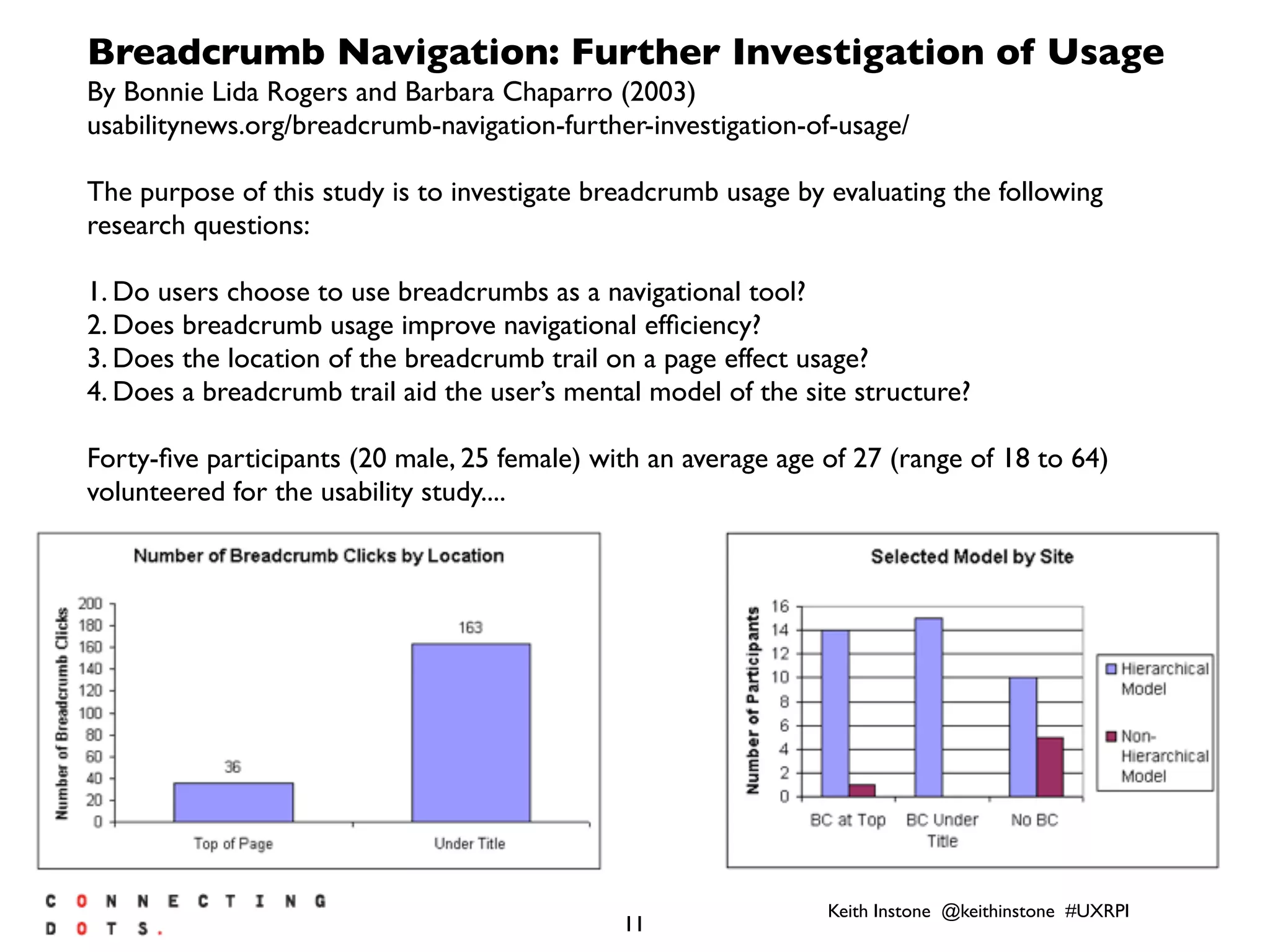
Breadcrumb Navigation: Further Investigation of Usage
By Bonnie Lida Rogers and Barbara Chaparro (2003)
usabilitynews.org/breadcrumb-navigation-further-investigation-of-usage/
The purpose of this study is to investigate breadcrumb usage by evaluating the following
research questions:
1. Do users choose to use breadcrumbs as a navigational tool?
2. Does breadcrumb usage improve navigational ef๏ฌciency?
3. Does the location of the breadcrumb trail on a page effect usage?
4. Does a breadcrumb trail aid the userโ€™s mental model of the site structure?
Forty-๏ฌve participants (20 male, 25 female) with an average age of 27 (range of 18 to 64)
volunteered for the usability study....
Keith Instone @keithinstone #UXRPI
11
Breadcrumb Navigation: Further Investigation of Usage
By Bonnie Lida Rogers and Barbara Chaparro (2003)
usabilitynews.org/breadcrumb-navigation-further-investigation-of-usage/
The purpose of this study is to investigate breadcrumb usage by evaluating the following
research questions:
1. Do users choose to use breadcrumbs as a navigational tool?
2. Does breadcrumb usage improve navigational ef๏ฌciency?
3. Does the location of the breadcrumb trail on a page effect usage?
4. Does a breadcrumb trail aid the userโ€™s mental model of the site structure?
Forty-๏ฌve participants (20 male, 25 female) with an average age of 27 (range of 18 to 64)
volunteered for the usability study....
Keith Instone @keithinstone #UXRPI
11
Breadcrumb Navigation: Further Investigation of Usage
By Bonnie Lida Rogers and Barbara Chaparro (2003)
usabilitynews.org/breadcrumb-navigation-further-investigation-of-usage/
The purpose of this study is to investigate breadcrumb usage by evaluating the following
research questions:
1. Do users choose to use breadcrumbs as a navigational tool?
2. Does breadcrumb usage improve navigational ef๏ฌciency?
3. Does the location of the breadcrumb trail on a page effect usage?
4. Does a breadcrumb trail aid the userโ€™s mental model of the site structure?
Forty-๏ฌve participants (20 male, 25 female) with an average age of 27 (range of 18 to 64)
volunteered for the usability study....
Keith Instone @keithinstone #UXRPI
12
Keith Instone @keithinstone #UXRPI
13
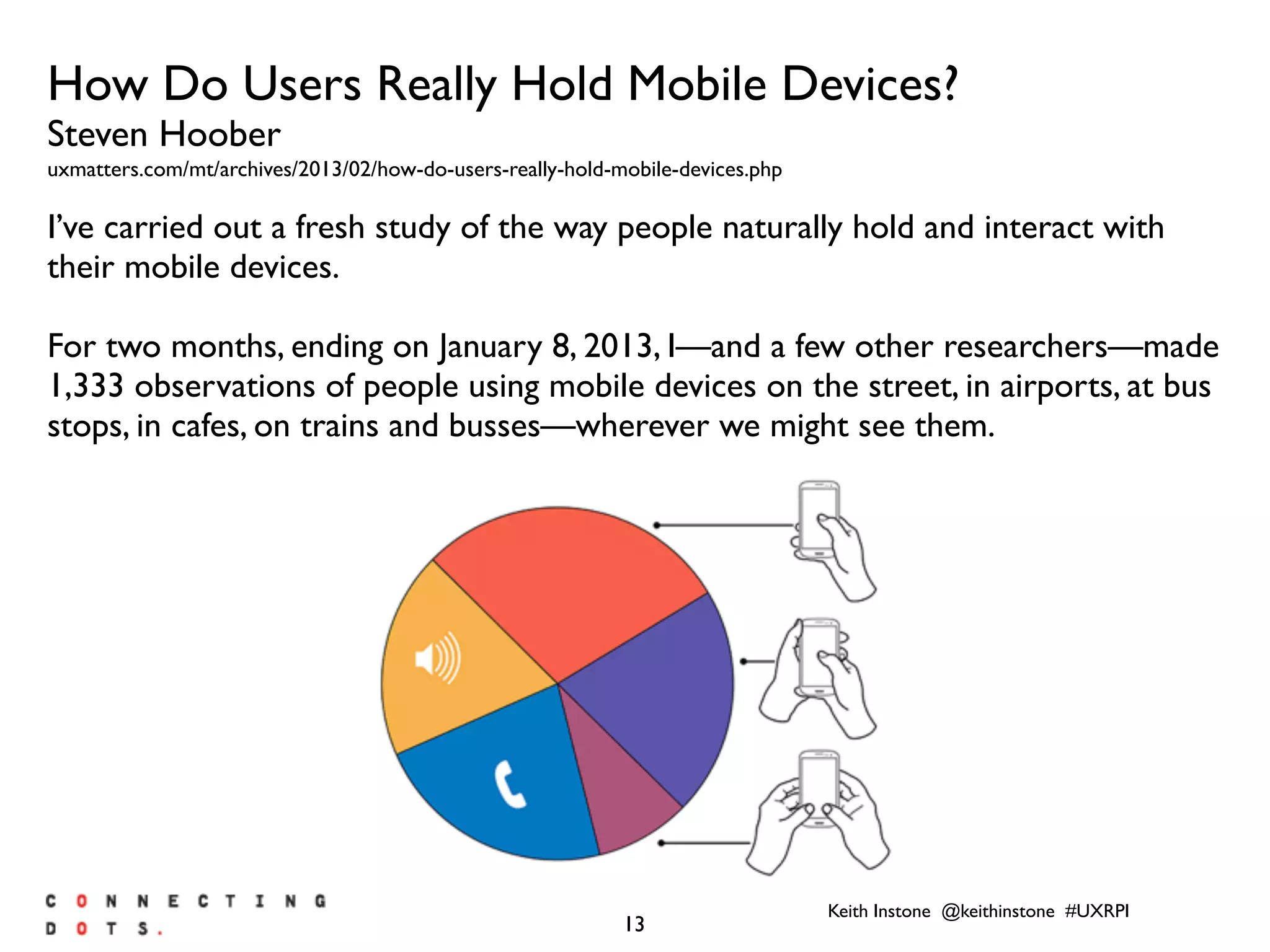
How Do Users Really Hold Mobile Devices?
Steven Hoober
uxmatters.com/mt/archives/2013/02/how-do-users-really-hold-mobile-devices.php
Iโ€™ve carried out a fresh study of the way people naturally hold and interact with
their mobile devices.
For two months, ending on January 8, 2013, Iโ€”and a few other researchersโ€”made
1,333 observations of people using mobile devices on the street, in airports, at bus
stops, in cafes, on trains and bussesโ€”wherever we might see them.
Keith Instone @keithinstone #UXRPI
13
How Do Users Really Hold Mobile Devices?
Steven Hoober
uxmatters.com/mt/archives/2013/02/how-do-users-really-hold-mobile-devices.php
Iโ€™ve carried out a fresh study of the way people naturally hold and interact with
their mobile devices.
For two months, ending on January 8, 2013, Iโ€”and a few other researchersโ€”made
1,333 observations of people using mobile devices on the street, in airports, at bus
stops, in cafes, on trains and bussesโ€”wherever we might see them.
Keith Instone @keithinstone #UXRPI
14
What the $%&#*! is RESEARCH anyway?
Is there value in separating types of research?
Wikipedia types
scienti๏ฌc (hypothesis testing)
humanities (historical/context)
artistic
Karelโ€™s types
practical: improve a product, service
practice-based: ๏ฌnd patterns in small groups
academic: generate & validate knowledge
Keith Instone @keithinstone #UXRPI
15
If you are a user experience practitioner:
What do you wish you had a โ€œscienti๏ฌcโ€ answer to?
Have you tried to ๏ฌnd these answers in the research
literature?
Roadblocks?
Successes in applying to your practice?
Keith Instone @keithinstone #UXRPI
16
If you are a researcher:
What is the value of engaging with practitioners for you?
Any examples where your research got better because
of interactions you had with practitioners?
Keith Instone @keithinstone #UXRPI
17
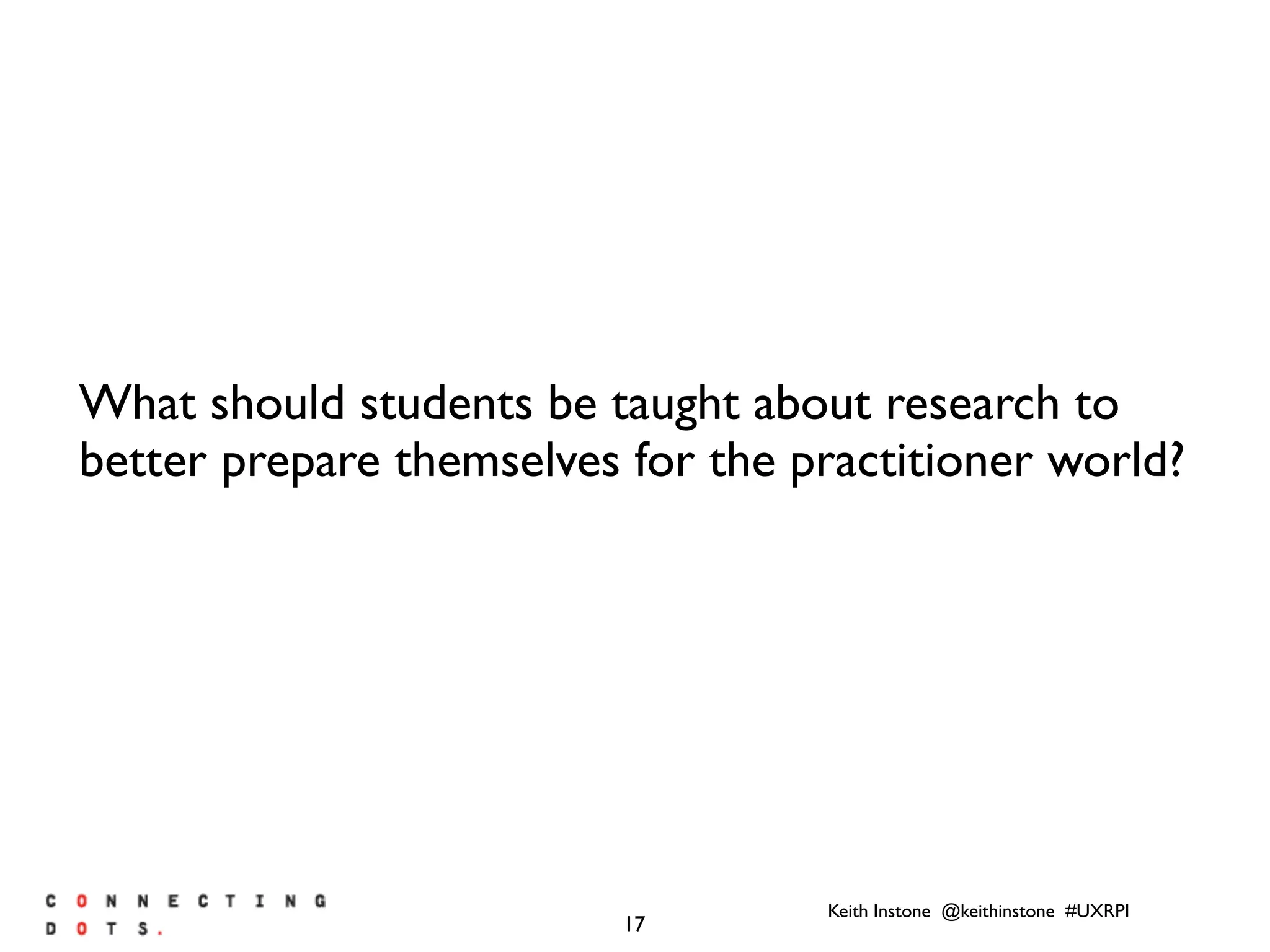
What should students be taught about research to
better prepare themselves for the practitioner world?
Keith Instone @keithinstone #UXRPI
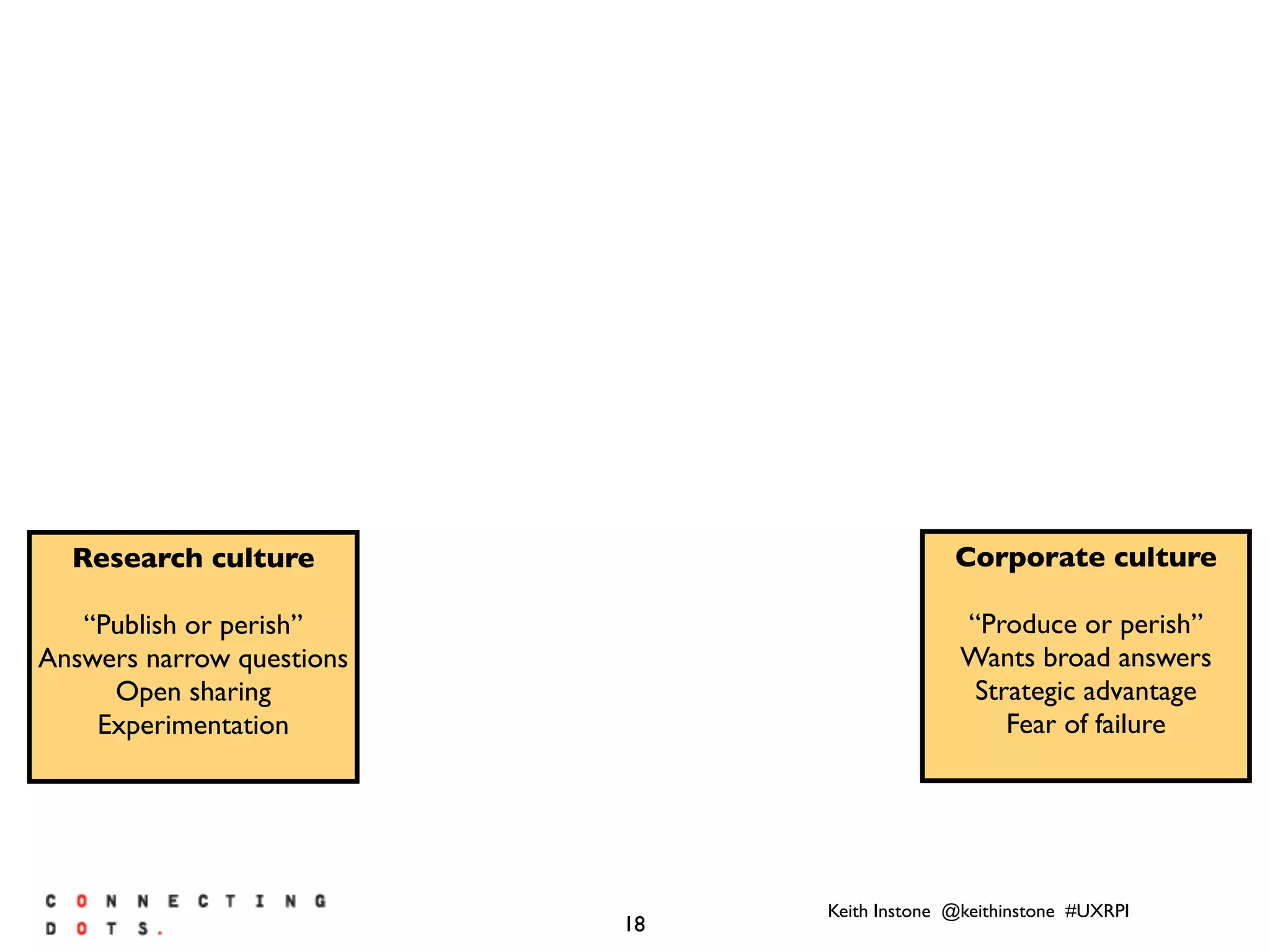
18
Research culture
โ€œPublish or perishโ€
Answers narrow questions
Open sharing
Experimentation
Corporate culture
โ€œProduce or perishโ€
Wants broad answers
Strategic advantage
Fear of failure
Keith Instone @keithinstone #UXRPI
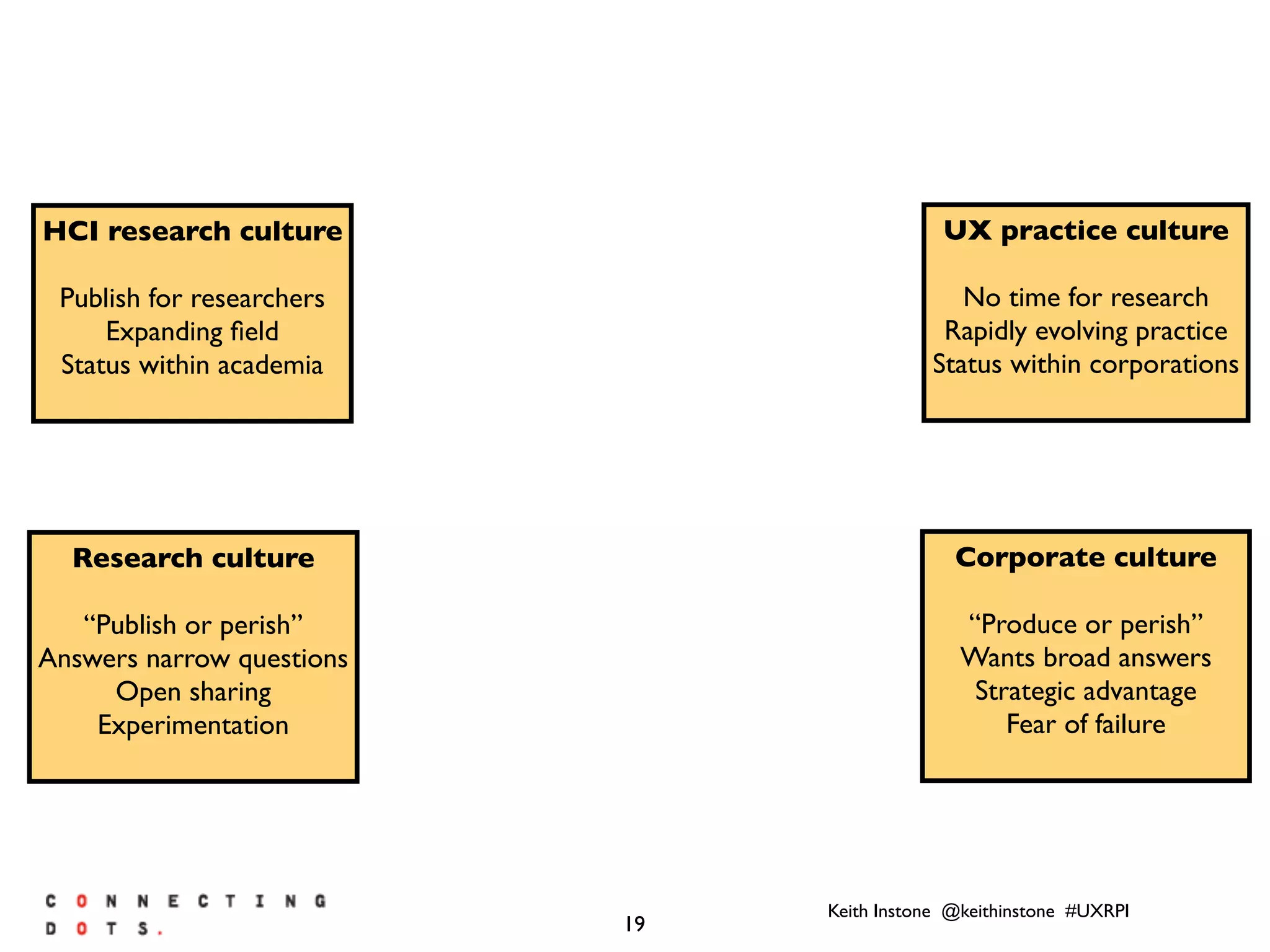
19
Research culture
โ€œPublish or perishโ€
Answers narrow questions
Open sharing
Experimentation
Corporate culture
โ€œProduce or perishโ€
Wants broad answers
Strategic advantage
Fear of failure
HCI research culture
Publish for researchers
Expanding ๏ฌeld
Status within academia
UX practice culture
No time for research
Rapidly evolving practice
Status within corporations
Keith Instone @keithinstone #UXRPI
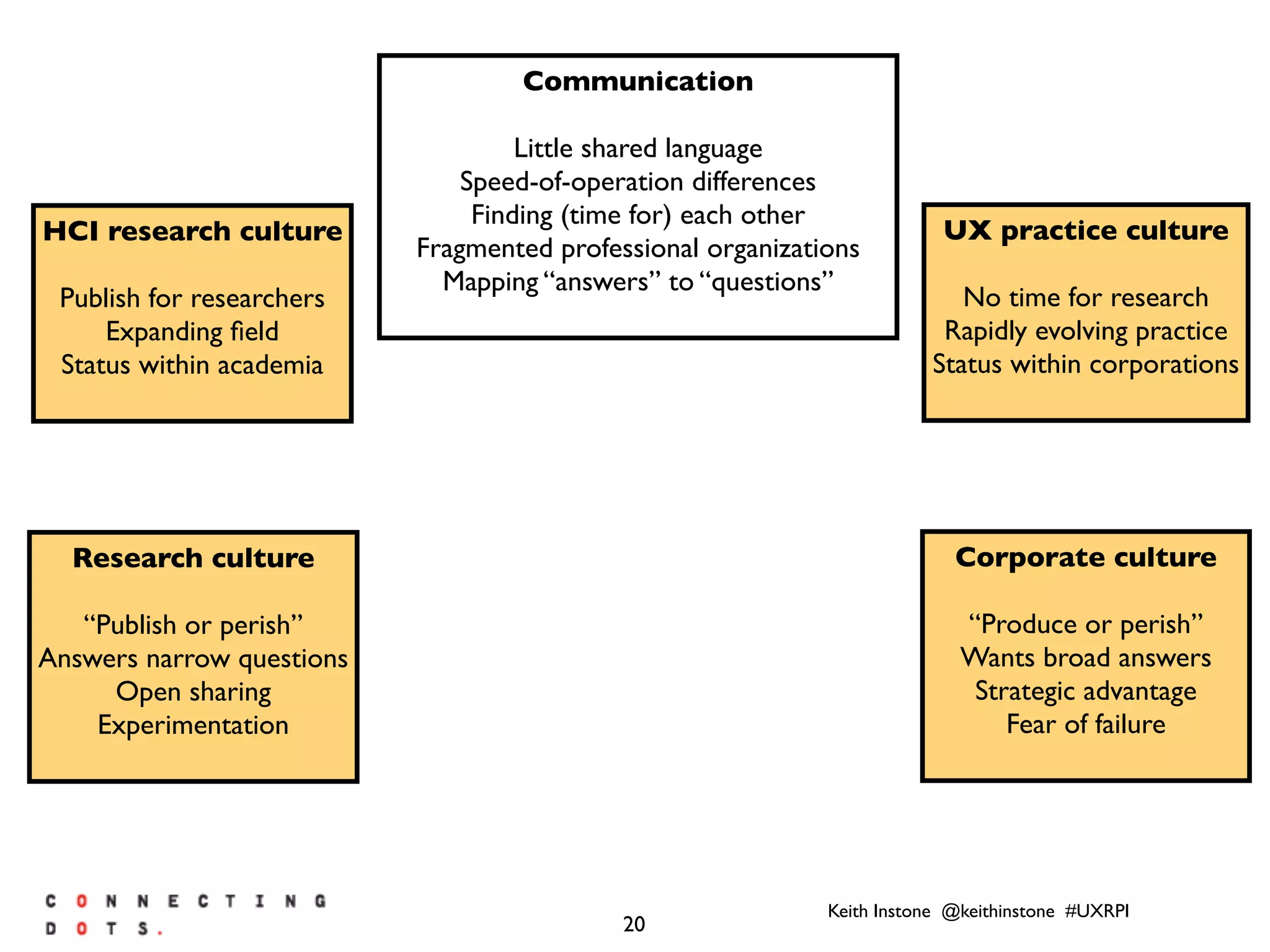
20
Research culture
โ€œPublish or perishโ€
Answers narrow questions
Open sharing
Experimentation
Corporate culture
โ€œProduce or perishโ€
Wants broad answers
Strategic advantage
Fear of failure
HCI research culture
Publish for researchers
Expanding ๏ฌeld
Status within academia
UX practice culture
No time for research
Rapidly evolving practice
Status within corporations
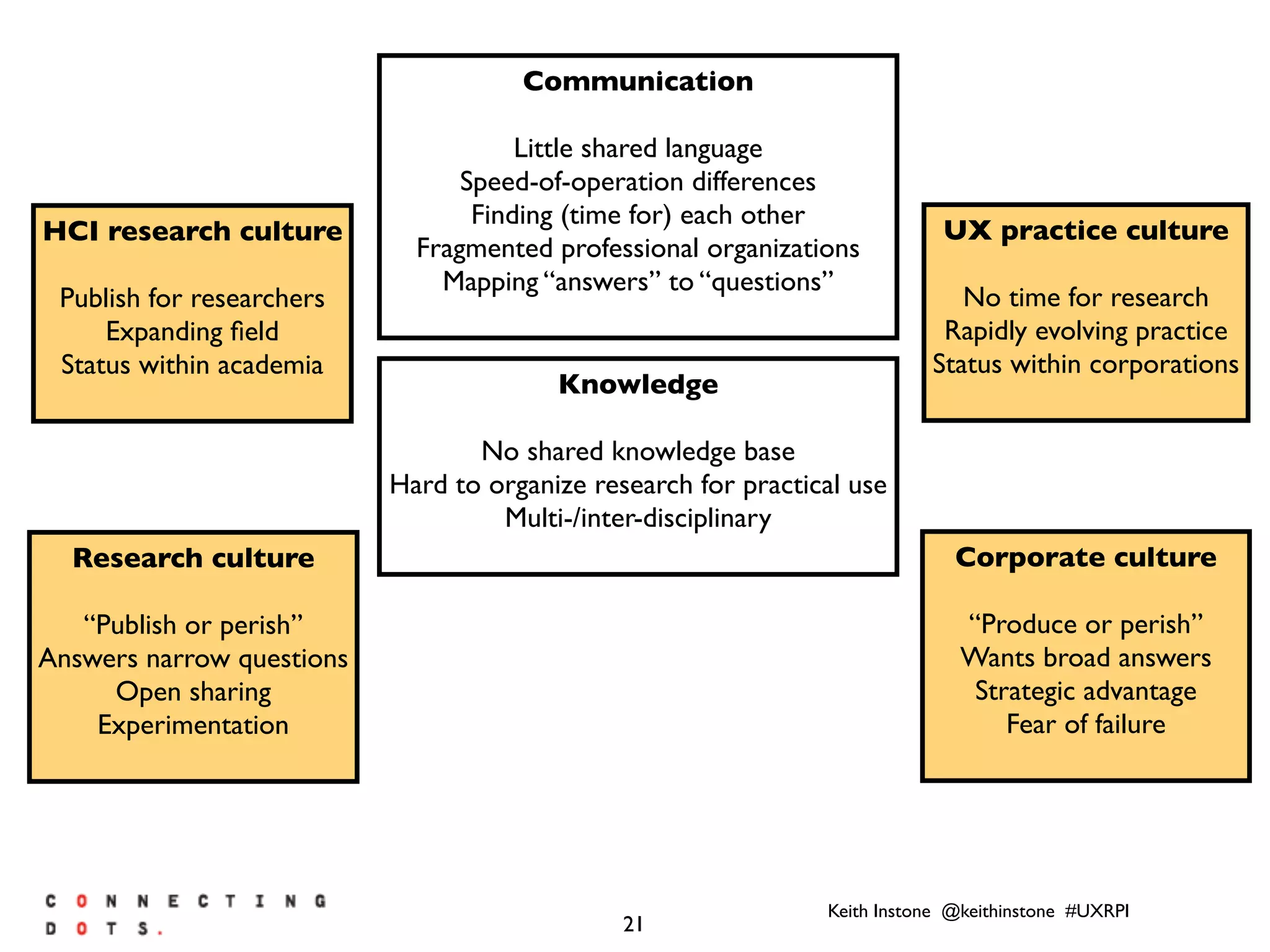
Communication
Little shared language
Speed-of-operation differences
Finding (time for) each other
Fragmented professional organizations
Mapping โ€œanswersโ€ to โ€œquestionsโ€
Keith Instone @keithinstone #UXRPI
21
Research culture
โ€œPublish or perishโ€
Answers narrow questions
Open sharing
Experimentation
Corporate culture
โ€œProduce or perishโ€
Wants broad answers
Strategic advantage
Fear of failure
HCI research culture
Publish for researchers
Expanding ๏ฌeld
Status within academia
UX practice culture
No time for research
Rapidly evolving practice
Status within corporations
Knowledge
No shared knowledge base
Hard to organize research for practical use
Multi-/inter-disciplinary
Communication
Little shared language
Speed-of-operation differences
Finding (time for) each other
Fragmented professional organizations
Mapping โ€œanswersโ€ to โ€œquestionsโ€
Keith Instone @keithinstone #UXRPI
22
Research culture
โ€œPublish or perishโ€
Answers narrow questions
Open sharing
Experimentation
Corporate culture
โ€œProduce or perishโ€
Wants broad answers
Strategic advantage
Fear of failure
HCI research culture
Publish for researchers
Expanding ๏ฌeld
Status within academia
UX practice culture
No time for research
Rapidly evolving practice
Status within corporations
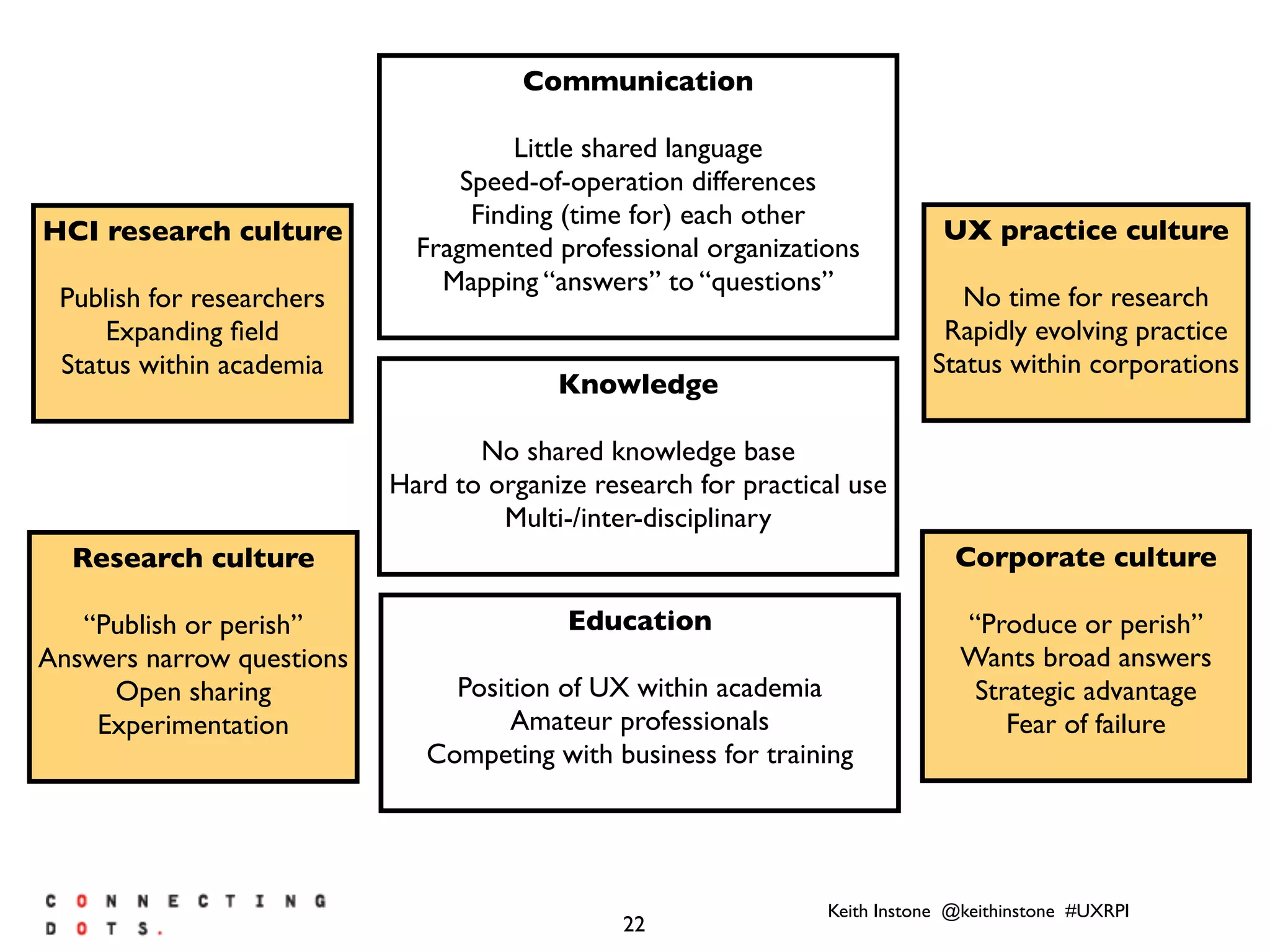
Education
Position of UX within academia
Amateur professionals
Competing with business for training
Knowledge
No shared knowledge base
Hard to organize research for practical use
Multi-/inter-disciplinary
Communication
Little shared language
Speed-of-operation differences
Finding (time for) each other
Fragmented professional organizations
Mapping โ€œanswersโ€ to โ€œquestionsโ€
Keith Instone @keithinstone #UXRPI
23
Keith Instone @keithinstone #UXRPI
24
Keith Instone @keithinstone #UXRPI
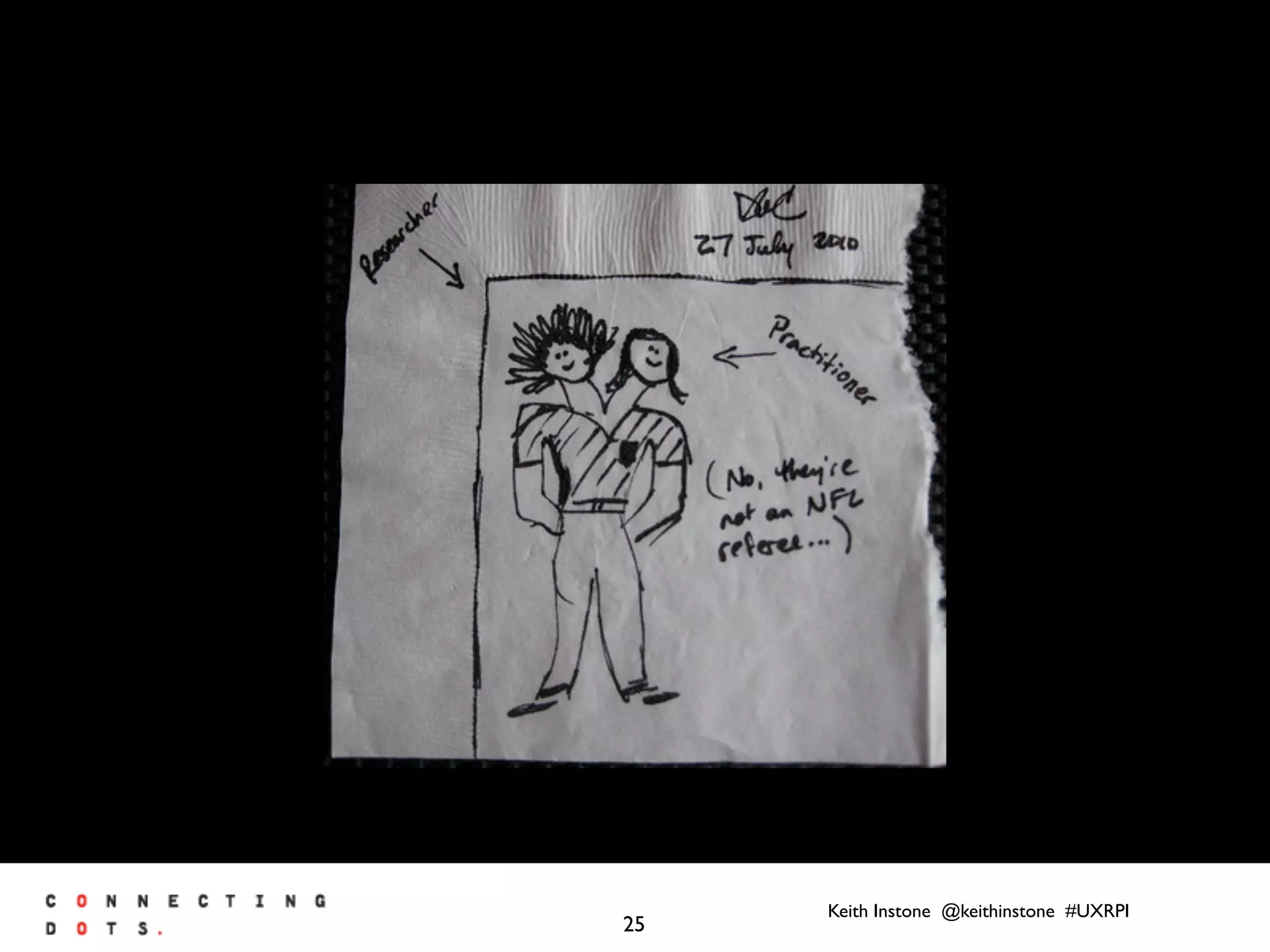
25
Keith Instone @keithinstone #UXRPI
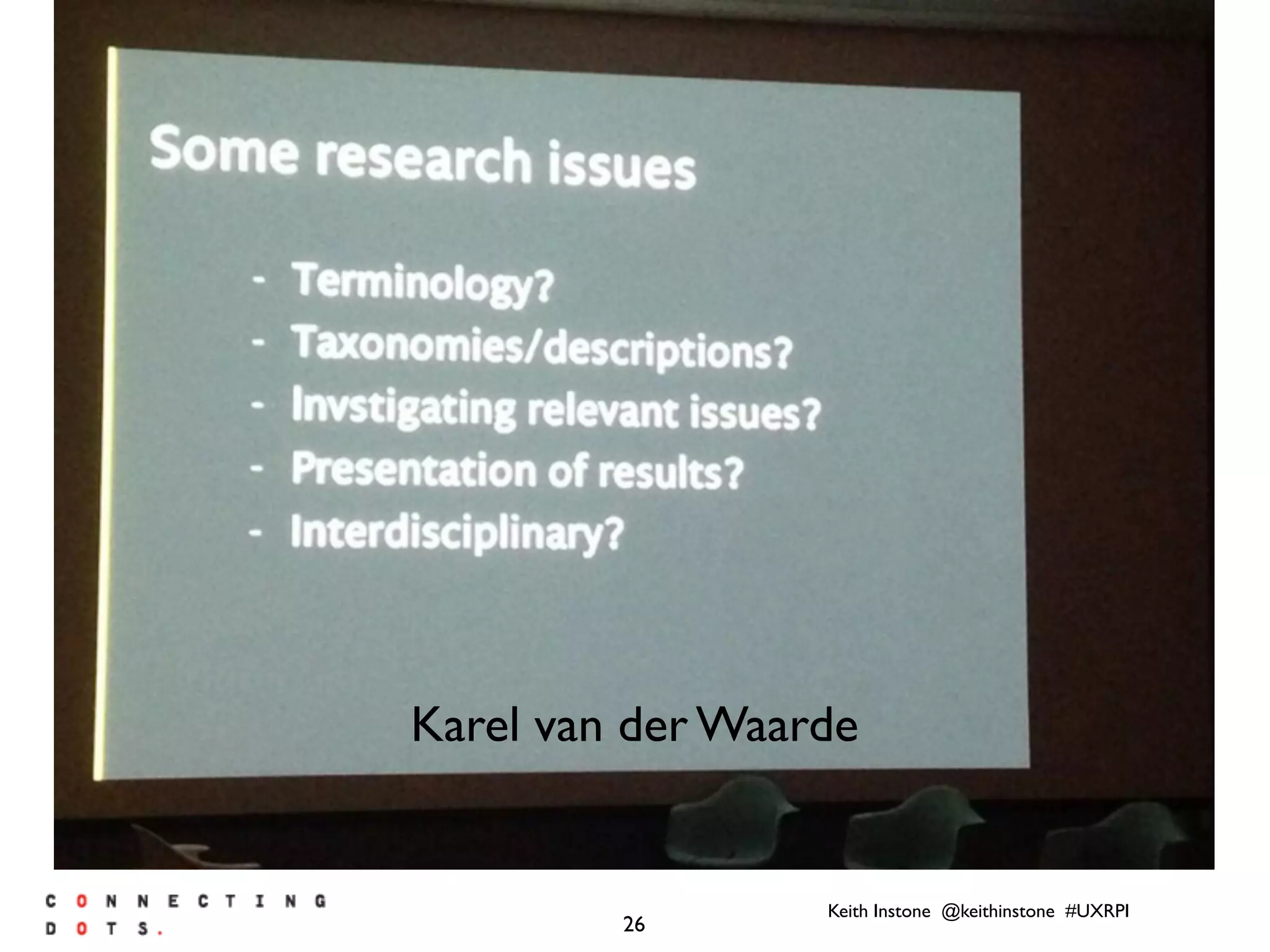
26
Karel van der Waarde
Keith Instone @keithinstone #UXRPI
27
Which problem statements
resonate with you?
Do you have more to add?
(Draw me a picture!)
Keith Instone @keithinstone #UXRPI
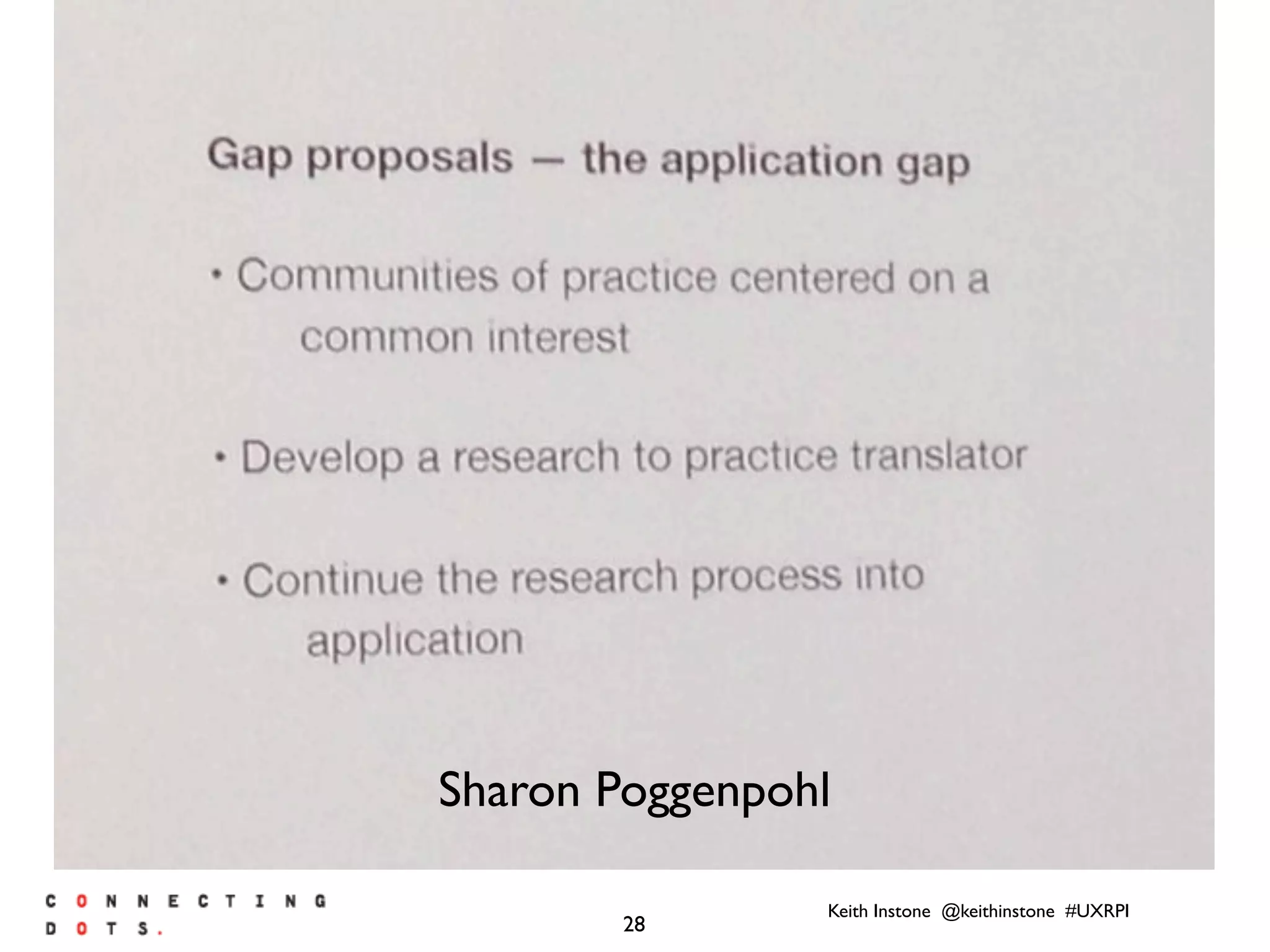
28
Sharon Poggenpohl
Keith Instone @keithinstone #UXRPI
29
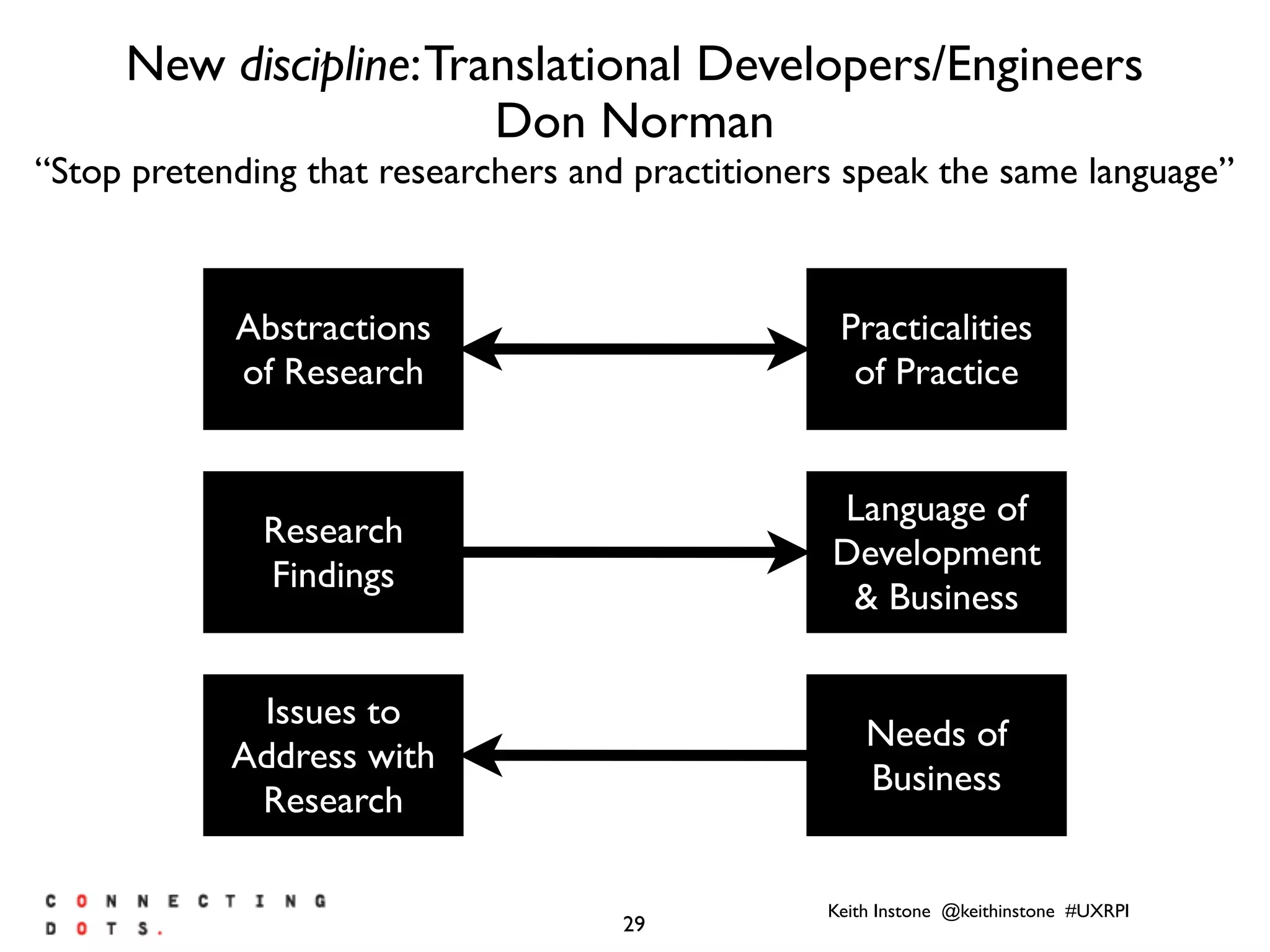
New discipline:Translational Developers/Engineers
Don Norman
โ€œStop pretending that researchers and practitioners speak the same languageโ€
Abstractions
of Research
Practicalities
of Practice
Research
Findings
Language of
Development
& Business
Issues to
Address with
Research
Needs of
Business
Keith Instone @keithinstone #UXRPI
30
Keith Instone @keithinstone #UXRPI
31
Keith Instone @keithinstone #UXRPI
32
Keith Instone @keithinstone #UXRPI
33
Keith Instone @keithinstone #UXRPI
34
Keith Instone @keithinstone #UXRPI
35
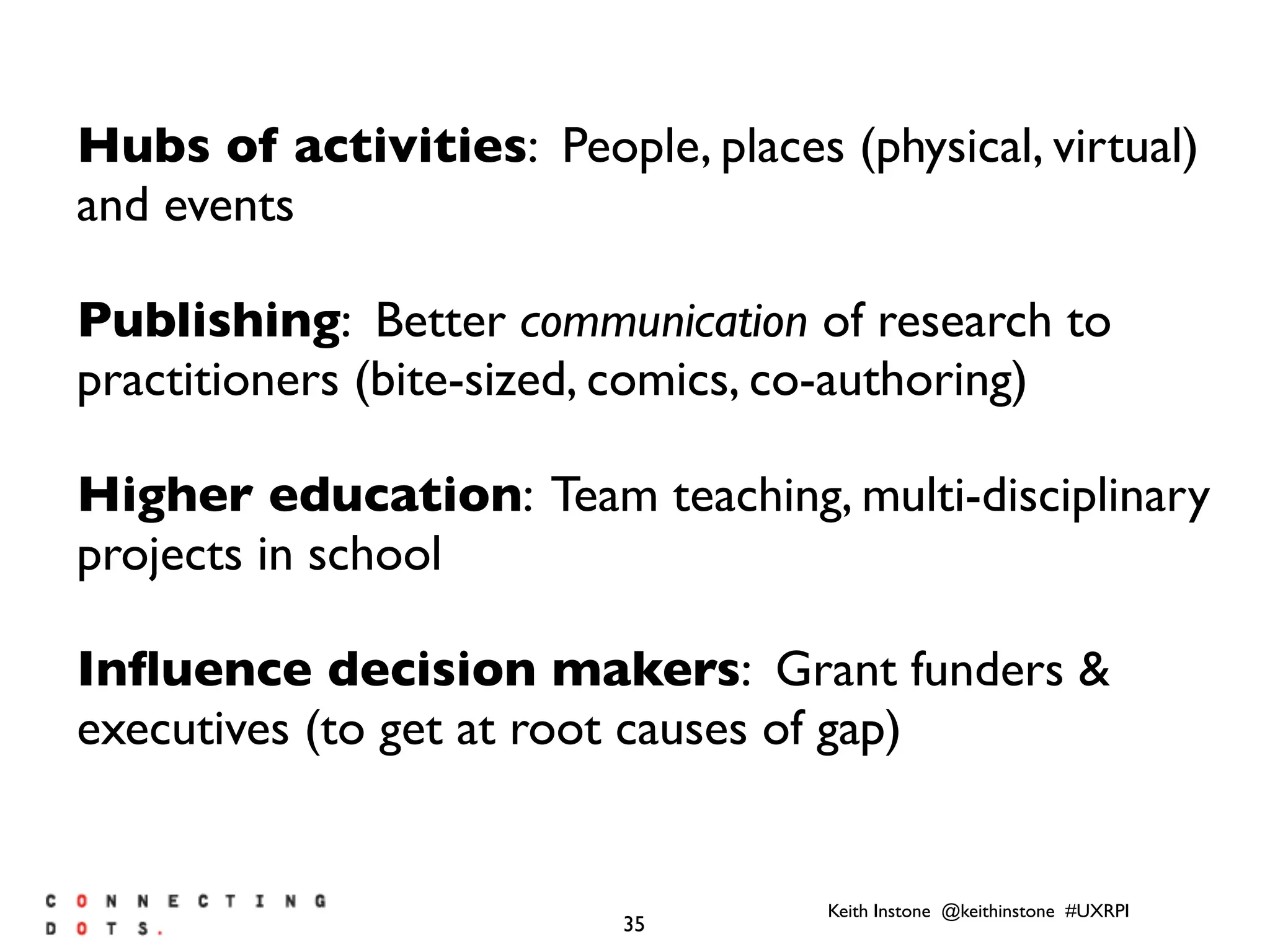
Hubs of activities: People, places (physical, virtual)
and events
Publishing: Better communication of research to
practitioners (bite-sized, comics, co-authoring)
Higher education: Team teaching, multi-disciplinary
projects in school
In๏ฌ‚uence decision makers: Grant funders &
executives (to get at root causes of gap)
Keith Instone @keithinstone #UXRPI
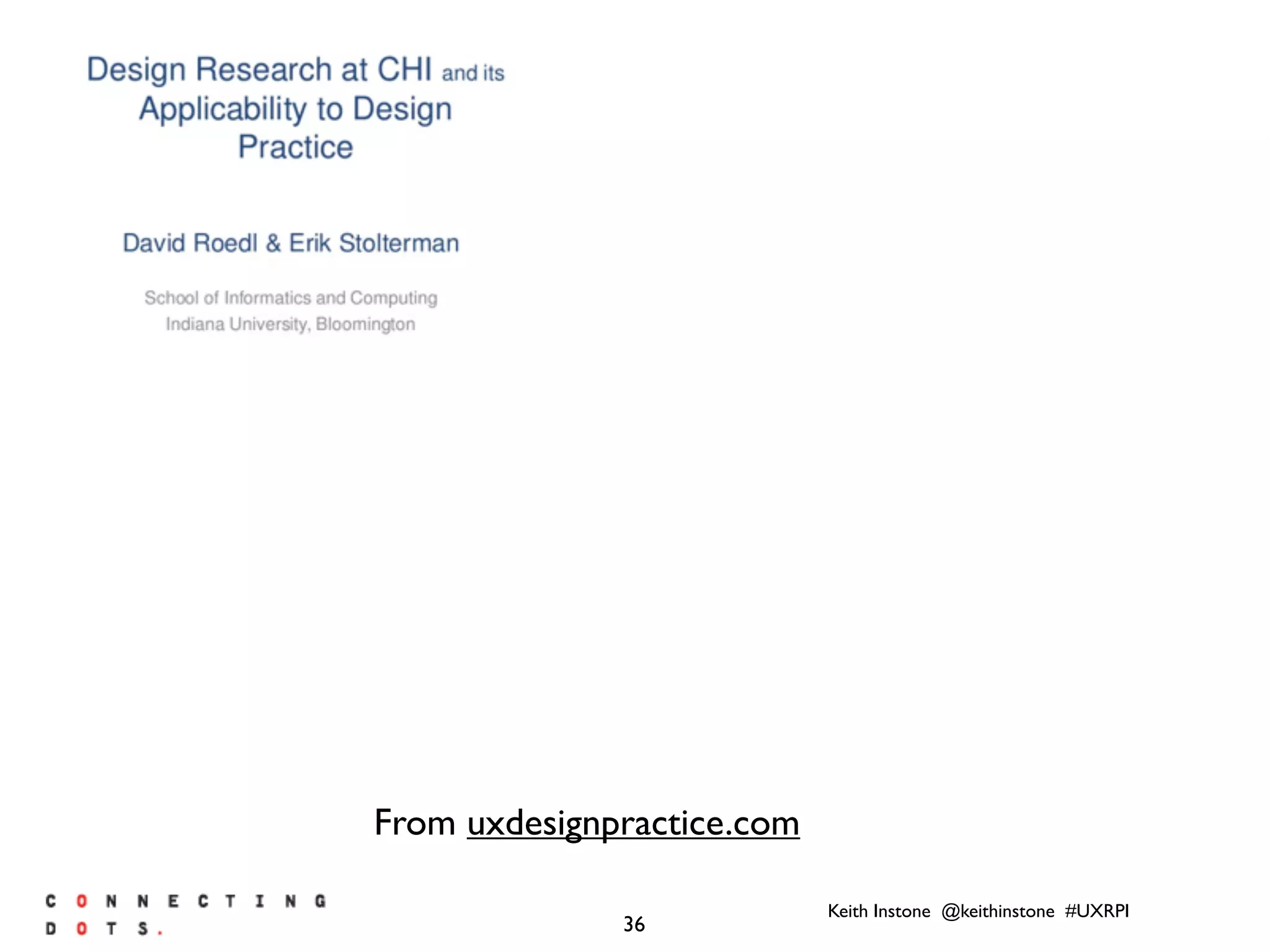
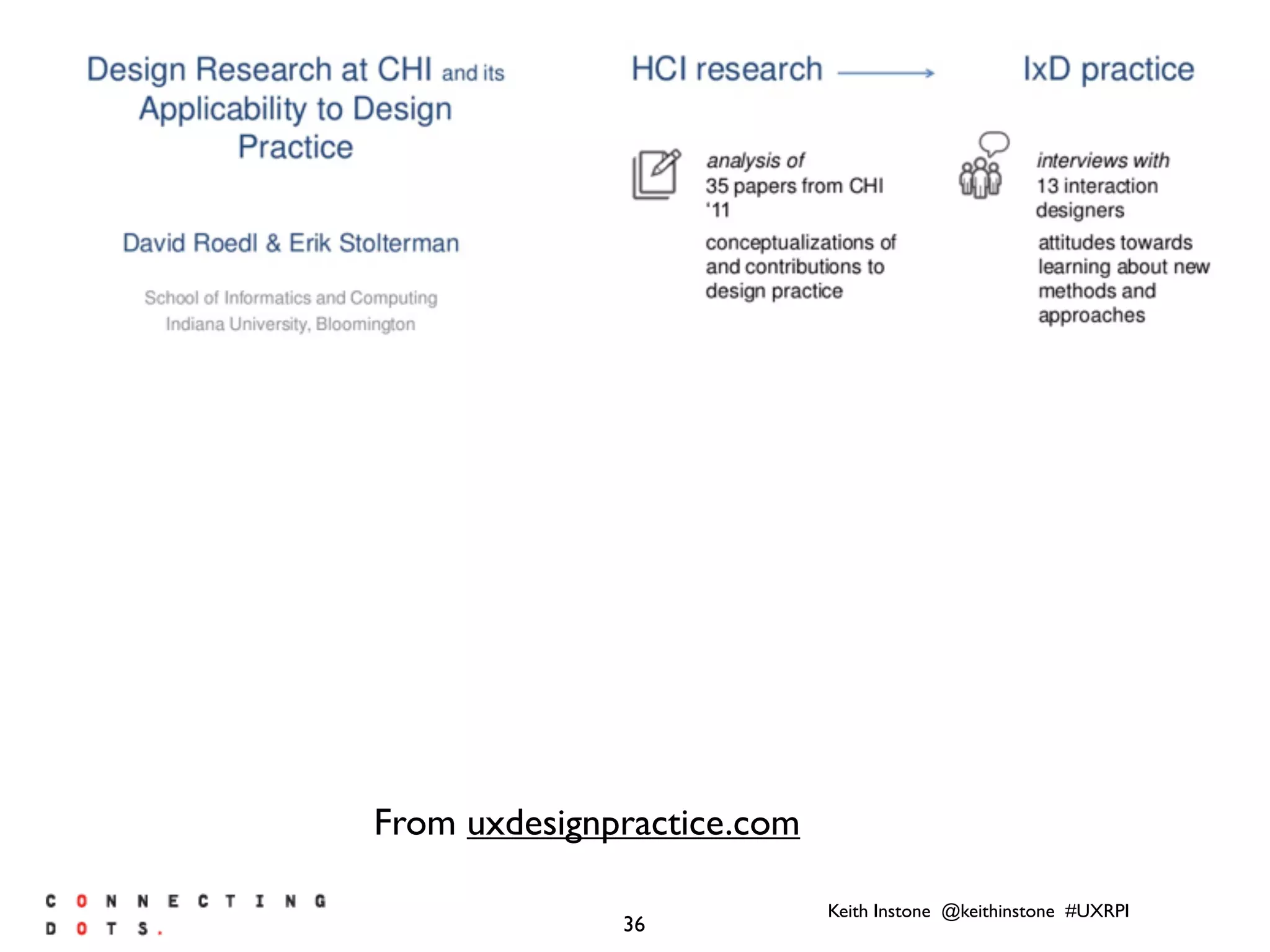
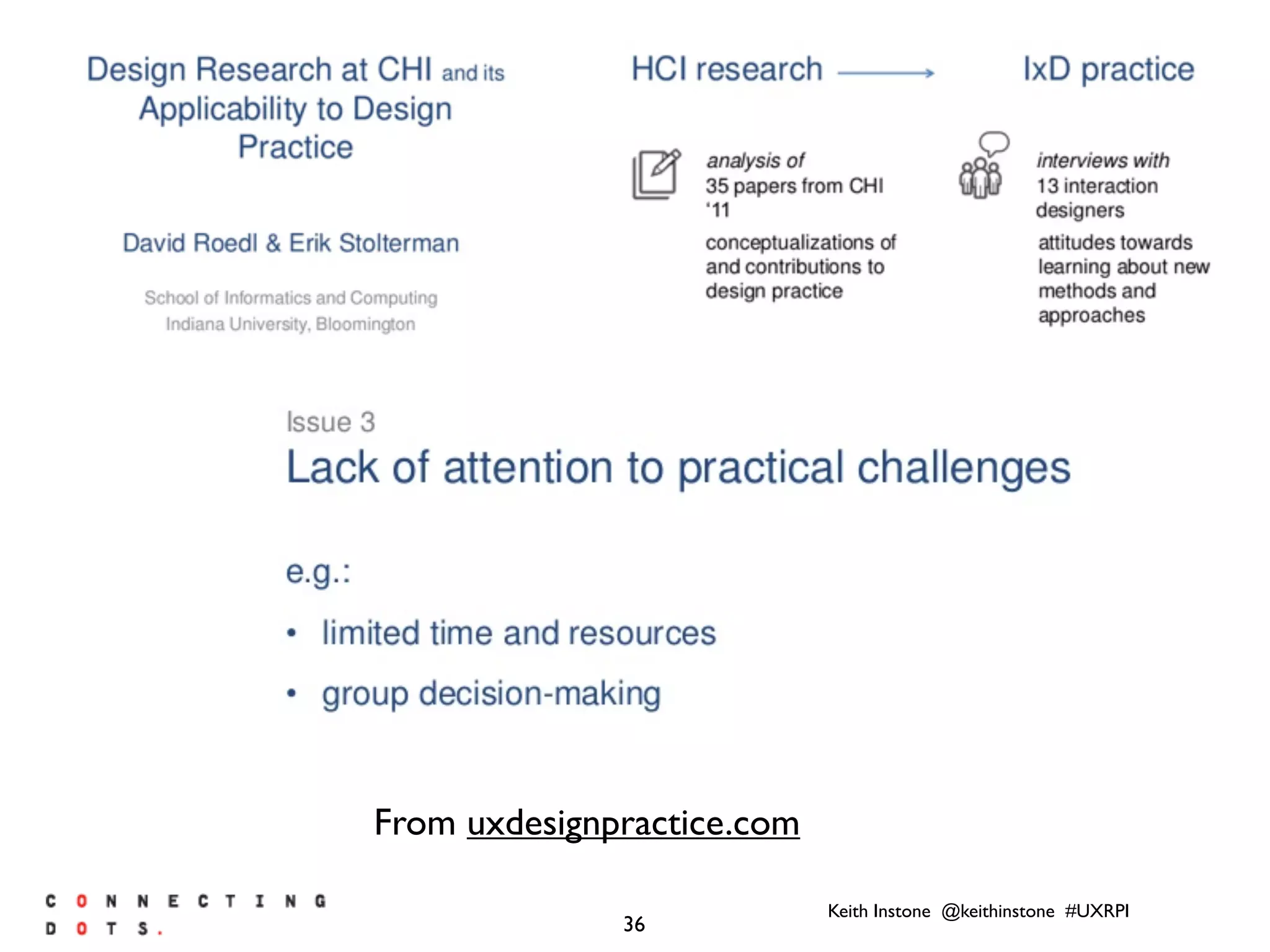
36
From uxdesignpractice.com
Keith Instone @keithinstone #UXRPI
36
From uxdesignpractice.com
Keith Instone @keithinstone #UXRPI
36
From uxdesignpractice.com
Keith Instone @keithinstone #UXRPI
37
Which solutions/ideas resonate
with you?
What is your community doing
well that others can learn from?
Keith Instone @keithinstone #UXRPI
38
How does collaboration happen
across disciplines & professions?
My view: Treat it as a design project
Letโ€™s Connect the Dots to improve
the interaction between
research & practice!
Keith Instone @keithinstone #UXRPI
39
Thanks!
Keith Instone
keith2014@instone.org
@keithinstone
instone.org
#UXRPI

User Experience Research-Practice Interaction (at Connecting Dots)

  • 1.
  • 2.
    Keith Instone @keithinstone#UXRPI 2 BGSU Computer science โ†’ HCI (research) Web usability โ†’ LIS โ†’ IA (practice) IBM (practice) โ†’ UX Strategic UX consulting
  • 3.
    Keith Instone @keithinstone#UXRPI 3 The Disciplined Designer educators.aiga.org/the-disciplined-designer [INFORMATION ARCHITECTURE][USER EXPERIENCE] [INTERACTION DESIGN]
  • 4.
    Keith Instone @keithinstone#UXRPI 4 From Donโ€™t Make Me Think, Steve Krug
  • 5.
  • 6.
  • 7.
  • 8.
    Keith Instone @keithinstone#UXRPI 8 Research: the higher authority for a practitioner
  • 9.
    Keith Instone @keithinstone#UXRPI 9 Research Design Development Research Practice
  • 10.
    Keith Instone @keithinstone#UXRPI 9 Research โ€œUserโ€ Research Design Development Research Practice
  • 11.
    Keith Instone @keithinstone#UXRPI 9 Research โ€œUserโ€ Research Design Development โ€œScienti๏ฌcโ€ Research Research Practice
  • 12.
    Keith Instone @keithinstone#UXRPI 9 Research โ€œUserโ€ Research Design Development โ€œScienti๏ฌcโ€ Research Research Practice Similar methods Different goals
  • 13.
  • 14.
  • 15.
    Keith Instone @keithinstone#UXRPI 11 Breadcrumb Navigation: Further Investigation of Usage By Bonnie Lida Rogers and Barbara Chaparro (2003) usabilitynews.org/breadcrumb-navigation-further-investigation-of-usage/ The purpose of this study is to investigate breadcrumb usage by evaluating the following research questions: 1. Do users choose to use breadcrumbs as a navigational tool? 2. Does breadcrumb usage improve navigational ef๏ฌciency? 3. Does the location of the breadcrumb trail on a page effect usage? 4. Does a breadcrumb trail aid the userโ€™s mental model of the site structure? Forty-๏ฌve participants (20 male, 25 female) with an average age of 27 (range of 18 to 64) volunteered for the usability study....
  • 16.
    Keith Instone @keithinstone#UXRPI 11 Breadcrumb Navigation: Further Investigation of Usage By Bonnie Lida Rogers and Barbara Chaparro (2003) usabilitynews.org/breadcrumb-navigation-further-investigation-of-usage/ The purpose of this study is to investigate breadcrumb usage by evaluating the following research questions: 1. Do users choose to use breadcrumbs as a navigational tool? 2. Does breadcrumb usage improve navigational ef๏ฌciency? 3. Does the location of the breadcrumb trail on a page effect usage? 4. Does a breadcrumb trail aid the userโ€™s mental model of the site structure? Forty-๏ฌve participants (20 male, 25 female) with an average age of 27 (range of 18 to 64) volunteered for the usability study....
  • 17.
    Keith Instone @keithinstone#UXRPI 11 Breadcrumb Navigation: Further Investigation of Usage By Bonnie Lida Rogers and Barbara Chaparro (2003) usabilitynews.org/breadcrumb-navigation-further-investigation-of-usage/ The purpose of this study is to investigate breadcrumb usage by evaluating the following research questions: 1. Do users choose to use breadcrumbs as a navigational tool? 2. Does breadcrumb usage improve navigational ef๏ฌciency? 3. Does the location of the breadcrumb trail on a page effect usage? 4. Does a breadcrumb trail aid the userโ€™s mental model of the site structure? Forty-๏ฌve participants (20 male, 25 female) with an average age of 27 (range of 18 to 64) volunteered for the usability study....
  • 18.
  • 19.
    Keith Instone @keithinstone#UXRPI 13 How Do Users Really Hold Mobile Devices? Steven Hoober uxmatters.com/mt/archives/2013/02/how-do-users-really-hold-mobile-devices.php Iโ€™ve carried out a fresh study of the way people naturally hold and interact with their mobile devices. For two months, ending on January 8, 2013, Iโ€”and a few other researchersโ€”made 1,333 observations of people using mobile devices on the street, in airports, at bus stops, in cafes, on trains and bussesโ€”wherever we might see them.
  • 20.
    Keith Instone @keithinstone#UXRPI 13 How Do Users Really Hold Mobile Devices? Steven Hoober uxmatters.com/mt/archives/2013/02/how-do-users-really-hold-mobile-devices.php Iโ€™ve carried out a fresh study of the way people naturally hold and interact with their mobile devices. For two months, ending on January 8, 2013, Iโ€”and a few other researchersโ€”made 1,333 observations of people using mobile devices on the street, in airports, at bus stops, in cafes, on trains and bussesโ€”wherever we might see them.
  • 21.
    Keith Instone @keithinstone#UXRPI 14 What the $%&#*! is RESEARCH anyway? Is there value in separating types of research? Wikipedia types scienti๏ฌc (hypothesis testing) humanities (historical/context) artistic Karelโ€™s types practical: improve a product, service practice-based: ๏ฌnd patterns in small groups academic: generate & validate knowledge
  • 22.
    Keith Instone @keithinstone#UXRPI 15 If you are a user experience practitioner: What do you wish you had a โ€œscienti๏ฌcโ€ answer to? Have you tried to ๏ฌnd these answers in the research literature? Roadblocks? Successes in applying to your practice?
  • 23.
    Keith Instone @keithinstone#UXRPI 16 If you are a researcher: What is the value of engaging with practitioners for you? Any examples where your research got better because of interactions you had with practitioners?
  • 24.
    Keith Instone @keithinstone#UXRPI 17 What should students be taught about research to better prepare themselves for the practitioner world?
  • 25.
    Keith Instone @keithinstone#UXRPI 18 Research culture โ€œPublish or perishโ€ Answers narrow questions Open sharing Experimentation Corporate culture โ€œProduce or perishโ€ Wants broad answers Strategic advantage Fear of failure
  • 26.
    Keith Instone @keithinstone#UXRPI 19 Research culture โ€œPublish or perishโ€ Answers narrow questions Open sharing Experimentation Corporate culture โ€œProduce or perishโ€ Wants broad answers Strategic advantage Fear of failure HCI research culture Publish for researchers Expanding ๏ฌeld Status within academia UX practice culture No time for research Rapidly evolving practice Status within corporations
  • 27.
    Keith Instone @keithinstone#UXRPI 20 Research culture โ€œPublish or perishโ€ Answers narrow questions Open sharing Experimentation Corporate culture โ€œProduce or perishโ€ Wants broad answers Strategic advantage Fear of failure HCI research culture Publish for researchers Expanding ๏ฌeld Status within academia UX practice culture No time for research Rapidly evolving practice Status within corporations Communication Little shared language Speed-of-operation differences Finding (time for) each other Fragmented professional organizations Mapping โ€œanswersโ€ to โ€œquestionsโ€
  • 28.
    Keith Instone @keithinstone#UXRPI 21 Research culture โ€œPublish or perishโ€ Answers narrow questions Open sharing Experimentation Corporate culture โ€œProduce or perishโ€ Wants broad answers Strategic advantage Fear of failure HCI research culture Publish for researchers Expanding ๏ฌeld Status within academia UX practice culture No time for research Rapidly evolving practice Status within corporations Knowledge No shared knowledge base Hard to organize research for practical use Multi-/inter-disciplinary Communication Little shared language Speed-of-operation differences Finding (time for) each other Fragmented professional organizations Mapping โ€œanswersโ€ to โ€œquestionsโ€
  • 29.
    Keith Instone @keithinstone#UXRPI 22 Research culture โ€œPublish or perishโ€ Answers narrow questions Open sharing Experimentation Corporate culture โ€œProduce or perishโ€ Wants broad answers Strategic advantage Fear of failure HCI research culture Publish for researchers Expanding ๏ฌeld Status within academia UX practice culture No time for research Rapidly evolving practice Status within corporations Education Position of UX within academia Amateur professionals Competing with business for training Knowledge No shared knowledge base Hard to organize research for practical use Multi-/inter-disciplinary Communication Little shared language Speed-of-operation differences Finding (time for) each other Fragmented professional organizations Mapping โ€œanswersโ€ to โ€œquestionsโ€
  • 30.
  • 31.
  • 32.
  • 33.
    Keith Instone @keithinstone#UXRPI 26 Karel van der Waarde
  • 34.
    Keith Instone @keithinstone#UXRPI 27 Which problem statements resonate with you? Do you have more to add? (Draw me a picture!)
  • 35.
    Keith Instone @keithinstone#UXRPI 28 Sharon Poggenpohl
  • 36.
    Keith Instone @keithinstone#UXRPI 29 New discipline:Translational Developers/Engineers Don Norman โ€œStop pretending that researchers and practitioners speak the same languageโ€ Abstractions of Research Practicalities of Practice Research Findings Language of Development & Business Issues to Address with Research Needs of Business
  • 37.
  • 38.
  • 39.
  • 40.
  • 41.
  • 42.
    Keith Instone @keithinstone#UXRPI 35 Hubs of activities: People, places (physical, virtual) and events Publishing: Better communication of research to practitioners (bite-sized, comics, co-authoring) Higher education: Team teaching, multi-disciplinary projects in school In๏ฌ‚uence decision makers: Grant funders & executives (to get at root causes of gap)
  • 43.
    Keith Instone @keithinstone#UXRPI 36 From uxdesignpractice.com
  • 44.
    Keith Instone @keithinstone#UXRPI 36 From uxdesignpractice.com
  • 45.
    Keith Instone @keithinstone#UXRPI 36 From uxdesignpractice.com
  • 46.
    Keith Instone @keithinstone#UXRPI 37 Which solutions/ideas resonate with you? What is your community doing well that others can learn from?
  • 47.
    Keith Instone @keithinstone#UXRPI 38 How does collaboration happen across disciplines & professions? My view: Treat it as a design project Letโ€™s Connect the Dots to improve the interaction between research & practice!
  • 48.
    Keith Instone @keithinstone#UXRPI 39 Thanks! Keith Instone keith2014@instone.org @keithinstone instone.org #UXRPI