1
USEAGE OF CELLULAR SERVICES
Introduction:
We are a group of students who are doing a small scale research in their locality i.e
Peshawar city .We are going to be collecting data from the cellular service providers that
are zong , ufone , warid , mobilink , telenor and check the useage of their services on
different axis , genders etc that how much of the people/population is using which service
and why and we will be asking people the questions about the organizations / should we
ask the organization questions about how much ppl using it?
Gender Analysis
The surveyfor the purpose of analysis was carried out amongst 100 respondents from University of
Peshawar.There were 53 male students and 47 female respondents who responded to this survey
with an average age of 23 years.
Most Preferred Cellular Service in Peshawar
15%
22%
24%
31%
8%
Most Preferred Cellular Service
Mobilink Telenor Warid Ufone Zong
Gender
Frequency Percent ValidPercent
Cumulative
Percent
Valid
Male 53 53.0 53.0 53.0
Female 47 47.0 47.0 47.0
Total 100 100.0 100.0
2
As evident from the figure above, the majority of the cellular users who responded to the
questionnaire prefer Ufone (31%) over all other competing cellular providers in Peshawar. Thus,
Ufone isthe most preferred cellular provider in Peshawar by the younger population. Warid (24%)
holds second place in the line of preference, followed by Telenor (22%), Mobilink (15%) and Zong
(8%).
Major Influence while purchasing a SIM Card
From figure, it can be interpreted that most of the young users of cellular services are highly
influenced by friends (49%) while making the SIMpurchasing decision while 23% make purchases
based on self taken decisions followed by families that influence the decision of purchasing a SIM
card (20%). The least influencing factor found to have affected SIM purchasing decision is that of
Television advertisements (8%).
High Call Rates
23%
20%49%
8%
Influencing Factor
Self Family Friends Television Ads
High Call Rates
Observed N Expected N Residual
Very Likely 41 20.0 21.0
Likely 33 20.0 13.0
Neutral 19 20.0 -1.0
3
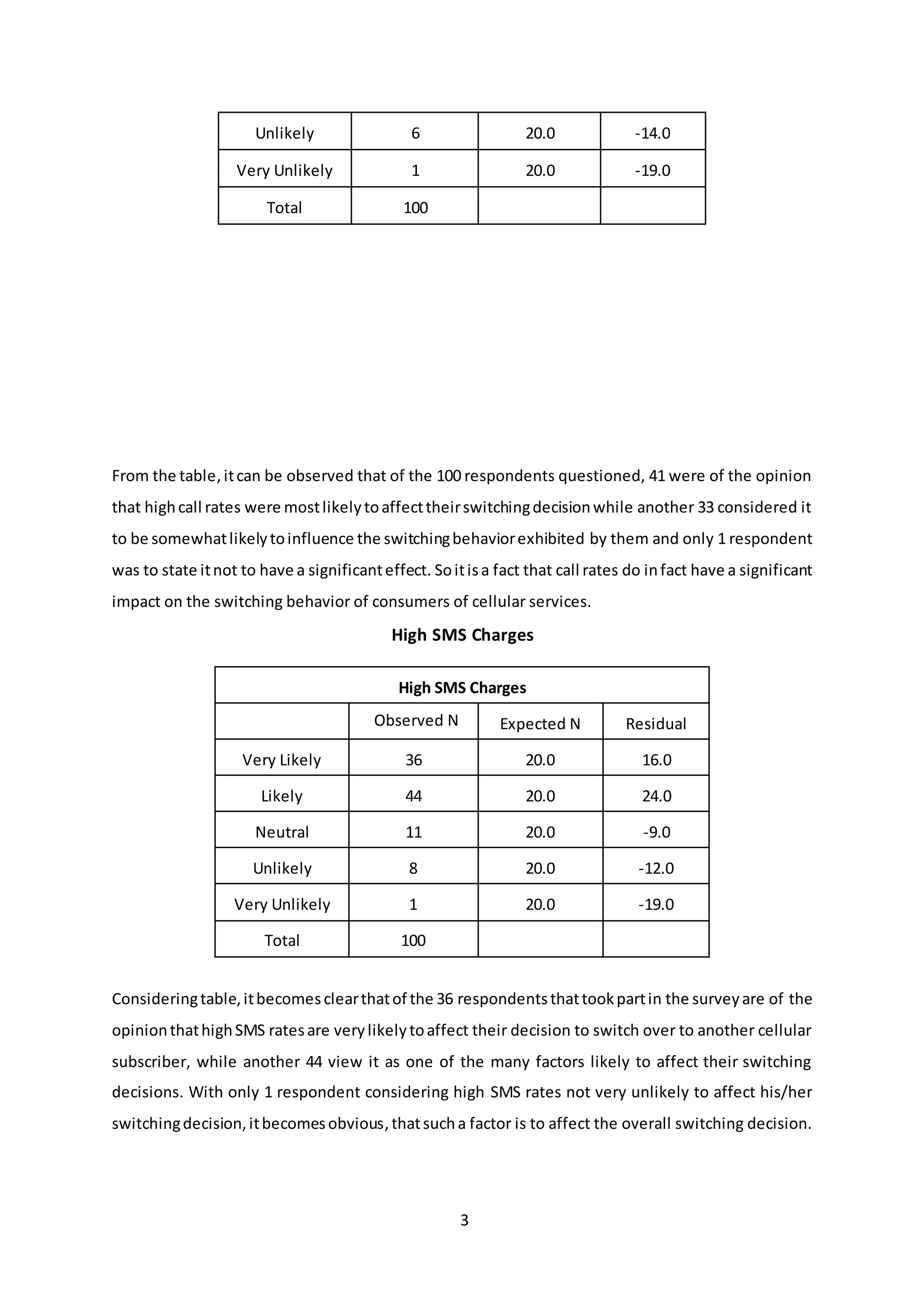
From the table,itcan be observed that of the 100 respondents questioned, 41 were of the opinion
that highcall rates were mostlikelytoaffecttheirswitchingdecisionwhile another 33 considered it
to be somewhatlikelytoinfluence the switchingbehaviorexhibited by them and only 1 respondent
was to state itnot to have a significanteffect. Soitisa fact that call rates do infact have a significant
impact on the switching behavior of consumers of cellular services.
High SMS Charges
High SMS Charges
Observed N Expected N Residual
Very Likely 36 20.0 16.0
Likely 44 20.0 24.0
Neutral 11 20.0 -9.0
Unlikely 8 20.0 -12.0
Very Unlikely 1 20.0 -19.0
Total 100
Consideringtable,itbecomesclearthatof the 36 respondentsthattookpartin the surveyare of the
opinionthathighSMS ratesare verylikelytoaffect their decision to switch over to another cellular
subscriber, while another 44 view it as one of the many factors likely to affect their switching
decisions. With only 1 respondent considering high SMS rates not very unlikely to affect his/her
switchingdecision,itbecomesobvious,thatsucha factor is to affect the overall switching decision.
Unlikely 6 20.0 -14.0
Very Unlikely 1 20.0 -19.0
Total 100
4
Cheaper Tariff Plans offered by Competitors
Cheaper Tariff Plans
ObservedN Expected N Residual
Very Likely 27 20.0 7.0
Likely 43 20.0 23.0
Neutral 16 20.0 -4.0
Unlikely 8 20.0 -12.0
Very Unlikely 6 20.0 -14.0
Total 100
From figure, it is found that cheaper tariff plans offered by competing service providers are also
likelytoaffectthe switchingdecisionof the consumerwhile of the 100 respondentsonly6are of the
opinion that it is the least contributing factor when it comes to switching over to another cellular
service brand.
Cheaper Internet Tariffs offered by Competitors
Cheaper Internet Tariffs
Observed N Expected N Residual
Very Likely 11 20.0 -9.0
Likely 31 20.0 11.0
Neutral 30 20.0 10.0
Unlikely 13 20.0 -7.0
Very Unlikely 15 20.0 -5.0
Total 100
Table represents the responses to the likeliness of cheaper internet tariffs offered by competing
cellular service providers affecting the ultimate switching over decision. While majority of the
respondents (31%) were of the view that such a factor is likely to influence their decision, 13
respondents answered that such a reason was most likely to affect their switching decision.
5
However, referring back to table, it is obvious that such a factor, indeed, is to have a significant
impact on the switching behavior of consumers.
Greater Hidden Charges
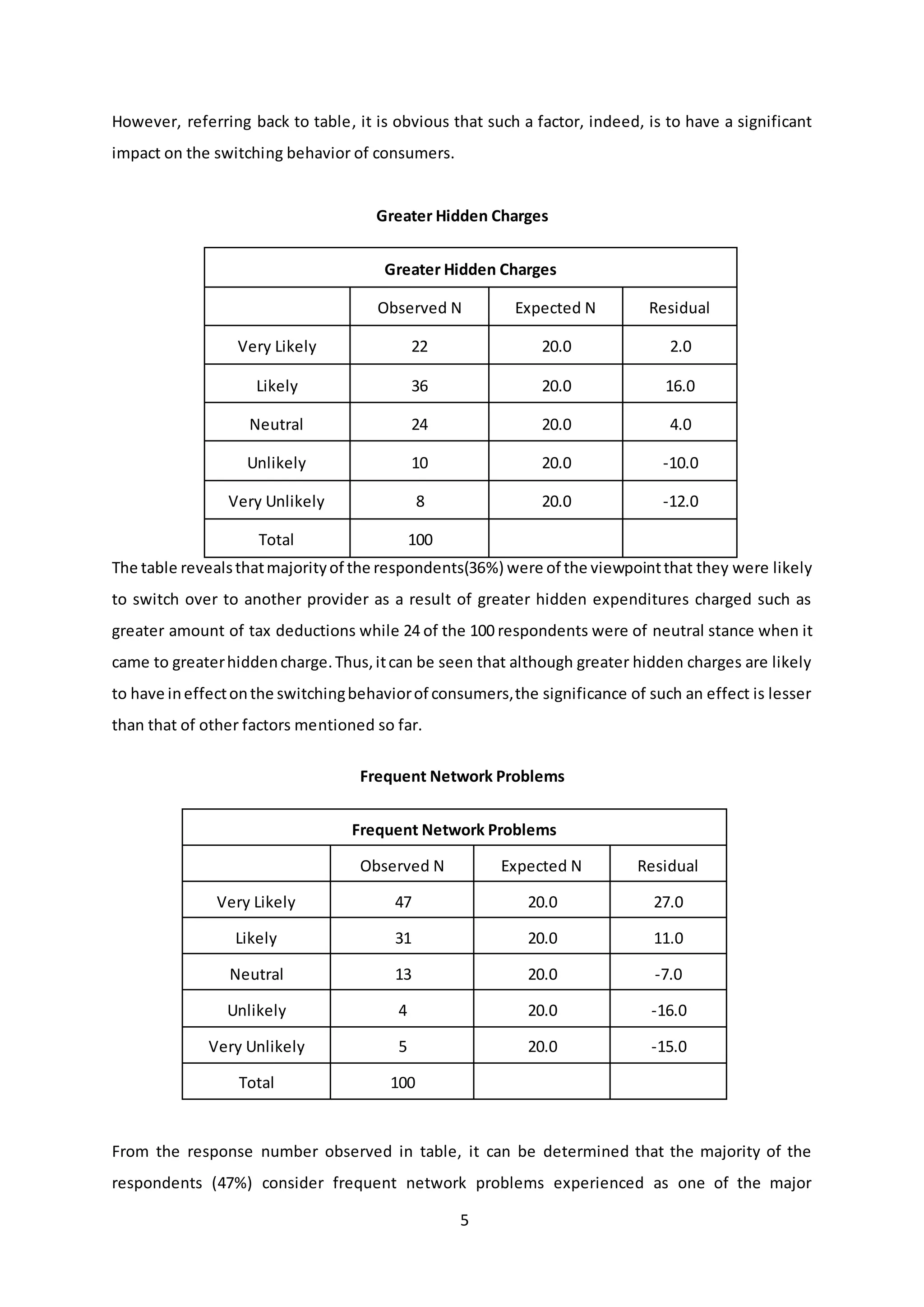
Observed N Expected N Residual
Very Likely 22 20.0 2.0
Likely 36 20.0 16.0
Neutral 24 20.0 4.0
Unlikely 10 20.0 -10.0
Very Unlikely 8 20.0 -12.0
Total 100
The table revealsthatmajorityof the respondents(36%) were of the viewpointthat they were likely
to switch over to another provider as a result of greater hidden expenditures charged such as
greater amount of tax deductions while 24 of the 100 respondents were of neutral stance when it
came to greaterhiddencharge.Thus,itcan be seen that although greater hidden charges are likely
to have ineffectonthe switchingbehaviorof consumers,the significance of such an effect is lesser
than that of other factors mentioned so far.
Frequent Network Problems
Observed N Expected N Residual
Very Likely 47 20.0 27.0
Likely 31 20.0 11.0
Neutral 13 20.0 -7.0
Unlikely 4 20.0 -16.0
Very Unlikely 5 20.0 -15.0
Total 100
From the response number observed in table, it can be determined that the majority of the
respondents (47%) consider frequent network problems experienced as one of the major
6
contributing factors towards their switching behavior while 31 of the respondents hold it likely to
affect their decision. A very few respondents are of the fact that such a factor is not very likely to
affect their switching decision. Thus, it can be observed that frequent network problems
experienced are most likely to have a significant impact on the switching behavior of consumers.
Cheaper Value Added Services offered by Competitors
Cheaper Value Added Services
Observed N Expected N Residual
Very Likely 11 20.0 -9.0
Likely 28 20.0 8.0
Neutral 35 20.0 15.0
Unlikely 9 20.0 -11.0
Very Unlikely 17 20.0 -3.0
Total 100
From the table, it is evident that majority of the respondents that are 35 in number, hold a neutral
stance in a response to the factor of cheaper value added services provided by competing firms
while the second highestnumberof respondents(28%) are of the view that such a factor is likely to
affecttheirdecisionof switchingover.17of the 100 respondentsview this factor as very unlikely to
affect their decisions. Therefore, it is clear that while such a factor is likely to affect the switching
decision of consumers of mobile services, its significant impact is lesser than of other factors and
similar to that of ‘greater hidden charges’.
Improper Consumer Service
Observed N Expected N Residual
Very Likely 21 20.0 1.0
Likely 29 20.0 9.0
Neutral 34 20.0 14.0
Unlikely 12 20.0 -8.0
7
Very Unlikely 4 20.0 -16.0
Total 100
Table represents that while majority of the consumers (34%) hold a neutral view of the impact of
improper consumer service on their switching behavior, 21% view it to have a significant impact
while another 29 % consider it likely to affect their switching decision. Thus improper consumer
service isobservedtohave asignificantimpactonthe switchingbehaviorexhibited by consumers in
the cellular industry.
Long Waiting Periods by Customers
Long Waiting Periods
Observed N Expected N Residual
Very Likely 14 20.0 -6.0
Likely 26 20.0 6.0
Neutral 37 20.0 17.0
Unlikely 19 20.0 -1.0
Very Unlikely 4 20.0 -16.0
Total 100
From table,itisclearthat of the total respondents the majority (37%) opted for a neutral response
to the impact of long waiting periods experienced by consumers while 26% were of the view that
such a factor is likelytoimpacttheirswitchingbehavior.Thus,the factdoeshave a significanton the
switching behavior of consumers.
Behavioral Factors
8
Variety Seeking
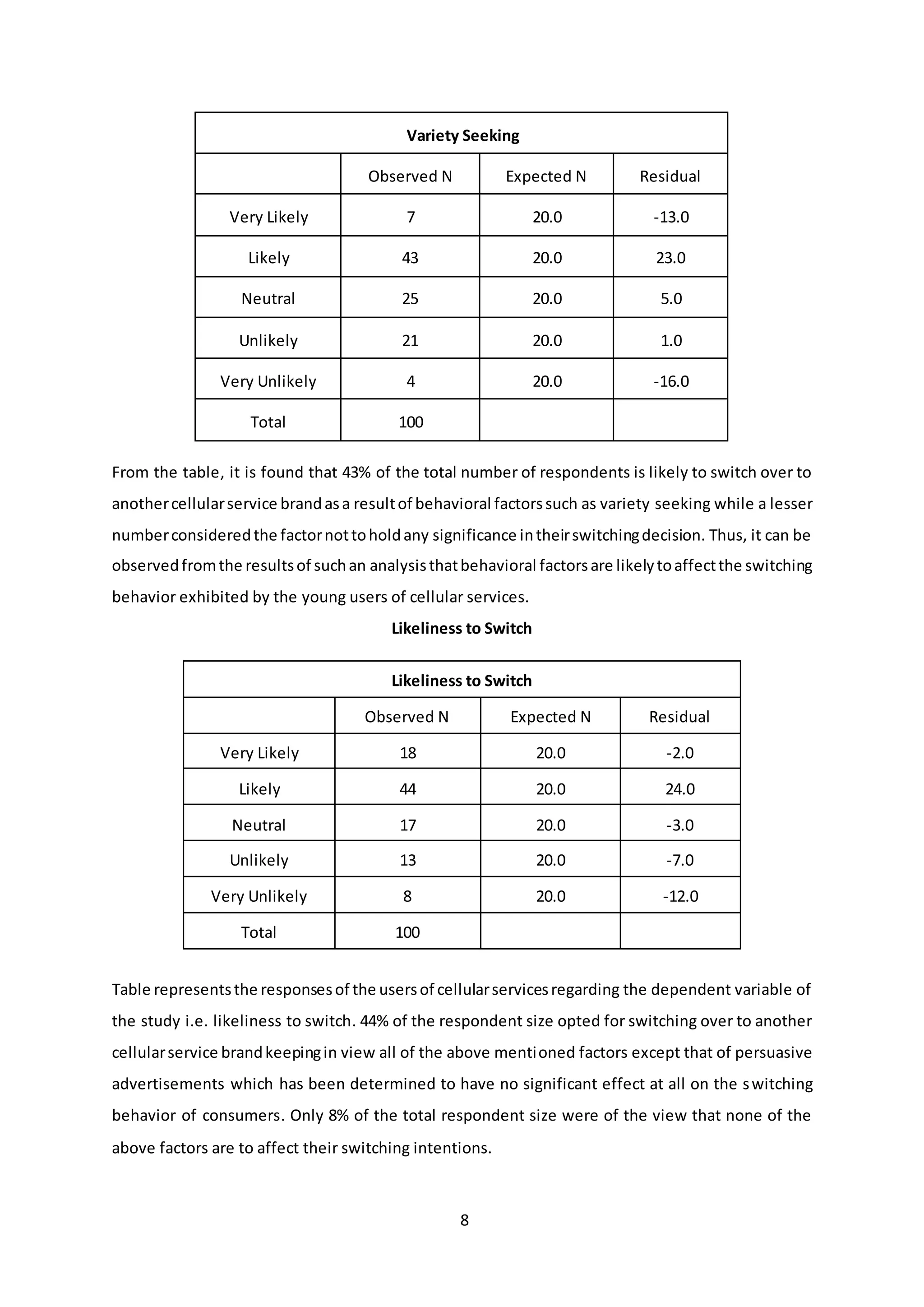
Observed N Expected N Residual
Very Likely 7 20.0 -13.0
Likely 43 20.0 23.0
Neutral 25 20.0 5.0
Unlikely 21 20.0 1.0
Very Unlikely 4 20.0 -16.0
Total 100
From the table, it is found that 43% of the total number of respondents is likely to switch over to
anothercellularservice brandasa resultof behavioral factorssuch as variety seeking while a lesser
numberconsideredthe factornottoholdany significance intheirswitchingdecision. Thus, it can be
observedfromthe resultsof suchan analysisthatbehavioral factorsare likelytoaffectthe switching
behavior exhibited by the young users of cellular services.
Likeliness to Switch
Observed N Expected N Residual
Very Likely 18 20.0 -2.0
Likely 44 20.0 24.0
Neutral 17 20.0 -3.0
Unlikely 13 20.0 -7.0
Very Unlikely 8 20.0 -12.0
Total 100
Table representsthe responsesof the usersof cellularservicesregarding the dependent variable of
the study i.e. likeliness to switch. 44% of the respondent size opted for switching over to another
cellularservice brandkeepingin view all of the above mentioned factors except that of persuasive
advertisements which has been determined to have no significant effect at all on the switching
behavior of consumers. Only 8% of the total respondent size were of the view that none of the
above factors are to affect their switching intentions.
9
Findings
 In accordance with the survey undertaken, it has been found that Ufone (31%) is the most
preferred cellular service amongst the young population of Peshawar followed by Warid
(24%), Telenor (22%), Mobilink (15%) and Zong (8%).
 The study alsopointsoutthe fact that the youngpopulationof the cityismost influencedby
friends (49%) while making the decision of purchasing a new SIMfollowed by self (23%),
families (20%) and Television advertisements (8%).
 The surveyand the analysishasrevealedthatthe independentfactorsof highcall rates, high
SMS charges, cheaper call and internet tariffs offered by competitors and greater hidden
charges such as tax deductions do exhibit a significant effect on the switching behavior of
consumers. These variables collectively make up the determinant of price, thus it can be
assumed that price does play a major role in determining the switching decision of
consumers.
 It has alsobeen uncovered that consumer service quality factors such as frequent network
problemsexperienced,widenetworkcoverage andcheapervalue addedservicesoffered by
competitors, improper consumer service experiences as a result of unknowledgeable
employeesaswell aslongwaitingperiodsdue toslow service processare alsolikelytoaffect
the switching behavior exhibited by cellular users.
Conclusion
Results drawn exhibit the fact that while the factors of price, consumer service quality as well as
varietyseekingare chief determinantsof switching behavior observed amongst the cellular service
consumers, persuasive advertisements are least likely to affect a consumers decision to switch.
Outcomes of the study also exhibit that the most preferred cellular service amongst the young
populationisthatof Ufone,contributingfromthe factthat Ufone has primarilybeenpositioned as a
cellularservice especiallyforthe young.The studyhasalso uncovered that the decision to purchase
a newSIMis mostlikelytobe manipulatedbytheirfriends sustainedbythe reality that the younger
market is more closely in contact with friends via cell phones and thus subscribe for the same
cellular providers to cut down on usage costs. The conclusions drawn regarding the independent
variables and their consequent effect on switching can be supported with the fact that consumers
that fall withinthe age categorydefinedforthe surveyare more price conscious and observed to be
10
more appealed towards greater variety and innovation. Also, with the widespread use of cellular
services, consumers are focusing more on the quality of the service and expect greater quality
enhancements on behalf of the service firms in order to maintain as loyals.
Questionnaire
Note: The following questionnaire has been designed for the purpose of studying the Switching
Behavior exhibited by consumers and its determinants in the cellular service industry of Pakistan
withreference tothe cityof Peshawar. It is expected of the respondents to devote few minutes of
their time to pick the answer of their preference.
Age _______________
Gender_______________
Instructions: Kindly,encircle the answerof yourchoice.
1. Whichcellularservice providerof Pakistan ismostpreferredbyyou?
 Mobilink • Telenor • Warid • Ufone • Zong
2. What are the majorinfluencesthatswingyourdecisiontopurchase anew SIMcard?
 Self • Family • Friends • Televison •Ads
 Very
Likely
Likely Neutral Unlikely Very
Unlikely
 .
3. Highcall ratesare likelytoaffectyourdecision
of switchingovertoanotherservice provider.
1 2 3 4 5
11
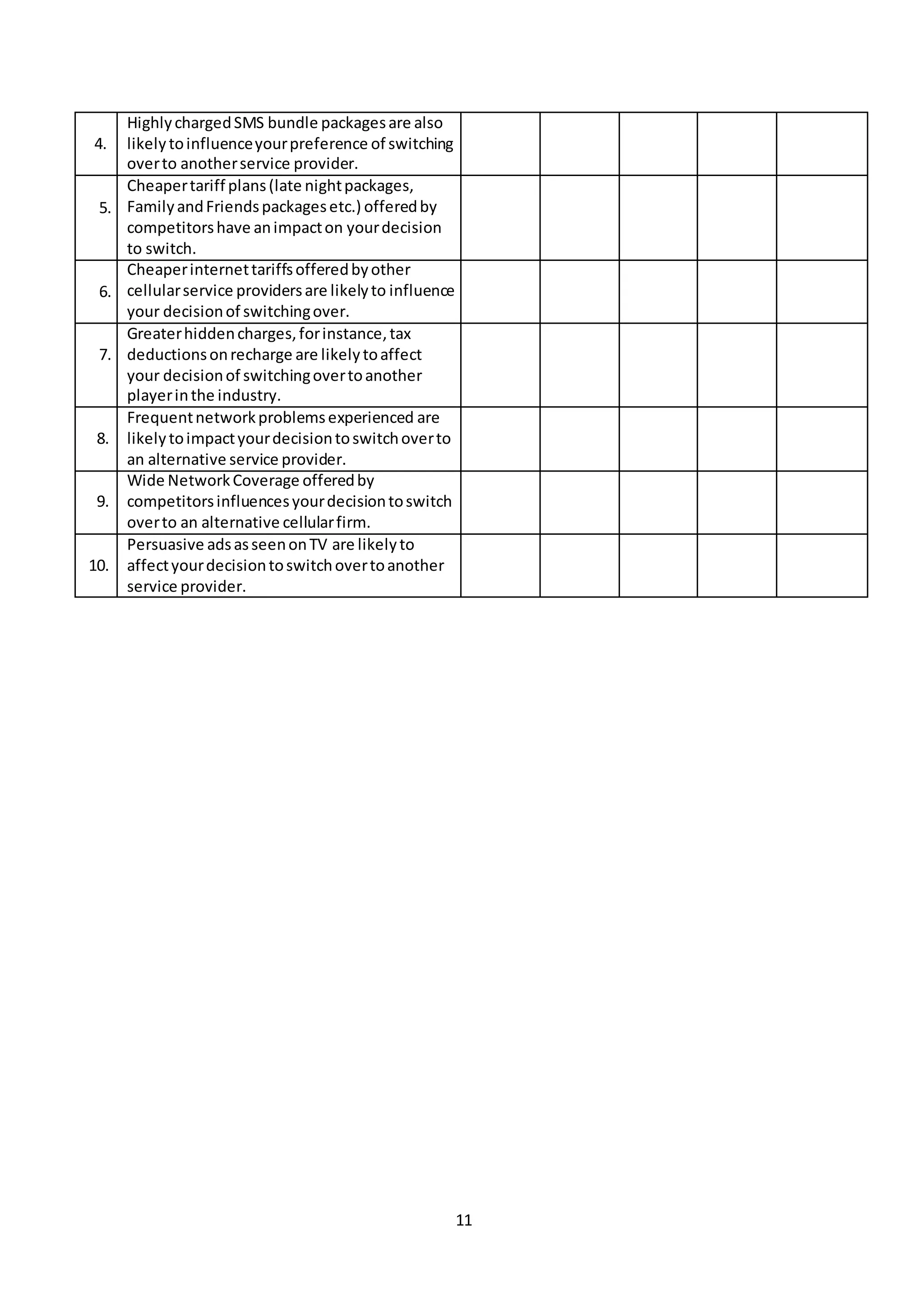
4.
HighlychargedSMS bundle packagesare also
likelytoinfluenceyourpreference of switching
overto anotherservice provider.
 4
5.
Cheapertariff plans(late nightpackages,
FamilyandFriendspackagesetc.) offeredby
competitorshave animpacton yourdecision
to switch.

6.
Cheaperinternettariffsofferedbyother
cellularservice providersare likelyto influence
your decisionof switchingover.
 5
7.
Greaterhiddencharges,forinstance,tax
deductionsonrecharge are likelytoaffect
your decisionof switchingovertoanother
playerinthe industry.
8.
Frequentnetworkproblemsexperienced are
likelytoimpactyourdecisiontoswitchoverto
an alternative service provider.
9.
Wide NetworkCoverage offeredby
competitorsinfluencesyourdecisiontoswitch
overto an alternative cellularfirm.
10.
Persuasive adsasseenonTV are likelyto
affectyourdecisiontoswitchovertoanother
service provider.

USEAGE OF CELLULAR SERVICES Most Preferred Cellular Service

  • 1.
    1 USEAGE OF CELLULARSERVICES Introduction: We are a group of students who are doing a small scale research in their locality i.e Peshawar city .We are going to be collecting data from the cellular service providers that are zong , ufone , warid , mobilink , telenor and check the useage of their services on different axis , genders etc that how much of the people/population is using which service and why and we will be asking people the questions about the organizations / should we ask the organization questions about how much ppl using it? Gender Analysis The surveyfor the purpose of analysis was carried out amongst 100 respondents from University of Peshawar.There were 53 male students and 47 female respondents who responded to this survey with an average age of 23 years. Most Preferred Cellular Service in Peshawar 15% 22% 24% 31% 8% Most Preferred Cellular Service Mobilink Telenor Warid Ufone Zong Gender Frequency Percent ValidPercent Cumulative Percent Valid Male 53 53.0 53.0 53.0 Female 47 47.0 47.0 47.0 Total 100 100.0 100.0
  • 2.
    2 As evident fromthe figure above, the majority of the cellular users who responded to the questionnaire prefer Ufone (31%) over all other competing cellular providers in Peshawar. Thus, Ufone isthe most preferred cellular provider in Peshawar by the younger population. Warid (24%) holds second place in the line of preference, followed by Telenor (22%), Mobilink (15%) and Zong (8%). Major Influence while purchasing a SIM Card From figure, it can be interpreted that most of the young users of cellular services are highly influenced by friends (49%) while making the SIMpurchasing decision while 23% make purchases based on self taken decisions followed by families that influence the decision of purchasing a SIM card (20%). The least influencing factor found to have affected SIM purchasing decision is that of Television advertisements (8%). High Call Rates 23% 20%49% 8% Influencing Factor Self Family Friends Television Ads High Call Rates Observed N Expected N Residual Very Likely 41 20.0 21.0 Likely 33 20.0 13.0 Neutral 19 20.0 -1.0
  • 3.
    3 From the table,itcanbe observed that of the 100 respondents questioned, 41 were of the opinion that highcall rates were mostlikelytoaffecttheirswitchingdecisionwhile another 33 considered it to be somewhatlikelytoinfluence the switchingbehaviorexhibited by them and only 1 respondent was to state itnot to have a significanteffect. Soitisa fact that call rates do infact have a significant impact on the switching behavior of consumers of cellular services. High SMS Charges High SMS Charges Observed N Expected N Residual Very Likely 36 20.0 16.0 Likely 44 20.0 24.0 Neutral 11 20.0 -9.0 Unlikely 8 20.0 -12.0 Very Unlikely 1 20.0 -19.0 Total 100 Consideringtable,itbecomesclearthatof the 36 respondentsthattookpartin the surveyare of the opinionthathighSMS ratesare verylikelytoaffect their decision to switch over to another cellular subscriber, while another 44 view it as one of the many factors likely to affect their switching decisions. With only 1 respondent considering high SMS rates not very unlikely to affect his/her switchingdecision,itbecomesobvious,thatsucha factor is to affect the overall switching decision. Unlikely 6 20.0 -14.0 Very Unlikely 1 20.0 -19.0 Total 100
  • 4.
    4 Cheaper Tariff Plansoffered by Competitors Cheaper Tariff Plans ObservedN Expected N Residual Very Likely 27 20.0 7.0 Likely 43 20.0 23.0 Neutral 16 20.0 -4.0 Unlikely 8 20.0 -12.0 Very Unlikely 6 20.0 -14.0 Total 100 From figure, it is found that cheaper tariff plans offered by competing service providers are also likelytoaffectthe switchingdecisionof the consumerwhile of the 100 respondentsonly6are of the opinion that it is the least contributing factor when it comes to switching over to another cellular service brand. Cheaper Internet Tariffs offered by Competitors Cheaper Internet Tariffs Observed N Expected N Residual Very Likely 11 20.0 -9.0 Likely 31 20.0 11.0 Neutral 30 20.0 10.0 Unlikely 13 20.0 -7.0 Very Unlikely 15 20.0 -5.0 Total 100 Table represents the responses to the likeliness of cheaper internet tariffs offered by competing cellular service providers affecting the ultimate switching over decision. While majority of the respondents (31%) were of the view that such a factor is likely to influence their decision, 13 respondents answered that such a reason was most likely to affect their switching decision.
  • 5.
    5 However, referring backto table, it is obvious that such a factor, indeed, is to have a significant impact on the switching behavior of consumers. Greater Hidden Charges Greater Hidden Charges Observed N Expected N Residual Very Likely 22 20.0 2.0 Likely 36 20.0 16.0 Neutral 24 20.0 4.0 Unlikely 10 20.0 -10.0 Very Unlikely 8 20.0 -12.0 Total 100 The table revealsthatmajorityof the respondents(36%) were of the viewpointthat they were likely to switch over to another provider as a result of greater hidden expenditures charged such as greater amount of tax deductions while 24 of the 100 respondents were of neutral stance when it came to greaterhiddencharge.Thus,itcan be seen that although greater hidden charges are likely to have ineffectonthe switchingbehaviorof consumers,the significance of such an effect is lesser than that of other factors mentioned so far. Frequent Network Problems Frequent Network Problems Observed N Expected N Residual Very Likely 47 20.0 27.0 Likely 31 20.0 11.0 Neutral 13 20.0 -7.0 Unlikely 4 20.0 -16.0 Very Unlikely 5 20.0 -15.0 Total 100 From the response number observed in table, it can be determined that the majority of the respondents (47%) consider frequent network problems experienced as one of the major
  • 6.
    6 contributing factors towardstheir switching behavior while 31 of the respondents hold it likely to affect their decision. A very few respondents are of the fact that such a factor is not very likely to affect their switching decision. Thus, it can be observed that frequent network problems experienced are most likely to have a significant impact on the switching behavior of consumers. Cheaper Value Added Services offered by Competitors Cheaper Value Added Services Observed N Expected N Residual Very Likely 11 20.0 -9.0 Likely 28 20.0 8.0 Neutral 35 20.0 15.0 Unlikely 9 20.0 -11.0 Very Unlikely 17 20.0 -3.0 Total 100 From the table, it is evident that majority of the respondents that are 35 in number, hold a neutral stance in a response to the factor of cheaper value added services provided by competing firms while the second highestnumberof respondents(28%) are of the view that such a factor is likely to affecttheirdecisionof switchingover.17of the 100 respondentsview this factor as very unlikely to affect their decisions. Therefore, it is clear that while such a factor is likely to affect the switching decision of consumers of mobile services, its significant impact is lesser than of other factors and similar to that of ‘greater hidden charges’. Improper Consumer Service Improper Consumer Service Observed N Expected N Residual Very Likely 21 20.0 1.0 Likely 29 20.0 9.0 Neutral 34 20.0 14.0 Unlikely 12 20.0 -8.0
  • 7.
    7 Very Unlikely 420.0 -16.0 Total 100 Table represents that while majority of the consumers (34%) hold a neutral view of the impact of improper consumer service on their switching behavior, 21% view it to have a significant impact while another 29 % consider it likely to affect their switching decision. Thus improper consumer service isobservedtohave asignificantimpactonthe switchingbehaviorexhibited by consumers in the cellular industry. Long Waiting Periods by Customers Long Waiting Periods Observed N Expected N Residual Very Likely 14 20.0 -6.0 Likely 26 20.0 6.0 Neutral 37 20.0 17.0 Unlikely 19 20.0 -1.0 Very Unlikely 4 20.0 -16.0 Total 100 From table,itisclearthat of the total respondents the majority (37%) opted for a neutral response to the impact of long waiting periods experienced by consumers while 26% were of the view that such a factor is likelytoimpacttheirswitchingbehavior.Thus,the factdoeshave a significanton the switching behavior of consumers. Behavioral Factors
  • 8.
    8 Variety Seeking Observed NExpected N Residual Very Likely 7 20.0 -13.0 Likely 43 20.0 23.0 Neutral 25 20.0 5.0 Unlikely 21 20.0 1.0 Very Unlikely 4 20.0 -16.0 Total 100 From the table, it is found that 43% of the total number of respondents is likely to switch over to anothercellularservice brandasa resultof behavioral factorssuch as variety seeking while a lesser numberconsideredthe factornottoholdany significance intheirswitchingdecision. Thus, it can be observedfromthe resultsof suchan analysisthatbehavioral factorsare likelytoaffectthe switching behavior exhibited by the young users of cellular services. Likeliness to Switch Likeliness to Switch Observed N Expected N Residual Very Likely 18 20.0 -2.0 Likely 44 20.0 24.0 Neutral 17 20.0 -3.0 Unlikely 13 20.0 -7.0 Very Unlikely 8 20.0 -12.0 Total 100 Table representsthe responsesof the usersof cellularservicesregarding the dependent variable of the study i.e. likeliness to switch. 44% of the respondent size opted for switching over to another cellularservice brandkeepingin view all of the above mentioned factors except that of persuasive advertisements which has been determined to have no significant effect at all on the switching behavior of consumers. Only 8% of the total respondent size were of the view that none of the above factors are to affect their switching intentions.
  • 9.
    9 Findings  In accordancewith the survey undertaken, it has been found that Ufone (31%) is the most preferred cellular service amongst the young population of Peshawar followed by Warid (24%), Telenor (22%), Mobilink (15%) and Zong (8%).  The study alsopointsoutthe fact that the youngpopulationof the cityismost influencedby friends (49%) while making the decision of purchasing a new SIMfollowed by self (23%), families (20%) and Television advertisements (8%).  The surveyand the analysishasrevealedthatthe independentfactorsof highcall rates, high SMS charges, cheaper call and internet tariffs offered by competitors and greater hidden charges such as tax deductions do exhibit a significant effect on the switching behavior of consumers. These variables collectively make up the determinant of price, thus it can be assumed that price does play a major role in determining the switching decision of consumers.  It has alsobeen uncovered that consumer service quality factors such as frequent network problemsexperienced,widenetworkcoverage andcheapervalue addedservicesoffered by competitors, improper consumer service experiences as a result of unknowledgeable employeesaswell aslongwaitingperiodsdue toslow service processare alsolikelytoaffect the switching behavior exhibited by cellular users. Conclusion Results drawn exhibit the fact that while the factors of price, consumer service quality as well as varietyseekingare chief determinantsof switching behavior observed amongst the cellular service consumers, persuasive advertisements are least likely to affect a consumers decision to switch. Outcomes of the study also exhibit that the most preferred cellular service amongst the young populationisthatof Ufone,contributingfromthe factthat Ufone has primarilybeenpositioned as a cellularservice especiallyforthe young.The studyhasalso uncovered that the decision to purchase a newSIMis mostlikelytobe manipulatedbytheirfriends sustainedbythe reality that the younger market is more closely in contact with friends via cell phones and thus subscribe for the same cellular providers to cut down on usage costs. The conclusions drawn regarding the independent variables and their consequent effect on switching can be supported with the fact that consumers that fall withinthe age categorydefinedforthe surveyare more price conscious and observed to be
  • 10.
    10 more appealed towardsgreater variety and innovation. Also, with the widespread use of cellular services, consumers are focusing more on the quality of the service and expect greater quality enhancements on behalf of the service firms in order to maintain as loyals. Questionnaire Note: The following questionnaire has been designed for the purpose of studying the Switching Behavior exhibited by consumers and its determinants in the cellular service industry of Pakistan withreference tothe cityof Peshawar. It is expected of the respondents to devote few minutes of their time to pick the answer of their preference. Age _______________ Gender_______________ Instructions: Kindly,encircle the answerof yourchoice. 1. Whichcellularservice providerof Pakistan ismostpreferredbyyou?  Mobilink • Telenor • Warid • Ufone • Zong 2. What are the majorinfluencesthatswingyourdecisiontopurchase anew SIMcard?  Self • Family • Friends • Televison •Ads  Very Likely Likely Neutral Unlikely Very Unlikely  . 3. Highcall ratesare likelytoaffectyourdecision of switchingovertoanotherservice provider. 1 2 3 4 5
  • 11.
    11 4. HighlychargedSMS bundle packagesarealso likelytoinfluenceyourpreference of switching overto anotherservice provider.  4 5. Cheapertariff plans(late nightpackages, FamilyandFriendspackagesetc.) offeredby competitorshave animpacton yourdecision to switch.  6. Cheaperinternettariffsofferedbyother cellularservice providersare likelyto influence your decisionof switchingover.  5 7. Greaterhiddencharges,forinstance,tax deductionsonrecharge are likelytoaffect your decisionof switchingovertoanother playerinthe industry. 8. Frequentnetworkproblemsexperienced are likelytoimpactyourdecisiontoswitchoverto an alternative service provider. 9. Wide NetworkCoverage offeredby competitorsinfluencesyourdecisiontoswitch overto an alternative cellularfirm. 10. Persuasive adsasseenonTV are likelyto affectyourdecisiontoswitchovertoanother service provider.