MEASURING EFFECTIVENESS OF
    TELECOM REGULATION


             PRESENTED BY:
             KASHIF NAVEED
             10E0052

1
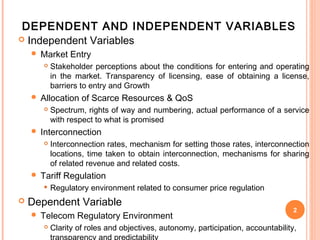
DEPENDENT AND INDEPENDENT VARIABLES
 Independent Variables
       Market Entry
           Stakeholder perceptions about the conditions for entering and operating
            in the market. Transparency of licensing, ease of obtaining a license,
            barriers to entry and Growth
       Allocation of Scarce Resources & QoS
           Spectrum, rights of way and numbering, actual performance of a service
            with respect to what is promised
       Interconnection
           Interconnection rates, mechanism for setting those rates, interconnection
            locations, time taken to obtain interconnection, mechanisms for sharing
            of related revenue and related costs.
       Tariff Regulation
           Regulatory environment related to consumer price regulation
   Dependent Variable
                                                                                    2
       Telecom Regulatory Environment
           Clarity of roles and objectives, autonomy, participation, accountability,
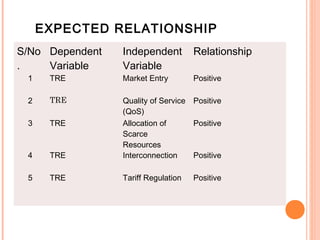
EXPECTED RELATIONSHIP
S/No Dependent   Independent         Relationship
.    Variable    Variable
 1    TRE        Market Entry        Positive

 2    TRE        Quality of Service Positive
                 (QoS)
 3    TRE        Allocation of      Positive
                 Scarce
                 Resources
 4    TRE        Interconnection    Positive

 5    TRE        Tariff Regulation   Positive
DATA COLLECTION METHOD

 Survey    Technique (Primary Data)
       Opinion of those directly or indirectly impacted by regulatory actions


                                                                                 4
SAMPLE SIZE
   Category-I
 Those directly involved in service provision within the sector such as
  operators, equipment vendors equipment manufacturers.
 Sample Size : 30
   Category-II
 Those indirectly impacted by the sector or those studying and those
  observing the sector with broader interest such as consultants and
  lawyers.
 Sample Size : >100
   Category-III
 Those who represent the broader public interest such as media
  personnel, other government officials, former regulators and staff,
  and civil society organizations.
 Sample Size : >500                                                       5
INSTRUMENTS
 Questionnaire (Quantitative)
 Questionnaire  was framed in the format of Likert scale for
  data collection.
 The responses ranged between Highly Ineffective to Highly
  Effective


                                                                6
FINDINGS
   The conditions for obtaining a new mobile license or renewing and exiting one
    are straightforward - each operator has to pay USD 291 million.
   License conditions are enforced
   operators indeed negotiate their      interconnection   rates   mutually(RIO-
    Reference Interconnection Offer)
   Tariff Regulation have even improved since 2006 ,Fixed has increased from
    3.7 to 3.9; mobile has increased from 3.5 to 3.9)
   QoS has improved since 2006.


                                                                               7
FUTURE RESEARCH DIRECTIONS
   Higher TRE scores necessarily result in increased
    connectivity, increased choice etc, after controlling for other
    factors (such as the political climate, economic conditions )


                                                                      8

Measuring effectiveness of telecom regulation

  • 1.
    MEASURING EFFECTIVENESS OF TELECOM REGULATION PRESENTED BY: KASHIF NAVEED 10E0052 1
  • 2.
    DEPENDENT AND INDEPENDENTVARIABLES  Independent Variables  Market Entry  Stakeholder perceptions about the conditions for entering and operating in the market. Transparency of licensing, ease of obtaining a license, barriers to entry and Growth  Allocation of Scarce Resources & QoS  Spectrum, rights of way and numbering, actual performance of a service with respect to what is promised  Interconnection  Interconnection rates, mechanism for setting those rates, interconnection locations, time taken to obtain interconnection, mechanisms for sharing of related revenue and related costs.  Tariff Regulation  Regulatory environment related to consumer price regulation  Dependent Variable 2  Telecom Regulatory Environment  Clarity of roles and objectives, autonomy, participation, accountability,
  • 3.
    EXPECTED RELATIONSHIP S/No Dependent Independent Relationship . Variable Variable 1 TRE Market Entry Positive 2 TRE Quality of Service Positive (QoS) 3 TRE Allocation of Positive Scarce Resources 4 TRE Interconnection Positive 5 TRE Tariff Regulation Positive
  • 4.
    DATA COLLECTION METHOD Survey Technique (Primary Data)  Opinion of those directly or indirectly impacted by regulatory actions 4
  • 5.
    SAMPLE SIZE  Category-I  Those directly involved in service provision within the sector such as operators, equipment vendors equipment manufacturers.  Sample Size : 30  Category-II  Those indirectly impacted by the sector or those studying and those observing the sector with broader interest such as consultants and lawyers.  Sample Size : >100  Category-III  Those who represent the broader public interest such as media personnel, other government officials, former regulators and staff, and civil society organizations.  Sample Size : >500 5
  • 6.
    INSTRUMENTS  Questionnaire (Quantitative) Questionnaire was framed in the format of Likert scale for data collection.  The responses ranged between Highly Ineffective to Highly Effective 6
  • 7.
    FINDINGS  The conditions for obtaining a new mobile license or renewing and exiting one are straightforward - each operator has to pay USD 291 million.  License conditions are enforced  operators indeed negotiate their interconnection rates mutually(RIO- Reference Interconnection Offer)  Tariff Regulation have even improved since 2006 ,Fixed has increased from 3.7 to 3.9; mobile has increased from 3.5 to 3.9)  QoS has improved since 2006. 7
  • 8.
    FUTURE RESEARCH DIRECTIONS  Higher TRE scores necessarily result in increased connectivity, increased choice etc, after controlling for other factors (such as the political climate, economic conditions ) 8