Fresh Flower
Care & Handling
Care and Handling
Vase Life-length of time flowers remain
beautiful
Senescence-flower death
Why flowers wilt and die prematurely
Stem diameter and thickness
Genetics
Inability of the stem to absorb water
Lack of carbohydrates
Excessive transpiration
Bacterial growth and disease
Ethylene gas
Improper surrounding conditions
The Chain of Life
 The Chain of Life-a long chain of handlers
involved in moving the floral product from the
greenhouse/field to the design bench
 Grower- harvest flowers and ship them to an auction
 Broker-receives large quantities from foreign countries and
domestic growers
 Shipper-ships by air or truck to wholesalers
 Wholesaler-receives flowers from brokers and growers;
conditions flowers and sells to retail florists
 Florist-receives flowers from wholesalers and local growers;
conditions flowers and sells and delivers flowers to consumers
 Customer-receives flowers as a gift or purchases them for
personal enjoyment
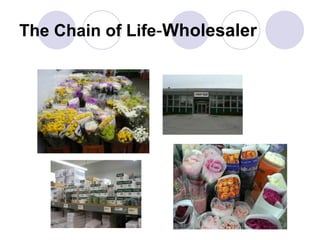
The Chain of Life-Wholesaler
Chemical Treatments
Rehydrating
Add hydrating solution to water after harvesting
plant material
encourages water absorption and maintains turgidity
Repeat if cut flowers transported out of water
rehydrate with clean, good quality water
Use a biocide and or an acidifier
Chemical Treatments
Pulsing-method of conditioning in which
fresh cut plant material is in a particular
solution for a certain time
contains sugars like sucrose
given with growth regulators
used to inhibit bacterial growth
improve product quality during shipping &
storage to extend the ultimate vase life of the
flowers
important to know about how the product has
been cared for along its journey
Chemical Treatments
Preventing the effects of ethylene gas--
Ethylene
naturally occurring plant hormone
involved in the aging process
released as an odorless, colorless gas
extremely harmful to cut flowers
produced by ripening fruit & vegetables,
decomposing plant material, bacteria, and burning of
gasoline, diesel fuel, firewood, and tobacco
Treatment-silver thiosufate solution
General Guidelines on Care and
Handling
On receiving cut plant material:
Open and unpack immediately
Allow the produce to breathe
Check name, quantity, & price against invoice
Remember correct plant & variety name for
future reference
Check quality and look for damage
General Guidelines on Care and
Handling
Begin re-cutting and conditioning
immediately
Use properly sanitized buckets
Bacteria shortens the lifespan of cut flowers
and foliage.
Sanitize knives, cutters, work surfaces, coolers
& buckets.
General Guidelines on Care and
Handling
Fill the buckets with six to eight inches
of clean, lukewarm water.
100-110 Degrees F
Warm water will encourage the development
and opening of the plant material.
General Guidelines on Care and
Handling
Add a correctly measured amount of
the appropriate floral preservative to
clean water and make sure that it is
well dissolved.
Floral preservative doubles the vase life of cut
flowers.
Floral preservative ingredients
 Sugars
carbohydrates to nourish
 Biocides
inhibits the growth of microorganisms
 Acidifiers
lowers pH levels
 Growth regulators
to increase the vase life of some flowers
 Wetting agents
to aid in water absorption
General Guidelines on Care and
Handling
Remove any foliage that will be below
the water line
Discourages bacterial growth
avoid damaging the stem’s skin when stripping
juices from stem causes extra bacterial growth
General Guidelines on Care and
Handling
 Cut 1-3 inches off the bottoms of the stems
Re-cutting exposes fresh, healthy tissue to better
uptake water
Callus—outer cells surrounding cut that dry out-
preventing uptake
repeated cutting under the same water can pollute
with accumulating debris and bacteria
cut the plant stem at a 45-degree slant using a knife
 exposes a maximum area of clean, open cells
 keeps the bottom of the stem from resting flat on the bottom
of the bucket, further impeding water uptake.
General Guidelines on Care and
Handling
 If a product has not been pre-treated, do so
by placing or dipping into an appropriate
hydrating solution.
 Place flowers into buckets containing warm,
pre-mixed nutrient solution.
 Prevent unnecessary handling
Dirt or salt and sweat on the hands can easily stain and
leave permanent damage on delicate plant surfaces.
General Guidelines on Care and
Handling
Condition the product
Leave product to recover and acclimatize for
several hours
Product becomes fully hydrated
Encourages bud development
General Guidelines on Care and
Handling
Store product at the right temperature
and humidity
A lower temperature slows the respiration rate
of cut plant material
Storage temperature--36-38 degrees F
Tropical plant materials—store 55-60 degrees
F.
Humidity--minimum of 80%
General Guidelines on Care and
Handling
 Rotate stock
 Always practice the ‘First In, First Out’ rule.
 Maintain proper care and handling practices at the
design bench
 Use plant material sensibly and pay attention to its needs
and its destination.
 Soak floral foam and bouquet holders in clean water with
nutrient solution
 Keep cut flowers in water rather than laying them on the
bench
 Include a packet of floral preservative with wrapped flowers
and hand tied bouquets.
 Include care instructions with flowers that are delivered.

General Guidelines on Care and
Handling
 Keep up with regular maintenance
Remove dead flowers
Remove empty buckets and clean carefully
Change the water in the buckets and replace with the
correct cut flower food
Re-stock partly filled buckets from flower stock
Care and Handling
of Floral Arrangements
 Care tag
 Replenish water preservative solution
 Misting
 Remove wilted and re-cut or discard
 Keep away from ethylene sources
 Keep out of direct sunlight
 Avoid warm sources (TV, microwave)
 Avoid drafts
Examples of Care and Handling
Experiments
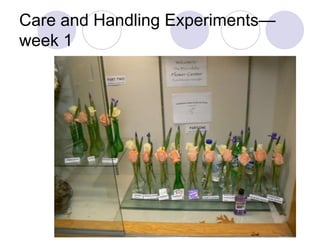
Care and Handling Experiments—
week 1
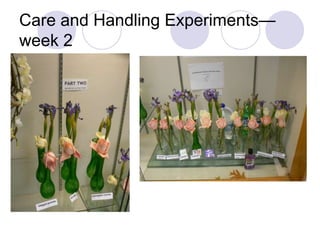
Care and Handling Experiments—
week 2
Care and Handling Experiments
Some of the home remedies added to the
water were:
Bleach and lemon-lime soda
Listerine
Sugar and vinegar
Lemon juice, sugar, bleach
Aspirin and a penny
Clear water
Care and Handling Experiments
Some of the preservative solutions added
to the water were:
Floralife preservative solution
Nutriflo preservative solution
Aqualplus preservative solution
Care and Handling Experiments
Some of the methods of cutting the stems
were:
Underwater
In the air
Crushing stems
Cutting with scissors
Cutting with knife
Cutting with pruners
Not re-cutting the stems
Care and Handling Experiments
Some methods of storing plant material:
Cooler vs. room temp
Any variable temperatures
Store on a microwave or TV

335-J-Fresh-Flower-Care-Handling.ppt

  • 1.
  • 2.
    Care and Handling VaseLife-length of time flowers remain beautiful Senescence-flower death
  • 3.
    Why flowers wiltand die prematurely Stem diameter and thickness Genetics Inability of the stem to absorb water Lack of carbohydrates Excessive transpiration Bacterial growth and disease Ethylene gas Improper surrounding conditions
  • 4.
    The Chain ofLife  The Chain of Life-a long chain of handlers involved in moving the floral product from the greenhouse/field to the design bench  Grower- harvest flowers and ship them to an auction  Broker-receives large quantities from foreign countries and domestic growers  Shipper-ships by air or truck to wholesalers  Wholesaler-receives flowers from brokers and growers; conditions flowers and sells to retail florists  Florist-receives flowers from wholesalers and local growers; conditions flowers and sells and delivers flowers to consumers  Customer-receives flowers as a gift or purchases them for personal enjoyment
  • 5.
    The Chain ofLife-Wholesaler
  • 6.
    Chemical Treatments Rehydrating Add hydratingsolution to water after harvesting plant material encourages water absorption and maintains turgidity Repeat if cut flowers transported out of water rehydrate with clean, good quality water Use a biocide and or an acidifier
  • 7.
    Chemical Treatments Pulsing-method ofconditioning in which fresh cut plant material is in a particular solution for a certain time contains sugars like sucrose given with growth regulators used to inhibit bacterial growth improve product quality during shipping & storage to extend the ultimate vase life of the flowers important to know about how the product has been cared for along its journey
  • 8.
    Chemical Treatments Preventing theeffects of ethylene gas-- Ethylene naturally occurring plant hormone involved in the aging process released as an odorless, colorless gas extremely harmful to cut flowers produced by ripening fruit & vegetables, decomposing plant material, bacteria, and burning of gasoline, diesel fuel, firewood, and tobacco Treatment-silver thiosufate solution
  • 9.
    General Guidelines onCare and Handling On receiving cut plant material: Open and unpack immediately Allow the produce to breathe Check name, quantity, & price against invoice Remember correct plant & variety name for future reference Check quality and look for damage
  • 10.
    General Guidelines onCare and Handling Begin re-cutting and conditioning immediately Use properly sanitized buckets Bacteria shortens the lifespan of cut flowers and foliage. Sanitize knives, cutters, work surfaces, coolers & buckets.
  • 11.
    General Guidelines onCare and Handling Fill the buckets with six to eight inches of clean, lukewarm water. 100-110 Degrees F Warm water will encourage the development and opening of the plant material.
  • 12.
    General Guidelines onCare and Handling Add a correctly measured amount of the appropriate floral preservative to clean water and make sure that it is well dissolved. Floral preservative doubles the vase life of cut flowers.
  • 13.
    Floral preservative ingredients Sugars carbohydrates to nourish  Biocides inhibits the growth of microorganisms  Acidifiers lowers pH levels  Growth regulators to increase the vase life of some flowers  Wetting agents to aid in water absorption
  • 14.
    General Guidelines onCare and Handling Remove any foliage that will be below the water line Discourages bacterial growth avoid damaging the stem’s skin when stripping juices from stem causes extra bacterial growth
  • 15.
    General Guidelines onCare and Handling  Cut 1-3 inches off the bottoms of the stems Re-cutting exposes fresh, healthy tissue to better uptake water Callus—outer cells surrounding cut that dry out- preventing uptake repeated cutting under the same water can pollute with accumulating debris and bacteria cut the plant stem at a 45-degree slant using a knife  exposes a maximum area of clean, open cells  keeps the bottom of the stem from resting flat on the bottom of the bucket, further impeding water uptake.
  • 16.
    General Guidelines onCare and Handling  If a product has not been pre-treated, do so by placing or dipping into an appropriate hydrating solution.  Place flowers into buckets containing warm, pre-mixed nutrient solution.  Prevent unnecessary handling Dirt or salt and sweat on the hands can easily stain and leave permanent damage on delicate plant surfaces.
  • 17.
    General Guidelines onCare and Handling Condition the product Leave product to recover and acclimatize for several hours Product becomes fully hydrated Encourages bud development
  • 18.
    General Guidelines onCare and Handling Store product at the right temperature and humidity A lower temperature slows the respiration rate of cut plant material Storage temperature--36-38 degrees F Tropical plant materials—store 55-60 degrees F. Humidity--minimum of 80%
  • 19.
    General Guidelines onCare and Handling  Rotate stock  Always practice the ‘First In, First Out’ rule.  Maintain proper care and handling practices at the design bench  Use plant material sensibly and pay attention to its needs and its destination.  Soak floral foam and bouquet holders in clean water with nutrient solution  Keep cut flowers in water rather than laying them on the bench  Include a packet of floral preservative with wrapped flowers and hand tied bouquets.  Include care instructions with flowers that are delivered. 
  • 20.
    General Guidelines onCare and Handling  Keep up with regular maintenance Remove dead flowers Remove empty buckets and clean carefully Change the water in the buckets and replace with the correct cut flower food Re-stock partly filled buckets from flower stock
  • 21.
    Care and Handling ofFloral Arrangements  Care tag  Replenish water preservative solution  Misting  Remove wilted and re-cut or discard  Keep away from ethylene sources  Keep out of direct sunlight  Avoid warm sources (TV, microwave)  Avoid drafts
  • 22.
    Examples of Careand Handling Experiments
  • 23.
    Care and HandlingExperiments— week 1
  • 24.
    Care and HandlingExperiments— week 2
  • 25.
    Care and HandlingExperiments Some of the home remedies added to the water were: Bleach and lemon-lime soda Listerine Sugar and vinegar Lemon juice, sugar, bleach Aspirin and a penny Clear water
  • 26.
    Care and HandlingExperiments Some of the preservative solutions added to the water were: Floralife preservative solution Nutriflo preservative solution Aqualplus preservative solution
  • 27.
    Care and HandlingExperiments Some of the methods of cutting the stems were: Underwater In the air Crushing stems Cutting with scissors Cutting with knife Cutting with pruners Not re-cutting the stems
  • 28.
    Care and HandlingExperiments Some methods of storing plant material: Cooler vs. room temp Any variable temperatures Store on a microwave or TV

Editor's Notes

  • #3 Hunter, Norah T., The Art of Floral Design Second Edition Delmar 2000.
  • #4 Hunter, Norah T., The Art of Floral Design Second Edition Delmar 2000.
  • #5 The American Institute of Floral Designers. The AIFD Guide to Floral Design. Terms, Techniques, and Traditions. The Intelvid Group 2005.
  • #7 The American Institute of Floral Designers. The AIFD Guide to Floral Design. Terms, Techniques, and Traditions. The Intelvid Group 2005.
  • #8 The American Institute of Floral Designers. The AIFD Guide to Floral Design. Terms, Techniques, and Traditions. The Intelvid Group 2005.
  • #9 The American Institute of Floral Designers. The AIFD Guide to Floral Design. Terms, Techniques, and Traditions. The Intelvid Group 2005.
  • #10 The American Institute of Floral Designers. The AIFD Guide to Floral Design. Terms, Techniques, and Traditions. The Intelvid Group 2005.
  • #11 The American Institute of Floral Designers. The AIFD Guide to Floral Design. Terms, Techniques, and Traditions. The Intelvid Group 2005.
  • #12 The American Institute of Floral Designers. The AIFD Guide to Floral Design. Terms, Techniques, and Traditions. The Intelvid Group 2005.
  • #13 The American Institute of Floral Designers. The AIFD Guide to Floral Design. Terms, Techniques, and Traditions. The Intelvid Group 2005.
  • #14 Hunter, Norah T., The Art of Floral Design Second Edition Delmar 2000.
  • #15 The American Institute of Floral Designers. The AIFD Guide to Floral Design. Terms, Techniques, and Traditions. The Intelvid Group 2005.
  • #16 The American Institute of Floral Designers. The AIFD Guide to Floral Design. Terms, Techniques, and Traditions. The Intelvid Group 2005.
  • #17 The American Institute of Floral Designers. The AIFD Guide to Floral Design. Terms, Techniques, and Traditions. The Intelvid Group 2005.
  • #18 The American Institute of Floral Designers. The AIFD Guide to Floral Design. Terms, Techniques, and Traditions. The Intelvid Group 2005.
  • #19 The American Institute of Floral Designers. The AIFD Guide to Floral Design. Terms, Techniques, and Traditions. The Intelvid Group 2005.
  • #20 The American Institute of Floral Designers. The AIFD Guide to Floral Design. Terms, Techniques, and Traditions. The Intelvid Group 2005.
  • #21 The American Institute of Floral Designers. The AIFD Guide to Floral Design. Terms, Techniques, and Traditions. The Intelvid Group 2005.
  • #22 Hunter, Norah T., The Art of Floral Design Second Edition Delmar 2000.