USDA is an equal opportunity provider, employer, and lender.
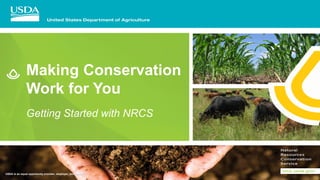
Making Conservation
Work for You
Getting Started with NRCS
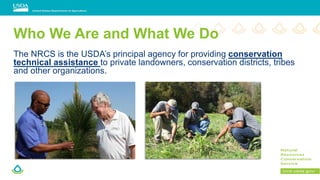
Who We Are and What We Do
The NRCS​ is the USDA’s principal agency for providing conservation
technical assistance to private landowners, conservation districts, tribes
and other organizations.
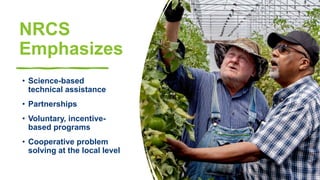
NRCS
Emphasizes
• Science-based
technical assistance
• Partnerships
• Voluntary, incentive-
based programs
• Cooperative problem
solving at the local level
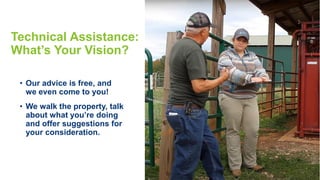
Technical Assistance:
What’s Your Vision?
• Our advice is free, and
we even come to you!
• We walk the property, talk
about what you’re doing
and offer suggestions for
your consideration.
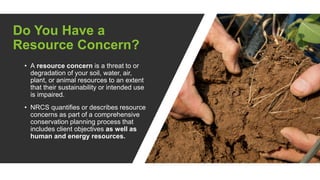
Do You Have a
Resource Concern?
• A resource concern is a threat to or
degradation of your soil, water, air,
plant, or animal resources to an extent
that their sustainability or intended use
is impaired.
• NRCS quantifies or describes resource
concerns as part of a comprehensive
conservation planning process that
includes client objectives as well as
human and energy resources.
Financial Assistance
to Reach Your Goals
• Once you have a plan, we help
you understand Farm Bill
Programs and consider options
for financial assistance.
• If you own the land and are new
to our programs, you’ll need to
take a copy of your deed and plat
to the Farm Service Agency (FSA)
to get a Farm and Tract number.
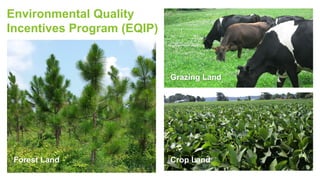
Environmental Quality
Incentives Program (EQIP)
Grazing Land
Crop Land
Forest Land
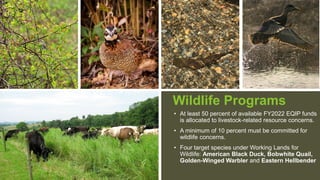
Wildlife Programs
• At least 50 percent of available FY2022 EQIP funds
is allocated to livestock-related resource concerns.
• A minimum of 10 percent must be committed for
wildlife concerns.
• Four target species under Working Lands for
Wildlife: American Black Duck, Bobwhite Quail,
Golden-Winged Warbler and Eastern Hellbender
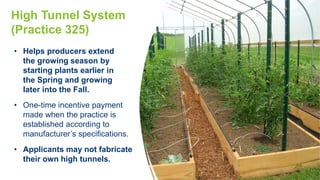
High Tunnel System
(Practice 325)
• Helps producers extend
the growing season by
starting plants earlier in
the Spring and growing
later into the Fall.
• One-time incentive payment
made when the practice is
established according to
manufacturer’s specifications.
• Applicants may not fabricate
their own high tunnels.
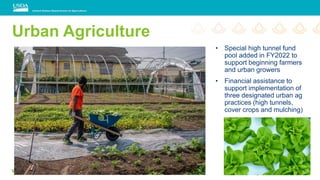
Urban Agriculture
• Special high tunnel fund
pool added in FY2022 to
support beginning farmers
and urban growers
• Financial assistance to
support implementation of
three designated urban ag
practices (high tunnels,
cover crops and mulching)
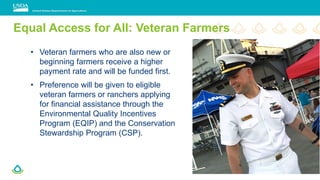
• Veteran farmers who are also new or
beginning farmers receive a higher
payment rate and will be funded first.
• Preference will be given to eligible
veteran farmers or ranchers applying
for financial assistance through the
Environmental Quality Incentives
Program (EQIP) and the Conservation
Stewardship Program (CSP).
Equal Access for All: Veteran Farmers
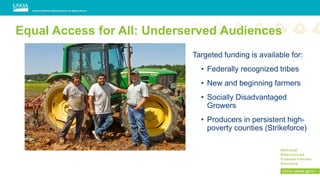
Equal Access for All: Underserved Audiences
Targeted funding is available for:
• Federally recognized tribes
• New and beginning farmers
• Socially Disadvantaged
Growers
• Producers in persistent high-
poverty counties (Strikeforce)
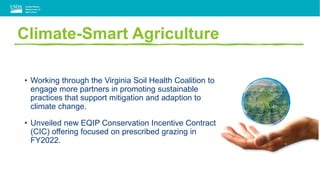
Climate-Smart Agriculture
• Working through the Virginia Soil Health Coalition to
engage more partners in promoting sustainable
practices that support mitigation and adaption to
climate change.
• Unveiled new EQIP Conservation Incentive Contract
(CIC) offering focused on prescribed grazing in
FY2022.
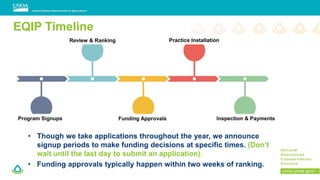
EQIP Timeline
• Though we take applications throughout the year, we announce
signup periods to make funding decisions at specific times. (Don’t
wait until the last day to submit an application).
• Funding approvals typically happen within two weeks of ranking.
Program Signups
Review & Ranking
Funding Approvals
Practice Installation
Inspection & Payments
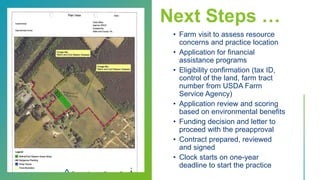
Next Steps …
• Farm visit to assess resource
concerns and practice location
• Application for financial
assistance programs
• Eligibility confirmation (tax ID,
control of the land, farm tract
number from USDA Farm
Service Agency)
• Application review and scoring
based on environmental benefits
• Funding decision and letter to
proceed with the preapproval
• Contract prepared, reviewed
and signed
• Clock starts on one-year
deadline to start the practice
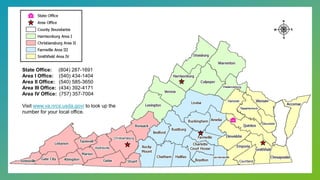
State Office: (804) 287-1691
Area I Office: (540) 434-1404
Area II Office: (540) 585-3650
Area III Office: (434) 392-4171
Area IV Office: (757) 357-7004
Visit www.va.nrcs.usda.gov/ to look up the
number for your local office.
An Equal Opportunity Provider and Employer
The U.S. Department of Agriculture (USDA) prohibits discrimination against its customers. If you believe you experienced
discrimination when obtaining services from USDA, participating in a USDA program, or participating in a program that receives
financial assistance from USDA, you may file a complaint with USDA. Information about how to file a discrimination complaint is
available from the Office of the Assistant Secretary for Civil Rights.
USDA prohibits discrimination in all its programs and activities on the basis of race, color, national origin, age, disability, and
where applicable, sex (including gender identity and expression), marital status, familial status, parental status, religion, sexual
orientation, political beliefs, genetic information, reprisal, or because all or part of an individual’s income is derived from any
public assistance program. (Not all prohibited bases apply to all programs.)
To file a complaint of discrimination, complete, sign and mail a program discrimination complaint form, available at any USDA
office location or online at www.ascr.usda.gov, or write to:
USDA
Office of the Assistant Secretary for Civil Rights
1400 Independence Avenue, S.W.
Washington, D.C. 20250-9410
Or call toll free at (866) 632-9992 (voice) to obtain additional information, the appropriate office or to request documents.
Individuals who are deaf, hard of hearing or have speech disabilities may contact USDA through the Federal Relay service at (800)
877-8339 or (800) 845-6136 (in Spanish). USDA is an equal opportunity provider, employer and lender.
Persons with disabilities who require alternative means for communication of program information (e.g., Braille, large print,
audiotape, etc.) should contact USDA's TARGET Center at (202) 720-2600 (voice and TDD).

USDA Natural Resources Conservation Service - Services

  • 1.
    USDA is anequal opportunity provider, employer, and lender. Making Conservation Work for You Getting Started with NRCS
  • 2.
    Who We Areand What We Do The NRCS​ is the USDA’s principal agency for providing conservation technical assistance to private landowners, conservation districts, tribes and other organizations.
  • 3.
    NRCS Emphasizes • Science-based technical assistance •Partnerships • Voluntary, incentive- based programs • Cooperative problem solving at the local level
  • 4.
    Technical Assistance: What’s YourVision? • Our advice is free, and we even come to you! • We walk the property, talk about what you’re doing and offer suggestions for your consideration.
  • 6.
    Do You Havea Resource Concern? • A resource concern is a threat to or degradation of your soil, water, air, plant, or animal resources to an extent that their sustainability or intended use is impaired. • NRCS quantifies or describes resource concerns as part of a comprehensive conservation planning process that includes client objectives as well as human and energy resources.
  • 7.
    Financial Assistance to ReachYour Goals • Once you have a plan, we help you understand Farm Bill Programs and consider options for financial assistance. • If you own the land and are new to our programs, you’ll need to take a copy of your deed and plat to the Farm Service Agency (FSA) to get a Farm and Tract number.
  • 8.
    Environmental Quality Incentives Program(EQIP) Grazing Land Crop Land Forest Land
  • 9.
    Wildlife Programs • Atleast 50 percent of available FY2022 EQIP funds is allocated to livestock-related resource concerns. • A minimum of 10 percent must be committed for wildlife concerns. • Four target species under Working Lands for Wildlife: American Black Duck, Bobwhite Quail, Golden-Winged Warbler and Eastern Hellbender
  • 10.
    High Tunnel System (Practice325) • Helps producers extend the growing season by starting plants earlier in the Spring and growing later into the Fall. • One-time incentive payment made when the practice is established according to manufacturer’s specifications. • Applicants may not fabricate their own high tunnels.
  • 11.
    Urban Agriculture • Specialhigh tunnel fund pool added in FY2022 to support beginning farmers and urban growers • Financial assistance to support implementation of three designated urban ag practices (high tunnels, cover crops and mulching)
  • 12.
    • Veteran farmerswho are also new or beginning farmers receive a higher payment rate and will be funded first. • Preference will be given to eligible veteran farmers or ranchers applying for financial assistance through the Environmental Quality Incentives Program (EQIP) and the Conservation Stewardship Program (CSP). Equal Access for All: Veteran Farmers
  • 13.
    Equal Access forAll: Underserved Audiences Targeted funding is available for: • Federally recognized tribes • New and beginning farmers • Socially Disadvantaged Growers • Producers in persistent high- poverty counties (Strikeforce)
  • 14.
    Climate-Smart Agriculture • Workingthrough the Virginia Soil Health Coalition to engage more partners in promoting sustainable practices that support mitigation and adaption to climate change. • Unveiled new EQIP Conservation Incentive Contract (CIC) offering focused on prescribed grazing in FY2022.
  • 15.
    EQIP Timeline • Thoughwe take applications throughout the year, we announce signup periods to make funding decisions at specific times. (Don’t wait until the last day to submit an application). • Funding approvals typically happen within two weeks of ranking. Program Signups Review & Ranking Funding Approvals Practice Installation Inspection & Payments
  • 16.
    Next Steps … •Farm visit to assess resource concerns and practice location • Application for financial assistance programs • Eligibility confirmation (tax ID, control of the land, farm tract number from USDA Farm Service Agency) • Application review and scoring based on environmental benefits • Funding decision and letter to proceed with the preapproval • Contract prepared, reviewed and signed • Clock starts on one-year deadline to start the practice
  • 17.
    State Office: (804)287-1691 Area I Office: (540) 434-1404 Area II Office: (540) 585-3650 Area III Office: (434) 392-4171 Area IV Office: (757) 357-7004 Visit www.va.nrcs.usda.gov/ to look up the number for your local office.
  • 18.
    An Equal OpportunityProvider and Employer The U.S. Department of Agriculture (USDA) prohibits discrimination against its customers. If you believe you experienced discrimination when obtaining services from USDA, participating in a USDA program, or participating in a program that receives financial assistance from USDA, you may file a complaint with USDA. Information about how to file a discrimination complaint is available from the Office of the Assistant Secretary for Civil Rights. USDA prohibits discrimination in all its programs and activities on the basis of race, color, national origin, age, disability, and where applicable, sex (including gender identity and expression), marital status, familial status, parental status, religion, sexual orientation, political beliefs, genetic information, reprisal, or because all or part of an individual’s income is derived from any public assistance program. (Not all prohibited bases apply to all programs.) To file a complaint of discrimination, complete, sign and mail a program discrimination complaint form, available at any USDA office location or online at www.ascr.usda.gov, or write to: USDA Office of the Assistant Secretary for Civil Rights 1400 Independence Avenue, S.W. Washington, D.C. 20250-9410 Or call toll free at (866) 632-9992 (voice) to obtain additional information, the appropriate office or to request documents. Individuals who are deaf, hard of hearing or have speech disabilities may contact USDA through the Federal Relay service at (800) 877-8339 or (800) 845-6136 (in Spanish). USDA is an equal opportunity provider, employer and lender. Persons with disabilities who require alternative means for communication of program information (e.g., Braille, large print, audiotape, etc.) should contact USDA's TARGET Center at (202) 720-2600 (voice and TDD).