Sarah Hackney, Grassroots Director, NSAC Demystifying the 2012 Farm Bill January 27, 2012
Welcome and technology overview Who is the Central Appalachian Network? Presentation from Sarah Hackney, National Sustainable Agriculture Coalition Questions and discussion Agenda:
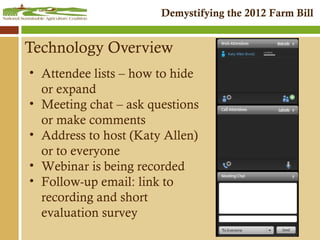
Technology Overview Attendee lists – how to hide or expand Meeting chat – ask questions or make comments Address to host (Katy Allen) or to everyone Webinar is being recorded Follow-up email: link to recording and short evaluation survey
The Central Appalachian Network Network led by six non-profit organizations ACEnet – Athens, OH ASD – Abingdon, VA CEO – Charleston, WV MACED – Berea, KY NCIF – Shepherdstown, WV Rural Action – Trimble, OH Shared purpose is to work for a more just and sustainable Appalachia
The Central Appalachian Network Focused on building and strengthening local and regional agricultural value chains  Training, technical assistance, network-building, regional gatherings, online learning opportunities, policy outreach and education, small grants program For more information, visit  www.cannetwork.org
NSAC Background Our mission:  to support, build, develop, and engage the grassroots of sustainable agriculture for the health and vitality of the sustainable agriculture movement; and to research, develop, and advocate federal policies relating to farm, food, and environmental issues, appropriations, and implementation to support and advance sustainable agriculture. An alliance of  grassroots organizations  that advocates for federal policy reform to advance the sustainability of agriculture, food systems, natural resources, and rural communities.
NSAC Background Started in 1988; currently have 80+ member organizations from around the country We work on the Farm Bill, agricultural legislation, budget and appropriations, USDA, EPA, FDA, etc. In short:  our job is to make sure that federal policy helps farmers succeed while protecting the environment and keeping our food safe and accessible! We are a DC voice for farmers and grassroots advocates across the country, and we work as a coalition.
Farm Bill Basics Large piece of legislation Written by the Agriculture Committees Reauthorized every 5-7 years Next reauthorization up in 2012
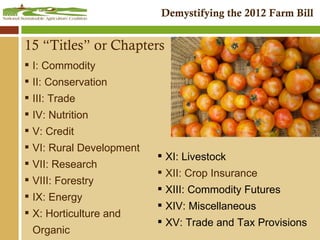
15 “Titles” or Chapters I: Commodity II: Conservation III: Trade IV: Nutrition V: Credit VI: Rural Development VII: Research VIII: Forestry IX: Energy X: Horticulture and Organic XI: Livestock XII: Crop Insurance XIII: Commodity Futures XIV: Miscellaneous XV: Trade and Tax Provisions
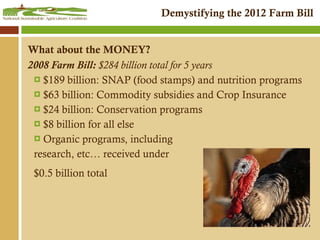
What about the MONEY? 2008 Farm Bill:  $284 billion total for 5 years $189 billion: SNAP (food stamps) and nutrition programs  $63 billion: Commodity subsidies and Crop Insurance $24 billion: Conservation programs $8 billion for all else Organic programs, including  research, etc… received under  $0.5 billion total
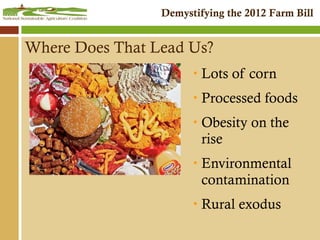
Where Does That Lead Us? Lots of corn Processed foods Obesity on the rise Environmental contamination Rural exodus
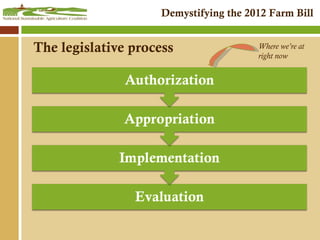
The legislative process Where we’re at right now
NSAC’s Priority Programs in the Farm Bill THERE ARE MANY! Research, Extension, and Education Conservation Marketing Rural Development  Competition and Fair Markets Beginning and Socially Disadvantaged Farmers Local Farms, Food and Jobs …  and more
Under the Hood:  What does Reforming the Farm Bill look like anyway? Listening and reaching out for input Developing recommendations and reforms Bundling them into marker bills and platforms Identify legislative targets Rally grassroots to get better bill passed
1) Listening and Reaching Out Farmer/Community Workshops & Trainings Listening Sessions and Hearings Policy Analysis Conferences
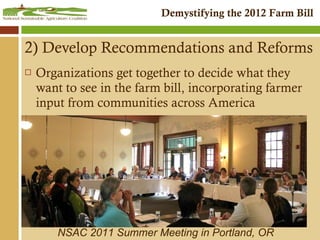
2)  Develop Recommendations and Reforms Organizations get together to decide what they want to see in the farm bill, incorporating farmer input from communities across America NSAC 2011 Summer Meeting in Portland, OR
3) Marker Bills  Smaller placeholder bills that present our Farm Bill priorities in strategic packages – intended to be ‘rolled up’ into the Farm Bill The Local Farms, Food, and Jobs Act The Beginning Farmer and Rancher Opportunity Act …  more to come
4) Legislative Targets House and Senate Agriculture Committees They write the Farm Bill House and Senate Appropriations Committees They fund the Farm Bill programs House and Senate Budget Committees They determine how much money can be spent on programs
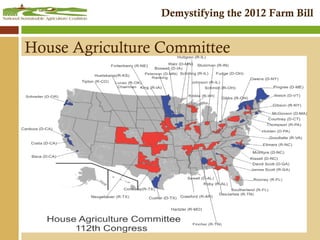
House Agriculture Committee
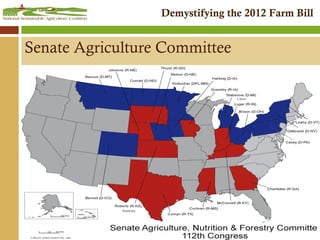
Senate Agriculture Committee
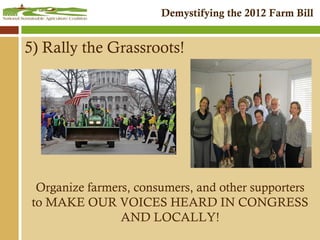
5) Rally the Grassroots! Organize farmers, consumers, and other supporters to MAKE OUR VOICES HEARD IN CONGRESS AND LOCALLY!
So, where are we now? Farm Bill up for re-authorization in 2012 The Super Committee process and ‘secret’ Farm Bill A mixed bag and an important starting point An uncertain future for a 2012 Farm Bill But we want one this year!  Context:  Senate up for grabs, election cycle, sequestration… Primary 2012 Farm Bill goals: Protect our base – crucial programs and funding Push the policy envelope – key reforms and improvements Build long term grassroots capacity – strengthen our voice Marker Bills are in motion!
The Local Farms, Food, and Jobs Act Creating jobs and spurring economic growth  through food and farms Creating economic opportunities for farmers and ranchers through local and regional markets. Improving processing and distribution infrastructure for local and regional agriculture. Expanding access to healthy food for consumers, including underserved communities. Providing research, training, and information that farm entrepreneurs need to be successful.
A few highlights: Expand  Value-Added Producer Grant Program  to food hubs and underserved states/communities Create whole-farm revenue  insurance  product for specialty crop producers, livestock/mixed-grain farmers Fund the  National Organic Certification Cost Share Program  at an annual amount of $7 million and raising the maximum cap per participants from $750 to $1,000  Local Marketing Promotion Program  – formerly the Farmers Market Promotion Program plus funding for larger scale, non-direct local marketing – at $30 million per year The Local Farms, Food, and Jobs Act
The Beginning Farmer and Rancher Opportunity Act Investing in America’s future farmers and ranchers Helping new producers access land and be good land stewards.  Assisting new producers to launch and strengthen entrepreneurial ventures and increase the profitability of their agricultural operations and value-adding enterprises. Providing training, mentoring, and research that beginning farmers and ranchers need to be successful. Enhancing access to crop insurance for new producers. Ensuring coordination of federal services for beginning farmers at the state level and conducting outreach on agricultural job opportunities for military veterans.
The Beginning Farmer and Rancher Opportunity Act A few highlights: Young Beginning Farmer and Rancher Microloan Program:  Create a new simplified loan category within direct operating loans to provide flexible capital through operating microloans for beginning farmers and ranchers from 19-35 years old who also receive borrower training. Beginning Farmer and Rancher Development Program:  Reauthorize this highly successful flagship training program, increase mandatory funding from $75 million to $125 million over the next 5 years to help meet growing demand for the program, and include a new priority on agricultural rehabilitation and vocational training programs for military veterans.
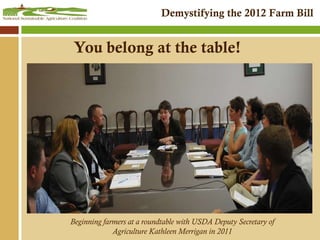
You belong at the table! Beginning farmers at a roundtable with USDA Deputy Secretary of  Agriculture Kathleen Merrigan in 2011
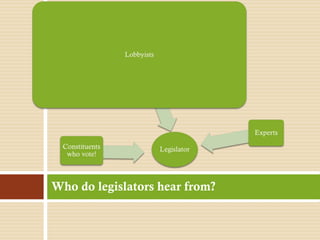
Who do legislators hear from?
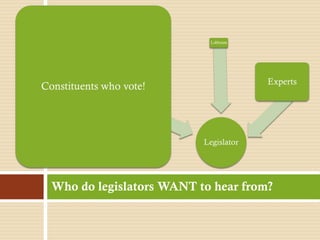
Who do legislators WANT to hear from?
Speak up! What can you do in your community? Join your local/regional advocacy group Attend farm bill listening sessions and field hearings, and get 10 of your friends to come with you. Get to know your legislators (call and visit them!) Know your story and tell it well Hold discussions with farmers in your area Sign up for our alerts and news: http://www.sustainableagriculture.net
Speak up! Every small, local action matters. A lot. Talk to people in your community Call and email your congressional representative This really, truly does have BIG IMPACT! Ask fellow farmers to get involved Support your local organic farmer!
A note on nonprofits and advocacy…  All nonprofits can engage in advocacy, but the scope / extent of their lobbying varies according to their tax exempt status. 501(c)(3) organizations can engage in a limited amount of lobbying, 501(c)(4) organizations can engage in an unlimited amount of lobbying, and political organizations may make very limited lobbying expenditures. The “insubstantial part” test - which, since 1934, has required that “no substantial part of a charity’s activities... be carrying on propaganda or otherwise attempting to influence legislation.” The 501(h) is the option for more extensive lobbying. You CAN: advocate for programs and policy reforms. You CANNOT:  engage in partisan political activity. source:  http://www.afj.org
Questions? Sarah Hackney [email_address] 202-547-5754

Demystifying the Farm Bill

  • 1.
    Sarah Hackney, GrassrootsDirector, NSAC Demystifying the 2012 Farm Bill January 27, 2012
  • 2.
    Welcome and technologyoverview Who is the Central Appalachian Network? Presentation from Sarah Hackney, National Sustainable Agriculture Coalition Questions and discussion Agenda:
  • 3.
    Technology Overview Attendeelists – how to hide or expand Meeting chat – ask questions or make comments Address to host (Katy Allen) or to everyone Webinar is being recorded Follow-up email: link to recording and short evaluation survey
  • 4.
    The Central AppalachianNetwork Network led by six non-profit organizations ACEnet – Athens, OH ASD – Abingdon, VA CEO – Charleston, WV MACED – Berea, KY NCIF – Shepherdstown, WV Rural Action – Trimble, OH Shared purpose is to work for a more just and sustainable Appalachia
  • 5.
    The Central AppalachianNetwork Focused on building and strengthening local and regional agricultural value chains Training, technical assistance, network-building, regional gatherings, online learning opportunities, policy outreach and education, small grants program For more information, visit www.cannetwork.org
  • 6.
    NSAC Background Ourmission: to support, build, develop, and engage the grassroots of sustainable agriculture for the health and vitality of the sustainable agriculture movement; and to research, develop, and advocate federal policies relating to farm, food, and environmental issues, appropriations, and implementation to support and advance sustainable agriculture. An alliance of grassroots organizations that advocates for federal policy reform to advance the sustainability of agriculture, food systems, natural resources, and rural communities.
  • 7.
    NSAC Background Startedin 1988; currently have 80+ member organizations from around the country We work on the Farm Bill, agricultural legislation, budget and appropriations, USDA, EPA, FDA, etc. In short: our job is to make sure that federal policy helps farmers succeed while protecting the environment and keeping our food safe and accessible! We are a DC voice for farmers and grassroots advocates across the country, and we work as a coalition.
  • 8.
    Farm Bill BasicsLarge piece of legislation Written by the Agriculture Committees Reauthorized every 5-7 years Next reauthorization up in 2012
  • 9.
    15 “Titles” orChapters I: Commodity II: Conservation III: Trade IV: Nutrition V: Credit VI: Rural Development VII: Research VIII: Forestry IX: Energy X: Horticulture and Organic XI: Livestock XII: Crop Insurance XIII: Commodity Futures XIV: Miscellaneous XV: Trade and Tax Provisions
  • 10.
    What about theMONEY? 2008 Farm Bill: $284 billion total for 5 years $189 billion: SNAP (food stamps) and nutrition programs $63 billion: Commodity subsidies and Crop Insurance $24 billion: Conservation programs $8 billion for all else Organic programs, including research, etc… received under $0.5 billion total
  • 11.
    Where Does ThatLead Us? Lots of corn Processed foods Obesity on the rise Environmental contamination Rural exodus
  • 12.
    The legislative processWhere we’re at right now
  • 13.
    NSAC’s Priority Programsin the Farm Bill THERE ARE MANY! Research, Extension, and Education Conservation Marketing Rural Development Competition and Fair Markets Beginning and Socially Disadvantaged Farmers Local Farms, Food and Jobs … and more
  • 14.
    Under the Hood: What does Reforming the Farm Bill look like anyway? Listening and reaching out for input Developing recommendations and reforms Bundling them into marker bills and platforms Identify legislative targets Rally grassroots to get better bill passed
  • 15.
    1) Listening andReaching Out Farmer/Community Workshops & Trainings Listening Sessions and Hearings Policy Analysis Conferences
  • 16.
    2) DevelopRecommendations and Reforms Organizations get together to decide what they want to see in the farm bill, incorporating farmer input from communities across America NSAC 2011 Summer Meeting in Portland, OR
  • 17.
    3) Marker Bills Smaller placeholder bills that present our Farm Bill priorities in strategic packages – intended to be ‘rolled up’ into the Farm Bill The Local Farms, Food, and Jobs Act The Beginning Farmer and Rancher Opportunity Act … more to come
  • 18.
    4) Legislative TargetsHouse and Senate Agriculture Committees They write the Farm Bill House and Senate Appropriations Committees They fund the Farm Bill programs House and Senate Budget Committees They determine how much money can be spent on programs
  • 19.
  • 20.
  • 21.
    5) Rally theGrassroots! Organize farmers, consumers, and other supporters to MAKE OUR VOICES HEARD IN CONGRESS AND LOCALLY!
  • 22.
    So, where arewe now? Farm Bill up for re-authorization in 2012 The Super Committee process and ‘secret’ Farm Bill A mixed bag and an important starting point An uncertain future for a 2012 Farm Bill But we want one this year! Context: Senate up for grabs, election cycle, sequestration… Primary 2012 Farm Bill goals: Protect our base – crucial programs and funding Push the policy envelope – key reforms and improvements Build long term grassroots capacity – strengthen our voice Marker Bills are in motion!
  • 23.
    The Local Farms,Food, and Jobs Act Creating jobs and spurring economic growth through food and farms Creating economic opportunities for farmers and ranchers through local and regional markets. Improving processing and distribution infrastructure for local and regional agriculture. Expanding access to healthy food for consumers, including underserved communities. Providing research, training, and information that farm entrepreneurs need to be successful.
  • 24.
    A few highlights:Expand Value-Added Producer Grant Program to food hubs and underserved states/communities Create whole-farm revenue insurance product for specialty crop producers, livestock/mixed-grain farmers Fund the National Organic Certification Cost Share Program at an annual amount of $7 million and raising the maximum cap per participants from $750 to $1,000 Local Marketing Promotion Program – formerly the Farmers Market Promotion Program plus funding for larger scale, non-direct local marketing – at $30 million per year The Local Farms, Food, and Jobs Act
  • 25.
    The Beginning Farmerand Rancher Opportunity Act Investing in America’s future farmers and ranchers Helping new producers access land and be good land stewards. Assisting new producers to launch and strengthen entrepreneurial ventures and increase the profitability of their agricultural operations and value-adding enterprises. Providing training, mentoring, and research that beginning farmers and ranchers need to be successful. Enhancing access to crop insurance for new producers. Ensuring coordination of federal services for beginning farmers at the state level and conducting outreach on agricultural job opportunities for military veterans.
  • 26.
    The Beginning Farmerand Rancher Opportunity Act A few highlights: Young Beginning Farmer and Rancher Microloan Program: Create a new simplified loan category within direct operating loans to provide flexible capital through operating microloans for beginning farmers and ranchers from 19-35 years old who also receive borrower training. Beginning Farmer and Rancher Development Program: Reauthorize this highly successful flagship training program, increase mandatory funding from $75 million to $125 million over the next 5 years to help meet growing demand for the program, and include a new priority on agricultural rehabilitation and vocational training programs for military veterans.
  • 27.
    You belong atthe table! Beginning farmers at a roundtable with USDA Deputy Secretary of Agriculture Kathleen Merrigan in 2011
  • 28.
  • 29.
    Who do legislatorsWANT to hear from?
  • 30.
    Speak up! Whatcan you do in your community? Join your local/regional advocacy group Attend farm bill listening sessions and field hearings, and get 10 of your friends to come with you. Get to know your legislators (call and visit them!) Know your story and tell it well Hold discussions with farmers in your area Sign up for our alerts and news: http://www.sustainableagriculture.net
  • 31.
    Speak up! Everysmall, local action matters. A lot. Talk to people in your community Call and email your congressional representative This really, truly does have BIG IMPACT! Ask fellow farmers to get involved Support your local organic farmer!
  • 32.
    A note onnonprofits and advocacy… All nonprofits can engage in advocacy, but the scope / extent of their lobbying varies according to their tax exempt status. 501(c)(3) organizations can engage in a limited amount of lobbying, 501(c)(4) organizations can engage in an unlimited amount of lobbying, and political organizations may make very limited lobbying expenditures. The “insubstantial part” test - which, since 1934, has required that “no substantial part of a charity’s activities... be carrying on propaganda or otherwise attempting to influence legislation.” The 501(h) is the option for more extensive lobbying. You CAN: advocate for programs and policy reforms. You CANNOT: engage in partisan political activity. source: http://www.afj.org
  • 33.
    Questions? Sarah Hackney[email_address] 202-547-5754