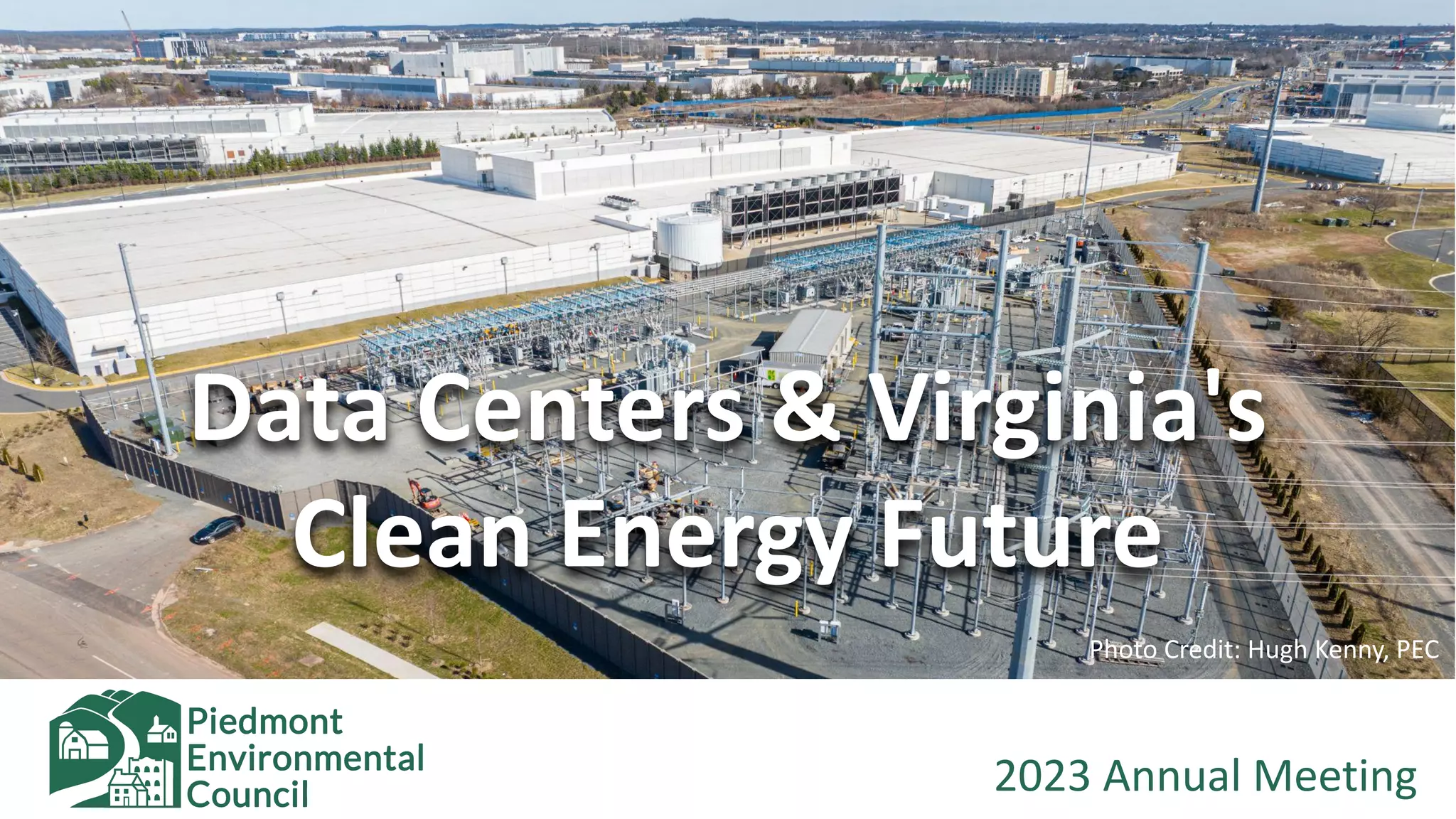
Data Centers & Virginia's
Clean Energy Future
2023 Annual Meeting
Photo Credit: Hugh Kenny, PEC
Julie Bolthouse
Director of Land Use
jbolthouse@pecva.org
Ashish Kapoor
Senior Energy and Climate Policy Analyst
akapoor@pecva.org
Today’s Presentation
● Climate Change Action
and Policies
● Energy Transition
● Exploding Data Center
Energy Demand
● Dominion’s 2023
Integrated Resource Plan
● What can we do?
Photo Credit: Lynne Kaye
Climate Change Threat - Changing
Temperatures and Precipitation Patterns
● Hotter summers and the associated health impacts
● Seasonal cycles are shifting and impacting important
plants and animals, like crops and pollinators
● More flooding and more drought as rain events
become concentrated into fewer, bigger storms
between dry periods, and groundwater and
reservoirs can’t replenish as quickly as in the past
PEC’s Actions on Climate
● Reducing vehicle miles
traveled through better
land use and transportation
planning
● Land conservation and
sustainable land
management
● Green energy policy and
planning for resilience
● National and Regional
policies
● Utility Scale Solar
● Distributed Generation
● Newer Technologies
Energy Transition
Energy Talk
● Definitions
○ 1,000 KW=1 MW
○ 1,000 MW = 1 GW
○ kWh= electricity produced
○ Transmission/Distribution/
Substation
● PJM
○ A regional transmission
operator that operates the
grid essentially from IL to
VA and NJ to NC
Virginia Clean Economy Act
● Mandatory Renewable Portfolio
Standard
○ 100% renewable energy by
2045
● 25% of renewable generation can
come from out of state
● Distributed Generation Cap → 6%
● Market based, cooperative
agreement between 12
eastern states
● Pushed CO2 emissions
down by 50% and raised
$6B for local communities
● Air Pollution Board voted
6/7 to leave agreement
RGGI:
Regional Greenhouse Gas Initiative
Inflation Reduction Act
Summary of National and State Landscape
State:
Virginia Clean Economy Act = 100% renewable by 2050
Regional:
RGGI = Carbon Cap Agreement has reduced CO2 by 50%
National:
Inflation Reduction Act = $400B of clean energy incentives
Utility Scale Solar
Large Scale Solar
Future in Virginia
● 11th nationally in solar
capacity
● South Atlantic fastest
growing solar region in U.S.
● Avg. 1 MW of generation
requires 7-10 acres of land
for solar development.
Source: VALEN Tracker
Process/Queue
Source: PV Magazine
Chesapeake Conservancy: Neural AI Mapping Research
● Bullets
Best Practices
● Minimize impacts to:
○ Historical, cultural and
scenic resources
○ Prime agricultural soils and
forested land
○ Wildlife
○ Water Quality
● Minimal grading with soil and
erosion control
● Construction
● Decommissioning
● Pollinator-Smart Program
Summary of Utility Scale Solar in VA
● Big portion of solar future
● Best practices
● Data center demand = 100,000s acres of solar
● Interconnection queue backlog
● Bullets
Distributed Generation
● Rooftop
● Community
● Brownfields
● Commercial
● Parking Lot
● Agrivoltaics
Challenges of Distributed
Generation
● Changing policy environment
● Often requires 5-7 year ROI
● Labor challenges
Benefits of Distributed
Generation
● Distribution based
● Less lost to inefficiency
● Protection against outages
○ Load shifting
○ Battery
● Faster interconnection
● Energy Independence
● Protection against rate increases
Source: Google Project Sunroof
About ¼ of
Virginia’s
demand from
rooftop solar
Source: Google Project Sunroof
● Allow residents to get their energy
from small solar facilities not
located on their property
● Particularly appealing for those who
rent, live in multifamily buildings or
have shady yards or other physical
restrictions that prevent them from
mounting panels on their own roof.
Community Solar in
Virginia
Avoid the Queue!
● PJM currently has 150 GW of solar
in the interconnection queue.
● Community and distributed solar
is an optimal way to add more
solar, faster to the grid.
● Less impact to agricultural land
Brownfields
● Land developed in the
past – not currently
being used because of
contaminants on the site
● Thousands of sites
available
Source: DEQ
Parking Lot Solar
Challenges of Parking Lot
Solar
● Costs more than building solar
on an open space
● 10-12 year average ROI
● Need data on site viability
Advantages of Parking Lot
Solar
● There is a lot of parking
● Built land
● EV adoption can offset higher cost
● Shading/Protection from
elements
● PPA option
● Bullets
Agrivoltaics
● Co-location of agricultural
production and energy
production
● Elevated panels
● Crop success has been
found with winter wheat,
kale, broccoli, potatoes,
swiss chard. Shade
tolerant crops tend to do
better
Challenges of Agrivoltaics
● Existing studies limited
● Need trials for Virginia climate and
crops
● Need local policy that shows zoning
districts where agrivoltaics can be
productive/compatible with local
ordinances
● Incentives and retention of agricultural
tax benefits
● More expensive
● Less effective crop yield
● Ordinances that limit net metering
for agricultural zones properties
Advantages of Agrivoltaics
● Farmers can diversify income
● Cost saving on vegetation
management
● Increased overall use of the land
● Increased efficiency for panels
● Higher panels run cooler and more
efficient
● Increased moisture content can lead
to higher biomass growth and/or
nutrient rich content for grazing
● Shade for cows and sheep
● Waste as fertilizer
Pieces of a Puzzle
● Rooftop/Community
● Brownfields
● Parking Lot Solar
● Agrivoltaics
But we have a big problem…
…exploding data center energy
demand
Photo Credit: Hugh Kenny, PEC
Source: www.vedp.org/industry/data-centers
Threat to Decades of
Conservation
● Land
● Wildlife/Habitat
● Water
● Recreation/Parks
● Air Quality
● History Photo Credit: Hugh Kenny, PEC
Power Hungry → Land Hungry
Even if additional power is met through renewable utility scale solar that
requires hundreds of acres of solar panels per building along with new
substations and transmission lines.
1 data center = 30-90 MW
1 MW of solar ≈ 10 acres
One data center building ≈ 300-900 acres of utility scale solar
Threat to Decades of
Conservation
● Land
● Wildlife/Habitat
● Water
● Recreation/Parks
● Air Quality
● History Photo Credit: Graham Cullen, Frederick News-Post
Threat to Decades of
Conservation
Photo of Occoquan Reservoir from Kokosing Dam Upgrade Project
● Land
● Wildlife/Habitat
● Water
● Recreation/Parks
● Air Quality
● History
Threat to Decades of
Conservation
● Land
● Wildlife/Habitat
● Water
● Recreation/Parks
● Air Quality
● History Photo of cyclist passing AWS data center on the Washington and
Old Dominion Trail in Ashburn, VA. Credit: Hugh Kenny, PEC
Threat to Decades of
Conservation
● Land
● Wildlife/Habitat
● Water
● Recreation/Parks
● Air Quality
● History
Source:
www.pecva.org/work/energy-work/data-centers
-diesel-generators-and-air-quality-pec-web-map/
Threat to Decades of
Conservation
● Land
● Wildlife/Habitat
● Water
● Recreation/Parks
● Air Quality
● History
Full story available:
www.datacenterdynamics.co
m/en/news/historic-black-cem
etery-was-moved-for-microsof
t-data-center-in-virginia/
The Digital Age
● Outsourcing of information
technology functions
● Advancing smartphone
technology and apps (5G)
● Roll out of rural broadband
● Digitalization and storage of
data
● Internet of things
● Artificial intelligence and
machine learning
What is a Data Center?
North Fork of Broad Run
Fuel Storage
Diesel Generators
Photo Credit: Hugh Kenny, PEC Photo Credit: Christopher Bowns,
Wikimedia Commons
Photo Source: www.globalpwr.com
Types of Data Centers
● Cloud - hosted off-premises (ex:
Amazon (AWS), Microsoft (Azure),
Google
● Colocation - companies rent space
(ex: Digital Realty and QTS)
● Enterprise - built, owned, and
operated by companies (ex: Meta)
● Bitcoin Miner - dedicated to
cryptocurrency (ex: TeraWulf)
Photo Credit: Hugh Kenny, PEC
Local Land Use Impacts
of Data Centers Vary…
● Traffic
● Noise
● Lighting
● Water Vapor Plumes
● Wastewater Discharge
● Effect on Adjacent Uses
● Water Usage
● Air Quality
● Water Quality
● Energy Usage Photo Credit: Hugh Kenny, PEC
Data Centers Consume a Huge Amount of Electricity
Photo Credit: Hugh Kenny, PEC
Photo Source: www.dominionenergy.com
Dominion’s Quarterly Report from Q4 2022
Source: Dominion Q4 2022 earnings presentation
Source: www.pjm.com/-/media/library/reports-notices/load-forecast/2023-load-report.ashx
Regional Growth for Entire PJM Area
Forecast assumptions:
● Increased adoption of EV’s
● Increased adoption of
behind-the-meter solar
generation
● Increased battery storage
PJM Mid Atlantic Section
PJM Western Section
Dominion Area Explosive Growth Trends
That’s a doubling of peak load within 14 years!
Source: cdn-dominionenergy-prd-001.azureedge.net/-/media/pdfs/global/company/2023-va-integrated-resource-plan.pdf
Large increases in cost compared to just last year…
Source: cdn-dominionenergy-prd-001.azureedge.net/-/media/pdfs/global/company/2022-va-integrated-resource-plan.pdf
Reason for drastic increase in cost is demonstrated by
this chart showing how the projections for power
demand have increased over the past 4 years.
Dominion’s Five Plans
● All delay retirement of fossil fuel
power sources
● All include 970 MW of new
fracked gas generation with one
proposing nearly 3GW!
● All include small nuclear reactors,
a costly and unproven technology
● All have a heavy reliance on
purchasing out of state power
● All include billions for new
transmission line construction Source:
cdn-dominionenergy-prd-001.azureedge.net/-/media/pdfs/global/company/2023-va-int
egrated-resource-plan.pdf
Existing Transmission Lines
Source: www.pjm.com/
Source: www.datacentermap.com
What can we do?
1. Keep up progress on
transition to renewable energy
● Well sited and designed utility scale solar
● Peak load and resiliency
○ Smart thermostats
○ Batteries
○ Virtual Power Plants
● Lift cap on Distributed Generation
(currently at 6% of peak load)
● State incentives: parking lot, brownfield,
agrivoltaics, rooftop
● Solarize Piedmont & Solar on the Farm Photo Credit: Hugh Kenny, PEC
2. Raise Awareness and
Demand Data Center Reform
● Spread the word!
● Contact Elected Officials
○ Educate them about the
impacts
○ Demand a statewide study
○ Shift cost to the industry
● Join the statewide coalition!
Photo Credit: Hugh Kenny, PEC
Questions?

Data Centers & Virginia's Clean Energy Future

  • 1.
    Data Centers &Virginia's Clean Energy Future 2023 Annual Meeting Photo Credit: Hugh Kenny, PEC
  • 2.
    Julie Bolthouse Director ofLand Use jbolthouse@pecva.org Ashish Kapoor Senior Energy and Climate Policy Analyst akapoor@pecva.org
  • 3.
    Today’s Presentation ● ClimateChange Action and Policies ● Energy Transition ● Exploding Data Center Energy Demand ● Dominion’s 2023 Integrated Resource Plan ● What can we do? Photo Credit: Lynne Kaye
  • 4.
    Climate Change Threat- Changing Temperatures and Precipitation Patterns ● Hotter summers and the associated health impacts ● Seasonal cycles are shifting and impacting important plants and animals, like crops and pollinators ● More flooding and more drought as rain events become concentrated into fewer, bigger storms between dry periods, and groundwater and reservoirs can’t replenish as quickly as in the past
  • 5.
    PEC’s Actions onClimate ● Reducing vehicle miles traveled through better land use and transportation planning ● Land conservation and sustainable land management ● Green energy policy and planning for resilience
  • 6.
    ● National andRegional policies ● Utility Scale Solar ● Distributed Generation ● Newer Technologies Energy Transition
  • 7.
    Energy Talk ● Definitions ○1,000 KW=1 MW ○ 1,000 MW = 1 GW ○ kWh= electricity produced ○ Transmission/Distribution/ Substation ● PJM ○ A regional transmission operator that operates the grid essentially from IL to VA and NJ to NC
  • 8.
    Virginia Clean EconomyAct ● Mandatory Renewable Portfolio Standard ○ 100% renewable energy by 2045 ● 25% of renewable generation can come from out of state ● Distributed Generation Cap → 6%
  • 9.
    ● Market based,cooperative agreement between 12 eastern states ● Pushed CO2 emissions down by 50% and raised $6B for local communities ● Air Pollution Board voted 6/7 to leave agreement RGGI: Regional Greenhouse Gas Initiative
  • 10.
  • 11.
    Summary of Nationaland State Landscape State: Virginia Clean Economy Act = 100% renewable by 2050 Regional: RGGI = Carbon Cap Agreement has reduced CO2 by 50% National: Inflation Reduction Act = $400B of clean energy incentives
  • 13.
  • 15.
    Large Scale Solar Futurein Virginia ● 11th nationally in solar capacity ● South Atlantic fastest growing solar region in U.S. ● Avg. 1 MW of generation requires 7-10 acres of land for solar development.
  • 16.
  • 17.
  • 18.
    Chesapeake Conservancy: NeuralAI Mapping Research
  • 19.
    ● Bullets Best Practices ●Minimize impacts to: ○ Historical, cultural and scenic resources ○ Prime agricultural soils and forested land ○ Wildlife ○ Water Quality ● Minimal grading with soil and erosion control ● Construction ● Decommissioning ● Pollinator-Smart Program
  • 20.
    Summary of UtilityScale Solar in VA ● Big portion of solar future ● Best practices ● Data center demand = 100,000s acres of solar ● Interconnection queue backlog
  • 21.
    ● Bullets Distributed Generation ●Rooftop ● Community ● Brownfields ● Commercial ● Parking Lot ● Agrivoltaics
  • 22.
    Challenges of Distributed Generation ●Changing policy environment ● Often requires 5-7 year ROI ● Labor challenges
  • 23.
    Benefits of Distributed Generation ●Distribution based ● Less lost to inefficiency ● Protection against outages ○ Load shifting ○ Battery ● Faster interconnection ● Energy Independence ● Protection against rate increases
  • 24.
  • 25.
    About ¼ of Virginia’s demandfrom rooftop solar Source: Google Project Sunroof
  • 26.
    ● Allow residentsto get their energy from small solar facilities not located on their property ● Particularly appealing for those who rent, live in multifamily buildings or have shady yards or other physical restrictions that prevent them from mounting panels on their own roof. Community Solar in Virginia
  • 27.
    Avoid the Queue! ●PJM currently has 150 GW of solar in the interconnection queue. ● Community and distributed solar is an optimal way to add more solar, faster to the grid. ● Less impact to agricultural land
  • 28.
    Brownfields ● Land developedin the past – not currently being used because of contaminants on the site ● Thousands of sites available Source: DEQ
  • 29.
  • 31.
    Challenges of ParkingLot Solar ● Costs more than building solar on an open space ● 10-12 year average ROI ● Need data on site viability
  • 32.
    Advantages of ParkingLot Solar ● There is a lot of parking ● Built land ● EV adoption can offset higher cost ● Shading/Protection from elements ● PPA option
  • 33.
    ● Bullets Agrivoltaics ● Co-locationof agricultural production and energy production ● Elevated panels ● Crop success has been found with winter wheat, kale, broccoli, potatoes, swiss chard. Shade tolerant crops tend to do better
  • 35.
    Challenges of Agrivoltaics ●Existing studies limited ● Need trials for Virginia climate and crops ● Need local policy that shows zoning districts where agrivoltaics can be productive/compatible with local ordinances ● Incentives and retention of agricultural tax benefits ● More expensive ● Less effective crop yield ● Ordinances that limit net metering for agricultural zones properties
  • 36.
    Advantages of Agrivoltaics ●Farmers can diversify income ● Cost saving on vegetation management ● Increased overall use of the land ● Increased efficiency for panels ● Higher panels run cooler and more efficient ● Increased moisture content can lead to higher biomass growth and/or nutrient rich content for grazing ● Shade for cows and sheep ● Waste as fertilizer
  • 37.
    Pieces of aPuzzle ● Rooftop/Community ● Brownfields ● Parking Lot Solar ● Agrivoltaics
  • 38.
    But we havea big problem… …exploding data center energy demand Photo Credit: Hugh Kenny, PEC
  • 39.
  • 40.
    Threat to Decadesof Conservation ● Land ● Wildlife/Habitat ● Water ● Recreation/Parks ● Air Quality ● History Photo Credit: Hugh Kenny, PEC
  • 41.
    Power Hungry →Land Hungry Even if additional power is met through renewable utility scale solar that requires hundreds of acres of solar panels per building along with new substations and transmission lines. 1 data center = 30-90 MW 1 MW of solar ≈ 10 acres One data center building ≈ 300-900 acres of utility scale solar
  • 42.
    Threat to Decadesof Conservation ● Land ● Wildlife/Habitat ● Water ● Recreation/Parks ● Air Quality ● History Photo Credit: Graham Cullen, Frederick News-Post
  • 43.
    Threat to Decadesof Conservation Photo of Occoquan Reservoir from Kokosing Dam Upgrade Project ● Land ● Wildlife/Habitat ● Water ● Recreation/Parks ● Air Quality ● History
  • 44.
    Threat to Decadesof Conservation ● Land ● Wildlife/Habitat ● Water ● Recreation/Parks ● Air Quality ● History Photo of cyclist passing AWS data center on the Washington and Old Dominion Trail in Ashburn, VA. Credit: Hugh Kenny, PEC
  • 45.
    Threat to Decadesof Conservation ● Land ● Wildlife/Habitat ● Water ● Recreation/Parks ● Air Quality ● History Source: www.pecva.org/work/energy-work/data-centers -diesel-generators-and-air-quality-pec-web-map/
  • 46.
    Threat to Decadesof Conservation ● Land ● Wildlife/Habitat ● Water ● Recreation/Parks ● Air Quality ● History Full story available: www.datacenterdynamics.co m/en/news/historic-black-cem etery-was-moved-for-microsof t-data-center-in-virginia/
  • 47.
    The Digital Age ●Outsourcing of information technology functions ● Advancing smartphone technology and apps (5G) ● Roll out of rural broadband ● Digitalization and storage of data ● Internet of things ● Artificial intelligence and machine learning
  • 48.
    What is aData Center? North Fork of Broad Run Fuel Storage Diesel Generators Photo Credit: Hugh Kenny, PEC Photo Credit: Christopher Bowns, Wikimedia Commons Photo Source: www.globalpwr.com
  • 49.
    Types of DataCenters ● Cloud - hosted off-premises (ex: Amazon (AWS), Microsoft (Azure), Google ● Colocation - companies rent space (ex: Digital Realty and QTS) ● Enterprise - built, owned, and operated by companies (ex: Meta) ● Bitcoin Miner - dedicated to cryptocurrency (ex: TeraWulf) Photo Credit: Hugh Kenny, PEC
  • 50.
    Local Land UseImpacts of Data Centers Vary… ● Traffic ● Noise ● Lighting ● Water Vapor Plumes ● Wastewater Discharge ● Effect on Adjacent Uses ● Water Usage ● Air Quality ● Water Quality ● Energy Usage Photo Credit: Hugh Kenny, PEC
  • 51.
    Data Centers Consumea Huge Amount of Electricity Photo Credit: Hugh Kenny, PEC Photo Credit: Hugh Kenny, PEC Photo Source: www.dominionenergy.com
  • 52.
    Dominion’s Quarterly Reportfrom Q4 2022 Source: Dominion Q4 2022 earnings presentation
  • 53.
  • 54.
    Regional Growth forEntire PJM Area Forecast assumptions: ● Increased adoption of EV’s ● Increased adoption of behind-the-meter solar generation ● Increased battery storage
  • 55.
  • 56.
  • 57.
  • 58.
    That’s a doublingof peak load within 14 years!
  • 60.
  • 61.
    Large increases incost compared to just last year… Source: cdn-dominionenergy-prd-001.azureedge.net/-/media/pdfs/global/company/2022-va-integrated-resource-plan.pdf
  • 62.
    Reason for drasticincrease in cost is demonstrated by this chart showing how the projections for power demand have increased over the past 4 years.
  • 63.
    Dominion’s Five Plans ●All delay retirement of fossil fuel power sources ● All include 970 MW of new fracked gas generation with one proposing nearly 3GW! ● All include small nuclear reactors, a costly and unproven technology ● All have a heavy reliance on purchasing out of state power ● All include billions for new transmission line construction Source: cdn-dominionenergy-prd-001.azureedge.net/-/media/pdfs/global/company/2023-va-int egrated-resource-plan.pdf
  • 64.
  • 65.
  • 66.
  • 67.
    1. Keep upprogress on transition to renewable energy ● Well sited and designed utility scale solar ● Peak load and resiliency ○ Smart thermostats ○ Batteries ○ Virtual Power Plants ● Lift cap on Distributed Generation (currently at 6% of peak load) ● State incentives: parking lot, brownfield, agrivoltaics, rooftop ● Solarize Piedmont & Solar on the Farm Photo Credit: Hugh Kenny, PEC
  • 68.
    2. Raise Awarenessand Demand Data Center Reform ● Spread the word! ● Contact Elected Officials ○ Educate them about the impacts ○ Demand a statewide study ○ Shift cost to the industry ● Join the statewide coalition! Photo Credit: Hugh Kenny, PEC
  • 69.