Solve the clues and complete the crossword on the following slide.
https://www.educaplay.com/learning-resources/5730265-biology_scientific_research.html
The video shows scenes of different movies. All the scenes
have something in common. Watch and say what it is…
Time for some grammar guessing!
Could you find the similarity?
Can you guess what it is?
o IF…
o IF …. WILL
o IF … WOULD
Do you remember HOW we call these sentences?
I guess you all know we are
going to talk about
conditionals, right?
Could you remember why and
when we use conditionals?
Let’s have a look at some examples?
• If you love her, you have to tell her.
• If you are good at something, never do it for free.
• If your father dies, you will make the deal.
• If you don’t release her, you will never see home again.
• This is my kingdom, If I don’t fight for it, Who will?
• I would not be standing here if I knew any other way.
Let’s have a look at some examples?
• If you love her, you have to tell her.
• If you are good at something, never do it for free.
• If your father dies, you will make the deal.
• If you don’t release her, you will never see home again.
• This is my kingdom, If I don’t fight for it, Who will (fight)?
• I would not be standing here if I knew any other way.
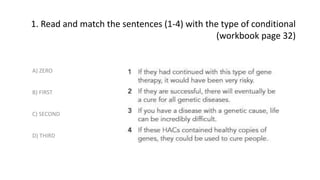
1. Read and match the sentences (1-4) with the type of conditional
(workbook page 32)
A) ZERO
B) FIRST
C) SECOND
D) THIRD
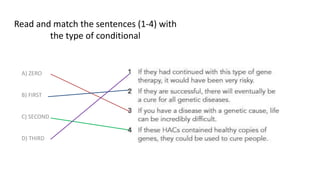
Read and match the sentences (1-4) with
the type of conditional
A) ZERO
B) FIRST
C) SECOND
D) THIRD
When do we use them?
o zero for situations that are generally or always true, facts;
If you heat chocolate, it melts.
o first conditional to talk about possible and probable situations in the
future, and their consequences (real);
If you play until late, you will be tired tomorrow.
o second conditional to talk about imaginary or improbable situations and
their consequences (unreal);
If corona didn’t exist, we would be in school.
o third conditional to talk about imaginary or impossible situations in the
past. (unreal in the past)
If we had followed the lockdown we would have returned to school last
week.
o zero = if + present simple, present simple;
If you heat chocolate, it melts.
o first conditional = if + present simple, will + infinitive;
If you play until late, you will be tired tomorrow.
o second conditional = if + past simple, would + infinitive;
If corona didn’t exist, we would be in school.
o third conditional = if + past perfect, would have + past participle
If corona didn’t exist, we would be in school.
How do we use them?
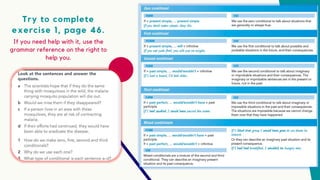
Try to complete
exercise 1, page 46.
If you need help with it, use the
grammar reference on the right to
help you.
o zero = if + present simple,
present simple;
o first conditional = if + present
simple, will + infinitive;
o second conditional = if + past
simple, would + infinitive;
o third conditional = if + past
perfect, would have + past
participle
1.
o zero for situations that are generally
or always true;
o first conditional to talk about
possible and probable situations in
the future, and their consequences;
o second conditional to talk about
imaginary or improbable situations
and their consequences;
o third conditional to talk about
imaginary or impossible situations in
the past.
2.
a. first conditional
b. second conditional
c. zero conditional
d. third conditional
3.
Check your answers.
Let’s practice!
.
Enjoy it! 
https://player.quizalize.com/quiz/df168a93-0c2e-4ba9-82f0-e742432591cb
Practice makes
perfect!
Workbook page 32 ex. 2
This class will give you
plenty of opportunities to
achieve perfection!
Student’s book page 46 – exercise 3
Checkyouranswers
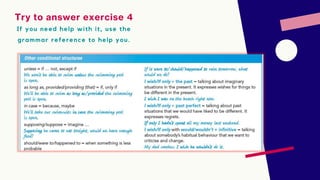
Try to answer exercise 4
If you need help with it, use the
grammar reference to help you.
Try to answer exercise 4
If you need help with it, use the
grammar reference to help you.
https://play.kahoot.it/v2/?quizId=fb850c77-732d-4480-8ba7-e83f12821433
Student’s book page 46
EXAM SUCCESS
In transformation activities,
check that you have not
changed the meaning from the
original sentence or changed
the form of the word given.
Checkyouranswers
I’ll help you
providing/provided that you
pay close attention.
.
Unless they succeed, they
may lose all their funding. .
I wish we had seen each
other.
Suppose we can stop the
situation, would it not be
worth doing?
I’ll be right here waiting for
you in case you need me.
We’ll publish your research
as long as you have
evidence of your findings.
Speaking
1.
If I pass all my exams with
outstanding marks, …
3.
If I had more time, …
2.
If I could have any job in the
world, …
4.
If I were a politician, …
Complete the sentences
with your own ideas.
Developing vocabulary
Page 47, ex. 1 and 2
https://quizlet.com/_8gjr1x?x=1qqt&i=e137z
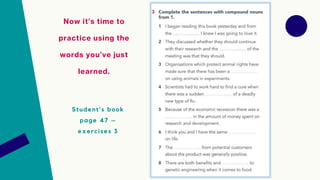
Now it’s time to
practice using the
words you’ve just
learned.
Student’s book
page 47 –
exercises 3
Check your
answers.
outset
outcome
crackdown
outbreak
cutback
outlook
feedback
drawbacks
Now it’s time to
practice using the
words you’ve just
learned.
Student’s book
page 47 –
exercises 4
Check your
answers.
breakthrough genetically modified
offspring
outset
drawback
lifetime
worthwhile
high-risk
crackdown
outcome
Us2   week 9 - unit 4 - class 16 - 10.06

Us2 week 9 - unit 4 - class 16 - 10.06

  • 2.
    Solve the cluesand complete the crossword on the following slide.
  • 3.
  • 4.
    The video showsscenes of different movies. All the scenes have something in common. Watch and say what it is… Time for some grammar guessing!
  • 5.
    Could you findthe similarity? Can you guess what it is? o IF… o IF …. WILL o IF … WOULD Do you remember HOW we call these sentences?
  • 6.
    I guess youall know we are going to talk about conditionals, right? Could you remember why and when we use conditionals?
  • 7.
    Let’s have alook at some examples? • If you love her, you have to tell her. • If you are good at something, never do it for free. • If your father dies, you will make the deal. • If you don’t release her, you will never see home again. • This is my kingdom, If I don’t fight for it, Who will? • I would not be standing here if I knew any other way.
  • 8.
    Let’s have alook at some examples? • If you love her, you have to tell her. • If you are good at something, never do it for free. • If your father dies, you will make the deal. • If you don’t release her, you will never see home again. • This is my kingdom, If I don’t fight for it, Who will (fight)? • I would not be standing here if I knew any other way.
  • 10.
    1. Read andmatch the sentences (1-4) with the type of conditional (workbook page 32) A) ZERO B) FIRST C) SECOND D) THIRD
  • 11.
    Read and matchthe sentences (1-4) with the type of conditional A) ZERO B) FIRST C) SECOND D) THIRD
  • 12.
    When do weuse them? o zero for situations that are generally or always true, facts; If you heat chocolate, it melts. o first conditional to talk about possible and probable situations in the future, and their consequences (real); If you play until late, you will be tired tomorrow. o second conditional to talk about imaginary or improbable situations and their consequences (unreal); If corona didn’t exist, we would be in school. o third conditional to talk about imaginary or impossible situations in the past. (unreal in the past) If we had followed the lockdown we would have returned to school last week.
  • 13.
    o zero =if + present simple, present simple; If you heat chocolate, it melts. o first conditional = if + present simple, will + infinitive; If you play until late, you will be tired tomorrow. o second conditional = if + past simple, would + infinitive; If corona didn’t exist, we would be in school. o third conditional = if + past perfect, would have + past participle If corona didn’t exist, we would be in school. How do we use them?
  • 14.
    Try to complete exercise1, page 46. If you need help with it, use the grammar reference on the right to help you.
  • 15.
    o zero =if + present simple, present simple; o first conditional = if + present simple, will + infinitive; o second conditional = if + past simple, would + infinitive; o third conditional = if + past perfect, would have + past participle 1. o zero for situations that are generally or always true; o first conditional to talk about possible and probable situations in the future, and their consequences; o second conditional to talk about imaginary or improbable situations and their consequences; o third conditional to talk about imaginary or impossible situations in the past. 2. a. first conditional b. second conditional c. zero conditional d. third conditional 3. Check your answers.
  • 16.
    Let’s practice! . Enjoy it! https://player.quizalize.com/quiz/df168a93-0c2e-4ba9-82f0-e742432591cb
  • 17.
    Practice makes perfect! Workbook page32 ex. 2 This class will give you plenty of opportunities to achieve perfection! Student’s book page 46 – exercise 3
  • 18.
  • 20.
    Try to answerexercise 4 If you need help with it, use the grammar reference to help you.
  • 21.
    Try to answerexercise 4 If you need help with it, use the grammar reference to help you.
  • 23.
  • 25.
    Student’s book page46 EXAM SUCCESS In transformation activities, check that you have not changed the meaning from the original sentence or changed the form of the word given.
  • 26.
    Checkyouranswers I’ll help you providing/providedthat you pay close attention. . Unless they succeed, they may lose all their funding. . I wish we had seen each other. Suppose we can stop the situation, would it not be worth doing? I’ll be right here waiting for you in case you need me. We’ll publish your research as long as you have evidence of your findings.
  • 27.
    Speaking 1. If I passall my exams with outstanding marks, … 3. If I had more time, … 2. If I could have any job in the world, … 4. If I were a politician, … Complete the sentences with your own ideas.
  • 29.
    Developing vocabulary Page 47,ex. 1 and 2 https://quizlet.com/_8gjr1x?x=1qqt&i=e137z
  • 30.
    Now it’s timeto practice using the words you’ve just learned. Student’s book page 47 – exercises 3
  • 31.
  • 32.
    Now it’s timeto practice using the words you’ve just learned. Student’s book page 47 – exercises 4
  • 33.
    Check your answers. breakthrough geneticallymodified offspring outset drawback lifetime worthwhile high-risk crackdown outcome