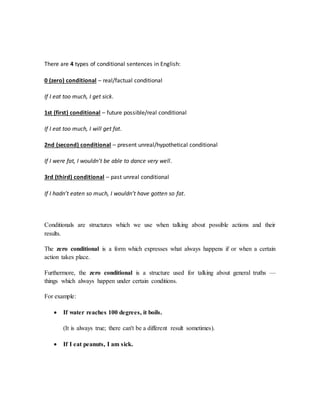
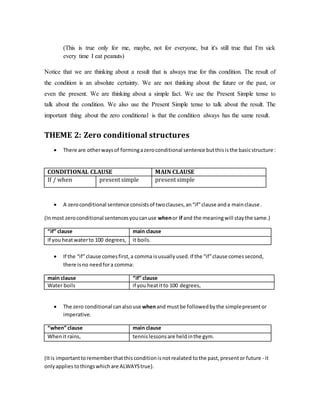
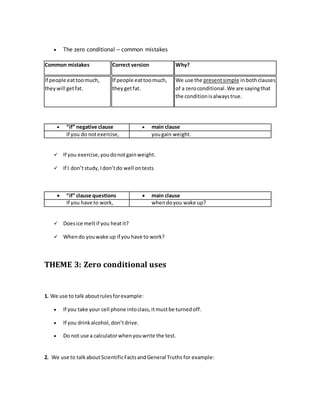
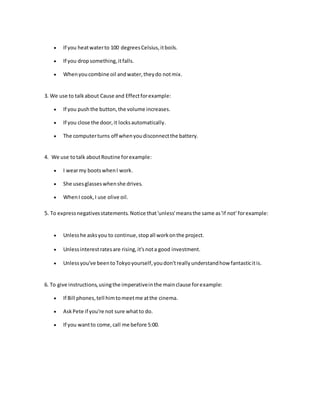
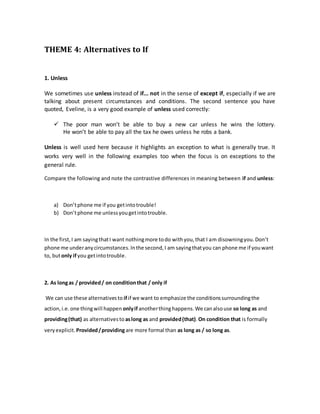
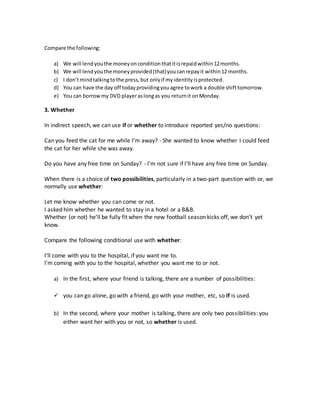
This document provides information about zero conditional sentences in English grammar. It begins by explaining that conditional sentences have two clauses: a conditional (if) clause and a main clause. A zero conditional expresses something that is always true when a certain condition occurs. It uses the present simple tense in both clauses since it refers to general truths and facts. Examples are provided like "If I eat too much, I get sick" and "Water boils if you heat it to 100 degrees." The document outlines the basic structure of zero conditional sentences and discusses their uses, such as for rules, scientific facts, cause and effect, routines, and negatives. It also presents alternatives to "if" like "unless," "as long as," and "

![THEME 1: Introduction to conditional sentences
Conditional sentences are usually made up of two parts, a conditional clause and a main clause.
The conditional clause is the 'if' part of the sentence and the main clause is the result, what
happens.
Furthermore, a conditional sentence is a sentence structure commonly used in English to talk
about something (a result) that may happen ONLY IF something else happens first (a condition).
The conditionmaybe somethingreal orunreal/hypothetical, andthe resultcouldadefinite result,
or just a possible/likely result.
The most common type of conditional sentence uses if. These are the easiest conditional
sentences to form and understand. You could also use unless, when, after, before or as soon as.
Here, we will focus on using conditional sentences with if.
The two clausescan come inany order.In writtenEnglishif the conditional clausecomesfirst, you
put a comma between it and the main clause. You don't use a comma if the main clause comes
first.
Then there are 2 parts to a conditional sentence. These two parts are also called clauses.
[A clause is any part of a sentence with a subject and a verb.]
Part 1 – the if or condition clause: the event that needs to occur; also called the
dependentclause because itisnota complete sentence andisdependentonthe 2nd part of the
sentence.
Part 2 – the result or main clause, or what happens when the event in the if/condition
clause occurs; also called the independent clause.
Either part can come first:
If I eattoo much,Iget sick.
[Whenthe ‘if’partcomesfirst,the two parts are separatedwitha comma( , )]
I get sick if I eat too much.
Changingthe order of the clauses does not change the meaning; the two sentences above mean
exactly the same thing.](https://image.slidesharecdn.com/grammarzeroconditional-150716164750-lva1-app6891/85/Grammar-zero-conditional-2-320.jpg)