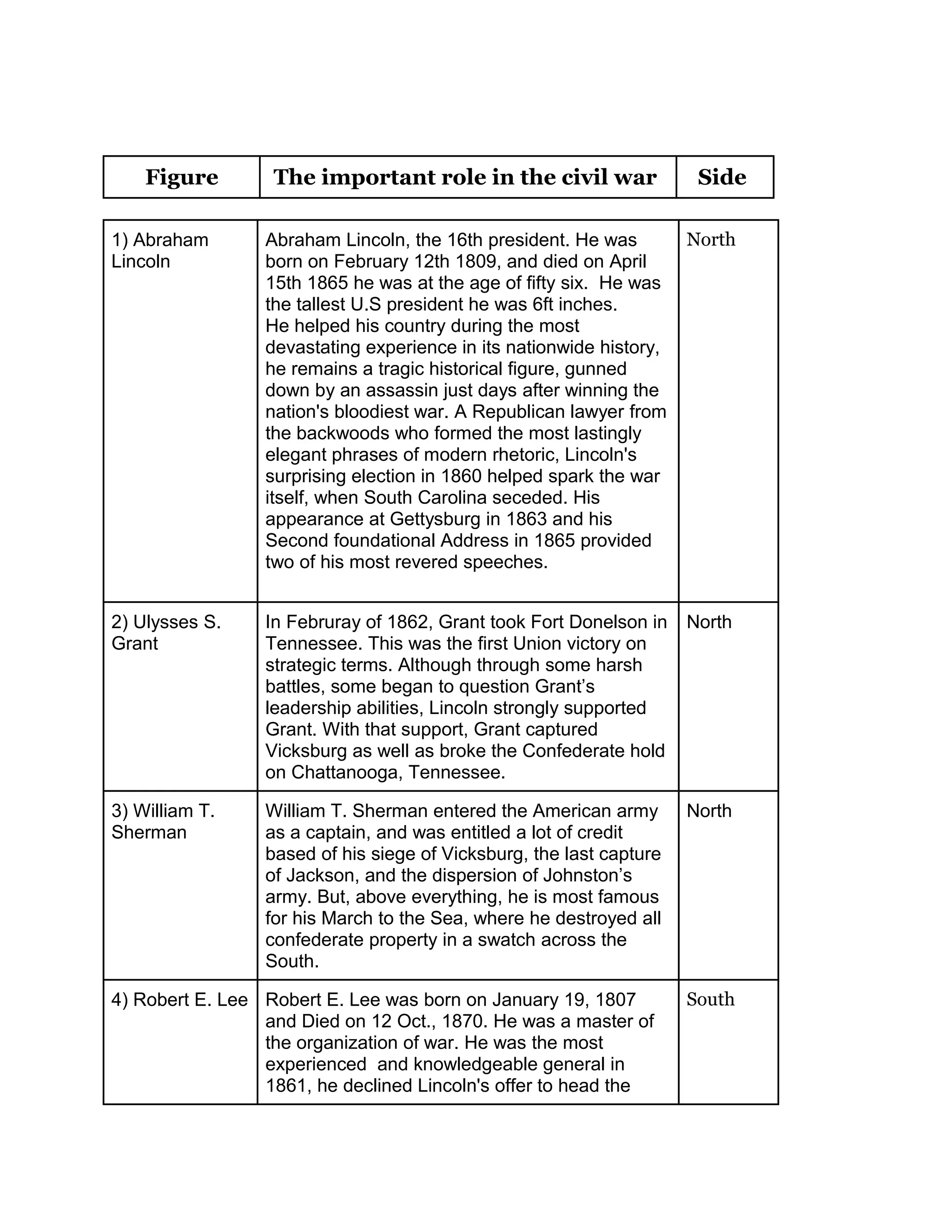
Figure The important role in the civil war Side
1) Abraham
Lincoln
Abraham Lincoln, the 16th president. He was
born on February 12th 1809, and died on April
15th 1865 he was at the age of fifty six. He was
the tallest U.S president he was 6ft inches.
He helped his country during the most
devastating experience in its nationwide history,
he remains a tragic historical figure, gunned
down by an assassin just days after winning the
nation's bloodiest war. A Republican lawyer from
the backwoods who formed the most lastingly
elegant phrases of modern rhetoric, Lincoln's
surprising election in 1860 helped spark the war
itself, when South Carolina seceded. His
appearance at Gettysburg in 1863 and his
Second foundational Address in 1865 provided
two of his most revered speeches.
North
2) Ulysses S.
Grant
In Februray of 1862, Grant took Fort Donelson in
Tennessee. This was the first Union victory on
strategic terms. Although through some harsh
battles, some began to question Grant’s
leadership abilities, Lincoln strongly supported
Grant. With that support, Grant captured
Vicksburg as well as broke the Confederate hold
on Chattanooga, Tennessee.
North
3) William T.
Sherman
William T. Sherman entered the American army
as a captain, and was entitled a lot of credit
based of his siege of Vicksburg, the last capture
of Jackson, and the dispersion of Johnston’s
army. But, above everything, he is most famous
for his March to the Sea, where he destroyed all
confederate property in a swatch across the
South.
North
4) Robert E. Lee Robert E. Lee was born on January 19, 1807
and Died on 12 Oct., 1870. He was a master of
the organization of war. He was the most
experienced and knowledgeable general in
1861, he declined Lincoln's offer to head the
South
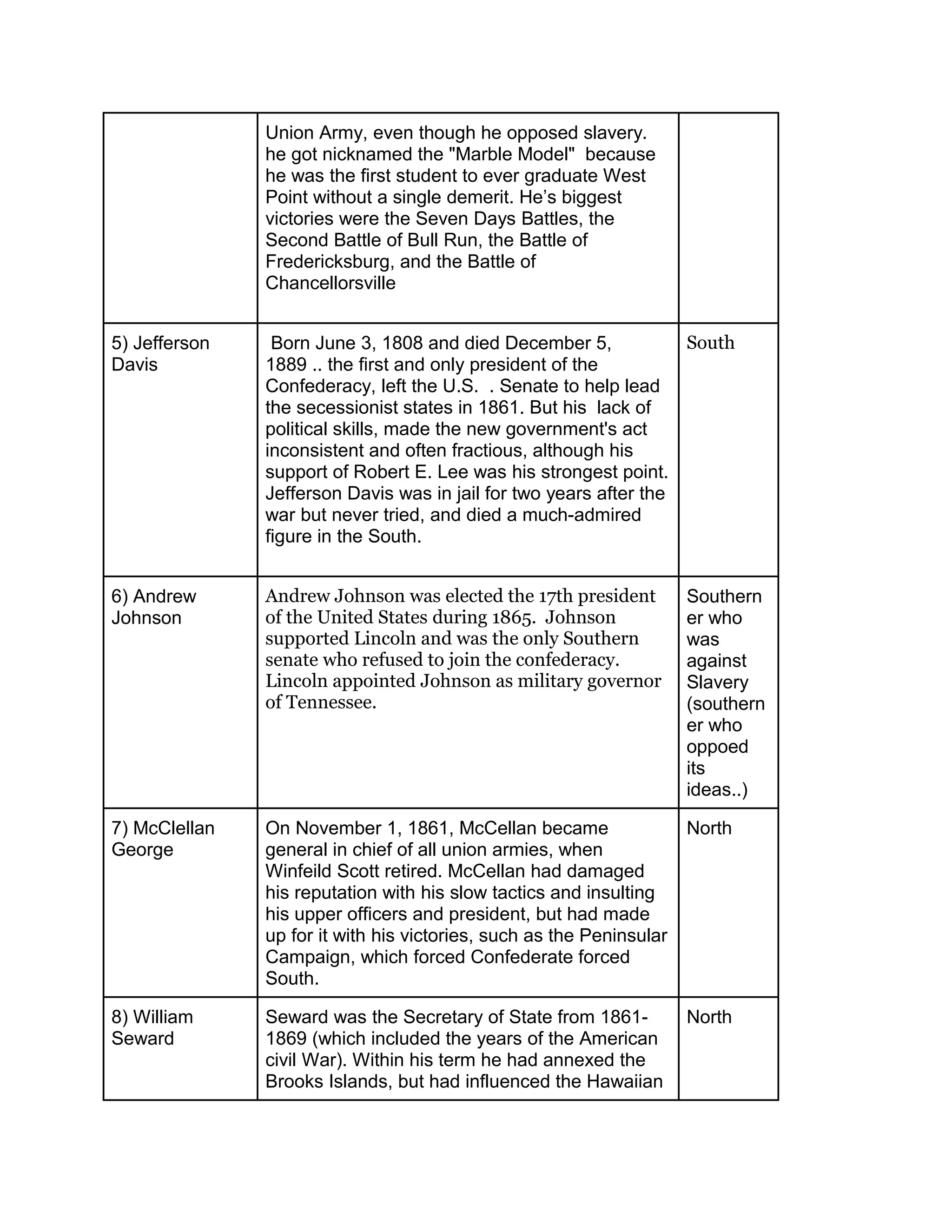
Union Army, even though he opposed slavery.
he got nicknamed the "Marble Model" because
he was the first student to ever graduate West
Point without a single demerit. He’s biggest
victories were the Seven Days Battles, the
Second Battle of Bull Run, the Battle of
Fredericksburg, and the Battle of
Chancellorsville
5) Jefferson
Davis
Born June 3, 1808 and died December 5,
1889 .. the first and only president of the
Confederacy, left the U.S. . Senate to help lead
the secessionist states in 1861. But his lack of
political skills, made the new government's act
inconsistent and often fractious, although his
support of Robert E. Lee was his strongest point.
Jefferson Davis was in jail for two years after the
war but never tried, and died a much-admired
figure in the South.
South
6) Andrew
Johnson
Andrew Johnson was elected the 17th president
of the United States during 1865. Johnson
supported Lincoln and was the only Southern
senate who refused to join the confederacy.
Lincoln appointed Johnson as military governor
of Tennessee.
Southern
er who
was
against
Slavery
(southern
er who
oppoed
its
ideas..)
7) McClellan
George
On November 1, 1861, McCellan became
general in chief of all union armies, when
Winfeild Scott retired. McCellan had damaged
his reputation with his slow tactics and insulting
his upper officers and president, but had made
up for it with his victories, such as the Peninsular
Campaign, which forced Confederate forced
South.
North
8) William
Seward
Seward was the Secretary of State from 1861-
1869 (which included the years of the American
civil War). Within his term he had annexed the
Brooks Islands, but had influenced the Hawaiian
North
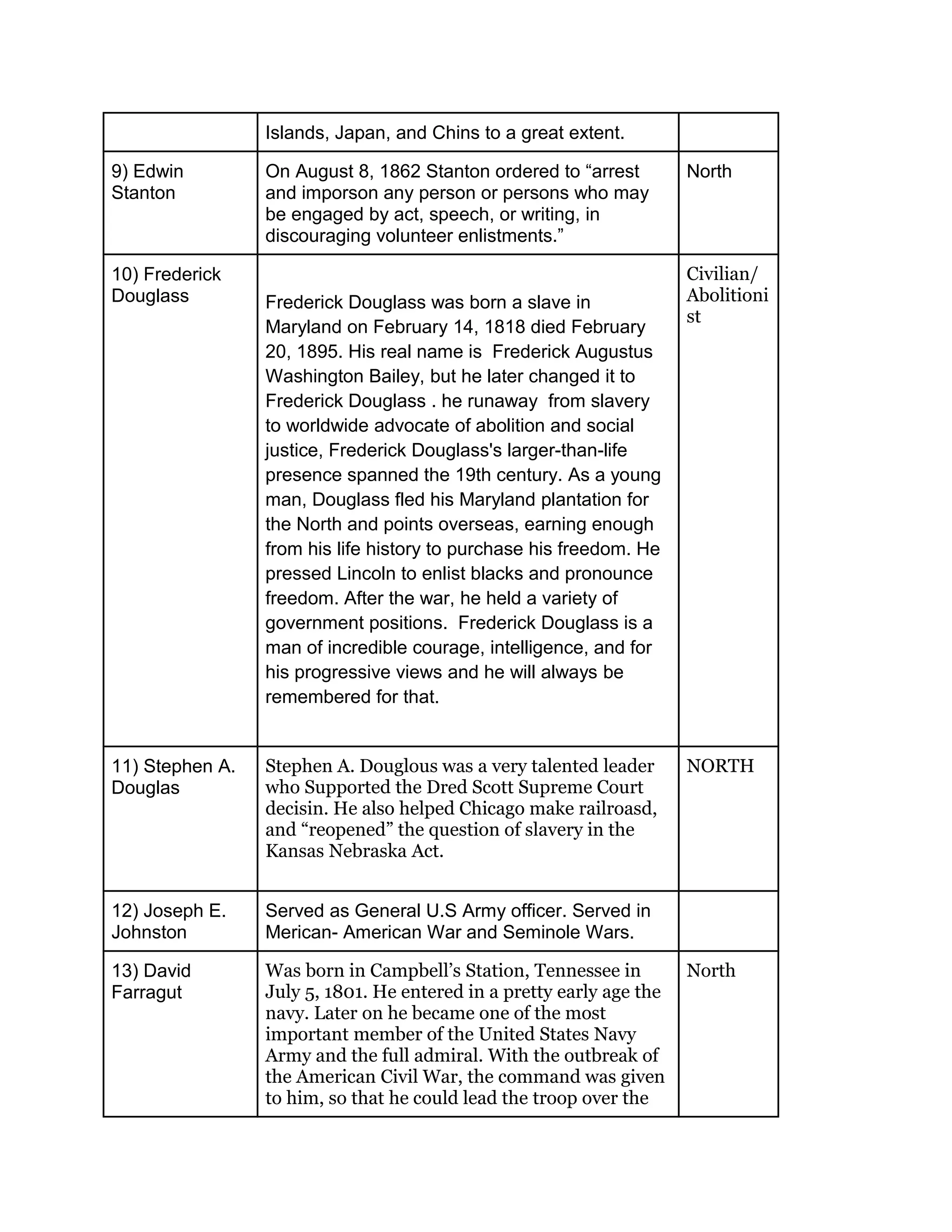
Islands, Japan, and Chins to a great extent.
9) Edwin
Stanton
On August 8, 1862 Stanton ordered to “arrest
and imporson any person or persons who may
be engaged by act, speech, or writing, in
discouraging volunteer enlistments.”
North
10) Frederick
Douglass Frederick Douglass was born a slave in
Maryland on February 14, 1818 died February
20, 1895. His real name is Frederick Augustus
Washington Bailey, but he later changed it to
Frederick Douglass . he runaway from slavery
to worldwide advocate of abolition and social
justice, Frederick Douglass's larger-than-life
presence spanned the 19th century. As a young
man, Douglass fled his Maryland plantation for
the North and points overseas, earning enough
from his life history to purchase his freedom. He
pressed Lincoln to enlist blacks and pronounce
freedom. After the war, he held a variety of
government positions. Frederick Douglass is a
man of incredible courage, intelligence, and for
his progressive views and he will always be
remembered for that.
Civilian/
Abolitioni
st
11) Stephen A.
Douglas
Stephen A. Douglous was a very talented leader
who Supported the Dred Scott Supreme Court
decisin. He also helped Chicago make railroasd,
and “reopened” the question of slavery in the
Kansas Nebraska Act.
NORTH
12) Joseph E.
Johnston
Served as General U.S Army officer. Served in
Merican- American War and Seminole Wars.
13) David
Farragut
Was born in Campbell’s Station, Tennessee in
July 5, 1801. He entered in a pretty early age the
navy. Later on he became one of the most
important member of the United States Navy
Army and the full admiral. With the outbreak of
the American Civil War, the command was given
to him, so that he could lead the troop over the
North
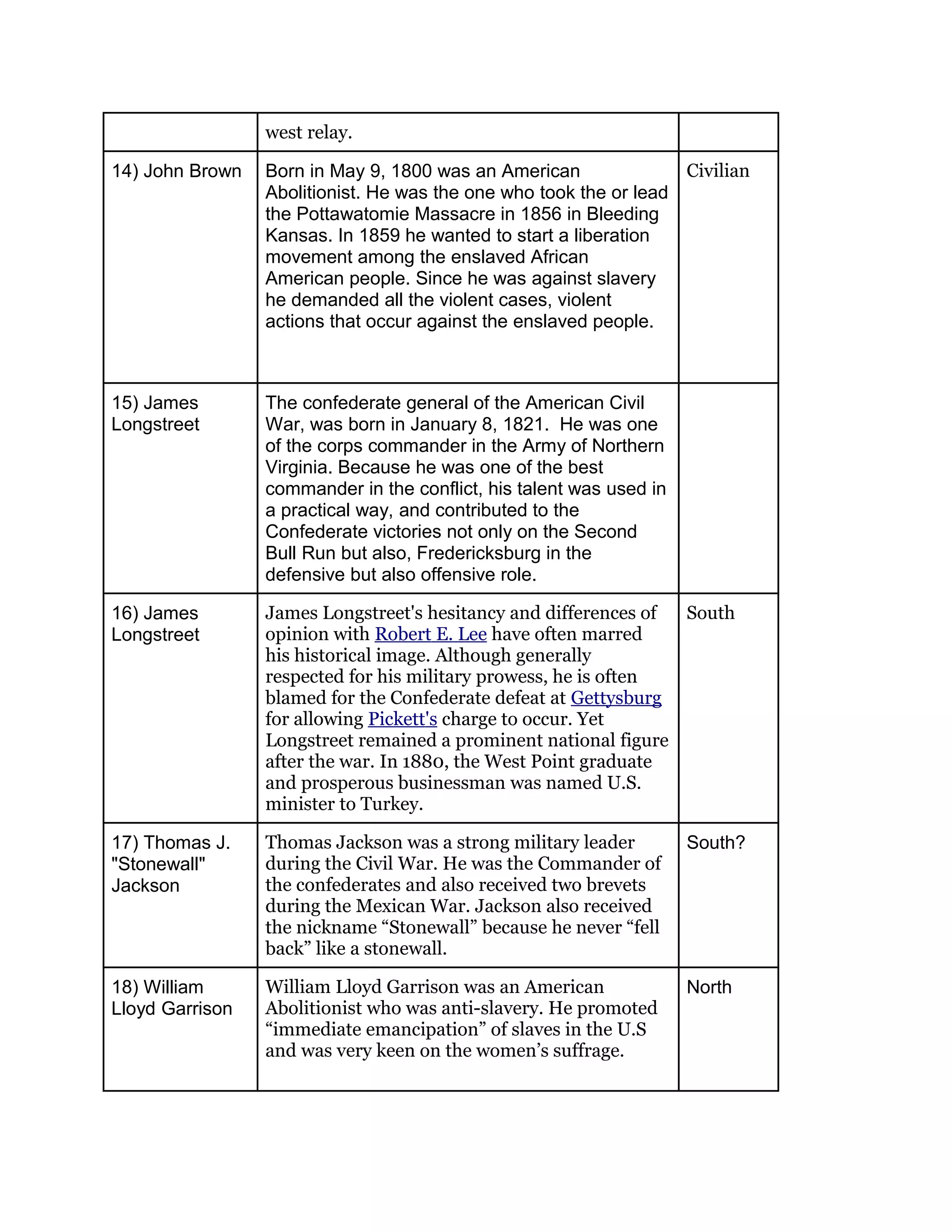
west relay.
14) John Brown Born in May 9, 1800 was an American
Abolitionist. He was the one who took the or lead
the Pottawatomie Massacre in 1856 in Bleeding
Kansas. In 1859 he wanted to start a liberation
movement among the enslaved African
American people. Since he was against slavery
he demanded all the violent cases, violent
actions that occur against the enslaved people.
Civilian
15) James
Longstreet
The confederate general of the American Civil
War, was born in January 8, 1821. He was one
of the corps commander in the Army of Northern
Virginia. Because he was one of the best
commander in the conflict, his talent was used in
a practical way, and contributed to the
Confederate victories not only on the Second
Bull Run but also, Fredericksburg in the
defensive but also offensive role.
16) James
Longstreet
James Longstreet's hesitancy and differences of
opinion with Robert E. Lee have often marred
his historical image. Although generally
respected for his military prowess, he is often
blamed for the Confederate defeat at Gettysburg
for allowing Pickett's charge to occur. Yet
Longstreet remained a prominent national figure
after the war. In 1880, the West Point graduate
and prosperous businessman was named U.S.
minister to Turkey.
South
17) Thomas J.
"Stonewall"
Jackson
Thomas Jackson was a strong military leader
during the Civil War. He was the Commander of
the confederates and also received two brevets
during the Mexican War. Jackson also received
the nickname “Stonewall” because he never “fell
back” like a stonewall.
South?
18) William
Lloyd Garrison
William Lloyd Garrison was an American
Abolitionist who was anti-slavery. He promoted
“immediate emancipation” of slaves in the U.S
and was very keen on the women’s suffrage.
North
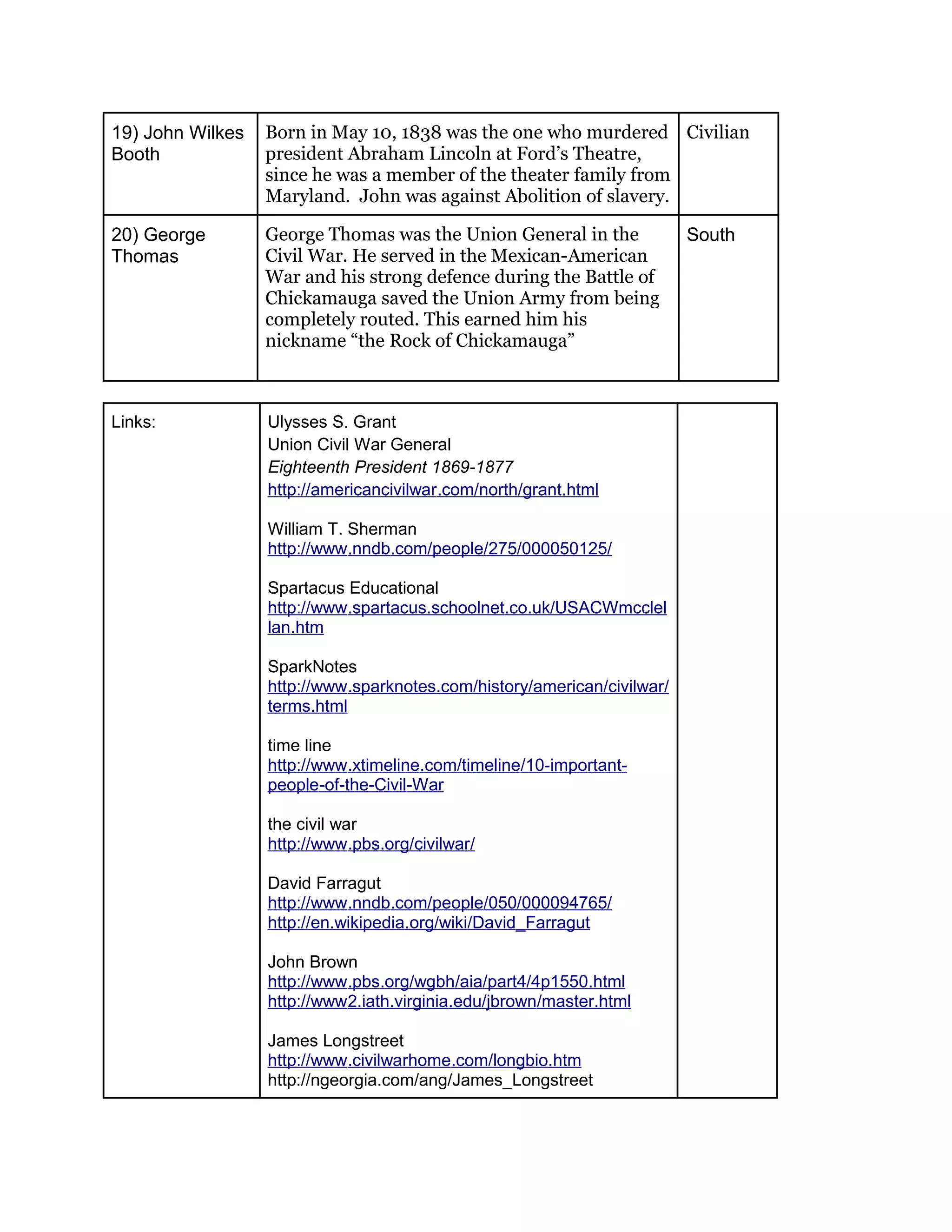
19) John Wilkes
Booth
Born in May 10, 1838 was the one who murdered
president Abraham Lincoln at Ford’s Theatre,
since he was a member of the theater family from
Maryland. John was against Abolition of slavery.
Civilian
20) George
Thomas
George Thomas was the Union General in the
Civil War. He served in the Mexican-American
War and his strong defence during the Battle of
Chickamauga saved the Union Army from being
completely routed. This earned him his
nickname “the Rock of Chickamauga”
South
Links: Ulysses S. Grant
Union Civil War General
Eighteenth President 1869-1877
http://americancivilwar.com/north/grant.html
William T. Sherman
http://www.nndb.com/people/275/000050125/
Spartacus Educational
http://www.spartacus.schoolnet.co.uk/USACWmcclel
lan.htm
SparkNotes
http://www.sparknotes.com/history/american/civilwar/
terms.html
time line
http://www.xtimeline.com/timeline/10-important-
people-of-the-Civil-War
the civil war
http://www.pbs.org/civilwar/
David Farragut
http://www.nndb.com/people/050/000094765/
http://en.wikipedia.org/wiki/David_Farragut
John Brown
http://www.pbs.org/wgbh/aia/part4/4p1550.html
http://www2.iath.virginia.edu/jbrown/master.html
James Longstreet
http://www.civilwarhome.com/longbio.htm
http://ngeorgia.com/ang/James_Longstreet
U.shistoryproject (6)

U.shistoryproject (6)

  • 1.
    Figure The importantrole in the civil war Side 1) Abraham Lincoln Abraham Lincoln, the 16th president. He was born on February 12th 1809, and died on April 15th 1865 he was at the age of fifty six. He was the tallest U.S president he was 6ft inches. He helped his country during the most devastating experience in its nationwide history, he remains a tragic historical figure, gunned down by an assassin just days after winning the nation's bloodiest war. A Republican lawyer from the backwoods who formed the most lastingly elegant phrases of modern rhetoric, Lincoln's surprising election in 1860 helped spark the war itself, when South Carolina seceded. His appearance at Gettysburg in 1863 and his Second foundational Address in 1865 provided two of his most revered speeches. North 2) Ulysses S. Grant In Februray of 1862, Grant took Fort Donelson in Tennessee. This was the first Union victory on strategic terms. Although through some harsh battles, some began to question Grant’s leadership abilities, Lincoln strongly supported Grant. With that support, Grant captured Vicksburg as well as broke the Confederate hold on Chattanooga, Tennessee. North 3) William T. Sherman William T. Sherman entered the American army as a captain, and was entitled a lot of credit based of his siege of Vicksburg, the last capture of Jackson, and the dispersion of Johnston’s army. But, above everything, he is most famous for his March to the Sea, where he destroyed all confederate property in a swatch across the South. North 4) Robert E. Lee Robert E. Lee was born on January 19, 1807 and Died on 12 Oct., 1870. He was a master of the organization of war. He was the most experienced and knowledgeable general in 1861, he declined Lincoln's offer to head the South
  • 2.
    Union Army, eventhough he opposed slavery. he got nicknamed the "Marble Model" because he was the first student to ever graduate West Point without a single demerit. He’s biggest victories were the Seven Days Battles, the Second Battle of Bull Run, the Battle of Fredericksburg, and the Battle of Chancellorsville 5) Jefferson Davis Born June 3, 1808 and died December 5, 1889 .. the first and only president of the Confederacy, left the U.S. . Senate to help lead the secessionist states in 1861. But his lack of political skills, made the new government's act inconsistent and often fractious, although his support of Robert E. Lee was his strongest point. Jefferson Davis was in jail for two years after the war but never tried, and died a much-admired figure in the South. South 6) Andrew Johnson Andrew Johnson was elected the 17th president of the United States during 1865. Johnson supported Lincoln and was the only Southern senate who refused to join the confederacy. Lincoln appointed Johnson as military governor of Tennessee. Southern er who was against Slavery (southern er who oppoed its ideas..) 7) McClellan George On November 1, 1861, McCellan became general in chief of all union armies, when Winfeild Scott retired. McCellan had damaged his reputation with his slow tactics and insulting his upper officers and president, but had made up for it with his victories, such as the Peninsular Campaign, which forced Confederate forced South. North 8) William Seward Seward was the Secretary of State from 1861- 1869 (which included the years of the American civil War). Within his term he had annexed the Brooks Islands, but had influenced the Hawaiian North
  • 3.
    Islands, Japan, andChins to a great extent. 9) Edwin Stanton On August 8, 1862 Stanton ordered to “arrest and imporson any person or persons who may be engaged by act, speech, or writing, in discouraging volunteer enlistments.” North 10) Frederick Douglass Frederick Douglass was born a slave in Maryland on February 14, 1818 died February 20, 1895. His real name is Frederick Augustus Washington Bailey, but he later changed it to Frederick Douglass . he runaway from slavery to worldwide advocate of abolition and social justice, Frederick Douglass's larger-than-life presence spanned the 19th century. As a young man, Douglass fled his Maryland plantation for the North and points overseas, earning enough from his life history to purchase his freedom. He pressed Lincoln to enlist blacks and pronounce freedom. After the war, he held a variety of government positions. Frederick Douglass is a man of incredible courage, intelligence, and for his progressive views and he will always be remembered for that. Civilian/ Abolitioni st 11) Stephen A. Douglas Stephen A. Douglous was a very talented leader who Supported the Dred Scott Supreme Court decisin. He also helped Chicago make railroasd, and “reopened” the question of slavery in the Kansas Nebraska Act. NORTH 12) Joseph E. Johnston Served as General U.S Army officer. Served in Merican- American War and Seminole Wars. 13) David Farragut Was born in Campbell’s Station, Tennessee in July 5, 1801. He entered in a pretty early age the navy. Later on he became one of the most important member of the United States Navy Army and the full admiral. With the outbreak of the American Civil War, the command was given to him, so that he could lead the troop over the North
  • 4.
    west relay. 14) JohnBrown Born in May 9, 1800 was an American Abolitionist. He was the one who took the or lead the Pottawatomie Massacre in 1856 in Bleeding Kansas. In 1859 he wanted to start a liberation movement among the enslaved African American people. Since he was against slavery he demanded all the violent cases, violent actions that occur against the enslaved people. Civilian 15) James Longstreet The confederate general of the American Civil War, was born in January 8, 1821. He was one of the corps commander in the Army of Northern Virginia. Because he was one of the best commander in the conflict, his talent was used in a practical way, and contributed to the Confederate victories not only on the Second Bull Run but also, Fredericksburg in the defensive but also offensive role. 16) James Longstreet James Longstreet's hesitancy and differences of opinion with Robert E. Lee have often marred his historical image. Although generally respected for his military prowess, he is often blamed for the Confederate defeat at Gettysburg for allowing Pickett's charge to occur. Yet Longstreet remained a prominent national figure after the war. In 1880, the West Point graduate and prosperous businessman was named U.S. minister to Turkey. South 17) Thomas J. "Stonewall" Jackson Thomas Jackson was a strong military leader during the Civil War. He was the Commander of the confederates and also received two brevets during the Mexican War. Jackson also received the nickname “Stonewall” because he never “fell back” like a stonewall. South? 18) William Lloyd Garrison William Lloyd Garrison was an American Abolitionist who was anti-slavery. He promoted “immediate emancipation” of slaves in the U.S and was very keen on the women’s suffrage. North
  • 5.
    19) John Wilkes Booth Bornin May 10, 1838 was the one who murdered president Abraham Lincoln at Ford’s Theatre, since he was a member of the theater family from Maryland. John was against Abolition of slavery. Civilian 20) George Thomas George Thomas was the Union General in the Civil War. He served in the Mexican-American War and his strong defence during the Battle of Chickamauga saved the Union Army from being completely routed. This earned him his nickname “the Rock of Chickamauga” South Links: Ulysses S. Grant Union Civil War General Eighteenth President 1869-1877 http://americancivilwar.com/north/grant.html William T. Sherman http://www.nndb.com/people/275/000050125/ Spartacus Educational http://www.spartacus.schoolnet.co.uk/USACWmcclel lan.htm SparkNotes http://www.sparknotes.com/history/american/civilwar/ terms.html time line http://www.xtimeline.com/timeline/10-important- people-of-the-Civil-War the civil war http://www.pbs.org/civilwar/ David Farragut http://www.nndb.com/people/050/000094765/ http://en.wikipedia.org/wiki/David_Farragut John Brown http://www.pbs.org/wgbh/aia/part4/4p1550.html http://www2.iath.virginia.edu/jbrown/master.html James Longstreet http://www.civilwarhome.com/longbio.htm http://ngeorgia.com/ang/James_Longstreet