HEALTH CARE SYSTEM IN CANADA
Canada is the second largest country in the world, with a land area of about 10 million km2. It is a confederation of 10 provinces and 2 territories.The estimated total population of the country is about 29.6 million peopleOVERVIEW
Publicly funded, privately delivered health care system Best described as an interlocking set of ten provincial and three territorial health insurance plans.Known to Canadians as “Medicare,” the system provides access to universal, comprehensive coverage for medically necessary hospital and physician services.The services are administered and delivered by the provincial and territorial (i.e., state or regional) governments, and are provided free of chargeHEALTHCARE SYSTEM
Also assistance from the federal (i.e., national) government in funding To receive their full allocation of federal funding for health care, the provincial and territorial health insurance plans must meet five criteria:Comprehensiveness, Universality, Portability, Accessibility  Public Administration
The provincial and territorial plans must insure all medically necessary services provided by hospitals, medical practitioners and dentists working within a hospital setting.All insured health services provided by hospitals and medical practitioners be covered by the planCOMPREHENSIVENESS
The provincial and territorial plans must entitle all insured persons to health insurance coverage on uniform terms and conditions It should cover 100% of the total insured populationUNIVERSALITY
The provincial and territorial plans must cover all insured persons when they move to another province or territory within Canada and when they travel abroad.The provinces and territories have some limits on coverage for services provided outside Canada, and may require prior approval for non-emergency services delivered outside their jurisdiction.PORTIBILITY
The provincial and territorial plans must provide all insured persons reasonable access to medically necessary hospital and physician services without financial or other barriers.ACESSIBILITY
The provincial and territorial plans must be administered and operated on a non profit basis by a public authority accountable to the provincial or territorial government.PUBLIC  ADMINISTRATION
ORGANIZATIONAL STRUCTURE OF THE HEALTH CARE SYSTEM
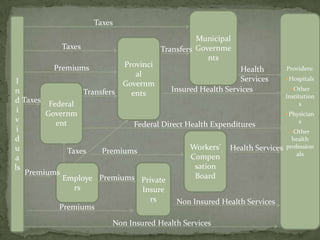
Municipal GovernmentsProviders:HospitalsOther InstitutionsPhysiciansOther health professionalsIndividualsTaxesProvincial GovernmentsTaxesTransfersPremiumsHealth ServicesFederal GovernmentInsured Health ServicesTransfersTaxesFederal Direct Health ExpendituresWorkers’Compensation BoardHealth ServicesTaxesPremiumsEmployersPrivate InsurersPremiumsPremiumsNon Insured Health ServicesPremiumsNon Insured Health Services
Financed primarily through taxation, both provincial and federal, personal and corporate income taxesFederal funding is transferred to the provinces as a combination of cash contributions and tax points (taxing power).Public sector funding represents about 72% of total health expenditure. The remaining 28% is financed privately through supplementary insurance, employer-sponsored benefits or directly out-of-pocket.HEALTH CARE FINANCE AND EXPENDITURE
Most public sector funding comes from central revenue streams. Some provinces use ancillary funding methods which are nominally targeted for health care, such as sales taxes, payroll levies and lottery proceeds.BENEFITS:Aminimum, medically necessary hospital
Medicare care as provided for under the Canada Health ActApproximately 1.6 million people work in health care and social services in Canada, and include a mix of professionals in addition to nurses and physicians.The health industry is the 3rd largest employer after manufacturing and the retail trade.HEALTH HUMAN RESOURCE
HEALTH CARE DELIVERY SYSTEM
By general practitioners (GPs) and family physiciansUsually the initial contact with the formal health care system Control access to most specialists, many allied providers, admissions to hospitals at which they have admitting privileges, diagnostic testing and prescription drug therapy.Most GPs are private practitioners who work in independent or group practices and enjoy a high degree of autonomy.PRIMARY HEALTH CARE
Private practitioners are generally paid on a fee-for-service basis and submit their service claims directly to the provincial insurance plan for payment.Patients are free to choose their own physiciansUse of the emergency room is also their primary access point for health care. This practice is generally discouraged by provincial governments due to the cost of emergency care.Other healthcare personnel includes:Dentists
Nurses
PharmacistsPrimary health care services often includes: Prevention and treatment of common diseases and injuries; basic emergency services;
 Referrals to and coordination with other levels of care , such as hospital and specialist care;
 Primary mental health care; palliative and end-of-life care;
 Health promotion;
 Healthy child development;
 Primary maternity care;

Health care system in canada

  • 1.
  • 2.
    Canada is thesecond largest country in the world, with a land area of about 10 million km2. It is a confederation of 10 provinces and 2 territories.The estimated total population of the country is about 29.6 million peopleOVERVIEW
  • 3.
    Publicly funded, privatelydelivered health care system Best described as an interlocking set of ten provincial and three territorial health insurance plans.Known to Canadians as “Medicare,” the system provides access to universal, comprehensive coverage for medically necessary hospital and physician services.The services are administered and delivered by the provincial and territorial (i.e., state or regional) governments, and are provided free of chargeHEALTHCARE SYSTEM
  • 4.
    Also assistance fromthe federal (i.e., national) government in funding To receive their full allocation of federal funding for health care, the provincial and territorial health insurance plans must meet five criteria:Comprehensiveness, Universality, Portability, Accessibility Public Administration
  • 5.
    The provincial andterritorial plans must insure all medically necessary services provided by hospitals, medical practitioners and dentists working within a hospital setting.All insured health services provided by hospitals and medical practitioners be covered by the planCOMPREHENSIVENESS
  • 6.
    The provincial andterritorial plans must entitle all insured persons to health insurance coverage on uniform terms and conditions It should cover 100% of the total insured populationUNIVERSALITY
  • 7.
    The provincial andterritorial plans must cover all insured persons when they move to another province or territory within Canada and when they travel abroad.The provinces and territories have some limits on coverage for services provided outside Canada, and may require prior approval for non-emergency services delivered outside their jurisdiction.PORTIBILITY
  • 8.
    The provincial andterritorial plans must provide all insured persons reasonable access to medically necessary hospital and physician services without financial or other barriers.ACESSIBILITY
  • 9.
    The provincial andterritorial plans must be administered and operated on a non profit basis by a public authority accountable to the provincial or territorial government.PUBLIC ADMINISTRATION
  • 10.
    ORGANIZATIONAL STRUCTURE OFTHE HEALTH CARE SYSTEM
  • 11.
    Municipal GovernmentsProviders:HospitalsOther InstitutionsPhysiciansOtherhealth professionalsIndividualsTaxesProvincial GovernmentsTaxesTransfersPremiumsHealth ServicesFederal GovernmentInsured Health ServicesTransfersTaxesFederal Direct Health ExpendituresWorkers’Compensation BoardHealth ServicesTaxesPremiumsEmployersPrivate InsurersPremiumsPremiumsNon Insured Health ServicesPremiumsNon Insured Health Services
  • 12.
    Financed primarily throughtaxation, both provincial and federal, personal and corporate income taxesFederal funding is transferred to the provinces as a combination of cash contributions and tax points (taxing power).Public sector funding represents about 72% of total health expenditure. The remaining 28% is financed privately through supplementary insurance, employer-sponsored benefits or directly out-of-pocket.HEALTH CARE FINANCE AND EXPENDITURE
  • 13.
    Most public sectorfunding comes from central revenue streams. Some provinces use ancillary funding methods which are nominally targeted for health care, such as sales taxes, payroll levies and lottery proceeds.BENEFITS:Aminimum, medically necessary hospital
  • 14.
    Medicare care asprovided for under the Canada Health ActApproximately 1.6 million people work in health care and social services in Canada, and include a mix of professionals in addition to nurses and physicians.The health industry is the 3rd largest employer after manufacturing and the retail trade.HEALTH HUMAN RESOURCE
  • 15.
  • 16.
    By general practitioners(GPs) and family physiciansUsually the initial contact with the formal health care system Control access to most specialists, many allied providers, admissions to hospitals at which they have admitting privileges, diagnostic testing and prescription drug therapy.Most GPs are private practitioners who work in independent or group practices and enjoy a high degree of autonomy.PRIMARY HEALTH CARE
  • 17.
    Private practitioners aregenerally paid on a fee-for-service basis and submit their service claims directly to the provincial insurance plan for payment.Patients are free to choose their own physiciansUse of the emergency room is also their primary access point for health care. This practice is generally discouraged by provincial governments due to the cost of emergency care.Other healthcare personnel includes:Dentists
  • 18.
  • 19.
    PharmacistsPrimary health careservices often includes: Prevention and treatment of common diseases and injuries; basic emergency services;
  • 20.
    Referrals toand coordination with other levels of care , such as hospital and specialist care;
  • 21.
    Primary mentalhealth care; palliative and end-of-life care;
  • 22.
  • 23.
    Healthy childdevelopment;
  • 24.