TURKEY & EUROPEAN UNION
General Turkey  has been an associate member of the   European Union and its predecessors since  1964 .  The country formally applied for full membership on  April 14 1987 , but 12 years passed before it was recognized as a candidate country at the Helsinki Summit in  1999 .  The European Council announced that membership negotiations with Turkey were officially opened on  October 3, 2005.  The screening process which began on October 20, 2005 was completed on  October 18, 2006.
Against Many opponents argue that Turkey's current and past governments do not respect key principles expected in a  liberal democracy  because of  discrimination  against ethnic minorities, particularly  Kurds ,  non-Sunni Muslim  religious minorities, political dissidents and critics of the  'Kemalist' nationalism , and because of the significant role of the  army  on the Turkish political foreground. Its large  population  would also alter the balance of power in the representative European institutions. Some oppose the accession of a large  Muslim  country.
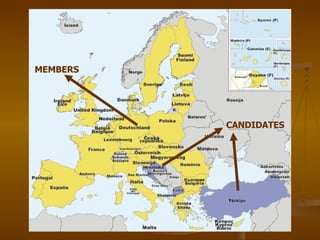
MEMBERS CANDIDATES
For Arguments in favour of Turkey joining include the belief that this would bolster democratic institutions in Turkey,  strengthen the EU's economy  with the addition of an  OECD   (  Organi z ation for Economic Co-operation and Development)   and  G-20  ( Group of 20 industrial nations) member to the bloc, and strengthen the EU's military with the addition of  the second largest armed force of NATO . Proponents also argue that it abides by most conditions for accession. Some maintain that the EU can no longer refuse Turkey, as it has had an open candidacy for over  40 years , and has made major improvements in  human rights  in order to try to satisfy the entry conditions.
Expectations "Europe needs a stable, democratic and more prosperous Turkey which adopts our  values , our rule of law, and our common policies. The accession perspective has already driven forward bold and significant reforms. If the rule of  law  and  human rights  are guaranteed throughout the country, Turkey can join the EU and thus become an even stronger bridge between civilizations as it is already today."  Matt Rosenberg
 

Turkey & European Union

  • 1.
  • 2.
    General Turkey has been an associate member of the European Union and its predecessors since 1964 . The country formally applied for full membership on April 14 1987 , but 12 years passed before it was recognized as a candidate country at the Helsinki Summit in 1999 . The European Council announced that membership negotiations with Turkey were officially opened on October 3, 2005. The screening process which began on October 20, 2005 was completed on October 18, 2006.
  • 3.
    Against Many opponentsargue that Turkey's current and past governments do not respect key principles expected in a liberal democracy because of discrimination against ethnic minorities, particularly Kurds , non-Sunni Muslim religious minorities, political dissidents and critics of the 'Kemalist' nationalism , and because of the significant role of the army on the Turkish political foreground. Its large population would also alter the balance of power in the representative European institutions. Some oppose the accession of a large Muslim country.
  • 4.
  • 5.
    For Arguments infavour of Turkey joining include the belief that this would bolster democratic institutions in Turkey, strengthen the EU's economy with the addition of an OECD ( Organi z ation for Economic Co-operation and Development) and G-20 ( Group of 20 industrial nations) member to the bloc, and strengthen the EU's military with the addition of the second largest armed force of NATO . Proponents also argue that it abides by most conditions for accession. Some maintain that the EU can no longer refuse Turkey, as it has had an open candidacy for over 40 years , and has made major improvements in human rights in order to try to satisfy the entry conditions.
  • 6.
    Expectations "Europe needsa stable, democratic and more prosperous Turkey which adopts our values , our rule of law, and our common policies. The accession perspective has already driven forward bold and significant reforms. If the rule of law and human rights are guaranteed throughout the country, Turkey can join the EU and thus become an even stronger bridge between civilizations as it is already today." Matt Rosenberg
  • 7.