Prachi
B.Sc Nursing
Topic : Urinary Tract Infection
Subject : Adult Health Nursing - II
URINARY
TRACT
INFECTION
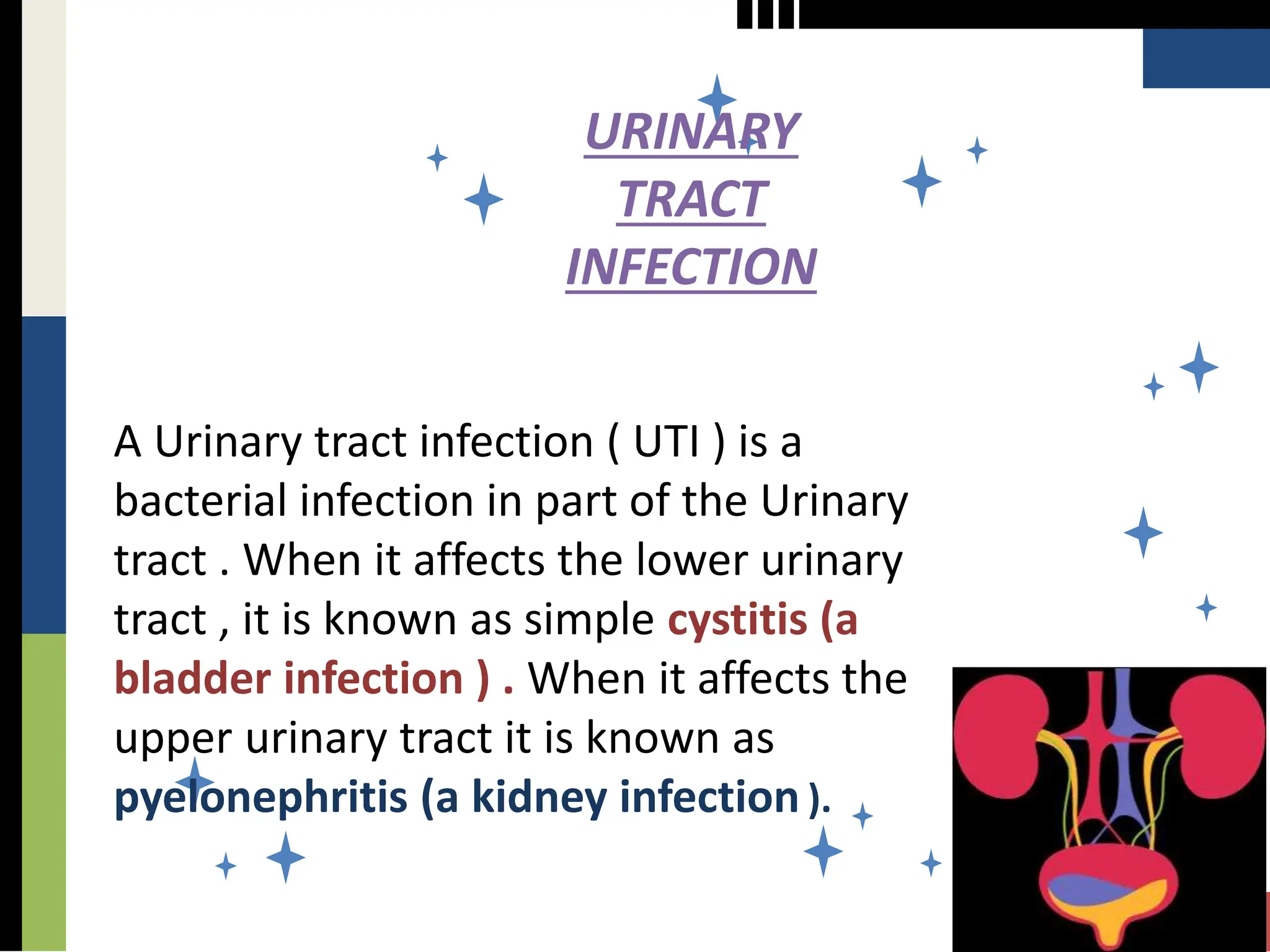
A Urinary tract infection ( UTI ) is a
bacterial infection in part of the Urinary
tract . When it affects the lower urinary
tract , it is known as simple cystitis (a
bladder infection ) . When it affects the
upper urinary tract it is known as
pyelonephritis (a kidney infection ).
DEFINITION
A urinary tract infection ( UTI ) is an infection of urinary
tract which involves infection of urinary tract organs such
as urethra , bladder .
OUR TEAM
Classification
Urinary Tract
Infections
1. According
to location
2.According
to
complication
s
3.
According
to history of
UTI.
1. According to location
Upper UTI
2. According to complications
a) Complicated UTI : These infections are related to
complication of certain conditions such as
catheterization , diabetes , an obstruction of urinary
tract and neurological disorders.
b) Uncomplicated UTI : These infections occur without
any complications of medical conditions.
3. According to history of UTI
a) Initial or Isolated UTI : These are the types of
infection which occurs at first time and haven’t
previous history of UTI’s.
b) Recurrent UTI : Recurrent UTI is an infection which
having history of UTIs . These occur after the treatment
and Correction of urinary tract infection.
CYSTITIS
URETERITIS
Instructions for use (premium
users)
Incidence
Urinary tract infection mostly occurs in old age
people more than 60 years . UTI is the second
most common bacterial infectious disease .
Female are most affected than males due to
shorter urethra .
Etiology
A. Anatomical defects :
∞ Shorter female urethra
∞ Congenital defects
∞ Stricture Urethra .
B. Medical conditions :
∞ Neurological disorders
∞ Diabetes Mellitus
∞ Human immune deficiency virus infection
C. Others :
∞ Catheterizations
∞ Voiding dysfunction
∞ Pregnancy
∞ Sexual intercourse with multiple sex partners .
Instructions for use
CAUSATIVE AGENTS
• Escherichia Coli ~ E.coli { causes 80 % of cases }
• proteus
• Enterococcus
• Staphylococcus
• Candida
• Klebsiella
PATHOPHYSIOLOGY
Normally Urine is sterile and produced by the kidney .
Physiologically urine passes from kidney to bladder by the
ureters . The body’s defence mechanism prevent the infection
by bladder mucosa through antibacterial action.
Any defect in defence mechanism produces the chances of
urinary tract infections. Many procedure like URINARY
CATHETERIZATION leads to direct entry of pathogenic
organism which produce UTI’s .
Upper UTI Clinical Manifestation
• Flank pain
• Fever
• Dysuria
• Chills
• Frequency
• Malaise
• Possible bloody or cloudy urine .
Lower UTI Clinical Manifestation
• Frequency & Urgency
• Burning on Urination
• Nocturia
• Inflamed swollen meatus in
urethritis
This presentation has been made using the following fonts:
Hammersmith One
(https://fonts.google.com/specimen/Hammersmith+One)
Asap
(https://fonts.google.com/specimen/Asap)
Fonts & colors used
DIAGNOSTIC EVALUATION
• Ultrasound
• Bladder & Kidney Biopsy
Intravenous Pyelography Cystoscopic Examination
• Urine Analysis
• Urine Culture
• Blood Analysis
• Renal function test
• Creatinine
• Voiding Cystourethrogram
• X- Rays
• CT Scan
• Blood Culture
VOIDING CYSTOURETHROGRAM
MANAGEMENT
Medical Management
• Ampicillin with aminoglycoside ( in complicated UTI )
• Trimethoprim sulfamethoxazole .
• Levofloxacin ( in complicated UTI ).
• Analgesics such as Phenazopyridine :: to relieve
discomfort .
• Administration of amoxicillin , ampicillin or
cephalosporin for one week in pregnancy.
Storyset
Nursing Management
Nursing diagnosis
• Altered body comfort related to acute pain .
• Impaired urinary elimination related to dysuria and urinary frequency.
• Hyperthermia and chills related to infection evidenced by increase
temperature, malaise and tachycardia .
• Knowledge deficit related to disease condition and preventive
measures .
Nursing Interventions
• Apply local heat on suprapubic area to relieve abdominal discomfort.
• Administer IV fluids if not contraindicated .
• Maintain input and output chart .
• Use aseptic techniques before any procedure .
• Procedures such as catheterization should be avoided , if possible.
• Check the vital signs .
• Ask the patient to observe colour and amount of urine .
• Educate the patient about preventive measures .
Storyset
Patient and Family Teaching
• Instruct the patient to complete avoidance of acohol.
• Advise to avoid eating of high spicy foods , chocolates
• Instruct to empty the bladder before and after intercourse .
• Explain the importance of maintenance of personal
hygiene.
• Explain the drugs actions , indications , their effects and
side effects .
• Instruct to maintain perineal hygiene .
THANK YOU

Urinary Tract Infection Medical . pptx

  • 1.
    Prachi B.Sc Nursing Topic :Urinary Tract Infection Subject : Adult Health Nursing - II
  • 2.
    URINARY TRACT INFECTION A Urinary tractinfection ( UTI ) is a bacterial infection in part of the Urinary tract . When it affects the lower urinary tract , it is known as simple cystitis (a bladder infection ) . When it affects the upper urinary tract it is known as pyelonephritis (a kidney infection ).
  • 3.
    DEFINITION A urinary tractinfection ( UTI ) is an infection of urinary tract which involves infection of urinary tract organs such as urethra , bladder .
  • 4.
  • 5.
    Classification Urinary Tract Infections 1. According tolocation 2.According to complication s 3. According to history of UTI.
  • 6.
    1. According tolocation Upper UTI
  • 7.
    2. According tocomplications a) Complicated UTI : These infections are related to complication of certain conditions such as catheterization , diabetes , an obstruction of urinary tract and neurological disorders. b) Uncomplicated UTI : These infections occur without any complications of medical conditions.
  • 8.
    3. According tohistory of UTI a) Initial or Isolated UTI : These are the types of infection which occurs at first time and haven’t previous history of UTI’s. b) Recurrent UTI : Recurrent UTI is an infection which having history of UTIs . These occur after the treatment and Correction of urinary tract infection.
  • 9.
  • 11.
    Instructions for use(premium users) Incidence Urinary tract infection mostly occurs in old age people more than 60 years . UTI is the second most common bacterial infectious disease . Female are most affected than males due to shorter urethra .
  • 12.
    Etiology A. Anatomical defects: ∞ Shorter female urethra ∞ Congenital defects ∞ Stricture Urethra . B. Medical conditions : ∞ Neurological disorders ∞ Diabetes Mellitus ∞ Human immune deficiency virus infection C. Others : ∞ Catheterizations ∞ Voiding dysfunction ∞ Pregnancy ∞ Sexual intercourse with multiple sex partners .
  • 13.
    Instructions for use CAUSATIVEAGENTS • Escherichia Coli ~ E.coli { causes 80 % of cases } • proteus • Enterococcus • Staphylococcus • Candida • Klebsiella
  • 14.
    PATHOPHYSIOLOGY Normally Urine issterile and produced by the kidney . Physiologically urine passes from kidney to bladder by the ureters . The body’s defence mechanism prevent the infection by bladder mucosa through antibacterial action. Any defect in defence mechanism produces the chances of urinary tract infections. Many procedure like URINARY CATHETERIZATION leads to direct entry of pathogenic organism which produce UTI’s .
  • 15.
    Upper UTI ClinicalManifestation • Flank pain • Fever • Dysuria • Chills • Frequency • Malaise • Possible bloody or cloudy urine .
  • 16.
    Lower UTI ClinicalManifestation • Frequency & Urgency • Burning on Urination • Nocturia • Inflamed swollen meatus in urethritis
  • 17.
    This presentation hasbeen made using the following fonts: Hammersmith One (https://fonts.google.com/specimen/Hammersmith+One) Asap (https://fonts.google.com/specimen/Asap) Fonts & colors used DIAGNOSTIC EVALUATION • Ultrasound • Bladder & Kidney Biopsy Intravenous Pyelography Cystoscopic Examination
  • 18.
    • Urine Analysis •Urine Culture • Blood Analysis • Renal function test • Creatinine • Voiding Cystourethrogram • X- Rays • CT Scan • Blood Culture
  • 19.
  • 20.
    MANAGEMENT Medical Management • Ampicillinwith aminoglycoside ( in complicated UTI ) • Trimethoprim sulfamethoxazole . • Levofloxacin ( in complicated UTI ). • Analgesics such as Phenazopyridine :: to relieve discomfort . • Administration of amoxicillin , ampicillin or cephalosporin for one week in pregnancy.
  • 21.
    Storyset Nursing Management Nursing diagnosis •Altered body comfort related to acute pain . • Impaired urinary elimination related to dysuria and urinary frequency. • Hyperthermia and chills related to infection evidenced by increase temperature, malaise and tachycardia . • Knowledge deficit related to disease condition and preventive measures . Nursing Interventions • Apply local heat on suprapubic area to relieve abdominal discomfort. • Administer IV fluids if not contraindicated . • Maintain input and output chart . • Use aseptic techniques before any procedure . • Procedures such as catheterization should be avoided , if possible. • Check the vital signs . • Ask the patient to observe colour and amount of urine . • Educate the patient about preventive measures .
  • 22.
    Storyset Patient and FamilyTeaching • Instruct the patient to complete avoidance of acohol. • Advise to avoid eating of high spicy foods , chocolates • Instruct to empty the bladder before and after intercourse . • Explain the importance of maintenance of personal hygiene. • Explain the drugs actions , indications , their effects and side effects . • Instruct to maintain perineal hygiene .
  • 23.