Urinary tract infection
Mr. Jitendra Singh
Associate professor
Nims college of nursing
Introduction
• A urinary tract infection (UTI) is a bacterial infection in part of
the urinary tract. When it affects the lower urinary tract, it is
known as lower urinary tract infection
eg.Cystitis,urethritis).When it affects the upper urinary tract, it is
known as upper urinary tract infection eg. Pylonephritis and
ureteritis .
• UTI is 50 times more common in women.UTI is uncommon in
men below 60 years of age, but the frequency is similar in men
and women in older age groups.
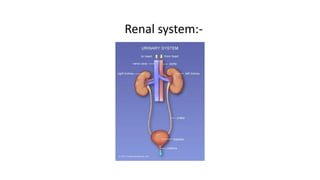
Renal system:-
Classification:-
1 .Upper urinary tract infection :-it is infection of upper urinary tract
such as
pyelonephritis ,glomerulonephritis ,and ureteritis .
2.Lower urinary tract infection:- it is the infection of lower urinary
tract .such as cystitis ,
Urethritis etc.
Or
1.Acute urinary tract infection:- sudden and immediate onset of UTI.
2.Chronic urinary tract infection:- persisting for a long time or
constant recurring.
Causes:-
• Bacterial infection .
• Escherichia coli [ causes 80% of cases ]
• Enterococcus
• Klebsiella
• Enterobacter
• Proteus
• Pseudomonas etc.
• Failure to empty urine completely
• Decreased immunity
• Instrumentation of urinary tract .
• Obstruction in urinary flow .
Clinical features :-
• A strong, persistent urge to urinate
• A burning sensation when urinating (dysuria)
• Passing frequent, small amounts of urine
• Urine that appears cloudy
• Urine that appears red, bright pink or cola-colored — a sign of blood
in the
urine(hematuria)
• Strong-smelling urine
• Pelvic pain, in women — especially in the center of the pelvis and
around the area of the pubic bone
Diagnostic evaluation:-
• .History taking with detailed clinical manifestations
• Physical examination
• Urinalysis-
• Urine Culture-
• Ultrasound- Ultrasound is a noninvasive imaging test that can be used to screen for
hydronephrosis (obstructions of the flow of urine).
• X-Rays- Special x-rays can be used to screen for structural abnormalities, urethral narrowing,
or incomplete emptying of the bladder. Due to the possible risks to the fetus, x-rays are not
performed on pregnant women.
• Voiding cystourethrogram- It is an x-ray of the bladder and urethra.To obtain a
cystourethrogram, a dye, called contrast material, is injected through a catheter inserted into
the urethra and passed through the bladder.
• An intravenous pyelogram (IVP)- It is an x-ray of the kidney. For a pyelogram, the contrast
matter is injected into a vein and eliminated by the kidneys. In both cases, the dye passes
through the urinary tract and reveals any obstructions or abnormalities on x-ray images.
Diagnostic evaluation:-
• Cystoscopy- Cystoscopy is used to detect structural abnormalities,
interstitial cystitis, or masses that might not show up on x-rays
during an IVP.The patient is given a light anesthetic, and the bladder
is filled with water.The procedure uses a cystoscope, a flexible, tube-
like instrument that the urologist inserts through the urethra into
the bladder
• ComputedTomography (CT)- A computed tomography (CT) scans
may be used to check for kidney stones or other obstructions.
• Blood Cultures- If symptoms are severe; the doctor will order blood
cultures to determine if the infection is in the bloodstream and
threatening other parts of the body.
Medical management :-
• Assess condition .
• Assess vital signs.
• Symptomatic treatment involve:-
• Urinary analgesic for Dysuria. Such as Pyridium ,Urispas.
• Anti emetics for nausea and vomiting .
• Antipyretics incase of fever.
• Plenty of water around 3-4litres.
• Antibiotics such as :- amoxycillin.levofloxacin. Bactrim septra,
Nitrofurantoin.
Note:- incase of Nitrofurantoin urinary insufficiency should not be
Less than 50 ml/hours
Medical management:-
LongTerm PharmacologicTherapy-
• The women with recurrent UTIs may be instructed to begin
treatment to her own whenever symptoms occur and to contact her
health care provider only when symptoms persist, fever occurs, or
the number of treatment episodes exceeds four in a 6 month period.
• If infection recurs after complete antimicrobial therapy another
short course (3 to 4 days) of full dose antimicrobial therapy may be
prescribed.
• After treatment and sterilization of urine low dose preventive
therapy (trimethoprim with or without sulfamethoxazole) each night
at bed time is often prescribed.
Health education:-
• Patient education-
• The following are measures that studies suggest may reduce the incidence of
urinary tract infections. These may be appropriate for people, especially women,
with recurrent infections:
• Do not delay urination when it is necessary. A high fluid intake is essential.
• Cleaning the urethral meatus (the opening of the urethra) after intercourse has
been shown to be of some benefit; however, whether this is done with an
antiseptic or a placebo ointment (an ointment containing no active ingredient)
does not appear to matter.
• Drinking 250 to 500ml of cranberry juice daily and avoidance of bubble baths may
also help.
• Often long courses of low-dose antibiotics are taken at night to help prevent
otherwise unexplained cases of recurring cystitis.
Nursing management:-
• . NURSING DIAGNOSIS Acute pain related to infection within the urinary
tract as manifested by pain on urination, suprapubic pain and bladder
spasms. GOAL Pain and discomfort will be relieved. INTERVENTION
• Assess the onset, duration and level of pain.
• Provide analgesic drugs.
• Provide comfortable position.
• Reassure and provide divertional therapy.
• Give psychological support.
• Alert patient that phenazopyridine will color urine orange.
• Apply heating pad to painful area. EVALUATION Reports relief of pain.
Nursing management:-
• 2. NURSING DIAGNOSIS Impaired urinary elimination related to UTIs as
manifested by urgency, frequency, incontinence or hematuria and verbalization of
concern over altered elimination pattern. GOAL Normal urination pattern will be
returned. INTERVENTION
• Assess for changes in usual voiding pattern. Instruct patient regarding reason for
symptoms.
• Encourage high fluid intake or administer IV fluid as ordered. Obtain urine for
culture and sensitivity.
• Administer antimicrobial medications as ordered
• . Instruct patient about good perineal care and cleansing after each bowel
movement.
• Tell patient to observe urine for color, odor,amount and frequency. EVALUATION
Exhibits normal urination pattern.
Nursing management:-
• 3. NURSING DIAGNOSIS Hyperthermia related to infection as
manifested by elevation in temperature, tachycardia, chills and
malaise GOAL Normal body temperature will be returned.
INTERVENTION Assess vital signs 2-4 hourly. Administer
antipyretics and antibiotics as ordered. Ensure hydration via
oral or IV route. Monitor intake and output. Cover patient
and keep him dry. Provide cooling sponge baths or
compresses. EVALUATION Reports return of normal
temperature.
Nursing management:-
• 4. NURSING DIAGNOSIS Risk for reinfection related to lack of knowledge regarding measure
to prevent recurrence. GOAL Signs of infection will not be present. INTERVENTION
• Assess the signs and symptoms of infection.
• Explain importance of taking all the antibiotics as prescribed. Symptoms will improve after 1-
2 days of therapy, but organisms may still be present.
• Instruct the patient on appropriate hygiene, including-
• Careful cleansing of perineal region.
• Wiping from front to back after urinating.
• Cleansing with soap and water after each bowel movement.
• Explain the emptying of bladder before and after intercourse.
• Instruct the patient to urinate when the urge occurs or at least 2-4 hour during the day.
• Instruct the patient about the need to maintain adequate fluid intake.
• Advise patient to report symptoms or signs of recurrent UTI. EVALUATION Improves
knowledge level of patient.
THANK
YOU

A brief description about urinary teact infection(ppt)

  • 1.
    Urinary tract infection Mr.Jitendra Singh Associate professor Nims college of nursing
  • 2.
    Introduction • A urinarytract infection (UTI) is a bacterial infection in part of the urinary tract. When it affects the lower urinary tract, it is known as lower urinary tract infection eg.Cystitis,urethritis).When it affects the upper urinary tract, it is known as upper urinary tract infection eg. Pylonephritis and ureteritis . • UTI is 50 times more common in women.UTI is uncommon in men below 60 years of age, but the frequency is similar in men and women in older age groups.
  • 3.
  • 4.
    Classification:- 1 .Upper urinarytract infection :-it is infection of upper urinary tract such as pyelonephritis ,glomerulonephritis ,and ureteritis . 2.Lower urinary tract infection:- it is the infection of lower urinary tract .such as cystitis , Urethritis etc. Or 1.Acute urinary tract infection:- sudden and immediate onset of UTI. 2.Chronic urinary tract infection:- persisting for a long time or constant recurring.
  • 5.
    Causes:- • Bacterial infection. • Escherichia coli [ causes 80% of cases ] • Enterococcus • Klebsiella • Enterobacter • Proteus • Pseudomonas etc. • Failure to empty urine completely • Decreased immunity • Instrumentation of urinary tract . • Obstruction in urinary flow .
  • 6.
    Clinical features :- •A strong, persistent urge to urinate • A burning sensation when urinating (dysuria) • Passing frequent, small amounts of urine • Urine that appears cloudy • Urine that appears red, bright pink or cola-colored — a sign of blood in the urine(hematuria) • Strong-smelling urine • Pelvic pain, in women — especially in the center of the pelvis and around the area of the pubic bone
  • 7.
    Diagnostic evaluation:- • .Historytaking with detailed clinical manifestations • Physical examination • Urinalysis- • Urine Culture- • Ultrasound- Ultrasound is a noninvasive imaging test that can be used to screen for hydronephrosis (obstructions of the flow of urine). • X-Rays- Special x-rays can be used to screen for structural abnormalities, urethral narrowing, or incomplete emptying of the bladder. Due to the possible risks to the fetus, x-rays are not performed on pregnant women. • Voiding cystourethrogram- It is an x-ray of the bladder and urethra.To obtain a cystourethrogram, a dye, called contrast material, is injected through a catheter inserted into the urethra and passed through the bladder. • An intravenous pyelogram (IVP)- It is an x-ray of the kidney. For a pyelogram, the contrast matter is injected into a vein and eliminated by the kidneys. In both cases, the dye passes through the urinary tract and reveals any obstructions or abnormalities on x-ray images.
  • 8.
    Diagnostic evaluation:- • Cystoscopy-Cystoscopy is used to detect structural abnormalities, interstitial cystitis, or masses that might not show up on x-rays during an IVP.The patient is given a light anesthetic, and the bladder is filled with water.The procedure uses a cystoscope, a flexible, tube- like instrument that the urologist inserts through the urethra into the bladder • ComputedTomography (CT)- A computed tomography (CT) scans may be used to check for kidney stones or other obstructions. • Blood Cultures- If symptoms are severe; the doctor will order blood cultures to determine if the infection is in the bloodstream and threatening other parts of the body.
  • 9.
    Medical management :- •Assess condition . • Assess vital signs. • Symptomatic treatment involve:- • Urinary analgesic for Dysuria. Such as Pyridium ,Urispas. • Anti emetics for nausea and vomiting . • Antipyretics incase of fever. • Plenty of water around 3-4litres. • Antibiotics such as :- amoxycillin.levofloxacin. Bactrim septra, Nitrofurantoin. Note:- incase of Nitrofurantoin urinary insufficiency should not be Less than 50 ml/hours
  • 10.
    Medical management:- LongTerm PharmacologicTherapy- •The women with recurrent UTIs may be instructed to begin treatment to her own whenever symptoms occur and to contact her health care provider only when symptoms persist, fever occurs, or the number of treatment episodes exceeds four in a 6 month period. • If infection recurs after complete antimicrobial therapy another short course (3 to 4 days) of full dose antimicrobial therapy may be prescribed. • After treatment and sterilization of urine low dose preventive therapy (trimethoprim with or without sulfamethoxazole) each night at bed time is often prescribed.
  • 11.
    Health education:- • Patienteducation- • The following are measures that studies suggest may reduce the incidence of urinary tract infections. These may be appropriate for people, especially women, with recurrent infections: • Do not delay urination when it is necessary. A high fluid intake is essential. • Cleaning the urethral meatus (the opening of the urethra) after intercourse has been shown to be of some benefit; however, whether this is done with an antiseptic or a placebo ointment (an ointment containing no active ingredient) does not appear to matter. • Drinking 250 to 500ml of cranberry juice daily and avoidance of bubble baths may also help. • Often long courses of low-dose antibiotics are taken at night to help prevent otherwise unexplained cases of recurring cystitis.
  • 12.
    Nursing management:- • .NURSING DIAGNOSIS Acute pain related to infection within the urinary tract as manifested by pain on urination, suprapubic pain and bladder spasms. GOAL Pain and discomfort will be relieved. INTERVENTION • Assess the onset, duration and level of pain. • Provide analgesic drugs. • Provide comfortable position. • Reassure and provide divertional therapy. • Give psychological support. • Alert patient that phenazopyridine will color urine orange. • Apply heating pad to painful area. EVALUATION Reports relief of pain.
  • 13.
    Nursing management:- • 2.NURSING DIAGNOSIS Impaired urinary elimination related to UTIs as manifested by urgency, frequency, incontinence or hematuria and verbalization of concern over altered elimination pattern. GOAL Normal urination pattern will be returned. INTERVENTION • Assess for changes in usual voiding pattern. Instruct patient regarding reason for symptoms. • Encourage high fluid intake or administer IV fluid as ordered. Obtain urine for culture and sensitivity. • Administer antimicrobial medications as ordered • . Instruct patient about good perineal care and cleansing after each bowel movement. • Tell patient to observe urine for color, odor,amount and frequency. EVALUATION Exhibits normal urination pattern.
  • 14.
    Nursing management:- • 3.NURSING DIAGNOSIS Hyperthermia related to infection as manifested by elevation in temperature, tachycardia, chills and malaise GOAL Normal body temperature will be returned. INTERVENTION Assess vital signs 2-4 hourly. Administer antipyretics and antibiotics as ordered. Ensure hydration via oral or IV route. Monitor intake and output. Cover patient and keep him dry. Provide cooling sponge baths or compresses. EVALUATION Reports return of normal temperature.
  • 15.
    Nursing management:- • 4.NURSING DIAGNOSIS Risk for reinfection related to lack of knowledge regarding measure to prevent recurrence. GOAL Signs of infection will not be present. INTERVENTION • Assess the signs and symptoms of infection. • Explain importance of taking all the antibiotics as prescribed. Symptoms will improve after 1- 2 days of therapy, but organisms may still be present. • Instruct the patient on appropriate hygiene, including- • Careful cleansing of perineal region. • Wiping from front to back after urinating. • Cleansing with soap and water after each bowel movement. • Explain the emptying of bladder before and after intercourse. • Instruct the patient to urinate when the urge occurs or at least 2-4 hour during the day. • Instruct the patient about the need to maintain adequate fluid intake. • Advise patient to report symptoms or signs of recurrent UTI. EVALUATION Improves knowledge level of patient.
  • 16.