S S N A S L I N A
UREA BREATH TEST
WHAT IS THE UREA BREATH TEST?
• The urea breath test is a rapid diagnostic procedure
used to identify infections by Helicobacter pylori, a
spiral bacterium implicated in gastritis, gastric ulcer,
and peptic ulcer disease. It is based upon the ability
of H. pylori to convert urea to ammonia and
carbon dioxide.
WHAT IS THE BASIS OF THIS TEST?
• The urea breath test is based on the ability of H.
pylori to break down urea, a chemical made up of
nitrogen and carbon, into carbon dioxide which
then is absorbed from the stomach and eliminated
in the breath. (Urea normally is produced by the
body from excess or "waste" nitrogen-containing
chemicals and then eliminated in the urine.)
Feature & Benefits of the Urea Breath Test
Otsuka's UBT
Serology
(ELISA)
Stool
(HpSA)
Endoscopy
Accuracy
98% sensitivity
98% specificity
85% sensitivity
79% specificity
93% sensitivity
93% specificity
90-95% sensitivity
100% specificity
Administration Non invasive Requires drawing blood
Inconvenient, requires handling of
faecal sample
Requires invasive procedure
Consistent Results
Tests for active infection reducing
the chance of false positives
Serological test (for H. pylori) is not
accurate enough for use in routine
clinical
Considerable lot-to-lot variation in
tests
Careful sample preparation is
necessary for optimal results
Scope of Test
Tests the entire gastric mucosa for
active H. pylori infection
Inactive antibody testing is 17 times
more likely to cause unnecessary
treatment
Second patient consultation is
required
Endoscopic biopsies only targets
small areas of the stomach
Eradication Monitoring
Indicated for the post-treatment
monitoring of H. pylori infection to
confirm eradication 4 weeks
following completion of therapy
Cannot confirm eradication
Must wait 6-8 weeks after therapy
to confirm eradication
Requires second invasive
procedure to confirm eradication
t
PREPARATION
• Fast for at least 6 hours prior to test
• No smoking for 2 hours prior to testing
• Ensure compliance with drug therapy – see below:
Antibiotics / Antibacterial
These drugs must be stopped at least 4 weeks before Urea Breath testing:
Amoxicillin (Amoxil, Moxam),Bismuth tricitrate (Denol), Clarithromycin (Klacid),
Fasigyn (Trinidazole), Metronidazole (Flagyl), Tetracycline (Tetrex, Mysteclin,
Achromycin), and any other antiobiotics.
Proton Pump Inhibitors
These drugs must be stopped at least 1 week before Urea Breath testing:
Losec (Omeprazole), Somac (Pantoprazole Sodium Sesquihydrate), Zoton
(Lansoprazole) and Nexiam.
H2 Receptor Antagonists
These drugs must be stopped at least 24 hours before Urea Breath testing.
Cimetidine (Tagamet, Sigmetadine, Magicul), Famotidine (Amfarnax, Pepcid,
Pepcidine), Nizatidine (Tazac) and Quick EzeRanitidine (Zantac, Rani 2).
•
HOW IS THIS BREATH TEST DONE?
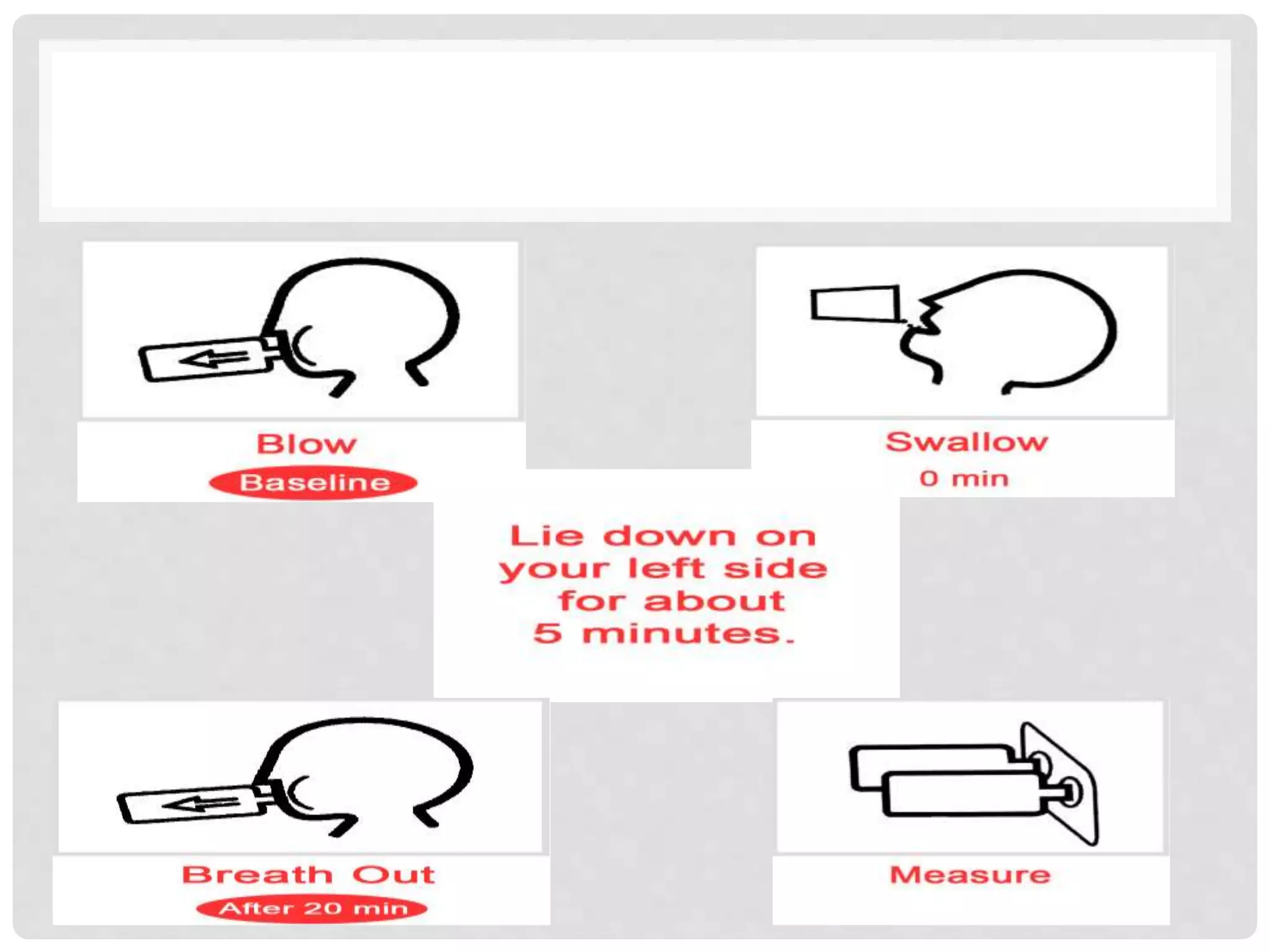
• Easy & Safe for Your Patients
• 4 simple steps
• Non-radioactive
• If samples are analyzed in clinics, results can be
obtained within 25 minutes
• Please always instruct the patient to exhale into the
mouthpiece of the bag until it is BLOATED. Sufficient
amount of air sample is crucial to obtain valid
results. Insufficient air in the bag may produce
invalid results which require a repeat collection. This
will lead to reagent wastage and inconvenience to
your patient.
CONT…
*Patient in a fasting condition to promptly (within 5 sec) swallow one
UBIT Tablet with 100mL of water without being crushed or chewed
3C-UREA BREATH TEST
• 3C-Urea Breath Test is widely recognized as the
easiest, safest and most reliable non-invasive
diagnostic test by many gastroenterologists. Unlike
14C, 13C is a stable, non-radioactive isotope. About
1.1% of our body contains naturally occurring 13C. A
normal daily food intake of an adult will contain
about 3g of 13C. During the test, patient takes
100mg 13C-Urea, which only represents a further
intake of 13C. The amount of urea (100 mg) taken
during a breath test is only a small percentage of
the average total body urea pool of 10g.
Urea breath test

Urea breath test

  • 1.
    S S NA S L I N A UREA BREATH TEST
  • 2.
    WHAT IS THEUREA BREATH TEST? • The urea breath test is a rapid diagnostic procedure used to identify infections by Helicobacter pylori, a spiral bacterium implicated in gastritis, gastric ulcer, and peptic ulcer disease. It is based upon the ability of H. pylori to convert urea to ammonia and carbon dioxide.
  • 3.
    WHAT IS THEBASIS OF THIS TEST? • The urea breath test is based on the ability of H. pylori to break down urea, a chemical made up of nitrogen and carbon, into carbon dioxide which then is absorbed from the stomach and eliminated in the breath. (Urea normally is produced by the body from excess or "waste" nitrogen-containing chemicals and then eliminated in the urine.)
  • 4.
    Feature & Benefitsof the Urea Breath Test Otsuka's UBT Serology (ELISA) Stool (HpSA) Endoscopy Accuracy 98% sensitivity 98% specificity 85% sensitivity 79% specificity 93% sensitivity 93% specificity 90-95% sensitivity 100% specificity Administration Non invasive Requires drawing blood Inconvenient, requires handling of faecal sample Requires invasive procedure Consistent Results Tests for active infection reducing the chance of false positives Serological test (for H. pylori) is not accurate enough for use in routine clinical Considerable lot-to-lot variation in tests Careful sample preparation is necessary for optimal results Scope of Test Tests the entire gastric mucosa for active H. pylori infection Inactive antibody testing is 17 times more likely to cause unnecessary treatment Second patient consultation is required Endoscopic biopsies only targets small areas of the stomach Eradication Monitoring Indicated for the post-treatment monitoring of H. pylori infection to confirm eradication 4 weeks following completion of therapy Cannot confirm eradication Must wait 6-8 weeks after therapy to confirm eradication Requires second invasive procedure to confirm eradication t
  • 5.
    PREPARATION • Fast forat least 6 hours prior to test • No smoking for 2 hours prior to testing • Ensure compliance with drug therapy – see below: Antibiotics / Antibacterial These drugs must be stopped at least 4 weeks before Urea Breath testing: Amoxicillin (Amoxil, Moxam),Bismuth tricitrate (Denol), Clarithromycin (Klacid), Fasigyn (Trinidazole), Metronidazole (Flagyl), Tetracycline (Tetrex, Mysteclin, Achromycin), and any other antiobiotics. Proton Pump Inhibitors These drugs must be stopped at least 1 week before Urea Breath testing: Losec (Omeprazole), Somac (Pantoprazole Sodium Sesquihydrate), Zoton (Lansoprazole) and Nexiam. H2 Receptor Antagonists These drugs must be stopped at least 24 hours before Urea Breath testing. Cimetidine (Tagamet, Sigmetadine, Magicul), Famotidine (Amfarnax, Pepcid, Pepcidine), Nizatidine (Tazac) and Quick EzeRanitidine (Zantac, Rani 2). •
  • 6.
    HOW IS THISBREATH TEST DONE? • Easy & Safe for Your Patients • 4 simple steps • Non-radioactive • If samples are analyzed in clinics, results can be obtained within 25 minutes • Please always instruct the patient to exhale into the mouthpiece of the bag until it is BLOATED. Sufficient amount of air sample is crucial to obtain valid results. Insufficient air in the bag may produce invalid results which require a repeat collection. This will lead to reagent wastage and inconvenience to your patient.
  • 8.
    CONT… *Patient in afasting condition to promptly (within 5 sec) swallow one UBIT Tablet with 100mL of water without being crushed or chewed
  • 9.
    3C-UREA BREATH TEST •3C-Urea Breath Test is widely recognized as the easiest, safest and most reliable non-invasive diagnostic test by many gastroenterologists. Unlike 14C, 13C is a stable, non-radioactive isotope. About 1.1% of our body contains naturally occurring 13C. A normal daily food intake of an adult will contain about 3g of 13C. During the test, patient takes 100mg 13C-Urea, which only represents a further intake of 13C. The amount of urea (100 mg) taken during a breath test is only a small percentage of the average total body urea pool of 10g.