
HISTORY OF VERNACULAR 
PRESS IN URDU
VERNACULAR PRESS 
 native language or native dialect of a 
specific population 
 newspapers came from smaller places of 
the country. 
 newspapers -published in local language 
or native language or vernacular language. 
 remarkable growth of vernacular press. 
 Newspapers role - creating socio-political 
consciousness.
URDU 
 Associated with Muslims of the region 
of Hindustan. 
 The national language of Pakistan 
 An official language of five Indian 
states 
 one of the 22 scheduled languages in 
the Constitution of India.
URDU JOURNALISM 
THE FORERUNNER 
 The Persian newspapers of West Bengal 
 The decline of Persian, Rise of Urdu. 
 Jam-e-Jahan Numa , a Urdu newspaper 
started in march 27,1822. 
 Editor - Harihar dutta. 
 Found that it would be very difficult to 
continue the publication of newspaper in 
Urdu 
 Changed it to a Persian daily from may16, 
1822.
THE FIRST URDU NEWSPAPER 
 The first Urdu newspaper - DELHI URDU 
AKHBAR in 1836. 
 Started by MAULVI MOHAMMED 
BAQAR. 
 Many Urdu newspapers and weeklies 
started. 
 Four main factors helped in progress of 
Urdu journalism in 3rd and 4th decade of 
19th century
FACTORS BEHIND 
PROGRESS OF URDU 
JOURNALISM 
 In 1830, EIC declared Urdu the official 
language for government institutions and 
court of law. So Urdu gained prominence. 
 After 1835, many vernacular language 
newspapers came to frontline. Among those , 
Urdu language newspapers were most 
important because Urdu was the official 
language.
FACTORS BEHIND 
PROGRESS OF URDU 
JOURNALISM 
 In 1836, Litho-type printing started. It was 
attractive and of low cost. Consequently, cost 
of printing Urdu newspaper reduced. It 
became easier to start an Urdu newspaper. 
 Urdu newspapers - suitable medium for 
promoting western ideas. The government 
purchased Urdu newspapers. Financially 
supported some of the newspapers.
URDU NEWSPAPER-PLACES 
OF PUBLICATION 
Later, many new Urdu papers started in following places 
 Delhi, 
 Lahore, 
 Multan, 
 Gujarat, 
 Peshawar, 
 Rawalpindi, 
 Lucknow, 
 Bombay, 
 Aligarh and 
 Madras. 
However, Delhi and Lahore are considered to be 
the mother land of Urdu journalism.
READERSHIP OF URDU 
NEWSPAPERS, JOURNALS, 
WEEKLIES. 
 Not very remarkable. 
 Koh-e-Noor, started by Munshi Harsukh Rai - 
highest circulation with 350copies a day. 
 Another weekly, Syed-ul-Akhbar - the lowest 
circulation of 27copies. 
 Majority of the newspapers – 50 copies per day. 
 some papers - 200 copies because the British 
took 50 to 100 copies on permanent basis.
THE FIRST JOURNALIST 
MARTYR 
 Maulvi Mohammed Baquar- founder of 
Delhi Urdu Akhbar 
 sentenced to death by British government . 
 First journalist to martyr in the history of 
Indian journalism. 
 Another incident-three year imprisonment 
given to editor Jamaludin of weekly Syed-ul- 
Akhbar. 
 A dramatic effect on Urdu journalism
A NEW ERA BEGINS 
 In 1848, there were 26 newspapers in India in 
vernacular language, out of which 19 were Urdu 
newspaper. 
 The great rebellion in 1857 also called as Sepoy 
mutiny affected the newspapers. 
 Some newspapers ceased publication. 
 After the major setback in 1857, Urdu newspaper 
realigned soon. 
 A new era of Urdu journalism began.
A NEW ERA BEGINS 
Some of the newspapers started after sepoy mutiny in 
1857 are listed below. 
 Oudh Akhbar, Lucknow 
 Tahazib-ul-Akhbar, Aligarh 
 The Oudh Punch, Lucknow 
 Akmalul Akhbar, Delhi 
 The Punjab Akhbar, Lahore 
 Shamsul Akhbar, Madras 
 The Khashful Akhbar, Bombay 
 Qasiv-ul-Akhbar,Banglore. 
 Out of these, OUDH AKHBAR started in 1858 lived longer 
and soon became a daily under the editorship of 
Ratannath Sarshar.
AFTER GREAT 
REBELLION 
 In 1858, Manbir Kabiruddin started 
The Urdu Guide - the first Urdu daily 
of Calcutta. 
 Roznamha-e-Punjab from Lahore in 
1858. 
 Oudh Akhbar by Munshi Nawal 
Kishore in1858 from Lucknow 
 Extensive growth in Urdu journalism 
from the 1850s till Independence in 
1947.
FROM DELHI 
 The first Urdu newspapers of Delhi – 
Fawaid-ul-Nazarin and 
Kiran-us-Sadai, 
Founded by Rama Chandra in 1852. 
 Urdu press in Delhi- highly critical of the 
British government. 
 Example : The Urdu Akhbar, edited by 
Syed Hasan, highlighted many civic issues 
like drainage, sanitation, adulteration of 
food, and corruption.
TREND IN 1870’s 
 In 1877, Maulvi Nasir Ali founded 3 
newspapers- 
Nusrat-ul-Akhbar, 
Nusrat-ul-Islam and 
Mihir-e-Darakhshan. 
 Focused on current civil and political affairs, 
valuable aids of Muslim empowerment. 
 In 1877, Oudh Punch, started by Sajjid 
Hussain. 
 Oudh Punch – 1st humour magazine in Urdu .
TREND IN 1870’s 
 The first women's journal in Urdu 
was Akhbar-un-Nisa. 
 During this time, Urdu journalist 
started using cartoons and 
humour was used as way in 
newspaper to attract readers. 
 The profession threw up a couple 
of talented cartoonist.
IN 1880’s AND 1890’s 
 In 1880’s,weeklies came out. 
Akhbar-i-aam, edited by Pandit 
Gopinath 
Paisa Akhbar , edited by Munshi 
Mahboob Aalam 
 A new phase of Urdu journalism began. 
 Newspapers - popular for more than half 
century. 
 Coverage was varied 
 But not extensive.
IN 1880’s AND 1890’s 
 An element added to their advertisements. 
 Editorial comment - better informed. 
 Ran on commercial lines and achieved 
success. 
 By the end of 19th century, Paisa Akhbar 
surpassed all the other Urdu newspapers 
in circulation.
BEGINNING OF 20TH 
CENTURY 
 Took on a strongly nationalistic note 
towards the turn of the 20th century. 
 Political and social issues dominated. 
 The political and social movements 
launched by Congress, 
the Muslim league, 
Aarya samaj, 
Khilafat committee, 
Aligarh movement .
BEGINNING OF 20TH 
CENTURY 
 The style more forceful 
 A much richer and varied vocabulary 
developed 
 Result of increased tempo and widening 
of horizons. 
 Newspapers like Zameendar, 
Hindustan, Al Hilal, Paisa Akhbar, 
oudh Akhbar introduced the political 
purposefulness of journalism.
20TH CENTURY 
 Maulana Muhammad Ali Jauhar started 
Naqeeb-e-Hamdard in 1912. 
 Another powerful political periodical was the 
Madina, edited by Hamidul Ansari. 
 The greatest Urdu periodical that time was Al 
Hilal, started by Maulana Abul Kalam Azad 
 A weekly, Al-Hilal created political and 
religious consciousness among the muslims. 
 put equal importance on content and 
presentation including the layout and design. 
 the pattern of Egyptian newspapers. 
 asset was the content. 
 style of expression.
20TH CENTURY 
 In 1919, The Pratap was started in Lahore by 
Mahshe Krishnan. 
 vigorously supported Gandhis policies and the 
Indian National Congress. 
 a victim of government harassment and 
suspended publication several times. 
 In 1923, the Arya Samaj started The Milap, a 
daily in Lahore. 
 It was known for its powerful nationalistic 
editorials. 
 Jawaharlal Nehru founded Qaumi Awaaz in 
1945.
FATHER OF URDU 
JOURNALISM 
 Maulana Zafar Ali Khan, father of 
Urdu journalism 
 Took charge of zameendhar and 
converted it into a revolutionary 
press. 
 Zameendar, started in Lahore in 
1903. 
 The first Urdu newspaper to 
subscribe to news agencies.
FATHER OF URDU 
JOURNALISM 
 Zameendar was intensely nationalistic 
 Circulation over 30,000 copies 
 Mainly due to efforts of Zafar Ali Khan. 
 Attracted the Muslim youth of Punjab. 
 No important incidents were left 
uncovered by this veteran journalist. 
 He helped Pakistan movement gain 
momentum.
DURING AND AFTER 
PARTITION 
 Urdu journalism suffered heavily, during 
and after Partition. 
 Riots in Lahore lead to mobs raiding the 
office of Milap and burning machines 
and newsprint. 
 Its Managing Editor, Ranbir was stabbed 
and the paper was closed for six weeks. 
It then shifted to Delhi. 
 Due to the unrest, the Pratap also 
shifted to Delhi.
DURING AND AFTER 
PARTITION 
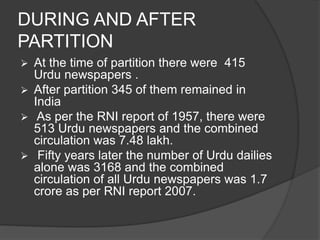
 At the time of partition there were 415 
Urdu newspapers . 
 After partition 345 of them remained in 
India 
 As per the RNI report of 1957, there were 
513 Urdu newspapers and the combined 
circulation was 7.48 lakh. 
 Fifty years later the number of Urdu dailies 
alone was 3168 and the combined 
circulation of all Urdu newspapers was 1.7 
crore as per RNI report 2007.
DURING AND AFTER 
PARTITION 
 Urdu newspapers after partition in India 
are Dawat, Nai Duniya, a popular Urdu 
weekly 
 After 1980s , a gradual decline in the 
number of publications and readership . 
 Some ceased publication. For example, in 
West Bengal Shan-e-Millat, Imroze, Asre- 
Jadeed, Ghazi and Iqra were closed. 
 In 21st century, a number of new 
newspapers making their entry.
TODAY’S SCENARIO 
 More number of urdu newspapers published 
today 
 Till 2006 Andhra Pradesh had the maximum 
number of registered Urdu newspapers (506) 
 Mumbai have several Urdu publications 
including The Inquilab daily and Urdu Times. 
 West Bengal, especially Kolkata has a 
sizable number of Urdu publications. 
 In 2005 there were five Urdu dailies in 
Kolkata: Azad Hind, Rozana Hind, Akhbaar - 
e- Mashrique, Aabshaar and Akkas.
TODAY,S SCENARIO-GETTING INTO 
INTERNET 
 Hyderabad based Siyasat was the first Urdu 
newspaper to start a web edition in late 90s. 
Several other Urdu publications presently have 
their web edition. SOME URDU NEWSPAPES 
PRESENT TODAY 
 Hamara Samaj 
 Hindustan Express 
 Inquilab, Mumbai 
 Jadeed Mail, New Delhi 
 Jadid Khabar, New Delhi 
 Munsif,Hyderabad 
 Rashtriya Sahara 
 Roznama Sahafat 
 Siasat, Hyderabad 
 Urdu Times, Mumbai.
REFERENCES 
 1)Dr. Mrinal Chatterjee; Professor, Indian Institute of 
Mass Communication www.mrinalchatterjee.in 
 -http://www.orissadiary.com/ 
 2)WIKIPEDIA-en.wikipedia.org/wiki/urdu 
 3)www .docstoc.com/docs/23631682/History-of-Urdu- 
Journalism 
 4) madrasa.wordpress.com/category/urdu-journalism/ 
 5)www.gktoday.in 
 6)www.thefreedictionary.in 
 7)www.mediahive.co.in 
 8)www.urdumediamonitor.com 
 9)blogs.thenews.com.pk 
 10)www.nusratalinsari.com 
 11)www.google.co.in
Urdu journalism

Urdu journalism

  • 1.
    HISTORY OF VERNACULAR PRESS IN URDU
  • 2.
    VERNACULAR PRESS native language or native dialect of a specific population  newspapers came from smaller places of the country.  newspapers -published in local language or native language or vernacular language.  remarkable growth of vernacular press.  Newspapers role - creating socio-political consciousness.
  • 3.
    URDU  Associatedwith Muslims of the region of Hindustan.  The national language of Pakistan  An official language of five Indian states  one of the 22 scheduled languages in the Constitution of India.
  • 4.
    URDU JOURNALISM THEFORERUNNER  The Persian newspapers of West Bengal  The decline of Persian, Rise of Urdu.  Jam-e-Jahan Numa , a Urdu newspaper started in march 27,1822.  Editor - Harihar dutta.  Found that it would be very difficult to continue the publication of newspaper in Urdu  Changed it to a Persian daily from may16, 1822.
  • 5.
    THE FIRST URDUNEWSPAPER  The first Urdu newspaper - DELHI URDU AKHBAR in 1836.  Started by MAULVI MOHAMMED BAQAR.  Many Urdu newspapers and weeklies started.  Four main factors helped in progress of Urdu journalism in 3rd and 4th decade of 19th century
  • 6.
    FACTORS BEHIND PROGRESSOF URDU JOURNALISM  In 1830, EIC declared Urdu the official language for government institutions and court of law. So Urdu gained prominence.  After 1835, many vernacular language newspapers came to frontline. Among those , Urdu language newspapers were most important because Urdu was the official language.
  • 7.
    FACTORS BEHIND PROGRESSOF URDU JOURNALISM  In 1836, Litho-type printing started. It was attractive and of low cost. Consequently, cost of printing Urdu newspaper reduced. It became easier to start an Urdu newspaper.  Urdu newspapers - suitable medium for promoting western ideas. The government purchased Urdu newspapers. Financially supported some of the newspapers.
  • 8.
    URDU NEWSPAPER-PLACES OFPUBLICATION Later, many new Urdu papers started in following places  Delhi,  Lahore,  Multan,  Gujarat,  Peshawar,  Rawalpindi,  Lucknow,  Bombay,  Aligarh and  Madras. However, Delhi and Lahore are considered to be the mother land of Urdu journalism.
  • 9.
    READERSHIP OF URDU NEWSPAPERS, JOURNALS, WEEKLIES.  Not very remarkable.  Koh-e-Noor, started by Munshi Harsukh Rai - highest circulation with 350copies a day.  Another weekly, Syed-ul-Akhbar - the lowest circulation of 27copies.  Majority of the newspapers – 50 copies per day.  some papers - 200 copies because the British took 50 to 100 copies on permanent basis.
  • 10.
    THE FIRST JOURNALIST MARTYR  Maulvi Mohammed Baquar- founder of Delhi Urdu Akhbar  sentenced to death by British government .  First journalist to martyr in the history of Indian journalism.  Another incident-three year imprisonment given to editor Jamaludin of weekly Syed-ul- Akhbar.  A dramatic effect on Urdu journalism
  • 11.
    A NEW ERABEGINS  In 1848, there were 26 newspapers in India in vernacular language, out of which 19 were Urdu newspaper.  The great rebellion in 1857 also called as Sepoy mutiny affected the newspapers.  Some newspapers ceased publication.  After the major setback in 1857, Urdu newspaper realigned soon.  A new era of Urdu journalism began.
  • 12.
    A NEW ERABEGINS Some of the newspapers started after sepoy mutiny in 1857 are listed below.  Oudh Akhbar, Lucknow  Tahazib-ul-Akhbar, Aligarh  The Oudh Punch, Lucknow  Akmalul Akhbar, Delhi  The Punjab Akhbar, Lahore  Shamsul Akhbar, Madras  The Khashful Akhbar, Bombay  Qasiv-ul-Akhbar,Banglore.  Out of these, OUDH AKHBAR started in 1858 lived longer and soon became a daily under the editorship of Ratannath Sarshar.
  • 13.
    AFTER GREAT REBELLION  In 1858, Manbir Kabiruddin started The Urdu Guide - the first Urdu daily of Calcutta.  Roznamha-e-Punjab from Lahore in 1858.  Oudh Akhbar by Munshi Nawal Kishore in1858 from Lucknow  Extensive growth in Urdu journalism from the 1850s till Independence in 1947.
  • 14.
    FROM DELHI The first Urdu newspapers of Delhi – Fawaid-ul-Nazarin and Kiran-us-Sadai, Founded by Rama Chandra in 1852.  Urdu press in Delhi- highly critical of the British government.  Example : The Urdu Akhbar, edited by Syed Hasan, highlighted many civic issues like drainage, sanitation, adulteration of food, and corruption.
  • 15.
    TREND IN 1870’s  In 1877, Maulvi Nasir Ali founded 3 newspapers- Nusrat-ul-Akhbar, Nusrat-ul-Islam and Mihir-e-Darakhshan.  Focused on current civil and political affairs, valuable aids of Muslim empowerment.  In 1877, Oudh Punch, started by Sajjid Hussain.  Oudh Punch – 1st humour magazine in Urdu .
  • 16.
    TREND IN 1870’s  The first women's journal in Urdu was Akhbar-un-Nisa.  During this time, Urdu journalist started using cartoons and humour was used as way in newspaper to attract readers.  The profession threw up a couple of talented cartoonist.
  • 17.
    IN 1880’s AND1890’s  In 1880’s,weeklies came out. Akhbar-i-aam, edited by Pandit Gopinath Paisa Akhbar , edited by Munshi Mahboob Aalam  A new phase of Urdu journalism began.  Newspapers - popular for more than half century.  Coverage was varied  But not extensive.
  • 18.
    IN 1880’s AND1890’s  An element added to their advertisements.  Editorial comment - better informed.  Ran on commercial lines and achieved success.  By the end of 19th century, Paisa Akhbar surpassed all the other Urdu newspapers in circulation.
  • 19.
    BEGINNING OF 20TH CENTURY  Took on a strongly nationalistic note towards the turn of the 20th century.  Political and social issues dominated.  The political and social movements launched by Congress, the Muslim league, Aarya samaj, Khilafat committee, Aligarh movement .
  • 20.
    BEGINNING OF 20TH CENTURY  The style more forceful  A much richer and varied vocabulary developed  Result of increased tempo and widening of horizons.  Newspapers like Zameendar, Hindustan, Al Hilal, Paisa Akhbar, oudh Akhbar introduced the political purposefulness of journalism.
  • 21.
    20TH CENTURY Maulana Muhammad Ali Jauhar started Naqeeb-e-Hamdard in 1912.  Another powerful political periodical was the Madina, edited by Hamidul Ansari.  The greatest Urdu periodical that time was Al Hilal, started by Maulana Abul Kalam Azad  A weekly, Al-Hilal created political and religious consciousness among the muslims.  put equal importance on content and presentation including the layout and design.  the pattern of Egyptian newspapers.  asset was the content.  style of expression.
  • 22.
    20TH CENTURY In 1919, The Pratap was started in Lahore by Mahshe Krishnan.  vigorously supported Gandhis policies and the Indian National Congress.  a victim of government harassment and suspended publication several times.  In 1923, the Arya Samaj started The Milap, a daily in Lahore.  It was known for its powerful nationalistic editorials.  Jawaharlal Nehru founded Qaumi Awaaz in 1945.
  • 23.
    FATHER OF URDU JOURNALISM  Maulana Zafar Ali Khan, father of Urdu journalism  Took charge of zameendhar and converted it into a revolutionary press.  Zameendar, started in Lahore in 1903.  The first Urdu newspaper to subscribe to news agencies.
  • 24.
    FATHER OF URDU JOURNALISM  Zameendar was intensely nationalistic  Circulation over 30,000 copies  Mainly due to efforts of Zafar Ali Khan.  Attracted the Muslim youth of Punjab.  No important incidents were left uncovered by this veteran journalist.  He helped Pakistan movement gain momentum.
  • 25.
    DURING AND AFTER PARTITION  Urdu journalism suffered heavily, during and after Partition.  Riots in Lahore lead to mobs raiding the office of Milap and burning machines and newsprint.  Its Managing Editor, Ranbir was stabbed and the paper was closed for six weeks. It then shifted to Delhi.  Due to the unrest, the Pratap also shifted to Delhi.
  • 26.
    DURING AND AFTER PARTITION  At the time of partition there were 415 Urdu newspapers .  After partition 345 of them remained in India  As per the RNI report of 1957, there were 513 Urdu newspapers and the combined circulation was 7.48 lakh.  Fifty years later the number of Urdu dailies alone was 3168 and the combined circulation of all Urdu newspapers was 1.7 crore as per RNI report 2007.
  • 27.
    DURING AND AFTER PARTITION  Urdu newspapers after partition in India are Dawat, Nai Duniya, a popular Urdu weekly  After 1980s , a gradual decline in the number of publications and readership .  Some ceased publication. For example, in West Bengal Shan-e-Millat, Imroze, Asre- Jadeed, Ghazi and Iqra were closed.  In 21st century, a number of new newspapers making their entry.
  • 28.
    TODAY’S SCENARIO More number of urdu newspapers published today  Till 2006 Andhra Pradesh had the maximum number of registered Urdu newspapers (506)  Mumbai have several Urdu publications including The Inquilab daily and Urdu Times.  West Bengal, especially Kolkata has a sizable number of Urdu publications.  In 2005 there were five Urdu dailies in Kolkata: Azad Hind, Rozana Hind, Akhbaar - e- Mashrique, Aabshaar and Akkas.
  • 29.
    TODAY,S SCENARIO-GETTING INTO INTERNET  Hyderabad based Siyasat was the first Urdu newspaper to start a web edition in late 90s. Several other Urdu publications presently have their web edition. SOME URDU NEWSPAPES PRESENT TODAY  Hamara Samaj  Hindustan Express  Inquilab, Mumbai  Jadeed Mail, New Delhi  Jadid Khabar, New Delhi  Munsif,Hyderabad  Rashtriya Sahara  Roznama Sahafat  Siasat, Hyderabad  Urdu Times, Mumbai.
  • 30.
    REFERENCES  1)Dr.Mrinal Chatterjee; Professor, Indian Institute of Mass Communication www.mrinalchatterjee.in  -http://www.orissadiary.com/  2)WIKIPEDIA-en.wikipedia.org/wiki/urdu  3)www .docstoc.com/docs/23631682/History-of-Urdu- Journalism  4) madrasa.wordpress.com/category/urdu-journalism/  5)www.gktoday.in  6)www.thefreedictionary.in  7)www.mediahive.co.in  8)www.urdumediamonitor.com  9)blogs.thenews.com.pk  10)www.nusratalinsari.com  11)www.google.co.in