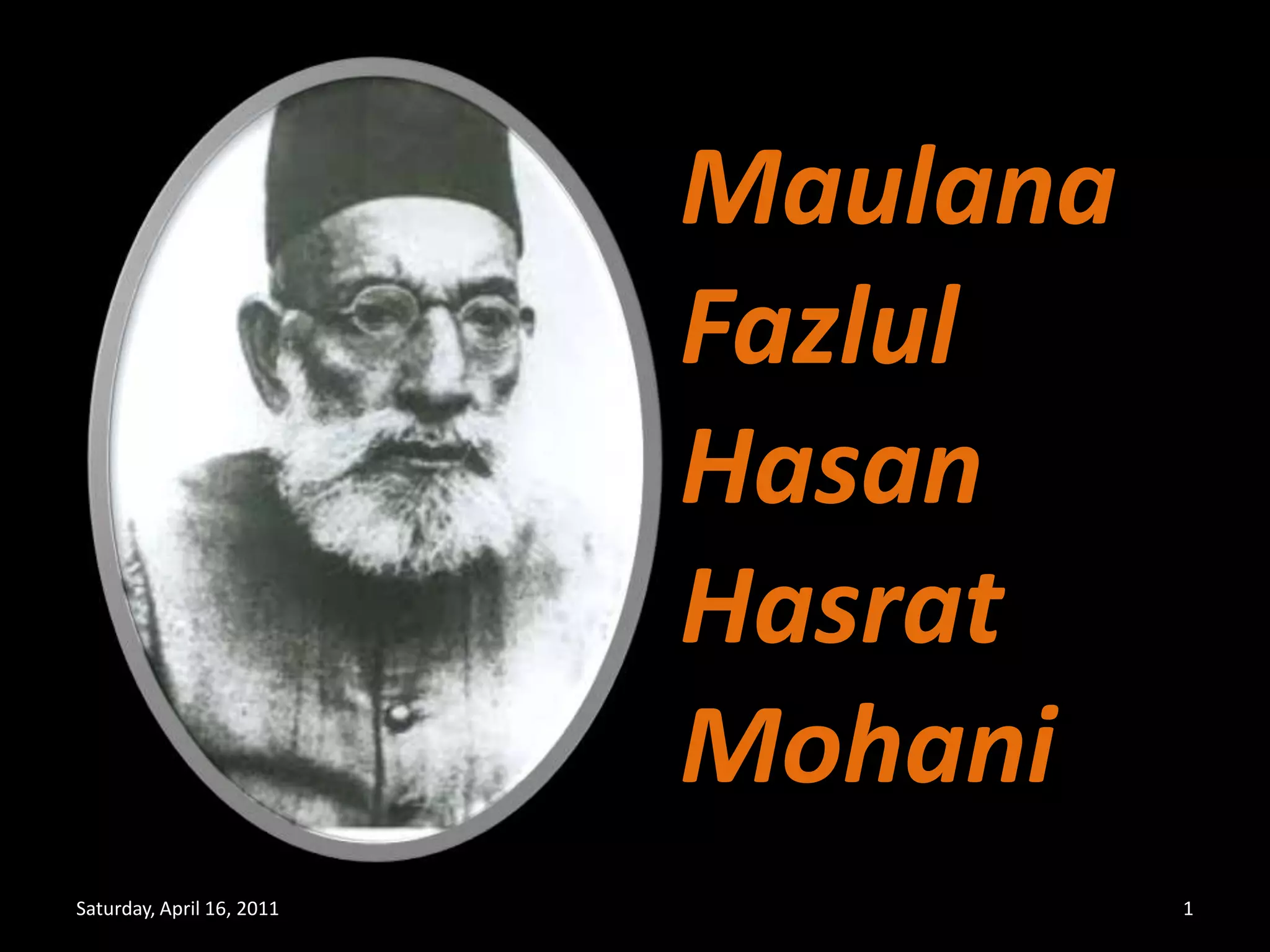
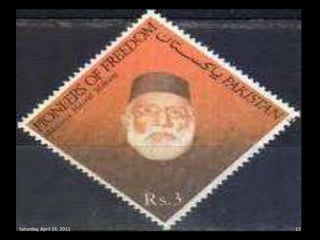
MaulanaFazlulHasanHasrat MohaniSaturday, April 16, 20111
“Lives of great men all remind us, we can make our lives sublime, and, departing, leave behind us, footprints on the sands of time.”Henry Wadsworth Longfellow Saturday, April 16, 20112
Early Life and Education of Maulana Hasrat MohaniSaturday, April 16, 20113
Early Life of MaulanaMaulanaSyedFazlul Hassan Hasrat Mohani was born in 1878.He was born in the middle class family of SyedAzharHasan in a small town Mohan in Unnao district, Lucknow.Saturday, April 16, 20114
Primary EducationHe completed his primary education from a Maktab (traditional Madarsah) in Mohan and acquired the knowledge of Urdu, Persian and Arabic from his teachers, MiyanJiGhulam Ali Mohani and MiyanJiBalaqi Mohani.Saturday, April 16, 20115
Middle schoolIn 1894, he passed his middle school from Mohan middle school and secured First position in entire state of Central Province.Saturday, April 16, 20116
High schoolIn 1899, he completed his High School from Government High School of Fatehpur. He was awarded a scholarship and joined Mohammedan Anglo Oriental College (MAO) Aligarh (now Aligarh Muslim University). He completed his admission in Inter College on 15th March 1899. Saturday, April 16, 20117
College LifeHasrat completed his Intermediate exam in 1901 and joined B.A with Arabic and Mathematics as Optional subject.He was a nationalist so once College Cricket team beat an English team and Maulana Hasrat Mohani led the celebration. Unhappy British establishment in the college had him rusticated. Saturday, April 16, 20118
Maulana fought back and got re-instated but was not allowed to live in hostel so he moved to a rented place in Rasal-Ganjarea of Aligarh city. During his college days, he started taking interest in national politics which was also not accepted by College administration and he was rusticated again, but every time he fought for truth and came back to college to complete his education. Saturday, April 16, 20119
In 1903, he completed his B.A. MAO College which was affiliated with University of Allahabad so he received a degree of BA from University of Allahabad.He was an ardent supporter of Aligarh Movement and mission of Sir Syed Ahmad Khan. His personality was a true interpretation of the product of Aligarh Movement, what Sir Syed had dreamed years ago. Saturday, April 16, 201110
The basic principle of Aligarh Movement was to follow your religion with full faith and integrity and at the same time take part in the individual and community growth to live a better life. Maulana Hasrat Mohani followed this principle in its entirety. From his early days to his last breath, he was an ardent follower of Islam. Saturday, April 16, 201111
His participation in the freedom struggle of India, Anti-British establishment nature, social communism lineage never deviated him from his religious beliefs and practices. During his stay of 2 years in jail, despite of the hard work, he was observing Ramadan fast and regular prayers.Saturday, April 16, 201112
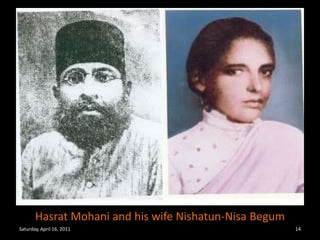
Marital lifeIn 1903, he got married to Nishatun-Nisa Begum.She was a well educated women.She was his biggest supporter.In 1937, Maulana lost his biggest support, his beloved wife. Saturday, April 16, 201113
Hasrat Mohani and his wife Nishatun-Nisa BegumSaturday, April 16, 201114
Political Contribution of Maulana Hasrat MohaniSaturday, April 16, 201115
Political Contribution of MaulanaHasratMohaniHe was the first voice of rebellion and revolution raised at Aligarh Muslim University where he studied. He coined the slogan InquilabZindabad.He advocated the cause of independence from the platform of Indian National Congress followed by his persistent demand from the platforms of theAll India Muslim League and the Communist Party.Saturday, April 16, 201116
Saturday, April 16, 201117
He made politics as his sacred mission and struggled for the causes of Muslims and other oppressed people of the society for his entire life.In 1904,Swadesi Movementwas launched and MaulanaHasratMohanibecame an active participant in the movement.He published several articles in Urdu-e-Mu-alla to support the Swadesi Movement.Saturday, April 16, 201118
To promote the Swadesi movement, he started a Swadesi store which was run buy his beloved wife and due to their efforts, the store became a successful venture.In the political thoughts, he was a supporter of Bal GangadharTilakand always criticized Motilal Nehru, Bal Krishna Gokhlayand other moderates of the party.MaulanaHasratMohanitook an active part in the movement to form Muslim Universityand wrote several articles in Urdu-e-Mu-allafor Muslim University.Saturday, April 16, 201119
In 1919, MaulanaHasratMohaniparticipated in Muslim League Convention in Amritsar.In 1925, HasratMohaniplayed a key role to organize annual convention of All India Communist Party in Kanpur. He was chairman of the reception committee of the convention.Saturday, April 16, 201120
Saturday, April 16, 201121In the same year, Ibn Saud attacked on Hijaz. This event displeased MaulanaHasratMohaniand they formed “AnjumanKhuddam-e-Harmain” under the leadership of Maulana Abdul Bari Farangimahli organized “All India Hijaz Conference”in Lucknow under its banners.In 1929, he started a daily newspaper “Mustaqil” from Kanpur. The newspaper did not survived for long time but he continued publishing Urdu-e-Mu-alla.
Saturday, April 16, 201122
MaulanaHasratMohanipresided over the annual session of the All India Khilafat Committee in 1923 and was elected President of the All India Muslim League in 1923.In 1945, he was elected as a member of UP Assembly and member of The Constituent Assembly as a representative of Muslim League.After the birth of Pakistan, he stayed behind in India to safeguard the interests of Muslims in India.Saturday, April 16, 201123
He asserted that at such a critical moment he could not think of leaving the Muslims of India in total despair.His memorable words challenging Sardar Patel, in the Constituent Assembly, will long run in the memory of future generations: “You should not think that Muslims are orphans today. I am here to defend their rights against all odds and will fight for them till death”. Saturday, April 16, 201124
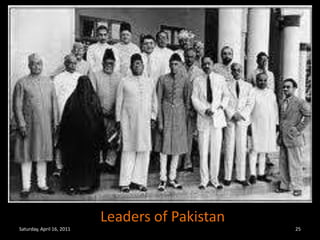
Leaders of PakistanSaturday, April 16, 201125
Journalism, Freedom Movement and Urdu LiteratureSaturday, April 16, 201126
Urdu –E – MuallaMaulana interest in Urdu literature inspired him to start URDU-E-MAULLA In 1903.He wrote many articles to support Swadesi movement.In 1908, he wrote an article to criticize the policies of British rulersof Egypt.After jail, he started this Urdu-e-Maulla in 1910.Saturday, April 16, 201127
After that Aligarh movement started to unite Muslims, he wrote many articles in Urdu-e-Maulla  to awake Muslims of University.  It appeared much earlier than Comrade, Zamindar and AL-Balagh.In 1916, the ideology and methodology to raise the Muslims against India lead him to house arrest.Saturday, April 16, 201128
Saturday, April 16, 201129When it comes to bold and trenchant political writings. The three main names usually invoked are:MAULANA MOHAMMAD ALI JOHAR	MAULANA ABUL KALAM AZAD	ZAFAR ALI KHANThe Maulla had invited British wrath for Hasrat’s writings during the agitation on the Kanpur Mosque demolition, resulting a security demand for Rs 3,000 under the Vernacular Press Act. It was sheer tyranny to demand Rs 3,000 from a press, worth little more than Rs 50.
However , he founded the TazkiratushShu’rain place of the Urdu-e-maulla.Saturday, April 16, 201130
Urdu LiteratureThe other side of Maulana Hasrat Mohani’s Life was his love for Urdu literature and poetry.The exceptional qualities of sincerity, forbearance, fearlessness, perseverance, patience and contentment, which the jail life had developed in his character, are profoundly reflected in his poetry.Saturday, April 16, 201131
He had left behind him ten volumes of poetical works.The best part of his contribution to Urdu poetry was composed in jail, wherefrom each time when he was released, he used to bring out a volume of Urdu poems.He was the founder of modern Urdu lyrics.He emphasized on depth of feelings and sincerity of thoughts, with the result that Urdu lyrics had become a mixture of unnatural and artificial picture of human life.Saturday, April 16, 201132
Hasrat may be termed as conservative lyrist, yet he infused A new life in its fast decaying body and after MIR may be classed as the best URDU LYRIST.He comes in the line of Momin Khan Mominand NaseemDehlaviin respect of the type of his verses.His poetry according to Arnold, literature is the mirror of life, and like the celebrated English poet Lord Tennyson, Hasrat too has been much affected by his environment.Saturday, April 16, 201133
He founded new school of Urdu lyrics whose aim is to depict the true human sentiments and reactions to his environments.He is the true product of his time.Saturday, April 16, 201134
WRITING STYLE OF HASRAT MOHANIThe writing style of Mohani was mostly emphasized on depth of feelings and sincerity of thoughts.His main attributes are purity of thoughts, simplicity of diction.His poetry is mainly subjective and he has tried to avoid the objective color, which had crept into the work of Urdu Lyrist of Lucknow.Saturday, April 16, 201135
Like Mir, Hasrat, too passed a life of despair and anxiety, hence there is a spiritual connection between the two and the work of both reflect deep pathos.His poetry was mostly composed in jail which developed sincerity, fearlessness, perseverance, and patience in his character and is reflected in his poetry.His verses are full of revolutionary thought, reactions and national aspiration of a person whose life was so stormy.Saturday, April 16, 201136
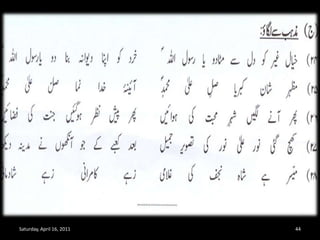
Hasrat Mohani’s Famous Literary Works Saturday, April 16, 201137
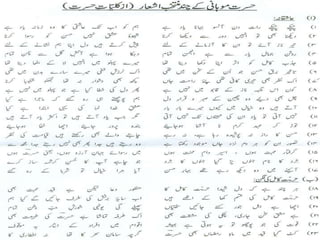
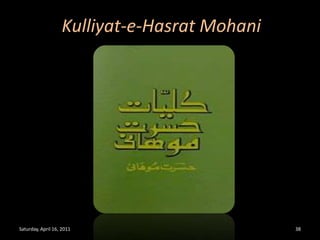
Kulliyat-e-Hasrat MohaniSaturday, April 16, 201138
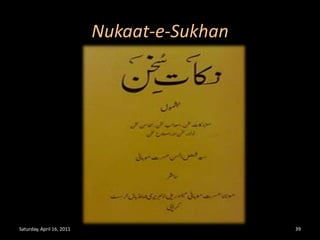
Nukaat-e-SukhanSaturday, April 16, 201139
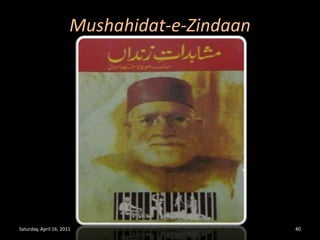
Mushahidat-e-ZindaanSaturday, April 16, 201140
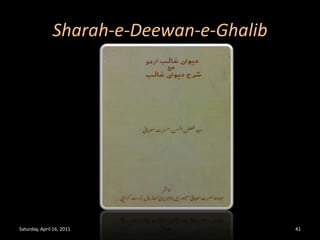
Sharah-e-Deewan-e-GhalibSaturday, April 16, 201141
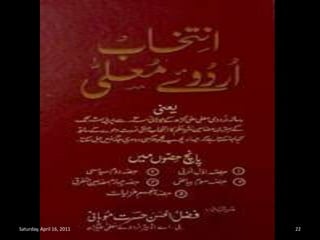
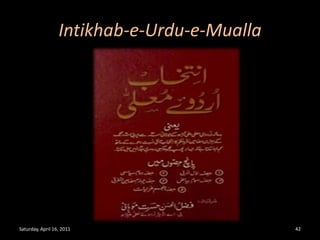
Intikhab-e-Urdu-e-MuallaSaturday, April 16, 201142
Saturday, April 16, 201143
Saturday, April 16, 201144
Hardships Faced By Maulana Hasrat MohaniSaturday, April 16, 201145
The Maulana was asked to disclose the name of the author of “British Policy in Egypt” published in Urdu-e-Maulla, but he declined to do so and preferred to undergo one year's rigorous imprisonment plus Rs 500 as fine. He raised his solitary voice in favour of freedom of the press when people shuddered even to utter a word against the Government, and the Congress leaders used to pass resolutions in support of British rule in India.The Maulanawas perhaps the first political prisoner in British India convicted under the Press Laws.Saturday, April 16, 201146
He had to undergo rigorous imprisonment and was not treated as a luxurious "A" Class Prisoner, but like ordinary criminal convicts. He was given the following garments for his use in the jail: a knickers, a shirt, a cap, a piece of jute cloth and a rough dirty blanket for his bedding. A big iron cup was supplied for eating and for other necessities.In order to realize the fine, the Magistrate confiscated the valuable books and rare manuscripts of his library and auctioned them for a paltry sum. These books were his only earthly wealth. Saturday, April 16, 201147
He was kept in solitary confinement and had to grind one mound of wheat per day which is not an easy task and requires much physical labour to which the Maulana was totally unaccustomed. He was, whipped for any loss of wheat which was sometimes deliberately stolen by his wards. His body bore the marks of whipping inflicted in jail. The Maulana wrote in his "Urdu-i-Mualla" that, in the beginning, he really felt the cruelty of jail life and was much distressed by his inadequate clothing and lack of proper arrangement for ablution which served as great obstacles in offering his prayers. Saturday, April 16, 201148
After sometimes, he was habituated to this sort of life and he realized that bliss lies not in multiplicity of wants but in their negation and was thankful to God for all his trials and tribulations. He was trained to lead a simple life, free of wants, which steeled his character and gave him courage to live up to his convictions and raised his voice in support of truth. It was the first trial of the Maulana.His very life was a struggle against the forces of evil.Saturday, April 16, 201149
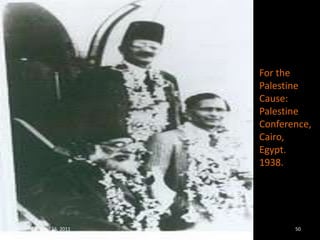
For the Palestine Cause:Palestine Conference, Cairo, Egypt. 1938.Saturday, April 16, 201150
He propagated the boycott of Italian goods during the War whereupon his poor (small) press was called upon to submit a security of Rs 3,000 by the Government of Sir James Meston. He had to close his magazine and start another one named "Tazkira-i-Shu`araa" (History of Poets). In 1916, he was again sent to jail for two years under the Safety Act. He was put to greatest hardships during this term. His pair of spectacles was confiscated, none was allowed to see him and he had to grind wheat throughout the holy month of Ramadhaan. Saturday, April 16, 201151
During his imprisonment, he was unnecessarily transferred to dozens of places and at one place he was given very dirty clothes to wear. He was taken in chains from one place to another.It was he alone who had the courage to face the fanaticism of the Hindu community drunk with power after the birth of Pakistan.He actually lived up to his convictions and professions. A person who had withstood the combined assault of British Imperialism and Hindu extremism in the early twenties of the present century.Saturday, April 16, 201152
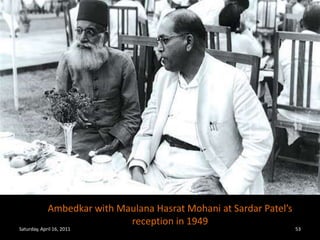
Ambedkar with Maulana Hasrat Mohani at Sardar Patel’s reception in 1949Saturday, April 16, 201153
He stood like a rock against the storm of Hindu communalism which was let loose on the helpless Muslims after the division of India. He was conscious of the dangers to Muslims inherent in the Indian society after the blood bath of August 1947, but like a true Muslim he stuck to his post and resolved to face the calamities with courage and perseverance. He was confronted with a dangerous task did not shirk to face them again.Saturday, April 16, 201154
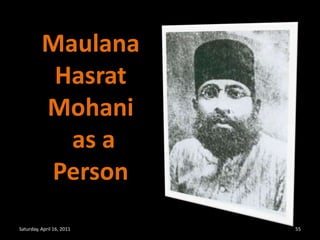
MaulanaHasrat Mohani as a PersonSaturday, April 16, 201155
Hasrat was a true Muslim. His greatest virtue was that he was a gentleman in the real sense of the word. As a man, his chief attributes were simplicity, sincerity, truth, fearlessness, straightforwardness, forbearance, and contentment. Amongst the politicians and poets of our times, he had the rare distinction of living up to his convictions. Saturday, April 16, 201156
SardarAbdurRabNishtar, who had been a distinguished colleague of the Maulanasince the Khilafatdays, paid rich tributes to Hasrat at the time of his death. He said, "Hasrat was a great poet, a great politician, a great litterateur but above all he was a great man".The Maulana led a life of simplicity and austerity. He was a man who was free from worldly desires and wants. Saturday, April 16, 201157
He was a selfless but fearless person who was afraid of none except God. He passed a saintly life and himself did all his household work. He even brought buckets of water from the water tap and always gently refused offers to share his household duties with others. He used very cheap and tattered clothes and wore a typical Turkish cap. He always travelled in a third class compartment and made several pilgrimages to Makkah declining the comforts of the first class journey offered to him by shipping companies.Saturday, April 16, 201158
He even declined the luxurious hospitality of the King of Arabia. His total luggage on such long and hazardous pilgrimages was a small bundle comprising his bedding and some necessary clothes. Being a true Muslim, he was never attracted by worldly pleasures or wealth. Whenever he received some monetary return for his publications, he distributed it among the needy. For days his family suffered starvation for want of food, but he bore all these trials with a smiling countenance. Saturday, April 16, 201159
Whenever he ascended the high pedestal of the Presidentship of All-India Muslim League or the All-India Khilafat Committee, he performed his duties like the early Caliphstreading on the footprints of the Holy Prophet. It may be said without fear of contradiction that Maulana Hasrat Mohani belonged to the illustrious tribe of great heroes of early Islam.As a whole, he was a versatile genius. Saturday, April 16, 201160
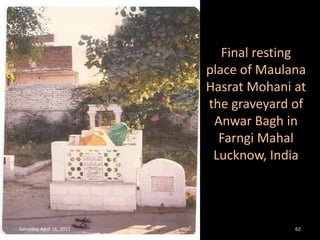
He possessed a many-sided personality who acquired greatness in contradictory traits of character and spheres of life like poetry and politics, literature and religion. He was the very picture of truth and sincerity.Hasrat Mohani Memorial Society was founded by MaulanaNusrat Mohani in 1951.In Karachi, Pakistan, a Memorial Hall and Library have been established by Hasrat Mohani Memorial Society (Regd.) On 13th May 1951, this great son of the soil and man of his convictions and professions died in Lucknow and was buried in the graveyard of Anwar Bagh in FirangiMahal.Saturday, April 16, 201161
Saturday, April 16, 201162Final resting place of Maulana Hasrat Mohani at the graveyard of Anwar Bagh in FarngiMahalLucknow, India
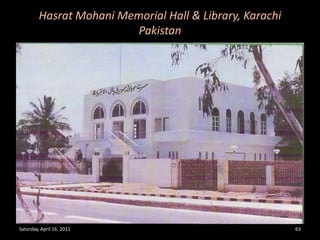
Hasrat Mohani Memorial Hall & Library, Karachi PakistanSaturday, April 16, 201163
Saturday, April 16, 201164

Maulana hasrat mauhani

  • 1.
  • 2.
    “Lives of greatmen all remind us, we can make our lives sublime, and, departing, leave behind us, footprints on the sands of time.”Henry Wadsworth Longfellow Saturday, April 16, 20112
  • 3.
    Early Life andEducation of Maulana Hasrat MohaniSaturday, April 16, 20113
  • 4.
    Early Life ofMaulanaMaulanaSyedFazlul Hassan Hasrat Mohani was born in 1878.He was born in the middle class family of SyedAzharHasan in a small town Mohan in Unnao district, Lucknow.Saturday, April 16, 20114
  • 5.
    Primary EducationHe completedhis primary education from a Maktab (traditional Madarsah) in Mohan and acquired the knowledge of Urdu, Persian and Arabic from his teachers, MiyanJiGhulam Ali Mohani and MiyanJiBalaqi Mohani.Saturday, April 16, 20115
  • 6.
    Middle schoolIn 1894,he passed his middle school from Mohan middle school and secured First position in entire state of Central Province.Saturday, April 16, 20116
  • 7.
    High schoolIn 1899,he completed his High School from Government High School of Fatehpur. He was awarded a scholarship and joined Mohammedan Anglo Oriental College (MAO) Aligarh (now Aligarh Muslim University). He completed his admission in Inter College on 15th March 1899. Saturday, April 16, 20117
  • 8.
    College LifeHasrat completedhis Intermediate exam in 1901 and joined B.A with Arabic and Mathematics as Optional subject.He was a nationalist so once College Cricket team beat an English team and Maulana Hasrat Mohani led the celebration. Unhappy British establishment in the college had him rusticated. Saturday, April 16, 20118
  • 9.
    Maulana fought backand got re-instated but was not allowed to live in hostel so he moved to a rented place in Rasal-Ganjarea of Aligarh city. During his college days, he started taking interest in national politics which was also not accepted by College administration and he was rusticated again, but every time he fought for truth and came back to college to complete his education. Saturday, April 16, 20119
  • 10.
    In 1903, hecompleted his B.A. MAO College which was affiliated with University of Allahabad so he received a degree of BA from University of Allahabad.He was an ardent supporter of Aligarh Movement and mission of Sir Syed Ahmad Khan. His personality was a true interpretation of the product of Aligarh Movement, what Sir Syed had dreamed years ago. Saturday, April 16, 201110
  • 11.
    The basic principleof Aligarh Movement was to follow your religion with full faith and integrity and at the same time take part in the individual and community growth to live a better life. Maulana Hasrat Mohani followed this principle in its entirety. From his early days to his last breath, he was an ardent follower of Islam. Saturday, April 16, 201111
  • 12.
    His participation inthe freedom struggle of India, Anti-British establishment nature, social communism lineage never deviated him from his religious beliefs and practices. During his stay of 2 years in jail, despite of the hard work, he was observing Ramadan fast and regular prayers.Saturday, April 16, 201112
  • 13.
    Marital lifeIn 1903,he got married to Nishatun-Nisa Begum.She was a well educated women.She was his biggest supporter.In 1937, Maulana lost his biggest support, his beloved wife. Saturday, April 16, 201113
  • 14.
    Hasrat Mohani andhis wife Nishatun-Nisa BegumSaturday, April 16, 201114
  • 15.
    Political Contribution ofMaulana Hasrat MohaniSaturday, April 16, 201115
  • 16.
    Political Contribution ofMaulanaHasratMohaniHe was the first voice of rebellion and revolution raised at Aligarh Muslim University where he studied. He coined the slogan InquilabZindabad.He advocated the cause of independence from the platform of Indian National Congress followed by his persistent demand from the platforms of theAll India Muslim League and the Communist Party.Saturday, April 16, 201116
  • 17.
  • 18.
    He made politicsas his sacred mission and struggled for the causes of Muslims and other oppressed people of the society for his entire life.In 1904,Swadesi Movementwas launched and MaulanaHasratMohanibecame an active participant in the movement.He published several articles in Urdu-e-Mu-alla to support the Swadesi Movement.Saturday, April 16, 201118
  • 19.
    To promote theSwadesi movement, he started a Swadesi store which was run buy his beloved wife and due to their efforts, the store became a successful venture.In the political thoughts, he was a supporter of Bal GangadharTilakand always criticized Motilal Nehru, Bal Krishna Gokhlayand other moderates of the party.MaulanaHasratMohanitook an active part in the movement to form Muslim Universityand wrote several articles in Urdu-e-Mu-allafor Muslim University.Saturday, April 16, 201119
  • 20.
    In 1919, MaulanaHasratMohaniparticipatedin Muslim League Convention in Amritsar.In 1925, HasratMohaniplayed a key role to organize annual convention of All India Communist Party in Kanpur. He was chairman of the reception committee of the convention.Saturday, April 16, 201120
  • 21.
    Saturday, April 16,201121In the same year, Ibn Saud attacked on Hijaz. This event displeased MaulanaHasratMohaniand they formed “AnjumanKhuddam-e-Harmain” under the leadership of Maulana Abdul Bari Farangimahli organized “All India Hijaz Conference”in Lucknow under its banners.In 1929, he started a daily newspaper “Mustaqil” from Kanpur. The newspaper did not survived for long time but he continued publishing Urdu-e-Mu-alla.
  • 22.
  • 23.
    MaulanaHasratMohanipresided over theannual session of the All India Khilafat Committee in 1923 and was elected President of the All India Muslim League in 1923.In 1945, he was elected as a member of UP Assembly and member of The Constituent Assembly as a representative of Muslim League.After the birth of Pakistan, he stayed behind in India to safeguard the interests of Muslims in India.Saturday, April 16, 201123
  • 24.
    He asserted thatat such a critical moment he could not think of leaving the Muslims of India in total despair.His memorable words challenging Sardar Patel, in the Constituent Assembly, will long run in the memory of future generations: “You should not think that Muslims are orphans today. I am here to defend their rights against all odds and will fight for them till death”. Saturday, April 16, 201124
  • 25.
  • 26.
    Journalism, Freedom Movementand Urdu LiteratureSaturday, April 16, 201126
  • 27.
    Urdu –E –MuallaMaulana interest in Urdu literature inspired him to start URDU-E-MAULLA In 1903.He wrote many articles to support Swadesi movement.In 1908, he wrote an article to criticize the policies of British rulersof Egypt.After jail, he started this Urdu-e-Maulla in 1910.Saturday, April 16, 201127
  • 28.
    After that Aligarhmovement started to unite Muslims, he wrote many articles in Urdu-e-Maulla to awake Muslims of University. It appeared much earlier than Comrade, Zamindar and AL-Balagh.In 1916, the ideology and methodology to raise the Muslims against India lead him to house arrest.Saturday, April 16, 201128
  • 29.
    Saturday, April 16,201129When it comes to bold and trenchant political writings. The three main names usually invoked are:MAULANA MOHAMMAD ALI JOHAR MAULANA ABUL KALAM AZAD ZAFAR ALI KHANThe Maulla had invited British wrath for Hasrat’s writings during the agitation on the Kanpur Mosque demolition, resulting a security demand for Rs 3,000 under the Vernacular Press Act. It was sheer tyranny to demand Rs 3,000 from a press, worth little more than Rs 50.
  • 30.
    However , hefounded the TazkiratushShu’rain place of the Urdu-e-maulla.Saturday, April 16, 201130
  • 31.
    Urdu LiteratureThe otherside of Maulana Hasrat Mohani’s Life was his love for Urdu literature and poetry.The exceptional qualities of sincerity, forbearance, fearlessness, perseverance, patience and contentment, which the jail life had developed in his character, are profoundly reflected in his poetry.Saturday, April 16, 201131
  • 32.
    He had leftbehind him ten volumes of poetical works.The best part of his contribution to Urdu poetry was composed in jail, wherefrom each time when he was released, he used to bring out a volume of Urdu poems.He was the founder of modern Urdu lyrics.He emphasized on depth of feelings and sincerity of thoughts, with the result that Urdu lyrics had become a mixture of unnatural and artificial picture of human life.Saturday, April 16, 201132
  • 33.
    Hasrat may betermed as conservative lyrist, yet he infused A new life in its fast decaying body and after MIR may be classed as the best URDU LYRIST.He comes in the line of Momin Khan Mominand NaseemDehlaviin respect of the type of his verses.His poetry according to Arnold, literature is the mirror of life, and like the celebrated English poet Lord Tennyson, Hasrat too has been much affected by his environment.Saturday, April 16, 201133
  • 34.
    He founded newschool of Urdu lyrics whose aim is to depict the true human sentiments and reactions to his environments.He is the true product of his time.Saturday, April 16, 201134
  • 35.
    WRITING STYLE OFHASRAT MOHANIThe writing style of Mohani was mostly emphasized on depth of feelings and sincerity of thoughts.His main attributes are purity of thoughts, simplicity of diction.His poetry is mainly subjective and he has tried to avoid the objective color, which had crept into the work of Urdu Lyrist of Lucknow.Saturday, April 16, 201135
  • 36.
    Like Mir, Hasrat,too passed a life of despair and anxiety, hence there is a spiritual connection between the two and the work of both reflect deep pathos.His poetry was mostly composed in jail which developed sincerity, fearlessness, perseverance, and patience in his character and is reflected in his poetry.His verses are full of revolutionary thought, reactions and national aspiration of a person whose life was so stormy.Saturday, April 16, 201136
  • 37.
    Hasrat Mohani’s FamousLiterary Works Saturday, April 16, 201137
  • 38.
  • 39.
  • 40.
  • 41.
  • 42.
  • 43.
  • 44.
  • 45.
    Hardships Faced ByMaulana Hasrat MohaniSaturday, April 16, 201145
  • 46.
    The Maulana wasasked to disclose the name of the author of “British Policy in Egypt” published in Urdu-e-Maulla, but he declined to do so and preferred to undergo one year's rigorous imprisonment plus Rs 500 as fine. He raised his solitary voice in favour of freedom of the press when people shuddered even to utter a word against the Government, and the Congress leaders used to pass resolutions in support of British rule in India.The Maulanawas perhaps the first political prisoner in British India convicted under the Press Laws.Saturday, April 16, 201146
  • 47.
    He had toundergo rigorous imprisonment and was not treated as a luxurious "A" Class Prisoner, but like ordinary criminal convicts. He was given the following garments for his use in the jail: a knickers, a shirt, a cap, a piece of jute cloth and a rough dirty blanket for his bedding. A big iron cup was supplied for eating and for other necessities.In order to realize the fine, the Magistrate confiscated the valuable books and rare manuscripts of his library and auctioned them for a paltry sum. These books were his only earthly wealth. Saturday, April 16, 201147
  • 48.
    He was keptin solitary confinement and had to grind one mound of wheat per day which is not an easy task and requires much physical labour to which the Maulana was totally unaccustomed. He was, whipped for any loss of wheat which was sometimes deliberately stolen by his wards. His body bore the marks of whipping inflicted in jail. The Maulana wrote in his "Urdu-i-Mualla" that, in the beginning, he really felt the cruelty of jail life and was much distressed by his inadequate clothing and lack of proper arrangement for ablution which served as great obstacles in offering his prayers. Saturday, April 16, 201148
  • 49.
    After sometimes, hewas habituated to this sort of life and he realized that bliss lies not in multiplicity of wants but in their negation and was thankful to God for all his trials and tribulations. He was trained to lead a simple life, free of wants, which steeled his character and gave him courage to live up to his convictions and raised his voice in support of truth. It was the first trial of the Maulana.His very life was a struggle against the forces of evil.Saturday, April 16, 201149
  • 50.
    For the PalestineCause:Palestine Conference, Cairo, Egypt. 1938.Saturday, April 16, 201150
  • 51.
    He propagated theboycott of Italian goods during the War whereupon his poor (small) press was called upon to submit a security of Rs 3,000 by the Government of Sir James Meston. He had to close his magazine and start another one named "Tazkira-i-Shu`araa" (History of Poets). In 1916, he was again sent to jail for two years under the Safety Act. He was put to greatest hardships during this term. His pair of spectacles was confiscated, none was allowed to see him and he had to grind wheat throughout the holy month of Ramadhaan. Saturday, April 16, 201151
  • 52.
    During his imprisonment,he was unnecessarily transferred to dozens of places and at one place he was given very dirty clothes to wear. He was taken in chains from one place to another.It was he alone who had the courage to face the fanaticism of the Hindu community drunk with power after the birth of Pakistan.He actually lived up to his convictions and professions. A person who had withstood the combined assault of British Imperialism and Hindu extremism in the early twenties of the present century.Saturday, April 16, 201152
  • 53.
    Ambedkar with MaulanaHasrat Mohani at Sardar Patel’s reception in 1949Saturday, April 16, 201153
  • 54.
    He stood likea rock against the storm of Hindu communalism which was let loose on the helpless Muslims after the division of India. He was conscious of the dangers to Muslims inherent in the Indian society after the blood bath of August 1947, but like a true Muslim he stuck to his post and resolved to face the calamities with courage and perseverance. He was confronted with a dangerous task did not shirk to face them again.Saturday, April 16, 201154
  • 55.
    MaulanaHasrat Mohani asa PersonSaturday, April 16, 201155
  • 56.
    Hasrat was atrue Muslim. His greatest virtue was that he was a gentleman in the real sense of the word. As a man, his chief attributes were simplicity, sincerity, truth, fearlessness, straightforwardness, forbearance, and contentment. Amongst the politicians and poets of our times, he had the rare distinction of living up to his convictions. Saturday, April 16, 201156
  • 57.
    SardarAbdurRabNishtar, who hadbeen a distinguished colleague of the Maulanasince the Khilafatdays, paid rich tributes to Hasrat at the time of his death. He said, "Hasrat was a great poet, a great politician, a great litterateur but above all he was a great man".The Maulana led a life of simplicity and austerity. He was a man who was free from worldly desires and wants. Saturday, April 16, 201157
  • 58.
    He was aselfless but fearless person who was afraid of none except God. He passed a saintly life and himself did all his household work. He even brought buckets of water from the water tap and always gently refused offers to share his household duties with others. He used very cheap and tattered clothes and wore a typical Turkish cap. He always travelled in a third class compartment and made several pilgrimages to Makkah declining the comforts of the first class journey offered to him by shipping companies.Saturday, April 16, 201158
  • 59.
    He even declinedthe luxurious hospitality of the King of Arabia. His total luggage on such long and hazardous pilgrimages was a small bundle comprising his bedding and some necessary clothes. Being a true Muslim, he was never attracted by worldly pleasures or wealth. Whenever he received some monetary return for his publications, he distributed it among the needy. For days his family suffered starvation for want of food, but he bore all these trials with a smiling countenance. Saturday, April 16, 201159
  • 60.
    Whenever he ascendedthe high pedestal of the Presidentship of All-India Muslim League or the All-India Khilafat Committee, he performed his duties like the early Caliphstreading on the footprints of the Holy Prophet. It may be said without fear of contradiction that Maulana Hasrat Mohani belonged to the illustrious tribe of great heroes of early Islam.As a whole, he was a versatile genius. Saturday, April 16, 201160
  • 61.
    He possessed amany-sided personality who acquired greatness in contradictory traits of character and spheres of life like poetry and politics, literature and religion. He was the very picture of truth and sincerity.Hasrat Mohani Memorial Society was founded by MaulanaNusrat Mohani in 1951.In Karachi, Pakistan, a Memorial Hall and Library have been established by Hasrat Mohani Memorial Society (Regd.) On 13th May 1951, this great son of the soil and man of his convictions and professions died in Lucknow and was buried in the graveyard of Anwar Bagh in FirangiMahal.Saturday, April 16, 201161
  • 62.
    Saturday, April 16,201162Final resting place of Maulana Hasrat Mohani at the graveyard of Anwar Bagh in FarngiMahalLucknow, India
  • 63.
    Hasrat Mohani MemorialHall & Library, Karachi PakistanSaturday, April 16, 201163
  • 64.